
International Research Journal of Engineering and Technology (IRJET) e-ISSN: 2395-0056
Volume: 13 Issue: 03 | Mar 2026 www.irjet.net p-ISSN: 2395-0072
International Research Journal of Engineering and Technology (IRJET) e-ISSN: 2395-0056
Volume: 13 Issue: 03 | Mar 2026 www.irjet.net p-ISSN: 2395-0072
Amit S. Gawande 1 , Pradnya M. Waghmare 2
1,2
Civil Engineering Department, College of Engineering and Technology, Akola, Maharashtra, India
Abstract - Seismic analysis is an essential aspect of structural design for buildings located in earthquake-prone regions. This study presents a comparative evaluation of seismic performance of a G+14 reinforced concrete building using the Equivalent Static Method and the Response Spectrum Method. The structural model was developed using STAAD.Pro and analyzed according to the provisions of IS 1893 (Part 1): 2016 and IS 456:2000. The comparison is carried out based on storey displacement, storey drift, base shear, and natural time period. The results indicate that the Response Spectrum Method provides a more realistic estimationofstructuralresponsecomparedtotheEquivalent Static Method, especially for multi-storey buildings.
Key Words: Seismic Analysis, Equivalent Static Method, Response Spectrum Method, RC Building, Storey Drift, STAAD.Pro
The rapid growth of urbanization has led to increased constructionofmulti-storeybuildings.Thesestructuresare often subjected to lateral forces such as wind and earthquakeloads.Earthquakeforcesaredynamicinnature and can significantly affect the structural stability of buildings.
Seismicdesignensuresthatstructurescanresistearthquake forces without collapse and with acceptable levels of damage.InIndia,seismicdesignisgovernedbyIS1893(Part 1): 2016, while reinforced concrete design is carried out accordingtoIS456:2000.
Twocommonlyusedseismicanalysismethodsare:
a) EquivalentStaticMethod
b) ResponseSpectrumMethod
TheEquivalentStaticMethodissimpleandsuitableforlowrise buildings, while the Response Spectrum Method is a dynamic approach that considers modal properties of the structure.
Thisstudyfocuses oncomparingthese two methodsfora G+14reinforcedconcretebuilding.
Seismic analysis of reinforced concrete (RC) multi-storey buildingshasbeenamajorfocusofstructuralengineering research due to the increasing demand for safe and
economical high-rise structures. The behavior of such buildings under earthquake loading depends on several parametersincludingstiffness,massdistribution,damping, andgeometricconfiguration.Variousanalyticalapproaches havebeendevelopedtoevaluateseismicresponse,among whichtheEquivalentStaticMethod(ESM)andtheResponse SpectrumMethod(RSM)arewidelyused.
The fundamental principles of structural dynamics and earthquakeresponse were extensivelystudied by Chopra (1), whoestablishedthattheseismicbehaviorofstructures is governed by their dynamic properties such as natural frequency, mode shapes, and damping. His work demonstrated that static methods may not adequately capture the true response of multi-storey buildings, especially when higher modes significantly influence structuralbehavior.
Similarly, Duggal (2) emphasized the importance of earthquake-resistant design and highlighted that the Equivalent Static Method is suitable for regular low-rise buildings, while dynamic analysis becomes essential for taller structures. He explained that dynamic methods provide a more realistic estimation of seismic forces by incorporatingmodalcharacteristicsofthestructure.
Agarwal and Shrikhande (3) studiedtheseismicdesignof reinforced concrete buildings and concluded that the Equivalent Static Method simplifies seismic forces into lateralloadsdistributedalongthebuildingheight,whereas the Response Spectrum Method evaluates peak responses consideringmultiplevibrationmodes.Theirworkshowed that dynamic analysis generally yields more reliable predictionsfordisplacementanddrift.
Several comparative studies have been carried out to evaluatethedifferencebetweenstaticanddynamicanalysis methods. Bagheri et al. (4) comparedstaticanddynamic responses of multi-storey buildings and observed that dynamicanalysisprovidesamoreaccuratedistributionof forces along the height of the structure. Their findings indicated that the Equivalent Static Method may either underestimateoroverestimateseismicdemanddepending onthestructuralconfiguration.
Research by Gottala and Kishore (5) demonstrated that storey displacement and drift obtained from response spectrum analysis differ significantly from static analysis results.Theyconcludedthatdynamicanalysiscapturesthe
International
Volume: 13 Issue: 03 | Mar 2026 www.irjet.net p-ISSN: 2395-0072
influence of higher modes, which becomes increasingly importantasbuildingheightincreases. Similarly,studiesby Meena and Grover (6) reportedthat thebaseshearobtainedfromtheEquivalentStaticMethodis often higher than the unscaled dynamic base shear. However,dynamicresultsaretypicallyscaledtomatchcodal requirements,ensuringconsistencyindesign.Their study also highlighted that dynamic analysis provides a more realistic representation of structural response along the buildingheight.
Research conducted by Mahmoud and Abdallah (7) showed that dynamic analysis methods such as response spectrum analysis account for modal participation and provideimprovedaccuracyinpredictingseismicresponse. They emphasized that static methods assume a simplified force distribution, which may not reflect actual behavior duringearthquakeexcitation.
Further studies by Meleka et al. (8) and Khan et al. (9) compared static and dynamic analysis techniques and concluded that response spectrum analysis yields better resultsintermsofdisplacement,drift,andinternalforces. These studies also confirmed that dynamic methods are moresuitableforhigh-risebuildingsandstructureslocated inhigherseismiczones.
According to general seismic analysis principles, the EquivalentStaticMethodassumesthatthebuildingresponds primarilyinitsfundamental mode, whichis validonlyfor low-riseandregularstructures.However,asbuildingheight increases,higher mode effectsbecomesignificant,making dynamicanalysisnecessaryforaccurateevaluation(10).
Recent studies using structural analysis software such as STAAD.Pro and ETABS have further reinforced these findings.Researchershavedemonstratedthatcomputational tools enable detailed modeling and accurate analysis of multi-storey buildings, allowing engineers to evaluate parameterssuchasstoreydisplacement,storeydrift,base shear,andmodaltimeperiodsefficiently.
Overall, the literature indicates that while the Equivalent StaticMethodissimpleandusefulforpreliminarydesign,it does not capture the dynamic behavior of structures effectively. In contrast, the Response Spectrum Method providesamorerealisticassessmentofseismicperformance byconsideringmodalcharacteristicsanddynamicresponse.
Therefore, for a G+14 reinforced concrete building, especially in higher seismic zones, a comparative study of thesetwomethodsisessentialtounderstandvariationsin displacement,drift,andbaseshear,andtoensuresafeand economicalstructuraldesign.
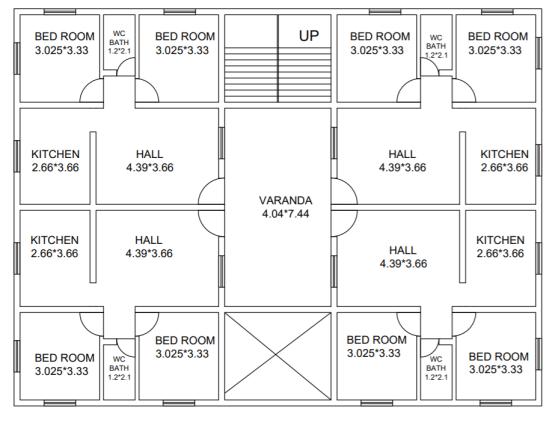
Themethodologyadoptedinthisstudyinvolvesmodeling, analysis,andcomparisonofseismicperformanceofaG+14 reinforcedconcretebuildingusingtwodifferentapproaches: the Equivalent Static Method (ESM) and the Response SpectrumMethod(RSM).Theentireprocessiscarriedout using STAAD.Pro in accordance with relevant Indian Standardcodes.
Thestudyfollowsasystematicprocedure:
a) Selection of building geometry and structural configuration
b) ModelingofthebuildinginSTAAD.Pro
c) Assignmentofmaterialproperties
d) Application of loads (dead load, live load, seismic load)
e) Definitionofseismicparameters
f) AnalysisusingEquivalentStaticMethod
g) AnalysisusingResponseSpectrumMethod
h) Extractionofresults
i) Comparativeevaluationofresults
Thebuildingismodeledasathree-dimensionalreinforced concreteframestructureusingbeamandcolumnelements.
a) Thestructureconsistsof G+14 storeys
b) Eachstoreyhasaheightof 3 m
c) Totalheightofthebuildingis 45 m.
d) The plan configuration is considered regular and symmetrical.
Structural Member Sizes:
Columns:400mm×600mm
Beams:230mm×500mm
Slabthickness:150mm
International Research Journal of Engineering and Technology (IRJET) e-ISSN: 2395-0056
Volume: 13 Issue: 03 | Mar 2026 www.irjet.net p-ISSN: 2395-0072
Where:
The supports are assumed to be fixed at the base, representingrigidfoundationconditions.
3.3 Material Properties
Materialpropertiesaredefinedasper:
IS456:2000
ConcreteGrade:M30
ModulusofElasticity:5000√fck
SteelGrade:Fe500
Thesepropertiesareassignedtoallstructuralmembersin themodel.
3.4 Load Considerations
Loadsareappliedaccordingto:
IS875(Part1):1987–DeadLoad
IS875(Part2):1987–LiveLoad
(a) Dead Load
Self-weightofstructuralmembers(automaticallycalculated)
Floorfinish:1kN/m²
Wallload:12–15kN/m
(b) Live Load
Typicalresidentialload:3kN/m²
3.5 Seismic Load Parameters
Seismicloadsareappliedaccordingto:
IS1893(Part1):2016
Table 1. SeismicParameters
3.6 Equivalent Static Method (ESM)
In this method, the total seismic base shear is calculated using:
=Baseshear
Horizontalseismiccoefficient
Seismicweight
Thebaseshearisdistributedalongthebuildingheightasper IS1893provisions.
Steps followed:
a) Calculateseismicweightofthestructure
b) Determinedesignhorizontalseismiccoefficient
c) Computebaseshear
d) Distributelateralforcesateachstorey
e) Performstaticanalysis
The Response Spectrum Method is a dynamic analysis techniquethatconsidersmultiplemodesofvibration.
Steps followed:
a) Performmodalanalysistoobtain:
b) Naturaltimeperiods
c) Modeshapes
d) DefineresponsespectrumcurveasperIS1893
e) ApplyseismicloadsinbothXandYdirections
f) Combinemodalresponsesusing:
g) SRSS(SquareRootofSumofSquares)or
h) CQC(CompleteQuadraticCombination)
i) Scaleresultstomatchbaseshear(ifrequired)
This method captures the dynamic characteristics of the structuremoreaccurately.
LoadcombinationsareappliedasperIScodes:
1.5(DL+LL)
1.2(DL+LL±EQ)
1.5(DL±EQ)
0.9DL±1.5EQ
These combinations ensure safety under different loading conditions.
The following response parameters are extracted for comparison:
StoreyDisplacement
StoreyDrift
BaseShear
NaturalTimePeriod
These parameters are used to evaluate structural performance.
International Research Journal of Engineering and Technology (IRJET) e-ISSN: 2395-0056
Volume: 13 Issue: 03 | Mar 2026 www.irjet.net p-ISSN: 2395-0072
Resultsobtainedfrombothmethodsarecomparedbasedon:
Variationofdisplacementalongheight
Driftlimitsaspercode
Differenceinbaseshear
Influenceofdynamiceffects
This comparison helps in identifying the most suitable methodforseismicanalysisofhigh-risebuildings.
The seismic analysis of the G+14 reinforced concrete building was carried out using both the Equivalent Static MethodandtheResponseSpectrumMethodinSTAAD.Pro. The results obtained from both methods are compared to evaluatestructuralperformance.
Storey displacement is an important parameter that indicatesthelateralmovementofthebuildingunderseismic loading.
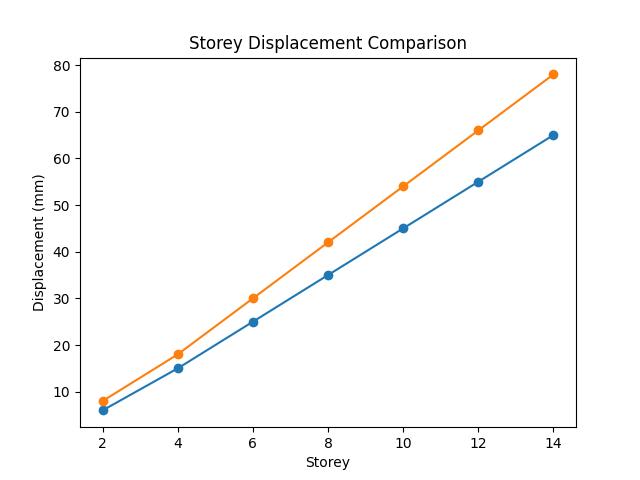
Chart 1. StoreyDisplacementComparison
Table 2. StoreyDisplacementComparison
Discussion:
Displacementincreaseswithheight
Maximumdisplacementoccursattopstorey ResponseSpectrumMethodgiveshighervalues Staticmethodunderestimatesactualresponse
This is because dynamic analysis considers modal participation
Storey drift is the relative displacement between two consecutivestoreys.
PermissibledriftasperIS1893(Part1):2016:
DriftLimit=0.004×StoreyHeight
For3mheight→Limit=0.012m(12mm)
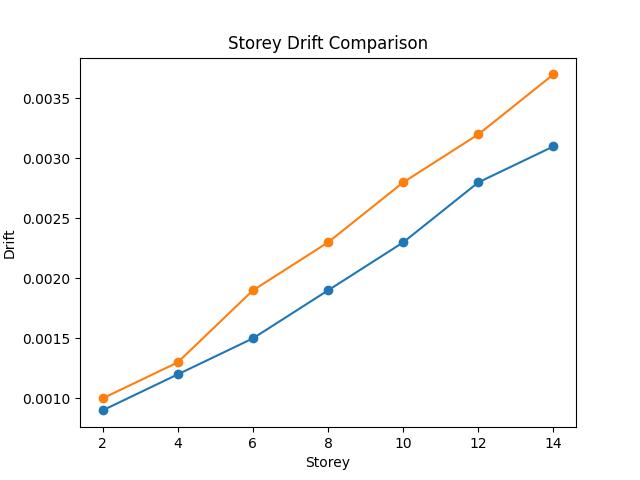
Chart 2. StoreyDriftComparison
Table 3 StoreyDriftComparison
Discussion:
Driftvaluesarewithinpermissiblelimits
Maximumdriftoccursatmid-height
International
Volume: 13 Issue: 03 | Mar 2026 www.irjet.net
Dynamicmethodgivesslightlyhigherdrift Itindicatessafestructuralbehavior
4.3 Base Shear
Baseshearrepresentstotalseismicforceactingatbase.
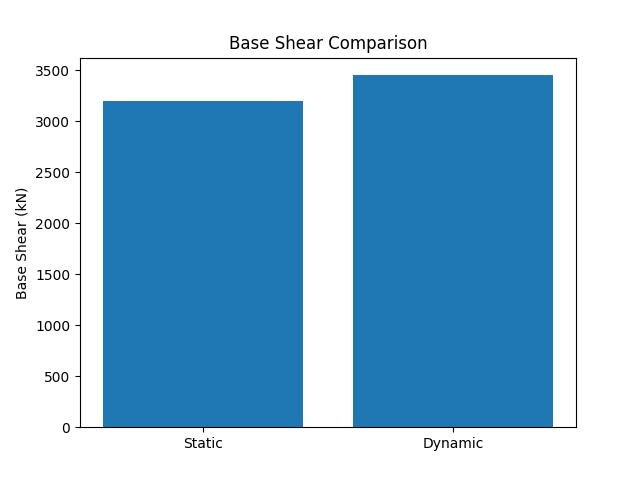
Chart 3. BaseShearComparison Method
Base Shear (kN)
EquivalentStatic 3200
ResponseSpectrum 3450
Table 4. BaseShearComparison
Discussion:
Dynamicanalysisgiveshigherbaseshear
Indicatesmorerealisticseismicdemand
Staticmethodissimplifiedapproach
4.4 Natural Time Period
Table 5. NaturalTimePeriod
Discussion:
Timeperiodincreaseswithflexibility
Importantforresponsespectrumcalculation
Dynamicmethodusesactualstiffness
4.5 Overall Comparison
Table 6. OverallComparison
Key Observation:
ResponseSpectrumMethodprovidesmoreaccurate andrealisticresults
Equivalent Static Method is suitable only for preliminarydesign
A comparative seismic analysis of a G+14 reinforced concretebuildingwascarriedoutusingtheEquivalentStatic MethodandtheResponseSpectrumMethodwiththehelpof STAAD.Pro in accordance with the provisions of IS 1893 (Part1):2016.
Based on the results obtained from the analysis, the followingconclusionscanbedrawn:
1. The storey displacement increases progressively withheightforbothmethods;however,thevalues obtainedfromtheResponseSpectrumMethodare consistentlyhigherthanthosefromtheEquivalent Static Method. This indicates that static analysis tendstounderestimatelateraldeformationinmultistoreybuildings.
2. Storeydriftvaluesobtainedfrombothmethodsare withinthepermissiblelimitsspecifiedbythecode, confirmingthatthestructuresatisfiesserviceability requirements.However,thedynamicmethodshows slightlyhigherdriftvalues,especiallyinthemiddle storeys.
3. The base shear calculated using the Response Spectrum Method is marginally higher than that obtained from the Equivalent Static Method. This suggests that dynamic analysis provides a more realisticrepresentationofseismicforcesactingon thestructure.
4. The natural time period obtained from modal analysis reflects the actual stiffness and mass distributionofthebuilding,whichisnotexplicitly consideredintheEquivalentStaticMethod.
5. TheEquivalentStaticMethodis simple,lesstimeconsuming,andsuitableforpreliminarydesignor low-rise regular structures. However, it does not capturethedynamiccharacteristicsoftallbuildings effectively.
6. TheResponseSpectrumMethod,beingadynamic analysis approach, considers modal participation and provides a more accurate and reliable estimation of seismic response for multi-storey buildings.
International Research Journal of Engineering and Technology (IRJET) e-ISSN: 2395-0056
Volume: 13 Issue: 03 | Mar 2026 www.irjet.net p-ISSN: 2395-0072
Overall Conclusion:
For high-rise reinforced concrete buildings such as G+14 structures,especiallyinhigherseismiczones,theResponse Spectrum Method is recommended over the Equivalent Static Method for accurate evaluation of seismic performance. The comparative study highlights the importanceofdynamicanalysisinensuringstructuralsafety, reliability,andcodecompliance.
The findings of this study can be useful for structural engineers in selecting appropriate seismic analysismethodsforthedesignofmulti-storeyreinforced concretebuildings.”
(1)Chopra,A.K.,DynamicsofStructures,PearsonEducation, 2012.
(2)Duggal,S.K.,EarthquakeResistantDesignofStructures, OxfordUniversityPress,2013.
(3) Agarwal, P. and Shrikhande, M., Earthquake Resistant DesignofStructures,PHILearning,2011.
(4) Bagheri, B., et al., “Comparative Study of Static and DynamicAnalysisofMulti-StoreyBuildings,”International JournalofCivilEngineering,2012.
(5)Gottala,A.,Kishore,N.S.,“ComparativeStudyofStaticand DynamicSeismicAnalysis,”IJSTE,2015.
(6)Meena,R.,Grover,R.K.,“ComparativeStudyonStaticand DynamicAnalysisofRCCBuilding,”IJERT,2026.
(7)Mahmoud,S.,Abdallah,W.,“ResponseAnalysisofMultiStorey RC Buildings,” International Journal of Civil EngineeringResearch,2014.
(8) Meleka, N., et al., “Comparative Study on Static and Dynamic Analysis of Structures,” Engineering Research Journal,2016.
(9) Khan, M.M., et al., “Comparative Study of Linear Static andDynamicAnalysis,”IRJET,2022.
(10) Costa, J.D., “Standard Methods for Seismic Analysis,” 2003.
(11) IS 1893 (Part 1): 2016, Criteria for Earthquake ResistantDesignofStructures,BIS,India.
(12) IS 456:2000, Plain and Reinforced Concrete Code of Practice,BIS,India.
(13)IS875(Part1&2):1987,DesignLoadsforBuildings, BIS,India.