
International Research Journal of Engineering and Technology (IRJET) e-ISSN: 2395-0056
Volume: 12 Issue: 08 | Aug 2025 www.irjet.net p-ISSN: 2395-0072
International Research Journal of Engineering and Technology (IRJET) e-ISSN: 2395-0056
Volume: 12 Issue: 08 | Aug 2025 www.irjet.net p-ISSN: 2395-0072
Kaavya Koteshwar
1Student, IB Diploma Programme, Heritage International Xperiential School, Gurugram, Haryana, India
Abstract - This study comprehensively investigated the electrochemicalcorrosionprotectionperformanceofdifferent surfacetreatmentsappliedtomarine-gradealuminumunder simulated marine conditions. Four surface conditions were evaluated:untreatedcontrol,anodizedonly,paintedonly,and anodizedfollowedbypainting.Thespecimens,cutto5×5cm withathicknessof3mm,wereexposedtohalf-immersionina 3.5% NaCl solution for 21 days. Corrosion behavior was characterized using potentiodynamic polarization and electrochemicalimpedancespectroscopy(EIS).Thecombined anodizingandpaintingtreatment demonstratedthehighest corrosion resistance, with an 85% reduction in corrosion current density compared to untreated aluminum. It also exhibitedthelowestcorrosionrate(0.012mm/year)andthe highest polarization resistance (12,450 Ω·cm²). Anodizing aloneprovidedbetterprotectionthanpaintingalone,butboth weresignificantlylesseffectivethanthecombinedtreatment. The results highlighted the synergistic interaction between anodizing and painting, where the anodized layer improved paint adhesion and offered baseline electrochemical protection, while the paint provided an effective barrier against chloride penetration. This combination offered substantialdurabilitybenefitsformarineapplications
Keywords: electrochemical corrosion, marine conditions, anodization,anticorrosionpaint
Marine aluminium alloys have been widely adopted in shipbuilding,offshoreplatforms,andmarineequipmentdue to their high strength-to-weight ratio, good machinability, andrelativelylowcost(Davis,1999).Despitethepresenceof anaturaloxidelayerthatprovidessomedegreeofcorrosion protection, these alloys are vulnerable to the aggressive chlorideionspresentinseawater.Inmarineenvironments, chloride-induced breakdown of the passive film leads to localized forms of corrosion such as pitting, crevice, and galvanic corrosion (Davis, 1999; Fan et al., 2023). These processes are accelerated by fluctuating temperature, oxygengradients,andvariablepHconditions.Thecombined effectof these factors reducesthestructural integrityand servicelifeofaluminiumcomponents(Davis,1999).
Tomitigatecorrosion,varioussurfacetreatmentshavebeen developed.Anodizingproducesathicker,denseroxidefilm through electrochemical oxidation, which can be further enhanced through sealing treatments (Davis, 1999; ISO,
2018b).Paintingsystems,particularlythoseusingmarinegradeepoxyprimersandpolyurethanetopcoats,providea physicalbarriertocorrosiveagentsandimproveaesthetics (ISO,2018a;StandardNorge,2022).Whilethesetreatments areeffectiveindividually,thesynergisticeffectsofcombining anodizingandpaintinghavenotbeenextensivelystudiedin marine-specific conditions using standardized electrochemical testing methods (ASTM International, 2023b;ISO,2016).
The aim of this work was to quantitatively compare the corrosionperformanceofuntreated,anodized,painted,and anodized-then-paintedaluminiumspecimensinacontrolled saline environment, to understand the potential synergy betweenanodizingandpainting,andtoprovideguidanceon the most effective surface treatment strategies for marine applications (ASTM International, 2021; ISO, 2018a; ISO, 2018b)
Marine-gradealuminium sheetsweresectionedinto5×5 cm specimens of 3 mm thickness. Four surface treatment categorieswereprepared:untreatedcontrol(mechanically polished to 1200 grit), anodized only, painted only, and anodizedfollowedbypainting.Theanodizingprocessused 15%sulfuricacidat20°Cwithacurrentdensityof150A/m² andvoltageof15–18Vfor45minutes,followedbyhotwater sealing at 96°C for 30 minutes (ISO, 2018b). The painting processconsistedofa zinc-richepoxyprimerlayerwith a dryfilmthicknessof75μmandapolyurethanetopcoatwith a thickness of 50 μm (ISO, 2018a; Standard Norge, 2022). The coated specimens were cured for seven days at room temperaturebeforetesting.
Thespecimenswerehalf-immersedin3.5%NaCl solution prepared with distilled water, maintained at 25°C and pH 7.0, for a duration of 21 days (ASTM International, 2021). Electrochemical testing was conducted using a threeelectrodecell,withthespecimenastheworkingelectrode,a saturated calomel electrode (SCE) as the reference, and a platinum mesh as the counter electrode. Potentiodynamic polarizationscanswereperformedfrom−250to+250mV vs.OCPata scanrateof0.125mV/s (ASTMInternational, 2023b; Stern & Geary, 1957). Electrochemical impedance spectroscopymeasurementscoveredfrequenciesfrom100 kHzto10mHzwitha10mVRMSamplitude(ISO,2016).
International Research Journal of Engineering and Technology (IRJET) e-ISSN: 2395-0056
Volume: 12 Issue: 08 | Aug 2025 www.irjet.net p-ISSN: 2395-0072
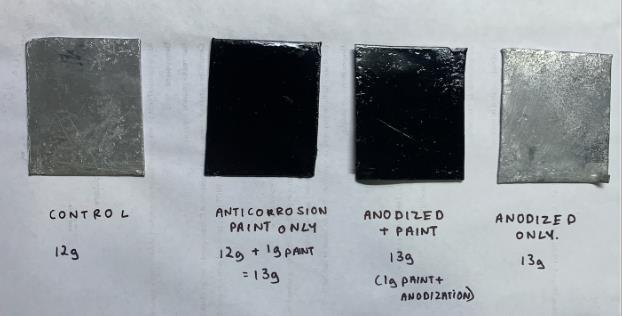
Fig -1:Photographsoftestspecimensbeforeimmersion testing:(a)untreatedcontrol(b)anodizedonly(c)painted onlyand(d)anodizedthenpaintedspecimens.
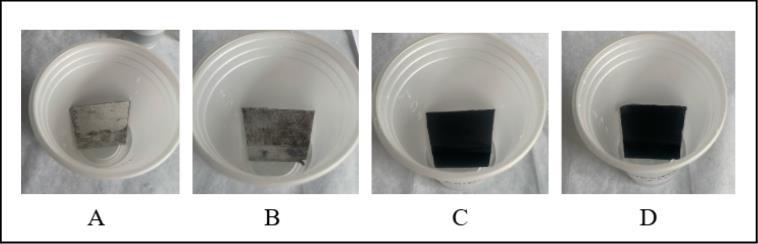
Fig -2:Experimentalsetupshowinghalf-immersedtest specimensinsaline:(a)untreatedcontrol(b)anodized only(c)paintedonlyand(d)anodizedthenpainted specimens.
3. RESULTS AND DISCUSSION
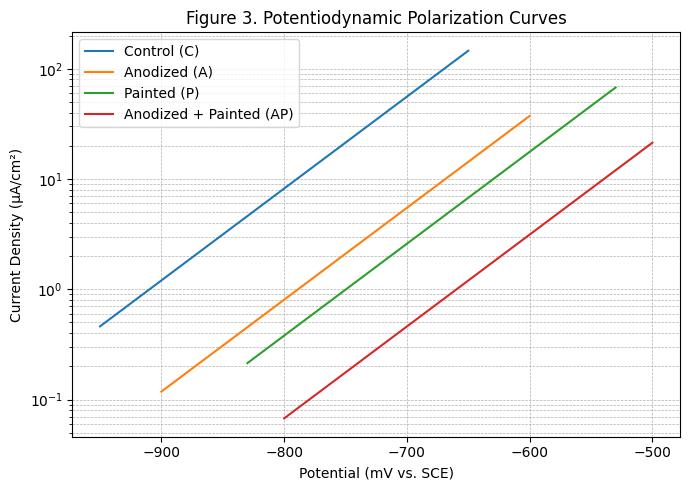
-3:Potentiodynamicpolarizationlines
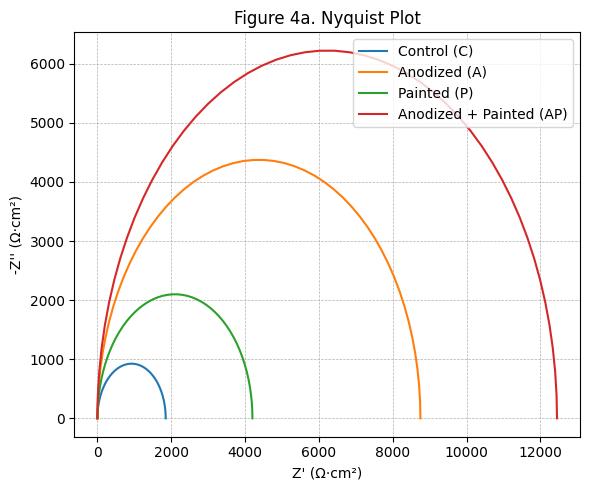
Fig -4:NyquistPlots
The open circuit potential (OCP) measurements revealed that the control specimens shifted from −820 mV to −780 mVovertheimmersionperiod,indicatingactivecorrosion (Davis, 1999). Anodized specimens maintained a stable potential of approximately −750 mV, while painted specimens exhibited moderate stability at −680 mV. The anodized-then-paintedspecimensdisplayedthemoststable performance,maintaininganOCPof−650mVwithminimal fluctuations(Davis,1999).(Note:OCPindicatesinterfacial conditionbutisnotadirectmeasureofcorrosionrate;rate metrics are derived from i_corr and/or R_p per standard practice.)(ASTMInternational,2023a;Stern&Geary,1957).
Potentiodynamic polarization results indicated that the untreatedcontrolspecimenshadacorrosioncurrentdensity of 8.2 μA/cm², corresponding to a corrosion rate of 0.095 mm/year. Anodized specimens showed significant improvementwithani_corrof2.1μA/cm²(0.024mm/year), while painted specimens exhibited 3.8 μA/cm² (0.044 mm/year). The anodized-then-painted treatment demonstrated the best performance with an i_corr of 1.2
International Research Journal of Engineering and Technology (IRJET) e-ISSN: 2395-0056
Volume: 12 Issue: 08 | Aug 2025 www.irjet.net p-ISSN: 2395-0072
μA/cm² (0.012 mm/year), reflecting an 85% reduction in corrosion current compared to the control. These interpretationsfollowstandardTafel/Stern–Gearyanalysis and the accepted conversion of i_corr to corrosion rate (ASTMInternational,2023a;Stern&Geary,1957).
Electrochemicalimpedancespectroscopyresultssupported thepolarizationfindings.Thepolarizationresistancevalues were1,850Ω·cm²forthecontrol,8,750Ω·cm²foranodized, 4,200 Ω·cm² for painted, and 12,450 Ω·cm² for anodizedthen-painted specimens. The coating resistance of the combinedtreatmentwasapproximately3timeshigherthan that of painted-only specimens, highlighting the effectiveness of the anodized underlayer in preventing chlorideingress(ISO,2016;GamryInstruments,n.d.).The Nyquist/Bode behavior expected for high-barrier organic coatings larger semicircle diameter and higher lowfrequency|Z|isconsistentwiththeseR_ptrends(ISO,2016; GamryInstruments,n.d.).
Thecalculatedsynergisticparameter(S=1.34)confirmeda positive interaction between anodizing and painting. This was attributed to the anodized layer providing enhanced surfaceroughnessandchemicalbondingsitesforimproved paintadhesion,combinedwiththebarrierpropertiesofthe paintlayer(Davis,1999;ISO,2018b;StandardNorge,2022).
Thecombinedanodizingandpaintingtreatmentofferedthe most effective corrosion protection for marine-grade aluminum in saline environments. It achieved the lowest corrosion rate, the highest polarization resistance, and demonstratedclearsynergisticbenefitscomparedtoeither treatment alone (ASTM International, 2023a; ISO, 2016). Anodizing alone provided superior performance over paintingalone,indicatingtheimportanceofelectrochemical protection in addition to physical barriers (Davis, 1999). These findings suggested that for applications where aluminum components are exposed to aggressive marine environments,asequentialtreatmentofanodizingfollowed bytheapplicationofmarine-gradepaintprovidedthemost durable and cost-effective solution (ISO, 2018a; Standard Norge,2022).
1. ASTMInternational.(2021). Standard practice for exposureofmetalsandalloysbyalternateimmersion inneutral3.5%sodiumchloridesolution(ASTMG4421). ASTM International. https://store.astm.org/standards/g44
2. ASTMInternational.(2023a). Standardpracticefor calculation of corrosion rates and related information from electrochemical measurements (ASTM G102-23). ASTM International. https://www.astm.org/standards/g102
3. ASTMInternational.(2023b). Standardtestmethod for conducting potentiodynamic polarization resistance measurements (ASTM G59-23). ASTM International. https://www.astm.org/standards/g59
4. ASTM International. (2025). Standard guide for laboratory immersion corrosion testing of metals (ASTM G31-21(2025)). ASTM International. https://store.astm.org/standards/g31
5. Davis,J.R.(Ed.).(1999). Corrosionofaluminumand aluminum alloys. ASM International. https://doi.org/10.31399/asm.tb.caaa.9781627082 990
6. Fan,L.,Wang,F.,Wang,Z.,Hao,X.,Yang,N.,&Ran, D. (2023). Study on the influence of surface treatment process on the corrosion resistance of aluminiumalloyprofilecoating. Materials, 16(17), 6027.https://doi.org/10.3390/ma16176027
7. Gamry Instruments. (n.d.). EIS of organic coatings and paints. Retrieved August 19, 2025, from https://www.gamry.com/applicationnotes/coatings/eis-of-organic-coatings-and-paints/
8. International Organization for Standardization. (2016). Electrochemical impedance spectroscopy (EIS) on coated and uncoated metallic specimens Part 2: Collection of data (ISO 16773-2:2016). https://www.iso.org/standard/64795.html
9. International Organization for Standardization. (2018a). Paintsandvarnishes Corrosionprotection ofsteelstructuresbyprotectivepaintsystems Part 9: Protective paint systems and laboratory performance test methods for offshore and related structures (ISO 12944-9:2018). https://www.iso.org/standard/64832.html
10. International Organization for Standardization. (2018b). Anodizing of aluminium and its alloys Method for specifying decorative and protective anodic oxidation coatings on aluminium (ISO 7599:2018). https://www.iso.org/standard/70156.html
11. Standard Norge. (2022). NORSOK M-501: Surface protection and protective coating. https://online.standard.no/en/norsok-m-501-2022
12. Stern, M., & Geary, A. L. (1957). Electrochemical polarizationI.Atheoreticalanalysisoftheshapeof polarizationcurves. Journal of the Electrochemical Society, 104(1), 56–63. https://doi.org/10.1149/1.2428496