
International Research Journal of Engineering and Technology (IRJET) e-ISSN: 2395-0056
Volume: 13 Issue: 01 | Jan 2026 www.irjet.net p-ISSN: 2395-0072
COMPARATIVE ANALYSIS OF IN VITRO ANTI-BACTERIAL ACTIVITY
(BACILLUS CEREUS AND ESCHERICHIA COLI) OF ABUTILON INDICUM LEAF EXTRACTS WITH AMOXICILLIN CAPSULE
M.
Kavitha1, B. Gokul2, G. Gopika3, M. Gowtham4
1 Assistant Professor, Sri Vijay Vidyalaya College of Pharmacy, Dharmapuri, Tamil Nadu (India) 2, 3, 4 B. Pharm Students, Sri Vijay Vidyalaya College of Pharmacy, Dharmapuri, Tamil Nadu (India) ***
Abstract- The aim of the study is a comparative analysis of in vitro antibacterial activity (Bacillus cereus and Escherichia coli) of Abutilon indicum (L.) Sweet leaf extracts with amoxicillin capsules.
Method: Fresh leaves of Abutilon indicum (L.) Sweet were collected, shade dried, and coarsely powdered. The powdered plant material was subjected to the cold maceration extraction method using ethanol and acetone as solvents. The further extract was determined by preliminary phytochemical and comparative in vitro antibacterial activity.
Conclusion: The Abutilon indicum (L.) Sweet shows antibacterial activity against pathogenic microorganisms like Bacillus cereus and Escherichia coli. The given ethanol shows good antibacterial activity against Bacillus cereus and Escherichia coli compared with the acetone extract.
Key words: Abutilon indicum (L.) Sweet Leaf, Antibacterial Activity, Amoxicillin Capsule
I. INTRODUCTION
Abutilonindicum(L.)Sweet,belongingtothefamilyMalvaceae,isamedicinalplanttraditionallyusedforthetreatmentof fever,wounds,inflammation,andmicrobialinfections[1].
PhytochemicalinvestigationsofA.indicumleaveshaverevealedthepresenceofbioactiveconstituentssuchasflavonoids, phenoliccompounds,tannins,alkaloids,andsaponins,whichareknowntocontributetoitsantimicrobialpotential[2].
Several experimental studies have demonstrated that leaf extracts of Abutilon indicum exhibit significant antibacterial activityagainstbothGram-positiveandGram-negativebacteria,includingEscherichiacoliandBacillusspecies[1,3].
TheantibacterialefficacyofA.indicumhasbeenreportedtovarydependingonthetypeofsolventusedforextraction,as solventpolarityinfluencestheextractionofactivephytochemicals[3,4].
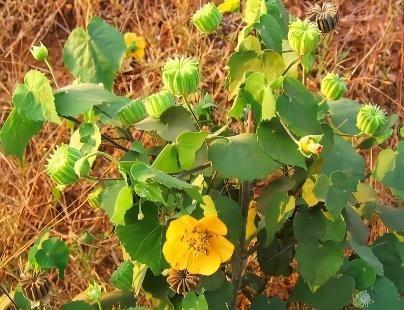
Fig: 01 AbutilonIndicum
Taxonomical classification:
Taxonomy: Abutilonindicium
Kingdom:Plantae
Division: Magnoliophyta
International Research Journal of Engineering and Technology (IRJET) e-ISSN: 2395-0056
Volume: 13 Issue: 01 | Jan 2026 www.irjet.net p-ISSN: 2395-0072
Class: Magnoliopsida
Subclass: Dilleniidae
Order: Malvales
Family: Malvaceae
Genus: Abutilon
Species: Abutilonindicum
Vernacular Name:
English: Indianmallow,CountryMallow,IndianAbutilon, Tamil:Thutthi,Tutti,
Telugu:TutturiBenda,Adavibenda,Botlabenda,Dudi
Malayalam: Velluram,Katturam,Tutti,Uram
II. MATERIALS AND METHODS
Leaves and materials:
The Abutilon indicium leaves used in the study were collected from the Collectorate area, Dharmapuri. The collected sampleswerecarefullycleanedandrinsedtwotothreetimeswithdistilledwatertoremovedustandadheringimpurities. Theleaveswerethenshade-driedunderambientconditionsforsevendays.Thedriedleaveswerecoarselygroundusinga mechanicalgrindertoobtainacoarsepowder,whichwasusedforfurtherextractionstudies.
Materials:
Conicalflask
Solvent(ethanol,acetoneasused)
Sample(coarsepowder)
WhatmanNo.1filterpaper
Magneticstirrerorshaker
preparation of extracts:
ThepreparationofextractsfromthepowderedleavesofAbutilonindicumisdonebyusingthefollowingsolvent:
1. Ethanolextract
2. Acetoneextract
Ethanol extract
Theshade-driedcoarsepowderofAbutilonindicumleaves(50g)wastransferredintoacleanconicalflaskandsubjected to cold maceration using 250 mL of solvent. The mixture was kept on a magnetic stirrer at room temperature with intermittentstirringfor48hours.Aftermaceration,theextractwasfilteredusingWhatman No.1filterpaper.Thefiltrate wasconcentrated by evaporationatroom temperaturetoremovethesolventcompletely.The obtainedextract wasdried andstoredinadesiccatoruntilfurtheruse.Thedried extractwasweighed,andthepercentageyield wascalculatedwith respecttotheair-driedcrudedrug.
Acetone extract
Theshade-driedcoarsepowderofAbutilonindicumleaves(50g)wastakeninacleanconicalflaskandsubjectedtocold maceration with 250 mL of acetone. The mixture was kept on a magnetic stirrer at room temperature with occasional
© 2026, IRJET | Impact Factor value: 8.315 | ISO 9001:2008 Certified Journal | Page448
International Research Journal of Engineering and Technology (IRJET) e-ISSN: 2395-0056
Volume: 13 Issue: 01 | Jan 2026 www.irjet.net p-ISSN: 2395-0072
stirringfor48hours.ThemaceratedextractwasthenfilteredusingWhatmanNo.1filterpaper.Thefiltratewasallowedto evaporateatroomtemperaturetoremovethesolventcompletely.Thedriedextractwasstoredinadesiccatoruntilfurther use.Theextractwasweighed,andthepercentageyieldwascalculatedbasedontheair-driedcrudedrug.
III. PHYTOCHEMICAL ANALYSIS OF ABUTILON INDICUM
Test for Alkaloids:
Dragendorff’s test:
An aliquot (1 mL) of the plant extract was treated with Dragendorff’s reagent. The appearance of an orange-collared precipitateconfirmedthepresenceofalkaloids.
Test for Glycosides:
Preparationoftestsolution:
Theextractwasdissolvedinalcoholtoobtainthetestsolution.
Keller–Killiani test:
A few drops of ferric chloride were added to the test solution, followed by careful addition of concentrated sulfuric acid. Thedevelopmentoftwolayers,withareddish-brownlowerlayerandabluish-greenupperlayer,indicatedglycosides.
Test for Carbohydrates:
Molisch test:
Thetestsolution(2–3mL) wasmixedwithMolischreagent,andconcentratedsulphuricacid wasgentlyaddedalongthe sidesofthetesttube.Theformationofavioletringattheinterfacesuggestedthepresenceofcarbohydrates.
Test for Terpenoids:
One millilitre of the extract was mixed with chloroform, followed by the addition of concentrated sulfuric acid. The formationofareddish-browncolorationatthejunctionofthetwolayersconfirmedterpenoids.
Test for Flavonoids:
Theextractwastreatedwithleadacetatesolution.Ayellowprecipitateindicatedthepresenceofflavonoids.
Test for Tannins:
Preparationoftestsolution:
Theextractwasdissolvedinahydro-alcoholicmixture.
Ferric chloride test:
Additionofferricchloridetotheextractproducedadarkblueorgreenish-blackcolor,indicatingtannins.
Test for Saponins:
Foam test:
The aqueous extract was vigorously shaken with water. The absence of stable froth indicated that saponins were not present.
International Research Journal of Engineering and Technology (IRJET) e-ISSN: 2395-0056
Test for Proteins:
Biuret test:
The extract solution was treated with sodium hydroxide followed by copper sulfate solution. The appearance of a blue colorationindicatedproteins.
Test for Fats:
Solubility test:
The extract was tested for solubility in various solvents. Solubility in chloroform and ether with insolubility in water indicatedthepresenceoffats.
Test for Cholesterol:
Theextractdissolvedinchloroformwastreatedwithaceticanhydrideandconcentratedsulphuricacid.Theabsenceofred colorationindicatedcholesterolwasnotpresent.
Test for Steroids:
The extract was mixed with chloroform and concentrated sulphuric acid. Formation of a reddish-brown ring at the
interfacesuggestedthepresenceofsteroids.
TABLE 01: PhytoconstituentsofethanolandacetoneofdriedleavesofAbutilonindicum.
IV. ANTI MICROBIAL ACTIVITY OF ABUTILON INDICUM TEST MICROORGANISMS:
Totally Two bacterial strains were used throughout investigation. All the bacterial cultures were obtained from the Microbial Type Culture Collection (MTCC), Institute of Microbial Technology, Chandigarh, India. The bacteria used were BacilluscereusandEscherichiacoli
ANTIBACTERIAL ASSAY:
i. PREPARATION OF INOCULUMS
Stock cultures were maintained at 4°C on slopes of nutrient agar. Active cultures of the experiment were prepared by transferring a loopful of cells from the stock cultures to a test tube of Muller-Hinton broth (MHB) for bacteria that were incubatedwithoutagitationfor24hrsat37°C.TheculturesweredilutedwithfreshMuller-Hintonbrothtoachieveoptical densitiescorrespondingto2.0X106 colony-formingunits(CFU/ml)forbacteria(Smith&Doe2018).
Volume: 13 Issue: 01 | Jan 2026 www.irjet.net p-ISSN: 2395-0072 © 2026, IRJET | Impact Factor value: 8.315 | ISO 9001:2008 Certified Journal | Page450
International Research Journal of Engineering and Technology (IRJET) e-ISSN: 2395-0056
Volume: 13 Issue: 01 | Jan 2026 www.irjet.net p-ISSN: 2395-0072
ii. PREPARATION OF STERILE SWABS
A cotton wool swab on wood or plastic was prepared and sterilized by autoclaving or by dry heat (only for the wooden swabs).Itwassterilizedbypackingtheswabsinculturetubes,papers,ortins,etc.
iii. STERILIZATION OF FORCEPS
Forcepscanbesterilizedbydippingtheminalcoholandburningoffthealcohol.
ANTIBACTERIAL ASSAY USING AGAR WELL DIFFUSION METHOD
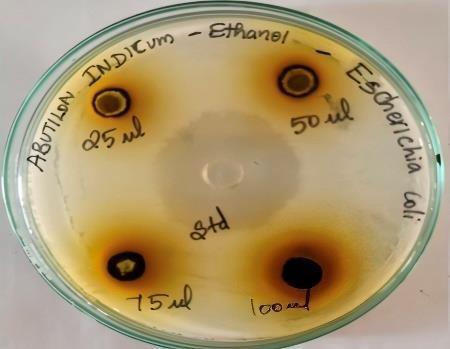
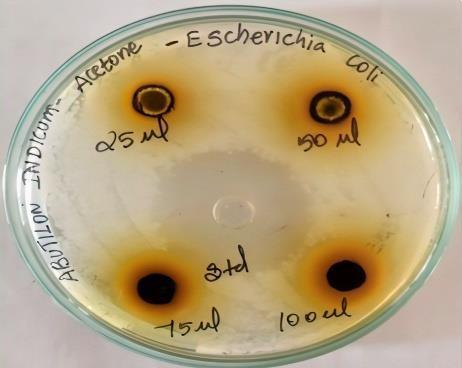
The well diffusion method was used to screen the antimicrobial activity. In vitro antimicrobial activity was screened by usingMullerHintonAgar(MHA)obtained from Hi media(Mumbai).TheMHA plates were preparedby pouring15 ml of molten media into sterile petri plates. The plates could solidify for 5 minutes, and a 0.1% inoculum suspension was swabbeduniformly,andtheinoculumcoulddryfor5minutes.Wellswerecut,and20μlofthedifferentconcentrationsof test drug were added. The plates were then incubated at 37°C for 24 hours. The antibacterial activity was assayed by measuring the diameter of the inhibition zone formed around the well (NCCLS, 1993). An amoxicillin disc was used as a positivecontrol.
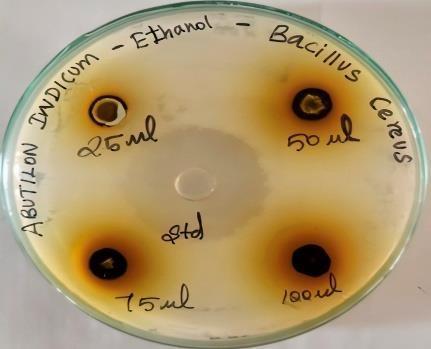
ETHANOL:
International Research Journal of Engineering and Technology (IRJET) e-ISSN: 2395-0056
Volume: 13 Issue: 01 | Jan 2026 www.irjet.net p-ISSN: 2395-0072


ANTI MICROBIAL ACTIVITY OF ABUTILON INDICUM-ETHANOL








02: Concentrationvs.Inhibition
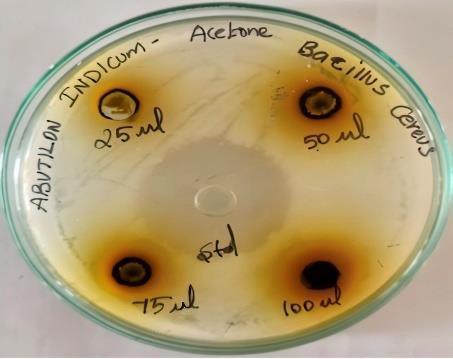
ANTI MICROBIAL ACTIVITY OF ABUTILON INDICUM-ACETONE









Fig.03 ConcentrationvsInhibition


ZONE OF INHIBITION
International Research Journal of Engineering and Technology (IRJET) e-ISSN: 2395-0056
Volume: 13 Issue: 01 | Jan 2026 www.irjet.net p-ISSN: 2395-0072
V. CONCLUSION
It can be concluded that the presence of secondary metabolites such as alkaloids, flavonoids, tannins, terpenoids, glycosides,proteins,andsteroidsintheleafextractsofAbutilonindicum(L.)Sweetcontributestoitsantibacterialactivity. TheAbutilonindicumleafextractsshowedeffective antibacterialactivityagainstthepathogenicmicroorganismsBacillus cereusandEscherichiacoli.Amongthesolventsused,theethanolextractshowedbetterantibacterialactivitycomparedto theacetoneextract.Theantibacterialeffectwasfoundtoincreasewith anincreaseinconcentrationoftheextracts.When comparedwiththeplantextracts,thestandarddrugamoxicillinshowedhigherantibacterialactivityagainstbothbacterial strains.Hence,Abutilonindicumleavespossesspotentialantibacterialproperties.
REFERENCES
[1] PoonkothaiM.AntibacterialactivityofleafextractofAbutilonindicum.AncientSciLife.2006.
[2] Saranya D, Sekar J, Adaikala Raj G. Phytochemical analyses, antibacterial and antifungal activity of leaves from Abutilonindicum(L.)Sweet.JChemPharmRes.2015
[3] RautRR,SawantAR.AntibacterialactivityofAbutilonindicumleafextracts.WorldJPharmRes.2016.
[4] SuriyaJ,BharathiRS,SekarV,RajasekaranR.AntimicrobialactivityofmethanolicextractofAbutilonindicum.IntJ PharmSciRes,2012.
[5] Smith, J. A., & Doe, R. B. Evaluation of the antimicrobial activity of herbal extracts against clinical pathogens. JournalofMicrobialResearch,2018.
[6] National Committee for Clinical Laboratory Standards (NCCLS). (1993). Methods for dilution antimicrobial susceptibilitytestsforbacteriathatgrowaerobically(3rd ed.).NCCLS.