
International Research Journal of Engineering and Technology (IRJET) e-ISSN: 2395-0056
Volume: 13 Issue: 03 | Mar 2026 www.irjet.net p-ISSN: 2395-0072
International Research Journal of Engineering and Technology (IRJET) e-ISSN: 2395-0056
Volume: 13 Issue: 03 | Mar 2026 www.irjet.net p-ISSN: 2395-0072
Ayesha Mir1 , Iffat Shaikh2 , Maria Shaikh3, Tanzeem Shaikh4
Ayesha-Iffat-Maria-Tanzeem Department of Information Technology
Project Guide & HOD I/C HOD IF, Lecturer IF, MHSSP Department of Information Technology M. H. Saboo Siddik Polytechnic, India
Abstract - In the digital era, many residential societies, colleges, and municipal bodies still rely on manual methods suchasregisters, phonecalls,andemailstohandlecomplaints, leading to delays and lack of transparency. This paper presents the Community Complaint Management System (CCMS), a web-based application developed using Python Flask and SQLite/MySQL. The system allows users to register, login, andsubmitcomplaintsunderdifferentcategories,while administrators can manage complaints, assign them to departments, andupdatetheirstatus withemailnotifications. The proposed system improves efficiency, transparency, and accountability in community grievance management.
Key Words: Complaint Management, Python Flask, Web Application, E-Governance, Automation
A. Definition
Thecornerstoneofafunctionalcommunity,whether a small residential society or a large municipality, is the efficientresolutionofitsmembers'grievances.Traditional complaint management mechanisms, however, are often plagued by significant shortcomings. Manual processes involving paper registers are prone to data loss, physical damage, and retrieval difficulties. Verbal or telephonic complaints often lack proper documentation, making it difficult to track the progress or status of an issue. As a result, these limitations frequently lead to delayed responses,unresolvedproblems,anddissatisfactionamong communitymembers.
Toaddressthesesystemicissues,theCommunityComplaint ManagementSystem(CCMS)isproposedasadigitalsolution thatprovidesacentralizedplatformforgrievancehandling. The system aims to create a seamless bridge between community members and administrators. Through this platform, users can submit complaints online from any location and monitor their status in real time. Administrators, on the other hand, gain a structured interfacetomanageincomingcomplaints,categorizethem, and ensure they are addressed promptly by the relevant departments.
The system leverages modern web technologies to implement this functionality. It utilizes Python’s Flask framework for backend logic, along with SQLite for
development and MySQL for scalable deployment as databasesystems.TheCCMSincorporatesessentialfeatures such as secure user authentication, role-based access control, complaint categorization, status tracking, and automated email notifications to improve efficiency and transparencyingrievancemanagement.
ThecoreconceptoftheCommunityComplaintManagement System is based on digitalizing and centralizing the complaint management process to ensure transparency, accountability,andefficientcommunicationbetweenusers andadministrators.
The system enables community members to register complaintsthroughanonlineinterface.Userscanloginto the system and submit complaints by selecting the appropriatecategory,providinga descriptionoftheissue, and optionally attaching supporting information. Each complaint is stored in the database and assigned a status suchasPending,InProgress,orResolved,allowingusersto tracktheprogressoftheirsubmissions.
Theadministrativemoduleallowsauthorizedpersonnelto view, categorize, and manage all submitted complaints throughacentralizeddashboard.Administratorscanupdate complaint statuses, assign them to the appropriate departments, and send automated email notifications to inform users about the progress of their complaints. This structuredmanagementsystemensuresthatgrievancesare addressedefficientlyandtransparently.
The origin of the Community ComplaintManagement System(CCMS)stemsfromthegrowingneedtomodernize complaint handling processes within small and mediumsizedcommunitiessuchasresidentialsocieties,colleges,and hostels.Traditionalsystemsrelyheavilyonmanualregisters, phone calls,and informal communication channels, which oftenresultininefficienciesandlackofaccountability.
ThedevelopmentofCCMSwasmotivatedbytheneedto replace these outdated methods with a centralized digital platform that ensures transparency, efficient
International Research Journal of Engineering and Technology (IRJET) e-ISSN: 2395-0056
Volume: 13 Issue: 03 | Mar 2026 www.irjet.net p-ISSN: 2395-0072
communication,andsystematicgrievancemanagement.By enabling users to submit complaints online and administrators to track and resolve them through a structured interface, the system aims to improve overall communitygovernance.
In many communities, complaint handling is still managedthroughpaperregistersorverbalcommunication. Thesemethodsarepronetoseveralissuessuchas:
Lossordamageofrecords
Lackofpropertrackingmechanisms
Delayedresponsestocomplaints
Difficulty in monitoring complaint resolution progress
Due to the absence of a centralized system, administratorsoftenstruggletoprioritizeissuesormaintain accountability. This situation frequently leads to dissatisfactionamongcommunitymembersandunresolved grievances.
The evolution of CCMS involved transitioning from traditional complaint recording methods to a web-based managementsystempoweredbymoderntechnologies.
Initially, the concept was limited to a simple digital complaintregister.However,throughfurtherdevelopment, thesystemevolvedtoincludeadditionalfeaturessuchas:
Userauthenticationandregistration
Complaintcategorization
Role-basedadministrativeaccess
Real-timestatustracking
Automatedemailnotifications
The system was implemented using Python Flask for backend development,alongwith SQLitefordevelopment environmentsandMySQLforscalabledeployment,ensuring alightweightyetflexiblearchitecture.
C.
The primary aim of the Community Complaint Management System is to create an efficient, transparent, andaccessibleplatformformanagingcommunitygrievances.
The key objectives include:
Providing an online platform for users to submit complaints.
Enabling administrators to manage and resolve complaintsefficiently.
Improvingtransparencyingrievancehandling.
Reducingdelaysandimprovingresponsetimes.
Establishing a centralized complaint tracking mechanism.
ThissectionexplainsthestructuraldesignoftheCCMS system, focusing on system workflow, data flow, and architecturalorganization.
The internal workflow of the Community Complaint Management System (CCMS) follows a structured process where user complaints are collected, processed, and resolvedthroughacentralizeddigitalplatform.Asshownin theDataFlowDiagram(Level0).
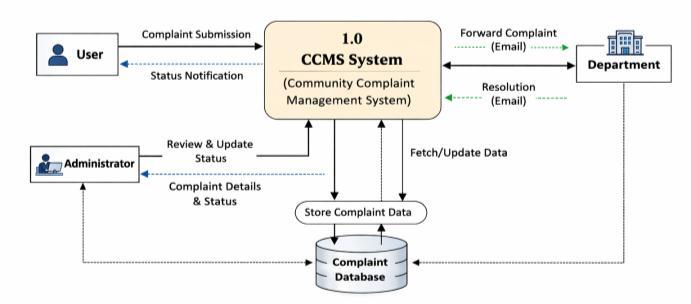
The Data Flow Diagram (Level 0) provides a high-level abstraction of the Community Complaint Management System(CCMS),illustratingthecentralizedprocessingunit (1.0 CCMS System) and its interaction with the primary external entities: User, Administrator, and Department. In thisprocess,theusersubmitsacomplaintthroughtheweb interface, the administrator reviews the complaint and forwardsittotheconcerneddepartmentviaemail,andafter resolutiontheadministratorupdatesthecomplaintstatus and notifies the user. This diagram represents the input–process–output flow for efficient complaint handling and transparentcommunication.
International Research Journal of Engineering and Technology (IRJET) e-ISSN: 2395-0056
Volume: 13 Issue: 03 | Mar 2026 www.irjet.net p-ISSN: 2395-0072
The internal workflow of the Community Complaint Management System (CCMS) follows a sequential process where user complaints are processed, managed, and resolvedthroughdifferentsystemmodules.Asshowninthe DataFlowDiagram(Level1),theprocessbeginswithUser Authentication(1.1),whichverifiesusercredentialsbefore grantingaccesstothesystem.Aftersuccessfullogin,theuser proceedstoComplaintSubmission(1.2),where complaint detailsarecapturedandstoredintheComplaintDatabase (D1).
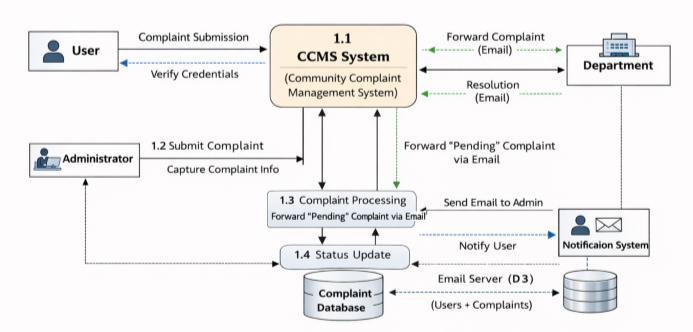
TheData FlowDiagram(DFD)Level 1providesa detailed breakdown of the internal processes within the CCMS system.Itillustratesthejourneyofacomplaintstartingfrom User Authentication (1.1) and moving to Complaint Submission(1.2)whereusercomplaintsarerecorded.The process then continues with Complaint Processing (1.3), where the administrator reviews the complaint and forwardsittotherelevantdepartmentviaemail.Afterthe departmentresolvestheissue,theadministratorperformsa StatusUpdate(1.4)andtheNotificationSystem(1.5)sends updates to the user. This structured workflow ensures efficient complaint tracking, transparency, and effective communicationwithinthecommunitymanagementsystem.
ThissectiondescribestheimplementationoftheCCMS systemandthetechnologiesusedtodeveloptheplatform.
Thesystemwasdevelopedusingamodulararchitecturethat separatesthefrontendinterfacefrombackendprocessing.
Frontend Technologies:
HTML5
CSS3
JavaScript
Thesetechnologieswereusedtocreateresponsiveanduserfriendly interfaces for complaint submission and administrativemanagement.
Backend Technologies:
Python3.x
FlaskFramework
Flask-SQLAlchemy
Flask-Login
Flaskhandlesrouting,sessionmanagement,andapplication logic.
Database System:
SQLite(developmentstage)
MySQL(productiondeployment)
SQLAlchemyORMwasusedtomanagedatabaseoperations securely.
Thesystemworkflowincludesthefollowingsteps:
Userregistersandlogsintothesystem.
Usersubmitsacomplaintusingthecomplaintform.
Complaintdetailsarestoredinthedatabase.
Administrator reviews the complaint through the adminpanel.
Administratorupdatescomplaintstatusandsends notifications.
This workflow ensures efficient complaint handling and transparency.
WhilethecurrentimplementationoftheCommunity Complaint Management System (CCMS) successfully providesessentialfunctionalitiesforcomplaintsubmission, tracking, and administrative management, the system architectureisdesignedinamodularmannerthatallowsfor futureimprovementsandscalability.Theseenhancements cansignificantlyimprovesystemaccessibility,automation, andanalyticalcapabilities.
OneofthemostsignificantfutureenhancementsofCCMSis the development of a dedicated mobile application for AndroidandiOSplatforms.Amobileapplicationwouldallow
2395-0056
Volume: 13 Issue: 03 | Mar 2026 www.irjet.net p-ISSN: 2395-0072
users to submit complaints, upload images, and track the statusoftheircomplaintsdirectlyfromtheirsmartphones. Since mobile devices are widely used in modern communities,integratingamobileplatformwouldincrease systemaccessibilityanduserengagement.Additionally,push notificationscanbeimplementedwithinthemobileappto instantly notify users about complaint status updates and administrativeresponses.
Currently,theCCMSprimarilyreliesonemailnotifications for communication between administrators, departments, and users. However, integrating an SMS gateway service wouldenhancethecommunicationmechanismbyproviding real-time text message notifications. This feature would ensure that users receive immediate updates regarding complaint status changes, resolution confirmations, or additionalinformationrequestseveniftheydonotregularly checktheiremail.SMSnotificationswouldalsobebeneficial in rural or low-bandwidth environments where internet accessmaybelimited.
Anotherpotentialenhancementinvolvestheintegrationof dataanalyticsandreportingtoolstoprovideadministrators with meaningful insights into complaint management patterns.Byanalyzinghistoricalcomplaintdata,thesystem couldgeneratestatisticalreportsandvisualdashboardsthat assist administrators in decision-making. Some useful analyticsfeaturesmayinclude:
Average complaint resolution time, helping authoritiesevaluateoperationalefficiency.
Most common complaint categories, identifying recurringissueswithinthecommunity.
Departmentperformancemetrics,measuringhow quickly and effectively departments resolve complaints.
Monthlyoryearlycomplainttrends,whichcanhelp local authorities prioritize infrastructure improvements.
SuchanalyticalcapabilitieswouldtransformtheCCMSfrom asimplecomplaintsystemintoadecision-supportplatform forcommunitymanagement.
To improve accountability and ensure timely complaint resolution, the system can incorporate an automated escalation mechanism. This feature would automatically forwardunresolvedcomplaintstohigherauthoritiesifthey remain pending beyond a predefined time limit. For example, if a complaint is not addressed within a specific number of days, the system could escalate the issue to a senioradministratorormanagementauthority.Thisensures
that no complaint remains ignored and enhances transparencyinthecomplaintresolutionprocess.
SincetheCommunityComplaintManagementSystem processesuserdata,complaintdetails,andadministrative actions, ensuring data privacy and system security is of criticalimportance.Thesystemincorporatesseveralsecurity mechanismstoprotectsensitiveinformationandmaintain usertrust.
Usercredentialsandpersonalinformationmustbeprotected from unauthorized access. In the CCMS implementation, passwords are stored using secure hashing techniques ratherthanplaintextstorage.Thisensuresthatevenifthe databaseiscompromised,userpasswordsremainprotected. Additionally, secure communication protocols can be implemented during deployment to protect data transmissionbetweenusersandtheserver.
Thesystemimplementsrole-basedaccesscontrol(RBAC)to ensurethatonlyauthorizedindividualscanaccesssensitive functionalities. Regular users are allowed to submit and track complaints, while administrative privileges such as complaintmodification,departmentassignment,andstatus updatesarerestrictedexclusivelytosystemadministrators. Thisaccesscontrolmechanismpreventsmisuseofsystem privilegesandmaintainsoperationalintegrity.
Maintaining the integrity of stored complaint data is essentialforsystemreliability.TheCCMSusesSQLAlchemy ORM(ObjectRelationalMapping) fordatabaseoperations, whichreducestheriskofSQLinjectionattacksandsimplifies securedatahandling.BymappingdatabasetablestoPython objects, SQLAlchemy ensures structured database interactionsandimprovesapplicationsecurity.
The User Interface (UI) of the Community Complaint Management System is designed with a strong focus on simplicity,usability,andaccessibility.Thegoalistoensure that both community members and administrators can interact with the system efficiently without requiring technicalexpertise.
Theuser-sideinterfaceprovidesanintuitive environment wherecommunitymemberscaneasilysubmitandmonitor complaints.Keyfeaturesinclude:
International Research Journal of Engineering and Technology (IRJET) e-ISSN: 2395-0056
Volume: 13 Issue: 03 | Mar 2026 www.irjet.net p-ISSN: 2395-0072
Complaint Submission Form: Users can submit complaints by selecting a category, providing a subject, writing a detailed description, and optionallyattachingsupportingimages.
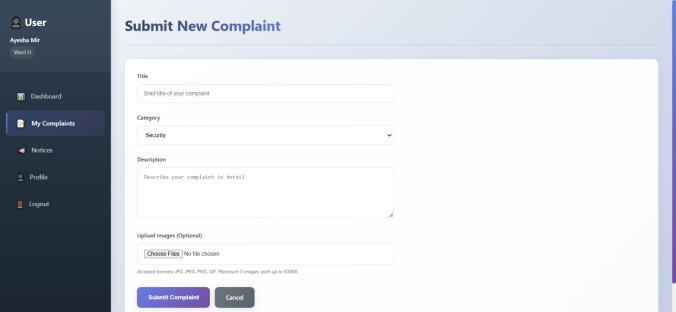
ComplaintStatusTrackingPage: Aftersubmittinga complaint,userscanmonitoritsprogressthrough differentstatusessuchasPending,InProgress,and Resolved.
User Profile Management: Registered users can manage their personal details, view complaint history, and track all previously submitted complaintsinacentralizeddashboard.
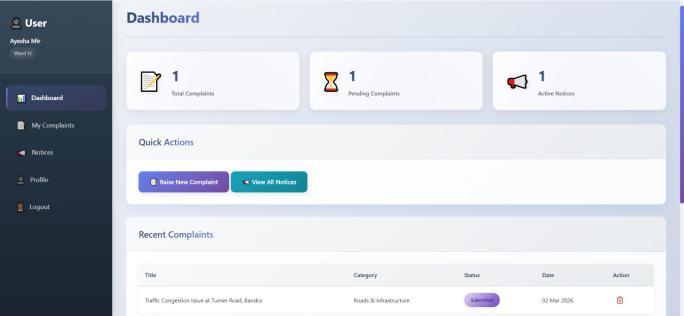
Thesefeaturesensurethatusersremaininformedaboutthe statusoftheircomplaintsandfeelactivelyinvolvedinthe grievanceresolutionprocess.
Theadministrativeinterfaceactsasthecontrolcenterofthe CCMS, enabling administrators to manage all complaints efficiently.Theadmindashboardincludes:
Complaint Overview and Statistics: A centralized view of all complaints, including summaries and quickstatistics.
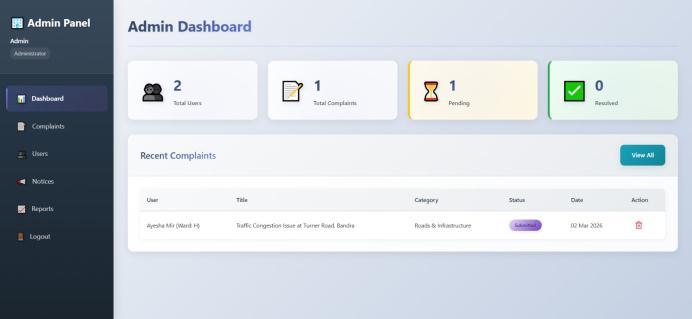
Complaint Filtering and Categorization: Administrators can filter complaints based on categories, dates, or current status to prioritize taskseffectively.
StatusUpdateControls: Administratorscanupdate complaintstatusesastheymovethroughdifferent stagesofresolution.
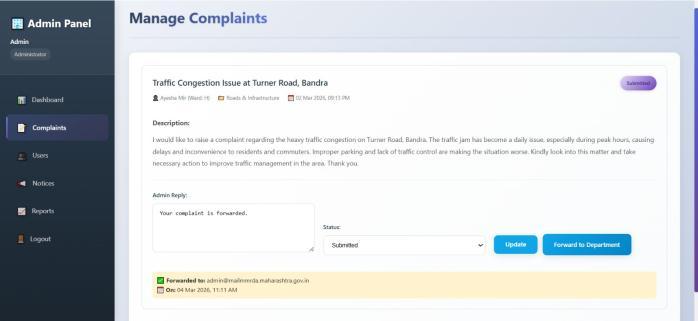
Email Notification System: The system automatically sends emails to the relevant departments when a complaint is forwarded and notifiesuserswhenthecomplaintstatusisupdated.
Theuser-friendlyinterfaceensuressmoothcommunication between users, administrators, and departments, thereby improvingoverallsystemefficiency.
The Community Complaint Management System (CCMS) demonstrates an effective digital alternative to traditional manual methods of grievance handling. By leveraging the Python Flask framework and a relational database system, the project provides a functional, userfriendly, and transparent platform for complaint management.
The system empowers community members by allowingthemtosubmitcomplaintseasilyandtrack their status in real time, thereby improving communication between users and administrators. At the same time, administratorsareprovidedwithefficienttoolstomanage
International Research Journal of Engineering and Technology (IRJET) e-ISSN: 2395-0056
Volume: 13 Issue: 03 | Mar 2026 www.irjet.net p-ISSN: 2395-0072
complaints,forwardthemtotheappropriatedepartments, andupdatetheirresolution status.Asa result, the system addresses several key challenges of manual complaint handling,suchasdelaysinprocessing,lackoftransparency, andweakaccountabilitymechanisms.
Overall,theproposedsystemenhancestheefficiency, transparency and organization of community grievance management while promoting transparency and faster problemresolution.
[1] M.Grinberg, Flask Web Development: Developing Web Applications with Python,2nded.O'ReillyMedia,2018.
[2] R. Challapalli, P. Kaushik, S. Suman, B. Shivahare, V. BibhuandA.Rana,"WebBasedComplaintManagement System," 2020 2nd International Conference on Advances in Computing, Communication Control and Networking (ICACCCN),GreaterNoida,India,2020,pp. 680-684.
[3] A. Sharma and R. Sharma, "A Review on Online GrievanceRedressalSystem," International Journal of Computer Applications,vol.175,no.10,pp.35-38,Oct. 2020.
[4] SQLiteDocumentation.[Online].Available: https://www.sqlite.org/docs.html
[5] FlaskDocumentation.[Online].Available: https://flask.palletsprojects.com/