
International Research Journal of Engineering and Technology (IRJET) e-ISSN: 2395-0056
Volume: 13 Issue: 04 | Apr 2026 www.irjet.net p-ISSN: 2395-0072

International Research Journal of Engineering and Technology (IRJET) e-ISSN: 2395-0056
Volume: 13 Issue: 04 | Apr 2026 www.irjet.net p-ISSN: 2395-0072
Velpula Swarna 1 , Vemulapalli Tanmayee Santhoshi 2 , Ajjarapu Geetha Sree 3 , Angari Mounika 4 , Havilah Neal 5
1234 B. Tech Students, Department of Computer Science and System Engineering, Andhra University College of Engineering for Women, Visakhapatnam, India
5 Assistant Professor, Department of Computer Science and System Engineering, Andhra University College of Engineering for Women, Visakhapatnam, India
Abstract: The College Timetable and Academic Management Systemis a web-basedapplicationdeveloped using PHP and MySQL, deployed on the XAMPP server, to automate and streamline academic and administrative processes within a college. The system provides a centralized platform with three user roles: Admin, Faculty, and Student, each with dedicated dashboards and functionalities. The admin module manages departments, subjects, faculty, students, rooms, and time slots, all stored in a structured database. It includes automated timetable generation for classes and mid-examinations, along with export options. Additional features include placement management with statistical analysis, activity and event management, notice board, and complaint handling. The faculty module enables secure login, timetable access, assignment management, and placement insights. It incorporates a location-basedattendance system usingQR code and OTP verification to ensure authenticity. Faculty can also handle student grievances, view institutional activities, and participate in the Lost and Found system. The student module provides access to attendance tracking with calendar visualization, timetables, assignments, placement details, and institutional updates. Students can raise complaints, engage in activity modules, and use the Lost and Found feature for item recovery. A key highlight of the system is the integration of real-time communication, graphical analytics, and email notifications for efficient information flow. Overall, the system enhances operational efficiency, transparency, and user interaction, making college management more organizedanduser-friendly.
Key Words: College Management System, Timetable Generation, Academic Automation, PHP, MySQL, QR Code Attendance, OTP Verification, Placement Management, Student Information System, Web Application
In recent years, the rapid growth of digital technologies has significantly transformed the education sector, leading to the adoption of smart systems for managing academic and administrative activities. Traditional manual methods of handling timetables, attendance, student records, and communication are often time-
consuming, error-prone, and inefficient. To overcome these limitations, various automated systems such as enotice boards, attendance systems, grievance portals, and timetable management solutions have been developed[1],[5],[6].
Severalresearchworkshavefocusedonspecificmodules like notice board systems [1], attendance management [7],assignmenthandling[8],placementsystems[9],and lostandfoundportals[4].Similarly,collegemanagement systems have been proposed to digitize administrative tasksandimproveefficiency[2].However,mostofthese systems operate independently and lack integration, resulting in fragmented management and reduced effectiveness.
To address these challenges, this research proposes a comprehensive College Timetable and Academic ManagementSystem,whichintegratesmultipleacademic and administrative modules into a single web-based platform.ThesystemisdevelopedusingPHPandMySQL and provides role-based access for Admin, Faculty, and Students. It includes features such as automated timetable generation, secure location-based attendance using QR code and OTP, assignment management, placement tracking with statistical analysis, and grievancehandling.
Additionally, the system enhances communication through modules like official notice boards, activity management,andeventgalleries.Auniquefeatureofthe proposed system is the Lost and Found Item Management System, which enables efficient item tracking and recovery through automated email notifications[4].
By integrating all these functionalities into a centralized platform, the proposed system aims to improve operationalefficiency,transparency,anduserinteraction within educational institutions, thereby overcoming the limitationsofexistingstandalonesystems.
The primary objective of this research is to design and develop a comprehensive web-based College Timetable and Academic Management System that automates and
International Research Journal of Engineering and Technology (IRJET) e-ISSN: 2395-0056
Volume: 13 Issue: 04 | Apr 2026 www.irjet.net p-ISSN: 2395-0072
integrates academic and administrative activities into a singleplatform.
Thespecificobjectivesofthestudyare:
To develop a centralized system that efficiently manages departments, subjects, faculty, students, rooms, and time slots using a structureddatabase.
To implement an automated timetable generation system for both class schedules and mid-examinations, reducing manual effort and schedulingconflicts.
To design role-based dashboards for Admin, Faculty, and Students, ensuring secure access anduser-specificfunctionalities.
To develop a secure attendance system using locationverification,QRcode,andOTPtoensure authenticityandpreventproxyattendance.
To provide assignment management features that enable faculty to upload assignments and students to interact through acknowledgement anddiscussion.
To integrate placement management modules for tracking student placements, company drives, and analyzing hiring trends using graphicalrepresentations.
To implement a grievance management system that allows students to raise complaints and faculty/admintoresolvethemefficiently.
To enhance communication through modules such as official notices, activity management, andeventgalleries.
To develop a Lost and Found Item Management System with automated email notifications for efficientitemtrackingandrecovery.
To improve overall efficiency, transparency, and user interaction within the college by providing aunifiedanduser-friendlyplatform.
The scope of the proposed College Timetable and Academic Management System covers the complete automation and integration of academic and administrative activities within a college environment. The system is designed as a web-based platform using PHPandMySQL,supportingthreeprimaryusers:Admin, Faculty,andStudents.
The project includes modules for department management, course handling, faculty and student
informationmanagement,roomallocation,andtimeslot scheduling. It supports automatic generation of class timetables and mid-exam schedules based on available resources. The system also incorporates advanced features such as location-based attendance using QR codeandOTPverification,assignmentmanagementwith interactive discussion, and placement tracking with graphicalanalysis.
Additional functionalities include grievance management, official notice board, activity and event management, and a Lost and Found Item Management System with email notifications. The system ensures real-timedataupdatesandcentralizedaccess.
Future directions of the project include integrating mobile application support, AI-based timetable optimization, predictive analytics for placements, cloud deployment for scalability, and enhanced security mechanismssuchasbiometricauthentication.
The proposed system significantly improves the efficiency and effectiveness of college management by replacing manual processes with an automated and integrated digital platform. It reduces administrative workload,minimizes errors inscheduling,and enhances data accuracy through centralized database management.
The system ensures transparency and accountability by providing real-time access to information such as attendance, complaints, placements, and academic activities. The implementation of secure attendance using location verification, QR code, and OTP helps preventmalpracticeandensuresauthenticity.
One of the key contributions of this research is the integration of multiple independent modules such as timetable generation, attendance management, placement tracking, grievance handling, and Lost and Found system into a single unified platform. This eliminates the need for separate systems and improves overallcoordination.
The inclusion of communication-enhancing features like notice boards, activity modules, and event galleries strengthens interaction between students, faculty, and administration. The Lost and Found system with automated email notifications adds practical value by addressingreal-lifecampusissues.
Overall, the system contributes to the digital transformationofeducationalinstitutionsbyprovidinga scalable, user-friendly, and efficient solution that enhances productivity, decision-making, and user experience.
2025, IRJET | Impact Factor value: 8.315 | ISO 9001:2008
International Research Journal of Engineering and Technology (IRJET) e-ISSN: 2395-0056
Volume: 13 Issue: 04 | Apr 2026 www.irjet.net p-ISSN: 2395-0072
Thedigitaltransformationofeducationalinstitutionshas led to the development of various systems aimed at automating specific academic and administrative functions. Several researchers have proposed solutions targetingindividualcomponentsofcollegemanagement.
Theconceptofdigitalcommunicationwithininstitutions has been addressed through E-Notice Board systems, which enable quick dissemination of information to students and staff [1]. Similarly, general College Management Systems have been developed to handle student records, faculty details, and administrative processes,improvingoperationalefficiency[2].However, these systems often lack integration with advanced academicmodules.
Department-level activity management systemsfocus on organizing extracurricular and academic events, improving student engagement and participation [3]. In addition, Digital Lost and Found Item Portals have been introduced to help track and recover lost items within campus environments, enhancing convenience and communication[4].
Grievance management systems play a crucial role in addressing student issues and improving institutional transparency. Studies highlight the importance of structured complaint handling systems for efficient problem resolution [5]. Timetable management has also been widely studied, where automated systems reduce schedulingconflictsandmanualworkload[6].
Attendance management systems have evolved with the useof moderntechnologies suchasQRcodesandsmart tracking to ensure accuracy and prevent proxy attendance [7]. Online assignment systems further enhance academic interaction by allowing students and facultytocommunicateeffectivelyregardingcoursework [8].
Placement management modules have also been proposed to track student recruitment, analyze hiring trends,andmanagecompanydrivesefficiently[9].While these systems provide valuable functionalities, most existing solutions are standalone and lack a unified platformthatintegratesallfeatures.
The proposed system addresses this gap by combining timetable generation, attendance tracking, assignment management, placement analysis, grievance handling, activity management, and lost and found services into a single, centralized web-based application, thereby offeringa morecomprehensiveandefficientsolutionfor collegemanagement.
The College Timetable and Academic Management System is developed using a modular and structured methodology to ensure efficient integration of academic and administrative processes. The system is implemented as a web-based application using PHP, MySQL, and XAMPP, with role-based access for Admin, Faculty,andStudents.
3.1.SystemModule
Thesystemfollowsathree-tierarchitectureconsistingof the user interface (frontend), application logic (backend),anddatabaselayer.Role-basedauthentication is implemented to provide secure access to Admin, Faculty, and Student dashboards. All modules are interconnected and operate on a centralized MySQL database.
3.2.AdminModule
The admin module is responsible for overall system controlandmanagement.Itincludesfunctionalitiessuch as managing departments, subjects, faculty details, student records, rooms, and time slots. Each entity is stored in structured database tables and linked using uniquedepartmentIDs.ThemodulealsosupportsCRUD operationsandallowsexportingdataintoExcelformat.
3.3.TimetableGenerationModule
This module automatically generates class timetables based on constraints such as subject availability, faculty allocation, room capacity, and time slots. It ensures conflict-free scheduling. Additionally, the Mid-Exam Timetable Generator enables the admin to create exam schedules by selecting department, semester, subjects, rooms, and session timings, with an option to download inPDFformat.
3.4.FacultyModule
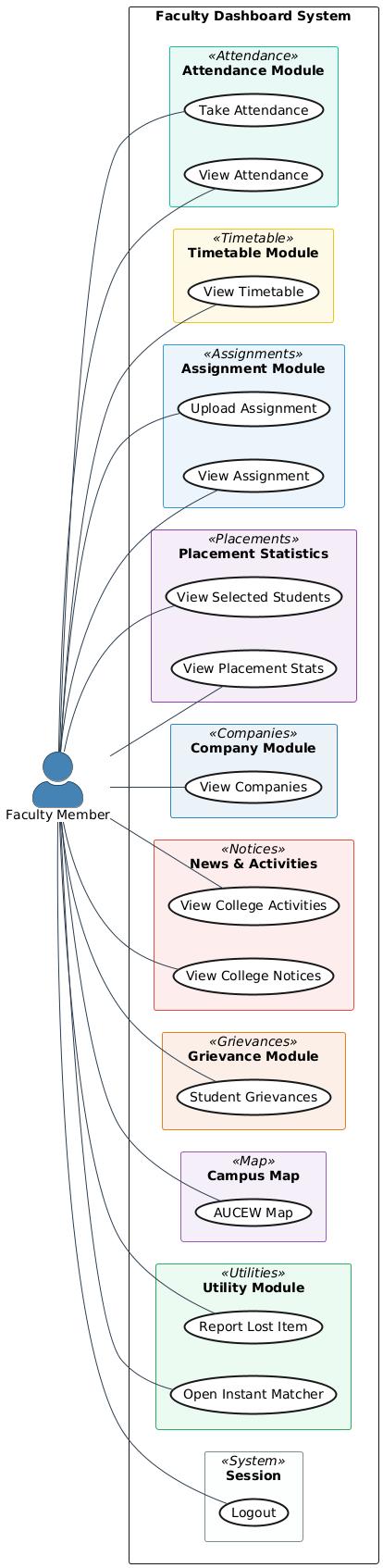
The faculty module provides secure login and a personalized dashboard. Faculty members can view timetables, manage assignments, analyse placement data, and access activities and notices. The module also allows faculty to handle student grievances and participateintheLostandFoundsystem.
3.5.AttendanceManagementModule
The attendance system uses location-based verification combined with QRcodeandOTPauthentication.Faculty initiate attendance sessions, and students mark attendance by scanning the QR code and entering the OTP within a time limit. This ensures accuracy and preventsproxyattendance.
Volume: 13 Issue: 04 | Apr 2026 www.irjet.net
3.6.StudentModule
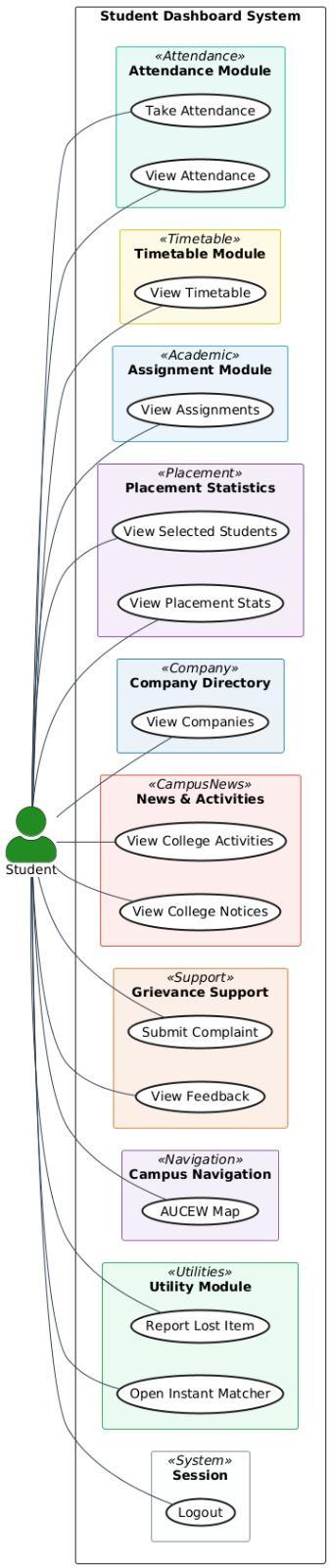
The student module provides access to attendance records, timetables, assignments, placement details, and institutional updates. Attendance is displayed using a calendarinterface withstatus indicatorsandpercentage calculations. Students can also interact with faculty throughassignmentdiscussions.
3.7.AssignmentManagementModule
Faculty can upload assignments with details such as subject, semester, and deadlines. Students can view assignments, acknowledge them, and communicate with facultythroughadiscussionchatfeature.
3.8.PlacementManagementModule
Thismodulemanagesplacementdata,includingselected students,companydetails,jobroles,andsalarypackages. Itprovidesgraphicalanalysisofplacementstatisticssuch ashiringtrends,highestsalary,andaveragepackages.
3.9.GrievanceManagementModule
The system includes a complaint management feature where students can report issues related to infrastructureorservices.FacultyandAdmincanreview and resolve complaints, and feedback is provided to students.
3.10.ActivityandCommunicationModule
This module includes features such as official notice boards, workshops, event galleries, and activity management. Users can view updates, images, and descriptions,improvingcommunicationandengagement withintheinstitution.
3.11.LostandFoundItemManagementModule
This module allows users to report lost items with details and images. The system matches lost and found itemsthroughanInstantMatcherfeature.Whenamatch is identified, the system sends email notifications via Outlookintegrationtotheitemownerforquickrecovery.
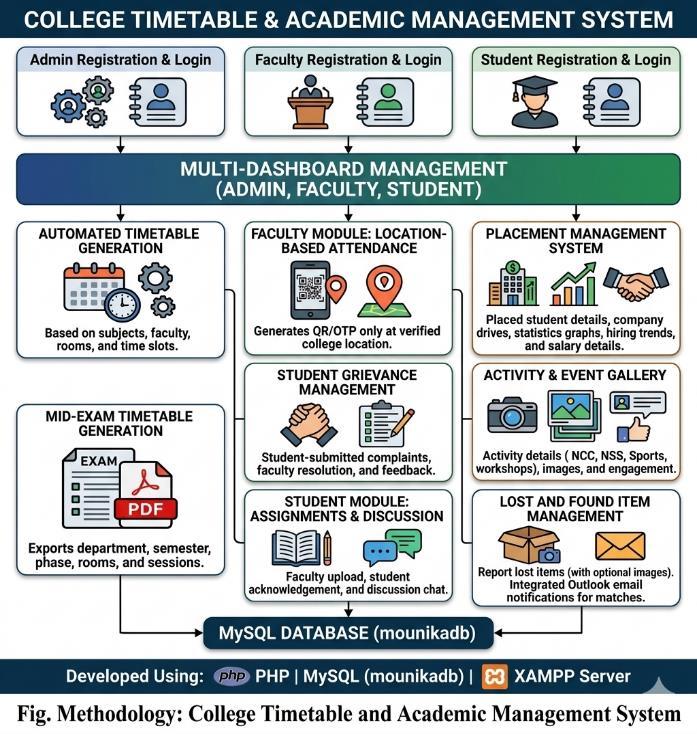
The College Timetable and Academic Management System is designed using a three-tier architecture, which ensures modularity, scalability, and efficient data handling.Thesystemintegratesauser-friendlyfrontend, adynamicbackend,andastructureddatabase.
4.1ArchitectureOverview
Thesystemfollowsthreemainlayers:
Presentation Layer (Frontend): Developed using HTML, CSS, JavaScript, and Bootstrap, this layer provides interactive dashboards for Admin, Faculty, and Students. It handlesuser input, displaysdata,and ensures a responsiveinterface.
Application Layer (Backend): Implemented using PHP, this layer processes user requests, applies business logic, validates inputs,andcommunicateswiththedatabase.
Data Layer (Database): MySQL database (mounikadb) is used to store and manage all system data including users, departments, subjects, timetables, attendance, placements,andcomplaints.
4.2SystemModules
Thesystemisdividedintomultiplefunctionalmodules:
AdminModule
Department,Course,andSubjectManagement
FacultyandStudentRecordManagement
RoomandTimeSlotAllocation
International Research Journal of Engineering and Technology (IRJET) e-ISSN: 2395-0056
Volume: 13 Issue: 04 | Apr 2026 www.irjet.net p-ISSN: 2395-0072
AutomaticTimetableGeneration
Mid-ExamTimetableGenerator(PDFexport)
PlacementManagementandAnalytics
ActivityandNoticeManagement
ComplaintMonitoringSystem
LostandFoundItemManagement
FacultyModule
SecureLoginandDashboardAccess
Location-Based Attendance Management (QR + OTP)
TimetableViewingandDownload
AssignmentUploadandDiscussionChat
PlacementInsightsandCompanyDrives
ComplaintResolutionandFeedback
LostandFoundItemReporting
StudentModule
RegistrationandLogin
QR+OTP-BasedAttendanceMarking
AttendanceTrackingwithCalendarView
TimetableandAssignmentAccess
PlacementInformationandStatistics
ComplaintSubmissionandTracking
ActivityParticipationandFeedback
LostandFoundItemReporting
4.3DatabaseDesign
The database is structured using relational tables with proper normalization to avoid redundancy and ensure consistency.
KeyTablesInclude:
UsersTable: Storeslogincredentialsandroles
Departments Table: Contains department detailswithuniqueIDs
Faculty Table: Faculty information linked with departments
Students Table: Student data including roll numberanddepartment
Subjects Table: Subject details mapped to departments
TimetableTable: Storesgeneratedschedules
AttendanceTable: Recordsstudentattendance
PlacementsTable: Storesplacementdetailsand statistics
ComplaintsTable: Tracksgrievancesandstatus
LostandFoundTable: Maintainslostandfound itemrecords
Relationships between tables are maintained using primarykeysandforeignkeys,ensuringdataintegrity.
4.4KeyDesignFeatures
Role-Based Access Control: Different dashboardsforAdmin,Faculty,andStudents
Location-Based Authentication: Ensures attendanceismarkedonlywithincampus
Automation: Timetable and exam schedule generation
Real-Time Updates: Changes in the system are instantlyreflectedinthedatabase
Data Export: Excel and PDF generation for reports
Email Integration: Automatic notifications for lostandfounditems
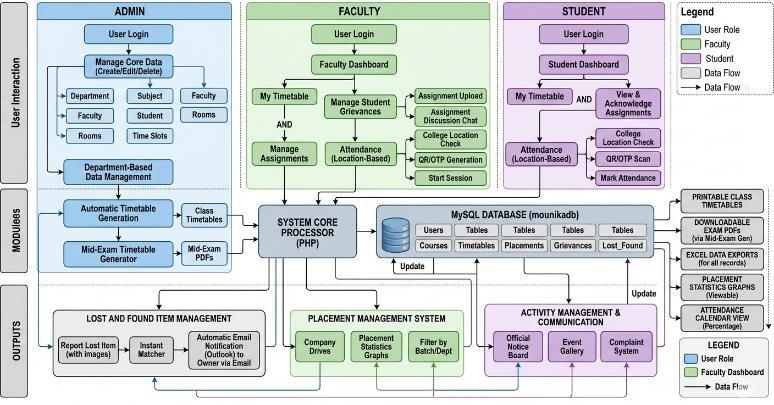
Fig2:SystemDesignandArchitecture
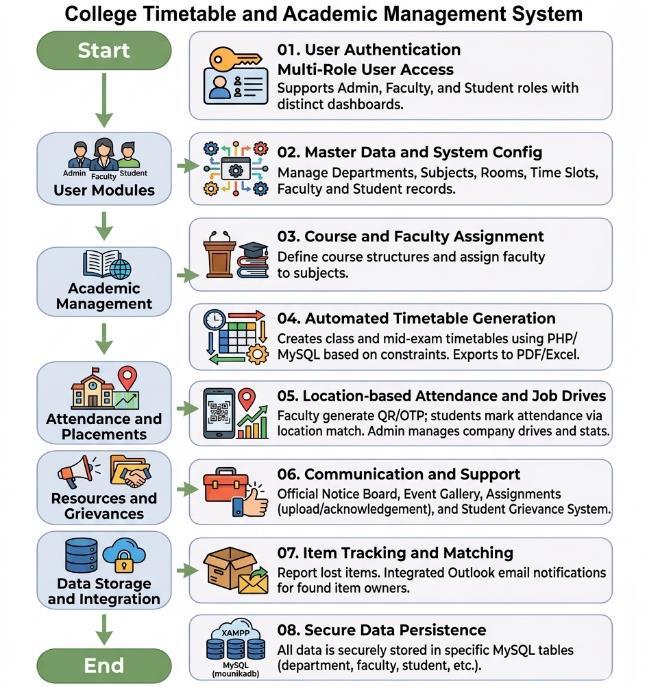
5. SYSTEM WORKFLOW
Theworkflowdefineshowdataflowsthroughthesystem andhowusersinteractwithdifferentmodules.
5.1OverallWorkflow
1. User accesses the system through the web interface
International Research Journal of Engineering and Technology (IRJET) e-ISSN: 2395-0056
Volume: 13 Issue: 04 | Apr 2026 www.irjet.net p-ISSN: 2395-0072
2. User registers or logs in based on role (Admin/Faculty/Student)
3. Systemvalidatescredentialsandredirectstothe respectivedashboard
4. User performs operations (create, view, update, delete)
5. Backend processes the request and updates the database
6. Updated information is reflected in the user interface
5.2AdminWorkflow
1. Adminlogsintothesystem
2. Creates and manages departments, subjects, faculty,andstudents
3. Definesroomsandtimeslots
4. Initiatesautomatictimetablegeneration
5. Reviewsandexportstimetables
6. Managesplacements,activities,andnotices
7. Monitorscomplaintsandlost/founditems
8. Generatesreports(Excel/PDF)
5.3FacultyWorkflow
1. Facultylogsintothesystem
2. Viewsdashboardandtimetable
3. Startsattendancesession:
o Locationverification
o GeneratesQRcodeandOTP
4. StudentsmarkattendanceusingQR+OTP
5. Facultyreviewsattendancerecords
6. Uploadsassignmentsandinteractsviachat
7. Reviewsplacementdataandcompanydrives
8. Resolves student complaints and provides feedback
9. Reportslostorfounditems
5.4StudentWorkflow
1. Studentregisters/logsintothesystem
2. Viewsdashboardandacademicdetails
3. Marksattendance:
o Locationverification
o ScansQRcode
o EntersOTP
4. Viewsattendanceincalendarformat
5. Accessestimetableandassignments
6. Interacts with faculty through assignment discussions
7. Viewsplacementopportunitiesandstatistics
8. Submitscomplaintsandchecksstatus
9. Reportslostitemsandreceivesnotifications
5.5TimetableGenerationWorkflow
1. Admininputs:
o Subjects
o Facultyavailability
o Rooms
o Timeslots
2. Systemprocessesconstraints:
o Nofacultyconflicts
o Noroomoverlap
o Department-wisescheduling
3. Generatesoptimizedtimetable
4. Timetableisstoredindatabase
5. Userscanview/downloadtimetable
5.6AttendanceWorkflow
1. Facultyinitiatesattendancesession
2. Systemverifiesfacultylocation
3. QRcodeandOTParegenerated
4. StudentscansQRandentersOTP
5. Systemvalidates:
o Location
o QRsession
o OTPcorrectness
6. Attendanceisrecordedindatabase
7. Studentscanviewattendancestatistics
International Research Journal of Engineering and Technology (IRJET) e-ISSN: 2395-0056
Volume: 13 Issue: 04 | Apr 2026 www.irjet.net p-ISSN: 2395-0072
5.7LostandFoundWorkflow
1. Userreportslostitemwithdetailsandimage
2. ItemisdisplayedonInstantMatcherpage
3. Anotherusermarksitemasfound
4. Systemmatchesrecords
5. Emailnotificationissenttotheowner
6. Itemstatusisupdatedto“Found”
5.8ComplaintManagementWorkflow
1. Studentsubmitscomplaintwithdescriptionand image
2. Complaintisstoredindatabase
3. Faculty/Adminreviewscomplaint
4. Actionistaken
5. Feedbackisupdatedinsystem
6. Studentcheckscomplaintstatus
6. RESULTS
The implementation of the College Timetable and Academic Management System demonstrates significant improvementsinmanagingacademicandadministrative activities. The system successfully automates complex processes such as timetable generation, attendance tracking, and data management, reducing manual effort andminimizingerrors.
The automatic timetable generation module efficiently createsconflict-freeschedulesbyconsideringconstraints like faculty availability, room allocation, and subject requirements.Thishasgreatlyreducedthetimerequired for timetable preparation compared to traditional methods.
The attendance system, integrated with location verification, QR code, and OTP authentication, ensures secure and accurate attendance recording, eliminating proxy attendance issues. Both faculty and students can easily access attendance records, improving transparency.
The placement management module provides clear insights into student placements through graphical analysis, helping administrators and faculty track performance and trends effectively. Similarly, the complaint management system ensures that student issues are recorded, monitored, and resolved systematically.
Additional modules such as assignment management, notices,activities,andLostandFoundItemManagement System enhance communication and interaction among users. The automated email notification feature ensures timelyupdatesandfasterresolutionofreportedissues.
Overall, the system provides a centralized, efficient, and user-friendly platform, significantly improving productivity, accuracy, and communication within the institution.
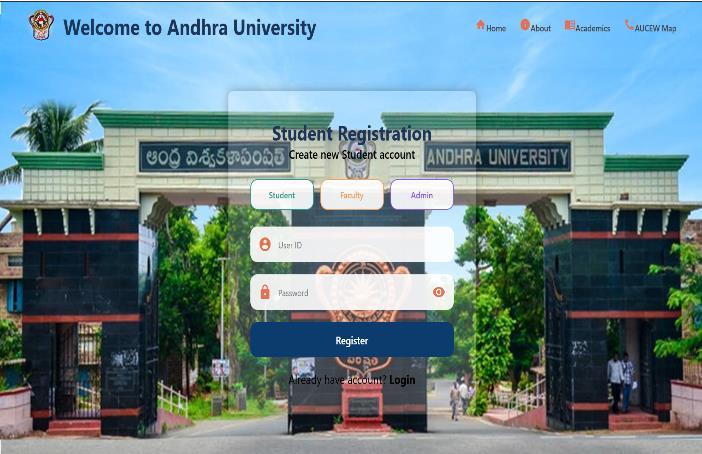
Fig4:LoginandRegistrationwebpage
International Research Journal of Engineering and Technology (IRJET) e-ISSN: 2395-0056
Volume: 13 Issue: 04 | Apr 2026 www.irjet.net p-ISSN: 2395-0072
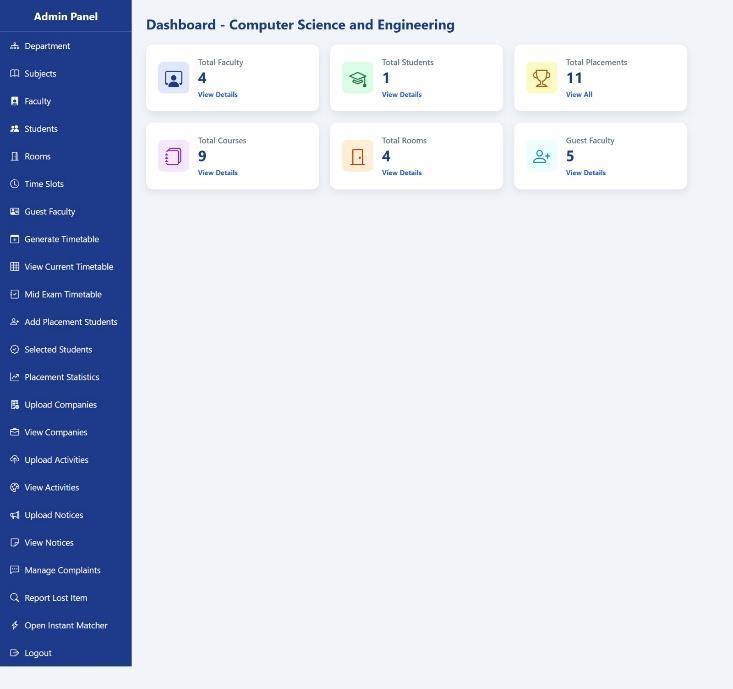
Fig5:AdminDashboard
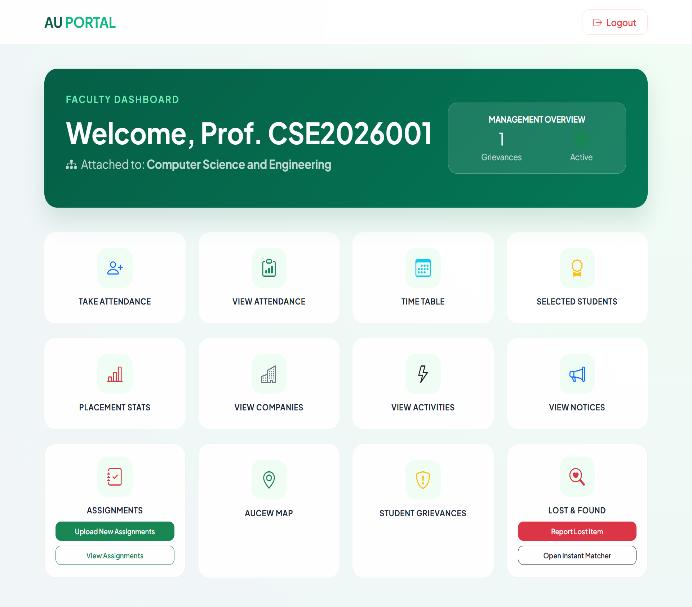
Fig6:FacultyDashboard
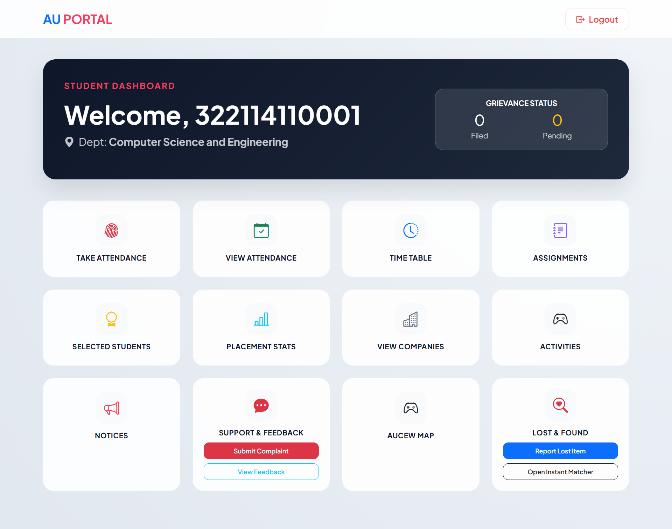
Fig7:StudentDashboard
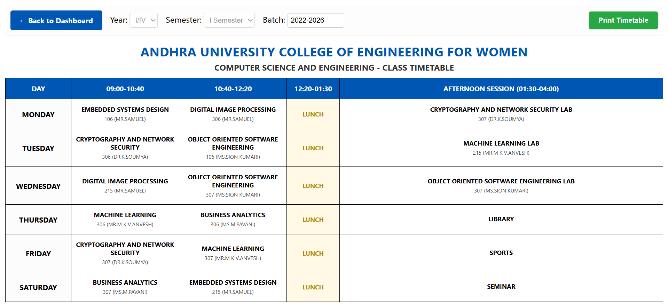
Fig8:ClassTimetable
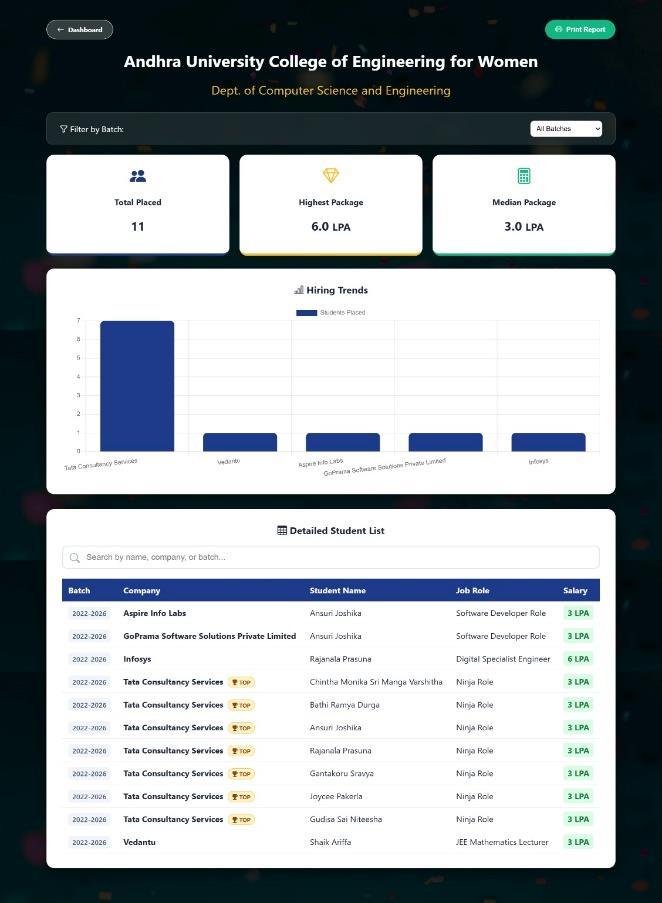
Fig9:PlacementStatistics
International Research Journal of Engineering and Technology (IRJET) e-ISSN: 2395-0056
Volume: 13 Issue: 04 | Apr 2026 www.irjet.net p-ISSN: 2395-0072

International Research Journal of Engineering and Technology (IRJET) e-ISSN: 2395-0056
Volume: 13 Issue: 04 | Apr 2026 www.irjet.net p-ISSN: 2395-0072
The College Timetable and Academic Management System successfully addresses the challenges associated with manual academic and administrative processes in educational institutions. The system provides a comprehensive, web-based solution that integrates multiple functionalities such as timetable generation, attendance management, student information handling, placement tracking, and communication modules into a singlecentralizedplatform.
The implementation of role-based access for Admin, Faculty, and Students ensures secure and organized system usage. The admin module effectively manages core institutional data including departments, subjects, faculty, students, rooms, and time slots, forming the foundation for automated operations. The automatic timetable generation feature proved to be efficient in creating conflict-free schedules, significantly reducing manual effort and human errors. Additionally, the MidExam Timetable Generator simplifies exam scheduling andenableseasyexportofschedulesinPDFformat.
The faculty module enhances teaching and administrative efficiency through features such as location-based attendance using QR code and OTP, assignment management, and student interaction via discussion chats. The integration of placement analytics and complaint resolution systems further supports faculty in monitoring student progress and addressing issueseffectively.
The student module offers a user-friendly interface that allows students to access academic resources, track attendance through a visual calendar, participate in placement activities, and communicate with faculty. The secure attendance mechanism ensures authenticity, while the assignment and discussion features promote betteracademicengagement.
Additional functionalities such as the complaint management system, activity and notice modules, and event galleries improve communication and transparency within the institution. The Lost and Found Item Management System, integrated with email notifications, adds practical valueby facilitating efficient recoveryoflostitems.
Overall, the system demonstrates high reliability, usability, and efficiency in managing diverse college operations. It reduces administrative workload, minimizes errors, improves data accessibility, and enhances communication among stakeholders. The integration of automation and real-time data processing makes the system a scalable and effective solution for moderneducationalinstitutions.
International Research Journal of Engineering and Technology (IRJET) e-ISSN: 2395-0056
Volume: 13 Issue: 04 | Apr 2026 www.irjet.net p-ISSN: 2395-0072
Inconclusion,thedevelopedsystemfullfillsitsobjective of digitizing and streamlining academic and administrative activities, thereby contributing to improved institutional productivity and a better user experienceforstudents,faculty,andadministrators.
[1] B. P. Dharask, P. Waghmare, C. Gijare, S. Mohane, S. Palode, and S. Dhunde, "E-Notice Board System," International Journal of Advanced Research in Science, Communication and Technology (IJARSCT), vol. 2, no. 1, pp.255–261,May2022,doi:10.48175/IJARSCT-3518.
[2]H.Shingade,V.Shedge,S.Bhise,andA.Salve,"College Management System," International Journal of Scientific Research in Computer Science, Engineering and Information Technology (IJSRCSEIT), vol. 8, no. 2, pp. 469–475,Mar.-Apr.2022,doi:10.32628/IJSRCSEIT.
[3] S. S. Shintre, S. B. Bagul, A. B. Kanawade, S. B. Tajanpure, and K. N. Shedge, "Department Activity Management System," Int. J. Creative Res. Thoughts (IJCRT),vol.8,no.3,pp.2531–2535,Mar.2020.
[4] T. Mahadik, S. Renapurkar, and S. Ganorkar, “Digital Lost and Found Item Portal,” International Research Journal of Engineering and Technology (IRJET), vol. 10, no.11,pp.549–553,Nov.2023.
[5] G. M. Patil, S. Koppad, S. Patil, S. Pasanavar, and P. Kenchakanavar, “A Survey on College Grievance Portal,” International Journal of Novel Research and Development(IJNRD),vol.10,no.5,pp.e681–e686,May 2025.
[6] A. Pawar, A. Chavan, A. Mulla, O. Musmade, and S. S. Naik, “Academia Timetable Management System: A Review,” International Journal of Creative Research Thoughts (IJCRT), vol. 10, no. 12, pp. e172–e177, Dec. 2022.
[7]D.Band,G.Agrawal,H.Deo,V.Dhengekar,R.Dadanje, and Y. Thakare, "Smart Attendance Management System (SAMS): Attendance Tracking Process in Educational Institution," International Research Journal of Engineering and Technology (IRJET), vol. 11, no. 04, pp. 1414–1420,Apr.2024.
[8] T. Kainath, A. Rayan, K. Juned, and Prof. M. Ansari, "Online Assignment System," International Research JournalofEngineeringandTechnology(IRJET),vol.7,no. 3,pp.890–893,Mar.2020.
[9] Bhagyashri Panari, S. V. Shetage, A. S. Kamble, A. S. Palkar,andS.P.Patil,“SmartPlacementModule,”Journal of Emerging Technologies and Innovative Research (JETIR),vol.11,no.5,May2024,ISSN:2349-5162.
2025, IRJET | Impact Factor value: 8.315 | ISO 9001:2008 Certified Journal | Page1228