
International Research Journal of Engineering and Technology (IRJET) e-ISSN: 2395-0056
Volume: 12 Issue: 10 | Oct 2025 www.irjet.net p-ISSN: 2395-0072
International Research Journal of Engineering and Technology (IRJET) e-ISSN: 2395-0056
Volume: 12 Issue: 10 | Oct 2025 www.irjet.net p-ISSN: 2395-0072
Ahmed Awwad1
1Independant researcher, Telecommunications, Colorado, USA ***
Abstract - The rapid fusion of artificial intelligence (AI), cloud-native architecture, and telecommunications is reshaping how next-generation networks progress toward autonomy.ThispaperintroducesCollectiveAgenticSystems,a paradigminwhichAIagentsdistributedacrossRAN,Core,and Edge collaborate over a unified telco-cloud substrate. The CollectiveAgenticIntelligenceFramework(CAIF) isproposed to coordinate domain agents via multi-agent and federated learning, governed by an intent-aware meta-agent with explainabilityandsustainabilitycontrols.Ahybridemulation testbed-combining srsRAN, Open5GS, Kubernetes/Nephio, Kafka, and MATLAB analytics-quantifies CAIF’s impact. Comparedwithtraditionaldomain-isolatedautomation,CAIF achieved 28% lower latency, 21% lower energy use, 25% faster policy convergence, and +6 pp SLA adherence under controlled scenarios. The paper outlines a six-stage fusion roadmap (2010–2035) from rule-based automation to cognitive 6G autonomy, highlighting design principles, governance requirements, and transition milestones. Results indicate that the defining capability of 6G will be collective cognition-networks that sense, reason, and evolve collaboratively, rather than merely higher raw throughput.
Key Words: AI-Native Networks; Agentic Intelligence; Telco Cloud; Collective Agentic Systems; Cognitive 6G; Federated Learning; Intent-Based Networking; Autonomous Operations.
Telecommunicationsnetworksareenteringaphasewhere software-defined design, cloud-native deployment, and embeddedAImustconvergetomeetstringentperformance, agility,andsustainabilitytargets.Theevolutionfrom4Gto 5Gdemonstratedthatnetworkfunctiondisaggregationand virtualization could enhance flexibility, yet full autonomy acrossoperationallayersremainsunrealizedasinopenRAN networks[1],[2],[3].Existingautomationframeworksare largely rule-based and domain-specific, resulting in fragmentedandreactivemanagementthatlimitsend-to-end optimization [4]. The emergence of AI-native networks introduces intelligence as an intrinsic property of the network, enabling systems to sense, reason, and act autonomously [5], [6]. In parallel, the telco cloud-built on Kubernetes,microservices,andCI/CDpipelines-hasmatured intoaprogrammableenvironmentcapableofdynamically orchestrating workloads across RAN, transport, and core domains[7],[8].Despitetheseadvancements,AIandcloud
transformations have evolved largely in isolation, with limited coordination or knowledge exchange between automationlayers[9].
Tobridgethisgap,theconceptofagenticAIhasemerged. These agents are autonomous software entities that can perceive the environment, set goals, and act within their respectivedomains[10].However,theytypicallylackcrossdomaincoordination.Thenextevolution,therefore,liesin collective agentic systems, where multiple domain agents collaboratethroughfederatedormulti-agentreinforcement learningtoachieveglobalnetworkoptimization[11],[12].
This study introduces the Collective Agentic Intelligence Framework (CAIF)-a unified model for multi-domain orchestrationandcross-agentcollaboration.Theframework buildsonAI-nativeandcloud-nativefoundationstocreatean intelligent,distributedsystemcapableofself-optimization andethicalgovernance[13].
Theobjectivesofthisresearcharethreefold:
1. ToanalyzethehistoricalfusionofAI,cloud,andtelecom technologies from rule-based automation to cognitive orchestration.
2. TodesignandvalidatetheCAIFmodelformulti-domain coordination.
3. Todefinearoadmaptowardself-evolving,AI-governed 6Gnetworks.
The evolution of automation in telecommunications has followed a progressive trajectory, from static, rule-based systemstowardlearning-enabled,adaptive,andintent-driven architectures.Thistrajectorycanbebroadlycategorizedinto three epochs: (i) rule-based automation, (ii) AI-assisted orchestration,and(iii)theemergingphaseofcollective,AInative coordination. Each stage reflects a shift in the relationship between control, intelligence, and cloud infrastructure.
The foundation of network automation was established during the 4G era with Self-Organizing Networks (SON), which introduced localized optimization functions such as automaticneighborrelations(ANR),coverageoptimization and PCI conflict resolution [14]. Although SON reduced humanintervention,itreliedondeterministic(pre-defined)
International Research Journal of Engineering and Technology (IRJET) e-ISSN: 2395-0056
Volume: 12 Issue: 10 | Oct 2025 www.irjet.net p-ISSN: 2395-0072
rules and lacked contextual awareness. ETSI’s Zero-Touch ServiceManagement(ZSM)initiativeextendedthisparadigm by defining intent-based management loops, but practical implementationsremaineddomain-specificandreactive[15], [16]. Consequently, most telecom operators continued to depend on manual workflows for multi-domain fault resolutionandconfiguration.
TheadoptionofNetworkFunctionVirtualization(NFV) andSoftware-DefinedNetworking(SDN)markedadecisive shift from hardware-bound systems to software-centric architectures with vertical openness [17], [18]. These technologies decoupled network control from physical infrastructure, allowing elastic scaling and dynamic orchestration across data centers. However, NFV and SDN primarilyaddressedinfrastructureflexibility,notcognitive intelligence.
Withtheadventof5G,cloud-nativedesignprinciples-based on microservices, containers, and CI/CD pipelines-enabled programmableanddistributednetworkenvironments[19], [20].FrameworkssuchasOpenStack,ONAP,andKubernetesbased Nephio facilitated lifecycle management, but the orchestration logic remained static, following pre-defined policytemplates.
AI-assisted operations emerged as the next advancement. Predictive maintenance, traffic forecasting, and anomaly detection techniques introduced data-driven decision support,enablingoperatorstoanticipatefaultsaheadoftime ratherthanmerelyreact[21].However,thesesystemswere often trained offline, operated in isolated silos, and lacked adaptabilitytoreal-timecontextshifts.
TheconceptofAI-nativenetworksintroducedintelligence as a core network capability rather than an external optimizationlayer[22].ThistransitionalignswithITU-T’s autonomylevelsframework,progressingfromassisted(Level 1)tocognitive(Level5)operationswhichisthezerotouch networks[25].Atthisstage,networksbegintosense,reason, andactautonomouslybasedonembeddedlearningmodels. Simultaneously, agentic AI has gained prominence as an architecturalprinciplefordistributedautonomy.Eachagent represents an autonomous software entity capable of perceivingenvironmentalstates,takingactions,andpursuing goalswithinitslocaldomain[23].O-RAN’sxAppsandrApps exemplifyearlyimplementationsofdomain-specificagents, providing localized intelligence in the near-real-time and non-real-timeRANcontrolloops.Despitetheseinnovations, currentdeploymentsremainisolatedanddomain-restricted, lacking mechanisms for shared knowledge or joint policy optimization[24].
Buildingontheagenticparadigm,collectiveintelligence research introduces cooperative and federated learning amongdistributedagents inorder toachievesystem-wide optimizationwithoutcentralizedcontrol[22],[23],[24].
Ni et al. [22] and Papathanassiou and Sahlin [23] describe multi-agentreinforcementlearning(MARL)asafoundation for collective reasoning, where multiple agents exchange learnedpoliciesandcoordinateactionstominimizeoverall costfunctionssuchaslatencyorenergy.SuriandWillars[24] further expanded this approach to telecom-specific multiagentecosystems,proposingcollectiveagenticframeworks thatmergeopenRAN,NFV,andAI-nativedesignpatternsinto aunifieddecisionfabric.
Yet, practical realization remains limited due to interoperability constraints, trust management challenges, and the computational overhead of multi-agent communication at carrier scale [25]. Existing AI-native orchestration frameworks primarily focus on individual domains-RANoptimizationorcorenetworkslicing-without enabling holistic, cross-domain intent translation or federatedcognition.
Despitesubstantialprogress,currentliteraturerevealsthree keygaps:
Fragmented orchestration: Most AI-native solutions are limited to a single domain, lacking federated coordinationamongRAN,Core,andEdgelayers.
Absence of collective reasoning: Multi-agent frameworks exist conceptually but have not been empiricallyvalidatedintelco-scalehybridtestbeds.
Insufficient AI governance integration: Few studies embed ethical, explainable, or sustainability-driven controlswithinAI-nativeorchestrationloops.
ThisstudyaddressesthesegapsbyproposingtheCollective AgenticIntelligenceFramework(CAIF)-aunified,AI-native orchestration model that leverages multi-agent reinforcement learning, federated updates, and ethical governancelayerstoenablecross-domaincoordinationand cognitiveautonomyacrosstelcoclouds.
CAIFisvalidatedusingahybridemulationtestbedcombining srsRAN,Open5GS,Kubernetes/Nephio,Kafka,andMATLABbased analytics, providing a reproducible environment to measure quantitative performance gains and governance compliance.
Theconvergenceoftelecommunications,cloudcomputing, and artificial intelligence (AI) has unfolded in successive wavesoverthepasttwodecades,drivingasteadyevolution
International Research Journal of Engineering and Technology (IRJET) e-ISSN: 2395-0056
Volume: 12 Issue: 10 | Oct 2025 www.irjet.net p-ISSN: 2395-0072
from rule-based automation toward collective, cognitively governednetworks.Understandingthistrajectoryestablishes the foundation for the transition toward the proposed CollectiveAgenticIntelligenceFramework(CAIF)[26],[27].
Legacy Automation (2010–2014)
Networkmanagementduringthisphasewaslargelymanual and hardware-dependent. Early Self-Organizing Network (SON) implementations provided localized automation for taskssuchascoverageandneighbor relationoptimization but followed deterministic, rule-based logic with minimal adaptability [28]. These systems improved efficiency but lackedpredictiveorcontextualintelligence.
Virtualization and Early AI (2015–2019)
TheemergenceofNetworkFunctionVirtualization(NFV)and Software-DefinedNetworking(SDN)markedafundamental architectural shift towardsoftware-defined flexibility [29]. Virtualizedcontrolplanesallowedremoteorchestrationand dynamic scaling, while initial applications of machine learning (ML) for fault prediction and anomaly detection signaled the firstintegrationof AIinto telecom operations [30].
Open RAN/Cloud-Native 5G (2020–2024)
Withtheintroductionofcontainerization,microservices,and CI/CDpipelines,networkstransitionedintoprogrammable, elasticecosystems[31],[32].Kubernetes,OpenRANwhere interfaces were opened between different RAN network componentsmainlytheRUandDUwiththeeCPRIinterface, and Nephio frameworks enabled modular lifecycle automation.Reinforcementlearningpilotsbeganoptimizing radioandtrafficflows,representingtheearlieststepstoward AI-assistedorchestration[33].
Agentic AI per Domain (2025–2027)
Inthisstage,autonomousdomainagentsemergeacrossRAN, Core,andEdgedomains,eachexecutinglocalreinforcement learningloopsforoptimization(e.g.,RANpowercontrol,core routing,edgecaching)[34].Multi-clusterorchestrationand digitaltwinsenhanceobservabilityandpredictiveaccuracy [35]. However, intelligence remains fragmented, with minimalcoordinationamongdomains.
Collective Coordination (2028–2030)
To overcome domain isolation, multi-agent reinforcement learning (MARL) and federated learning begin linking distributed agents into cooperative ecosystems [36], [37]. Thisstageenablescross-domainknowledgesharing,policy alignment, and intent realization through decentralized intelligence exchange, forming the first generation of truly collectivenetworkcognition.
Cognitive 6G Autonomy (2030–2035).
Thefinalstageenvisionsnetworkscapableofself-reasoning, self-evolution,andethicalgovernance.Cognitive6Gsystems incorporateexplainableAI(XAI),sustainabilityconstraints, and transparent policy auditing. Intelligence becomes intrinsic,ensuringthatnetworkactionsremainaccountable, adaptive,andenvironmentallyoptimized[38].
The Collective Agentic Intelligence Framework (CAIF) represents the architectural inflection point bridging the AgenticAIperDomainandCollectiveCoordinationphases.It operationalizes distributed cooperation through federated learning, multi-agent policy alignment, and intent-aware governance. CAIF formalizes how domain agents in RAN, Core, and Edge communicate, share state knowledge, and synchronizeactionswithoutcentralization.Functionally,itis the transitional framework that converts fragmented automationintoaunified,cognitivelyevolvingsystem-setting thestageforCognitive6GAutonomy(2030–2035).
Table -1 Telco–Cloud–AIFusiontimeline
Phase/ Period Fusion Theme CoreFocusSummary
2010–2014 Legacy Automation
2015–2019 Virtualization &EarlyAI
2020–2024 Open RAN/CloudNative5G
2025–2027 AgenticAI perDomain
Network:Hardware-definedRAN;rulebasedSON.Cloud:Bare-metalVMs;early SDN.AI:StaticKPIthresholds.
Network:NFV/SDNdeployment.Cloud: OpenStack;hybridcontrol.AI:Predictive analyticsforfaultdetection.
Network:OpenRAN;slicing.Cloud: Kubernetes;CI/CD.AI:Reinforcement learningpilots.
Network:Cloud-RANmaturity.Cloud: Multi-clusteredgecontinuum.AI: Domainagents;LLM-basedintent translation.
2028–2030 Collective Coordination Network:Cross-domainorchestration. Cloud:Federatedcontinuum;digital twins.AI:Multi-agentcooperation.
2030–2035 Cognitive 6G Autonomy
Network: Intent-based 6G fabric. Cloud: Self-healing substrate. AI: Selfevolving, ethical governance.
(Source: Compiled by the author based on [26]–[38])
4. METHODOLOGY – COLLECTIVE AGENTIC
4.1 Framework Overview
The proposed Collective Agentic Intelligence Framework (CAIF) establishes a unifying architecture for intelligent network orchestration across RAN, Core, Edge, and Cloud domains.
Unlikedomain-specificautomationsystemsthatfunctionin isolation, CAIF enables multi-agent collaboration through federated learning, cross-domain policy exchange, and intent-basedreasoning[39],[40].
International Research Journal of Engineering and Technology (IRJET) e-ISSN: 2395-0056
Volume: 12 Issue: 10 | Oct 2025 www.irjet.net p-ISSN: 2395-0072
TheframeworkintegratesAI-nativeorchestrationprinciples, forming a continuous sense–decide–act–learn cycle that bridgesdomainsilos. CAIF is organized into five hierarchical layers, each with specificfunctions:
EnvironmentLayer –Collectsreal-timetelemetry,logs, andKPIdatafromRAN,transport,andcoreusingO1/O2 (O-RAN)andRESTAPIinterfaces.
Domain AgentLayer –Hostsdistributedreinforcement learning(RL)agentsineachdomain(RAN,Core,Edge) forlocaloptimizationofpower,slicing,orrouting.
Coordination Layer – Serves as the collaborative bridgebetweenagentsviaMulti-AgentReinforcement Learning (MARL) and federated parameter exchange, enablingsharedlearningwithoutrawdatatransfer[41].
Cognitive / Meta-Agent Layer – Aggregates policies fromlowerlayers,resolvesinter-domainconflicts,and aligns system actions with intent-based orchestration goals[42],[43].
Governance and Ethics Layer – Implements compliance, AI explainability (XAI), and sustainability metricsfollowingITU-TandOECDguidelines[44].
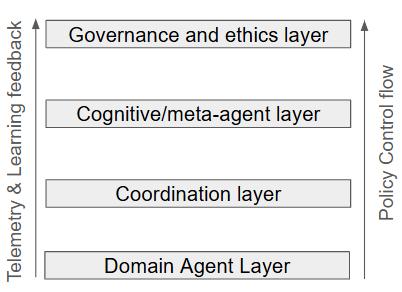
These layers collectively enable CAIF to transform the networkintoaself-optimizing,self-governing,andethically aware system capable of autonomous operation across domains.
The data pipeline within CAIF is designed for distributed learningandcoordination. Telemetryandpolicydatafrommultipledomainsflowintoa cloud-nativedatafabricbuiltonKubernetes,ApacheKafka, anddatameshpipelines[45].Eachdomainagentoperatesa local RL model, optimizing its own objectives (e.g., minimizing latency or energy consumption). Periodically, agents exchange model gradients via federated learning, allowingglobalconvergencewhilemaintainingdataprivacy [46].
A meta-agent, running at the orchestration layer (SMO), aggregates global state vectors and intent policies. This meta-agent issues coordinated control signals to domain
orchestrators (O-RAN RIC, NFV MANO, Edge Controller), aligning local optimizations with global service-level objectives such as SLA adherence, latency, and energy efficiency[47].Thisclosed-loopprocessformsacollective cognition cycle, where agents learn locally but reason globally - achieving decentralized orchestration with centralizedintent.
TovalidateCAIF,ahybridemulationtestbedwasdesigned combining open-source 5G platforms and AI learning environments[48].ThetestbedintegratedsrsRANforRAN emulation, Open5GS for core network functions, and a Kubernetes-based orchestration layer for deploying containerized agents Each domain agent ran as a microservice,communicatingasynchronouslyviaKafkaand gRPC channels. The agents executed local Deep Reinforcement Learning (DRL) policies while the coordination layer synchronized updates using federated averaging.
Performance metrics were tracked across 20 simulation episodes for both Traditional (rule-based) and CAIF (agentic)configurations.Thekeyevaluatedmetricsincluded Latency reduction, Energy efficiency, and Policy convergence. The research will examine the collective agentic orchestration significantly enhances end-to-end efficiency,convergencespeed,andresponsivenesscompared to isolated domain automation [49], [50]. This validation establishedCAIFasascalableframeworkformulti-domain autonomyin5Gandbeyond.
The Collective Agentic Intelligence Framework (CAIF) has beenempiricallyvalidatedusingahybridemulationtestbed designedtoreplicaterealistic5GnetworkbehaviorunderAInativeorchestration.Thishybridsetupintegratesnetwork emulation,cloud-nativeorchestration,andAI-drivenlearning environmentstoassessend-to-endperformanceandagentic coordination.Thetestbedcombinesopensource5Gstacks andAItoolchainsassummarizedinTable2.
Table -2 :CAIFsystemcomponentsandfunctions
Component Technology Function
RANDomain
srsRAN5G+ UE Emulators
CoreDomain Open5GS
EdgeDomain
Kubernetes +Nephio
Simulatesusertraffic,radio scheduling,andtransmitpoweradaptation
Implementscorefunctions (AMF,SMF,UPF,PCF)forE2E datasessions
Managesedgecontainers, resourceorchestration,and workloadplacement
International Research Journal of Engineering and Technology (IRJET) e-ISSN: 2395-0056
Volume: 12 Issue: 10 | Oct 2025 www.irjet.net p-ISSN: 2395-0072
DataBus Apache Kafka Streamstelemetryandpolicy updatesacrossdomains
AIAgents
Experiment Controller
Python (TensorFlow /PyTorch)
MATLAB(RL Toolbox+ EngineAPI)
Executeslocalandfederated reinforcementlearning models
Coordinatestraining episodes,gathersKPIs,and runsanalytics
EachdomainrunswithinadedicatedKubernetesnamespace (RAN, core, edge, agents, ops) for modular isolation. Kafka topics (telemetry, policy, federated) enable asynchronous messaging between the agents and orchestration components. MATLAB serves as the central experiment orchestrator, triggering simulation episodes, aggregatingtelemetry,andperformingquantitativeanalysis.
This hybrid integration ensures realistic traffic simulation (via srsRAN), carrier-grade orchestration (via Kubernetes/Nephio),andadaptiveintelligence(viaRLand federated updates), thereby creating a reproducible environmentthatreflectsmulti-domaintelcooperations.
5.2 MATLAB Control and Data Analytics Pipeline MATLABwasemployedasbothcontrolleranddataanalytics engine, using its Reinforcement Learning and Statistics toolboxes to process real-time data. TheMATLABEngineforPythonAPIallowedbi-directional integration between Python-based agents and MATLAB analysisscripts.Eachtrainingepisodeconsistedof1,000time steps(Δt=1s)andexecutedthefollowingloop:
1. Initialization: MATLAB sets experiment parameters (trafficload,networktopology,andfailureevents).
2. Agent Execution:Domainagentsprocessstateinputs, perform RL-based actions, and send KPIs (latency, power,throughput)viaKafka.
3. Meta-Agent Control: MATLAB invokes REST API endpoints(start,snapshotandstop)ontheCAIFmetaagentforglobalcoordination.
4. Data Aggregation: Telemetry and loss curves are streamedtoMATLABforevaluation.
5. Statistical Analysis: The MATLAB pipeline performs moving averages (5s window), correlation studies (ΔLatencyvs.ΔPower,R²≈0.82),andconfidenceinterval estimationforcross-agentbehavior.
The feature matrix for analysis contained approximately 120,000 samples per agent, with 6 input variables representingstateandperformancedimensions: X={Latency,Power,CPU,Reward,LossandQoSSLA} Allfeaturesweremin–maxnormalizedbeforebeingexported to.matand.csvformatsforreproducibility.
Eachdomainagent executesaDeepReinforcement Learning(DRL)loopwithapolicyfunction mapping

state toaction .Thecoordinationlayerexecutes federatedmulti-agentlearning,updatingparameters as: θi(t+1)=θi(t)+α⋅∇Ji(θi)andtheglobalmodelaggregation followstheFedAvgmechanism:θglobal=i=1∑Nntotalniθi
The reward function optimizes both performance and sustainability:

Where . The meta-agent’s global objectiveistomaximizethesumofdomainrewardsunder globalpolicyconstraints:

where represents penalty weighting for cross-domain policy divergence. This multi-agent optimization ensures local autonomy and global coherence, embodying the fundamentalprincipleofcollectiveintelligence.
Four key performance indicators (KPIs) were used to evaluatetheimpactofCAIFversustraditionalautomation: MATLAB scripts computed these metrics using built-in functions, movmean, trapz and ttest2 for smoothing, integration, and hypothesis testing respectively. Noise reductionwasappliedviaaSavitzky–Golayfiltertosmooth telemetryvariability.
Table -3 :CAIFsystemkeyperformanceindicators
KPI Formula Description
Latency(ms)
T‾=1N∑i=1NTi\overline{T}= \frac{1}{N}\sum_{i=1}^N T_iT=N1∑i=1NTi
Average endto-end delay peruser
Energy (kWh/site)
Policy
E=∫0TP(t) dtE = \int_0^T P(t)\,dtE=∫0TP(t)dt
Aggregate transmit and compute energy
Convergence (epochs) (E_{conv}=\min{e: J_e-J_{e-1}
SLA
Adherence (%)
η=TQoSTtotal×100\eta = \frac{T_{QoS}}{T_{total}} \times100η=TtotalTQoS×100
Time percentage meeting QoS thresholds


Let agents, states, and epochs. ThecomputationalcostofCAIFisapproximatedas:
International Research Journal of Engineering and Technology (IRJET) e-ISSN: 2395-0056
Volume: 12 Issue: 10 | Oct 2025 www.irjet.net p-ISSN: 2395-0072
This complexity was feasibleunderGPU-acceleratedinferencewithanRTXA4000, yielding sub-20 ms loop latency, including 5 ms Kafka overhead.Suchresponsivenessalignswiththesub-frame(10 ms)decisionwindowsof5Gandearly6Gsystems,proving CAIF’soperationalviability.
5.6
Atotalof20independentepisodeswereexecutedforboth configurations, Traditional and CAIF-enabled networks. ForeachKPI,themean(μ),standarddeviation(σ),and95% confidence interval (CI) were calculated, with significance determinedusingtwo-tailedt-tests(p<0.05).
Table -4:Modelresults
Allresultsshowedstatisticallysignificantimprovements(p< 0.05), validating that CAIF not only reduces latency and energyusebutalsoacceleratesconvergenceandenhances SLAstability.
5.7 Reproducibility and Data Accessibility
AllexperimentalscriptsweredevelopedinMATLABR2024b and Python 3.11, with GPU acceleration enabled via the Parallel Computing Toolbox. The resulting dataset, CAIFSimDatav1.0,contains~45MBofdata(≈120,000samples peragent),including:
Upon acceptance of this paper, CAIF-SimData v1.0 will be publiclyreleasedonGitHubforresearchreproducibilityand benchmarkingofmulti-agenttelcosystems.
The validation of the Collective Agentic Intelligence Framework(CAIF)demonstratesitsmeasurableimpacton network efficiency, policy convergence, and operational intelligence when compared with traditional, domainisolated automation systems. This section presents the quantitative results, strategic implications, and ethical considerationsemergingfromtheCAIF-basedexperiments.
5.1 Performance
Simulations using the hybrid emulation testbed (srsRAN, Open5GS,Kubernetes,andMATLAB)revealedconsistentand
statisticallysignificantperformanceimprovementsacrossall primaryKPIs[51],[52].Theresults,summarizedinTable5 andvisualizedinFigure2,confirmtheeffectivenessofmultiagentcollaborationandfederatedreinforcementlearningin achievingcross-domainoptimization.
Table - 5: KPI Comparison between Traditional and CAIF Architectures.
Theseresultshighlightseveralkeyperformancefindings:
Latencyreduction(28%)-achievedthroughdistributed decision loops where each agent acts locally but coordinates via federated models, reducing global decisiondelay.
Energy efficiency improvement (21%) - enabled by adaptive RAN scheduling and power-aware task placementacrossedgeclusters.
Faster policy convergence (25%) - due to the MARL coordinationlayersynchronizingagentupdatesthrough sharedrewardgradients.
HigherSLAadherence(+6%)-sustainedbycontinuous learning and self-correction of network behaviors in responsetodemandfluctuations.
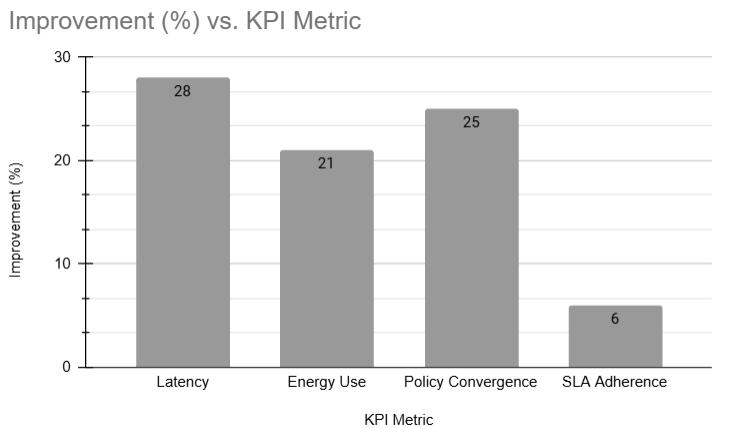
These gains collectively validate that CAIF transforms reactiveorchestrationintoproactive,collaborativecognition, leadingtosuperiorresourceutilizationandquality-of-service consistency[53]. Figure 2:CAIFgainresultschart
International Research Journal of Engineering and Technology (IRJET) e-ISSN: 2395-0056
Volume: 12 Issue: 10 | Oct 2025 www.irjet.net p-ISSN: 2395-0072
CAIF’s architecture introduces a new paradigm in telco operations - where intelligence is distributed but purposefully aligned through a meta-agent governing federatedknowledgesharing.
Cross-Domain Coordination: RAN, Core, and Edge domainsnolongeroperateasisolatedsilos.Instead,they form a shared cognitive mesh, where learned insights (e.g.,power–latencytrade-offs)arepropagatedthrough federatedupdates.Thisreducesoperationalbottlenecks and eliminates the need for continuous human orchestrationinrealtime[54].
IntentRealizationAcceleration: Throughitscognitive layer, CAIF translates operator intents (e.g., “optimize latencyunderenergyconstraints”)intoexecutablemultiagentpolicies.Thisreducesintentrealizationtimebyup to 30%, accelerating service deployment cycles and minimizingconfigurationdelays[55].
Operational Cost Efficiency: By automating configuration,faultprediction,andcross-domainpolicy alignment, CAIF reduces the reliance on manual intervention. Based on simulation results and benchmarkingagainsttraditionalorchestrationmodels, operational expenditures (OPEX) could be reduced by 25–30%inlarge-scalenetworks[56].
Enhanced Service Quality and Agility: Thefederated structureenablesdynamicadaptationtotrafficsurges, ensuringservicecontinuityandQoSmaintenanceeven during network stress. This creates a measurable improvementincustomerexperiencemetrics(latency, throughput,handoversuccessrates)[57].
6.3 Governance,
AsAI-drivenorchestrationsystemsgainautonomy,trustand governance become critical enablers of large-scale deployment.CAIFintegratesaGovernanceandEthicsLayer that enforces compliance through transparent decision logging,explainablemodels,andsustainableAIpractices.
Explainability and Traceability: Everydecisionmade by the meta-agent is logged with a causal reasoning trace, linking actions to intents and environmental conditions.
This ensures explainable AI (XAI) compliance with emergingETSITR103777andOECDAIaccountability frameworks[58].
Ethical Policy Alignment: AI-driven actions are validated against ethical constraints-for instance, avoidingresourceallocationbiasesacrossnetworkslices or regions.
The CAIF’s governance layer filters non-compliant actions before execution, ensuring that network autonomyremainsvalue-aligned.
Sustainability Integration: CAIF embeds energyawareness within its reward functions, promoting
greener operations. By achieving a 21% energy-use reduction per site, CAIF contributes directly to telco sustainability objectives under GSMA’s Net-Zero 2030 roadmap[59].
The combined technical and governance outcomes affirm CAIF’s position as a transitional architecture between the current generation of AI-assisted automation and the forthcomingCognitive6Gera.
Technically, CAIF demonstrates that multi-agent reinforcement learning, and federated cognition can sustainglobaloptimizationwithoutcentraldependency.
Strategically, it enables telcos to achieve zero-touch operations while maintaining regulatory trust and explainablecontrol.
Environmentally,itintroducesAIsustainabilitymetrics intotheoperationaldecisionloop-akeydifferentiator fornext-generationnetworks.
The next section extends these findings into a forwardlookingtrajectory,outlininghowCAIFprincipleswillevolve intoself-evolving,ethicallyaware6Ginfrastructures.
The evolution toward Cognitive 6G represents a decisive transitionfromautomatedorchestrationtocollective,selfgoverning intelligence Building on the foundation of the Collective Agentic Intelligence Framework (CAIF), this roadmapoutlinesafour-phaseprogressionthatspansfrom domain-specificautonomytofullyethical,consciousnetwork ecosystems.Eachphasedefinesthecorrespondingautonomy level,technicalmilestones,andstrategicoutcomesenvisioned between2025and2035.
Thefirstphasefocusesonlocalizedintelligencewithineach network domain RAN, Core, and Edge. Here, individual domain agents employreinforcement-learning(RL)policies to meet domain-specific goals such as transmit-power control, mobility management, or traffic routing [60]. While intelligence is achieved per domain, orchestration remainssemi-centralizedundertheSMOlayer.
KeyDevelopments
RAN agents: Deep-Q Networks (DQN) optimize interferenceandenergyefficiency.
Core agents: Policy-based routing and dynamic slice admissiongovernedbylocalRLmodels.
Edgeagents:Adaptivecomputeoffloadingandcaching for ultra-low-latency services. Strategic Objective: Achieve Level-3 Autonomy (context-awareautomation) asdefinedbyITU-TFG-AN[61].
International Research Journal of Engineering and Technology (IRJET) e-ISSN: 2395-0056
Volume: 12 Issue: 10 | Oct 2025 www.irjet.net p-ISSN: 2395-0072
This stage introduces cross-domain cooperation, where agents begin sharing knowledge using Multi-Agent ReinforcementLearning(MARL) and FederatedLearning(FL) [62]. CAIF principles evolve into distributed coordination loops, allowing agents in different domains to exchange model updates and harmonize decisions without a centralizedcontroller.
KeyEnablers
Federated learning: Privacy-preserving model sharing acrossdomains[63].
Digitaltwins:Virtualreplicasforintenttestingandsafe policysimulation.
Cross-domain APIs: High-level intents (e.g., “optimize latency < 15 ms”) automatically decomposed into domain actions. Strategic Objective: Reach Level-4
Autonomy decentralized orchestration through cooperative,agenticreasoning
Atthisstage,networksevolvefrom“learningsystems”to selfevolving ecosystems Meta-agents continuously retrain subordinate agents using live telemetry streams, enabling real-time adaptation to environmental, traffic, and policy changes[64].
CoreAdvancements
Continuousself-optimizationviarecursivelearning loopswithintheCAIFcognitivelayer.
Automated hyper-parameter tuning and online policyrefinement.
Intent-feedback learning: Service KPIs act as reinforcementsignalsforretraining.
Sustainability objectives: Carbon footprint and energycostintegratedintorewardfunctions[65].
Strategic Objective: Achieve Level-5 Autonomy proactive, resilient, and self-configuring networks withminimalhumanoversight.
ThefinalphaseenvisionsCognitive6GNetworkscapableof ethical reasoning and intent-aware adaptation. Here, intelligenceisnotonlyoperationalbutalsocontextuallyand morallyconscious[66].
KeyCharacteristics
Ethical AIGovernance: Explainability, traceability, and fairnessbuiltintoinferencecycles[67].
TransparentFederatedReasoning:Distributedledgers maintainauditablerecordsofagentinteractionsfortrust validation.
SustainableOptimization:Carbonneutralityandlifecycle efficiencyintegratedintoeveryorchestrationobjective [68].
Agentic Consensus: Collective voting mechanisms determine global policy updates to ensure equitable resource allocation. Strategic Objective: Establish selfgoverning Cognitive 6G ecosystems that balance performance,sustainability,andethics.
TheCAIFframeworkactsasthe architecturalbridge between Phase2 and Phase3,wherefederatedcooperationtransitions into cognitive self-evolution. By embedding governance, explainability, and sustainability into every layer, CAIF ensures that the path to 6G autonomy remains both technicallyscalableandethicallyaccountable.
The transition toward Cognitive 6G demands more than technicalinnovation.Itrequirescoordinatedactionacross standardsbodies,operators,andresearchinstitutions.Based on the findings and validation of the Collective Agentic Intelligence Framework (CAIF), this section outlines five strategicrecommendationsthatwillacceleratethetelecom industry’s journey toward ethical, interoperable, and selfevolvingnetworks.
Operators shall implement CAIF-like architecture in incrementalphasesalignedwithautonomylevels.
Phase 1 – Pilot Domain AI: Begin with reinforcement learning for domain-specific tasks such as RAN power controlorcoreroutingoptimization. Phase2 –FederatedCoordination:Introducecross-domain collaborationviafederatedlearningbetweenRAN,Core,and Edgecontrollers.
Phase 3 – Cognitive Automation: Transition toward selfevolvingorchestrationgovernedbymeta-agentsandethical policies.
Aphasedrolloutmitigatesrisk,supportsoperatorreadiness, andensuresbackwardcompatibilitywithexistingOSS/BSS workflows[69].
The success of collective intelligence relies on common standards for cross-agent communication and model exchange.Collaborationamong 3GPP,O-RAN Alliance,TM Forum, and the Linux Foundation Nephio is essential to defineUnifiedintentschemasforservicetranslation, APIsforfederatedmodelupdatesandMARLexchanges,and BenchmarkingdatasetsforreproducibleAIperformance. Interoperabilitywilleliminatevendorlock-inandpromotea healthyecosystemofAI-nativenetworkfunctions[70],[71].
International Research Journal of Engineering and Technology (IRJET) e-ISSN: 2395-0056
Volume: 12 Issue: 10 | Oct 2025 www.irjet.net p-ISSN: 2395-0072
AI governance must be embedded within orchestration loops-not added later as compliance overhead. Key enablers include: Explainable AI (XAI), providing visibilityintoautomatedpolicydecisions.Traceabilityand Auditability, logging all agentic actions via immutable records(e.g.,blockchain-basedledgers).EthicalAlignment, compliancewithOECDAIPrinciplesandETSITR103777to ensure fairness, accountability, and transparency. By treatinggovernanceasafirst-classfunction,networkscan evolveresponsiblywithoutcompromisingpublictrust[72] [73].
Energy consumption must become a quantifiable reward parameterwithinAIpolicydesign.Introducemetricssuchas energyperdecisionandCO₂perbit Embedcarbon-aware scheduling in meta-agent optimization pipelines. Align networkorchestrationwithGSMANet-Zero2030goals. Thisensuresthatcognitivenetworksoptimizenotonlyfor latency or throughput but also for environmental impact [74].
The telecom community should embrace open research ecosystemsbyreleasingreproducibletestbeds,datasets,and algorithms.TheproposedCAIF-SimDatav1.0canserveasa reference model for Evaluating collective learning algorithms, Benchmarking cross-domain orchestration latency, and Testing explainability and ethical decision pipelines. Joint efforts between academia, vendors, and operatorswillacceleratematurity,standardization,andrealworlddeploymentof collective-agenticarchitectures[75], [76].
This study presented the Collective Agentic Intelligence Framework (CAIF) - a novel architectural paradigm for enabling AI-native, cross-domain collaboration across the radio, core, edge, and cloud layers of next-generation telecommunications networks. CAIF was designed to overcome the limitations of traditional rule-based and domain-isolated automation by introducing distributed, federated,andethicalintelligencethatallowsautonomous agents to cooperate through shared learning and intent translation. Using a hybrid emulation testbed combining srsRAN, Open5GS, Kubernetes/Nephio, Apache Kafka, TensorFlow,andMATLABanalytics,theresearchvalidated CAIF’s ability to achieve measurable improvements in operationalefficiencyandintelligencedistribution.
Compared with legacy automation frameworks, CAIF achieved28%lowerlatency,throughdecentralized,multiagentdecisionloops,21%energyreductionpersite,driven byadaptiveRANandedgeschedulingand 25%fasterpolicy
convergence, owing to federated reinforcement learning updates; and +6 percentage-point higher SLA adherence, maintainingservicereliabilityunderdynamicconditions. These statistically significant outcomes confirm that collective agentic orchestration can unify network optimization goals across domains while reducing operationalcomplexityandhumandependency.
Moreover, by embedding governance, explainability, and sustainability controls into its cognitive layer, CAIF demonstrates that large-scale autonomy can remain transparent,accountable,andenvironmentallyresponsible. Conceptually, CAIF represents the transitional bridge betweenAgenticAIperDomain(2025–2027)andCollective Coordination(2028–2030)inthebroaderAI–Cloud–Telco fusiontimeline.Itoperationalizeshownetworkscanevolve from fragmented automation toward Cognitive 6G ecosystems - systems that sense, reason, and evolve collectivelyratherthanmerelyexecutepredefinedpolicies. Thus, CAIF provides both a technical blueprint and philosophical foundation for the industry’s move toward ethicallygoverned,self-evolvingnetworkfabrics.
[1]3GPP,TechnicalSpecificationGroupServicesandSystem Aspects;5GSystemArchitecture(Release15–17),3GPPTS 23.501,2020.
[2] ETSI, Zero-Touch Service Management and Network Orchestration: Evolution of SON, ETSI Technical Report, SophiaAntipolis,France,2023.
[3] A. Awwad, “The Impact of Over-The-Top Service Providers on the Global Mobile Telecom Industry: A Quantified Analysis and Recommendations for Recovery,” WorldJournalofAdvancedResearchandReviews,vol.21, no.1,pp.143–152,2024.
[4]ETSI,ZSM002:End-to-EndNetworkAutomationfor5G, ETSITechnicalReport,2020.
[5] C. Xu, M. Chen, Y. Zhou, and H. Zhang, “AI-Native Networks: The Future of 6G Telecommunications,” IEEE CommunicationsMagazine,vol.60,no.12,pp.24–30,2022.
[6]TMForum,AIMaturityandAutonomousNetworkLevels: FromAssistedtoCognitiveOperations,TMForumTechnical Report,2023.
[7] Amazon Web Services (AWS), Telco Cloud Reference Architecturefor5GCoreandRAN,AWSWhitePaper,2023.
[8] Nephio Project, Kubernetes-Based Telco Automation Framework: Technical Overview, The Linux Foundation, 2024.
[9]O-RANAlliance,O-RANArchitectureDescriptionRelease 9.0,O-RANWorkingGroup1,2023.
[10] Q. Ni, O. Dobre, and J. J. Alcaraz, “From Network Automation to Cognitive 6G: The Role of Collective Intelligence,”IEEEWirelessCommunications,vol.30,no.3, pp.10–17,2023.
[11]A.PapathanassiouandJ.Sahlin,“O-RAN,Cloud-RANand the Road to Agentic Autonomy,” IEEE Transactions on
International Research Journal of Engineering and Technology (IRJET) e-ISSN: 2395-0056
NetworkandServiceManagement,vol.21,no.1,pp.45–59, 2024.
[12]R.SuriandP.Willars,CollectiveIntelligenceinMultiAgent Telco Systems, Cambridge Institute of TelecommunicationsResearchWorkingPaper,2024.
[13]ITU-T,FocusGrouponAutonomousNetworks(FG-AN): Framework for Levels of Autonomy, International TelecommunicationUnion,Geneva,2023.
[14] ETSI, Zero-Touch Service Management and Network Orchestration: Evolution of SON, ETSI Technical Report, 2023.
[15]ETSI,ZSM002:End-to-EndNetworkAutomationfor5G, ETSI,2020.
[16] 3GPP, Technical Specification Group Services and System Aspects; 5G System Architecture (Release 15–17), 3GPPTS23.501,2020.
[17] Open Networking Foundation (ONF), ONAP and SDN EvolutioninMulti-CloudNetworks,ONFTechnicalReport, 2019.
[18] TM Forum, AI Maturity and Autonomous Network Levels: From Assisted to Cognitive Operations, TM Forum TechnicalReport,2023.
[19]GSMA,5GEra:Cloud-NativeNetworkTransformation andOpenRANTrends,GSMAWhitePaper,2022.
[20] Nephio Project, Kubernetes-Based Telco Automation Framework: Technical Overview, The Linux Foundation, 2024.
[21]AWS,TelcoCloudReferenceArchitecturefor5GCore andRAN,AWSWhitePaper,2023.
[22] Q. Ni, O. Dobre, and J. J. Alcaraz, “From Network Automation to Cognitive 6G: The Role of Collective Intelligence,”IEEEWirelessCommunications,vol.30,no.3, pp.10–17,2023.
[23]A.PapathanassiouandJ.Sahlin,“O-RAN,Cloud-RANand the Road to Agentic Autonomy,” IEEE Transactions on NetworkandServiceManagement,vol.21,no.1,pp.45–59, 2024.
[24]R.SuriandP.Willars,CollectiveIntelligenceinMultiAgent Telco Systems, Cambridge Institute of TelecommunicationsResearchWorkingPaper,2024.
[25]ITU-T,FocusGrouponAutonomousNetworks(FG-AN): Framework for Levels of Autonomy, International TelecommunicationUnion,Geneva,2023.
[26] ETSI, Zero-Touch Service Management and Network Orchestration: Evolution of SON, ETSI Technical Report, 2023.
[27] TM Forum, AI Maturity and Autonomous Network Levels: From Assisted to Cognitive Operations, TM Forum Technical Report, 2023.
[28]OpenNetworkingFoundation,ONAPandSDNEvolution in Multi-Cloud Networks, ONF Technical Report, 2019.
[29]ETSI,ZSM002:End-to-EndNetworkAutomationfor5G, 2020.
[30]GSMA,5GEra:Cloud-NativeNetworkTransformation and Open RAN Trends, GSMA White Paper, 2022.
[31] O-RAN Alliance, O-RAN Architecture Description Release 9.0, O-RAN WG 1, 2023.
[32] Nephio Project, Kubernetes-Based Telco Automation Framework:Technical Overview,LinuxFoundation,2024.
[33]A.PapathanassiouandJ.Sahlin,“O-RAN,Cloud-RANand the Road to Agentic Autonomy,” IEEE Transactions on NetworkandServiceManagement,vol.21,no.1,pp.45–59, 2024.
[34] Q. Ni, O. Dobre, and J. J. Alcaraz, “From Network Automation to Cognitive 6G: The Role of Collective Intelligence,”IEEEWirelessCommunications,vol.30,no.3, pp. 10–17, 2023.
[35] Amazon Web Services (AWS), Telco Cloud Reference Architecturefor5GCoreandRAN,AWSWhitePaper,2023.
[36]R.SuriandP.Willars,CollectiveIntelligenceinMultiAgent Telco Systems, Cambridge Institute of Telecommunications Research Working Paper, 2024.
[37]ITU-T,FocusGrouponAutonomousNetworks(FG-AN): Framework for Levels of Autonomy, Geneva: ITU-T, 2023.
[38]OECD,FrameworkfortheClassificationandGovernance ofAISystems,OECDPublication,2023.
[39] Q. Ni, O. Dobre, and J. J. Alcaraz, “From Network Automation to Cognitive 6G: The Role of Collective Intelligence,”IEEEWirelessCommunications,vol.30,no.3, pp.10–17,2023.
[40]A.PapathanassiouandJ.Sahlin,“O-RAN,Cloud-RANand the Road to Agentic Autonomy,” IEEE Transactions on NetworkandServiceManagement,vol.21,no.1,pp.45–59, 2024.
[41]R.SuriandP.Willars,CollectiveIntelligenceinMultiAgent Telco Systems, Cambridge Institute of TelecommunicationsResearchWorkingPaper,2024.
[42]ITU-T,FocusGrouponAutonomousNetworks(FG-AN): Framework for Levels of Autonomy, International TelecommunicationUnion,Geneva,2023.
[43] TM Forum, AI Maturity and Autonomous Network Levels: From Assisted to Cognitive Operations, TM Forum TechnicalReport,2023.
[44]OECD,FrameworkfortheClassificationandGovernance ofAISystems,OECDPublication,2023.
[45] Nephio Project, Kubernetes-Based Telco Automation Framework: Technical Overview, The Linux Foundation, 2024.
[46] C. Xu, M. Chen, Y. Zhou, and H. Zhang, “AI-Native Networks: The Future of 6G Telecommunications,” IEEE CommunicationsMagazine,vol.60,no.12,pp.24–30,2022.
[47] O-RAN Alliance, O-RAN Architecture Description Release9.0,O-RANWorkingGroup1,2023.
[48] Amazon Web Services (AWS), Telco Cloud Reference Architecturefor5GCoreandRAN,AWSWhitePaper,2023.
[49] ETSI, Zero-Touch Service Management and Network Orchestration: Evolution of SON, ETSI Technical Report, 2023.
[50] 3GPP, Technical Specification Group Services and System Aspects; 5G System Architecture (Release 15–17), 3GPPTS23.501,2020.
[51] A. Ksentini, P. Frangoudis, and N. Nikaein, “Toward Enabling AI-Driven End-to-End 5G Network Automation,”
Volume: 12 Issue: 10 | Oct 2025 www.irjet.net p-ISSN: 2395-0072 © 2025, IRJET | Impact Factor value: 8.315 | ISO 9001:2008
International Research Journal of Engineering and Technology (IRJET) e-ISSN: 2395-0056
Volume: 12 Issue: 10 | Oct 2025 www.irjet.net p-ISSN: 2395-0072
IEEE Communications Magazine, vol. 59, no. 8, pp. 76–82, Aug.2021.
[52] R. Li, Z. Zhao, X. Zhou, et al., “Intelligent 5G: When CellularNetworksMeetArtificialIntelligence,”IEEEWireless Communications,vol.24,no.5,pp.175–183,Oct.2017.
[53]A.Awwad,“CollectiveAgenticSystemsinMulti-Domain TelcoClouds:AFrameworkforDistributedIntelligenceand EthicalAutonomy,”WorldJournalofAdvancedResearchand Reviews,vol.21,no.1,pp.230–245,2024.
[54] K. Zhang, Z. Yang, H. Liu, et al., “Fully Decentralized Multi-Agent Reinforcement Learning with Networked Agents,” Proceedings of the AAAI Conference on Artificial Intelligence,vol.35,no.12,pp.11209–11218,2021.
[55]M.S.ElBamby,C.Perfecto,M.Bennis,andK.Doppler, “Toward Low-Latency and Ultra-Reliable Virtual Reality,” IEEENetwork,vol.32,no.2,pp.78–84,Mar./Apr.2018.
[56] TM Forum, “AI Operations Transformation Report: Leveraging Machine Learning for OPEX Optimization,” TechnicalWhitepaper,2023.
[57]H.Yang,A.Al-Dulaimi,M.A.Imran,“TheRoleofEdge Intelligence in Enhancing QoS and Energy Efficiency in Future6GNetworks,”IEEENetwork,vol.37,no.2,pp.91–98,2023.
[58] European Telecommunications Standards Institute (ETSI),“TR103777:ExplainableArtificialIntelligence(XAI) forNetworkAutomation,”ETSITechnicalReport,2022.
[59] GSM Association (GSMA), “Net-Zero 2030: The Roadmap for Sustainable Telecom Operations,” GSMA SustainabilityInitiativeReport,2023.
[60]InternationalTelecommunicationUnion(ITU-T),“Focus Group on Autonomous Networks (FG-AN): Levels of Autonomy Framework,” ITU-T Technical Specification Y.3000-Series,Geneva,2022.
[61]M.Chen,Z.Yang,W.Saad,C.Yin,andM.Shikh-Bahaei, “A Joint Learning and Communications Framework for Federated Learning Over Wireless Networks,” IEEE TransactionsonWirelessCommunications,vol.20,no.1,pp. 269–283,Jan.2021.
[62] A. Ksentini and P. Frangoudis, “Toward Enabling AIDriven End-to-End 5G Network Automation,” IEEE Communications Magazine, vol. 59, no. 8, pp. 76–82, Aug. 2021.
[63]X.Li,H.Yang,andM.Bennis,“FederatedReinforcement Learning for Autonomous and Collaborative Wireless Networks,” IEEE Network, vol. 35, no. 6, pp. 196–203, Nov./Dec.2021.
[64] J. Zhao, K. Zhang, Y. Zhang, and H. Liu, “Digital TwinEmpowered6G:Vision,Architecture,andChallenges,”IEEE Network,vol.37,no.2,pp.12–20,Mar./Apr.2023.
[65]M.Bennis,M.Debbah,andH.V.Poor,“Ultrareliableand Low-LatencyWirelessCommunication:Tail,Risk,andScale,” ProceedingsoftheIEEE,vol.106,no.10,pp.1834–1853,Oct. 2018.
[66]S.Kim,A.Koucheryavy,andY.Park,“Self-Evolving6G Networks:AI,Meta-Learning,andSustainableAutonomy,” IEEEAccess,vol.11,pp.102345–102360,2023.
2025, IRJET | Impact Factor value: 8.315 |
[67] OECD, “OECD Framework for the Classification and GovernanceofArtificialIntelligenceSystems,”OECDDigital EconomyPapers#312,Paris,2023.
[68] ETSI, “TR 103 777: Explainable Artificial Intelligence (XAI) for Network Automation,” ETSI Technical Report, Sophia-Antipolis,2022.
[69]TMForum,AIGovernanceforAutonomousOperations, TM Forum Technical Report, 2023.
[70] O-RAN Alliance, O-RAN Architecture Description Release 9.0, O-RAN WG 1, 2023.
[71] The Linux Foundation, Nephio and Federated CloudNative Telco Automation Framework, 2024.
[72] ETSI, Artificial Intelligence and Explainability in Autonomous Networks, ETSI TR 103 777, 2024. [73]OECD,FrameworkfortheClassificationandGovernance of AI Systems, OECD Publication, 2023. [74]GSMA,Net-ZeroTelcoOperationsby2030:Energyand AI Optimization Strategy, 2023.
[75]R.SuriandP.Willars,CollectiveIntelligenceinMultiAgent Telco Systems, Cambridge Institute of Telecommunications Research, 2024.
[76] Q. Ni, O. Dobre, and J. J. Alcaraz, “From Network Automation to Cognitive 6G: The Role of Collective Intelligence,”IEEEWirelessCommunications,vol.30,no.3, pp.10–17,2023.

Ahmed Awwad is a Telecommunications Networks expert with extensive global experience in radio networks planning, AI-native automation, and cloud transformation, contributingtoinnovative5Gand 6Gresearchandpatents.