
International Research Journal of Engineering and Technology (IRJET) e-ISSN: 2395-0056
Volume: 13 Issue: 03 | Mar 2026 www.irjet.net p-ISSN: 2395-0072
International Research Journal of Engineering and Technology (IRJET) e-ISSN: 2395-0056
Volume: 13 Issue: 03 | Mar 2026 www.irjet.net p-ISSN: 2395-0072
Trupti Pawar1 , Nandini Dorle2 , Dipali Chopade3 , Vaishnavi More4 , PROF. R.V.Patil5
1,2,3,4 (Students, Department of Computer Engineering), S.Y.P Shreeyash College Of Engineering And Technology (Polytechnic), Chh.Sambhajinagar, India
5(Professor, Dept. Of Computer Engineering), S.Y.P Shreeyash College Of Engineering And Technology (Polytechnic), Chh.Sambhajinagar, India
Abstract - The Cloud-Based Online Examination System is designed to make the examination process simple, fast, and accessible from anywhere. In today’s digital world, traditional paper-based exams require a lot of time, effort, and physical resources. This project provides a smart solution by conducting exams online using cloud technology.
The system allows teachers to create and manage exams easily, while students can attend exams securely through the internet. It automatically evaluates objective-type questions and generates results instantly, saving time and reducing manual errors. All exam data is stored safely in the cloud, which ensures security, backup, and easy access.
Key words: Automate exam creation, Conduct online tests, Store and analyze results, Reduce manual work, Improves evaluation speed, Minimizes human error.
Acloud-basedonlineexaminationsystemisadigitalplatform that allows students or candidates to take exams through the internet instead of using traditional paper-based tests. It uses cloud technology, which means that all exam data including question papers, answers, and results is stored on remote servers and accessed via a web browser on a computer,tablet,orsmartphone.
This system is widely used in schools, universities, corporate training programs, certification exams, and competitive testsbecauseitallowsexamstobeconductedsecurely,efficiently,andremotely.
CloudproviderslikeAmazonWebServices,GoogleCloud, andMicrosoftAzureprovidetheinfrastructurethatmakesthese systemsscalableandreliable.
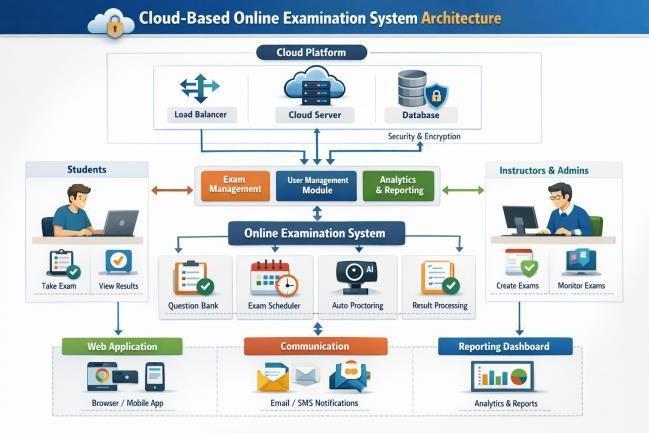
Thearchitectureisdesignedusingamodularandrole-basedapproachtoensureefficientmanagementofexamination activities.ThesystemintegratesAdmin, Faculty,Student,Dashboard,andDatabasecomponentstoprovideasecureand automatedexaminationenvironment.
International Research Journal of Engineering and Technology (IRJET) e-ISSN: 2395-0056
Volume: 13 Issue: 03 | Mar 2026 www.irjet.net p-ISSN: 2395-0072
The Database serves as the central repository of the system.Itstoresallcriticalinformationincludingstudent records, faculty details, examination questions, schedules, and results. The database supports insert, update, and retrieval operations,ensuringdataconsistencyandintegritythroughoutthesystem.
The Admin module is responsible for overall system management. The admin performs operations such as inserting and updating student and faculty data, managing examination schedules, and publishing results to the dashboard. This moduleensurespropercoordinationbetweensystemcomponentsandmaintainsoperational control.
The Faculty module handles academic-related tasks within the system. Faculty members are authorized to create question sets, define examination parameters, and analyzestudentperformance. Theycan viewexamination results and generateperformancereportsthroughthedashboardinterface.
The Student module representstheendusersofthesystem.Studentscanloginsecurely,attemptonline examinations, andviewtheirresultsafterevaluation.Thesystemmayalsonotifystudentsregardingexaminationschedulesandresult publicationthroughemailnotifications.
The Dashboard acts as a centralized monitoring and communication interface. It displays examination schedules, publishedresults,andperformancereports. Thiscomponentenhancestransparencyandfacilitatesreal-timeinformation accessforallauthorizedusers.
Overall,theproposedarchitectureensuressecuredatahandling,role-basedaccesscontrol,automatedresultprocessing, and efficient communication between stakeholders. The centralized database model improves system reliability and supportsscalabledeploymentinacloudenvironment.
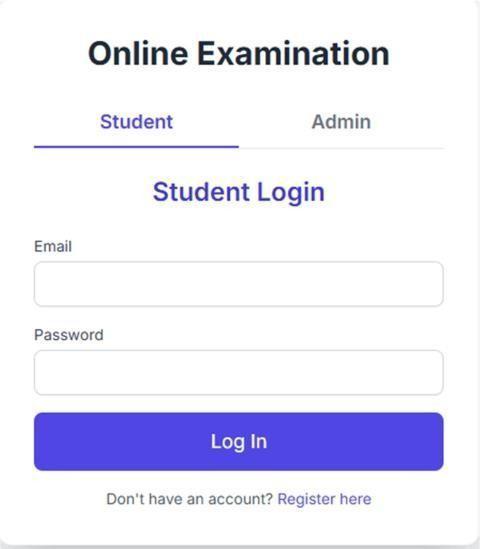
The Student Login interface serves as the authorized access point to the Cloud-Based Online Examination System. This moduleisdesignedtoensuresecure,structured,androle-basedentryintotheexaminationplatform.
The interface clearly distinguishes between Student and Admin access through dedicated tabs, ensuring controlled system usage based on user roles. The Student login section requires registered credentials, including email and password,toauthenticateusersbefore grantingaccesstoexaminationresources.
This login module ensures:
Secureauthenticationofregistered candidates
Controlled accesstoexaminationdata
Protectionof confidentialacademicinformation
Streamlined user management
The inclusion of a registration option supports new user on boarding while maintaining structured database records. Thecleanandminimaluserinterfacereflectsusabilitystandardssuitableforacademicandinstitutionalenvironments.
International Research Journal of Engineering and Technology (IRJET) e-ISSN: 2395-0056
Volume: 13 Issue: 03 | Mar 2026 www.irjet.net p-ISSN: 2395-0072
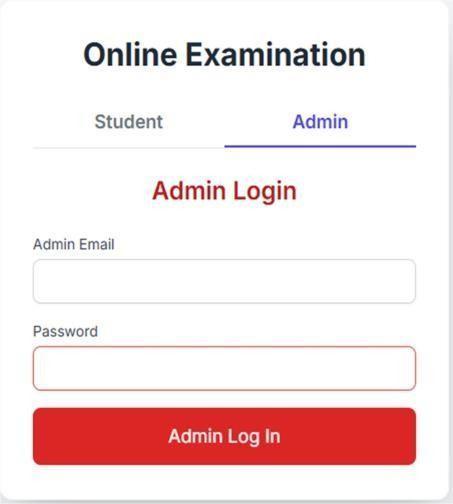
The Admin Login interface functions as the restricted access portal for administrative authorities within the CloudBasedOnlineExaminationSystem. Thismoduleisspecificallydesignedtoensuresecureandcontrolledmanagementof examinationoperations.
The interface clearly differentiates user roles through Student and Admin tabs, with the Admin section actively selected. This structured role separation ensures that only authorized personnel can access administrative functionalities.
International Research Journal of Engineering and Technology (IRJET) e-ISSN: 2395-0056
Volume: 13 Issue: 03 | Mar 2026 www.irjet.net p-ISSN: 2395-0072
The login form requires the following credentials:
Admin Email –RegisteredadministrativeemailID
Password –Secureauthentication credential
The “Admin Log In” button initiates the authentication process. Upon successful verification, the administrator is granted access to the system dashboard, where key management functions such as exam scheduling, question bank management,studentmanagement,andresultmonitoringcanbeperformed.
This module ensures:
Role-basedaccess control
Securehandlingofinstitutionaldata
Centralized administration of examinations
Protection againstunauthorized systemaccess
Thecleanandstructureduserinterfacereflectsprofessionalstandardssuitablefor institutionaldeployment.Overall,the Admin Login page serves as a secure control gateway, maintaining system integrity, confidentiality, and operational managementwithinthecloud-basedexaminationframework.
Online examination systems have become increasingly popular due to the rise of online courses, e-learning platforms, and remote education programs. They allow students to take exams from anywhere and help educational institutions manage tests more efficiently, reducing manual grading and administrative work. Traditional systems improved accessibilityandspeedcomparedtopaper-basedexams,butoftenfacedchallengeswithscalabilityandsecurity.
Security and exam integrity remain major concerns. Researchers have explored methods like facial recognition, biometrics, and typing pattern analysis to verify student identity and prevent cheating. While these methods improve reliability, they sometimes require specialized hardware or high processing power, which can be a limitation for widescaleuse.
Modern systems are also focusing on adaptive testing, where the difficulty of questions adjusts based on student performance.Thishelpsinprovidingamoreaccurateassessment ofstudentknowledgeandskills.Additionally,withthe increasinguseofmobiledevices,manyonlineexamplatformsarenowdesignedtobemobile-friendly,withfeaturesthat handlesloworintermittentinternetconnectivity.
Despite these improvements, gaps stillexist. Manysystems rely only on basic login credentials, have limited real-time monitoring to prevent cheating, and lack large-scale adaptive testing implementations. Network reliability and offline functionalityarealsonotfullyaddressedinmostexistingplatforms.
Therefore, there is a need for an online examination system that is secure, scalable, user-friendly, and capable of delivering accurate and reliable results. Such a system should combine strong authentication, effective anti- cheating measures,adaptiveassessmentfeatures,androbustperformanceevenundernetworklimitations.
1. User Management and Authentication:
A robust authentication mechanism will be implemented toensurethatonlyauthorizedusers(studentsandfaculty) can access the system. This includes username/password verification, role- based access, and optional multi-factor authentication for enhanced security. Faculty can create and manage student accounts, assign roles, and control permissions.
International Research Journal of Engineering and Technology (IRJET) e-ISSN: 2395-0056
Volume: 13 Issue: 03 | Mar 2026 www.irjet.net p-ISSN: 2395-0072
2. Exam Scheduling and Management:
The system will provide an easy-to-use interface for scheduling exams, setting time limits, and managing multiple subjectsorcourses.Automatednotificationsandcalendarintegrationwillhelpstudentsandfacultystayinformedabout upcomingexams.
3. Question Bank and Adaptive Testing:
The system will include a centralized question bank, allowing faculty to create and categorize Questions. For improved assessment accuracy, the system may include adaptive testing features, where question difficulty adjusts according to studentperformance.
4. Online Exam Interface:
Students will take exams through a web or mobile interface. The interface will support multiple question types (MCQs, descriptive,true/false)andensuresmoothnavigation,timetracking,andauto-savingofresponsestopreventdataloss.
5. Result Publication and Analysis:
After exams are completed, results will be automatically calculated and published on the dashboard. The system will provide detailed performance analysis, including scores, rankings, and insights into strengths and weaknesses for each student.
6. Security and Anti-Cheating Measures:
The system will include measures such as restricted access, session timeouts, IP monitoring, and optional webcam monitoringtominimizecheating.Dataencryptionwillprotectsensitiveinformationlike studentrecordsandexamresults.
7. System Monitoring and Maintenance:
TheAdminmodulewillcontinuouslymonitorsystem activity,trackuseractions,andmaintainlogsforauditingpurposes. Thisensuressmoothoperationandquickdetectionoferrorsorunauthorizedaccessattempts.
1. Automate the Examination Process:
To reduce manual effort, the system will automate tasks such as question management, exam scheduling, result calculation,andresultpublication.Thisensuresfasterprocessingandlessadministrativeworkload.
2. Ensure Security and Integrity:
To prevent unauthorized access and cheating, the system will implement secure login, role-based access, and optional monitoringmeasures.Sensitiveinformation,suchasstudentdataandexamresults,willbeprotectedusingencryption.
3. Provide Easy User Management:
Thesystemwillallowadminsandfacultytoefficiently managestudentandteacheraccounts,assignsubjects,andcontrol permissions.Studentswillhaveasimpleinterfacetoaccessexams,checkschedules,andviewresults.
4. Support Adaptive and Flexible Testing:
To provide accurate evaluation, the system willinclude features like randomized questions from a centralized question bankandthepotentialforadaptivetesting,adjustingquestiondifficultyaccordingtostudent performance.
5. Enable Fast and Accurate Result Processing: The system will calculate exam scores automatically and display resultsonthedashboard.Facultywillalsoreceiveperformancereportstohelpidentifyareaswherestudentsmayneed improvement.
6. Ensure System Monitoring and Reliability: Theadminwillbeabletomonitoruseractivities,systemperformance, andexamsessionstoensuresmoothoperation,identifyerrors,andmaintainoverallreliability.
7. Improve Accessibility: Thesystem willbeaccessibleviacomputers and mobiledevices,allowingstudentstotakeexams fromanywhere,eveninareaswithintermittentinternet,makingitsuitableformoderne-learningenvironments.
International Research Journal of Engineering and Technology (IRJET) e-ISSN: 2395-0056
Volume: 13 Issue: 03 | Mar 2026 www.irjet.net p-ISSN: 2395-0072
The Online Examination System provides a modern and practical way to conduct exams in schools and colleges. It reduces the need for paper-based exams, saves time, and makes result processing faster and more accurate. Students cantakeexamsfromanywhere,andteacherscaneasilymanageschedules,questions,andresults.
The system also focuses on security and fairness. With proper login controls, access management, and optional monitoring features, it helps prevent cheating and ensures that exams are conducted properly. Automatic result calculation and performance reports make it easier for teachers to evaluate students and for students to track their progress.
Overall, this project shows that online exams can make the evaluation process simpler, faster, and more reliable. It improvesconvenienceforbothstudentsandteacherswhilemaintainingaccuracyandsecurity.Inthefuture,featureslike smarter adaptive testing, real-time proctoring, and better mobile support could make the system even more effective anduser-friend
1. R. Almalki, A. Alshammari, “An Online Examination System with Automated Grading,” International Journal of ComputerApplications,vol.122,no.9,pp.15–21,Aug.2015.
2. R. Singh, S. Kaur, “Design and Implementation of Online Examination System,” International Journal of ComputerApplications,vol.97,no.6,pp.7–12,Jun.2014.
3. M.Iqbal,M.Hasan,“AWebBasedOnlineExaminationSystem,”ProgressinSystemsEngineering,vol.1,no.1,pp.12–22,2017.
4. S. Al-Zoube, “Online Exam Management Support System,” Journal of King Saud University – Computer and Information Sciences,vol.28,no.2,pp.173–180,Apr.2016.
5. N. Gautam, A. Sharma, “Online Examination System Using Web Based Application,” International Journal of Engineering DevelopmentandResearch,vol.5,no.2,pp.1990–1994,2017.
6. R.Elmasri, S.B.Navathe,FundamentalsofDatabaseSystems,7thEdition,PearsonEducation,2016.
7. S.Tanenbaum,H.Bos,ModernOperatingSystems,4thEdition,Pearson,2015.
8. E.Balagurusamy,WebTechnologies:HTML,JavaScript,PHP,Java,JSP,ASP.NET,McGrawHillEducation,2017.
9. R.Pressman,SoftwareEngineering:APractitioner’sApproach,8thEdition,McGrawHill,2015.
10. L. Ali, “Importance of Online Examination Systems in E- Learning Environment,” International Journal of Education and Development using Information and Communication Technology(IJEDICT), vol.14,no.2,pp. 35–44,2018.
BIOGRAPHIES
MS.TRUPTI PAWAR
PursuingPoly(Co)S.Y.PSHREEYASHCOLLEGEOFENGINEERING ANDTECHNOLOGY(POLYTECHNIC)
MS. NANDINI DORLE
PursuingPoly(Co)S.Y.PSHREEYASHCOLLEGEOFENGINEERING ANDTECHNOLOGY(POLYTECHNIC)
International Research Journal of Engineering and Technology (IRJET) e-ISSN: 2395-0056
Volume: 13 Issue: 03 | Mar 2026 www.irjet.net p-ISSN: 2395-0072
MS. DIPALI CHOPADE
PursuingPoly(Co)S.Y.PSHREEYASHCOLLEGEOFENGINEERING ANDTECHNOLOGY(POLYTECHNIC)
MS. VAISHNAVI MORE
PursuingPoly(Co)S.Y.PSHREEYASHCOLLEGEOFENGINEERING ANDTECHNOLOGY(POLYTECHNIC)
PROF. R.V.PATIL
PROF, Dept. of Computer Engineering
S.Y.PSHREEYASHCOLLEGEOFENGINEERING ANDTECHNOLOGY(POLYTECHNIC).