
International Research Journal of Engineering and Technology (IRJET) e-ISSN: 2395-0056
Volume: 13 Issue: 03 | Mar 2026 www.irjet.net p-ISSN: 2395-0072

International Research Journal of Engineering and Technology (IRJET) e-ISSN: 2395-0056
Volume: 13 Issue: 03 | Mar 2026 www.irjet.net p-ISSN: 2395-0072
Harshraj Singh1 , Omnath Ganapure2 , Bhavik koli3 , Om Kokane4 , Prof. Ujwale Harode
Dept. Of Electronics & Computer Science Engineering, Pillai College of Engineering New Panvel (Autonomous)
Abstract Agriculture is one of the most important sectors that supports global food production and economic development. However, traditional farming methods rely heavily on manual observation and experience-based decision making, which can lead to delayed crop disease detection, inefficient resource management, and reduced crop productivity. To address these challenges, a Cloud Based Agriculture Monitoring System (CBAMS) is proposed that integrates Artificial Intelligence, Machine Learning, and Cloud Computing technologies to supportsmart farmingpractices.
The proposed system provides a cloud-based platform where farmers can monitor crop health, receive crop recommendations, and access real-time weather information. Farmers can upload crop images to detect diseases using AI models, while machine learning algorithms analyze environmental parameters to suggest suitable crops and fertilizers. The system also provides features such as task management, expert consultation, and an agricultural marketplace.
The platform is implemented using React.js for the frontend, Node.js and Express.js for the backend, PostgreSQL for database management, and cloud services for storage and deployment. By providing real-time insights and intelligent recommendations, CBAMS helps farmers make better decisions, improve crop productivity, and reduce resource wastage.
Keywords- Smart Agriculture, Cloud Computing, Artificial Intelligence, Crop Disease Detection, Precision Farming
Agricultureplaysacrucialroleinensuringfoodsecurity and supporting the livelihood of millions of people worldwide. Despite technological advancements in variousindustries,manyfarmersstill relyontraditional farming practices that depend on manual monitoring andexperience-baseddecisionmaking.
Farmers often face challenges such as delayed detection of crop diseases, unpredictable weather conditions, lack of access to expert agricultural guidance, and inefficient farm management. These challenges can significantly affectcropyieldandoverallfarmproductivity.
With the rapid advancement of technologies such as Artificial Intelligence (AI), Machine Learning (ML), and Cloud Computing, new opportunities have emerged to
improve agricultural practices through smart farming systems.Thesesystemscananalyzeenvironmentaldata, monitor crop health, and provide recommendations for betterfarmmanagement.
The Cloud Based Agriculture Monitoring System (CBAMS) is designed to address these challenges by providing an integrated digital platform that combines AI-basedcropdiseasedetection,machinelearning-based crop recommendations, weather monitoring, expert consultation, and agricultural marketplace services. The systemenablesfarmersto monitortheirfarmsremotely andmakeinformeddecisionsbasedonreal-timedata.
Several smart agriculture systems have been developed to improve crop monitoring and farm management. Traditional agricultural monitoring systems relied heavily on manual observation and basic environmental measurements.
Modern smart farming solutions incorporate technologies such as remote sensing and machine learning to analyze agricultural conditions. Systems like Plantix provide AI-based disease detection using image recognition techniques. However, these systems mainly focus on crop disease identification and do not provide comprehensivefarmmanagementfeatures.
Farm management platforms such as FarmLogs allow farmers to track crop performance and environmental conditions.However,these platformsareoftendesigned for large-scale farms and may require subscription fees, makingthemlessaccessibletosmall-scalefarmers.
The proposed CBAMS platform aims to overcome these limitations by integrating multiple agricultural services into a single cloud-based system that is affordable and easytouse.
The Cloud Based Agriculture Monitoring System (CBAMS) follows a layered architecture designed to collect agricultural data, process it using machine learning models, and provide intelligent
International Research Journal of Engineering and Technology (IRJET) e-ISSN: 2395-0056
Volume: 13 Issue: 03 | Mar 2026 www.irjet.net p-ISSN: 2395-0072
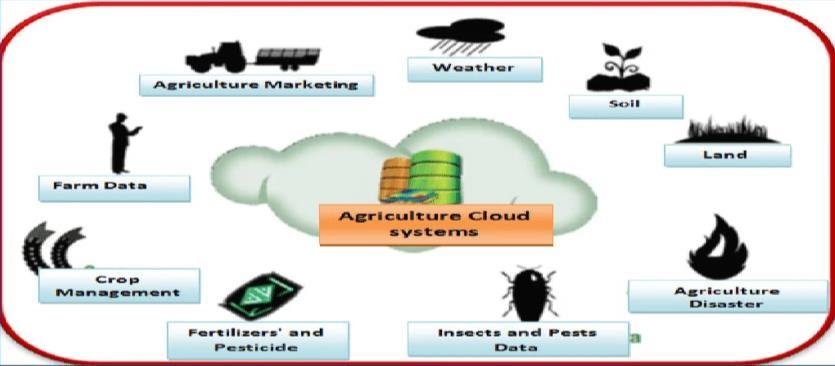
recommendations to farmers and agricultural stakeholders. The proposed system consists of five major stages: Data Acquisition, Data Preparation, Data Processing, Decision Making, and Service Delivery, as illustrated in Fig. 1. Each stage plays a crucialroleintransformingrawagriculturaldatainto actionableinsightsforfarmers.
3.1 Data Acquisition
The first stage of the system involves collecting data from various agricultural sources. This layer gathers information from multiple inputs and stores it in the cloud database, where the data is immediately available forprocessingandanalysis.
Thecollecteddataincludes:
● Soilmoisturelevels
● Temperatureandhumidityconditions
● Crop health images captured through drones or mobiledevices
● Environmental data, such as real-time weather and climatic forecasts, obtained from thirdpartyAPIs.
● Comprehensive historical farming records and public agricultural datasets used for training andvalidation.
Farmer experience and manual observations also contribute valuable contextual information such as pest attacks, soil conditions, and crop growth stages. These heterogeneous data sources form the foundation for the intelligent analysis performed in later stages of the system.
The raw agricultural data collected from different sourcesoftencontainsinconsistencies,missingvalues,or noise. Therefore, the data preparation stage focuses on improvingthequalityandusabilityofthecollecteddata.
Thisstageincludesthefollowingprocesses:
1.Data Control:
Ensures that only valid and relevant agricultural data is usedforanalysis.
2. Data Cleaning:
Removes duplicate records, missing values, and incorrectreadings.
3. Data Standardization:
Converts data into a standardized format so that it can beeasilyprocessedbymachinelearningmodels.
The prepared dataset ensures reliable input for further analysisandpredictionmodels.
After data preparation, the cleaned dataset is processed using cloud-based machine learning and artificial intelligence techniques. This stage is responsible for extracting meaningful patterns and generating predictions.
The main processes in this stage include:
Model Deployment:
Machine learning models are deployed in the cloud environmenttoanalyzeincomingagriculturaldata.
Data Processing:
The system processes real-time and historical data to identify trends related to crop growth, environmental conditions,andsoilhealth.
Prediction and Forecasting:
AI and machine learning algorithms are used to predict cropdiseases,recommendsuitablecrops,estimateyield,
International Research Journal of Engineering and Technology (IRJET) e-ISSN: 2395-0056
Volume: 13 Issue: 03 | Mar 2026 www.irjet.net p-ISSN: 2395-0072
andforecastenvironmentalconditions.Cloudcomputing resources ensure thatlarge volumesof agricultural data canbeprocessedefficientlyandinrealtime.
The insights generated by machine learning models are then used to support decision-making processes. This stage focuses on converting analytical results into actionablerecommendations.
Thedecision-makinglayerconsistsof:
System Monitoring:
Continuous monitoring of system performance and agriculturalconditions.
Rule Management:
Application of predefined agricultural rules and expert knowledgetorefinesystempredictions.
Model Metadata Management:
Tracking the performance and updates of machine learning models to ensure accuracy and reliability. This stage enables intelligent recommendations such as irrigation scheduling, fertilizer application, pest control measures,andcropselectionstrategies.
The final stage of the system delivers the processed insights and recommendations to various stakeholders throughcloud-basedservices.
Thesystemprovidesservicesto:
● Farmers
● Agriculturalresearchers
● Farmingserviceproviders
● Governmentagriculturalagencies
Throughauser-friendlydashboard,farmerscanmonitor crop health, receive crop recommendations, and access expert agricultural advice. Researchers and government agencies can use the aggregated data for agricultural planningandpolicydevelopment.
Security and privacy monitoring are applied across all stages of the system to ensure safe handling of agricultural data. Cloud-based security mechanisms protect sensitive farmer information, prevent unauthorized access, and ensure data integrity during storageandtransmission.
Encryption, authentication mechanisms, and access control policies are implemented to maintain the confidentiality and reliability of the agricultural monitoringsystem.
Tobringtheproposedmental healthmonitoringsystem tolife,arobusttechnologystackhasbeenemployed.The architecture combines modern frontend frameworks, secure backend services, intelligent AI models, and decentralized data storage. Each component is carefully selected to ensure scalability, responsiveness, and data privacy
The frontend of the system is developed using React.js and Tailwind CSS, which provide a responsive and interactive user interface accessible from both desktop and mobile devices. The frontend dashboard allows farmers to easily access system features such as crop analysis, weather monitoring, and farm task management.
The interface is designed to be simple and intuitive so that farmers with minimal technical knowledge can operate the system effectively. The dashboard presents key agricultural information such as crop health indicators,environmentaldata,andsystemalerts.
International Research Journal of Engineering and Technology (IRJET) e-ISSN: 2395-0056
Volume: 13 Issue: 03 | Mar 2026 www.irjet.net p-ISSN: 2395-0072
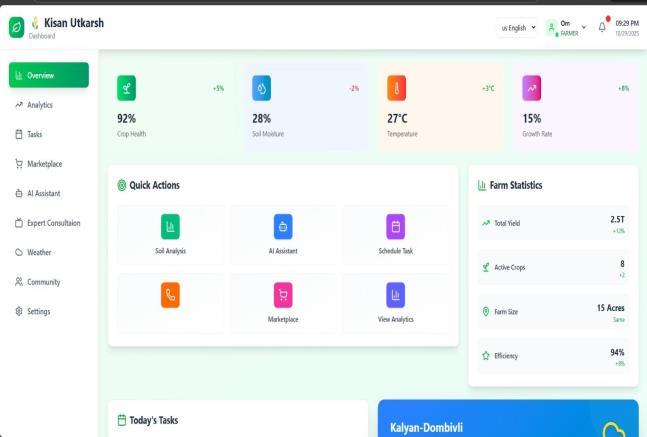
4.1 FarmerDashboard
1. Crop Analysis and Disease Detection Module
The crop analysis module uses Artificial Intelligence and image processing techniques to detect plant diseases from crop images uploaded by farmers. Farmerscancaptureimagesofaffectedcropsandupload themthroughtheplatform.
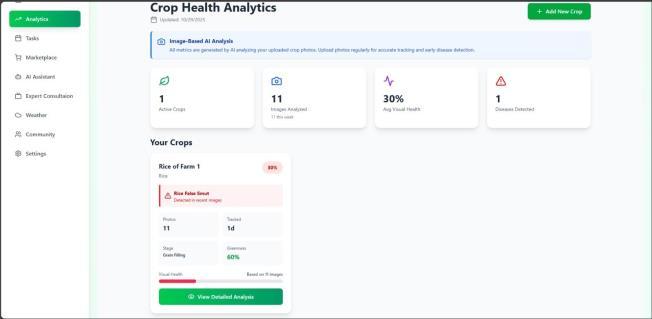
Fig. 4.2 CropAnalysisPage
The AI model analyzes leaf patterns, discoloration, and visiblesymptomstoidentifypotentialdiseases.Basedon the detected disease, the system provides recommendationsfortreatmentandprevention.
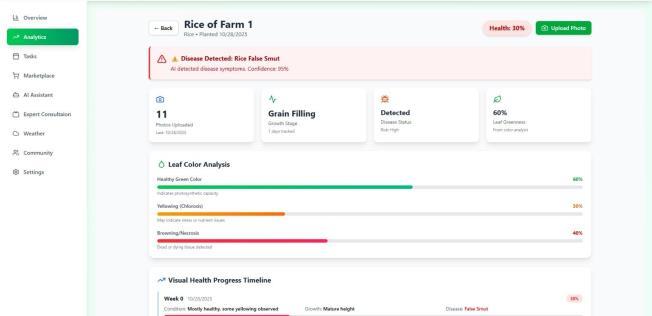
Fig. 4.3 AI-BasedCropDiseaseDetectionAnalysis
The system includes a farm task management feature that allows farmers to schedule and track agricultural activities such as irrigation, fertilization, pesticide application,andharvesting.
The task management module helps farmers organize their farm operations and ensures that important agriculturalactivitiesarecompletedontime.
This module helps farmers maintain proper farm managementandproductivity.
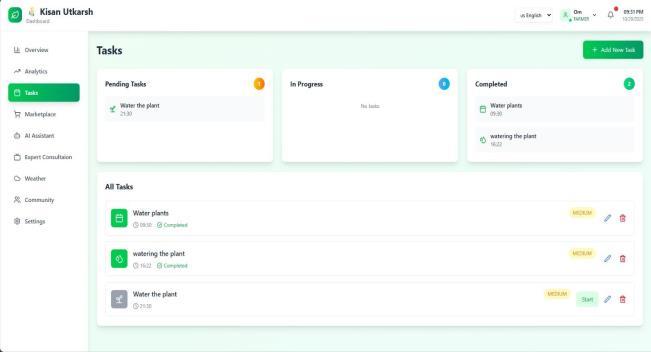
4.4 TaskDashboardPage
Weather conditions play a critical role in agricultural productivity. The CBAMS platform integrates weather APIs to provide farmers with real-time weather updates including temperature, humidity, rainfall predictions,andenvironmentalconditions.
These insights help farmers plan irrigation, planting schedules,andpestcontrolactivitieseffectively.
Weather conditions significantly impact agricultural output. The CBAMS platform addresses this by integratingweatherAPIs,offeringfarmerscrucial,up-todate information such as temperature, humidity, and rainfall forecasts, alongside other key environmental conditions.
International Research Journal of Engineering and Technology (IRJET) e-ISSN: 2395-0056
Volume: 13 Issue: 03 | Mar 2026 www.irjet.net p-ISSN: 2395-0072
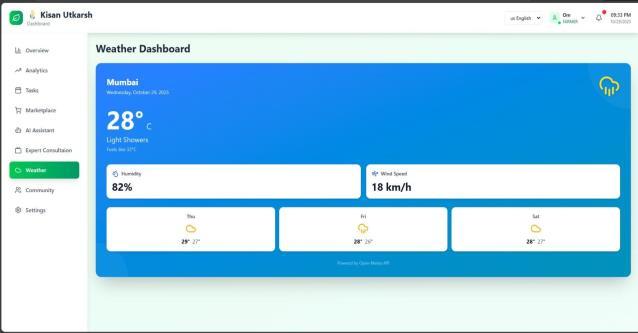
4.5 WeatherDashboardPage
4. Agricultural Marketplace Module
The marketplace module connects farmers with potential buyers and agricultural service providers. Farmers can list their products, view market demand, and communicate with buyers directly through the platform.
This feature reduces dependency on intermediaries and helpsfarmersobtainbetterpricesfortheircrops.
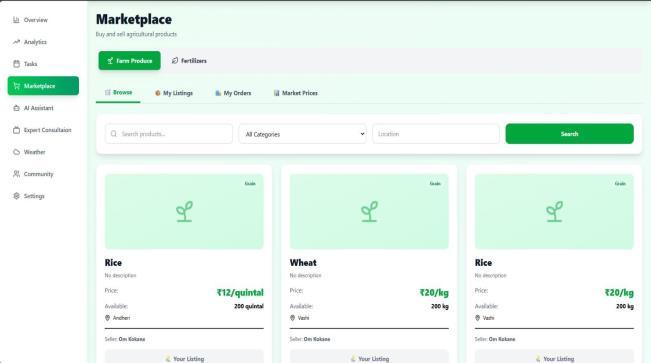
Fig. 4.6 Marketplace&ListingPage
5. Expert Consultation Module
Thesystemalsoprovidesanexpertconsultationfeature where farmers can communicate with agricultural experts to obtain professional advice regarding crop diseases,fertilizers,andfarmingtechniques.
Additionally, the system offers an expert consultation feature, enabling farmers to seek professional advice fromagriculturalexpertsontopicssuchascropdiseases, fertilizeruse,andfarmingtechniques.
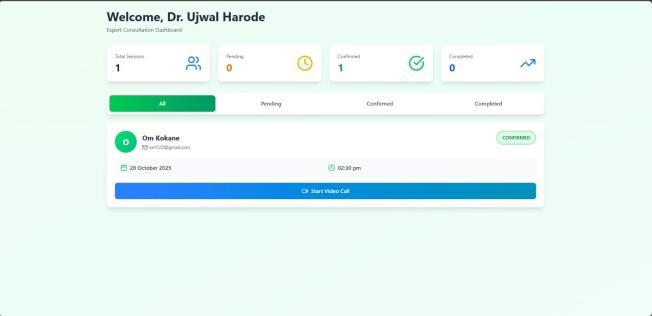
Fig. 4.7 DoctorDashboard
Experts can review crop conditions and provide guidancethroughthesystemdashboard.
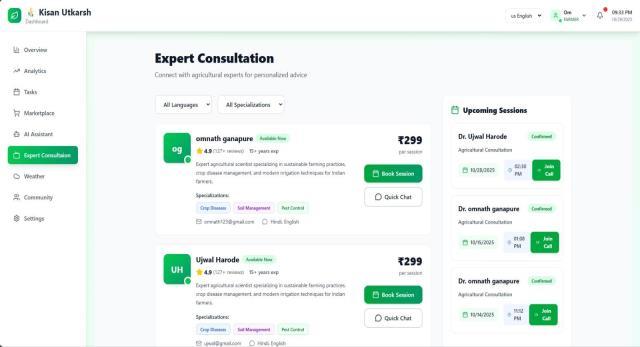
Fig. 4. 8 ExpertConsultationPage
V. RESULTS AND DISCUSSION
1. System Functionality Results
The developed system provides a fully functional web platformthatallowsfarmerstomonitorcropconditions and access various agricultural services through a centralized dashboard. The farmer dashboard displays key agricultural parameters such as crop health status, environmentalconditions,andfarmstatistics.
Farmers can upload crop images to the system to performdiseasedetectionusingtheintegratedAImodel. The system analyzes the uploaded image and identifies potential plant diseases along with recommended treatments. In addition, the crop recommendation module analyzes environmental parameters such as temperature, humidity, rainfall, and soil nutrients to suggestsuitablecropsforcultivation.
Theplatformalsoprovidesadditional featuresincluding task management, weather monitoring, expert consultation, and an agricultural marketplace. These features help farmers organize their farming activities andaccessprofessionalagriculturalsupport.
Volume: 13 Issue: 03 | Mar 2026 www.irjet.net p-ISSN: 2395-0072
The performance of the system was evaluated using several performance metrics including model accuracy, systemresponsetime,andplatformreliability.
The AI-based crop disease detection model achieved an accuracy of approximately 92.4% during testing using crop image datasets. The machine learning model used for crop recommendation achieved an accuracy of approximately 87.6% based on environmental parametersandsoildata.
The average response time of the system was observed tobe450milliseconds,allowingfarmerstoreceiverealtime predictions and recommendations. The system maintainedanuptimeofapproximately99.4%,ensuring continuousavailabilityoftheplatform.
These performance metrics indicate that the system is efficient, scalable, and suitable for deployment in agriculturalmonitoringapplications.
The testing results confirmed that the system performs efficiently and provides reliable outputs under various operationalconditions.
User experience evaluation was conducted to assess the usabilityofthesystemfromtheperspectiveoffarmers.A small group of users tested the platform and provided feedbackregardingsystemusabilityandfunctionality.
Themajorityofusersreportedthatthesysteminterface is simple and easy to navigate. The dashboard layout allows users to quickly access important agricultural information such as crop health analysis and environmentaldata.
Approximately 93% of users reported satisfaction with the system interface, indicating that the platform is suitableforfarmerswithlimitedtechnicalexperience.
The results obtained from the implementation and testing of the CBAMS platform demonstrate that the system can effectively support farmers in monitoring crop conditions and making data-driven agricultural decisions.
Table no. 5.1 Marketplace&ListingPage
To ensure system reliability and functionality, several typesoftestingwereconductedduringthedevelopment process.
Functional testing was performed to verify that all modulesofthesystemoperatecorrectly.Thesemodules include crop disease detection, crop recommendation, weather monitoring, task management, expert consultation,andmarketplaceservices.
User interface testing was conducted to ensure that the dashboard and other system interfaces are easy to use and accessible to farmers with minimal technical knowledge.
API integration testing verified that external services such as weather APIs and notification services work correctlywithinthesystem.
Byintegratingartificialintelligenceandcloudcomputing technologies, the system eliminates the need for expensive IoT hardware while still providing reliable predictionsand insights.TheAI-baseddiseasedetection system enables farmers to identify crop diseases at an early stage, reducing crop loss and improving productivity.
The cloud-based architecture ensures scalability and allows the system to handle multiple users simultaneously. Additionally, the inclusion of features such as weather monitoring, expert consultation, and agricultural marketplace services makes the system a comprehensivedigitalfarmingplatform.
Overall, the proposed system provides an efficient, scalable,andcost-effectivesolutionforsmartagriculture and can significantly improve farming productivity and resourcemanagement.
The Cloud Based Agriculture Monitoring System (CBAMS)providesanintelligentandscalablesolutionfor improving modern agricultural practices. The system integrates cloud computing, artificial intelligence, and machine learning technologies to monitor crop conditions, detect plant diseases, and provide crop
International Research Journal of Engineering and Technology (IRJET) e-ISSN: 2395-0056
Volume: 13 Issue: 03 | Mar 2026 www.irjet.net p-ISSN: 2395-0072
recommendationstofarmers.
The developed platform allows farmers to access agricultural insights through a user-friendly web dashboard where they can monitor environmental conditions, analyze crop health, and receive expert guidance. The AI-based disease detection module enables early identification of crop diseases, while the crop recommendation system assists farmers in selecting suitable crops based on environmental parameters.
Experimental results demonstrate that the system performs effectively in detecting crop diseases and providing agricultural recommendations with high accuracy. The cloud-based architecture ensures system scalability, real-time data access, and reliable performance.
Overall, the proposed system supports farmers in making data-driven decisions, improving crop productivity, and reducing agricultural losses. By integratingmultiplesmartfarmingservicesintoa single platform, the CBAMS system contributes to the development of sustainable and technology-driven agriculture.
[1] S. P. Mohanty, D. P. Hughes, and M. Salathé, “Using DeepLearningforImage-BasedPlantDiseaseDetection,” Frontiers in Plant Science,vol.7,pp.1–10,2016.
[2] O. Friha, M. A. Ferrag, L. Shu, and L. Maglaras, “Internet of Things for the Future of Smart Agriculture,” IEEE/CAA Journal of Automatica Sinica, vol. 8, no. 2, pp. 204–214,2021.
[3] P. Rajak, A. Ganguly, and A. Kumar, “Internet of Things and Smart Sensors in Agriculture: Scopes and Challenges,” Smart Agricultural Technology,vol.4,2023.
[4]I.Ivanochko,“SmartFarmingSystemBasedonCloud Computing and Sensor Technologies,” Procedia Computer Science,2024.
[5] X. Sun, Y. Zhang, and H. Wang, “Plant Disease IdentificationBasedonConvolutionalNeuralNetworks,” Computers and Electronics in Agriculture,2022.
[6] O. Debnath, P. K. Biswas, and A. Roy, “An IoT-Based Intelligent Farming System Using CNN for Early Disease Detection,” Information Processing & Management,2022.
[7] P. Trivedi and A. Sharma, “Plant Leaf Disease Detection and Classification Using Deep Learning,” The Open Agriculture Journal,vol.18,2024.
[8] W. B. Demilie and M. A. Tesema, “Plant Disease Detection and Classification Techniques Using Machine Learning,” Journal of Big Data,2024.
[9] A. Sharma, R. Gupta, and S. Singh, “Design and Implementation of a Cloud-Based Smart Agriculture System for Crop Yield Prediction,” International Journal of Agriculture Technology,2023.
[10] N. Shelar and R. Kulkarni, “Plant Disease Detection Using Convolutional Neural Networks,” ITM Web of Conferences,2022.