
International Research Journal of Engineering and Technology (IRJET) e-ISSN: 2395-0056
Volume: 13 Issue: 02 | Feb 2026 www.irjet.net p-ISSN: 2395-0072
International Research Journal of Engineering and Technology (IRJET) e-ISSN: 2395-0056
Volume: 13 Issue: 02 | Feb 2026 www.irjet.net p-ISSN: 2395-0072
Prof. Anik C. Naik1, Prof. Shilpa B. Pundge2, Somnath L. Gayke3 , Durgesh K. Rathod4, Pratik N. Bugad5 , Dhiraj V. Gaikwad6
1(HOD, Dept .of Computer Engineering), S.Y.P Shreeyash College Of Engineering And Technology(Polytechnic),Chh.Sambhajinagar,India
2(Prof (Guide) , Dept .of Computer Engineering), S.Y.P Shreeyash College Of Engineering And Technology(Polytechnic),Chh.Sambhajinagar,India
3,4,5,6(Students, Department of Computer Engineering ),S.Y.P Shreeyash College Of Engineering And Technology(Polytechnic),Chh.Sambhajinagar,India ***
Abstract - Attendance management is a critical and mandatory task in educational institutions, but traditional manual attendance systems are inefficient, time-consuming, and highly prone to errors, proxy attendance, data manipulation, and long-term data loss. Faculty members spend a significant amount of lecture time maintaining attendance registers, while students do not get real-time access to their attendance status, which affects transparency and academic monitoring. To overcome these limitations, this paper proposes a Cloud-Based Smart Attendance System for Students and Faculty developed using Android and cloud computing technologies. The proposed system is implemented using Android Studio, where XML is used for designing interactive and user-friendly interfaces, Java is used for implementing application logic and controlflow,andFirebase is utilized as a cloud-based platform for authentication, realtime database management, and secure data storage.
The application follows a role-based access mechanism with separate login and registration modules for students and teachers, ensuring data securityandcontrolledaccess.Faculty members can digitally mark attendance by selecting present students from a dynamically generated real-time student list, which minimizes manual effort, reduces human errors, and eliminates proxy attendance. Once attendance is marked, the data is instantly synchronized and stored on the cloud server, providing centralizedandreliabledatamanagement.Students can securely log in to the system and view their attendance details in percentage format, including lecture-wise, daily, weekly, and monthly attendance reports, which helps them track their academic participation effectively.Thesystemalso provides user profile management features, where students and teachers can view their registered personalandacademic information, along with secure session handling and logout functionality to protect user data.
By leveraging cloud computing, the proposed system offers real-time data access, scalability, improved transparency, reduced paperwork, enhanced reliability, and easy accessibility from anywhere using the internet. The system is cost-effective, user-friendly, and adaptable, making itsuitable for schools, colleges, and other educational institutes. Overall, the Cloud-Based Smart Attendance System supports the transition from traditional attendance methods to a modern,
digital, and automated academic management system, contributing significantly to the concept of smart education.
Key Words: Cloud Computing, Smart Attendance System, Android Application,Firebase Database,Student Attendance Management, Faculty Attendance, RoleBased Authentication, Real-Time Data Storage, Digital Education, Automated Academic Management System.
Attendancemanagementisoneofthemostimportantdaily activitiesinanyeducationalinstitution,asitdirectlyaffects studentdiscipline,academicperformance,andeligibilityfor examinations; however, traditional manual attendance systems based on paper registers are inefficient, timeconsuming, and highly prone to errors, proxy attendance, data loss, and long-term record management issues. In a typicalmanualsystem,teachersspendvaluablelecturetime callingoutstudentnamesandmarkingattendancebyhand, which reduces teaching efficiency and increases administrativeworkload,whilestudentsdonotgetreal-time accesstotheirattendanceinformation,resultinginalackof transparencybetweenstudentsandfaculty.
Toovercometheselimitations,thisprojectpresentsaCloudBased Smart Attendance System for Students and Faculty thatautomatestheentireattendanceprocessusingAndroid andcloudcomputingtechnologies.Theproposedsystemis developed using Android Studio as the development platform,whereXMLisusedtodesignsimple,interactive, and user-friendly interfaces, Java is used to implement applicationlogicandrole-basednavigation,andFirebaseis usedasacloudserviceforsecureauthentication,real-time datasynchronization,andcentralizeddatabasemanagement.
Thesystemfollowsarole-basedarchitectureinwhichusers are classified as students or teachers, starting from a common application interface that provides options for student login, teacher login, and new user registration, ensuringcontrolledandsecureaccesstothesystem.After successful authentication through Firebase, users are redirected to their respective dashboards based on their role,whereteachersareprovidedwithadigitalattendance
International Research Journal of Engineering and Technology (IRJET) e-ISSN: 2395-0056
Volume: 13 Issue: 02 | Feb 2026 www.irjet.net p-ISSN: 2395-0072
modulethatdisplaysareal-timelistofstudentsandallows attendancemarkingthroughasimpletick-basedinterface, ensuringaccuracy,reducingmanualeffort,andeliminating proxy attendance, while students are provided with an attendanceviewingmodulethatdisplaysattendancedetails inpercentageformatalongwithlecture-wise,daily,weekly, and monthly reports, enabling them to monitor their academic participation effectively. All attendance data marked by teachers is instantly uploaded to the cloud database,ensuringcentralizedstorage,dataconsistency,and real-time availability, while students retrieve their attendanceinformationdirectlyfromthecloud,makingthe system accessible anytime and from anywhere using an internetconnection.
ThearchitectureofthesystemconsistsofanAndroid-based userinterfacelayerforinteraction,anapplicationlogiclayer implementedinJavaforprocessingandvalidation,acloud serviceslayerprovidedbyFirebaseforauthenticationand real-time communication, and a cloud database layer for secure storage of user profiles and attendance records, creating a reliable, scalable, and efficient attendance management solution. Additional features such as user profile management, secure session handling, and logout functionalityenhancedatasecurityandusercontrol,while cloud-based storage minimizes the risk of data loss and reducesdependenceonphysicalrecords.Overall,theCloudBased Smart Attendance System significantly improves efficiency, accuracy, transparency, and reliability in attendance management, reduces paperwork and administrative burden, and provides a cost-effective, scalable, and user-friendly solution suitable for schools, colleges, and training institutes, supporting the transition from traditional manual systems to modern, digital, and automatedacademicmanagementsystemsalignedwiththe conceptofsmarteducation.
Attendance management has been an essential part of academic administration for many years, and various techniques have been used by educational institutions to recordandmaintainattendancedata.Themosttraditional method is the manual attendance system, where teachers record student attendance in paper registers, which is simplebuthighlyinefficient,time-consuming,andproneto humanerrorssuchasincorrectentries,missingrecords,and duplicationofdata,whilealsoincreasingthepossibilityof proxyattendanceandlong-termdatamanagementissues.To reduce paperwork, some institutions adopted basic computerized attendance systems using spreadsheets or local software, which improved data organization butstill suffered from limitations such as lack of real-time access, dependency on local storage, and risk of data loss due to systemfailure.Withtechnologicaladvancements,biometric attendancesystemsusingfingerprintsorfacialrecognition were introduced to improve accuracy and reduce proxy
attendance; however, these systems require additional hardware,involvehighinstallationandmaintenancecosts, and may face technical failures and operational delays, makingthemunsuitableformanysmallandmedium-sized institutions.QRcode–basedattendancesystemswerealso proposed in several studies, where students scan a generated code using mobile devices, offering faster attendancemarkingbutraisingconcernsrelatedtosecurity, misuse,internetdependency,andauthenticationreliability. Recent research highlights the growing use of mobile applicationscombinedwithcloudcomputingforattendance management,asAndroid-basedsystemsprovideportability, ease of use, and better user interaction, while cloud platforms offer centralized data storage, real-time synchronization,scalability, andimproveddata reliability. However, many existing systems focus only on limited functionality and do not provide a complete role-based frameworkwithsecureauthentication,detailedattendance analysis, profile management, and transparency for both students and faculty. Based on the study of existing attendancesystems,itisevidentthatthereisastrongneed for an integrated, cost-effective, and secure solution that combinesmobiletechnologywithcloudservices.
The proposed Cloud-Based Smart Attendance System addressesthesegapsbyofferingrole-basedaccess,real-time cloudstorageusingFirebase,digitalattendancemarkingby faculty,anddetailedattendancereportsforstudents,making attendance management more accurate, transparent, efficient,andsuitableformoderneducationalinstitutions
The Cloud-Based Smart Attendance System consists of several important objects that work together to manage attendanceefficientlyandsecurely.Theseobjectsrepresent themainusers,datacomponents,andfunctionalunitsofthe system.
1. Student–Logsintothesystem,viewsattendance percentage and daily, weekly, and monthly attendancereports,checksprofiledetails,andlogs outsecurely.
2. Teacher–Logsintothesystem,viewsstudentlist, marks attendance digitally, submits attendance recordstothecloud,viewsprofiledetails,andlogs out.
3. Authentication Module – Verifies student and teacherlogindetailsusingFirebaseAuthentication toensuresecureaccess.
4. AttendanceModule–Managesattendancemarking, storage,calculationofattendancepercentage,and reportgeneration.
Volume: 13 Issue: 02 | Feb 2026 www.irjet.net p-ISSN: 2395-0072
5. UserProfileModule–Storesanddisplayspersonal andacademicdetailsofstudentsandteachers.
6. FirebaseCloudDatabase–Storesuserinformation andattendancerecordssecurelywithreal-timedata synchronization.
7. Android Application Interface – Provides a userfriendlyinterfaceforlogin,registration,attendance, profile,andlogoutoperations.
SaThe methodology of the proposed Cloud-Based Smart AttendanceSystemfocusesondesigningandimplementinga simple,secureandefficientattendancemanagementsolution using Android and cloud technologies. The system is developedusingAndroidStudioastheprimarydevelopment environment,whereXMLisusedtodesigncleananduserfriendly interfaces, and Java is used to handle application logic, role-based navigation, and data processing. The methodologybeginswithrequirementanalysis,wherethe needs of students and faculty are studied to understand problemsrelatedtomanualattendancesystemssuchastime consumption, errors, proxy attendance, and lack of transparency. Based on these requirements, a role-based system is designed that clearly separates student and teacher functionalities. The application starts with a commonentrypagethatprovidesoptionsforstudentlogin, teacherlogin,andnewuserregistration.Duringregistration, users select their role and enter required personal and academicdetails,whicharevalidatedandsecurelystoredin theFirebaseclouddatabase.FirebaseAuthenticationisused to verify user credentials during login, ensuring secure accessandpreventingunauthorizedusage.Aftersuccessful authentication, users are redirected to their respective dashboards based on their selected role. In the teacher module, the system retrieves a real-time list of registered students from the cloud database and displays it on the teacher’sscreen,allowingtheteachertomarkattendanceby selecting present students using a simple tick-based interface;onceattendanceissubmitted,thedataisinstantly uploadedandsynchronizedwiththeFirebasedatabase.In the student module, attendance data is fetched from the cloud and displayed in an easy-to-understand format, including attendance percentage along with lecture-wise, daily,weekly,andmonthlyreports.Themethodologyalso includes profile management, where both students and teacherscanviewtheirregisteredinformation,andsecure logout functionality to properly end user sessions. Continuous testing is performed at each stage to ensure correct data flow, proper role-based access, and accurate attendancecalculation.ByintegratingAndroidtechnology with cloud-based Firebase services, the methodology ensures real-time data access, centralized storage, scalability, improved accuracy, and reliable attendance management, making the system suitable for modern educationalinstitutions.
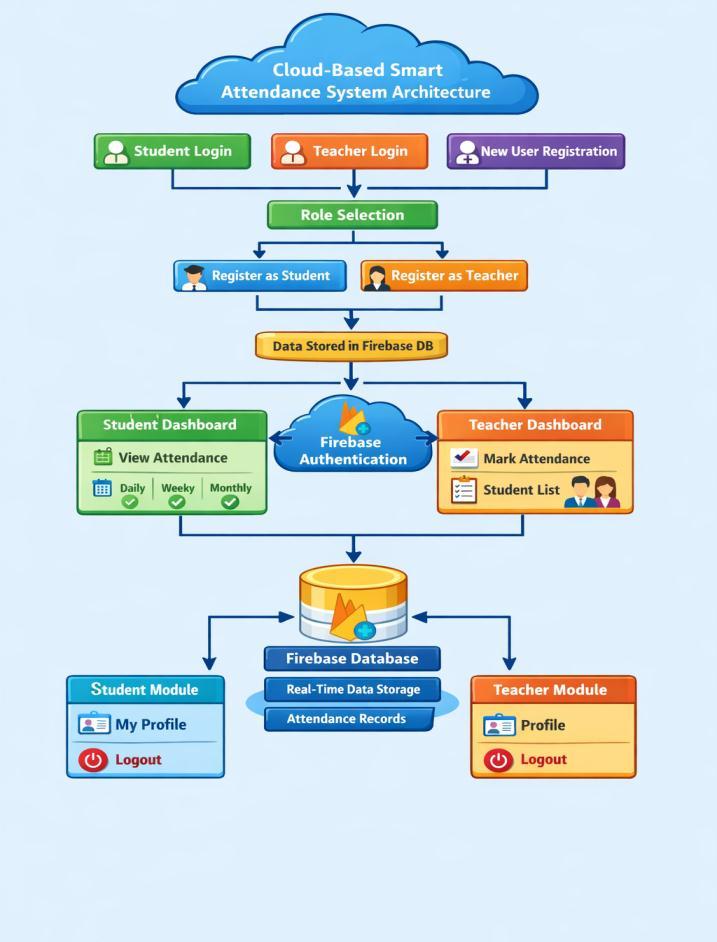
The above system architecture diagram represents the working structure of the Cloud-Based Smart Attendance SystemforStudentsandFaculty, developedusingAndroid Studio,XML,Java,andFirebase.Thearchitecturestartswith theAndroidapplicationinterface,whichprovidesthreemain entryoptions:StudentLogin,TeacherLogin,andNewUser Registration. New users first complete the registration processbyselectingtheirroleaseitherstudentorteacher andenteringrequiredpersonalandacademicdetails.These details are securely stored in the Firebase cloud database. Afterregistration,usersloginthroughtheirrespectivelogin modules, where Firebase Authentication verifies the credentials and ensures secure access to the system. Once authenticated, the system redirects users to role-based dashboards.Thestudentdashboardallowsstudentstoview their attendance details in percentage format along with daily,weekly,monthly,andlecture-wisereports,accesstheir profile information, and log out securely. The teacher dashboard provides access to a real-time list of registered studentsretrievedfromtheclouddatabase,enablingteachers tomarkattendancedigitallyusingatick-basedmethod.The markedattendancedataisinstantlysynchronizedandstored intheFirebasedatabase,ensuringcentralizedandreal-time
International Research Journal of Engineering and Technology (IRJET) e-ISSN: 2395-0056
Volume: 13 Issue: 02 | Feb 2026 www.irjet.net p-ISSN: 2395-0072
data management. Firebase acts as the core cloud service layerbyhandlingauthentication,real-timedatastorage,and synchronization between the Android application and the database.Overall,thisarchitectureensuressecurerole-based access, real-time attendance updates, reduced paperwork, improvedaccuracy,andreliableattendancemanagementfor bothstudentsandfaculty.
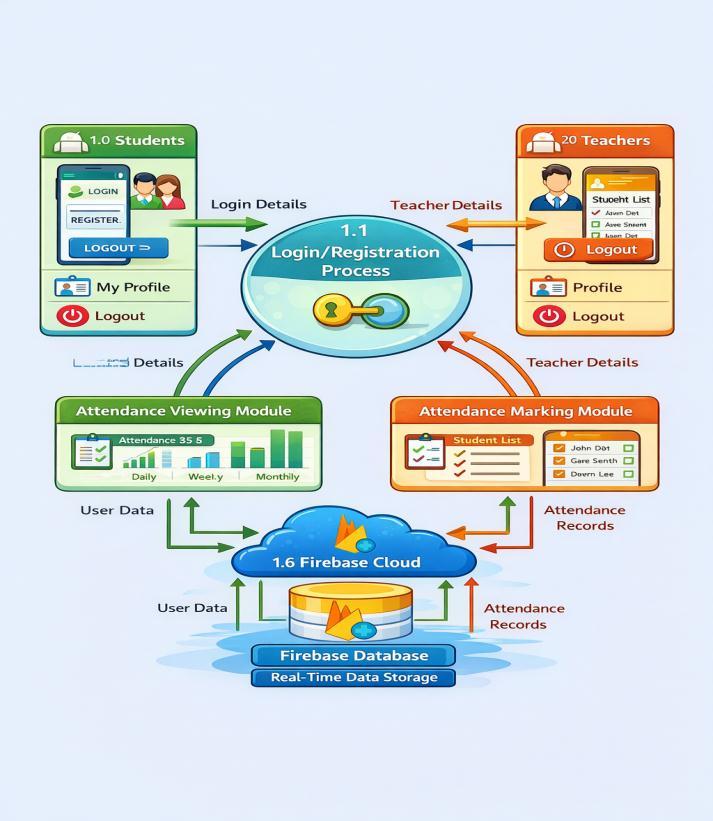
TheLevel1DataFlowDiagramexplainsthedetailedworking oftheCloud-BasedSmartAttendanceSystem.Inthissystem, therearetwomainusers:StudentandTeacher.Bothusers firstgothroughtheLogin/Registrationprocess,wheretheir detailsareverifiedusingFirebaseAuthenticationtoensure secure and role-based access. After successful login, the system divides the data flow based on the selected role. Students access the View Attendance module, where attendanceinformationisfetchedfromtheFirebaseCloud Databaseandshowninpercentageformatalongwithdaily, weekly, and monthly reports. Teachers access the Mark Attendancemodule,wheretheycanviewthelistofstudents and mark attendance for present students. The marked attendance data is then stored in the Firebase database in realtime.Firebaseworksasacentralizedcloudstoragethat managesuserdetailsandattendancerecordsandprovides real-timesynchronizationbetweentheAndroidapplication andthedatabase.ThisDFDLevel1clearlyshowshowlogin data, attendance data, and user information flow securely withinthesystem.
TheCloud-BasedSmartAttendanceSystemforStudentsand Faculty provides an effective and reliable solution to the challengesfacedbytraditionalmanualattendancesystems ineducationalinstitutions.Manualmethodsofattendance aretime-consuming,pronetoerrors,anddifficulttomanage over long periods, often leading to issues such as proxy attendance,dataloss,andlackoftransparencyforstudents. Theproposedsystemsuccessfullyaddressestheseproblems by automating the attendance process using Android and cloudcomputingtechnologies.
DevelopedinAndroidStudiousingXMLforuserinterface design, Java for application logic, and Firebase for secure authenticationandreal-timeclouddatastorage,thesystem ensuresaccuracy,efficiency,andeaseofuse.Therole-based architectureallowsteachersandstudentstoaccessseparate modules securely, enabling teachers to mark attendance digitally through a real-time student list while ensuring instant synchronization of attendance data with the cloud database. At the same time, students are provided with transparent access to their attendance information in percentageformat,includinglecture-wise,daily,weekly,and monthlyreports,whichhelpsthemmonitortheiracademic participationmoreeffectively.
The inclusion of user profile management, secure session handling, and logout functionality further enhances data securityandcontrolledaccess.ByusingFirebaseasacloud platform, the system offers centralized data management, real-timeupdates,scalability,andreducedriskofdataloss, while eliminating the need for physical registers and excessive paperwork. Overall, the Cloud-Based Smart Attendance System is cost-effective, user-friendly, and suitableforschools,colleges,andtraininginstitutes,andit stronglysupportsthetransitionfromtraditionalattendance practices to modern, digital, and automated academic management systems aligned with the goals of smart education.
[1]RajivKumar,AnkitSharma,“CloudComputing:Concepts andPractices,”InternationalJournalofAdvancedResearch inComputerScience,Vol.8,Issue5,pp.123–128,2017.
[2] P. Mell and T. Grance, “The NIST Definition of Cloud Computing,”NationalInstituteofStandardsandTechnology, SpecialPublication800-145,2011.
[3] S. Patil, R. Bhosale, “Online Attendance Management System Using Cloud Computing,” International Research JournalofEngineeringandTechnology(IRJET),Vol.6,Issue 4,pp.2450–2454,2019.
International Research Journal of Engineering and Technology (IRJET) e-ISSN: 2395-0056
Volume: 13 Issue: 02 | Feb 2026 www.irjet.net p-ISSN: 2395-0072
[4]A.Singh,N.Verma,“AutomatedAttendanceManagement System Using Web Technology,” International Journal of ComputerApplications,Vol.179,No.25,pp.1–5,2018.
[5] Amazon Web Services, “Introduction to Cloud Computing,” Available: https://aws.amazon.com/what-is cloud-computing/
[6]GoogleCloud,“CloudStorageDocumentation,”Available: https://cloud.google.com/storage/docs
[7] R. Buyya, C. Vecchiola, S. Selvi, “Mastering Cloud Computing,”McGraw-HillEducation,2013.
[8] IRJET, “Paper Submission Guidelines,” Available: https://www.irjet.net
[9]K.Kumar,S.Gupta,“DesignandImplementationofCloud BasedStudentAttendanceSystem,”InternationalJournalof EngineeringResearch&Technology(IJERT),Vol.7,Issue6, pp.412–416,2018.
[10] M. A. Khan, S. Khan, “Web Based Attendance Management System Using Cloud Platform,” International JournalofComputerScienceandInformationTechnologies, Vol.9,No.2,pp.85–89,2018.
[11] A. Mishra, R. Jain, “Secure Cloud Data Storage for AttendanceManagement,”InternationalJournalofScientific ResearchinComputerScience,Vol.6,Issue3,pp.112–116, 2019.
[12]L.Wang,G.Laszewski,“CloudComputing:APerspective Study,”NewGenerationComputing,Vol.28,No.2,pp.137–146, 2010. [13] S. Subashini, V. Kavitha, “A Survey on Security Issues in Service Delivery Models of Cloud Computing,”JournalofNetworkandComputerApplications, Vol.34,No.1,pp.111,2011.
[14] J. Dean, S. Ghemawat, “MapReduce: Simplified Data ProcessingonLargeClusters,”CommunicationsoftheACM, Vol.51,No.1,pp.107–113,2008.
[15]A.Verma,P.Tripathi,“Cloud-BasedWebApplicationfor EducationalInstitutions,”InternationalJournalofInnovative TechnologyandExploringEngineering(IJITEE),Vol.8,Issue 9,pp.2560–2564,2019.
[16] Microsoft Azure, “Cloud Computing Overview,” Available:https://azure.microsoft.com/en in/overview/what-is-cloud-computing/
[17] N. Sultan, “Cloud Computing for Education: A New Dawn?”InternationalJournalofInformationManagement, Vol.30,No.2,pp.109–116,2010.
PROF.ANILNAIK HOD,Dept.ofComputerEngineering
S.Y.PShreeyashCollegeofEngineeringandTechnology (POLYTECHNIC)
PROF.MAYUR.G.UHNALE GuideDept.ofComputerEngineering
S.Y.PShreeyashCollegeofEngineeringandTechnology (POLYTECHNIC)
MR.SOMNATHL.GAYKE PursuingPoly(Co)
S.Y.PShreeyashCollegeofEngineeringandTechnology (POLYTECHNIC)
MR.DURGESHK.RATHOD PursuingPoly(Co)
S.Y.PShreeyashCollegeofEngineeringandTechnology (POLYTECHNIC)
MR.PRATIKN.BUGAD PursuingPoly(Co)
S.Y.PShreeyashCollegeofEngineeringandTechnology (POLYTECHNIC)
MR.DHIRAJV.GAIKWAD PursuingPoly(Co)
S.Y.PShreeyashCollegeofEngineeringandTechnology (POLYTECHNIC)