
International Research Journal of Engineering and Technology (IRJET) e-ISSN: 2395-0056
Volume: 13 Issue: 03 | Mar 2026 www.irjet.net p-ISSN: 2395-0072
International Research Journal of Engineering and Technology (IRJET) e-ISSN: 2395-0056
Volume: 13 Issue: 03 | Mar 2026 www.irjet.net p-ISSN: 2395-0072
Prof. Anik C. Naik1 , Rof. Kalynani M. Khandal2, Amol A. Patil3, Varad B. Malode4, Rushikesh S. Narayankar5, Mayuresh A. Vetal6
1(Hod, Dept .Of Computer Engineering), S.Y.P Shreeyash College Of Engineering And Technology(Polytechnic),Chh.Sambhajinagar,India
2(Prof (Guide) , Dept .Of Computer Engineering), S.Y.P Shreeyash College Of Engineering And Technology(Polytechnic),Chh.Sambhajinagar,India
3,4,5,6(Students, Department Of Computer Engineering ),S.Y.P Shreeyash College Of Engineering And Technology(Polytechnic),Chh.Sambhajinagar,India
Abstract - The "Class Manager" project is a robust, rolebased Android application designed to streamline and digitize the academic management processes of polytechnic and engineering institutions. Developed using Android Studio and Firebase, the system addresses the limitations of manual record-keeping by providing a unified platform for Heads of Department (HODs), Teachers, and Students. The primary objective is to facilitate real-time communication, securedatahandling,andefficientacademictracking.
Unlike conventional management apps, Class Manager implements a Multi-Tier Security Architecture. It incorporates a mandatory Email Verification followed by a manual Admin Approval System, ensuring that only verified students and teachers can access the dashboard. The application leverages Firebase Realtime Database to offer instant synchronization of profile updates, attendance records, and academic marks. A standout feature is the Priority-Based Notification System, allowing teachers to categorize alerts as 'High Priority' (triggering instant popups) or 'Low Priority', targeted specifically to selected classes or divisions. attendance methods to a modern, digital, and automated academic management system, contributingsignificantlytotheconceptofsmarteducation.
"Class Manager" is an advanced, role-based Android application designed to revolutionize the academic administration of educational institutions. It addresses the inefficiencies of traditional manual systems by providing a centralized digital platform for Heads of Department (HODs), Teachers, and Students. The core objective of this project is to streamline daily operations such as attendance tracking, resource distribution, and critical communication, fostering a paperless and transparent campus environment. Developed using Android Studio and Firebase, Class Manager introduces a Multi-Tier Security Architecture. To combat unauthorized access and fake registrations, the system implements a mandatory Email Verification process followed by a manual Admin Approval System. This ensures thatonlyverifiedstakeholderscanaccesssensitiveacademic data.
Key Words: Class Manager, Android Application, Student Management System, Smart Campus, Digital Attendance, Firebase Realtime Database, Role Based Access Control (RBAC).
"Class Manager" is a cutting-edge, Android-based Smart CampusManagementSystemdesignedtorevolutionizethe traditional academic administration of polytechnic and engineeringinstitutes.Inaneraofrapiddigitalization,this application bridges the gap between manual recordkeeping and modern technological efficiency by offering a unified platform for Heads of Department (HODs), Teachers, and Students. The primary objective of Class Manager is to facilitate a paperless, transparent, and secureenvironmentformanagingdailyacademicactivities such as attendance tracking, resource sharing, and critical communication.
Unlike standard management applications, Class Manager introduces a robust Multi-Tier Security Framework. It mandates a stringent Email Verification process followed bymanual AdminApproval, ensuringthat only authorized personnel can access sensitive academic data. The system is powered by Firebase Realtime Database, which allows for instant synchronization of data across all three user modules. This means that profile updates, attendance records,andexaminationmarksarereflectedimmediately ontherespectivedashboardswithoutanydelay.
A distinctive featureof Class Manager is its Priority-Based Notification System, which empowers teachers to send highpriorityalerts(PopupNotifications)orgeneralnotices to specific classes and divisions, ensuring that no urgent information is missed by the students. Furthermore, the application integrates Firebase Cloud Storage to create a digital library where teachers can upload PDF notes and assignments, making study materials accessible to studentsanytime,anywhere.Bycombiningtheseadvanced featureswithauser-friendlyinterface,ClassManageraims to enhance the overall productivityofthe departmentand
International Research Journal of Engineering and Technology (IRJET) e-ISSN: 2395-0056
Volume: 13 Issue: 03 | Mar 2026 www.irjet.net p-ISSN: 2395-0072
foster a more connected educational ecosystem. "Class Manager" is a comprehensive, Android-based academic administration suite designed to orchestrate the complex workflow between Heads of Departments (HODs), Faculties, and Students. In the current landscape of technical education, the integration of digital solutions is no longer a luxury but a necessity. This project aims to replace the fragmented and manual methods of college management with a unified, smart, and real-time digital ecosystem.
ThecorephilosophybehindClassManageris"Connectivity and Transparency." Traditional systems often suffer from delayed information flow, where critical notices or attendance shortages are communicated too late. To counter this, our system utilizes Firebase Realtime Databasetechnology,ensuringthateverypieceofdata be ita student's profile update, a dailyattendance mark,or a semester result is synchronized instantly across all user panels.
Distinguishing itself from generic applications, Class Manager enforcesa Double-Layer VerificationProtocol. By combining automated Email Verification with a discretionary Manual Admin Approval, the system creates a secure perimeter that strictly prevents unauthorized access. This feature is particularly crucial for maintaining thesanctityofinstitutionaldata.
The development of the "Class Manager" system was preceded by an extensive study of existing academic management methodologies and available digital solutions. The survey focused on understanding the limitations of current practices and identifying the technologicalgapsthatourprojectaimstofill.
Analysis of Traditional Manual System:
Historically,andeveninmanyinstitutionstoday,academic dataismanagedmanuallyusingpaper-basedregistersand physical files. Our survey indicates several critical drawbacksinthisapproach:
Data Redundancy & Inconsistency: The same student data is often written in multiple registers (Attendance, Marks, Library),leadingtoduplicationanderrors.
Time Consumption: A study on academic administration revealsthatteachersspendapproximately15-20%oftheir lecture time manually taking attendance and another significant portion consolidating monthly reports. Lack of Data Security: Physical registers are prone to wear and tear, loss, or unauthorized access, posing a threat to studentprivacy.
While many institutions have adopted Web-based ERP portals, our literature review highlights a "Mobility Gap." Most of these systems are designed for desktop browsers. Accessibility Issues: Students and teachers often find it difficulttoaccessheavywebportalsonmobiledevicesdue tonon-responsiveinterfaces.
Server Latency: Traditional SQL-based web portals often suffer fromdowntime or slowloading speeds during peak traffic (e.g., result declaration), whereas our proposed system uses Firebase Realtime Database, which ensures millisecond-latencydatasyncing.
The primary objective of the "Class Manager" project is to design, develop, and implement a robust, Android-based academic management system that automates the manual and fragmented processes of polytechnic and engineering institutions. The system aims to provide a unified digital platform where Heads of Departments (HODs), Faculties, and Students can interact seamlessly in real-time. The specificobjectivesofthesystemareasfollows:
To Establish a Secure Digital Ecosystem: Toimplementa Multi-Tier Security Protocol involving mandatory Email VerificationfollowedbyamanualAdminApprovalSystem. Thisensuresthatonlyauthorizedpersonnelcanaccessthe system,therebyeliminatingfakeregistrationsandsecuring sensitiveinstitutionaldata.
To Enable Real-Time Data Synchronization: To utilize Firebase Realtime Database technology to ensure that any update whether it is a student's profile change, daily attendance marking, or marks entry is reflected instantly across all user dashboards without the need for manual refreshingordatareconciliation.
To Streamline Academic Communication:
TodevelopaPriority-BasedNotificationSystemthatallows teacherstocategorizealerts.Theobjectiveistoensurethat criticalinformation(HighPriority)triggersinstantpop-up alerts on student devices, while general notices are targetedspecificallytorelevantclassesordivisions.
The development of the "Class Manager" system strictly adhered to the Agile Software Development Life Cycle (SDLC) model, a choice that facilitated the iterative design andcontinuousintegrationofcomplexfeaturessuchasthe HOD dashboard and the multi-tier security protocol. The system is engineered upon a robust Client-Server Architecture, where the client-side interface is developed usingAndroidStudiowithJavaforbusinesslogicandXML fortheuserinterface,followingtheModel-View-Controller
International Research Journal of Engineering and Technology (IRJET) e-ISSN: 2395-0056
Volume: 13 Issue: 03 | Mar 2026 www.irjet.net p-ISSN: 2395-0072
(MVC) design pattern. On the server side, Google Firebase acts as the backend infrastructure, managing authentication, real-time database operations, and cloud storage, thereby eliminating the need for maintaining physicalservers.ThecommunicationbetweentheAndroid client and the Firebase server occurs via secure API calls, ensuringdataintegrityandrapidresponsetimes.
Acriticalaspectofthemethodologyistheimplementation of a unique "Double-Check" Authentication Algorithm designed to fortify system security. Unlike standard applications that rely solely on credential matching, Class Manager enforces a multi-layered verification logic where the system first validates the user via Firebase Authentication, then checks for mandatory Email Verification, and finally queries the database for an "AccountApproved"statusgrantedbytheHODorTeacher. Access to the dashboard is strictly denied unless all three conditions are met, ensuring that no unauthorized personnelorfakeprofilescanbreachthesystem.
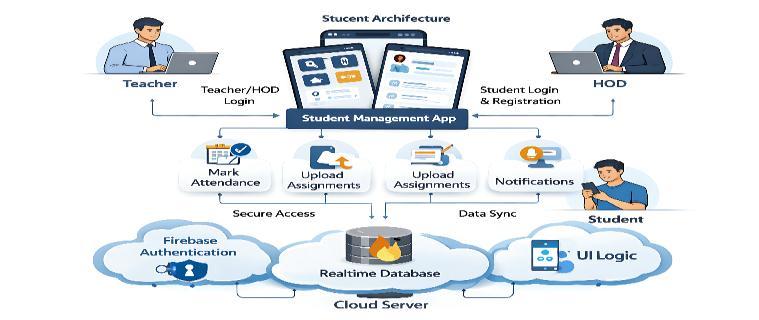
Fig -1:SystemArchitecture
TheClassManagersystemisdesignedusingaclient–server architecturethat integrates anAndroid mobileapplication with Google Firebase cloud services. The Android application acts as the client interface, allowing students, teachers, and administrators to interact with the system through rolebased dashboards. Firebase functions as the backend server responsible for authentication, real-time database management, and cloud storage. This architecture ensures secure access, real-time data synchronization, and efficient academic management. At the presentation layer, the Android application is developed using Android Studio with Java (or Kotlin) for application logic and XML for user interface design. This layer provides separate login screens for students and teachers,allowing usersto accesscustomizeddashboards. Students can view attendance records, download study materials, and check profile information, while teachers can manage student data, mark attendance, upload notes, and send notifications. The userfriendly interface ensures smooth interaction and accessibility from any mobile device. The application layer contains the core business logic of the system. It manages functions such as login
validation, role identification, attendance processing, notification handling, and file management. When a user enterslogincredentials,theapplicationsecurelysendsthe data to Firebase Authentication for verification. After successful authentication, the system determines whether the user is a student, teacher, or administrator and redirects them to the appropriate dashboard. This rolebased access control enhances data security and prevents unauthorizedaccess.
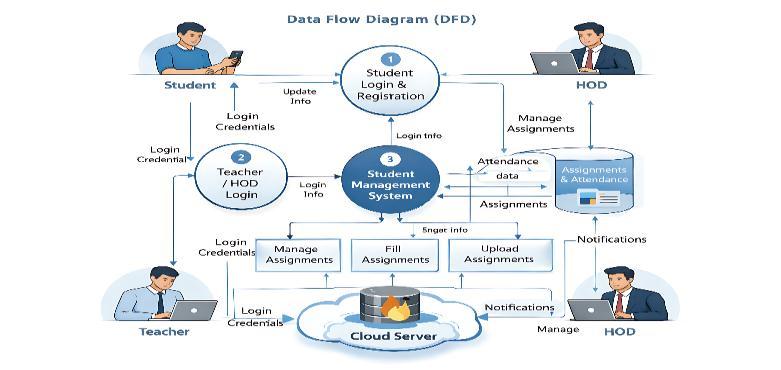
Role-Based Access Control (RBAC) flow chart illustrates how users are authenticated and authorized before accessing system resources. This model ensures that only permitted users can perform specific operations based on their assigned role. In the Class Manager system, RBAC is used to control access for Students, Teachers, and HOD/Administrators. The process begins when a user sends a request to the application service. The request is first forwarded to the authentication service, where the user’scredentialssuchasemailandpasswordareverified. If the authentication fails, the system immediately denies access and the user is marked as unauthorized. If authentication is successful, the system starts a user session and proceeds to the authorization stage. During authorization, the system checks the role assigned to the user.Eachrolehaspredefinedpermissions.
For example,students are allowed to view attendanceand download study materials, teachers can mark attendance and upload notes, and administrators can approve users and monitor system activities. If the role does not have permission for the requested operation, the system performsapolicycheck.Unauthorizedactionsareblocked and the user is denied access. If the role is valid and permissions match,the system allowsthe user to perform the required operation on the object, such as accessing records or updating information. After the operation is completed, the session eventually ends and the system returns to the security monitoring stage. The flow also includes continuous security checks for accumulated modifications to ensure that no unauthorized changes are madeduringoperation.
International Research Journal of Engineering and Technology (IRJET) e-ISSN: 2395-0056
Volume: 13 Issue: 03 | Mar 2026 www.irjet.net p-ISSN: 2395-0072
The Class Manager system successfully demonstrates the implementation of a role-based Android application designed to simplify and digitize academic management processes in educational institutions. By replacing traditional manual record-keeping with a centralized digital platform, the system improves efficiency, transparency, and data security. The application provides separate dashboards for students, teachers, and administrators,ensuringthateachusercanaccessonlythe information relevant to their role. The integration of Firebase Authentication enhances security by enabling verifiedloginaccess,whiletheFirebaseRealtimeDatabase ensures instant synchronization of attendance records, student details, and academic information. This real-time capability eliminates delays in communication and allows users to receive updated information immediately. The systemalsosupportsdigitaldistributionofstudymaterials and structured academic communication, reducing paperwork and improving accessibility for students and staff.
One of the major strengths of the Class Manager application is its role-based access control mechanism, whichpreventsunauthorizedaccessandprotectssensitive institutional data. Teachers can efficiently manage attendance and academic records, while students can easily monitor their own performance and download resources. The mobile-based design ensures that the system can be accessed anytime and anywhere, making it suitable for modern smart campus environments. Overall, the project proves that an Android and Firebase-based academic management system can significantly improve the organization of educational workflows. The Class Managerapplicationprovidesa secure,scalable,anduserfriendly solution that enhances communication, reduces manual effort, and supports the digital transformation of educationalinstitutions.
[1] Google Firebase, Firebase Authentication Documentation,Available: https://firebase.google.com/docs/auth
[2] GoogleFirebase,FirebaseRealtime Database Documentation,Available: https://firebase.google.com/docs/database
[3] Android Developers, Android Developer Guide, Available: https://developer.android.com
[4] Oracle Corporation, Java SE Documentation, Available:https://docs.oracle.com/javase
[5] IRJET,IRJETPaperFormatGuidelines,2026.
[6] S.KumarandR.Patel,“DesignandImplementationof Android Based Student Management System,” International Journal of Computer Applications, vol. 180,no.25,2023.
[7] A. Sharma, “Role-Based Access Control in Mobile Applications,” International Journal of Advanced ResearchinComputerScience,vol.14,no.3,2024.
PROF.ANIL NAIK
HOD,Dept.ofComputerEngineering
S.Y.PShreeYashCollegeofEngineering andTechnology (POLYTECHNIC)
PROF. KALYNANI M. KHANDAL GuideDept.ofComputerEngineering
S.Y.PShreeYashCollegeofEngineering andTechnology (POLYTECHNIC)
MR.AMOL A. PATIL PursuingPoly(Co)
S.Y.PShreeYashCollegeofEngineering andTechnology (POLYTECHNIC)
MR.RUSHIKESH S. NARAYANKAR PursuingPoly(Co)
S.Y.PShreeYashCollegeofEngineering andTechnology (POLYTECHNIC)
MR.VARAD B. MALODE PursuingPoly(Co)
S.Y.PShreeYashCollegeofEngineering andTechnology (POLYTECHNIC)
MR.MAYURESH A. VETAL PursuingPoly(Co)
S.Y.PShreeYashCollegeofEngineering andTechnology (POLYTECHNIC)