
International Research Journal of Engineering and Technology (IRJET) e-ISSN: 2395-0056
Volume: 13 Issue: 03 | Mar 2026 www.irjet.net p-ISSN: 2395-0072
International Research Journal of Engineering and Technology (IRJET) e-ISSN: 2395-0056
Volume: 13 Issue: 03 | Mar 2026 www.irjet.net p-ISSN: 2395-0072
1Prof. Dr. B. Geetha Vani, 2K. H. Koushikeswar Reddy, 3Y. Obul Reddy, 4T. Bhargav Sai Reddy
1Professor in Dept. of CSE, GPREC, Kurnool, India, 2,3,4 Undergraduate student in Dept. of CSE, GPREC, Kurnool, India
Abstract - Closed-circuit television (CCTV) systems play a vital role in modern surveillance; however, images captured by CCTV cameras frequently suffer from low resolution, compression artifacts, noise, and poor lighting conditions. These degradations reduce the effectiveness of visual inspection and analysis. In this work, Real-ESRGAN is utilized as the core super-resolution approach for enhancing CCTV images obtained under real-world surveillance conditions. A systematic enhancement workflow is designed to apply the model to CCTV imagery, and its effectiveness is examined through visual comparison The experimental results show noticeable improvements in perceptual quality and structural clarity of CCTV images, demonstrating the suitability of Real- ESRGAN for surveillance image enhancement tasks.
Key Words: CCTV image enhancement, Real-ESRGAN, super-resolution, surveillance imagery, image restoration
1. Introduction
Closed-circuit television (CCTV) systems are widely used for surveillance and security in public and private environments. However, images captured byCCTVcameras oftensuffer from low resolution, compression artifacts, noise, motion blur, and poor illumination conditions. These limitations arise due to hardware constraints, bandwidth restrictions, and challenging real-world environments. As a result, the visual quality of CCTV images is frequently insufficient for accurate monitoring, identification,andforensicanalysis,highlightingtheneedforeffectiveimageenhancementtechniques.
Severalapproacheshavebeenexploredtoimprovethequalityoflow-resolutionanddegradedimages,rangingfromtraditional imageprocessingtechniquestodeeplearning–basedmethods.Inrecentyears,super-resolutiontechniquesusingdeepneural networks have shown significant improvements over conventional methods. In particular, Generative Adversarial Networks (GANs) have been widely investigated for image enhancement tasks due to their ability to generate perceptually realistic details.PriorstudieshavedemonstratedthepotentialofGAN-basedsuper-resolutionmodelsforenhancinglow-qualityCCTV imagery,whilealsohighlightingchallengesrelatedtodatadiversity,trainingcomplexity,andcomputationalrequirements.
Recentadvancementsinsuper-resolutionhaveledto the development of enhancedGAN-based modelscapableof producing visually realistic high-resolution images. Among these, Real-ESRGANhasgainedattention for its ability to handle real-world degradations such as noise, blur, and compression artifacts.Unlikeearliersuper-resolutionapproachesthatrelyon idealized degradations, Real-ESRGAN is designed to operate effectively on practical, unconstrained images. Motivated by these capabilities, this work applies Real-ESRGAN to the task of CCTV image enhancement and examines its effectiveness on real surveillanceimagery,focusingonperceptualqualityimprovementratherthanmodelretrainingorarchitecturalmodification.
Image enhancement and super-resolution have been extensively studied to improve the visual quality of degraded images. Early approaches relied on traditional image processing techniques such as interpolation, denoising, and contrast enhancement;however,thesemethodsoftenfailedtorecoverfinedetailsinseverelydegradedimages.Withtheadvancement ofdeeplearning,convolutional neural networks(CNNs)havedemonstratedsignificantimprovementsinsingle-imagesuperresolutiontasksbylearningcomplexmappingsbetweenlow-andhigh-resolutionimages.
More recently,GenerativeAdversarial Networks(GANs)havebeenintroducedforimage enhancement duetotheirabilityto generate perceptually realistic textures. GAN-based super- resolution models have shown promising results in recovering structural details that are often lost in conventional CNN-based methods. Several studies have explored the use of GANs for enhancing low-quality and surveillance imagery, highlighting their effectiveness in improving resolution and perceptual quality whilealso notingchallenges related to training stability, dataset diversity, and computational In the context of CCTV
International Research Journal of Engineering and Technology (IRJET) e-ISSN: 2395-0056
Volume: 13 Issue: 03 | Mar 2026 www.irjet.net
p-ISSN: 2395-0072
image enhancement, existing works have primarily focused on training custom GAN models or modifying network architectures to address surveillance-specific degradations. While these approaches can achieve notable improvements, they oftenrequirelargedatasetsandsubstantialcomputationalresources.Incontrast,thisworkemphasizesapracticalapplication perspective by evaluating the effectiveness of Real-ESRGAN on CCTV imagery, aiming to assess its suitability for real-world surveillancescenarioswithoutextensiveretraining.
While existing studies have demonstrated the effectiveness of GAN-based super-resolution models for improving image quality, most approaches focus on model training, architectural modifications, or synthetic datasets. These methods often require large-scale training data and significant computational resources. In contrast, the proposed work emphasizes a practical application-oriented approach by directly applying the Real-ESRGAN model to real-world CCTV imagery without additionalretraining.Thisallowsevaluationofthemodel’seffectivenessunderrealisticsurveillanceconditions,whichis less exploredinpriorresearch.
The overall workflow begins with the acquisition of CCTV images collected from publicly available internet sources. These images represent realistic surveillance conditions, including low resolution, compression artifacts, noise, motion blur, and illumination inconsistencies. Since the images originate from real-world environments, they reflect practical challenges encounteredinsurveillancesystems.
Afteracquisition,eachimageundergoespreprocessingbeforebeingpassedtothesuper-resolutionmodel.Thepreprocessing stage includes resizing and noise filtering operations to stabilize input characteristics and reduce extreme distortions. AlthoughReal-ESRGANisdesignedtohandlereal-worlddegradations,preprocessingensuresconsistencyacrossvariedimage sourcesandimprovesenhancementreliability.
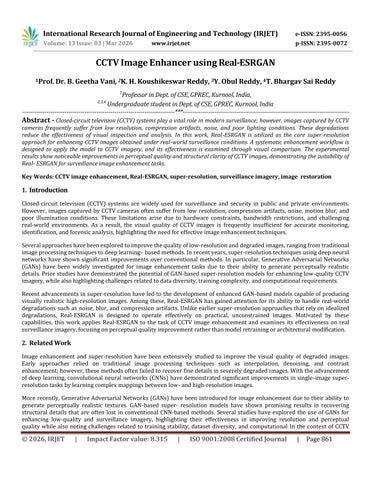
The enhanced output is generated using the Real-ESRGAN model. This model performs 4× super-resolution upscaling and reconstructsstructural andtextural detailsusinga GAN-basedframework.GPUacceleration was employed througha virtual GPU-enabledenvironmenttoimprovecomputationalefficiencyduringprocessing.
To evaluate enhancement performance, a comparative baseline was established using bicubic interpolation. For each input image,abicubic-upscaledversionwasgeneratedtomatchtheresolutionoftheReal-ESRGANoutput.Thisbaselineservesasa conventional interpolation reference against which the GAN-based enhancement is compared. Since true high-resolution ground-truth images were not available for real-world CCTV samples, this relative comparison strategy enables practical quantitativeevaluation.
International Research Journal of Engineering and Technology (IRJET) e-ISSN: 2395-0056
Volume: 13 Issue: 03 | Mar 2026 www.irjet.net p-ISSN: 2395-0072
International Research Journal of Engineering and Technology (IRJET) e-ISSN: 2395-0056
Volume: 13 Issue: 03 | Mar 2026 www.irjet.net p-ISSN: 2395-0072
Theexperimentalevaluationoftheproposedimage enhancementsystemwasconductedusingacollectionof morethan500 CCTV images obtained from multiple real-world sources. The dataset was designed to reflect realistic surveillance environments rather than controlled laboratory conditions. A portion of the images was collected from local surveillance environments,representingreal-timeCCTVconditions.Additionalsampleswereobtainedfrompubliclyavailablesurveillance footage, including frames extracted from online platforms such as YouTube. Furthermore, open-source images related to surveillancescenariosweregatheredfrompubliclyavailableinternetsourcestoincreasevariability.
The dataset includes a wide range of scenarios such as indoor monitoring areas, outdoor public spaces, streets, and parking zones, which are typical locations where CCTV cameras are deployed. It also incorporates variations in illumination conditions,noiselevels,motion blur,andcompression artifacts,whichcommonlydegradethe qualityofsurveillanceimages. Thisdiversityensuresthatthedatasetreflectspracticalchallengesencounteredinreal-worldCCTVsystems.
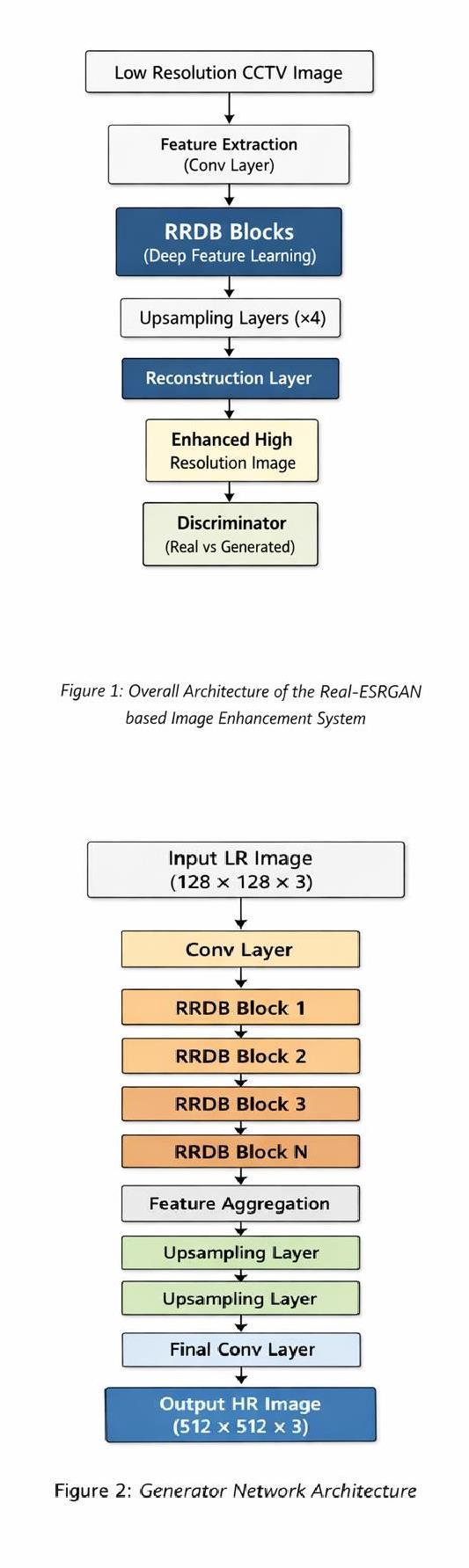
The model architecture utilizes a deep learning based super- resolution framework inspired by generative adversarial networks. In this architecture, the generator network focuses on reconstructing enhanced images by learning meaningful feature representations from the low-resolution inputs. The residual blocks within the generator play a crucial role in preserving important image structures while enabling deeper feature learning. Following feature extraction, upsampling layers increase the spatial resolution of the image, allowing the network toreconstructfinerdetailsthataretypicallylostin low-resolutionsurveillanceframes.
International Research Journal of Engineering and Technology (IRJET) e-ISSN: 2395-0056
Volume: 13 Issue: 03 | Mar 2026 www.irjet.net
p-ISSN: 2395-0072
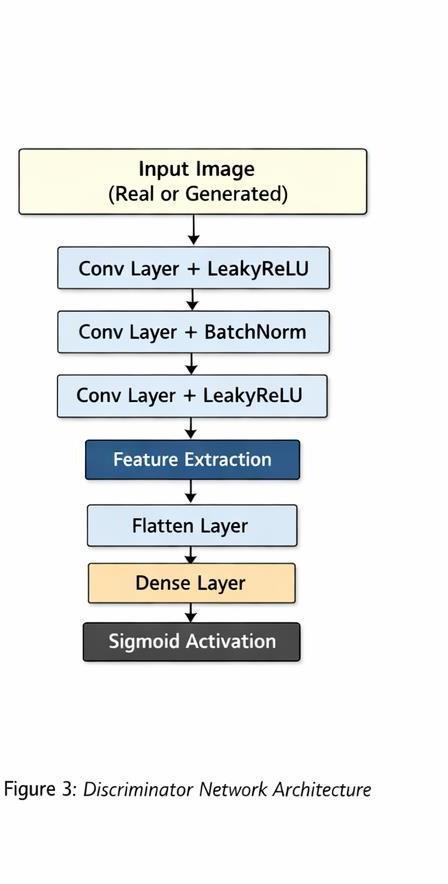
To further improve the quality of the generated images, a discriminator network is incorporated in the architecture. The discriminatorevaluateswhetherthegeneratedimageresemblesarealhigh-resolutionimageorareconstructedoutputfrom the generator. Through this adversarial learning mechanism, the generator gradually learns to produce images that contain sharpertexturesandimprovedvisualdetails.Theinteractionbetweenthegeneratoranddiscriminatornetworksenablesthe modeltoreducenoiseartifactsandreconstructmorerealisticimagestructures.
Each image in the dataset is processed individually through the enhancement model. The system records several evaluation parametersincludinginputresolution,outputresolution,andpixelexpansionratioinordertomeasuretheeffectivenessofthe super-resolution process. In addition to visual inspection, the enhanced images are compared against a baseline generated using bicubic interpolation, which is a commonly used traditional upscaling technique. This comparison allows the study to evaluate whether the deep learning based model provides superior enhancement compared to classical image processing methods.
Due to the absence of ground-truth high-resolution references for the collected CCTV images, full-reference reconstruction accuracycouldnotbecomputedintheconventionalsense.Instead,relativeevaluationwasperformedbycomparingtheRealESRGANoutputwithabicubicinterpolationbaseline.
PeakSignal-to-NoiseRatio(PSNR)wascalculatedbetweenthebicubic-upscaledimageandtheReal-ESRGANenhancedoutput. WhilePSNRtypicallymeasuresreconstructionfidelityrelativetoaground-truthimage,inthisstudyitservestoquantifypixellevelstructuraldeviationbetweeninterpolation-basedupscalingandGAN-basedsuper-resolution.
Similarly, the Structural Similarity Index (SSIM) was computed to measure luminance, contrast, and structural consistency between the two images. SSIM provides insight into how structural features differ when using deep learning-based enhancementcomparedtotraditionalinterpolation.
In addition to PSNR and SSIM, a gradient-based sharpness estimation method was implemented. This metric evaluates horizontalandverticalintensityvariationstoapproximateedgeclarityandtextureenhancement.Thesharpnessscoreenables estimationofperceiveddetailimprovementaftersuper-resolutionprocessing.
The experimental results demonstrate noticeable visual improvements in structural clarity and edge definition across the evaluatedCCTVimages.Comparedtotheoriginallow-resolutioninputs,theReal-ESRGANoutputsexhibitenhancedsharpness and improved perceptual quality. When compared with bicubic interpolation, the GAN-based approach reconstructs finer texturesandreducesvisibleblur.
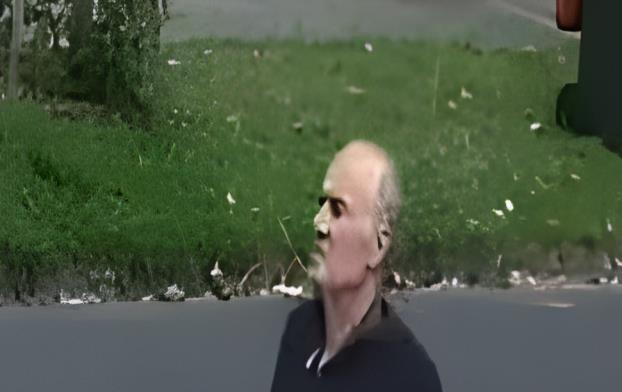
Facialregions,objectboundaries,andtextualelementswithinsurveillanceframesshowimprovedclarityafterenhancement. In several cases, small features that were previously indistinguishable become more recognizable. This improvement is particularlyimportantinforensicandsecurityapplicationswhereinterpretabilityplaysacriticalrole.
Quantitative evaluation indicates moderate PSNR and SSIM differences between bicubic interpolation and Real- ESRGAN output. As expected with GAN-based methods, perceptual quality improvements do not always correspond to significantly higherPSNRvalues.GANmodelsprioritize
visuallyrealistictexturereconstructionratherthanstrictpixel-wisesimilarity,whichexplainsmoderatePSNRmeasurements despiteclearperceptualenhancement.
Sharpness gain percentages consistently indicate improvement in edge intensity and gradient variation after enhancement. Thisconfirmsthatthesuper-resolutionmodeleffectivelyincreasesstructuraldetailrepresentation.
International Research Journal of Engineering and Technology (IRJET) e-ISSN: 2395-0056
Volume: 13 Issue: 03 | Mar 2026 www.irjet.net p-ISSN: 2395-0072
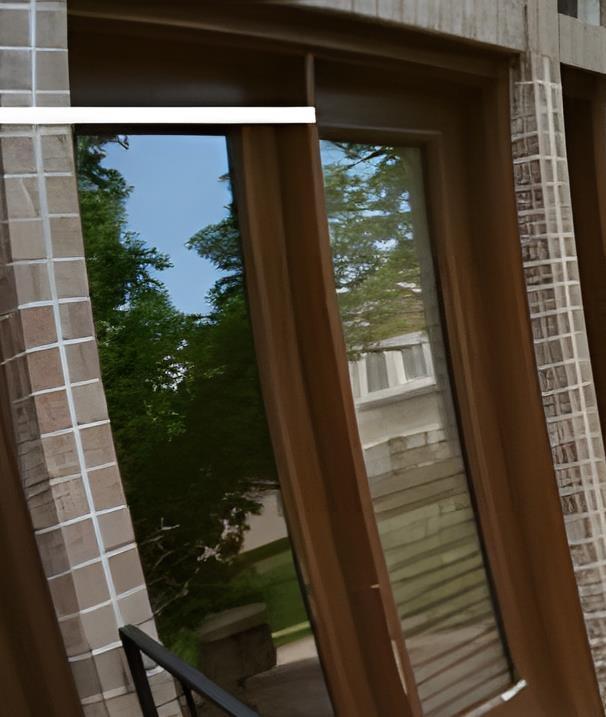
Figure - 4 Frames captured using surveillance system and the enhanced version of the image in the frame using the proposed model




International Research Journal of Engineering and Technology (IRJET) e-ISSN: 2395-0056
Volume: 13 Issue: 03 | Mar 2026 www.irjet.net p-ISSN: 2395-0072


International Research Journal of Engineering and Technology (IRJET) e-ISSN: 2395-0056
Volume: 13 Issue: 03 | Mar 2026 www.irjet.net p-ISSN: 2395-0072


International Research Journal of Engineering and Technology (IRJET) e-ISSN: 2395-0056
Volume: 13 Issue: 03 | Mar 2026 www.irjet.net p-ISSN: 2395-0072
Table 1 - Execution Time Table

7. Discussion
TheresultssuggestthatReal-ESRGANiswell-suitedforenhancingreal-worldCCTVimagery.
However,certainlimitationswereobserved.Extremelydegradedimageswithseveremotionblurorverylowinitialresolution occasionally produce minor artificial textures introduced by the GAN model. While these artifacts are generally subtle, they highlightthetrade-offbetweenperceptualrealismandstrictstructuralfidelity.
Additionally,sincetheevaluationreliesonrelativecomparisonratherthana bsoluteground-truthreconstruction,the reportedquantitativemetricsrepresentstructuraldifferencesratherthantruereconstructionaccuracy.Futurestudiesmay
International Research Journal of Engineering and Technology (IRJET) e-ISSN: 2395-0056
Volume: 13 Issue: 03 | Mar 2026 www.irjet.net
incorporateartificiallydegradeddatasets
8. Conclusion
p-ISSN: 2395-0072
ThisstudypresentedapracticalCCTVimageenhancementframeworkbasedontheReal-ESRGANmodel,aimedatimproving thevisualqualityoflow-resolutionsurveillanceimagery.Theprimaryobjectiveoftheworkwastoevaluatetheeffectivenessof the model in handling real-world surveillance images that often suffer from limitations such as noise, compression artifacts, poor illumination, and low spatial resolution. To achieve this, the proposed system incorporates a structured preprocessing stage followed by enhancement through the super-resolution model. The experimental setup also includes baseline comparisonandsystematicevaluationinordertomeasuretheimprovementachievedbythemodel.
TheresultsobtainedfromtheexperimentsdemonstratethattheReal-ESRGANbasedenhancementmodelproducessignificant improvements in image clarity and visual quality when compared with conventional upscaling approaches such as bicubic interpolation. The enhanced images show improved edge sharpness, better texture reconstruction, and higher perceptual quality, which makes the surveillance frames easier to interpret. These improvements are particularly valuable in practical surveillance applications where clearer visual information can assist in tasks such as object identification, monitoring, and forensic analysis. Both qualitative observations and quantitative comparisons indicate that the proposed enhancement frameworkiscapableofproducingmorevisuallyinformativeoutputsfromdegradedCCTVinputs.
Overall, the proposed system demonstrates that deep learning-based super-resolution models can play an important role in improving the usability of surveillance imagery. By enhancing low-resolution frames into more detailed and interpretable images,theframeworkcontributestothebroaderfieldofimagerestorationandsurveillanceanalytics.
Futureresearchmayfocusonseveral possibleimprovementstofurtherenhancethesystem’sperformance andapplicability. Onepotentialdirectionisthedevelopmentofdomain-specifictrainingstrategiesusingdedicatedsurveillancedatasets,which could allow themodeltobetteradapt totypicalCCTVconditions such as extreme lighting variations, motion blur, and longdistance camera capture. Another important extension would involve integrating the enhancement system with real-time videoprocessingpipelines,enablingcontinuousenhancementofliveCCTVfeeds.Additionally,futurestudies mayincorporate more comprehensive evaluation approaches, including advanced no-reference image quality assessment metrics and larger benchmark datasets, in order to provide a more detailed analysis of enhancement performance across diverse surveillance scenarios.
References
1) Chen, H., Li, H., Yao, C., Liu, G., & Wang, Z. (2025). "Image Super-Resolution Based on Improved ESRGAN and Its ApplicationinCameraCalibration."Measurement.
2) Liu, J., & Chandrasiri, N. P. (2024). "CA-ESRGAN: Super-Resolution Image Synthesis Using Channel Attention-Based ESRGAN."IEEEAccess.
3) Kumar, M. M., Gowrinath, P., Sujith, K., Pathan, M. A. K., & Tumuluru, T. P. (2024). "Enhancing Image Resolution Using HybridModel(EnhancedSuperResolutionGenerativeAdversarialNetwork)."AfricanJournalofBiomedicalResearch.
4) Rokade, P. M., Nikam, S., Nandan, S., Chouhan, V., & Shimpikar, S. (2024). "Image Resolution Enhancing Using ESRGAN Models."TIJER–InternationalResearchJournal.
5) Seshaiah, M., Nair, A. R., Mallya, E., & Dev, S. (2020). "CCTV Surveillance Camera’s Image Resolution EnhancementUsing SRGAN."InternationalResearchJournalofEngineeringandTechnology(IRJET).
6) Arain,H.A.,Imran,B.,Rehman,I.,&Farooqui,S.J.(2023)."ResolutionEnhancementofLow-QualityImages."
7) Goodfellow,I.,Pouget-Abadie,J.,Mirza,M.,Xu,B.,Warde-Farley,D.,Ozair,S.,Courville,A.,&Bengio,Y.(2014)."Generative AdversarialNets."AdvancesinNeuralInformationProcessingSystems.
International Research Journal of Engineering and Technology (IRJET) e-ISSN: 2395-0056
Volume: 13 Issue: 03 | Mar 2026 www.irjet.net p-ISSN: 2395-0072
8) Ledig, C., Theis, L., Huszár, F., Caballero, J., Cunningham, A., Acosta, A., Aitken, A., Tejani, A., Totz, J., Wang, Z., & Shi, W. (2017). "Photo-Realistic Single Image Super-Resolution Using a Generative Adversarial Network." IEEE Conference on ComputerVisionandPatternRecognition.
9) Wang,X.,Yu,K.,Wu,S.,Gu,J.,Liu,Y.,Dong,C.,Loy,C.C.,Qiao, Y., & Tang, X. (2018). "ESRGAN: Enhanced Super-Resolution Generative Adversarial Networks." European Conference on ComputerVisionWorkshops.
10) Wang,Z.,Bovik,A.C.,Sheikh,H.R.,&Simoncelli,E.P.(2004)."ImageQualityAssessment: FromErrorVisibilitytoStructural Similarity."IEEETransactionsonImageProcessing.