
International Research Journal of Engineering and Technology (IRJET) e-ISSN:2395-0056
Volume:12Issue:03|Mar2025 www.irjet.net p-ISSN:2395-0072
International Research Journal of Engineering and Technology (IRJET) e-ISSN:2395-0056
Volume:12Issue:03|Mar2025 www.irjet.net p-ISSN:2395-0072
Atharva Suhas Kulkarni1 ,
1
atharvakulkarni642@gmail.com
Abstract – This case study examines the feasibility, implementation, and operational efficiency of a floating offshore wind farm in Maharashtra, India. The study explores key aspects, including site selection, wind resource assessment,turbinetechnology,energyoutputoptimization, and challenges in grid integration. The project aims to assess the economic and environmental impact of floating offshore wind energy in India’s energy transition. Additionally, it evaluates the role of government policies, financial incentives, and technological innovations to enhance offshore wind deployment. The findings provide insights into the sustainability and feasibility of offshore wind energy in Maharashtra, contributing to India's renewableenergygoals.
Key Words: Floating Offshore Wind Energy, Maharashtra Wind Power, Renewable Energy, Offshore Wind Turbines, Wind Farm Feasibility, Grid Integration
1.INTRODUCTION
Offshore wind energy has emerged as a key player in the globaltransitiontowardsustainablepowergeneration[1]. Withincreasingenergydemandandtheurgencytoreduce carbon emissions, offshore wind farms provide a reliable andscalablesolution.Unlikeonshorewindfarms,offshore installationsbenefitfromhigherandmoreconsistentwind speeds,leadingtogreaterenergygenerationpotential [2] Withinoffshorewindtechnology,twoprimaryapproaches exist: fixed-bottom wind turbines, which are anchored to the seabed in shallow waters, and floating wind turbines, which are more suitable for deep waters where fixed foundationsarenotfeasible[3]
In India, Maharashtra’s Konkan region presents a viable location for offshore wind energy development due to its consistent wind speeds (6.5 – 8 m/s), proximity to urban energy demand centers (Mumbai, Pune), and access to maritimeinfrastructure[4]
Given the deep waters along Maharashtra’s coastline, floating offshore wind technology becomes the preferred choiceforenergygenerationinthisregion[5]
This case study aims to evaluate the feasibility, implementation, and challenges of developing a floating offshore wind farm in Maharashtra, addressing aspects
such as wind resource potential, turbine selection, economic viability, environmental impact, and future growthprospectsinIndia’soffshorewindsector.
Theselectionofa suitablesiteisa crucialstepinoffshore wind farm development, as it directly influences the energy output, cost-effectiveness, and environmental impact of the project. Maharashtra’s Konkan region has been identified as a promising location for offshore wind deployment due to its strategic positioning along the ArabianSeaandfavorablewindconditions[6].
Maharashtra’s coastal belt, stretching along the Konkan region, offers several advantages for offshore wind development. Firstly, the region is close to major urban energy demand centres such as Mumbai, Navi Mumbai, Pune, and Thane, making it an ideal location for clean energy generation. This proximity reduces transmission losses and enhances grid stability [7]. Secondly, Maharashtra is actively exploring offshore renewable energy as part of its long-term sustainability goals, aligning with India’s commitment to increasing its renewableenergycapacityto500GWby2030[8]
Additionally,theKonkancoastlinehasa mixofshallowto deep waters, allowing for the installation of floating offshorewindturbines,whichareessentialforharnessing wind energy in areas with water depths exceeding 50 meters. Compared to fixed-bottom wind turbines, which are limited to shallow waters, floating wind technology enablesMaharashtrato utilizeits deeper offshore regions efficiently[5].
The effectiveness of an offshore wind farm is highly dependent on wind speeds and consistency. Studies conducted by the National Institute of Wind Energy (NIWE) indicate that Maharashtra’s Konkan region experiencesaveragewindspeedsrangingfrom6.5–8m/s at 100 meters hub height. These speeds fall within the optimal range for efficient energy generation, particularly
International Research Journal of Engineering and Technology (IRJET) e-ISSN:2395-0056
Volume:12Issue:03|Mar2025 www.irjet.net p-ISSN:2395-0072
with large-capacity floating wind turbines like the Vestas V236-15.0MWmodelselectedforthisstudy[7].
The wind direction in this region is predominantly southwest during the monsoon season and northeast duringthewintermonths,ensuringrelativelysteadywind flow throughout the year. This consistency enhances the capacityfactorofoffshorewindturbines,leadingtohigher energy production compared to onshore wind farms, whichoftenexperiencegreaterseasonalfluctuations.[4]
The offshore waters of Maharashtra, exceeding 50 meters in depth, necessitate the use of floating wind turbines. Giventheseabedcompositionofsand,silt,androck,semisubmersible platforms are the most viable foundation, ensuringstabilityindynamicmarineconditions.
To mitigate environmental and socio-economic impacts, wind farms must be strategically positioned to avoid critical fishing zones and shipping lanes. Implementing low-noise installation techniques and engaging local stakeholderswill facilitatesustainabledevelopment while minimizing disruption to marine ecosystems and coastal livelihoods.
Additionally, the presence of busy shipping lanes near Mumbai poses a logistical challenge, requiring proper marinespatialplanningtopreventconflictsbetweenwind farm operations and commercial shipping routes. Collaboration with local fishing communities and port authorities is essential to ensure that offshore wind development does not negatively impact livelihoods or coastaleconomies.
Floating wind technology enables wind turbines to be installed in deep waters where fixed-bottom foundations are impractical. These turbines are mounted on floating structuresanchoredtotheseabedusingmooringsystems. This approach is essential for Maharashtra’s offshore waters, which exceed 50 meters in depth, making traditionalfixedfoundationsunsuitable.
Semi-submersibleplatformsarethemostsuitablefloating foundations for this project. They distribute the turbine’s weight across multiple pontoons, ensuring stability against strong ocean currents and wind forces. Their low center of gravity and dynamic positioning system make them highly effective in Maharashtra’s deep-water conditionswhileminimizingstructuralstress.
The following table compares two turbine models based onkeytechnicalparameters:
Table-1: Comparisonoftwoturbinemodels
Feature
Annual Energy
Production (AEP)
Suitability for Floating Wind
Higherdueto largersweptarea
Lowercomparedto Vestas
Provenoffshore technology Limitedoffshore deployment experience
Reason for Choosing Vestas V236-15.0 MW: TheVestas V236-15.0 MW turbine is selected for this project due to itshighercapacity,largersweptarea,andprovenoffshore performance [5]. Its greater energy capture efficiency reducesthe numberofturbinesrequired,optimizing both costandmaintenanceeffortsindeep-seaconditions[6]
The efficiency and reliability of a floating offshore wind turbine depend on its core components, which work together to convert wind energy into electricity. The diagrambelowillustratesthekeystructuralandfunctional elementsofafloatingoffshorewindturbine,includingthe nacelle, rotor blades, gearbox, generator, and tower. Understanding these components is essential for optimizing energy production and ensuring long-term operationalstability
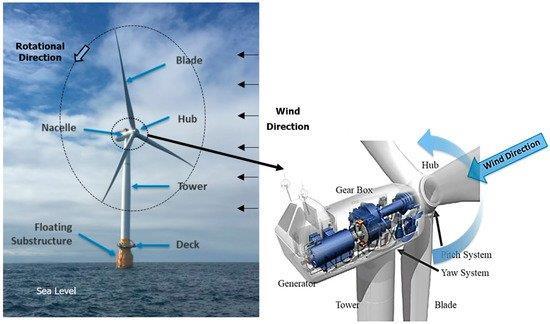
Fig-1:StructuralandFunctionalComponentsofaFloating OffshoreWindTurbine
International Research Journal of Engineering and Technology (IRJET) e-ISSN:2395-0056
Volume:12Issue:03|Mar2025 www.irjet.net p-ISSN:2395-0072
As seen in the diagram, the rotor blades capture wind energy, rotating the hub and transferring mechanical powerthroughthegearboxtothegeneratorhousedinthe nacelle. The yaw and pitch systems ensure optimal blade orientation based on wind direction, maximizing efficiency. The turbine is mounted on a floating substructure, allowing deployment in deeper waters, making it an ideal solution for Maharashtra’s offshore wind energy potential. These components work together toenablesustainableandreliablepowergeneration.
Thesuccessfulintegrationofafloatingoffshorewindfarm intoMaharashtra’spowergridrequiresstrategicplanning tomaximizeenergyoutput andensureefficient electricity transmission.
A 100 MW floating offshore wind farm in Maharashtra is expected to generate approximately 400–450 GWh per year,basedon:
High-Capacity Factor (~45%) – Offshore wind turbinesgeneratepowermoreconsistentlydueto strongerandsteadierwindspeeds.
Advanced Turbine Efficiency – The selected Vestas V236-15.0 MW turbine is designed for optimalperformanceinoffshoreconditions.
Minimal Land Constraints – Unlike onshore wind farms, offshore projects face no physical obstructions, enabling continuous energy production[8]
While offshore wind energy offers high reliability, integrating it into Maharashtra’s power grid presents severalchallenges:
Fluctuating Wind Speeds – Variability in wind intensity can cause fluctuations in power generation, requiring a balanced grid infrastructure.
Transmission Infrastructure Costs – Laying subsea HVDC cables and upgrading the existing powergridrequireshighcapitalinvestment.
Grid Stability and Demand-Supply Balance –Offshore wind farms need to be synchronized withthegridtopreventvoltagefluctuations.
To overcome transmission challenges, High Voltage Direct Current (HVDC) transmission is preferred over traditionalACsystemsdueto:
Lower Transmission Losses – Offshore wind farms are located far from demand centers, makingHVDCcablesmoreefficient.
Higher Power Transfer Capacity – HVDC lines can handle large amounts of power with minimal energydissipation.
Improved Grid Stability – HVDC converters regulate power flow and enhance system reliability.
The integration of HVDC technology ensures that offshore wind power is delivered efficiently to Maharashtra’s energy grid, reducing energy losses and maximizingeconomicreturns.
To ensure a consistent power supply, offshore wind energy can be combined with energy storage and hybrid renewablesolutions:
Battery Energy Storage Systems (BESS) –Stores excess wind power and releases it during periodsoflowwindspeeds.
Hybrid Offshore Wind-Solar Integration –Floating solar panels alongside wind turbines optimize energy output and ensure a steady supply.
Grid-Connected Smart Systems – AI-driven smartgridscanpredictenergydemandandadjust supplyaccordingly.
A floating offshore wind farm requires a substantial upfront investment due to the complexity of deep-sea installationsandtransmissioninfrastructure.
For a 100 MW floating offshore wind project in Maharashtra, the estimated capital expenditure (CapEx) is ₹3,000 – ₹3,700 crore ($360M – $450M). The cost distributionincludes:
TurbineProcurement&Installation –35%
FloatingPlatform&AnchoringSystem –30%
International Research Journal of Engineering and Technology (IRJET) e-ISSN:2395-0056
Volume:12Issue:03|Mar2025 www.irjet.net p-ISSN:2395-0072
HVDCTransmission&Substation –25%
Engineering,Development&Permits –10%
While offshore wind has a higher initial investment compared to onshore wind or solar, it ensures greater long-term energy reliability and higher capacity factors, makingitastrategiclong-terminvestment.
The financial sustainability of offshore wind energy depends on its generation capacity and market pricing. Theprojectedrevenueandcostbreakdownareasfollows:
Annual Energy Output: 400 – 450 GWh (45% capacityfactor)
TariffperkWh: ₹6.5 ($78/MWh)
Annual Revenue: ₹260 – ₹292 crore ($31M –$35M)
Operational Costs (O&M): ₹80 – ₹110 crore ($10M – $13M)peryear
Net Annual Profit: ₹180 – ₹210 crore ($21M –$25M)
Break-evenPeriod: 12 – 16years
TotalNetProfitOver30Years: ₹1,800 – ₹2,200 crore($215M – $260M)
Due to higher efficiency and predictable wind conditions offshore, this investment is financially viable, especially when supported by government incentives, tax credits, and long-term Power Purchase Agreements(PPAs).
5.3 Performance and Reliability: Offshore Wind vs. Solar
To evaluate long-term stability and energy reliability, offshore wind and solar power generation are compared over 30years [6]:
Table-2: ComparisonofOffshoreWindandSolar Factor
DegradationRate 0.3%per
Break-even Period 12–16years 5–7years
TotalNetProfit (30yrs) ₹1,800–₹2,200crore ($215M–$260M) ₹3,700crore ($450M)
The efficiency of a renewable energy source depends on its long-term performance. This graph compares the power generation decline of a 100 MW offshore wind farm (45% CF) and a 100 MW solar farm (20% CF) over30years,highlightingtheirreliabilityovertime.
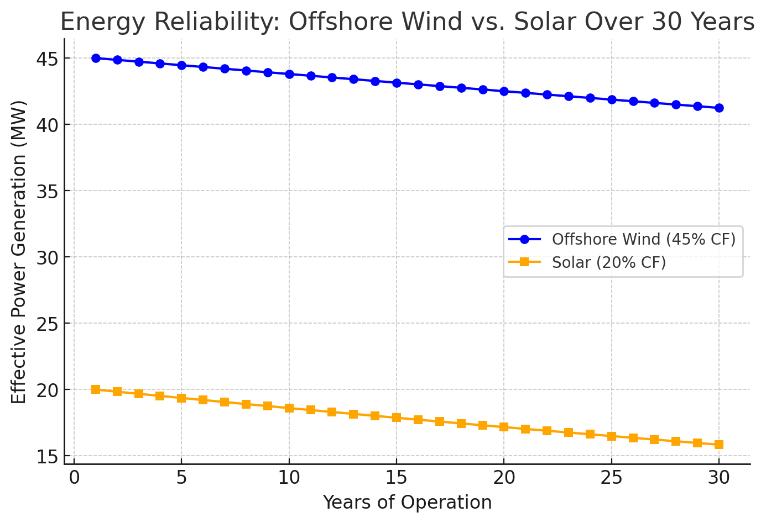
Fig-2: EnergyReliability–OffshoreWindvs.SolarOver 30Years
Offshorewindretainshigherefficiencyover30years,with only 0.3% annual degradation, whereas solar degrades at 0.8% per year. This makes offshore wind a more reliable and stable energy source for Maharashtra’s long-term energysecurity.
Offshore wind ensures long-term stability, with lower degradation(0.3%peryear)comparedtosolarovera30yearperiod.
Solarhasafasterpaybackperiod(5–7years)butdegrades morequickly,reducingitslong-termefficiency.
Offshore wind has a higher upfront investment but produces more power consistently due to its higher capacityfactor(45%).
Hybrid models (Offshore Wind + Solar + Battery Storage) are preferred for balancing cost efficiency and grid stability.
Government incentives (Viability Gap Funding, Tax Benefits)canimproveoffshorewindfinancialviabilityand reducethebreak-eventime.
International Research Journal of Engineering and Technology (IRJET) e-ISSN:2395-0056
Volume:12Issue:03|Mar2025 www.irjet.net p-ISSN:2395-0072
Despitea higherinitial investment,offshore windensures consistent energy production, even during nighttime and monsoonseasons,wheresolaroutputisminimal.
6. Challenges and Solutions
The deployment of a floating offshore wind farm in Maharashtra presents several challenges, ranging from technical complexities to financial constraints, environmental concerns, and regulatory hurdles. Addressing these challenges effectively is crucial for the project'ssuccess.Thissectionoutlineskeychallengesand providesstrategicsolutionstoovercomethem.
6.1TechnicalChallengesandSolutions
6.1.1FloatingTurbineStabilityinDeepWaters
Challenge: Floating offshore wind turbines must withstand harsh ocean conditions, strong currents, and highwaves,makingstabilityacriticalissue.
Solution:
Implement semi-submersible floating platforms toenhancestability.
Utilize dynamic mooring systems and AI-based stabilitycontrol forreal-timeadjustments.
Conduct continuous monitoring and predictive maintenance topreventstructuralfailures.
6.1.2 GridIntegrationandPowerTransmission
Challenge: Offshore wind farms require highvoltage subsea transmission, and fluctuating windspeedscanleadto gridinstability
Solution:
o Use HVDC subsea cables to minimize transmission losses and increase efficiency.
o Develop a hybrid wind-solar-storage system forenhancedgridstability.
o Implement smart grid technologies to balance energy supply and demand in real-time.
6.1.3OperationsandMaintenance(O&M)Complexity
Challenge: Conducting repairs and routine inspections in deep-sea environments is costly andlogisticallychallenging.
Solution:
o Deploy AI-driven predictive maintenance systems to detect issues beforefailuresoccur.
o Utilize autonomous underwaterdrones androboticrepairunits forinspections.
o Establish dedicated offshore O&M service vessels for quick response and maintenanceoperations.
6.2FinancialandInvestmentChallenges
6.2.1HighInitialCapitalInvestment
Challenge: Theprojectrequires ₹3,000 – ₹3,700 crore ($360M – $450M) in upfront investment, makingitlessattractiveforprivateinvestors.
Solution:
o Implement Viability Gap Funding (VGF) toreducefinancialrisks.
o Offer Green Bonds and Offshore Wind Investment Tax Credits to attract investors.
o Establish long-term Power Purchase Agreements (PPAs) to ensure stable revenue.
6.3EnvironmentalandSocialConsiderations
6.3.1ImpactonMarineBiodiversity
Challenge: Offshore wind projects can affect marine ecosystems, fish populations, and seabirdmigration.
Solution:
o Conduct detailed Environmental Impact Assessments (EIA) before deployment.
o Implement eco-friendly turbine foundations to promote marine habitat protection.
o Use low-noise installation techniques tominimizedisturbancetomarinelife.
6.3.2FishermenandLocalCommunityConcerns
Challenge: Offshore wind farms may interfere with traditional fishing zones,causingeconomic concernsforlocalcommunities.
Solution:
o Develop compensation and benefitsharingmodels foraffectedfishermen.
International Research Journal of Engineering and Technology (IRJET) e-ISSN:2395-0056
Volume:12Issue:03|Mar2025 www.irjet.net p-ISSN:2395-0072
o Establish fishermen co-management programs that allow sustainable fishing alongsideoffshorewindoperations.
o Conduct public consultations and stakeholder engagement to build local support.
The successful deployment of a floating offshore wind farm in Maharashtra has the potential to pave the way forlarge-scaleoffshorewinddevelopmentinIndia.
India has set ambitious renewable energy targets, and offshore wind is expected to play a crucial role in achieving them. The projected growth for offshore wind capacityincludes:
Table-3: OffshoreWindGrowthinIndia(2025–2050)
Year InstalledCapacity KeyMilestone
2025 50-100MW
2030 5GW
2040 20-30GW
2050 30-50GW
Pilot projects in Maharashtra&Gujarat
Offshore wind auctions, firstlarge-scalefarms
Hybrid models (wind + solar+batterystorage)
Offshorewindbecomesa major contributor to India’sgrid
Reductions
Continuous technological advancements will drive offshore wind adoption by making it more efficient and cost-effective.Keyinnovationsinclude:
Next-generation floating wind turbines with larger rotordiametersandhigherefficiency.
Smart grid integration and AI-based predictive maintenance tooptimizeenergyoutputandreduceO&M costs.
Advanced HVDC transmission systems to ensure minimalpowerlossesoverlongdistances.
Innovations in floating platforms,makingoffshorewind feasibleindeeperwatersatlowercosts.
To accelerate offshore wind deployment, India must establish strong policy frameworks and regulatory mechanisms.Keypolicyimprovementsinclude:
Long-term offshore wind auctions to provide financialsecurityforinvestors.
Viability Gap Funding (VGF) and Green Bonds toattractprivatesectorinvestment.
Clear environmental permitting guidelines to streamlineapprovalprocesses.
Incentives for local manufacturing of offshore windcomponents,reducingrelianceonimports.
This case study has demonstrated the feasibility, challenges, and future potential of developing a 100 MW floating offshore wind farm in Maharashtra, India.The findingsindicate that floating offshore wind technology presents a viable solution for harnessing India’s vast offshore wind resources, offering higher capacity factors, long-term energy reliability, and reduced land dependency compared to other renewable energy sources.
Despite challenges related to high capital costs, grid integration complexities, and environmental concerns, this study highlights key strategic solutions, including Viability Gap Funding (VGF), advanced HVDC transmission, hybrid wind-solar integration, and enhanced policy frameworks. These measures can mitigate financial risks, improve grid stability, and ensuresustainableprojectdeployment
Furthermore, projections suggest that India’s offshore wind capacity could grow from 100 MW (pilot stage) to 50 GW by 2050, positioning Maharashtra as a critical hubforoffshorewindenergyexpansion.
With the right policy instruments, technological innovations, and investment strategies, Maharashtra’s offshore wind sector can serve as a model for sustainable energy development, contributing significantly to India's cleanenergytransitionandclimatecommitments.
[1] [1]M.ArshadandB.C.O'Kelly,"Offshorewind-turbine structures: A review," Proceedings of the Institution of Civil Engineers Energy, vol. 166, no. EN4, Nov. 2013. Available: https://www.researchgate.net/publication/2604245 53_Offshore_wind-turbine_structures_A_review.
International Research Journal of Engineering and Technology (IRJET) e-ISSN:2395-0056
Volume:12Issue:03|Mar2025 www.irjet.net p-ISSN:2395-0072
[2] H. Almansoori, "Offshore Wind Farms Research Paper," ResearchGate, Aug. 2020. Available: https://www.researchgate.net/publication/3438785 59_Offshore_Wind_Farms_Research_Paper
[3] B.Desalegn,D.Gebeyehu,B.Tamrat,T.Tadiwose,and A. Lata, "Onshore versus offshore wind power trends and recent study practices in modeling of wind turbines’ life-cycle impact assessments," Cleaner Technologies and Environmental Policy, Nov. 2023, doi:10.1016/j.clet.2023.100691.
[4] L.AlhmoudandH.Al-Zoubi,"IoTApplicationsinWind Energy Conversion Systems," Engineering Review, vol. 39,no.6,Nov.2019,doi:10.1515/eng-2019-0061.
[5] B. Desalegn, D. Gebeyehu, and B. Tamrat, "Wind energy conversion technologies and engineering approaches to enhancing wind power generation: A review," Heliyon, vol. 8, no. 11, Nov. 2022, doi:10.1016/j.heliyon.2022.e11263.
[6] A.Fernández-Guillamón,K.Das,N.A.Cutululis,andÁ. Molina-García,"Offshore WindPowerIntegrationinto FuturePowerSystems:OverviewandTrends," Journal of Marine Science and Engineering, vol. 7, no. 11, Nov. 2019,doi:10.3390/jmse7110399.
[7] A. M.-Z. Gao, C.-H. Huang, J.-C. Lin, and W.-N. Su, "Review of recent offshore wind power strategy in Taiwan: Onshore wind power comparison," Energy Strategy Reviews, vol. 38, 2021, doi:10.1016/j.esr.2021.100747.
[8] P.Hevia-KochandH.K.Jacobsen,"Comparingoffshore and onshore wind development considering acceptance costs," Energy Policy, vol. 125, Feb. 2019, doi:10.1016/j.enpol.2018.10.019.