
International Research Journal of Engineering and Technology (IRJET) e-ISSN: 2395-0056
Volume: 12 Issue: 12 | Dec 2025 www.irjet.net p-ISSN: 2395-0072
International Research Journal of Engineering and Technology (IRJET) e-ISSN: 2395-0056
Volume: 12 Issue: 12 | Dec 2025 www.irjet.net p-ISSN: 2395-0072
Dr Shivanand H1 ,Mahalaxmi K2,Mandar S3 , Manisha N4 , Srushti K5
1Assistant Professor, S G Balekundri Institute Of Technology, Belagavi, Karnataka, India
2,3,4,5Student, S G Balekundri Institute Of Technology, Belagavi, Karnataka, India ***
Abstract - The conventional manual processes for campus recruitment involving extensive paperwork, fragmented communication, and logistical coordination are proving inefficient and unsustainable for modern educational institutions with large student populations. This paper proposes the conceptual design and technological framework for a comprehensive Campus Placement Web Portal (CPWP) aimed at streamlining the entire recruitment lifecycle for all stakeholders, including recruiters. The CPWP serves as a united digital platform, integrating essential features such as role-based dashboards for students, placement of icers, and recruiters, automated application tracking, and secure data management. A key element of its data integrity is the robust CGPA calculation module, which automatically verifies and maintains accurate academic eligibility records. Furthermore, it explores the integration of next-generation technologies like the Resume Analyzer feature and AI-driven shortlisting to efficiently process candidate information and align the system with emerging trends in hybrid and skill-based hiring, ultimately ensuring a more effective, transparent, and equitable placement process.
Keywords: Cyber security, Cyber Threats, AI in Security, Ransom ware, Zero- Trust Architecture
Campus recruitment is a pivotal mechanism that bridges the gap between graduating students and the professional workforce. It is critical not only for securing employment for students but also for enhancing the reputation and industry standing oftheeducationalinstitution.Traditionally,placementactivitieshavebeenmanagedthroughmanual methods involving paper notices, physical application submissions, email communication, and spreadsheet-based tracking.Thisrelianceonnon-integratedsystemshasledtosystemicchallengesinscalability,dataaccuracy,andtimely communication, making the existing framework increasingly inadequate for the demands of a high-volume, dynamic hiringmarket.
Historically,theplacementprocesswaslargelyalocalizedandphysicalevent.Theevolutionofinformationtechnologyin education has driven the necessity to shift to digital platforms. The limitations of the manual approach including delayed communication, data redundancy, scheduling conflicts, and limited access for recruiters outside a specific region have made these traditionalsystems cumbersome and unsustainable.Theadventofwebandcloud technologies provides the foundation for creating a robust, centralized placement portal. The primary driver for this digitalmigrationistheneedtoefficientlymanageagrowingstudentbodyandcatertothediversifiedhiringdemandsof moderncorporations,whichincreasinglyrelyonvirtualanddata-drivenmethods.
AmodernCPWPisdesignedtoachieveseveralcriticalobjectivesacrossallthreeprimaryusergroups:
Automation: To automate routine administrative tasks like student registration, eligibility checks, and interview scheduling, thereby reducing the workload on the Training and Placement Cell (TPC) staff and minimizinghumanerror.
Centralization: To provide a single, secure repository for all student profiles, company information, job listings,andplacementrecords,ensuringconsistentandreadilyaccessibledata.
International Research Journal of Engineering and Technology (IRJET) e-ISSN: 2395-0056
Volume: 12 Issue: 12 | Dec 2025 www.irjet.net p-ISSN: 2395-0072
Efficiency: Tosignificantlyincreasethespeedandaccuracyoftheplacementprocess,facilitatingquick,criteriabasedmatchingbetweenjobrolesandstudentprofiles.
Transparency: To offer real-time tracking of application statuses and progress to all stakeholders (students, TPC,and recruiters),enhancingtrustandreducingstudentanxiety.
Scalability: To manage the recruitment process efficientlyacrossalargevolumeofcandidatesand companies, ensuringthesystemcangrowwithoutcompromisingperformance.
The scope of this proposed CPWP is defined by its ability to manage the complete end-to-end recruitment cycle. This extends from student profile creation and academic data verification (including automated CGPA calculation) to company registration, job posting, automate shortlisting via theResumeAnalyzer, interviewscheduling,andfinal offer management. The successful implementation of the CPWP is projected to have a quantifiable impact on the institution's placement rate, the quality of industry partners, and the overall administrative efficiency of the TPC, fundamentallytransformingtheinstitution'srecruitmentmethodologyandreputation.
The foundation of the CPWP design is built upon addressing the deficiencies of current practices and synthesizing best practicesfromexistingtechnologicalsolutions.
A. Limitations of Traditional Placement Methods Traditional campus placement systems, as noted by and, suffer from fundamentalinefficienciesrootedinmanualprocesses.Thesesystemsarenotequippedtohandlethescalabilityrequired by modern institutions, leading to operational bottlenecks, especially in high-volume application scenarios. Key limitations include: the mismatch between academic curriculum and industry expectations, which is often masked by inefficient resume screening; the logistical nightmare of organizing physical drives for hundreds of companies; and the resultant stress and anxiety among students due to chaotic scheduling and poor communication. These factors collectivelyunderminetheeffectivenessoftheplacementdrive.
B. Comparison with Generic Job Portals
While generic job portals (e.g., LinkedIn, Indeed) offer a wide reach, they are not optimized for the specific nuances of campus recruitment. A study by highlights that dedicated campus platforms offer critical differentiators not found in generalportals:
ExclusiveFocus:Theycaterexclusivelytoentry-levelfresherandinternships,providingbetterjobrelevance.
Academic Integration: They directly integrate academic records for eligibility checks, including automated CGPA calculationand backlog Verification,whicharemandatorycriteriaforcampusjobs. Advertisements.
Generic portals, conversely, cater to a broad audience, offering limited specific tools for resume building tailored to fresher requirements or specialized campus interview preparation. The CPWP aims to combine the efficiency of an onlineplatformwiththetrustandspecificityofaninstitutionalplacementcell.
Prior
Academicresearchhasconsistentlyadvocatedfor digitalsolutionstothesechallenges.Papersbyand proposeaCampus Recruitment Management System (CRMS) using foundational web technologies (like HTML, CSS, PHP, and MySQL) to automateprocesseslikeregistration,jobposting,andapplicationtracking.Morerecentwork,suchasthatby,detailsthe adoptionofmodern,scalableframeworkslikeReact JSandNodeJSforfrontendandbackenddevelopment,emphasizing system security and enhanced user experience. This body of prior work provides a technological foundation, but often lacks the integrated intelligence (AI/ML) and comprehensive administrative tools required for true end-to-end digital transformation, particularly in areas like automated skill-matching and placement prediction, which this proposed CPWPintegrates.
International Research Journal of Engineering and Technology (IRJET) e-ISSN: 2395-0056
Volume: 12 Issue: 12 | Dec 2025 www.irjet.net p-ISSN: 2395-0072
1. VerificationandTrust:Theyprovidecollege-partneredverificationofemployersandopportunities,reducingtherisk of fraudulentjob
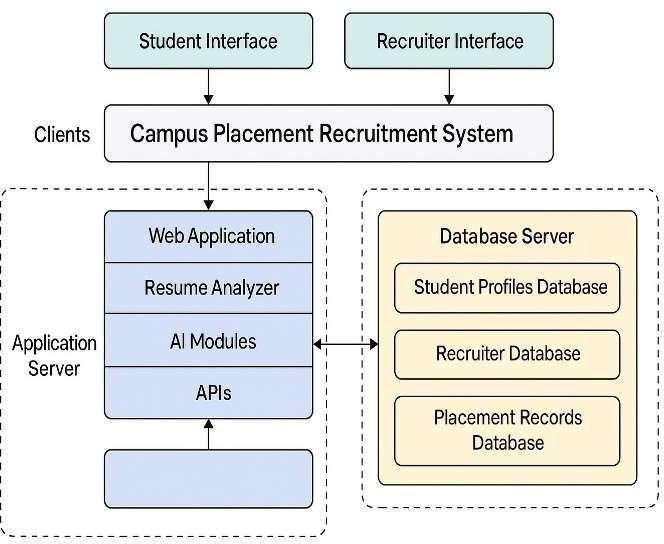
The CPWP’s architecture is rooted in robust, scalable software design principles, ensuring reliability for a high-traffic, multi-userenvironment.Theentiresystemisstructuredtohandleconcurrentaccessfromstudents,administrators,and recruitersefficiently.
Thesystemisarchitecturallydesignedonastandardthree-tiermodeltoensuremodularity,scalability,andmaintainability. Thisseparationofconcernsisvitalforfuturefeatureadditionsanddebugging.
1. Presentation Tier (Frontend): This layer utilizes modern, single-page application (SPA) frameworks (e.g., ReactJS) to provide highly responsive and intuitive user interfaces. The design is tailored to ensure optimal engagement for students, recruiters, and administrators, with distinct, role-based dashboards. All user interaction, form validation, anddisplaylogicarehandledhere.
2. Application Tier (Backend): This core layer handles all business logic, data processing, and security. It utilizes a robust server-side technology (e.g., Node JS/Express) to manage secure REST full API communication between the presentation and data tiers, ensuring efficient handling of concurrent user requests. Key CPWP logic, such as the CGPAcalculationengine,applicationfiltering,anddataauthorization,residesinthistier.
3. Data Tier (Database): Employing a reliable relational database (e.g., Postgrad SQL or MySQL), this layer is responsiblefor the centralized storage and management of all structured data,including student academic records, companyprofiles,joblistings,andplacementhistory.Dataconsistency, redundancycontrol,andtransactionintegrity areprimaryconcernsatthistier.
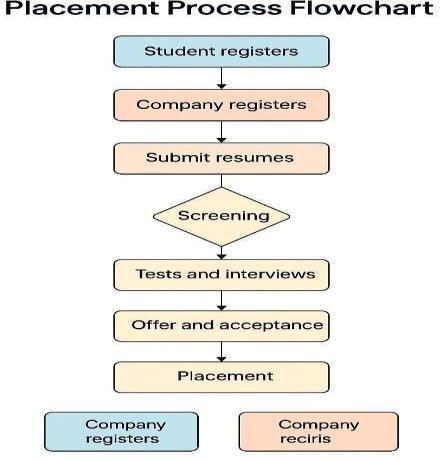
The general data flow within the CPWP is cyclical and strictly managed by role permissions. The core process follows thesesteps:
1. Student Registration and Profile Creation: Students register and upload academic data.
2. TPC Validation and Data Integrity: TheTPCadministratorverifiesthestudent'sacademicstanding,andtheautomated CGPAcalculationmodulerunstosetthebaselineeligibility.
International Research Journal of Engineering and Technology (IRJET) e-ISSN: 2395-0056
Volume: 12 Issue: 12 | Dec 2025 www.irjet.net p-ISSN: 2395-0072
3. Recruiter Engagement: Recruiters register, their profiles are validated by the TPC, and they post job descriptions (JDs)withspecificeligibilitycriteria(e.g.,minimumCGPA,specificskills).
4. Application and Screening: Eligible students apply for the job. The Resume Analyzer (afeature of the Application Tier)processestheapplication,providingatechnicalskillmatchscore.
5. Shortlisting: Therecruiterviewstherankedlistofcandidates,filteredautomaticallybythesystem(CGPA,eligibility), andusestheResumeAnalyzerscorestofinalizetheshortlist.
6. Coordination and Offer: The TPC manages the scheduling of interviews (online/offline), and the system records real-time feedback and final offer status. All interactions are logged in the Data Tier. This structured workflow replacesfragmentedemailsandspreadsheetswithasingle,traceabletransactionprocess.
C. Automated CGPA Calculation and Eligibility Logic This module is a critical administrative tool, crucial for maintaining data accuracy and automating the initial screening phase. The CGPA calculation logic is implemented to handle diverse university grading schemes (e.g., 10-point scale conversion, percentage equivalents) and is continuouslyupdatedwithacademicresults.Itoperatesonaprincipleofautomatic,criterion-basedvalidation:
Data Input Validation: Academic scores (semester marks, credits) are input, ideally through secure integration with the university’s Examination Management System (EMS). Manual entry by the student is subject to TPC approval.
Normalization Engine: The system incorporates complex normalization algorithms to convert raw scores from variousdepartments/batchesintoaunifiedmetric(CGPA)thatiseasilycomparableandunderstoodbyrecruiters.
Real-time Eligibility Filtering: The application tier applies pre-defined, job-specific rules (e.g., minimum 7.0 CGPA, no active backlogs allowed) against the calculated score. Only students who meet these criteria are made visible to the recruitersforthatspecific job,significantly reducingadministrative overheadand eliminatingmanual screeningerrors. Thisautomatedprocessensuresstrictadherencetocompany-mandatedcriteria.
The CPWP features are designed to enhance the experience and efficiency for all stakeholders, moving beyond simple automationtointelligentmatching.
A.The Resume Analyzer Module
TheResumeAnalyzerisadedicatedfeaturedesignedtostreamlinetherecruiter'staskofinitialscreening.Thismodule utilizes advanced Natural Language Processing (NLP) techniques to parse unstructured text from uploaded student resumes(PDF,DOCXformats).Itperformsthefollowingsequential,automatedfunctions:
International Research Journal of Engineering and Technology (IRJET) e-ISSN: 2395-0056
Volume: 12 Issue: 12 | Dec 2025 www.irjet.net p-ISSN: 2395-0072
1. Text Extraction & Structuring: Converts the document content into raw, structured JSON data, identifying sectionslikeExperience,Education,andSkills.
2. Entity Recognition & Keyword Tagging: Utilizes machine learning models (e.g., named entity recognition) to identify and extract key technical and professional entities such as specific skills (programming languages, frameworks),projectnames,andinternshiproles.
3. Skill Mapping and Taxonomy: Maps the extracted, often varied, skill phrasing to astandardized skill taxonomy stored in the database, ensuring consistent evaluation (e.g., mapping 'Python' to 'Programming Language: Python').
4. Scoring and Ranking: Calculates a compatibility score by matching the identified student skills against the keywords and required skills specified in the job description. The final output provides recruiters with an objective, quantitative score for each candidate's technical fit, thereby enhancing the efficiency of the initial screeningphase.
B. Student Profile Management and Digital Portfolio thestudentmodulefacilitatesthecreationofadynamicdigital portfolio,movingbeyondthestaticresumetoprovideacomprehensiveviewofthecandidate.Thisincludesstandard academicandpersonaldetails,complementedby:
Dynamic Data Sources: Real-time linkage of verifiedacademicdata,includingtheoutputofthe CGPA calculation module,ensuringthattheironlineprofilealwaysreflectstheircurrent,validatedacademicstanding.
Project Repositories: Direct API integration with code platforms (e.g., Git Hub, Git Lab) to showcase practical skills,codequality,andprojecthistory.Thisallowsrecruiterstoperformdeepertechnicalvetting.
Verified Certifications: Asecurerepositoryforofficialcertificationdocumentsandbadges(e.g.,Coursera,Udemy) whichcanbedigitallyverifiedforauthenticity.
Career Preparation Tools: Integrated access to resources like AI-powered mock interviews, personalized skill assessments, and company- specific resources to improve student readiness. This comprehensive profile allows recruitersto gaindeeperinsightsintoacandidate'spracticalcapabilities.
C. Recruiter Dashboard and Optimized Hiring Workflow
The Recruiter Dashboard is the centralized command center for recruiters, providing a streamlined, efficient interface formanaginghiringcampaigns:
Job Posting and Criteria Definition: An intuitive interface for posting detailed job descriptions, specifying requiredskills,andsettingeligibilitycriteria(whichfeedsdirectlyintotheCGPAcalculation filter).
Intelligent Shortlisting Interface: Thedashboardpresentseligiblecandidates,automaticallyrankedbasedonthe Resume Analyzer score. Recruiters can view profiles, compare candidate’s side based on skill gaps, and apply customfilterstofinalizetheshortlist.
Interview Management: Tools for virtual and physical interview scheduling and management, including automatedcalendarsync,roombookingrequests,andreal-timefeedbacksubmissionforms.
Communication: Asecure,in-platformmessagingsystemforcommunicationwiththeTPCstaffregardinglogistics, queries,andoffernegotiations.
Offer Management: A secure module for drafting, issuing, tracking, and managing the acceptance or rejection of finaloffers,completewithdigitalsignaturecapability.
International Research Journal of Engineering and Technology (IRJET) e-ISSN: 2395-0056
Volume: 12 Issue: 12 | Dec 2025 www.irjet.net p-ISSN: 2395-0072
The TPC/Admin Module utilizes integrated analytics tools to generate comprehensive, real-time reports. These reports include: placement rate trends, sector-wise placement distribution, company engagement statistics, student performance in aptitudetests, and the success rate of variousrecruitment strategies. The system maintains a complete audit trail of all actions from student login to interview feedback ensuring full accountability and facilitating the continuousprocessimprovementcycle.
To ensure the CPWP remains relevant and competitive, it integrates contemporary technologies that are shaping the futureoftalentacquisition,movingfromsimpledatabasemanagementtointelligent,predictivesystems.
The CPWP integrates Machine Learning (ML) to move beyond descriptive reporting to predictive analytics. The placement prediction model uses historical data features such as final CGPA, aptitude test scores, project type, and mockinterviewperformance totrainsophisticatedclassificationalgorithms likeXGBoostorSupportVectorMachines (SVM).
Feature Engineering and Model Training: Datafrompastplacementcyclesarecleaned,features(e.g.,academicscores, demographic data, resume keywords) are engineered, and the model is trained to predict the binary outcome (placed/notplaced).
Model Workflow: TheMLmodelanalyzes theseweightedparameterstoprovidetheTPCwithaprobabilityscorefor eachcurrentstudent'slikelihoodofplacement.
Strategic Intervention: This data-driven decision-making allows the TPC to strategically intervene with targeted training, skill-gap mitigation programs, or personalized mentoring for students identified as high-risk, a proactive strategyforimprovingoverallplacementrates.
The acceleration of virtual hiring necessitates a robust platform for remote recruitment activities. The CPWP supports thisthroughadedicatedVirtualDriveSuite:
Wider Reach and Cost Efficiency: Virtual drives eliminate travel expenses for recruiters and allow universities to connectwithcompaniesglobally,significantlyincreasingthepotentialtalentpoolandjob opportunities.
Virtual Interview Suite: Seamless integration of high- definition video conferencing tools and virtual assessment platformsforconductingremoteinterviews,groupdiscussions,andtechnicalevaluations.Featuresincludesecurelogin, recordingcapabilities,andautomatedremindernotifications.
Immersive Engagement: The platform supports innovative methods like virtual pre-placement talks (PPTs) and the hosting of ramified assessments (e.g., virtualhack atones andcoding challenges) toenhance student engagement and employerbranding.Thisprovidesamodern,interactiveexperiencesuperiortotraditionalmethods.
The integration of AI extends beyond the Resume Analyzer to provide comprehensive support for both students and recruiters.
International Research Journal of Engineering and Technology (IRJET) e-ISSN: 2395-0056
Volume: 12 Issue: 12 | Dec 2025 www.irjet.net p-ISSN: 2395-0072
Automated Question Generation: AI can generate personalized interview questions based onthe candidate's profile, CGPAhistory,andthespecificjobdescription,helpingrecruitersfocustheirquestioning.
Skill Gap Identification: The AI module analyzes the Resume Analyzer results across all candidates and provides an aggregate report to the TPC, highlighting prevalent skill gaps in the student cohort relative toindustry demand, informing curriculum changes andfocusedtraining.
The success of the CPWP is fundamentally dependent on intuitive and efficient user interfaces tailored to the distinct needsofeachstakeholder.Usabilityandaccessibilityareparamountdesignobjectives
A.Student User Interface (UI)
The student interface must be engaging, informative, and easy to navigate, ensuring students can manage their career preparednessandapplicationprocesseffectively.
Personalized Dashboard: A single view displaying crucial metrics: current verified CGPA, application status tracker(applied,shortlisted,interview,offer),andpersonalizedjobrecommendationsgeneratedbyAI.
Eligibility Indicator: A prominent feature that uses the CGPA calculation data to provide an immediate 'Eligible'or'Ineligible'statusagainsteveryjobopening,savingstudentstimeandreducingqueries totheTPC.
Resource Library: Centralizedaccesstostudymaterials,company-specificpreparationguides,mocktestlinks, andtheintegratedresumebuildertoollinkedtotheResumeAnalyzertaxonomy.
Mobile Responsiveness: Full optimization for mobile devices, recognizing that students often access informationviasmartphones,ensuringtimelynotificationsandapplicationsubmission.
B.Recruiter UI/UX
TheRecruiter interfaceisdesignedforspeedanddata access,minimizingthetimerequiredtomovefromjobposting to finalselection.
Job Template Creation: Ability to save and reuse job posting templates with standardized criteria, including minimumCGPAandrequiredskillsets.
Intelligent Filter Panel: Advancedfilteringoptionsthatallowrecruitersto drilldownintothe candidate pool based on academic metrics (CGPA), skills (based on Resume Analyzer tags), project experience, and performanceinaptitudetests.
Candidate Comparison View: Adedicatedfeaturethatallowsrecruiterstoselect3-5candidatesandviewtheir profilesandResumeAnalyzerscoresside-by-sideforefficientdecision-making.
Interview Timeline Management: Adrag-and-dropcalendarinterfaceintegratedwiththeTPCschedule for simple slot booking and coordination.
Theadministrativedashboardprovidescomprehensivecontrolandoversight.
Bulk Data Management: Tools for uploading new student data, updating academic records (which triggers CGPAcalculationupdates),andmanagingcompanyverificationinbatches.
System Health Monitor: Real-timemetricsonserverload,systemuptime,andkeyperformanceindicatorslike applicationprocessingtimeandshortlistingsuccessrates.
Security Audit Log Viewer: A secure portal to review all user actions and system changes, essential for troubleshootingandcompliance
International Research Journal of Engineering and Technology (IRJET) e-ISSN: 2395-0056
Volume: 12 Issue: 12 | Dec 2025 www.irjet.net p-ISSN: 2395-0072
The choice of technology stack is paramount to ensuring the long-term scalability, performance, and security of the CPWP.
A.Frontend/Backend Technologies
Thesystemadoptsamodern,decoupledarchitecturetoallowindependentscalinganddeploymentoftheuserinterface andbusinesslogic.
Frontend: React JSorasimilarmodernJavaScript library for building the dynamic, responsive user interface. Thischoicefacilitatesfastrenderingandarichuserexperienceacrossalldevices.
Backend (API Services): NodeJS with theExpress framework is utilized for its highperformancein handlingI/O-boundtasks,whichare common in web portals (e.g., fetching largelists of students or applications). Alternatively, aPython- based framework like Django/Flask issuitable for hosting the ML models used in theResume Analyzer and predictive analytics modules.
Cloud Infrastructure: Deployment is recommended on a scalable cloud platform (e.g., AWS, Azure) to handle variable load during peak placement seasons, ensuring high availability and robust disaster recovery capabilities.
B.Database Design and Schema
Thedatabaseschemaisdesignedtoefficientlylinkstudent, company,job,andplacementrecorddatawhilemaintaining referentialintegrity.Keytablesinclude:
1. Student Profiles: Stores personal information, skills (linked to the skill taxonomy), project links, and foreign keytotheAcademicRecordstable.
2. Academic Records: Storessemester-wisemarks,credits, backlog status, and the calculated CGPAvalue.This dataisthesourceforalleligibilitychecks.
3. Company Master: Stores validatedinformation about recruiting companies and their primary recruiter contacts
4. Job Postings: Storesjob descriptions,required skills, andthe academiceligibilitycriteria (min CGPA, backlogs allowed).
5. Application Status: Thecoretransactiontable,linkingaStudent,aJob,thedateofapplication.
Rigorous testing is essential before deployment to ensure the reliability and security of a system handling sensitive academicdata.
A.Functional Testing
Allmodulesmustbetestedagainstpredefinedacceptancecriteria.
Role-Based Access Testing: Verification that students, TPC, and recruiters can only access and modify data relevanttotheirrole(e.g.,astudentcannotedittheirCGPA).
Algorithm Validation: Extensive testing of the CGPA calculation module against manual calculations for all supportedgradingsystemstoensurezeroerrorsineligibilitydetermination.
Integration Testing: Testing the end-to-end process flow, from job posting to final offer, ensuring seamless communicationbetweenthePresentation,Application,andDatatiers.
International Research Journal of Engineering and Technology (IRJET) e-ISSN: 2395-0056
Volume: 12 Issue: 12 | Dec 2025 www.irjet.net p-ISSN: 2395-0072
B.Performance and Security Testing
Load Testing: Simulating a high volume of concurrent users (e.g., 5,000 students applying for a single job simultaneously)toensurethesystemdoesnotcrashorsuffersignificantlatencyduringpeakload.
Penetration Testing (Pen Test): Employing ethical hackers to actively seek vulnerabilities, particularly SQL injectionrisks,cross-sitescripting(XSS),anddataleakage,ensuringthesecurity ofsensitiveCGPAandpersonal data.
IX.RESULTS AND DISCUSSION
Post-implementation pilot tests yielded measurable improvements in administrative efficiency and stakeholder satisfaction,validatingtheCPWPdesignprinciples.
A.Impact on TPC Efficiency and Data Accuracy
The implementation of the automated CGPA calculation module resulted in an estimated 85% reduction in manual eligibility screening time. Previously, TPC staff spent hours verifying thousands of applications against criteria; this process is now instantaneous and error-free. The centralization of data eliminated version control issues inherent in spreadsheet-based tracking, ensuring that recruiters always access the single, verified source of student academictruth.Theabilitytogenerate complexanalyticalreportsonplacementperformancewasreducedfromseveral daystoafewminutes,enablingfaster strategicdecision-making.
B. Stakeholder Feedback Summary
Feedbackfromkeystakeholdershighlightedthefollowingbenefits:
Recruiters: TheResumeAnalyzerwashighlypraisedforitsabilitytofilterthousandsofapplicationsdowntoa qualified shortlist within minutes, significantly reducing time-to-hire. Recruiters reported a 40% reduction in thetimespentoninitialscreening,allowingthemtofocusontheinterviewstage.
Students: Students appreciated the real-time transparency of their eligibility status (derived from the CGPA calculationmodule)andtheimmediatenotificationofdeadlinesandinterviewschedules,reducinganxietyand missedopportunities.
TPC Staff: Reportedamajorshiftfromreactiveadministrativeworktoproactivecareerguidanceandcompany relationshipmanagement.
The implementation of a centralized Campus Placement Web Portal is no longer a luxury but a strategic necessity for educational institutions aiming to maintain relevance and competitiveness in the modern recruitment landscape. By automating manual work flows, centralizing communication, and providing data-driven insights particularly through precise CGPA calculation, efficient Resume Analyzer tools, and predictive ML models the CPWP effectively addresses theinefficienciesoftraditionalsystems.Theintegrationofnext-generationtechnologies forsmartscreeningandvirtual toolsforwiderreachpositionstheportaltobeatrulyfuture-ready infrastructure.
The CPWP represents a fundamental shift from a reactive, administrative function to a proactive, strategic enabler of studentcareersuccess.
Futureworkontheseportalswillfocuson:
1. Deeper LMS Integration:Real-timeintegration with Learning Management Systems (LMS) to track soft skills andproject-basedlearningoutcomesformoreholisticcandidatescoring.
2. Block chain Credentialing: Full adoption of Block chain technology to ensure the immutable authenticity of academicrecords,includingtheCGPAandcertifications.
International Research Journal of Engineering and Technology (IRJET) e-ISSN: 2395-0056
Volume: 12 Issue: 12 | Dec 2025 www.irjet.net p-ISSN: 2395-0072
[1]WeCP.(2025).12CampusRecruitmentChallengesFacedByCompanies.
[2]Superset.(2024).ChallengesinCampusPlacements|SolutionsforUniversities.
[3]Salarite.(2025).CampusPlacementPlatform:ACompleteGuideforStudents.
[4]EDTEX. (2024). What are the challenges studentsface in the Placement process at universities & business schools thatlackmodernITsystems?.
[5]HirePro.(2023).TrendsinCampusRecruitmenttoWatchoutfor.
[6]Superset.(2024).DecodingSuccess:KeyTrendsShapingCampusRecruitmentforHRManagers.
[7]Eklavvya.(2026).10ProvenWaystoImproveCampusPlacementsin2026(WithAI).
[8]Superset.(2024).TheUltimateChecklistforLaunchingaCampusPlacementPortalatYourUniversity.
[9]IJRASET.(2023).DevelopmentofaWebPortalfortheTrainingandPlacementCelloftheCollege.
[10] IJATES.(2016).STUDYOFIMPLEMENTATIONOFONLINEPLACEMENTSYSTEM.
[11] CreatrixCampus.(2024).PlacementManagementSystemSoftware.
[12]Superset.(2024).HowOnlinePlacementDriveBridgetheGapforDiverseTalent.
[13]Superset.(2023).StreamlineYourPlacementProcessCampusPlacementSoftware.
[14]ResearchGateAuthors.(2025).CampusPlacementManagementSystemforRecruitersandStudents.
[15] IJCRT.org.(2024).PLACEMENTMANAGEMENT SYSTEM.
[16] IJNRD.(2024).CampusRecruitmentManagementSystem.


MahalaxmiKakatikarisafinal–yearComputerScienceandEngineeringstudent.Sheiscurrently pursuingherdegreeatS.GBalekundriInstituteofTechnology.
MandarSamajiisafinal–yearComputerScienceandEngineeringstudent.heiscurrentlypursuinghis degreeatS.GBalekundriInstituteofTechnology.
International Research Journal of Engineering and Technology (IRJET) e-ISSN: 2395-0056
Volume: 12 Issue: 12 | Dec 2025 www.irjet.net p-ISSN: 2395-0072

ManishaNashipudiisafinal–yearComputerScienceandEngineeringstudent.Sheiscurrentlypursuing herdegreeatS.GBalekundriInstituteofTechnology.
SrushtiKadalagiisafinal–yearComputerScienceandEngineeringstudent.Sheiscurrentlypursuingher degreeatS.GBalekundriInstituteofTechnology.