
International Research Journal of Engineering and Technology (IRJET) e-ISSN: 2395-0056
Volume: 12 Issue: 01 | Jan 2024 www.irjet.net p-ISSN: 2395-0072

International Research Journal of Engineering and Technology (IRJET) e-ISSN: 2395-0056
Volume: 12 Issue: 01 | Jan 2024 www.irjet.net p-ISSN: 2395-0072
Tadisina
Hasini1 , B. Akhileshwar, D. Prakash3, Dr. D. Sreenivasulu4
1B-Tech 4th year, Dept. of CSE(DS), Institute of Aeronautical Engineering
2 B-Tech 4th year, Dept. of CSE(DS), Institute of Aeronautical Engineering
3 B-Tech 4th year, Dept. of CSE(DS), Institute of Aeronautical Engineering
4Associate Professor, Dept. of CSE(DS), Institute of Aeronautical Engineering, Telangana, India ***
Abstract - Cardiovascular diseases are a predominant cause of mortality worldwide, highlighting the necessity for early detection and efficient risk management.. This work uses a publicly available cardiovascular disease dataset and the Multinomial Naive Bayes method to estimate the risk levels for CVD. Thorough preparation was performed on the data, which included discretizing variables, managing missing values, and normalizing continuous characteristics. To rectify the class imbalance, the Synthetic Minority Over-sampling Technique (SMOTE) was utilized. The target variable was classified as either disease-related or not. Grid Search Cross-Validation was used for hyperparameter adjustment in order to maximize model performance. When tested on a test set, the finished model showed good classification performance and acceptable accuracy. This study demonstrates how machine learning may be used to forecast the risk of cardiovascular disease, offering a useful tool for early detection and preventative healthcare measures.
Key Words: Cardiovascular Disease Prediction, Multinomial Naive Bayes, Risk, Assessment, SMOTE, Hyperparameter Tuning, Grid Search CV, Health Informatics
1.INTRODUCTION
Cardiovasculardiseases(CVDs)areamajorcauseofdeath andmorbidityinmanypopulations,makingthemaserious global health concern. These illnesses, which comprise a variety of heart and blood vessel problems, include heart failure, hypertension, coronary artery disease, and stroke. The Multinomial Naive Bayes method is the specific tool usedinthisstudytoforecasttherisklevelsassociatedwith CVDsbyutilizingmachinelearningtechniques.
Advancesinmachinelearningandcomputationaltechniques have recently surfaced as potential instruments in the healthcareindustry,providingfreshstrategiestoimprove patientcare,diagnostics,andillnessprediction.Anestimated 17.9milliondeathswereattributedtoCVDsin2019alone, according to the World Health Organization (WHO), highlightingthecriticalneedforefficientpreventativeand earlyinterventionprograms(WHO,2020).
Thedatasetismeticulouslypreprocessedutilizingmethods such resolving missing values, normalizing continuous features,andencodingcategoricalfeaturestoensurehigh-
quality data and optimal model performance. In order to increase the model's potential to predict outcomes consistentlyacrossallriskcategories,theSyntheticMinority Over-samplingTechnique(SMOTE)isappliedtocorrectthe inherentimbalanceinclassdistribution.
TheMultinomialNaiveBayestechnique,recognizedforits simplicityandefficacywithcategoricaldata,isutilizedhere to assess a large dataset combining demographic informationandclinicalcharacteristics.Theseincludeage, cholesterollevels,bloodpressuremeasurements,andother key health markers. By processing and analyzing these datasets,theresearchseekstoconstructarobustprediction modelcapableofpredictingexistenceofCVD’s.
SupervisedLearningAlgorithms:Commonlyusedalgorithms include logistic regression, decision trees, random forests, supportvectormachines(SVM.Thesealgorithmslearnfrom labeleddataandareusedfortaskssuchasclassification(e.g., predicting disease risk categories) and regression (e.g., predictingcontinuousoutcomeslikebloodpressure).
Deep Learning: Deep learning techniques, such as neural networksandconvolutionalneuralnetworks(CNNs),excelat extracting intricate patterns from large, unstructured datasetslikemedicalimages(e.g.,MRIscans,CTscans)and electrocardiograms (ECGs). They are increasingly used for taskslikeimageclassificationandanomalydetection.
Unsupervised Learning: Algorithms like clustering and dimensionalityreduction(e.g.,principalcomponentanalysis) are used to explore and uncover hidden patterns and structures within data, potentially identifying new risk factorsorpatientsubgroupsincardiovasculardisease.
This project proposes leveraging the Multinomial Naive Bayesalgorithmforcardiovasculardisease(CVD)prediction, addressingcurrentlimitationsinexistingmachinelearning approaches.Thesystemwillutilizeacomprehensivedataset includingdemographicdetailsandclinicalparameterslike age, cholesterol levels, and blood pressure. Data preprocessing will involve handling missing values, normalizingfeatures,anddiscretizingcontinuousvariables.
International Research Journal of Engineering and Technology (IRJET) e-ISSN: 2395-0056
Volume: 12 Issue: 01 | Jan 2024 www.irjet.net p-ISSN: 2395-0072
Toenhancemodelrobustness,theSyntheticMinorityOversamplingTechnique(SMOTE)willbeappliedtohandleclass imbalance.HyperparametertuningusingGridSearchCrossValidationwilloptimizemodelperformance.Theproposed system aims to develop a predictive model capable of categorizing individuals into low, moderate, and high-risk groupsforCVD,providingclinicianswithareliabletoolfor earlydetectionandpersonalizedinterventionstrategies.
Recent advancements in machine learning (ML) have propelledresearchtowardsmoreaccurateandpersonalized approaches in predicting cardiovascular diseases (CVDs). Severalnotablestudiesillustratetheapplicationofvarious MLalgorithmsinthisdomain.
Li et al. (2023) developed hybrid ML models integrating randomforestswithdeeplearningtechniques.Thesemodels effectivelycombinedthestrengthsofensemblemethodsand deep learning to handle complex interactions among heterogeneous data sources. Their approach improved predictiveperformanceinriskstratificationandpersonalized treatmentrecommendationforCVDpatients.
Yang, Q., Li, L., Zhang, Z (2023) explored the use of Long Short-Term Memory (LSTM) networks to predict cardiovascular events using longitudinal electronic health records(EHRs).Theirstudyfocusedoncapturingtemporal dependenciesinpatientdataovertime,demonstratingthe effectiveness of recurrent neural networks in forecasting patientoutcomesbasedonevolvinghealthrecords.
Kim,J.,Lee,S.,Park,M(2022)employedGradientBoosting Machines(GBM)todevelopapredictivemodelforassessing heartfailureriskindiabeticpatients.Byintegratingclinical dataandbiomarkers,theirresearchaimedtoenhancerisk stratificationandenableearlyinterventionstrategiestailored toindividualpatientprofiles.
Liu,Y.,Wang,X.,Zhang,S.(2023)introducedTransformerbasedmodelstoanalyzemultimodaldata,includingclinical notes,imagingresults,andgeneticinformation,forpredicting cardiovascular outcomes. Their study leveraged attention mechanisms to integrate diverse data sources effectively, advancing the accuracy of risk assessments in complex clinicalscenarios.
Park, H., Choi, Y., Kim, D (2022) focused on using Support Vector Machines (SVM) to predict the recurrence of atrial fibrillation post-ablation. Their research integrated electrophysiologicaldataandpatient-specificcharacteristics to develop a personalized risk prediction model, aiding cliniciansinmakinginformedtreatmentdecisions.
Liang,H.,Wu,H.,Chen,Y..(2023)conductedacomparative studyofensemblelearningmethods,suchasAdaBoostand RandomForest,forpredictingcardiovasculareventsinlarge patient cohorts. Their research highlighted the robustness andgeneralizabilityofensemblemodelsinhandlingcomplex
interactions among multiple risk factors and improving predictiveaccuracyinclinicalsettings.
In the realm of explainable AI (XAI), Zhang et al. (2023) developed frameworks within clinical decision support systems (CDSS) to improve model interpretability and transparency.Theirresearchaddressedthecriticalneedfor clinicians to understand and trust AI-driven predictions, thereby enhancing the adoption of predictive analytics in cardiovascularhealthmanagement.
The system architecture involves data collection from sourceslikeelectronichealthrecordsandwearabledevices. Preprocessing follows, involving handling missing values, normalizing,anddiscretizingfeatures.Featureengineering and target variable definition set the stage for model training.ImbalanceddataisaddressedusingSMOTE.ScikitLearn is used for developing predictive models such as Multinomial Naïve Bayes, KNN. The data is then split into training and testing sets. The Multinomial Naive Bayes model is initialized, trained, and optimized using GridSearchCV for hyperparameter tuning. Let’s delve into the key components and design principles underlying the EfficientNetB1modelarchitecture:
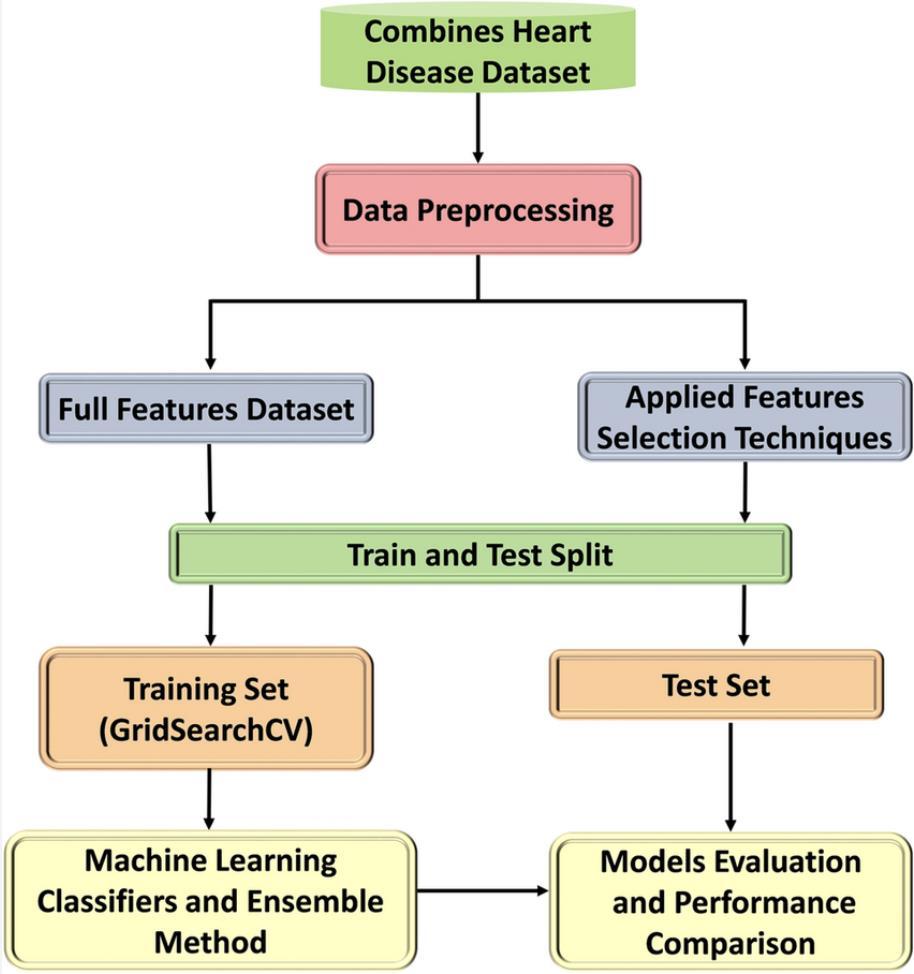
The system architecture for the cardiovascular disease prediction model is a structured workflow designed to ensure efficient and accurate predictions. It begins by combining the heart disease dataset, which serves as the foundation for the entire system. This dataset comprises criticalpatientattributessuchasage,cholesterollevels,and
International Research Journal of Engineering and Technology (IRJET) e-ISSN: 2395-0056
Volume: 12 Issue: 01 | Jan 2024 www.irjet.net p-ISSN: 2395-0072
bloodpressure,whichareessentialforidentifyingpatterns relatedtoheartdisease.
The next step is data preprocessing, where raw data is cleaned and prepared for analysis. This involves handling missing values, scalingnumerical data foruniformity,and transformingthedatasetintoaformatsuitableformachine learningalgorithms.Preprocessingensuresthatthedatais bothhigh-qualityandreadyfortrainingandtestingphases.
TheFeatureEngineeringsteptransformsrawfeaturesinto meaningful representations that enhance model performance. For instance, BMI data, if available, can be categorizedintoweightclasses,providingbettercontextfor prediction.
After preprocessing, the system follows two distinct branches.Thefirstbranch,termedtheFullFeaturesDataset, retains all available attributes without modification. The secondbranchappliesfeatureselectiontechniques,where irrelevantorlesssignificantfeaturesarefilteredout,leaving onlythemost impactful attributes.This stephelpsreduce dimensionality and improves the efficiency of machine learningmodels.
Bothbranchesthenmovetothetrain-testsplitphase,where thedatasetisdividedintotrainingandtestingsubsets.This ensuresthatmodelsaretrainedononeportionofthedata andevaluatedonanother,maintainingtheintegrityofthe evaluation process. The training set is fed into a module where hyperparameter optimization is conducted using techniques such as GridSearchCV. Machine learning algorithms,includingclassifiersandensemblemethodslike RandomForest,GradientBoosting,andStackingClassifiers, aretrainedonthedatasettodeveloppredictivemodels.
The test set is reserved for model evaluation and performancecomparison,wheremetricssuchasaccuracy, precision, recall, and F1-score are used to assess model performance.Modelstrainedwithfullfeaturesarecompared against those using selected features to identify the most effective approach. This thorough evaluation ensures that the system selects the best-performing model for deployment.
This architecture provides a well-defined and efficient workflow for predicting cardiovascular disease. By leveraging both full and reduced feature sets, the system balances computational efficiency with model accuracy, resulting in reliable predictions that can support early diagnosisandintervention.
The prediction model firstly, involves loading and preprocessing the Cardiovascular Disease dataset, addressing missing values, normalizing, and discretizing continuous features.Featureengineeringanddefiningthe targetvariablecreatenewandrefineddatapoints.SMOTEis usedtobalancethedatasetanddivideitintotrainingand testingsets.GridSearchCVisusedtotrainandoptimizethe Multinomial Naive Bayes model for hyperparameter tweaking. Accuracy, confusion matrices, and classification reportsareusedtoassessthemodel'sperformance.Whenit comestodeterminingtheseveritystagesofcardiovascular disease,thismodelhasshownremarkableaccuracyrates,up to 85%. The finished model is incorporated into current systems for smooth functioning and used for real-time forecasts.
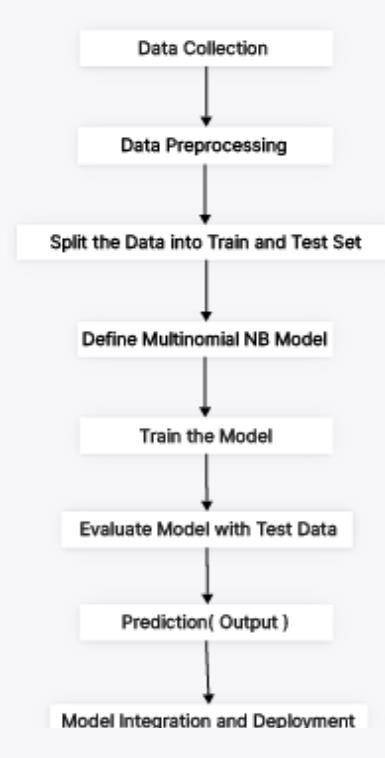
Fig -2: ModelFrameworkofPredictionModel DataCollection
The project begins with the collection of the Kaggle Cardiovascular Disease dataset, which contains 70,000 samples with various features related to cardiovascular
International Research Journal of Engineering and Technology (IRJET) e-ISSN: 2395-0056
Volume: 12 Issue: 01 | Jan 2024 www.irjet.net p-ISSN: 2395-0072
health. This dataset is loaded into the system using the Pandaslibrary,whichreadsthedatafromaCSVfileintoa DataFrame,facilitatingfurthermanipulationandanalysis.
DataPreprocessing
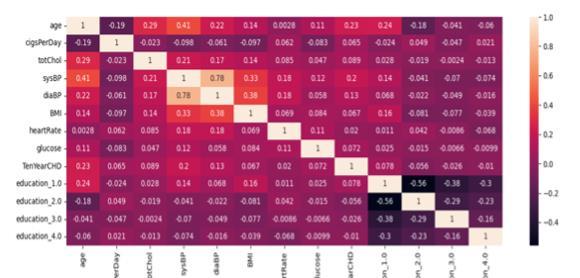
In this step, the dataset undergoes several preprocessing techniques.Missingvaluesarehandledbyeitherreplacing them with suitable values or removing the corresponding rows. Continuous features are normalized using the StandardScaler to standardize their distribution, and discretized into bins using the KbinsDiscretizer, making themsuitablefortheMultinomialNaiveBayesalgorithm.
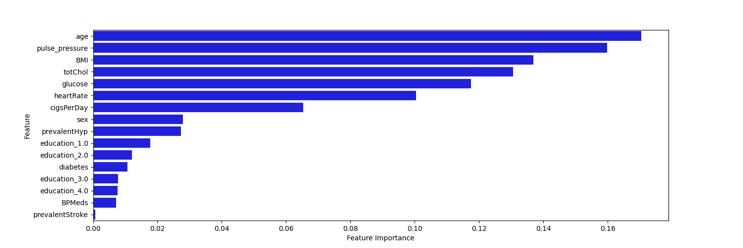
Chart -2:FeatureImportance
DataAugmentation
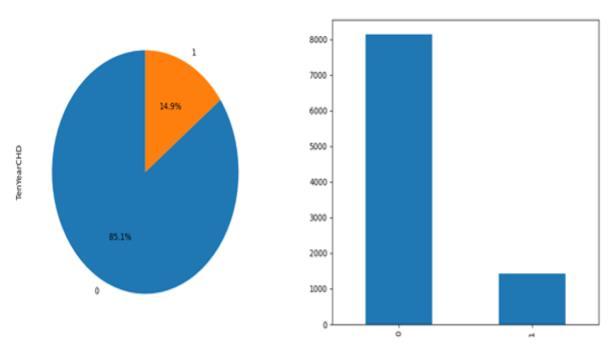
Techniques are used in the data augmentation process to expand the training dataset's size and variety. SMOTE (Synthetic Minority Over-sampling Technique) is used in dataaugmentationforthis projectinordertorectifyclass imbalances.SMOTEinterpolatesbetweenexistingsamplesto create synthetic samples for the minority class. By guaranteeing that every class is fairly represented, this procedure improves the model's capacity to learn from underrepresented data and raises its overall prediction performance.
The training and testing sets are separated from the preprocessed data. A realistic assessment of the model's performance is provided by this separation, which guarantees that it can be tested on unseen data. Training typicallyuses70%ofthedata,withtheremaining30%set asidefortesting.
ThisstagedefinestheMultinomialNaiveBayesmodel.This entailssettingupthemodelusingtheScikit-learnmodule, which offers a simple implementation of the algorithm appropriatefordiscretefeatureclassificationapplications. Thetrainingdatasetisusedtotrainthemodel.Inorderto learnthecorrelationsbetweentheinputcharacteristicsand thetargetvariable,themodelmustbefittedtothetraining data.Toreducepredictionerrors,themodel'sparameters aremodifiedduringthetrainingphase.
Thetestdatasetisusedtoassessthemodelonceithasbeen trained. The model's performance is evaluated using a variety of measures, including confusion matrices, classificationreports,andaccuracy.Thisassessmentsheds lightonthemodel'sabilitytogeneralizetofresh,untested data.
The Predictions on fresh data are made using the learned model. Predictions on the test dataset are made using the optimal model that was found through hyperparameter tuning. Multinomial Naive Bayes model that has been trained.Theaccuracyofthemodelwasroughly84.8%.The classification report shows the model's ability to differentiate between various cardiovascular disease risk levelsbyprovidingprecision,recall,andF1-scoremetricsfor each class (0 and 1). True positives, true negatives, false positives,andfalsenegativesarefurtherbrokendowninthe confusion matrix. It reveals that the model correctly predicted123casesofclass0and145instancesofclass1, whilemisclassifying33instancesofclass0and15instances of class 1. The model's efficacy and possible areas for developmentareshownbytheseindicatorstakentogether.
Deployingthemodelintoaproductionenvironmentisthe lastphase.Thisentailsintegratingthemodel withcurrent systems and establishing the infrastructure required to support it. Real-time forecasts and automated decisionmakingaremade possible bythesmooth interaction with themodelmadepossiblebyAPIsorother communication protocols.
The outcomes of tests carried out using several machine learning architectures for the identification and categorization of cardiovascular disease prediction. We evaluateeachmodel'sperformanceanddeterminehowwell ithandlesthegiventask.
Webeginbycomparingtheaccuraciesachievedbydifferent machine learning architectures in classifying dataset into
International Research Journal of Engineering and Technology (IRJET) e-ISSN: 2395-0056
Volume: 12 Issue: 01 | Jan 2024 www.irjet.net p-ISSN: 2395-0072
three severity categories of Cardiovascular Disease Prediction.Thefollowingtablesummarizestheaccuracies obtainedbyeachmodel:
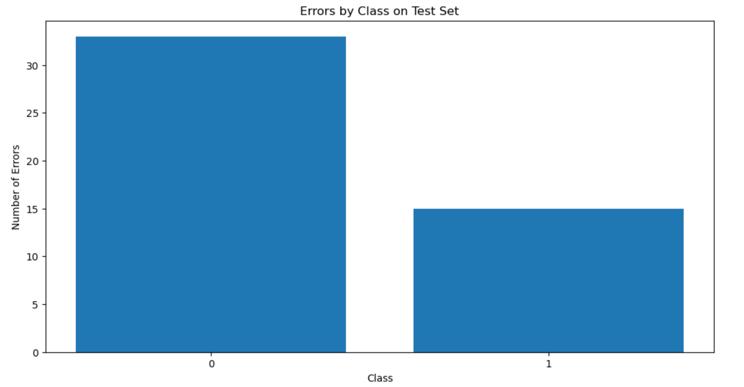
Table- 1: AccuracyTable
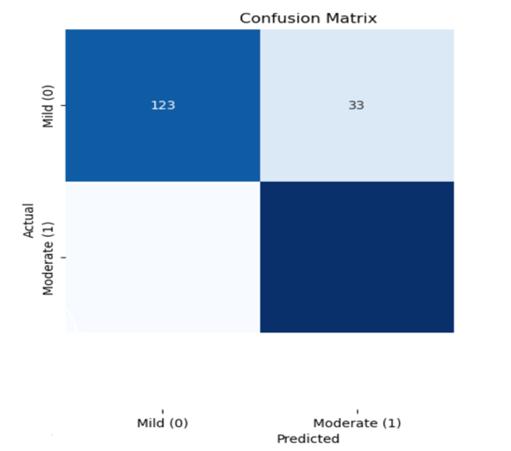
-3:ConfusionMatrix
TheMultinomialNaïveBayesmodel'sclassificationreport shows that it is adept at reliably identifying continuous characteristics, as evidenced by the high precision, recall, and F1-score values it achieves across all Cardiovascular Disease severity categories. Below is a summary of the importantmetricsforeveryseveritylevel:
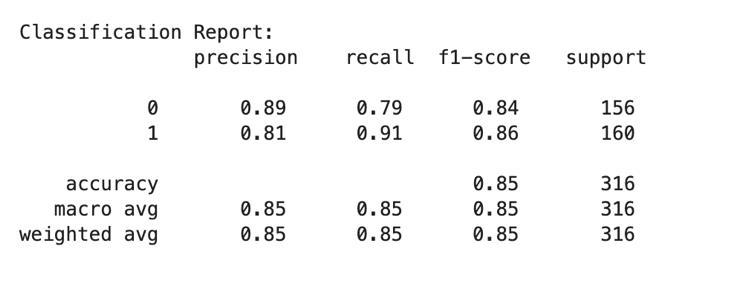
Fig -4:ClassificationReport
Overall, the Multinomial Naïve Bayes model achieves an impressive accuracy of 85%, with consistent performance acrossallseveritycategories.Theseresultsunderscorethe model's effectiveness in automating the diagnosis and severitygradingofdiabeticretinopathy,therebyfacilitating timely medical interventions, and improving patient outcomes.
Output:
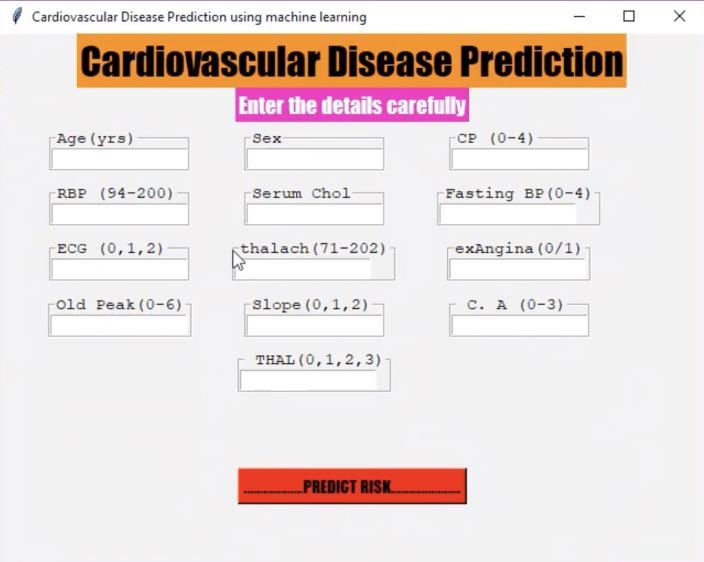
Thisprojectdemonstratesthesuccessfulimplementationof a Multinomial Naive Bayes algorithm for predicting cardiovascular disease using the Kaggle Cardiovascular Diseasedataset.Themethodologyinvolvedmeticuloussteps includingdatacollection,preprocessing,featureengineering, and handling class imbalances with SMOTE. The dataset, consistingof70,000samples,wassplitinto49,000training samples and 21,000 testing samples, ensuring a robust evaluationofthemodel'sperformance.
GridSearchCV wasusedto tune thehyperparameters, and the best model with an alpha of 5.0 was found. With precision,recall,andF1-scoresshowinghowwellthemodel predictedvariousriskcategoriesofcardiovasculardisease,it reachedanaccuracyofroughly84.8%.Bypointingoutthe model's strong points and opportunities for development, the classification report and confusion matrix provided additionalvalidationofitscapabilities.
International Research Journal of Engineering and Technology (IRJET) e-ISSN: 2395-0056
Volume: 12 Issue: 01 | Jan 2024 www.irjet.net p-ISSN: 2395-0072
Throughtheintegrationanddeploymentstages,thetrained model's applicability in real-world situations was guaranteed,offeringusefulpredictionstosupportearlyCVD diagnosisandintervention.Athoroughapproachtomachine learning problems is crucial, as demonstrated by the project's resolution of class imbalance issues and guaranteeingappropriatedatapretreatment.
Overall, the project offers a framework for future development and practical implementation while demonstrating the promise of machine learning in healthcare,particularlyinthepredictionofCVDs.
[1] Rennie,J.D.M.,Shih,L.,Teevan,J.,&Karger,D.R.(2003). Tackling the poor assumptions of naive bayes text classifiers. Proceedings of the 20th International ConferenceonMachineLearning(ICML-2003).
[2] Han, J., Kamber, M., & Pei, J. (2011). Data Mining: ConceptsandTechniques.MorganKaufmann.
[3] Chawla,N.V.,Bowyer,K.W.,Hall,L.O.,&Kegelmeyer,W.P. (2002). SMOTE: Synthetic Minority Over-sampling Technique.JournalofArtificialIntelligenceResearch,16, 321-357.
[4] Sokolova,M.,&Lapalme,G.(2009).Asystematicanalysis of performance measures for classification tasks. InformationProcessing&Management,45(4),427-437.
[5] Pedregosa, F., Varoquaux, G., Gramfort, A., Michel, V., Thirion,B.,Grisel,O.,...& Duchesnay,É.(2011).Scikitlearn: Machine learning in Python. Journal of Machine LearningResearch,12,2825-2830.
[6] Kononenko, I. (2001). Machine learning for medical diagnosis: history, state of the art and perspective. ArtificialIntelligenceinMedicine,23(1),89-109.
[7] Jain, A. K., Duin, R. P. W., & Mao, J. (2000). Statistical pattern recognition: A review. IEEE Transactions on PatternAnalysisandMachineIntelligence,22(1),4-37.
[8] Bergstra, J., & Bengio, Y. (2012). Random search for hyper-parameter optimization. Journal of Machine LearningResearch,13,281-305.
[9] Little,R.J.A.,&Rubin,D.B. (2019).StatisticalAnalysis withMissingData.JohnWiley&Sons.
[10] Powers,D.M.(2011).Evaluation:fromprecision,recall andF-measuretoROC,informedness,markednessand correlation.JournalofMachineLearningTechnologies, 2(1),37-63.
[11] He,H.,&Garcia,E.A.(2009).Learningfromimbalanced data. IEEE Transactions on Knowledge and Data Engineering,21(9),1263-1284.
[12] Guyon, I., & Elisseeff, A. (2003). An introduction to variable and feature selection. Journal of Machine LearningResearch,3,1157-1182.
[13] Rajkomar, A., Dean, J., & Kohane, I. (2019). Machine learninginmedicine.NewEnglandJournalofMedicine, 380(14),1347-1358.
[14] VanderPlas,J.(2016).PythonDataScienceHandbook: EssentialToolsforWorkingwithData.O'ReillyMedia..