
International Research Journal of Engineering and Technology (IRJET) e-ISSN:2395-0056
Volume: 12 Issue: 03 | Mar 2025 www.irjet.net p-ISSN:2395-0072
International Research Journal of Engineering and Technology (IRJET) e-ISSN:2395-0056
Volume: 12 Issue: 03 | Mar 2025 www.irjet.net p-ISSN:2395-0072
Manpreet Hire1, Yasir Khan2, Zuber Shaikh3, Priyanshu Prajapati4
1Asst. Professor, Department of Data Science, Thakur College of Science and Commerce, Mumbai, India
2Student, Department of Data Science, Thakur College of Science and Commerce, Mumbai, India
3Student, Department of Data Science, Thakur College of Science and Commerce, Mumbai, India
4Machine Learning Engineer Intern, BNK Infotech Pvt. Ltd., Delhi, India
Abstract - In this research, we develop a machine learning-based framework to predict patient-specific disease outcomes using a multifactorial healthcare dataset. The dataset encompasses a wide array of variables, includingdemographicdetails(suchasageandsex),clinical indicators (general health condition, medical checkup frequency, physical activity), behavioral aspects (smoking history), and records of chronic illnesses like cardiovascular disease, skin cancer, diabetes, arthritis, and other cancers. Our exploratory data analysis revealed notable patterns in disease occurrence, highlighting how various health and lifestyle factors influence disease susceptibility. Furthermore, the dataset presented challenges in the form of incomplete data, underscoring the necessity for effective handling of missing values to ensure model robustness. The predictive models developed in this study offer valuable insights for identifying high-risk individuals and facilitating early interventions. The findings underline the potential of machine learning methodologies in enhancing clinical decision-makingandadvancingpersonalizedhealthcare.
Key Words: Cardiovascular Disease Prediction, Machine Learning, Risk Assessment, Healthcare Data, Chronic Disease Forecasting, Clinical Analytics, Lifestyle Risk Factors, Predictive Modeling, Patient-Level Prognosis, ExploratoryDataAnalysis.
The growing burden of cardiovascular and other chronic diseases represents a significant challenge for modern healthcare systems. These conditions are influenced by a complex combination of demographic, behavioral, and clinical factors, necessitating accurate and early risk prediction to improve patient outcomes and reduce healthcare costs. Conventional risk scoring systems often failtocapturetheintricaterelationshipsembeddedwithin large-scale patient data, creating a demand for more advanced and flexible predictive tools. In this context, machine learning (ML) has emerged as a transformative approachinhealthcareanalytics,enablingthediscoveryof hidden patterns that traditional statistical models may overlook.ThisstudyfocusesonleveragingML,particularly gradient boosting algorithms such as XGBoost, to forecast
disease prognosis using a multifaceted healthcare dataset thatincludes patientdemographics,health behaviors, and clinicalhistory.
The proposed model is developed and validated using a train-testsplitstrategytoensurerobustandgeneralizable performance. A variety of evaluation metrics including the confusion matrix, ROC curve, and Precision-Recall curve are employed to provide a holistic assessment of the model’s effectiveness, particularly in managing class imbalance common in healthcare data. By integrating thesemethods,thestudydemonstratesthecapacityofML to significantly enhance disease risk assessment and inform clinical decision-making processes. The findings underscorethepotentialofpredictivemodelingtosupport healthcare professionals in identifying high-risk patients and tailoring early intervention strategies. Additionally, this research paves the way for future improvements through advanced data balancing techniques and the inclusion of supplementary clinical features, ultimately contributing to the broader adoption of data-driven, personalizedhealthcaresolutions.
Machine learning, particularly ensemble methods like gradient boosting, has proven to be highly effective in tackling these challenges. Algorithms such as XGBoost offerenhancedperformancebyiterativelyreducingerrors and handling imbalanced datasets commonly found in medical records. By integrating diverse patient-level data ranging from demographic information to lifestyle factors ML models can provide more precise and individualized risk assessments. This paradigm shift toward data-driven healthcare underscores the growing relevanceofpredictiveanalyticsinclinicalpractice.
This study primarily leverages Python, a versatile and widelyadoptedprogramminglanguageinthefieldofdata scienceandmachinelearning,duetoitsextensivelibraries and ease of integration in healthcare analytics workflows. The core machine learning framework utilized in this
International Research Journal of Engineering and Technology (IRJET) e-ISSN:2395-0056
Volume: 12 Issue: 03 | Mar 2025 www.irjet.net p-ISSN:2395-0072
project is Scikit-learn (Sklearn), which offers a comprehensive suite of tools for data preprocessing, model training, hyperparameter tuning, and evaluation. Sklearn’s modular and efficient implementation of algorithmssuchasgradientboosting,specificallyXGBoost, allows for scalable model development and seamless handling of healthcare datasets characterized by class imbalance and missing values. Additionally, key Python libraries, including Pandas and NumPy, are employed for data manipulation, exploratory data analysis, and feature engineering,facilitatingin-depthinsightsintopatient-level records. Matplotlib and Seaborn are used to visualize patterns and relationships within the data, supporting both the analytical and presentation phases of the research. The combination of these tools enables the development of a robust and interpretable machine learning pipeline, tailored to address the challenges of disease prognosis prediction. This technology stack ensures reproducibility, scalability, and efficiency in building healthcare models capable of assisting clinical decision-makingandenhancingpatientriskassessment.
1. A Machine LearningBased Approach for the Prediction of Cardiovascu larDiseases
To develop a machine learning framework for earlydetectionof cardiovascular diseases using supervised learning algorithmssuchas SVM, KNN, XGBoost,Random Forest,LightBoost, andSGD.
2. A Novel Approach for Cardiovascu lar Disease Prediction Using Machine Learning Algorithms
To enhance the prediction accuracyofheart diseases by employing ensemblemachine learning models, including kNearestNeighbor, XGBoost, AdaBoost, and RandomSubspace classifiers,andto identifyinfluential features using Linear Support Vector Feature
The study achieveda92.76% detection rate using the SGD classifier on an 80:20 training/testing split,indicatingthe effectiveness of machine learning models in predicting cardiovascular diseases.
The proposed ensemble model achieved a prediction accuracy of 96%, outperforming existing approaches. Key performance metrics included 97% precision, 95% sensitivity, and 95% Fmeasure, demonstratingthe model's robustness in
3. Cardiovascu lar Disease Prediction Using Various Machine Learning Algorithms
Measure. heart disease prediction.
To develop an efficientmodelfor predicting the probability of cardiovascular diseases by analyzing critical factors and employing algorithmssuchas Logistic Regression, SVM, MLP with PCA, Deep Neural Network, and Bootstrap Aggregationusing RandomForests.
4. NHS in England to TrialAITool to Predict RiskofFatal Heart Disease
5. Algorithm Could Help Prevent Thousands ofStrokesin UK Each Year
To evaluate the effectivenessofan AI tool, AI-ECG risk estimation (Aire), in predicting fatal heartdiseaseand early death by analyzingECGtest results.
Thestudyutilized theUCIrepository datasetandfound thattheproposed model could effectively predict heartdiseases.The integration of various machine learning algorithms providedarobust framework for cardiovascular diseaseprediction.
6. Predicting Cardiovascu
To develop a machine learning algorithmcapable of identifying undiagnosedatrial fibrillation(AF)to preventstrokesby analyzing factors suchasage,sex, ethnicity, and existing medical conditions.
TheAItool,Aire, demonstrated the ability to predict 10-year mortality, future heart failure, serious heart rhythm issues, and atherosclerotic cardiovascular disease with considerable accuracy, highlighting its potential to enhance preventive treatments and patient management.
The algorithm, developed using anonymized data frommillionsofGP records, successfully identifiedhigh-risk patients for AF. Early detection through this tool could lead to timely treatment, significantly reducing stroke incidence and associated healthcarecosts.
To compare various machine
The study concluded that
International Research Journal of Engineering and Technology (IRJET) e-ISSN:2395-0056
Volume: 12 Issue: 03 | Mar 2025 www.irjet.net p-ISSN:2395-0072
lar Disease Using Machine Learning Algorithms learning algorithms, includingDecision Trees, Random Forest, and GradientBoosting, in predicting cardiovascular diseases using patientdata.
ensemblemethods like Gradient Boostingprovided higheraccuracyin predicting cardiovascular diseasescompared to individual classifiers, emphasizing the importance of using advanced machine learning techniques for effective prediction.
3.1. LOGISTIC REGRESSION
Alogisticmodel(orlogitmodel)isastatisticalmodelthat modelsthelog-oddsofaneventasalinearcombinationof oneormoreindependentvariables.Inregressionanalysis, logistic regression (or logit regression) estimates the parameters of a logistic model (the coefficients in the linear or non linear combinations). The parameters of a logistic regression are most commonly estimated by maximum-likelihoodestimation(MLE).[1]
Owing to its simplicity and interpretability, Logistic Regressionisusedtoestablishalineardecisionboundary between healthy and at-risk patients. Despite its linear nature, it is highly effective when applied to healthcare datasets with well-separated classes and assists in providinganinitialriskstratificationofpatients.
regression tasks, the output is the average of the predictionsofthetrees.[2]
In the context of cardiovascular disease prediction, Random Forest is particularly useful for handling highdimensional feature spaces and extracting critical health andlifestylefactorsthatcontributesignificantlytodisease risk
Figure 3.2:RandomForestClassifier
Where:
Figure 3.1:LogisticRegression
Where:
● P(Y=1∣X) = Probability of positive class given featurevectorX
● β0=Interceptterm(bias)
● β1,β2,…,βn=Coefficientsforeachfeature
● x1,x2,…,xn=Inputfeatures(e.g.,age,sex,smoking history,etc.)
● e=Euler’snumber(approx.2.718)
Randomforestsorrandomdecisionforestsisanensemble learning method for classification, regression and other tasks that works by creating a multitude of decision trees during training. For classification tasks, the output of the random forest is the class selected by most trees. For

● =FinalpredictionoftheRandomForest
● =Predictionoftheithdecisiontree

● M=Totalnumberofdecisiontreesintheforest
AdaBoost (short for Adaptive Boosting) is a statistical classificationmeta-algorithm.Itcanbeusedinconjunction with many types of learning algorithms to improve performance. The output of multiple weak learners is combined into a weighted sum that represents the final output of the boosted classifier. Usually, AdaBoost is presented for binary classification, although it can be generalized to multiple classes or bounded intervals of realvalues.[3]
Within our framework, AdaBoost complements other models by increasing the sensitivity to minority or borderline disease cases, making it highly valuable in medicalriskassessmenttaskswherefalsenegativescould haveseriousclinicalconsequences.

Figure 3.3(A):AdaBoostClassifier
Where:
● H(x)=Finalstrongclassifier
● ht(x) = Weak classifier (e.g., a decision stump) at iterationt
● = Weight assigned to ht(x) based on its accuracy
● T=Totalnumberofweakclassifiers
Theweights(αt)arecalculatedas:

© 2025, IRJET | Impact Factor value: 8.315 | ISO 9001:2008
International Research Journal of Engineering and Technology (IRJET) e-ISSN:2395-0056
Volume: 12 Issue: 03 | Mar 2025 www.irjet.net p-ISSN:2395-0072
Figure 3.3(B):AdaBoostClassifier
Where:
● =Errorrateofht(x)
A Voting Classifier is an ensemble learning technique that aggregates the predictions of multiple base models (e.g., Logistic Regression, Random Forest, Support Vector Machines)tomakeafinalprediction.Thecoreideaisthat a group of diverse models will collectively perform better than any single model alone. The Voting Classifier is especially useful when the base models capture different perspectives or patterns in the data, making the final ensemblemorerobust.[4]
ThefinalpredictivemodelisanensembleVotingClassifier employing a hard voting mechanism, which synthesizes the outputs of Logistic Regression, Random Forest, and AdaBoost classifiers. This ensemble model adopts a majority-vote strategy, where each individual model contributesasinglevotetowardsthefinalclassprediction foreachpatient.

Figure 3.4:HardVotingClassifier
Where:
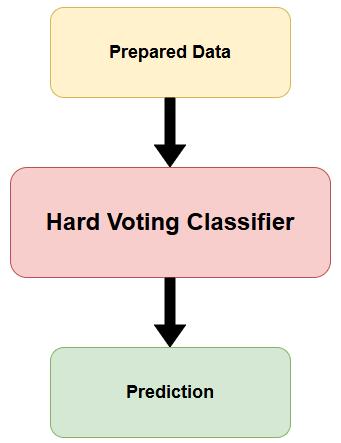
Fig -4.1:HighLevelFlowoftheOverallSystem
The process begins with data preparation, where the healthcaredataset,comprisingvarioushealthandlifestyle indicators such as age, gender, general health status, smoking habits, exercise frequency, and other disease histories, is cleaned and preprocessed. Missing values are handled using imputation techniques to ensure data completeness. Additionally, categorical features are encoded, and numerical features are normalized where necessary to enhance model interpretability and performance.
● =Finalensembleprediction(classlabel)
● c=Classlabel(0fornodisease,1fordisease)
● M=Numberofbasemodels(inthiscase,3)
● I() = Indicator function returns 1 if yhat_m = c else0
● =Predictionfromthemthbaseclassifier

4. DESIGN AND METHODOLOGY
The architecture of this project is built upon a straightforward yet effective machine learning pipeline, aimed at predicting the presence or absence of heart diseasebasedonpatient-levelhealthdata.
Followingdata preparation, therefineddataset isfedinto a Hard Voting Classifier. This ensemble model integrates the predictive capabilities of three distinct machine learning algorithms: Logistic Regression, Random Forest, and AdaBoost Classifier. Each of these base learners captures different patterns and relationships within the data, contributing to a more robust decision-making process.LogisticRegressionmodelsthelinearrelationship between input features and disease occurrence, while Random Forest captures non-linear patterns through multipledecisiontrees.AdaBoostfocusesonreducingbias andvariancebyiterativelyimprovingweaklearners.
Once trained, each base model independently makes a prediction on whether a patient has heart disease. The HardVotingmechanismthenaggregatesthesepredictions through a majority voting rule, where the class (presence or absence of heart disease) with the highest number of votesfromthebasemodelsisselectedasthefinaloutput.
The performance evaluation on the heart disease dataset revealed that the Hard Voting Classifier achieved the best generalization performance, securing the highest test accuracy of 73.16%. This demonstrates the effectiveness of aggregating Logistic Regression, Random Forest, and
International Research Journal of Engineering and Technology (IRJET) e-ISSN:2395-0056
Volume: 12 Issue: 03 | Mar 2025 www.irjet.net p-ISSN:2395-0072
AdaBoost models to deliver stable and reliable predictions.
Interestingly, while individual classifiers like Decision Tree Classifier and Random Forest reported extremely high training accuracies of 99.98%, their test accuracies dropped to 64.00% and 71.56%, respectively, indicating overfitting. On the other hand, the Soft Voting Classifier recordedatrainingaccuracyof83.19%,butitstillfailedto outperformtheHardVotingmodelonunseendata.
Additionally, ensemble models such as XGBoost and LGBMClassifier performed competitively with test accuracies of 73.09% and 73.00%, yet the Hard Voting Classifier retained the edge by providing a better balance betweentrainingandtestingperformance.
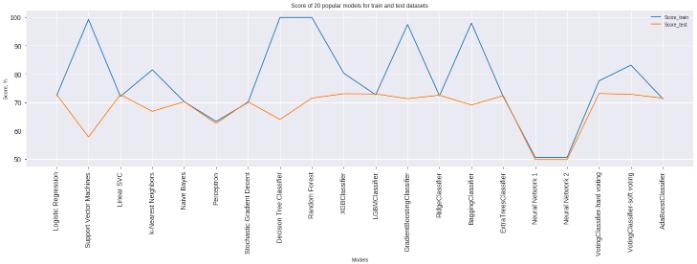
modelspronetooverfitting,suchastheDecisionTreeand Random Forest, the Hard Voting approach maintained a healthy balance between training and test accuracies, making it a reliable solution for healthcare prediction tasks. The success of this ensemble strategy highlights its potential for practical implementation in clinical decision support systems, where robust and consistent performance is crucial for patient risk assessment and earlydiagnosis.
[1] LogisticRegressiononWikipedia. https://en.wikipedia.org/wiki/Logistic_regression
[2] RandomForestonWikipedia. https://en.wikipedia.org/wiki/Random_forest
[3] AdaBoostonWikipedia. https://en.wikipedia.org/wiki/AdaBoost
[4] Sharma, G. (n.d.). Voting Classifier for Binary ClassificationProblemsonMedium. https://medium.com/@iGirijesh/voting-classifier-forbinary-classification-problems-e5fef5e6c54d
[5] Goodfellow, I., Bengio, Y., & Courville, A. (2016). Deep Learning.MITPress.
[6] Chollet, F. (2017). Deep learning with python. ManningPublications.
[7] AhmadAA,PolatH.PredictionofHeartDiseaseBased on Machine Learning Using Jellyfish Optimization Algorithm.Diagnostics(Basel).2023
[8] Damen, Johanna AAG, et al. "Prediction models for cardiovascular disease risk in the general population: systematicreview."bmj353(2016).
[9] Marimuthu, M., Abinaya, M., Hariesh, K. S., Madhankumar, K., & Pavithra, V. (2018). A review on heart disease prediction using machine learning and data analytics approach. International Journal of ComputerApplications,181(18),20-25.
[10] Mohan, S., Thirumalai, C., & Srivastava, G. (2019). Effective heart disease prediction using hybrid machine learning techniques. IEEE access, 7, 8154281554.
In this study, the Hard Voting Classifier emerged as the most effective approach for predicting the presence of heartdisease.Thisresultunderscoresthepowerofmodel diversity in ensemble learning, where the collective decision-making process helps reduce bias and variance, leading to better generalization on unseen data. Unlike
[11] Murray, Thomas H. "Ethics, genetic prediction, and heart disease." The American journal of cardiology 72.10(1993):D80-D84.
[12] Alwakid, Ghadah, et al. "Optimized machine learning framework for cardiovascular disease diagnosis: a
International Research Journal of Engineering and Technology (IRJET) e-ISSN:2395-0056
Volume: 12 Issue: 03 | Mar 2025 www.irjet.net p-ISSN:2395-0072
novel ethical perspective." BMC Cardiovascular Disorders25.1(2025):123.
[13] Geron, A. (2019). Hands-On Machine Learning with Scikit-Learn, Keras, and TensorFlow: Concepts, Tools, andTechniquestoBuildIntelligentSystems(2nded.). O’ReillyMedia,Inc.
[14] Miao, Kathleen H., Julia H. Miao, and George J. Miao. "Diagnosing coronary heart disease using ensemble machine learning." International Journal of Advanced ComputerScienceandApplications7.10(2016).
[15] Bajaj, Madhvan, et al. "Heart Disease Prediction using Ensemble ML." 2023 International Conference on Sustainable Computing and Data Communication Systems(ICSCDS).IEEE,2023.
© 2025, IRJET | Impact Factor value: 8.315 | ISO 9001:2008
| Page