
International Research Journal of Engineering and Technology (IRJET) e-ISSN:2395-0056
Volume:13Issue:03|Mar2026 www.irjet.net p-ISSN:2395-0072
International Research Journal of Engineering and Technology (IRJET) e-ISSN:2395-0056
Volume:13Issue:03|Mar2026 www.irjet.net p-ISSN:2395-0072
1Kunal Patil,2Nimesh Patil,3Pratik Sirsath,4Sanjay Sonkawade, 5Anand Ingle
1234 B.E Student, MGM college of Engineering and Technology
5 Professor, MGM college of Engineering and Technology
Abstract cardiovascular disease (CVD) is one of the major causes of morbidity and mortality worldwide, posing burden on healthcare systems. Accurate andearly prediction of cardiovascular disease is critical for enabling preventive measures with the increasing availabilityofmedicaldata,machine learningtechniques haveemergedaseffectivetoolsfordiseasepredictionand risk assessment. This paper presents an ensemble machinelearningapproachforpredictingcardiovascular diseaseusingacombinationofclinical,demographic,and lifestyle-related features such as age, gender, blood pressure,cholesterollevels,bodymassindex,andsmoking status. There are some Several individual classification models, such as Logistic Regression, Decision Tree, Support Vector Machine, and Random Forest, are developed and evaluated. To improve prediction performance and reduce model variance, ensemble techniques such as majority voting and boosting are employed to integrate the outputs of multiple base learners. The proposed ensemble model is assessed using standard evaluation metrics including accuracy, precision, recall, F1-score, and area under the ROC curve (AUC). Experimental results shows that the ensemblebased model achieves superior performance comparedto another classifiers, offering better robustness and generalization capability. The proposed approach can assist healthcare professionals in early diagnosis, risk stratification, and decision support, ultimately contributing to the reduction of cardiovascular diseaserelatedcomplications.
Cardiovascular disease (CVD) is a disease which comes from group of disorders affecting the heart and blood vessels and remains one of the major causes of death worldwide. According to global statistics, millions of people die each year due to heart-related problems such as coronary artery disease, heart failure, stroke, and hypertension. The increasing prevalence of uneven lifestyles, unhealthy dietary habits, smoking, obesity, diabetes, and stress has further contributed to the faster
riseincardiovasculardiseases.SotheEarlydetectionand accurate prediction of CVD play a vital role in reducing mortality rates and improving patient outcomes through timelymedicalandlifestylemodifications.
Traditional methods for diagnosing cardiovascular disease mostly depends on clinical expertise, medical examinations, and laboratory tests. While these methods areeffective,Buttheycanbetime-consuming,costly,and subject to human mistakes. This rising volume of healthcaredatageneratedfromelectronichealthrecords, wearable devices, and diagnostic systems has made it increasingly difficult for healthcare professionals to manually analyse and interpret data efficiently. This has created a strong demand for automated and intelligent systemscapableofassistingdoctorsindiseaseprediction anddecision-makingaboutthedisease.
Machine learning (ML) has emerged as a powerful tool in the healthcare domain due to its ability to analyse complex datasets, identify hidden patterns, and make accurate and quicker predictions. Machine learning algorithms such as Logistic Regression, Decision Trees, Support Vector Machines (SVM), k-Nearest Neighbours (k-NN), and Random Forest have been widely applied forcardiovasculardiseaseprediction.Thesemodelscan process number of risk factors simultaneously and providepredictiveinsightsthatsupportearlydiagnosis. However, the performance of individual models often depends on the behaviour of the dataset, feature distribution,andalgorithm-specificassumptions,which mayleadtolimitedaccuracyorgeneralizationissues.
International Research Journal of Engineering and Technology (IRJET) e-ISSN:2395-0056
Volume:13Issue:03|Mar2026 www.irjet.net p-ISSN:2395-0072
Cardiovascular disease prediction has been an active research space in the healthcare and machine learning. Several studies have explored in detail a wide range of machinelearningmodelstogetbettertheaccuracyand efficiency of heart disease diagnosis. Recent researches are primarily focused on old statistical models and singleclassifiersto identify risk factorsassociated with cardiovascular Situation i.e, Logistic Regression and DecisionTreemodelshavebeenwidelyusedbecauseof their interpretability and computational efficiency. However, these approaches often shows lower performance when faced with complex, nonlinear relationshipspresentinhigh-dimensionalclinicaldata.
Support Vector Machines (SVM) and k-Nearest Neighbours (k-NN) have also been applied to get the presence of cardiovascular disease. SVM, in particular, has shown robustness with high-dimensional feature area by maximizing the margin between classes. Detrital. applied SVM to heart disease datasets and reported satisfactory performance, although sensitivity to parameter selection limited generalizability. Similarly, k-NN demonstrated reliable accuracy in smaller datasets but suffered from increased computationaloverheadasthenumberofobjectsgrew.
With improvement in ensemble learning, researchers have increasingly leveraged techniques that get multiple models together to enhance predictive performance. Random Forest, an ensemble of decision
treesbuiltthroughbootstrapaggregation(bagging),has regularly outperformed its constituent-based learners by reducing overfitting and get better generalization. StudiessuchasthosebyParvinetal.demonstratedthat Random Forest models sent superior classification accuracy for CVD prediction when compared to singletreeapproaches.
Boosting methods, such as AdaBoost and Gradient BoostingMachines(GBM),havealsobeen foundforheart disease prediction. Boosting trains one after one to weak learners, typically decision stumps, by focusing on previouslymisclassified objects.Research bySubasiet al. shows that boosting-based models get higher precision and sensitivity than traditional models, especially on imbalancedcardiovasculardatasets.
In addition to classical ensemble techniques, hybrid and stacking models have been proposed to further improve performance. For instance, several studies integrated feature selection techniques with ensemble classifiers to eliminate irrelevant attributes, thereby enhancing model accuracyandreducingcomplexity.Singhetal.introduced a hybrid model combining feature ranking with votingbased ensembles, achieving competitive results on benchmark heart disease datasets. Similarly, stackingbased frameworks that integrate multiple heterogeneous baselearnershavebeenreportedto getbetterprediction accuracy by learning meta-level patterns that separate classification.
International Research Journal of Engineering and Technology (IRJET) e-ISSN:2395-0056
Volume:13Issue:03|Mar2026 www.irjet.net p-ISSN:2395-0072
TITLE
Involving machine learning techniques in heart disease diagnosis: aperformanceanalysis
AUTHORS
B.S.ShukurandM.M. Mijwil
Heart Disease Prediction Using Novel QuineMcCluskeyBinary Classifier(QMBC)
R.Kapila,T. Ragunathan,S.Saleti,T. J.Lakshmi,andM.W. Ahmad
Comprehensive analysis of supervised algorithms for coronary artery heart disease detection
Risk assessment of coronary heart disease based on cloud-random forest
S.Dhanka,V.K. Bhardwaj,andS.Maini
J.Wang,C.Rao,M.Goh, andX.Xiao
METHODOLOGY
Machine learning techniques including logistic regression, random forest, artificial neural network, support vector machines, and k-nearest neighbors are applied to diagnose heart disease using the Cleveland Clinic dataset for performancecomparison.
The QMBC model combines seven machine learning models (logistic regression, decision tree, random forest, K-nearest neighbor, naive Bayes, support vector machine, multilayer perceptron) with feature selection and Principal ComponentAnalysis.
Logistic Regression and XGBoost models are applied to the Statlog heart disease dataset. Hyperparameters are optimized using Random SearchCV. Performance is compared between nonoptimized and optimized models.
The C-RF model combines a cloud model and random forest by weighting evaluation attributes using a cloud-based algorithm, constructing new CART-based decision trees, and evaluating performance on the Framinghamdataset.
RESULTS
Support vector machines demonstrate the highest diagnostic accuracy of 96%, highlighting the significant role of machine learning in assisting healthcare professionals in heart disease diagnosis and improving decisionmaking.
The QMBC model outperforms existing methods in heart disease prediction, offering superior accuracy by leveraging an ensemble of models and feature extraction techniques for efficient and reliable predictions
Optimized Logistic Regression and XGBoost models significantly improve CAHD detection accuracy, with XGBoost achieving the highest performance, demonstrating their potential in early diagnosis and risk assessment for coronary arteryheartdisease
The C-RF model enhances CHD risk assessment with superior classification accuracy, reduced error rates, and higher AUC compared to CART, SVM, CNN,andRF,showcasing improved prediction performance.
International Research Journal of Engineering and Technology (IRJET) e-ISSN:2395-0056
Volume:13Issue:03|Mar2026 www.irjet.net p-ISSN:2395-0072
Heart Disease Prediction Using Stacking Model With Balancing Techniques and Dimensionality Reduction
A.Noor,N.Javaid,N. Alrajeh,B.Mansoor,A. Khaqan,andS.H.Bouk
PaRSEL uses a stacking model combining PAC, RC, SGDC, and XGBoost at the base layer with LogitBoost at the meta layer, incorporating dimensionality reduction and balancing techniques
Thischapterdeterminesthecomplete systemanalysis and design of the derived cardiovascular disease prediction system. It includes the system workflow, functional requirements, non-functional requirements, systemarchitecture,dataflow,anddesignmodules.The main goal of this system is to predict the risk of cardiovascular disease using ensemble machine learningmodels to get better prediction accuracy and reliability.
3.1
Cardiovascular disease is one of the major causes of deathworldwide.Manypatients nevershowsymptomsat an early stage, which makes early diagnosis difficult. Old diagnosis requires medical tests, expert consultation, and duration.
Hence,thissystemisdesignedto:
Collectpatienthealthcredentials(biometricdata)
Processandcleanthedata
Applyensemblemachinelearningalgorithms
Predict whether a patient has a risk of cardiovasculardisease
3.3 Objectives of the System
Themaininstancesare:
To develop a system that predicts cardiovascular disease riskusingmachinelearning.
To improve accuracy using an ensemble learning approach insteadofasinglemodel.
Toprovidequickandreliablepredictionoutcomes
To assist doctors and patients in early detection and prevention.
To create a user-friendly system for prediction and reporting.
3.4Biometricmodalities.
PaRSEL achieves superior accuracy, precision, and AUC-ROC, effectively addressing imbalanced and highdimensional data for heart disease prediction while providing interpretability using SHAP to analyze feature influence.
Biometric modalities are the measurable patienthealth parametersusedforprediction. Commoninputfeaturesareused:
Age
Gender
BloodPressure(Systolic/Diastolic)
Cholesterollevel
Bloodglucoselevel
BMI(BodyMassIndex)
Heartrate
Smokinghabit
Physicalactivity
ECGresults
3.5Non-FunctionalRequirements
The non-functional requirements of the CVD (cardiovascular disease) prediction system show the quality, performance, and operational constraints of the ensemble machine learning model. These needs ensures that the system is accurate, reliable, efficient, secure, and suitableforreal-worldhealthcareapplications.
Thesystemmustprovidehighperformancebygenerating cardiovascular disease predictions within a short response time. Even when processing large patient datasets, the ensemble learning approach should maintain stable performance without significant delays. Efficient computation is essential to support timely clinicaldecision-making.
Accuracy and reliability are critical non-functional requirements of the system. The ensemble machine learning model should deliver in the form of consistency accurate predictions and outperform individual machine learning models. The system must be evaluated using standard performance metrics such as accuracy,
International Research Journal of Engineering and Technology (IRJET) e-ISSN:2395-0056
Volume:13Issue:03|Mar2026 www.irjet.net
precision, recall, F1-score, and ROC-AUC to ensure dependableresults.
Scalability is an important need, as the system should be capable of handling an increasing number of patient records without degradation in performance. The architectureshouldsupportandhelptheadditionofnew machine learning models in the ensemble and allow future enhancements such as real-time prediction abilities.
Securityisessentialduetothesensitivenatureofmedical data. The system must make sure the secure storage, transmission, and processing of patient information. Proper authentication, verification and authorization mechanisms should be deployed, and encryption techniques should be used as security to protect confidentialhealthrecords.
Usability is another main requirement, as the system should be easy to use for healthcare professionals. The interfaceshouldbesimple,cleanandintuitive,allowing doctors to input patient data and interpret prediction results without requiring technical expertise. The predicted CVD risk should be clearly represented to supportclinicaldecision-making.
Thesystemshouldensurehighavailabilityandminimal downtime so that predictions can be accessed whenever required. Even if one model in the ensemble failssomewhere,thesystemshouldcontinuetofunction correctly using the remaining models. Proper error handling mechanisms should be implemented to maintainsystemstability.
Maintainability is required to ensure long-term usability of the system. The ensemble framework should allow easy updating, retraining, or replacement of machine learning models. A modular design and proper documentation will help developers maintain andimprovethesystemefficiently.
Interpretability is important in healthcare applications, as clinicians (Doctors) need to understand the factors influencing predictions. The system should provide insights into feature importance, helping doctors identify key risk factors contributing to cardiovascular disease.Thisimprovestrustandtransparencyinmodel predictions Finally, the system must go with the healthcare regulations and ethical standards. Patient data should be handled responsibly, by ensuring privacy and fairness. The ensemble machine learning model should minimize bias and support ethical decision-making in cardiovasculardiseaseprediction.
p-ISSN:2395-0072
Applyinghumanvisualpropertyintherecognitionof faces, people can identify face from very far distance, even the details are vague. It means the symmetry characteristicisenoughtoberecognized.Humanfaceis made up of eyes, nose, mouth and chin etc. There are some differences in shape, size and structure of those organssothefacesaredifferedinmultiplewaysandwe candescribethemwiththestructureoftheorganssoas to recognize them. One common method is to extract the shape of the eyes, nose, mouth and chin and then distinguish the faces by distance and scale of those organs.
Feature extraction is a crucial step in the cardiovascular disease (CVD) prediction system, as it transforms raw medicaldataintomeaningfulfeatures(likedatacleaning) thatcanbeeffectivelyusedbyensemblemachinelearning models. Proper feature extraction improves model accuracy, reduces noise, and enhances the overall performanceofthepredictionsystem.
In the proposed system, features are extracted from patientclinicalanddemographicdatasuchasage,gender, blood pressure, cholesterol levels, blood glucose, body mass index (BMI), smoking status, physical activity, and family history of heart disease. These parameters represent important risk factors associated with cardiovascular situations and provide a strong structure forprediction.
Beforefeatureextraction,datapre-processingtechniques suchashandlinglostvalues,normalization,andencoding ofcategoricalvariablesareapplied.Continuousattributes like blood pressure and cholesterol are scaled to a standardrange,whilecategoricalfeaturessuchasgender and smoking habits are converted into numerical form using proper encoding methods. This ensures compatibility with machine learning algorithms used in theensemblelearning.
Derived features are also created to improve predictive power. For example, ratios or combined indicators such as cholesterol-to-HDL ratio, BMI categories, and age-risk groups are generated from existing data. These derived features help the ensemble model capture complex relationships among health parameters that may not be evidentfromrawfeaturesalone.
Feature selection techniques are applied after extractiontogetthemostrelevantfeaturesandremove redundant or irrelevant attributes. Methods such as correlation analysis, feature importance from treebased models, and statistical tests are used to retain only those features that significantly contribute to CVD
International Research Journal of Engineering and Technology (IRJET) e-ISSN:2395-0056
Volume:13Issue:03|Mar2026 www.irjet.net
prediction. This reduces model complexity and improvesefficiency.
Theextractedfeaturesarethenprovidedasinputtothe ensemble machine learning models, such as Random Forest, Gradient Boosting, or Voting Classifiers. Effective feature extraction makes sure that the ensemble model learns meaningful patterns from patient data, leading to accurate and reliable cardiovasculardiseaseriskprediction.
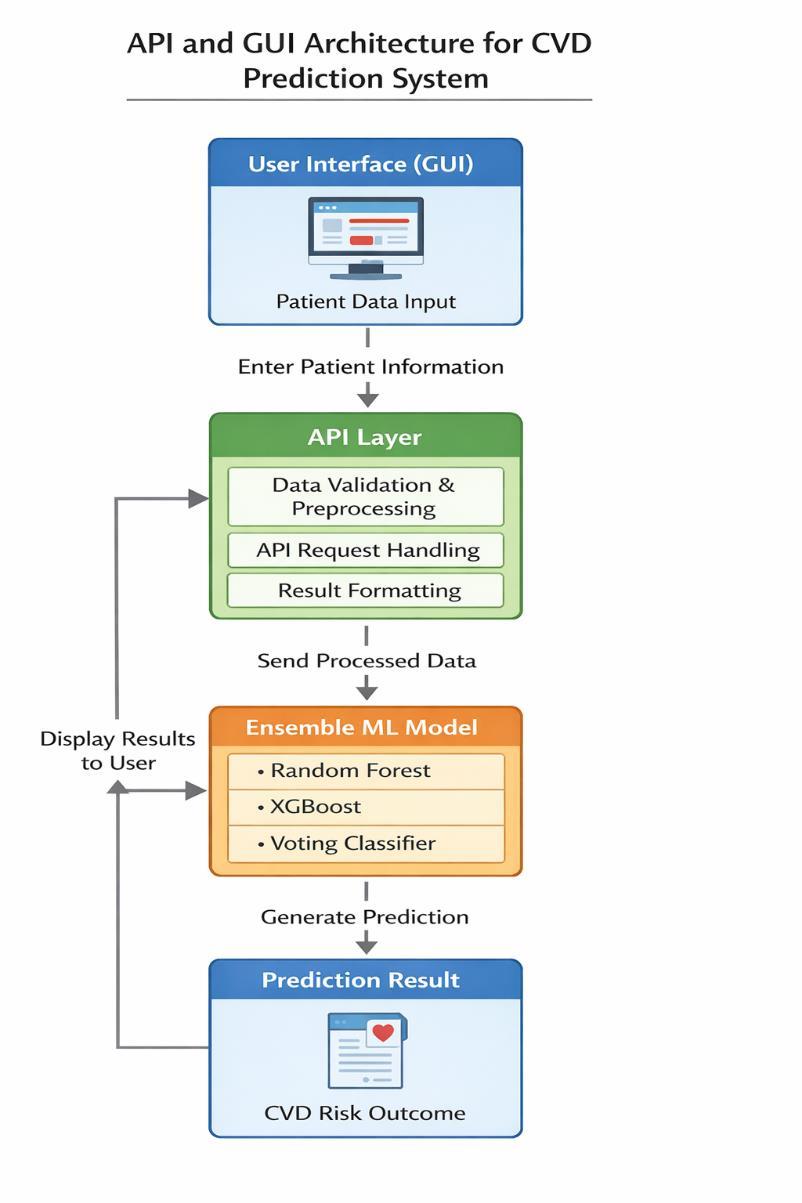
Theflowchartrepresentsthecompleteworking process of the cardiovascular disease (CVD) prediction system using an ensemble machine learning approach. It shows how user input is processed through the API and machine learning models to generate the last prediction.
The process begins at the Graphic User Interface(GUI), where the healthcare professional or user enters patient details such as age, blood pressure,
p-ISSN:2395-0072
cholesterol level, blood glucose, and other related medical parameters. The GUI provides a simple, easy and interactive form for data entry and ensures that seemeasyforuse.
Once the patient data is submitted, it is forwarded to the APILayer. The API acts as a bridge between the GUI and the machine learning models. At thisstep,theAPIperforms datavalidation tocheckfor missing or incorrect values and ensures that the collected data is in the correct format. It also handles data preprocessing, such as visualization, sampling normalization and encoding, to make the data suitable forthepredictionmodels.
After preprocessing, the API forwards the processed data to the Ensemble Machine Learning Model.Theensembleconsistsofmultiplealgorithmssuch as Random Forest, XGBoost, and a Voting Classifier. Each model separately analyzes the input features and generates its own prediction. The ensemble mechanism combines these separate predictions to get the more accurateandreliableCVDriskassessment.
The ensemble model then sends the final prediction back to the API Layer, where the result is formatted into a readable and structured response. This mayincludethepredictedCVDrisklevel(low,medium,or high)andconfidenceinformation.
Existing Security includes SSL Certification, User Ids & Passwords, One Time Passwords (OTPs) to customer’s mobile. But still there are various security aspects and threats.So,enhancingtheexistingsecurityisamust.This technologyevolutionisinevitable.NowthereareLaptops andmobileshavebiometricverificationinbuilt,forLogon with Finger Print Sensing. This same verification method can be integrated to Banking applications as well. Utilizing biometrics for internet banking will be considerably more accurate than current methods of VerificationPinsandpasswords.ThisBiometriccanbean additional authentication thus enhancing the existing security.
The cardiovascular disease (CVD) prediction system using an ensemble machine learning approach provides an effective and reliable solution for early risk assessment. By combining multiple machine learning models, the system improves prediction accuracy and reduces the limitations of individual algorithms. The use
International Research Journal of Engineering and Technology (IRJET) e-ISSN:2395-0056
Volume:13Issue:03|Mar2026 www.irjet.net p-ISSN:2395-0072
of ensemble techniques ensures robust and consistent performanceacrossdifferentpatientdatasets.
The integration of feature extraction, preprocessing, and model selection enables the system to identify important clinical risk factors such as age, blood pressure, cholesterol levels, and lifestyle attributes. These features play a crucial role in generating meaningful predictions and enhancing the overalleffectivenessofthemodel.
The development of the API and GUI ensures seamless interaction between users and the machine learning backend. The API enables secure and efficient data processing, while the GUI provides a simple and user-friendly interface for healthcare professionals. This design makes the system practical for real-world clinicalenvironments.
1. K. J. Roth et al., “Global burden of cardiovascular diseases and risk factors,” Journal of the American College of Cardiology, vol.76,no.25,pp.2982–3021.
2. T. Hastie, R. Tibshirani, and J. Friedman, The Elements of Statistical Learning: Data Mining, Inference, and Prediction, Springer, New York. Gunajit Sarma and Pranav Kumar-(2002) ‘Biometric Authentication’-International Journal of Pure Applied Sciences and Technology-ISSN2229-6107,pp67-68.
3. H.Witten,E.Frank,andM.A.Hall, DataMining: Practical Machine Learning Tools and Techniques, Morgan Kaufmann. John Trader(2014)‘ImpactofBiometricsinBanking’-IEEE Transaction-Vol54.
4. L. Breiman, “Random Forests,” Machine Learning,vol.45,no.1,pp.5–32.
5. T. Chen and C. Guestrin, “XGBoost: A scalable tree boosting system,” Proceedings of the 22nd ACM SIGKDD International Conference on KnowledgeDiscoveryandDataMining, pp. 785–794.
6. Marius Tico and Pauli Kuosmanen (2003) ‘Novel Fingerprint Representation, -IEEE Transactions on Pattern Analysis and Machine Intelligence”,Vol25,No.8.
7. Meraoumia and Bouridane-(2013) –‘Multimodal Biometrics System’-IEEE
Transactions on Electronic Circuits and Systems
8. Quinghan Xiao-(2007)’Spoofing Techniques ’IEEEComputationalIntelligence.
9. S.ShilaskarandA.Ghatol,“Featureselectionfor medical diagnosis,” International Journal of ComputerApplications,vol.1,no.4,pp.1–6.24, No.3.
10. World Health Organization (WHO), cardiovascular diseases (CVDs)- Fact sheet, WHOPress,Geneva
11. R. S. Deo. “Machine Learning in medicine” Circulation, vol.132,no.20,pp.1920-1930
2026, IRJET | Impact Factor value: 8.315 | ISO 9001:2008