
International Research Journal of Engineering and Technology (IRJET) e-ISSN: 2395-0056
Volume: 13 Issue: 03 | Mar 2026 www.irjet.net p-ISSN: 2395-0072

International Research Journal of Engineering and Technology (IRJET) e-ISSN: 2395-0056
Volume: 13 Issue: 03 | Mar 2026 www.irjet.net p-ISSN: 2395-0072
Fatima Zahra Ait Laaskri1,Wasif ur Rehman 2
Hubei Key Laboratory of Energy Storage and Power Battery, School of Mathematics, Physics and Optoelectronic Engineering, Hubei University of Automotive Technology, Shiyan442002, China ***
Abstract: The growing demand for sustainable and cost-effective energy storage materials has driven interest in biowaste-derived electrodes. Here, we report a hybrid electrode material, CPP@PPy@MXene, fabricated from carbonized pomelo peel (CPP) and MXene, designed to enhance the electrochemical performance of Zinc storage cathodes. Carbon derived from pomelo peel was activated via freeze-drying and calcination, while MXene was synthesized using a selective etching method. The materials were combined to form a coral reef–shaped nanocomposite, exhibiting a high surface area, enhanced conductivity, and structural stability. Electrochemical tests demonstrate that CPP@PPy@MXene electrodes achieve a specific capacity of approximately 224.9 mAh g⁻¹ at a current density of 1.0 A g⁻¹ , along with excellent cycling stability and rate capability. These results highlight the potential of integrating bio-waste carbon with MXene to create eco-friendly, high-performance electrodes, contributing to sustainability energy storage technologies.
Key words: Zinc storage, Carbonized pomelo peel, MXene, Polypyrrole, Hybrid nanocomposite, Electrochemical performance
The increasing demand for renewable and sustainable energy sources has intensified the need for efficient energy storagetechnologies.Rechargeablebatteries, particularlylithium-ionandsodium-ionsystems,are widelyregarded askeysolutionsduetotheirhighenergydensity,longcyclelife,andversatilityacrossapplicationssuchasportable electronics, electric vehicles, and grid-scale storage [1],[2],[3],[4],[5]. However, limited lithium availability, high costs, and environmental concerns associated with lithium extraction have motivated the development of alternative,earth-abundantbatterychemistries,suchassodium-ionandZinc-basedsystems[6],[7],[8].
Despite their potential, practical applications of sodium- and Zinc-ion batteries remain limited by intrinsic challenges in electrode materials. These include low electrical conductivity, structural instability during repeated cycling, slow ion diffusion kinetics, and insufficient specific capacity. Traditional electrode materials, such as pure carbon, transition metal oxides, or MXenes, often fail to simultaneously overcome these limitations, leading to reducedratecapabilityandpoorlong-termstability[6],[15].
Biomass-derived carbon offers a sustainable, low-cost, and environmentally friendly alternative. These materials providehierarchicalporousstructuresandnaturallyoccurringheteroatomsthatenhanceionstorageandelectronic conductivity. Among them, carbonized pomelo peel (CPP) is particularly promising due to its inherent cellular structure, which can be transformed into a three-dimensional porous carbon framework [9],[10],[11]. Conductive polymers such as polypyrrole (PPy) and two-dimensional MXene nanosheets further enhance charge transport, structuralstability,andsurfacearea,makingthemidealcandidatesforhybridelectrodedesign[15],[16].
In this study, CPP, PPy, and MXene are combined to construct a coral reef–shaped hierarchical composite (CPP@PPy@MXene). This architecture integrates the high surface area and defect-rich nature of biomass carbon with the electrical conductivity of PPy and MXene nanosheets, aiming to overcome the limitations of individual materials. The resulting composite exhibits improved Zinc/sodium storage capability, enhanced rate performance, andexcellentcyclingstability,demonstratingthesynergisticeffectofthismulti-componentdesign[12],[15]. Themainobjectivesofthisworkare:
To synthesize carbonized pomelo peel (CPP) and integrate it with PPy and MXene to form a hierarchical coral-like composite.
To systematically characterize the structural, morphological, and chemical properties of the CPP@PPy@MXene compositeusingXRD,SEM,TEM,Ramanspectroscopy,BET,andXPS[15],[16].
International Research Journal of Engineering and Technology (IRJET) e-ISSN: 2395-0056
To evaluate the electrochemical performance of the composite as a cathode material for Zinc/sodium storage, includingspecificcapacity,ratecapability,andcyclingstability[12].
Toelucidatethemechanismsunderlyingtheenhancedelectrochemicalbehaviorofthishybridcomposite,[16].
By addressing the limitations of traditional electrode materials and utilizing sustainable biomass resources, this studyprovides insights into thedesignofhigh-performance,environmentallyfriendlyelectrodematerialsfor nextgenerationenergystoragedevices[15],[17].
2.1 MaterialsAll chemicalsused in thisstudy were of analytical grade and used without further purification. The mainmaterialsincluded:
Freshpomelopeel(biomasscarbonsource)
Pyrrole(C₄H₅N,monomerforpolypyrrole)
Ferricchloridehexahydrate(FeCl₃·6H₂O,oxidizingagent)
Methylorange(MO,pHindicator)
MXenepowder(Ti₃C₂Tₓ)
Ethanol(solvent)
Deionizedwater
Zinc foil was used as the anode, and 2 M ZnSO₄ aqueous solution served as the electrolyte for all electrochemical measurements.
2.2 Preparation of CPP biomass foam
Freshpomelopeelwaswashed,cutintosmallpieces,andfreeze-driedfor30h.Thedriedbiomasswascarbonizedin a tube furnace under N₂ atmosphere at 260 °C (heating rate 5 °C/min) for 30 min to obtain the carbonized pomelo peel(CPP)foam.
2.3 Preparation of CPP@PPy Composite
CPPfoam (0.35 g) wasimmersedinanaqueous solutioncontaining pyrrole (0.453 g)and methyl orange (0.185g) and sonicated for 2 h. FeCl₃·6H₂O (1.827 g in 40 mL deionized water) was added dropwise to initiate in-situ polymerizationofpyrrole.Themixturewaskeptat−5 °Cfor24h,followedbysequentialwashingwithethanoland deionizedwater.TheresultingPPy-coatedCPPfoamwasdriedat60 °Cundervacuum.
2.4 Preparation of CPP@MXene Composite
MXenepowder(0.02g)wasdispersedin5mLanhydrousethanolandsonicatedfor15min.CPPfoamwasimmersed in deionized water for 5 min to prevent downward diffusion of the MXene solution. The MXene solution was then dropwise applied to the upper surface of CPP foam, and the sample was dried at 60 °C for 6 h, resulting in CPP@MXenefoam
2.5 Preparation of CPP@PPy@MXene Composite
MXenepowder(0.02g)wasdispersedin5mLanhydrousethanolandsonicatedfor15min.ThePPy-CPPfoamwas pre-soakedin10mLdeionizedwaterfor5min,thentheMXenesolutionwasapplieddropwiseonthePPy-CPPfoam. After treatment, the composite was dried at 60 °C to obtain the final CPP@PPy@MXene hierarchical foam. The synthesisrouteisillustratedinFig.1
2.6 Material Characterization
● Morphologyandmicrostructure:SEM(Hitachi)andTEM(JEOL)wereusedtoinvestigatesurfacetexture,porosity, andlayerstructure.
Volume: 13 Issue: 03 | Mar 2026 www.irjet.net p-ISSN: 2395-0072 © 2026, IRJET | Impact Factor value: 8.315 | ISO 9001:2008 Certified Journal | Page2370
International Research Journal of Engineering and Technology (IRJET) e-ISSN: 2395-0056
Volume: 13 Issue: 03 | Mar 2026 www.irjet.net p-ISSN: 2395-0072
● Phase analysis: XRD patterns were collected on a Bruker D8 Advance diffractometer with Cu Kα radiation (λ = 1.5406Å),scanning2θ=5–80°at7°/min.
● Thermalstability:TGAwasperformedunderN₂from25 °Cto800 °Cat10 °C/min.
● Surfacechemistry:XPSmeasurementswereconductedtodetermineelementalcompositionandbondingstates.
● Structuraldefectsandgraphitization:Ramanspectroscopywasperformedwitha532nmlaser.
● Surfacearea:BETanalysiswasperformedusingN₂adsorption–desorptionisothermsat77K.
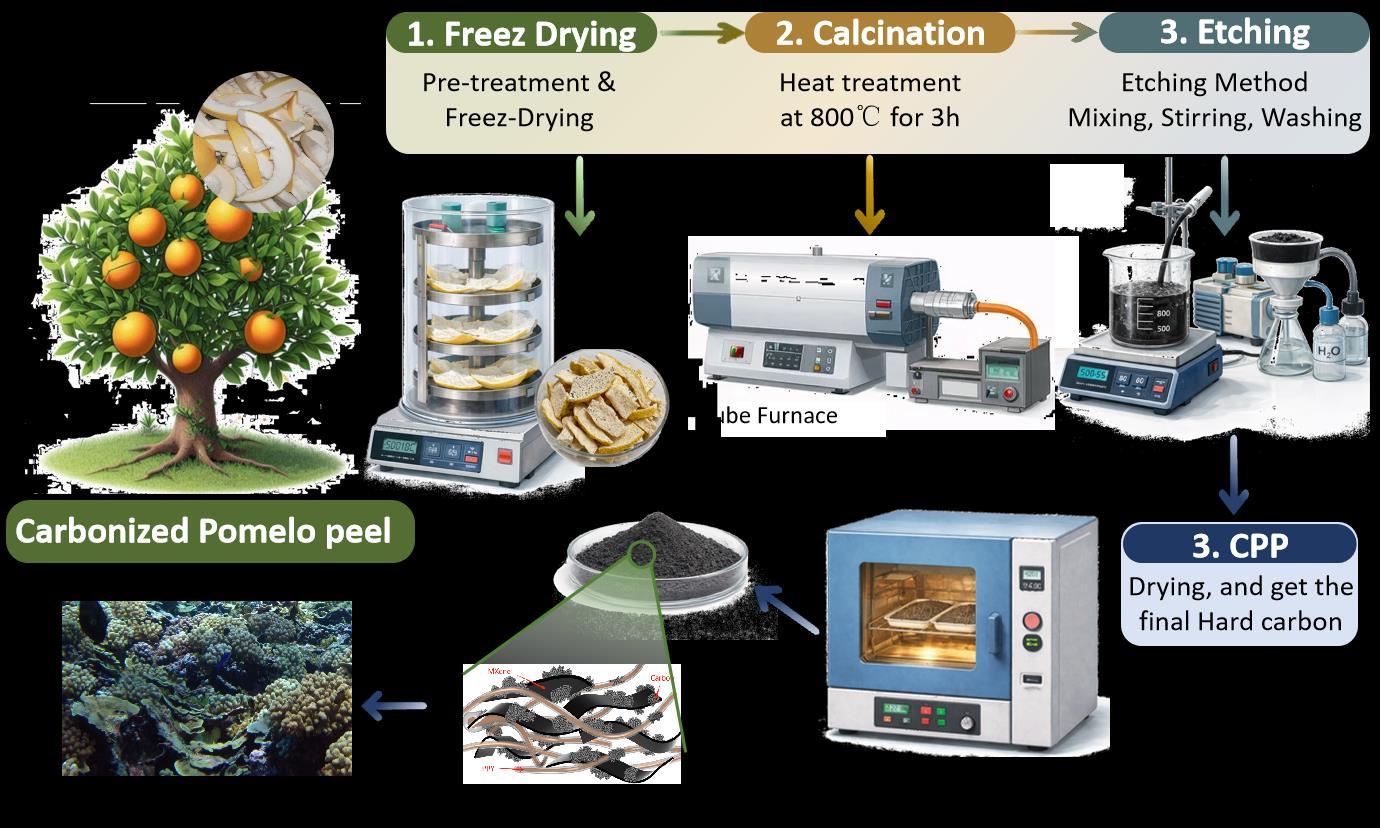
Fig- 1: schematicallypresentthecircletogetthemainformulaCPP@PPy@MXenepassingbytheCarbonactivation andMxenepreparationtogetthewantingformula.
2.7
Electrodes were prepared by compressing the active material (CPP@PPy@MXene) onto a stainless-steel current collector. Mass loading was controlled at ~1.5 mg/cm², and electrode thickness was ~100 µm. CR2032 coin cells wereassembledinanargon-filledgloveboxusingZnfoilastheanodeand2MZnSO₄astheelectrolyte.
Electrochemical measurements included:
● CyclicVoltammetry(CV):scanrate0.1–1mV/sover0.01–1.8VvsZn²⁺/Zn.
● Galvanostaticcharge–discharge(GCD):testedatcurrentdensitiesof0.1–2A/g.
● Electrochemical Impedance Spectroscopy (EIS): frequency range 100 kHz to 0.01 Hz with 5 mV AC amplitude at open-circuitpotential.
Thissetupallowedevaluationofspecificcapacity,ratecapability,cyclingstability,andcharge-transferresistance
© 2026, IRJET | Impact Factor value: 8.315 | ISO 9001:2008 Certified Journal | Page2371
Volume: 13 Issue: 03 | Mar 2026 www.irjet.net
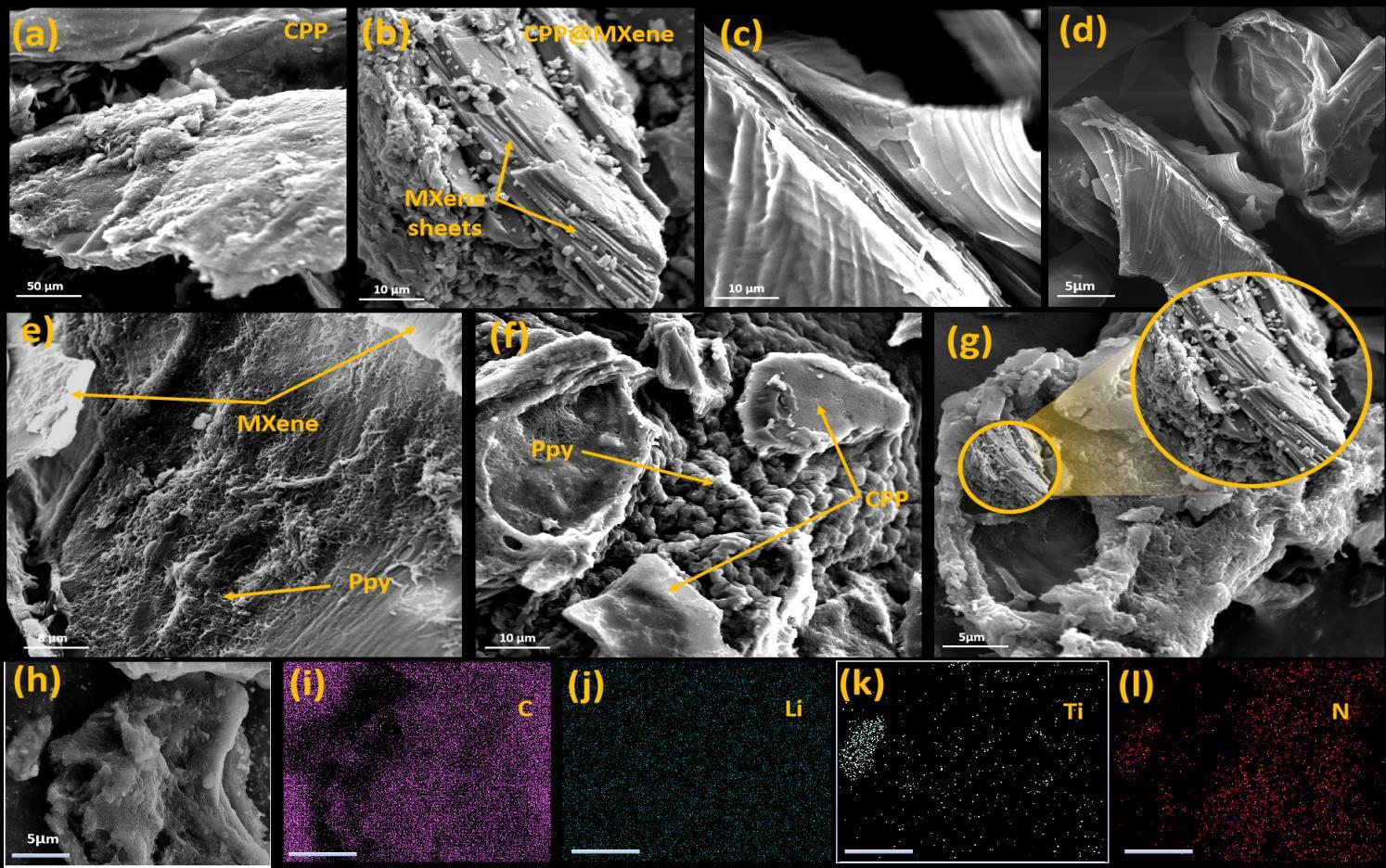
Fig- 2: (a)SEMimagesofcarbonizedpomelopeel-CPP,(b)CPP@MXenefoam,(c,d)carbonderivedfromthe pomelopeel,(e-f)indicatingeachofCPPandPPyregions,(g)SEMimageof2DdimensionalMxene@CPP@PPy,(i,j, k,l)elementalmappingofthedesiredelementsofC,Li,Ti,andN.
3.1 Morphology of CPP@PPy@MXene Composite
SEM images (Fig.2a–g) reveal that the carbonized pomelo peel (CPP) exhibits a porous framework with interconnectedchannels.AfterPPycoating(CPP@PPy)andMXenedeposition(CPP@MXene),thefoammaintainsits hierarchical structure, while sheet-like MXene nanosheets uniformly wrap the CPP surface. The final CPP@PPy@MXene composite displays a coral reef–like architecture, characterized by a highly irregular and wrinkledsurfacewithabundantmacroporesandmesopores.
TEM images (Fig.3a–f) confirm the intimate integration of MXene layers with PPy-coated CPP, forming a layered, conductive network. Elemental mapping indicates uniform distribution of C, N, and Ti, verifying the coexistence of the three components. The coral reef–like structure and hierarchical porosity are expected to facilitate electrolyte penetration, enhance ion diffusion, and buffer volume changes during cycling, which collectively improve electrochemicalperformance.
Volume: 13 Issue: 03 | Mar 2026 www.irjet.net p-ISSN: 2395-0072
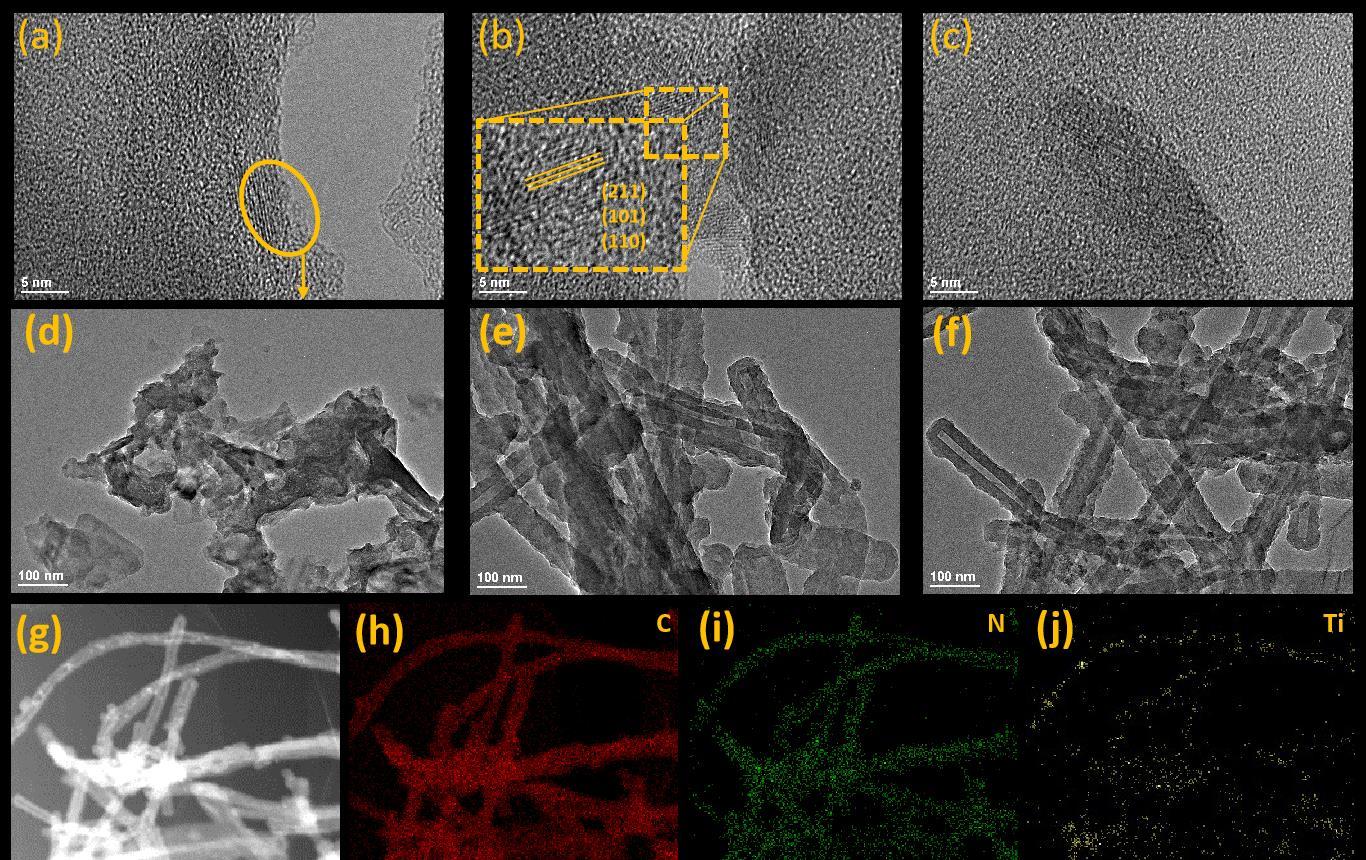
Fig- 3: TEMimages(a,b,c)high-resolutionTEMimagesofactivatedcarbondifferentsurfacebehavior(d,e,f) CPP@PPy@MXene,carbonizedpomelopeel@polypyrrol@MXene(d)imageelementalTEMmappingofthedesired elementsofC,N,Ti,andC.
3.2 Structural and Surface Properties
XRDpatterns(Fig.4g–i)showabroadpeakat20–25°forCPP,indicatinganamorphouscarbonstructure.AfterPPy coating and MXene incorporation, the broad carbon peak remains, with additional low-angle reflections correspondingtoMXenelayers,confirmingsuccessfulhybridformationwithoutimpurities.
Raman spectra (Fig.4e) reveal D and G bands at ~1350 cm⁻¹ and ~1580 cm⁻¹, respectively. The I_D/I_G ratio for CPP@PPy@MXene (~1.00) indicates a defect-rich carbon network, favorable for ion adsorption while maintaining electronicconductivity.
BET analysis (Fig.4d) indicates a hierarchical pore structure with a dominant mesopore peak around ~2 nm, providing high surface area for electrolyte access. TGA (Fig.4f) shows thermal stability up to 400 °C, with residual masscorrespondingtoMXeneandcarbon,confirmingcompositeintegrity.
XPS survey spectra (Fig.4a–c) verify the presence of C, N, O, and Ti, confirming successful integration of PPy and MXene.High-resolutionspectraindicatefunctionalgroups(C–C,C–N,Ti–O)thatenhanceelectronicconductivityand facilitate Zn²⁺ interaction. Overall, the structural and surface properties support efficient ion transport and mechanicalstabilityduringelectrochemicalcycling.
3.3 Electrochemical Performance
Thegalvanostaticcharge–dischargeprofiles(Fig.5a)showthatCPP@PPy@MXenedeliversahighspecificcapacityof 224.9 mAh g⁻¹ at 1 A g⁻¹. The composite exhibits excellent cycling stability, retaining ~92% of its initial capacity after500cycles,demonstratingthestructuralintegrityprovidedbythecoralreef–likearchitecture.
CV curves (Fig.5b,e) display well-defined redox peaks, indicating reversible Zn²⁺ intercalation/deintercalation. The ratecapabilitytest(Fig.5d)showsthatthecompositemaintainsacapacityof175mAhg⁻¹at2Ag⁻¹,confirmingfast iontransportfacilitatedbyhierarchicalporosityandMXeneconductivity.
EIS measurements (Fig.5c,f) indicate a low charge transfer resistance (R_ct ~35 Ω) before cycling, which slightly increases after 500 cycles, reflecting stable electrode/electrolyte interfaces. The combination of high surface area,
International Research Journal of Engineering and Technology (IRJET) e-ISSN: 2395-0056
Volume: 13 Issue: 03 | Mar 2026 www.irjet.net p-ISSN: 2395-0072
conductive PPy/MXene network, and porous CPP enables efficient electron transport, rapid ion diffusion, and minimalvolumeexpansion,resultinginsuperiorelectrochemicalperformance.
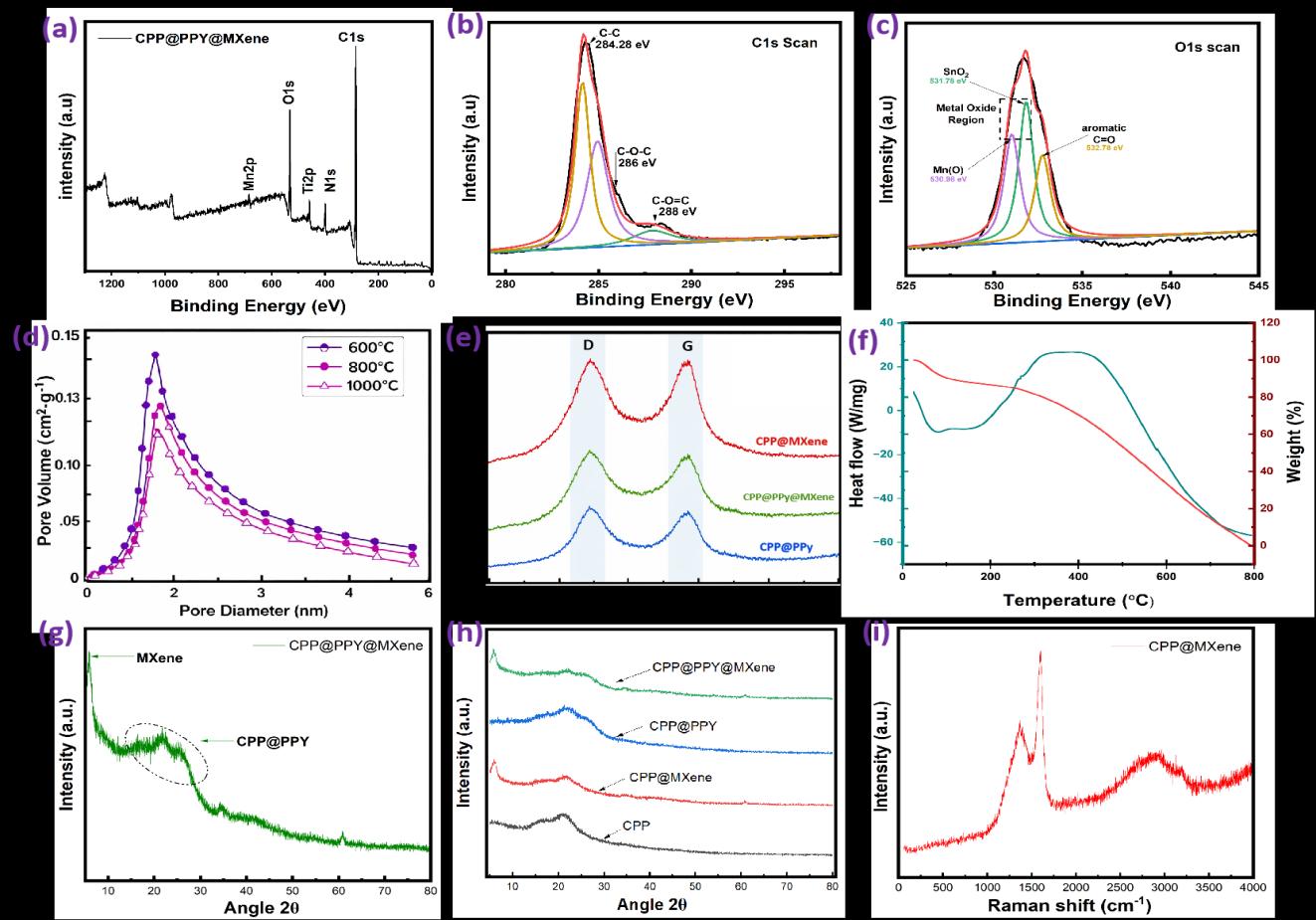
Fig- 4: (a)surveyspectrumofCPP@PPy@MXene,(b)high-resolutionC1sspectrum,(c)high-resolutionO1s spectrum,(d)PoresizedistributionofCPP@PPy@MXene(e)RAMANshiftofCPP@PPy@MXene,(f)TGof CPP@PPy@MXene,(g,h,i)X-raydiffraction(XRD)analysis
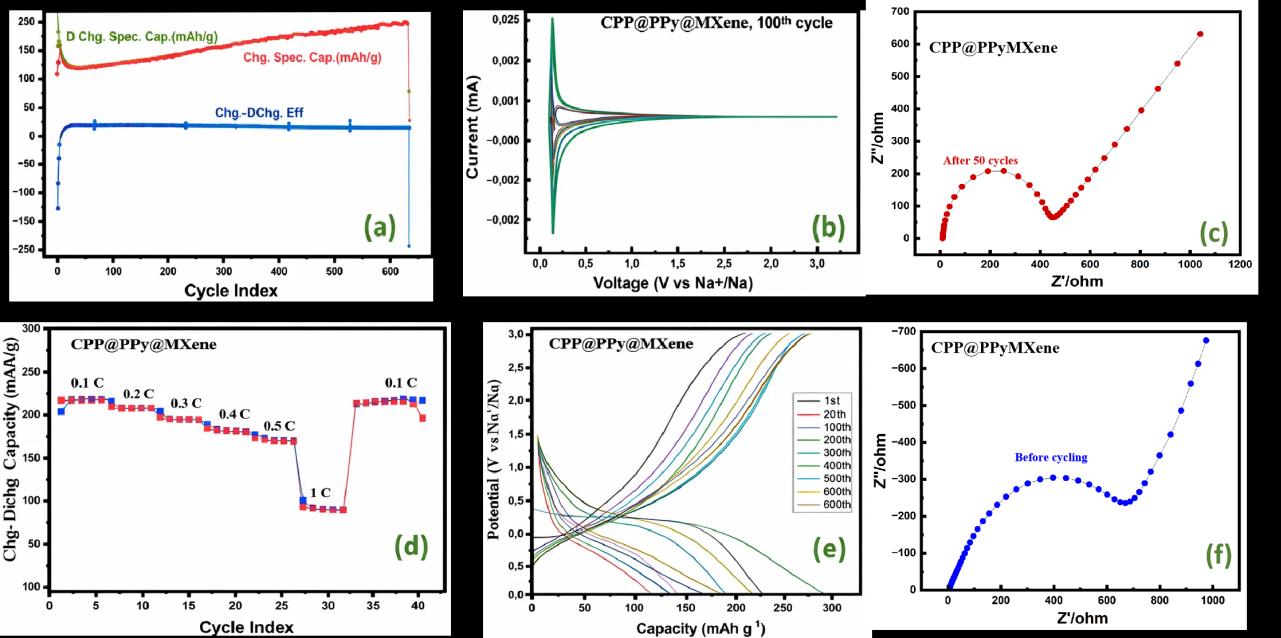
Fig- 5: ElectrochemicalperformanceofCPP@PPy@MXeneelectrodes:(a)Charge/dischargecapacity,(b,e)CV curves,(c)EISaftercycling,(d)ratecapabilityperformance,(f)EISbeforecycling
© 2026, IRJET | Impact Factor value: 8.315 | ISO 9001:2008 Certified Journal | Page2374
International Research Journal of Engineering and Technology (IRJET) e-ISSN: 2395-0056
Volume: 13 Issue: 03 | Mar 2026 www.irjet.net p-ISSN: 2395-0072
4. Conclusion
In this study, a hierarchical coral reef–shaped composite, CPP@PPy@MXene, was successfully fabricated by integrating carbonized pomelo peel (CPP), polypyrrole (PPy), and MXene nanosheets. Structural characterization confirmed the formation of a porous, defect-rich, and conductive network, while SEM and TEM analyses demonstrated uniform integration of all components. Electrochemical evaluations revealed that the composite exhibited a high specific capacity of 224.9 mAh g⁻¹ at 1 A g⁻¹, excellent rate capability, and outstanding cycling stabilitywith~92%capacityretentionafter500cycles.
Theenhancedperformanceisattributedtothesynergisticeffectofthecoralreef–likeCPPstructure,conductivePPy coating, and MXene nanosheets, which collectively improve electronic conductivity, ion diffusion, and structural stability. These results demonstrate that combining biomass-derived carbon with conductive polymers and 2D materials is a promising strategy for designing high-performance, sustainable electrodes for Zinc and sodium-ion storage. This work provides valuable insights for the development of eco-friendly energy storage materials with practicalapplicationpotential.
ACKNOWLEDGEMENT
This research received no external funding..The authors declare that they have no known competing financial interestsorpersonalrelationshipsthatcouldhaveappearedtoinfluencetheworkreportedinthismanuscript.
[1] M. Amir et al., “Energy storage technologies: An integrated survey of developments, global economical/environmental effects, optimal scheduling model, and sustainable adaption policies,” J Energy Storage, vol.72,p.108694,Nov.2023,doi:10.1016/J.EST.2023.108694.
[2] C. Senthil and C. W. Lee, “Biomass-derived biochar materials as sustainable energy sources for electrochemical energy storage devices,” Renewable and Sustainable Energy Reviews, vol. 137, p. 110464, Mar. 2021, doi: 10.1016/J.RSER.2020.110464.
[3]J.Ahmad,Z.Rehman,A.Azam,andF.Butt,“IntroductiontoElectrochemicalEnergyStorageTechnologies,”2024, pp.1–15.doi:10.1007/978-981-99-2796-8_1.
[4]P.Ragupathy,S.D.Bhat,andN.Kalaiselvi,“Electrochemicalenergystorageandconversion:Anoverview,” Wiley Interdiscip Rev Energy Environ,vol.12,Nov.2022,doi:10.1002/wene.464.
[5] S. P. S. Badwal, S. S. Giddey, C. Munnings, A. I. Bhatt, and A. F. Hollenkamp, “Emerging electrochemical energy conversion and storage technologies,” Front Chem, vol. 2, 2014, [Online]. Available: https://www.frontiersin.org/journals/chemistry/articles/10.3389/fchem.2014.00079
[6] R. Sharma et al., “Progress and challenges in electrochemical energy storage devices: Fabrication, electrode material, and economic aspects,” Chemical Engineering Journal, vol. 468, p. 143706, Jul. 2023, doi: 10.1016/J.CEJ.2023.143706.
[7]X.YuandA.Manthiram,“SustainableBatteryMaterialsforNext-GenerationElectricalEnergyStorage,” Advanced Energy and Sustainability Research, vol. 2, no. 5, p. 2000102, May 2021, doi: https://doi.org/10.1002/aesr.202000102.
[8]C.Müller, Innovative zinc materials for energy storage systems.2022.
[9]J.Looyrach,P.Methacanon,C.Gamonpilas,P.Lekpittaya,andA.Lertworasirikul,“Pomelo(Citrus maxima)PeelInspired Property for Development of Eco- Friendly Loose-Fill Foam,” Key Eng Mater, vol. 659, pp. 279–283, Aug. 2015,doi:10.4028/www.scientific.net/KEM.659.279.
[10]H.Das,“Cost-EffectiveandEco-FriendlyCarbon-BasedNanomaterialsinWearableEnergyStorageDevices,” ECS Meeting Abstracts,vol.MA2020-02,p.1137,Nov.2020,doi:10.1149/MA2020-0271137mtgabs.
[11]L.Xiao,F.Ye,Y.Zhou,andG.Zhao,“Utilizationofpomelopeelstomanufacturevalue-addedproducts:Areview,” Food Chem,vol.351,p.129247,Jul.2021,doi:10.1016/J.FOODCHEM.2021.129247.
International Research Journal of Engineering and Technology (IRJET) e-ISSN: 2395-0056
Volume: 13 Issue: 03 | Mar 2026 www.irjet.net p-ISSN: 2395-0072
[12]Z.Ji,S.Yassin,S.Abdalkarim,H.Li,R.Asad,andH.Yu,“Wastepomelopeels-derivedultralowdensity3D-porous carbonaerogels:Mechanismsof‘Soft-rigid’structuralformationandsolar-thermalenergystorageconversion,” Solar Energy Materials and Solar Cells,vol.259,p.112453,Jun.2023,doi:10.1016/j.solmat.2023.112453.
[13]N.Holubowitch,S.Manek,J.Landon,C.Lippert,S.Odom,andK.Liu,“Cathodecandidatesforzinc-basedthermalelectrochemicalenergystorage,” Int J Energy Res,vol.40,Sep.2015,doi:10.1002/er.3385.
[14] S. Li et al., “Shape-stable phase change composites based on carbonized waste pomelo peel for low-grade thermalenergystorage,” J Energy Storage,vol.47,p.103556,Nov.2021,doi:10.1016/j.est.2021.103556.
[15]J.Li,C.Wang,Z.Yu,Y.Chen,andL.Wei,“MXenesforZinc-BasedElectrochemicalEnergyStorageDevices,” Small, p.e2304543,Aug.2023,doi:10.1002/smll.202304543.
[16] T. A. Oyehan et al., “MXenes: Synthesis, properties, and applications for sustainable energy and environment,” Appl Mater Today,vol.35,p.101993,2023,doi:https://doi.org/10.1016/j.apmt.2023.101993.
[17] X. Sheng, D. Dong, X. Lu, L. Zhang, and Y. Chen, “MXene-Wrapped Bio-based Pomelo Peel Foam/Polyethylene Glycol Composite Phase Change Material with Enhanced Light-to-Thermal Conversion Efficiency, Thermal Energy Storage Capability and Thermal Conductivity,” Compos Part A Appl Sci Manuf, vol. 138, p. 106067, Aug. 2020, doi: 10.1016/j.compositesa.2020.106067.
[18] X. Sheng, D. Dong, X. Lu, L. Zhang, and Y. Chen, “MXene-wrapped bio-based pomelo peel foam/polyethylene glycol composite phase change material with enhanced light-to-thermal conversion efficiency, thermal energy storage capability and thermal conductivity,” Compos Part A Appl Sci Manuf, vol. 138, p. 106067, Nov. 2020, doi: 10.1016/J.COMPOSITESA.2020.106067.
© 2026, IRJET | Impact Factor value: 8.315 | ISO 9001:2008 Certified Journal | Page2376