
International Research Journal of Engineering and Technology (IRJET) e-ISSN: 2395-0056
Volume: 13 Issue: 02 | Feb 2026 www.irjet.net p-ISSN: 2395-0072
International Research Journal of Engineering and Technology (IRJET) e-ISSN: 2395-0056
Volume: 13 Issue: 02 | Feb 2026 www.irjet.net p-ISSN: 2395-0072
MR. ADITYA DILIP DAHALE1 , MS. MANSI MANOJ DEDWAL2 , PROF. ANIL NAIK3
1,2, (Students, Department Of Computer Engineering), Shreeyash College Of Engineering And Technology (Polytechnic), Chh. Sambhajinagar , India
3(Hod, Dept. Of Computer Engineering), Shreeyash College Of Engineering And Technology (Polytechnic), Chh. Sambhajinagar , India
Abstract - Maintaining discipline during lecture hours is a practical challenge faced by many educational institutions. It is commonly seen that students move around the campus while lectures are ongoing and, when questioned, often give incorrect information abouttheirdepartment,class,orlecture schedule. Since faculty members cannot easily recognize students from other departments, verifying such claims becomes difficult and usually depends on verbal explanations, which are not always reliable.
This paper presents CampusView,anapproachthatfocuses on photo-based student identification to support faculty in verifying student identity and lecture status during academic hours. The proposed approach involves capturing a student’s photograph and retrieving relevant academic details such as name, department, class,andcurrentlectureinformationfrom a centralized campus database. By connecting visual identification with timetable data, Campus View allows quick verification and helps reduce false identity claims without relying solely on manual questioning.
The approach aims to limit unauthorized roaming during lecture hours, reduce unnecessary confrontations, and assist faculty in maintaining a disciplined academic environment. Campus View is designed to be simple, institution-friendly,and scalable, with the potential to improve transparency and accountability within campus premises. In the future, the concept can be extended to include additional smart campus features.
Key Words: Campus View, Photo-Based Student Identification, Lecture Hour Monitoring, Campus Discipline, Student Verification, Smart Campus.
Educational institutions operate on structured academic schedules to ensure effective teaching and learning. However, maintaining discipline during lecture hours remainsachallengeinmanycampuses.Studentsareoften seen roaming within campus premises while lectures are ongoing, which disrupts the academic environment and affects overall discipline. Campus View is proposed to addressthesechallengesbyfocusingonphoto-basedstudent identification linked with academic records and lecture schedules. By capturing a student’s photograph, the
approach enables faculty to quickly verify identity details suchasdepartment,class,andcurrentlecturestatus.This helpsreducefalseidentityclaimsandunauthorizedroaming duringlecturehours.
In addition to student verification, Campus View also considers academic record management. The approach includesmaintainingleaverecordsandattendance-related data,whichcanbeanalysedtoprovideinsightsintolecture participation.Authorizedfacultyandhigherauthoritiescan view summarized attendance information in the form of graphical representations, such as the number of lectures attended or missed. This feature supports transparency, accountability,andbetteracademicmonitoring.
By combining visual identification with academic record analysis, Campus View aims to support faculty in maintaining a disciplined learning environment while providinghigherauthoritieswithmeaningfulinsightsinto academicengagement.
Withincreasingstudentstrengthandmultipledepartments operating simultaneously, it becomes difficult for faculty memberstomonitorstudentmovementoutsideclassrooms. Intheabsenceofproperverificationmechanisms,thisissue oftenleadstomisunderstandings,misuseoflecturehours, and reduced academic seriousness. Therefore, there is a growing need for a structured and reliable approach that supports faculty in verifying student identity and lecture statusduringacademichours.
Duringactivelecturesessions,studentsareoftenfoundin corridors,commonareas,orothercampuslocationswithout validreasons.Whenquestionedbyfacultymembers,these studentsmayclaimthattheyhaveafreelectureorprovide incorrectinformationregardingtheirdepartment,class,or yearofstudy.Inmanycases,studentsalsomisrepresenttheir identitybyclaimingtobelongtoadifferentdepartment.Since faculty members are generally familiar only with students fromtheirowndepartments,itbecomeschallengingtoverify suchclaimsimmediately.
This situation creates discomfort for both faculty and students.Facultymembersmustrelyonverbalexplanations,
International Research Journal of Engineering and Technology (IRJET) e-ISSN: 2395-0056
Volume: 13 Issue: 02 | Feb 2026 www.irjet.net p-ISSN: 2395-0072
whilestudentsmaytakeadvantageofthelackofverification. Overtime,thisleadstoreduceddiscipline,repeatedmisuseof academic time, and an increase in unauthorized roaming duringlecturehours.ThemotivationbehindCampusView arisesfromtheneedtoaddressthisgapbyprovidingaquick and reliable method for student identification and lecture verification.
Existing methods used to handle student movement during lecture hours are largely manual and informal. Faculty members typically question students and decide based on trust or assumption. There is no instant way to confirmwhetherastudentactuallyhasafreelectureoris skippinganongoingclass.Additionally,mostinstitutionsdo notmaintainacentralizeddigitalrecordthatlinksstudent identity, lecture schedules, and attendance details in real time.
Another limitation of current practices is the lack of analytical insight. Even when attendance or leave records aremaintained,theyareoftenstoredinseparateregistersor systems,makingitdifficulttoanalysesstudentparticipation patterns. Higher authorities have limited access to summarized information, such as how many lectures a studenthasattendedormissedoveraperiodoftime.This absenceofstructureddatalimitseffectivemonitoringand decision-making.
Inmanyeducationalinstitutions,maintainingdiscipline duringlecturehoursisapersistentchallenge.Studentsare often found roaming within campus premises while scheduled lectures are in progress. When questioned by faculty members or academic staff, students may provide incorrect or misleading information regarding their department,class,orlectureschedule,oftenclaimingtohave a free lecture when this is not the case. Due to the large number of students and multiple departments operating simultaneously, faculty members are unable to instantly recognize or verify the identity of students from other departments.
The absence of a reliable and instant verification mechanism forces faculty members to depend on verbal explanations,whicharenotalwaystrustworthy.Thisleadsto repeated misuse of lecture hours, increased unauthorized movement within the campus, and uncomfortable interactions between faculty and students. Additionally, existingpracticesdonotmaintainstructureddigitalrecords related to student movement, leave status, or lecture attendance, making it difficult to monitor academic engagementeffectively.
Furthermore, higher authorities lack access to summarizedandvisualinsights,suchasattendancetrendsor
the number of lectures attended or missed by students. Withoutcentralized records andanalytical representation, identifyingpatternsofirregularattendancebecomesdifficult. Hence,thereisaneedforanapproachthatsupportsphotobased student identification, verifies lecture status in real time,andmaintainsacademicrecordsthatcanbeanalysed and viewed by authorized personnel. Addressing these challengesformsthecoreproblemthatCampusViewaimsto resolve.
Variousdigitalsolutionshavebeenproposedtoimprove disciplineandmonitoringwithineducationalcampuses.One commonly adopted approach is RFID-based attendance systems,wherestudentsuseidentitycardsforverification duringlecturehours.Thesesystemsreducemanualrecord keeping; however, they depend on students carrying their cardsandarevulnerabletomisusethroughcardexchangeor proxyattendance.
Biometric-basedattendancesystems,suchasfingerprint orfacialrecognitionmechanisms,havealsobeenintroduced to improve accuracy. While these methods offer stronger identity verification, they require dedicated hardware infrastructure, regular maintenance, and higher implementationcosts.Inaddition,concernsrelatedtodata privacyanduserconvenienceoftenarise.
CCTV-based monitoring systems are widely used for general campus surveillance. Although CCTV improves security,itdoesnotprovidereal-timeacademicverification or connect student identity with lecture schedules and attendance records. Faculty members still rely on manual questioningtoverifylecturestatus.
Recent smart campus frameworks aim to integrate digital attendance, centralized databases, and academic analytics into a unified platform. However, many existing solutionsfocusprimarilyonattendancetrackinganddonot specificallyaddressunauthorizedstudentmovementduring lecturehours.
Based on the limitations of existing approaches, there is a need for a structured system that combines photo-based studentidentificationwithlecturescheduleverificationand centralized academic record analysis. Campus View is proposedtoaddressthisgapbyprovidingasimplifiedand institution-friendlyframework.
Theproposedapproachisdesignedwithcontrolledaccessin mind. Different stakeholders such as faculty members, mentors,andhigherauthoritiesareprovidedaccessbased onauthorizationlevels.Thisensuresthatsensitiveacademic data is viewed only by permitted users while maintaining transparencyandaccountabilityacrosstheinstitution.
International Research Journal of Engineering and Technology (IRJET) e-ISSN: 2395-0056
Volume: 13 Issue: 02 | Feb 2026 www.irjet.net p-ISSN: 2395-0072
The approach also emphasizes flexibility, allowing institutions to adapt the framework according to their academicstructure,departmentalorganization,andlecture schedulingpractices.
The Campus View system is designed as a centralized academicmonitoringandidentificationframeworktoassist faculty in maintaining discipline and transparency during lecture hours. The proposed methods focus on student identification,academicrecordverification,andcontrolled informationaccesswithincampuspremises.
During lecture hours, authorized faculty members or mentors capture a student’s photograph using a cameraenabled device. This step is initiated when students are found roaming within the campus or when identity verification is required. The captured image acts as the primaryinputforthesystem.
Thecapturedimageismatchedwithstudentrecordsstored in a centralized campus database. Each student profile contains basic academic information such as name, department,class,rollnumber,andtimetabledetails.This method reduces dependency on verbal explanations and helpspreventfalseidentityclaims.
3.3
Once identification is completed, the system retrieves relevantacademicinformation,includingthecurrentlecture scheduleandsubjectdetails.Thisallowsfacultymembersto verifywhetherthestudentisgenuinelyfreeorskippingan assignedlecture.
Campus View records instances of unauthorized roaming during lecture hours and securely links them to the respectivestudentprofiles.Theserecordshelpinidentifying repeated patterns of indiscipline and allow mentors or higherauthoritiestotakeappropriatecorrectiveactions.The structured tracking mechanism supports data-driven monitoringinsteadofrelyingsolelyonmanualobservation.
Thesystemsupportsastructuredleaverecordmechanism where student leave status is verified against academic schedules. Attendance data and leave information are maintaineddigitallytoensureaccuracyandreducemanual recordkeeping.
Access to Campus View is strictly role-based. Faculty, mentors, heads of departments, and administrators are granted different levels of access according to their responsibilities. Sensitive student data is visible only to authorizedpersonnel.
CampusViewgeneratessummarizedreportsandgraphical representations, such as attendance trends and lecture participationdata.Thesereportsassisthigherauthoritiesin understandingacademicengagement
3.8
All captured data and academic records are stored in a secure database. Access permissions and audit logs help maintaindataintegrityandaccountabilitywithinthesystem
Campus View integrates academic timetables with the centralized database to ensure accurate and real-time lectureverification.Thesystemmaintainsupdatedschedules foreachdepartment,class,andfacultymember.
Table -1: ModulesofCampusView
Module Name Description
StudentRegistration
Storesstudentdetailssuchas name,department,class,roll number,andphotographina centralizedcampusdatabase.
PhotoCapture Capturesthephotographofa studentduringlecturehoursto assistinidentificationand verification.
StudentIdentification Retrievesstudentdetailsby matchingthecaptured photographwithregistered records.
LeaveRecordManagement
AttendanceRecord
Maintainsrecordsofapproved studentleavesforspecific lecturehours.
Storeslectureattendance informationbasedon verificationandleaverecords.
AttendanceAnalysis Generatessummarized attendancedata,including lecturesattendedandmissed.
AuthorizedAccess Allowsonlyauthorizedfaculty andhigherauthoritiestoview detail
International Research Journal of Engineering and Technology (IRJET) e-ISSN: 2395-0056
Volume: 13 Issue: 02 | Feb 2026 www.irjet.net p-ISSN: 2395-0072
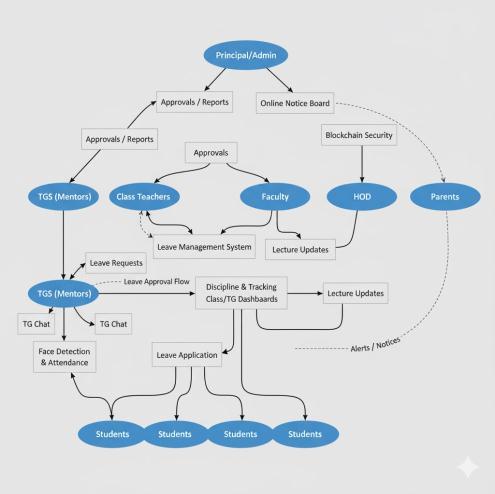
ThearchitectureillustratestheoverallworkflowofCampus View and the interaction between different campus stakeholders. Students interact with the system through photo-based attendance, leave applications, and communication with mentors. Faculty members and class teachershandlelectureupdates,attendanceverification,and leavemanagement.TGSmentorsmonitorstudentdiscipline and maintain dashboards for tracking attendance and movement.Approveddataflowstohigherauthoritiessuchas the Head of Department and Principal, who can access reports, approvals, and summarized information. Parents receive alerts and notices through the system. The centralized dashboards and record management ensure controlled access, transparency, and effective academic monitoringacrossthecampus.
Maintaining discipline and effective monitoring during lecturehoursisanongoingchallengeinmanyeducational institutions.Theabsenceofinstantstudentverificationand structured academic records often leads to unauthorized roaming,falseidentityclaims,anddependenceonmanual questioning. Campus View addresses these challenges by proposingaphoto-basedapproachthatsupportsfacultyin verifyingstudentidentityandlecturestatusduringacademic hours.
By integrating visual identification with centralized academicrecords,lectureschedules,leaveinformation,and attendance data, Campus View offers a structured and transparent method for campus monitoring. This reduces manual effort,minimizesconflicts,andsupportsinformed academicdecision-making.
Campus View is designed to be simple, scalable, and institution-friendly, making it suitable for adoption in campuses with diverse academic structures. Although the
approachisproposed,itestablishesastrongfoundationfor futureimplementationandenhancement.Overall,Campus View demonstrates the potential to improve academic discipline,accountability,andeffectivecampusmanagement throughaunifiedandstructuredframework.
ThekeycontributionsofCampusViewinclude:
- Photo-based student identification during lecture hours
- Integration of lecture schedules with attendance data
- Supportforfacultythroughquickverification
- Analytical insights through graphical attendance representation
CampusViewprovidesastrongfoundationforimproving discipline and academic monitoring within educational institutions. Although the current work focuses on photobased student identification and academic record management, the proposed approach can be extended in severalwaysinthefuture.
- MobileApplicationIntegration: CampusViewcan be extended into a mobile application to allow faculty and authorized staff to perform photo capture and verification using smartphones, improvingaccessibilityandeaseofuse.
- Advanced Analytics and Reporting: Future enhancementsmayincludedetailedanalyticssuch as subject-wise attendance trends, monthly participationreports,andperformancecorrelations tosupportacademicdecision-making.
- Automated Alerts and Notifications: Thesystem canbeenhancedtogenerateautomatedalertsfor irregular attendance, excessive leave, or repeated unauthorized roaming, which can be shared with mentors,parents,orhigherauthorities.
- Integration with Institutional Systems: Campus View can be integrated with existing Learning ManagementSystems(LMS),examinationsystems, and academic portals to create a unified digital campusecosystem.
- Improved Identification Techniques: More advanced image-processing or intelligent identification techniques can be explored to improveaccuracyandreducemanualintervention, whileensuringprivacyandethicalcompliance.
- Role-Based Access Expansion: Future versions can include finer-grained access control, enabling differentlevelsofdatavisibilityforfaculty,mentors, departmentheads,andadministrators.
International Research Journal of Engineering and Technology (IRJET) e-ISSN: 2395-0056
Volume: 13 Issue: 02 | Feb 2026 www.irjet.net p-ISSN: 2395-0072
[1] R. Want, “An Introduction to RFID Technology,” IEEE PervasiveComputing,vol.5,no.1,pp.25–33,2006.
[2] A.K.Jain,A.Ross,andS.Prabhakar,“AnIntroductionto BiometricRecognition,”IEEETransactionsonCircuits andSystemsforVideoTechnology,vol.14,no.1,pp.4–20,2004.
[3] M. W. M. K. Zaman et al., “Smart Attendance Management System Using Face Recognition,” InternationalJournalofAdvancedComputerScienceand Applications,vol.10,no.3,2019.
[4] S. Poslad, “Ubiquitous Computing: Smart Devices, EnvironmentsandInteractions,”Wiley,2011.
[5] FirebaseDocumentation,“FirebaseRealtimeDatabase,” Available:https://firebase.google.com/docs
MR.ADITYA DILIP DAHALE
PursuingPolytechnic(Computer) SHREEYASHCOLLEGEOFENGINEERINGAND TECHNOLOGY(POLYTECHNIC)
MS.MANSI MANOJ DEDWAL
PursuingPolytechnic(Computer) SHREEYASHCOLLEGEOFENGINEERINGAND TECHNOLOGY(POLYTECHNIC)
PROF. ANIL NAIK
HOD,Dept.ofComputerEngineering SHREEYASHCOLLEGEOFENGINEERINGAND TECHNOLOGY(POLYTECHNIC)