
International Research Journal of Engineering and Technology (IRJET) e-ISSN: 2395-0056
Volume: 13 Issue: 02 | Feb 2026 www.irjet.net p-ISSN: 2395-0072
International Research Journal of Engineering and Technology (IRJET) e-ISSN: 2395-0056
Volume: 13 Issue: 02 | Feb 2026 www.irjet.net p-ISSN: 2395-0072
Sakshi Kolte1 , Anjali Ambekar2 , Radhika Giri3 , Shivam Bahire⁴, Prof. P. D. Tangde5
¹²³´Diploma in Computer Engineering, Shreeyash College of Engineering and Technology (Polytechnic),Chh.Sambhajinagar, India
5Department of Computer Engineering, Shreeyash College of Engineering and Technology (Polytechnic),Chh.Sambhajinagar, India
Abstract - Mostmodernsocialnetworkingplatformsrelyon continuous internet connectivity to provide real-time communication and data synchronization. However, in many practical environments such as college campuses, rural institutions,workshops,temporaryworkspaces,anddisasteraffected areas, stable internet connectivity cannot always be guaranteed. Network congestion, limited infrastructure, and frequent interruptions often prevent users from accessing online communication platforms effectively. This limitation leadstocommunicationgaps,delayedannouncements,lossof collaborative efficiency, and reduced user experience.
Thispaperpresents CampusConnect,ahybridoffline–online social micro network designed to support reliable communication even under unstable or unavailable network conditions. The proposed system is implemented as a web application that enables users to interact through personal messaging, group discussions, and post sharing in offline mode. Campus Connect integrates Firebase Authentication for secure user login and Firestore Cloud Database for persistent online storage. For offline operations, the system employs IndexedDB to store chats, posts, and user activities locally on the client device. A background synchronization manager continuously monitors network availability and automatically uploads locally stored data to Firestore once connectivity is restored.
By adopting an offline-first design approach, Campus Connect minimizesdependencyoncontinuousinternetaccess while maintaining data consistency between local and cloud databases. Experimental evaluation shows that the system improves availability, reduces data loss during network failures, and enhances collaboration within campus environments. The proposed model provides a practical and scalablesolutionforeducationalinstitutionsandlow-network communication scenarios.
Key Words: Campus Connect, Offline-First Web App, Firebase Authentication, Firestore, Hybrid Social Network, Group Chat, Data Synchronization.
Socialnetworkingsystemsplayavitalroleinmoderndigital communicationbyenablingpeopletoexchangemessages, shareinformation,andcollaborateinrealtime.Applications
such as What’s App, Facebook, Telegram, and Instagram have transformed the way individuals and organizations interact. These platforms, however, are designed with the assumption that users always have stable internet connectivity.Inreality,thisassumptiondoesnotholdtruein many environments such as educational campuses, rural regions, industrial workplaces, and temporary event locations.
In college campuses, students and staff frequently experience connectivity problems due to limited network infrastructure, heavy traffic, bandwidth constraints, and maintenance issues. During lectures, examinations, seminars,andprojectdiscussions,reliablecommunicationis essential.Wheninternetconnectivityfails,traditionalsocial networking applications become unusable, leading to delayedcoordination,missedannouncements,andreduced collaborationamongusers.
The concept of offline-first applications has emerged to address such challenges. Offline-first systems allow applicationstocontinuefunctioningevenwhenthenetwork is unavailable by storing data locally and synchronizing it later.
This approach improves availability and user experience whileminimizingdisruptioncausedbyconnectivityissues.
Campus Connect is proposed as a hybrid offline–online social micro network specifically designed for campus communication.Thesystemallowsuserstosendmessages, participateingroupdiscussions,andpostannouncements even when they are offline. By integrating local storage, cloud services, and background synchronization, Campus Connect ensures reliable communication across varying networkconditions.Thegoalofthisworkistodesignand implement a practical communication platform that supports academic collaboration without being fully dependentoninternetconnectivity.
The overall operational flow of the proposed Campus ConnectsystemisillustratedinFig.1.Thediagramprovides a conceptual overview of user interaction, authentication, network connectivity checking, offline data handling, and cloudsynchronization.Ithighlightshowthesystemsupports
International Research Journal of Engineering and Technology (IRJET) e-ISSN: 2395-0056
Volume: 13 Issue: 02 | Feb 2026 www.irjet.net p-ISSN: 2395-0072
seamless communication in both offline and online environmentswithinacampus-basedsocialmicronetwork.
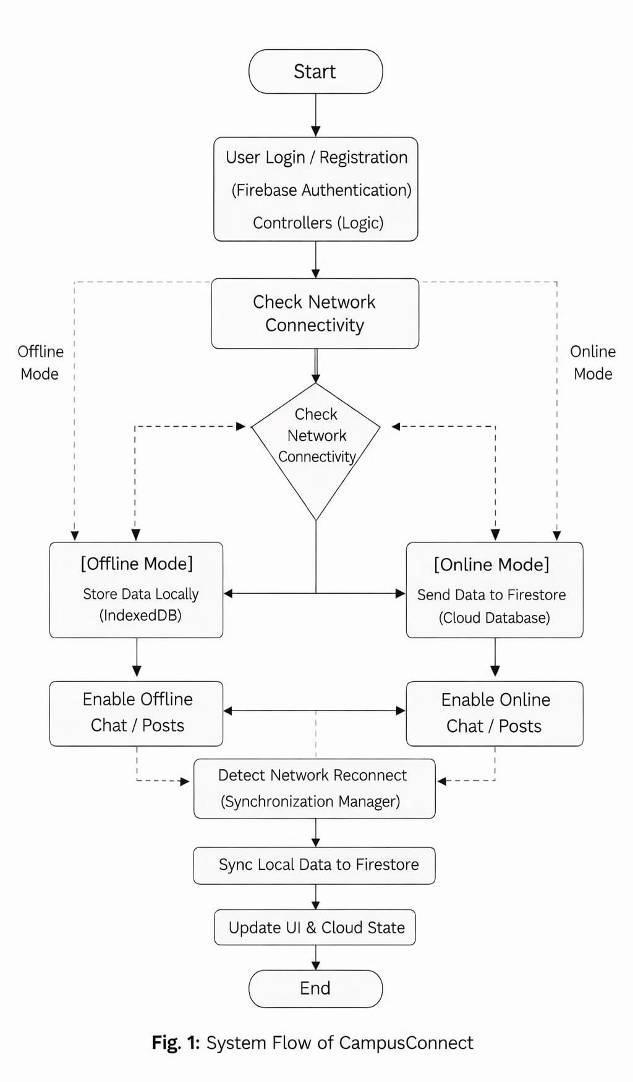
As shown in Fig. 1, the process begins with user login or registration using Firebase Authentication, followed by loading the frontend interface and controller logic. The systemthenchecksnetworkconnectivity.Ifthenetworkis unavailable, user actions such as messages and posts are stored locally using IndexedDB, enabling offline communication. When the network is available, data is directlysenttotheFirestoreclouddatabasetosupportrealtimeinteraction.Asynchronizationmanagercontinuously monitors connectivity changes and detects network reconnection.Onceconnectivityisrestored,alllocallystored dataissynchronizedwithFirestoreandtheuserinterfaceis updated accordingly. This mechanism ensures smooth transition between offline and online modes while maintaining data consistency and reliability across the CampusConnectplatform.
Smithetal.(2021)introducedaBluetooth-basedpeer-topeermessagingsystemfordisasterscenarios.Theirsystem allows devices to exchange messages without internet connectivity.Althougheffectiveinemergencies,theapproach lacks scalability, persistent cloud storage, and structured groupmanagementfeatures.
Kumar and Patel (2020) proposed a mesh network communication framework for rural areas. Their system enables devices to relay messages across a local network. While the solution improves connectivity, it introduces overhead in routing and suffers from limited user authenticationanddatasynchronizationmechanisms.
Progressive Web Applications (PWAs) have introduced offlinestorageandcachingtechniquesusingserviceworkers and IndexedDB. According to Google Developers (2022), PWAsimproveapplicationreliabilitybystoringdatalocally and synchronizing when the network becomes available. However,PWAsalonedonotprovidebuilt-inauthentication andscalablebackendservices.
Firebase provides cloud-based services including authentication and Firestore databases with offline persistence. Firestore supports client-side caching and synchronization,makingitsuitableforhybridapplications. However,buildingacompletesocialnetworkingmodelusing Firebase requires integration of offline logic, user management,andsynchronizationhandling.
Mostexistingsystemsfocusoneitherofflinecommunication or cloud-based social networking. Very few integrate both into a unified campus-oriented micro social network. CampusConnectbridgesthisgapbycombiningoffline-first design, Firebase authentication, local storage, and background synchronization into a single scalable communicationplatformtailoredforeducationalinstitutions.
Traditionalsocialnetworkingplatformsdependentirely oninternetconnectivity.Whenconnectivityisunavailableor unstable, these applications fail to provide essential communication services. In educational campuses, users often face network congestion, limited coverage, and intermittentfailuresduringacademicactivities.
The major challenges observed are:
• Users cannot send or receive messages without internet.
• Messagesandpostsarenotstoredwhenoffline.
• Data loss occurs during sudden network interruptions.
Several research efforts and systems have explored communication under limited network conditions. Offline communication has become particularly important in disaster recovery, rural connectivity, and campus environments.
International Research Journal of Engineering and Technology (IRJET) e-ISSN: 2395-0056
Volume: 13 Issue: 02 | Feb 2026 www.irjet.net p-ISSN: 2395-0072
• Collaboration becomes difficult in low-network environments.
• Security and authentication mechanisms are unavailableoffline.
These limitations reduce efficiency in campus communicationsystems.Studentsareunabletocoordinate project work, faculty cannot distribute announcements promptly, and emergency communication becomes unreliable. Therefore,thereisastrongneedforahybridcommunication platform that allows offline operations with secure authentication and automatic synchronization. CampusConnectaimstosolvetheseproblemsbyenabling local data storage and cloud synchronization while maintainingusabilityanddataintegrity.
Campus Connect isahybridoffline–onlinesocialmicro networkimplementedasawebapplication.Itsupportsboth offlineandonlinemodesofoperationusingFirebaseservices andlocalbrowserstoragetechnologies.
Thesystemprovidessecureuserregistrationandlogin usingFirebaseAuthentication.Onceauthenticated,userscan accesspersonalchat,groupchat,andpostmodules.During online mode, data is stored directly in Firestore Cloud Database. During offline mode, all interactions are stored locallyusingIndexedDB.
A synchronization manager continuously monitors networkavailabilityusingbrowserAPIs.Whenconnectivity isrestored,locallystoredmessagesandpostsareuploaded automaticallytoFirestore.Thisensuresconsistencybetween thelocalandclouddatabases.
The key features of Campus Connect include secure authentication, offline message storage, automatic synchronization,groupcommunication,andcampus-oriented posting feeds. The design follows offline-first principles to ensure availability and reliability even under unstable networkconditions.
Campus Connect followsalayeredhybridarchitecturethat supportsbothofflineandonlinecommunicationincampus environments. The architecture is designed to ensure continuoususerinteractionevenwheninternetconnectivity is unstable or unavailable. It integrates frontend web technologies with local storage mechanisms and cloud services to provide reliable data handling and synchronization.
Thesystembeginswithusersaccessingtheplatformthrough awebapplicationdevelopedusingReactandJavaScript.User authenticationandauthorizationarehandledsecurelyusing
Firebase Authentication. Once authenticated, users can performactivitiessuchaspersonalmessaging,groupchats, andpostingupdatesrelatedtocampusevents.
During offline conditions, the application stores all usergenerateddatalocallyusingIndexedDB.Asynchronization manager continuously monitors the network status and managesthetransitionbetweenofflineandonlinemodes. When connectivity is restored, locally stored data is synchronizedwiththeFirestoreclouddatabasetomaintain consistencyandreliabilityacrossdevices.
Fig. 2 illustrates the overall system architecture of CampusConnect and the interaction between users, web application,localstorage,synchronizationmanager,Firebase Authentication,andFirestoreclouddatabase.
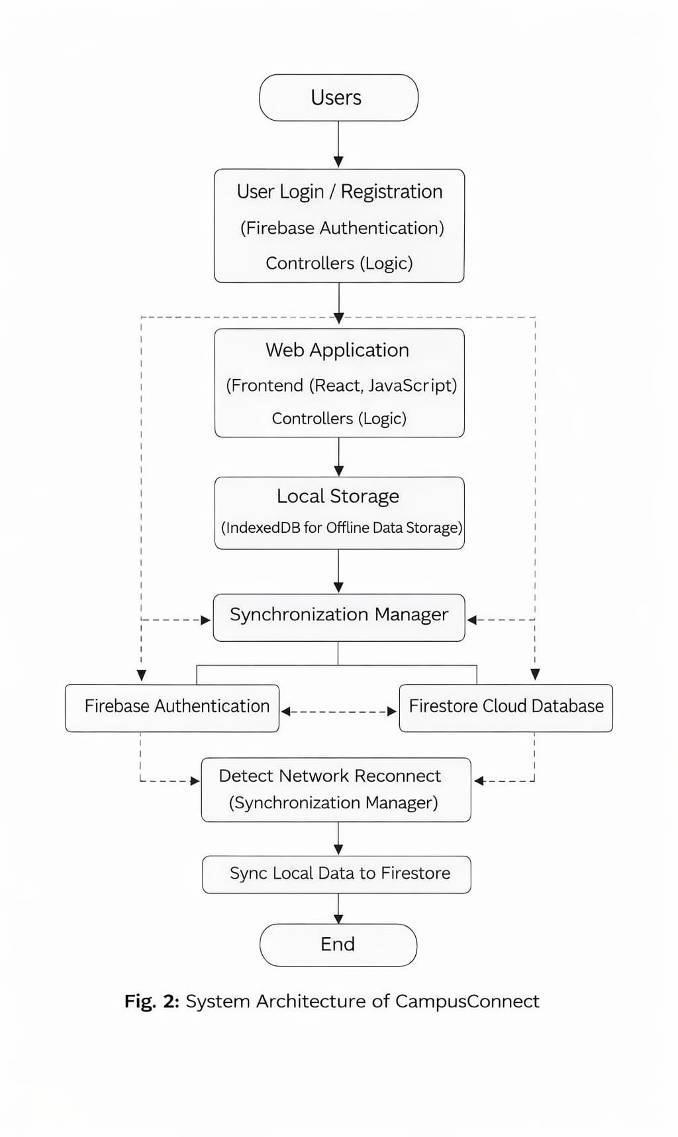
AsshowninFig.2,thearchitectureseparatesconcernsinto logical layers for better scalability and performance. The webapplicationlayerhandlesuserinteractionandbusiness logic, while the local storage layer ensures offline data persistence. The synchronization manager plays a crucial role in detecting network changes and resolving conflicts betweenlocalandclouddata.
International Research Journal of Engineering and Technology (IRJET) e-ISSN: 2395-0056
Volume: 13 Issue: 02 | Feb 2026 www.irjet.net p-ISSN: 2395-0072
Firebase Authentication provides secure access control, ensuringthatonlyauthorizeduserscanaccessthesystem. Firestore Cloud Database stores all synchronized data centrallyandsupportsreal-timeupdateswhenthesystemis online.ThisarchitectureallowsCampusConnecttodeliver uninterrupted communication services in low-network or disconnectedenvironments,improvingavailabilityanduser experiencewithincampusnetworks.
Thedevelopmentof Campus Connect followsastructured methodology:
• Requirement Analysis: Identify communication issues in campus environments and define functionalrequirementssuchaschat,posts,offline storage,andsynchronization.
• System Design: DesignUI andarchitecture using offline-firstprinciplesandlayeredmodels.
• Implementation: Develop the web application using React, JavaScript, Firebase Authentication, Firestore,andIndexedDB.
• Offline Storage Design: Implement local storage formessagesandpostsusingIndexedDB.
• Synchronization Design: Implementbackground synchronizationtouploadlocaldatatoFirestore.
• Testing: Perform functional testing under online, offline,andintermittentconnectivityconditions.
• Deployment: Deploythesystemforcampususage andevaluation.
Thismethodologyensuresreliabilityandconsistencyacross developmentphases.
Campus Connect is implemented as a modular web applicationconsistingofseveralfunctionalcomponents.
7.1 Authentication Module
Thismodule managesuser registration,login,andsession handling using Firebase Authentication. It ensures secure accesstothesystemandpreventsunauthorizedusersfrom accessingcommunicationmodules.
7.2 Personal Chat Module
The personal chat module enables one-to-one messaging betweenusers.MessagesarestoredlocallyusingIndexedDB duringofflinemodeandsynchronizedwithFirestoreduring onlinemode.
The group chat module supports creation of groups for classes,projects,andevents.Userscanexchangemessages withingroups,anddataisstoredofflineandsynchronized later.
7.4
Thismoduleallowsuserstocreateandviewpostsrelatedto campus announcements and activities. Posts are cached locallyduringofflinemodeandsynchronizedautomatically.
7.5 Synchronization Module
Thesynchronizationmodulemonitorsnetworkconnectivity usingbrowserAPIs.ItpusheslocallystoreddatatoFirestore wheninternetaccessisrestored,ensuringdataconsistency.
Campus Connect was evaluated under multiple network conditionsincludingfull connectivity,partial connectivity, andcompleteofflinemode.Duringofflinetesting,userswere able to send messages, create posts, and interact with the interfacewithouterrors.Allinteractionswerestoredlocally usingIndexedDB.
Once network connectivity was restored, the synchronization manager successfully uploaded locally stored messages and posts to Firestore. No data loss was observedduringsynchronization.Thesystemdemonstrated improved availability compared to traditional online-only socialnetworkingapplications.
Performanceanalysisshowedthatsynchronizationoccurred efficiently with minimal delay. User experience remained consistentacrossnetworktransitions.Theseresultsconfirm that Campus Connect effectively supports hybrid communicationinlow-networkcampusenvironments.
• Worksinofflineandonlinemodes.
• SecureFirebaseAuthentication.
• Localandclouddatastorage.
• Automaticdatasynchronization.
• Supportspersonalchat,groupchat,andposts.
• User-friendlycampus-orientedinterface.
Campus Connect isdesignedtosupportcommunicationand collaborationinenvironmentswhereinternetconnectivityis limitedorunstable.Thehybridoffline–onlinemodelenables its use across various academic and community-based scenarios.
International Research Journal of Engineering and Technology (IRJET) e-ISSN: 2395-0056
Volume: 13 Issue: 02 | Feb 2026 www.irjet.net p-ISSN: 2395-0072
Some important applications of the proposed system include:
1. Campus Communication Platform
Enablesstudentsandfacultytocommunicate through personal and group chats for academiccoordination,announcements,and discussions.
2. Student Collaboration for Projects
Supports group-based collaboration where studentscanshareideas,updates,andtasks evenduringtemporarynetworkoutages.
3. Event Announcements and Management
Allows institutions to post notices about workshops, seminars, exams, and cultural events with offline access and later synchronization.
4. Rural and Low-Network Environments
Usefulincollegeslocatedinruralareaswhere consistentinternetconnectivityisnotalways available.
5. Temporary Communication Networks
Canbedeployedintemporarysetupssuchas training camps, seminars, internships, and industrial visits where network access is limited.
6. Emergency Communication System
Provides reliable communication during network failures, power outages, or natural disasterswithincampusenvironments.
7. Academic Information Sharing
Facilitates sharing of study materials, circulars,andacademicupdateswithoffline accessibility.
8. Local Community Networking
Can be extended for small communities, hostels, or residential societies to maintain communication without depending fully on continuousinternet.
9. Hybrid Web Application Deployment
Servesasamodelarchitecturefordevelopers building offline-first web applications using cloudsynchronization.
10. Training and Educational Demonstrations
Useful as a teaching tool for demonstrating hybrid networking, offline storage, and synchronizationconceptstostudents.
Futureenhancementsfor Campus Connect include:
• End-to-endmessageencryption.
• Mobileapplicationversion.
• Fileandmediasharing.
• Pushnotifications.
• AI-basedcontentmoderation.
• Integrationwithcollegemanagementsystems.
Campus Connect presentsaneffectivehybridoffline–online social micro network designed specifically for campus communicationenvironments.Traditionalsocialnetworking platforms depend heavily on continuous internet connectivity, which often limits usability in areas with unstable or low network coverage. The proposed system overcomes this limitation by adopting an offline-first approachthatenablesuserstocontinuemessaging,posting, andcollaboratingevenwhennetworkaccessistemporarily unavailable.
By integrating modern web technologies with Firebase Authentication,Firestoreclouddatabase,andlocalstorage mechanismssuchasIndexedDB,Campus Connectensures secure access, reliable data persistence, and seamless synchronization.Useractivitiesperformedinofflinemode aresafelystoredlocallyandareautomaticallysynchronized withthecloudonceconnectivityisrestored.Thisapproach minimizes data loss and provides a smooth transition betweenofflineandonlinemodeswithoutinterruptinguser interaction.
Thesystemarchitectureandflowdesigndemonstratehow hybrid communication models can improve availability, performance, and user experience in campus-based social networks. Campus Connect enhancescollaborationamong students,supportsacademiccoordination,andenablesrealtime and delayed communication in resource-constrained environments. The proposed solution can be extended beyond campuses to rural communities, temporary networks, and low-bandwidth areas where consistent internetaccessisnotguaranteed.
Overall, Campus Connect contributes a practical and scalable model for offline-enabled social networking applications.Withfurtherimprovementssuchasencryption, mobile deployment, and intelligent synchronization strategies,thesystemhasthepotentialtobecomeareliable communication platform for educational institutions and othercommunity-basednetworks.
International Research Journal of Engineering and Technology (IRJET) e-ISSN: 2395-0056
[1] FirebaseDocumentation,GoogleDevelopers.Available: https://firebase.google.com/docs
[2] Cloud Firestore Documentation, Google Developers. Available:https://firebase.google.com/docs/firestore
[3] ProgressiveWebApps(PWA)Guide,GoogleDevelopers. Available: https://developer.chrome.com/docs/webplatform/pwa
[4] React Documentation, Meta Platforms. Available: https://react.dev
[5] IndexedDB API Documentation, MDN Web Docs. Available: https://developer.mozilla.org/enUS/docs/Web/API/IndexedDB_API
[6] OfflineDataSynchronizationTechniques,IEEEXplore DigitalLibrary.
[7] WebStorageandClient-SideDatabases,MDNWebDocs. Available:https://developer.mozilla.org
[8] Firebase Authentication Guide, Google Developers. Available:https://firebase.google.com/docs/auth
MS.SAKSHI KOLTE
PursuingDiplomaincomputerengineering SHREEYASHCOLLEGEOF ENGINEERINGANDTECHNOLOGY(POLYTECHNIC)
MS. ANJALI AMBEKAR
Pursuing Diploma in computer engineering SHREEYASH COLLEGEOF ENGINEERINGANDTECHNOLOGY(POLYTECHNIC)
MS. RADHIKA GIRI
Pursuing Diploma in computer engineering SHREEYASH COLLEGEOF ENGINEERINGANDTECHNOLOGY(POLYTECHNIC)
MR. SHIVAM BAHIRE
Pursuing Diploma in computer engineering SHREEYASH COLLEGEOF ENGINEERINGANDTECHNOLOGY(POLYTECHNIC)
PROF. PRIYA TANGDE
Dept.ofComputerEngineering SHREEYASHCOLLEGEOF ENGINEERINGANDTECHNOLOGY(POLYTECHNIC)
Volume: 13 Issue: 02 | Feb 2026 www.irjet.net p-ISSN: 2395-0072 © 2026, IRJET | Impact Factor value: 8.315 | ISO 9001:2008 Certified Journal | Page39