
International Research Journal of Engineering and Technology (IRJET) e-ISSN: 2395-0056
Volume: 12 Issue: 04 | Apr 2025 www.irjet.net p-ISSN: 2395-0072
International Research Journal of Engineering and Technology (IRJET) e-ISSN: 2395-0056
Volume: 12 Issue: 04 | Apr 2025 www.irjet.net p-ISSN: 2395-0072
Riya1 , Vanshita Das2 , Akansha Tiwari3, Vivek Krishna Mishra4
3Vivek Kumar Mishra Professor, Dept of Computer Science and Information Technology, Dronacharya Group of Institutions, Greater Noida, India
Abstract - This study introduces a YOLOv8-based PPE Compliance Detection System that uses the presence or lackof necessary personal protective equipment (PPE) to guarantee worker safety in industrial settings. We make use ofa subset of the SH17 dataset, which comprises 2,350 carefully chosen photos with annotations for 6 PPE-related classifications LabelImg was used to accomplish the annotation in YOLO format. To maximize training speed and model performance, images were scaled to 640 x 640 pixels. On Google Colab, we used a structured separation oftrainingandvalidation data to train the YOLOv8n model. The Flask web application, which allows users to upload photos and obtain annotated outputs indicating PPE compliance and associated risk levels, is coupled with the trained model to give real-time inference.
Key Words: PPEDetection,YOLOv8,SH17Dataset,Object Detection, Flask Deployment, Industrial Safety, Computer Vision.
Thefoundationofoccupationalsafetyandhealthisensuring adherence to personal protective equipment (PPE) in dangerousworkconditions.PPEisthefirstlineofdefense againstworkplacedangerssuchasexposuretochemicals, falling objects, extreme heat, and other damaging noises. Non-adherence to PPE requirements is a significant challengeinareaslikeconstruction,manufacturing,oiland gas, and healthcare, despite the implementation of strict safetyregulationsandtrainingprograms.Accordingtothe International Labour Organization (ILO) [1] inadequate safety compliance and protective measures are mostly to blame for the 2.78 million occupational fatalities that are predictedtooccurannually(ILO,2023).Moreover,non-fatal diseasesandinjuriescausedbypoorcompliancewithPPE account for around 374 million non-fatal occupational injuries annually, causing significant economic losses and decreasedproductivity(ILO,2023).
Closed-circuit television (CCTV), supervisory monitoring, and manual checking are all heavily reliant on traditional PPE monitoring methods. However, these procedures are oftenlaborious,pronetohumanerror,smallinscope,and lack real-time reaction. According to Smith et al. (2021), manual inspection systems are unreliable and unable to provide real-time feedback [2] , which leads to delayed correctiveactionandextendedriskexposure.Furthermore,
humansupervisorsfinditdifficulttoconsistentlycheckon each employee's compliance in large, complex work environments,particularlyduringhigh-riskactivitiesorshift changes (Smith et al., 2021). The limitations of the traditionalapproacheshighlighttheneedforanautomated andintelligentsolutiontoincreasetheaccuracyandefficacy ofPPEcompliancemonitoring.
The accelerated development of artificial intelligence (AI) and data analytics holds an unprecedented prospect to revolutionize occupational safety processes. AI-powered smartmonitoringsystemsutilizecomputervision,machine learning,andreal-timedataanalysistoautomatedetection and reporting of PPE infringements in risk-prone workplaces. Jones et al. (2022) showed that AI-powered systemsarecapableofdetectingwhetherornotworkersare wearing the proper protective equipment [3], including helmets,gloves,goggles,andhigh-visibilityvests,withahigh degree of accuracy. Such systems employ deep learning modelstrainedonlargedatabasesofPPEimagesandactual workingconditionstoidentifypatternsanddetectanomalies inrealtime.Withtheintegrationofpredictiveanalyticsand AI,suchsystemscandetectnon-compliancepatterns,predict future safety violations, and offer meaningful recommendationstoenhanceworkplacesafetyoverall[4].
This paper discusses designing and deploying a smart monitoring system based on AI and analytics to augment PPE compliance in high-risk work environments. The envisioned system will offer real-time PPE violation detection,predictivesafetyinsight,andautomatedreporting to facilitate proactive decision-making. The study aims at filling the gap between conventional safety monitoring practicesandAI,proposingascalableandeffectivesolution towardsenhancingoccupationalsafetystandards.Thestudy also identifies the possible pitfalls of AI-based monitoring systems such as data privacy issues, biases in algorithms, andsystemintegrationissues.Byovercomingtheseissues andtappingthepotentialofAIanddataanalytics,thisstudy hopestomakeacontributiontoasaferandmorecompliant workplace.
"Safetyisn’texpensive,it’spriceless."Asweliveinavastcity where the construction industry faces several challenges thatimpactitsefficiencyandgrowthsuchasLackofReal-
International Research Journal of Engineering and Technology (IRJET) e-ISSN: 2395-0056
Volume: 12 Issue: 04 | Apr 2025 www.irjet.net p-ISSN: 2395-0072
TimePPEComplianceMonitoring,InconsistentPPEUsageby Workers, High Rate of Workplace Accidents Due to NonCompliance,LimitedAccesstoHigh-QualityPPECompliance Datasets, Integration Issues with Existing Construction Safety System, Worker Privacy and Ethical Concerns and Limited Predictive Analytics for PPE Compliance Trends. EnsuringPPEcomplianceinhazardousworkplacesiscrucial, yetexistingmonitoringmethodssufferfrominefficiencies andhighhumandependency.AI-poweredsolutionsexistbut lackrobust,labeleddatasetsfortrainingmodelseffectively. This research proposes a smart monitoring system that builds a comprehensive dataset of workers, labels PPE compliancestatus,trainsAImodels,andstoresandanalyzes dataforreal-timecompliancetracking.ByintegratingAIand analytics,thissystemaimstoimproveworkplacesafetyand standardscompliance.
Ensuring compliance with Personal Protective Equipment (PPE)regulationsiscrucialforworkplacesafety,particularly in hazardous environments such asconstruction sites [5] Traditionalmethodssuchasmanualinspections,checklists, and RFID-based tracking systems are labor-intensive and pronetohumanerror.Surveillancecamerasareoftenused, but manual review of footage makes them inefficient for real-time detection. To overcome these limitations, researchershaveexploredAI-drivensolutionsthatautomate PPEcompliancemonitoringusingdeeplearningtechniques, significantlyimprovingdetectionaccuracyandenforcement.
One of the most effective deep learning models for PPE detection is YOLO (You Only Look Once), which provides real-timeobjectdetectioncapabilities.Studieshaveshown that YOLOv4-based PPE monitoring systems accurately identifyworkerswearingornotwearingPPE,outperforming modelssuchasFasterR-CNNandSSD(SingleShotMultiBox Detector) in terms of speed and efficiency. However, challenges such as occlusion, lighting variations, and lowresolutionimagesaffectmodelperformance,highlightingthe needforhigh-qualityannotateddatasets [6].LabelImg, an open-source annotation tool, has been widely used to manually label PPE datasets, ensuring precise object detection and improving AI model training. Additionally, active learning techniques have been explored to reduce manual annotation efforts by refining dataset labels iteratively.
EfficientdatamanagementisessentialforPPEcompliance tracking, as large volumes of compliance data must be stored, retrieved, and analyzed. MySQL, a widely used relationaldatabasemanagementsystem(RDBMS),hasbeen integratedintoAI-drivenPPEmonitoringsystemstoenable real-time storage and retrieval of compliance records [7] This allows construction firms to generate compliance reports, track violations, and implement corrective measures. However, challenges such as dataset diversity, real-timedeploymentonedgedevices,integrationwithIoT
and cloud platforms, and privacy concerns remain. By leveraging YOLOforobject detection,LabelIngfor dataset annotation, and MySQL for compliance data management, thisresearchaimstoenhance workplacesafety,automate compliancemonitoring,andreduceworkplaceaccidentsin hazardousenvironments.
This research aims to bridge these gaps by developing a smart monitoring system that combines AI-based PPE detection with advanced analytics. By creating a labeled dataset of workers, training deep learning models, and analyzing compliance trends, this study seeks to enhance workplace safety through an integrated, data-driven approach[8].
4.1 Dataset Collection
This study utilizes a curated subset of the SH17 (Safe Human) dataset [9], consisting of 2,350 images across six object classes related to personal protective equipment (PPE).Ratherthanusingthefulldataset,weselectedimages mostrelevanttoourobjectives,introducingmodifications and new ideas to enhance PPE detection capabilities in diverseindustrialenvironments.Theimagesweresourced from Pexels, a royalty-free platform ensuring clear usage rights.Relevantkeywordslike“manufacturingworker”and “industrial worker” were used for image retrieval, and accurate tagging reduced the need for extensive manual filtering.Bynarrowingthedatasetwhileretainingvariation, we ensured a focused yet diverse training set. These refinements aim to boost detection accuracy and support real-worldPPEcompliancemonitoringapplications.
4.2 Dataset Details
TheimagesselectedfromtheSH17datasetwereoriginally sourced from Pexels and resized to 640 × 640 pixels for consistency and computational efficiency. Our subset includes 2,350 images in both landscape and portrait orientations,eachcontainingmultiplePPE-relatedobjects. Annotations were formatted in YOLO format for compatibilitywithobjectdetectionmodels.Smallerobjects likeearsandearmuffswerelabeledtopreserveobjectsize diversity.WhilecertainPPEitemsappearmorefrequently, resultinginclassimbalance,thisdistributionwasanalyzed to identify potential bias and support effective model trainingandperformanceevaluation.
4.3 Data Annotation
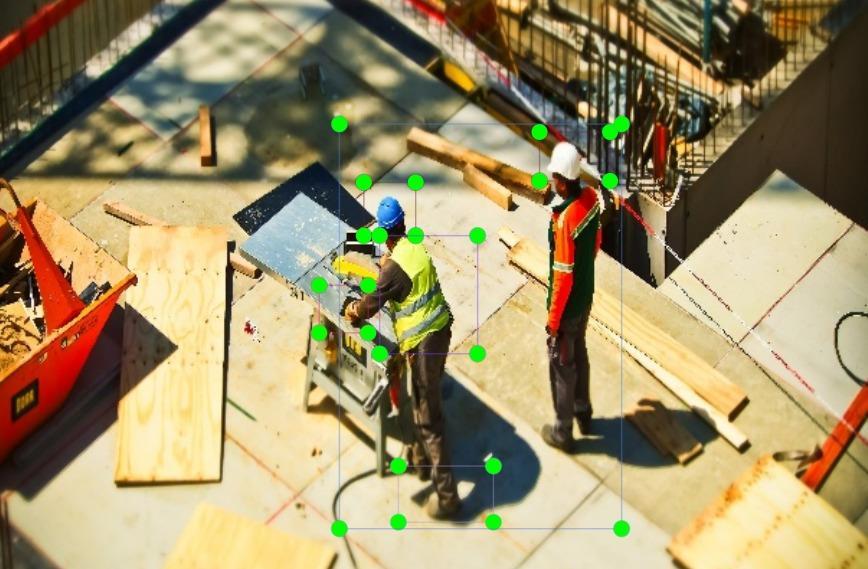
This project's annotation procedure was carried out methodically to guarantee precision and coherence. The chosen2,350photosfromtheSH17collectionwerelabeled by four human annotators. The 6 different PPE-related object types were first marked by three annotators who carried out the main labeling. A supervisor examined and fixedanydiscrepanciestoensurehigh-qualityannotations.
International Research Journal of Engineering and Technology (IRJET) e-ISSN: 2395-0056
Volume: 12 Issue: 04 | Apr 2025 www.irjet.net p-ISSN: 2395-0072
Inordertocorrectanylastmistakesandimprovethelabels, acomprehensiveinspectionprocesswascarriedout.
Forannotation,weutilizedLabelImg,anopen-sourcetoolfor boundingboxannotation,ensuringastructuredandefficient workflow.Thechoiceofannotationtoolwasstandardized acrosstheteamtomaintainconsistencyinlabelingquality. This process ensured that our dataset was accurately labeled, enhancing the reliability of our PPE compliance detectionmodel.
4.4 Class Imbalance and Preprocessing
A noticeable class imbalance exists, with some PPE items (e.g., safety vests, gloves) appearing more frequently than others(e.g.,helmets).Thisimbalancecanpotentiallyimpact modelperformance,leadingtolowerdetectionaccuracyfor underrepresentedclasses.Tomitigatethisissue,weapplied thefollowingpreprocessingtechniques:
DataAugmentation:Randomtransformationssuch as flipping, brightness adjustments, and cropping wereappliedtoimprovemodelgeneralization.
Class-Aware Weighting: Additional weight was assignedtolessfrequentPPEcategoriestoensure balancedtraining.
Selective Sampling: We carefully balanced the dataset by including more diverse images where underrepresentedPPEitemsappeared.
With these preprocessing strategies, the dataset has been optimized to support a robust PPE compliance detection modelthatperformseffectivelyacrossallcategories.
4.5
Forthisstudy,weemployedYOLOv8(YouOnlyLookOnce version8)asourobjectdetectionmodelforPPEcompliance detection. YOLOv8 is a state-of-the-art real-time object detection framework known for its speed, accuracy, and efficiency, making it well-suited for industrial safety applications.
We selected YOLOv8 over other object detection models (e.g.,FasterR-CNN,SSD)duetothefollowingreasons:
High Speed & Efficiency: YOLOv8 provides realtimedetectionwithminimalcomputationalcost.
SuperiorAccuracy:ItachieveshighmeanAverage Precision(mAP)comparedtoolderYOLOversions.
RobustPerformanceonSmallObjects:PPEitems such as gloves, helmets, and face masks can be small in images, and YOLOv8's anchor-free detectionimprovesdetectioninsuchcases.
SupportforEdgeDeployment:Duetoitslightweight nature,YOLOv8canbedeployedefficientlyinrealworldindustrialenvironments.
The model was trained using Google Colab, leveraging its GPU (NVIDIA Tesla T4) for faster processing. The dataset wasdivided intotraining(80%)andvalidation(20%)sets toensurebalancedmodelevaluation.
To further improve model performance, we applied data augmentation techniques, including flipping, rotation, brightnessadjustments,andnoiseaddition.
The training process was monitored using mAP (mean AveragePrecision)astheprimaryperformancemetric,along withprecisionandrecallscores.Themodelwasfine-tuned byadjustinghyperparameters andusing transferlearning fromapre-trainedYOLOv8model.
After training the PPE compliance detection model, we deployeditusingFlask,alightweightwebframeworkthat allows real-time inference through API endpoints. The deployment process enables users to upload images and receivepredictionsonPPEcompliancestatus.
The trained YOLOv8 model is loaded using Ultralytics and serves inference requests through Flask.
Themodeltakesaninputimage,processesit,and outputsboundingboxeswithPPEclassificationand risklevels.
FlaskhandlesincomingHTTPrequests,processes images, and returns detection results in JSON formatorasanannotatedimage.
International Research Journal of Engineering and Technology (IRJET) e-ISSN: 2395-0056
Volume: 12 Issue: 04 | Apr 2025 www.irjet.net p-ISSN: 2395-0072
TheFlaskapplicationprovidesthefollowingkeyendpoints:
TheFlaskapplicationprovidesthefollowingkey endpoints:
1. /upload (POST) –Allowsuserstouploadan imageforPPEdetection.
Theserverprocessestheimageandruns themodel.
Itreturnsdetectedobjectsand complianceclassification.
2. /predict (GET) –ProvidesanAPItofetch inferenceresults.
Userscanretrievepreviouslyanalyzed imagesandtheirresults.
3. /status (GET) –Ahealthcheckendpointto confirmiftheserverisrunning.
Inthisstudy,theYOLOv8objectdetectionmodelwastrained on a dataset of 2,350 annotated images encompassing six distinctclassesofpersonalprotectiveequipment(PPE).The dataset was carefully curated and split into training and validationsetstoensureproperevaluation.Themodelwas trained for 200 epochs using Google Colab with GPU acceleration, and the training process showed consistent decreases in box loss, classification loss, and distribution focalloss indicatingeffectivelearning.
Modelperformancewasevaluatedusingstandardmetrics, including precision, recall, and mean Average Precision (mAP). After training, the model achieved promising detection results, particularly for frequently occurring classessuchashelmetsandvests.Visualinspectionsshowed accurateboundingboxesaroundPPEobjects,whilethemAP scoreshowedimprovementsacrossepochs.However,minor misclassificationsoccurredinvisuallysimilaroroverlapping PPEitems.
These results confirm that YOLOv8 is well-suited for PPE compliance detection, even with moderate dataset sizes. Futureworkincludesextendingthedatasetandintegrating risk-levelclassification.
ThisstudypresentsaPersonalProtectiveEquipment(PPE) compliance detection system based on the YOLOv8 object detectionmodel,trainedusingasubsetoftheSH17dataset comprising2,350imagesacrosssixPPE-relatedclasses.By leveraging a curated dataset, annotating objects with precision, and employing the YOLOv8 architecture, the model demonstrated its ability to identify multiple PPE
componentsindiverseindustrialscenarios.Despitetraining with a limited dataset, the results indicate promising detectionaccuracy,validatingthemodel’spotentialforrealworld deployment. Furthermore, integration with a Flask web application enables real-time inference, making it practicalforworkplacesafetymonitoring.Futureworkwill focusonexpandingthedataset,fine-tuningthemodel,and addressingclassimbalancetofurtherenhancethesystem’s robustnessandperformance.
[1] "InternationalLabourOrganisation(ILO),"2023.
[2] A.J.B.L.C.Smith,"EnhancingWorkplaceSafetythrough AI-BasedMonitoringSystems,"vol.45,no.2,2021.
[3] M. k. S. P. R. Jones, "Real-Time PPE Compilance Monitoring using Compurer Vision and Machine learning," AI in Industry, vol.7,no.3,pp.211-228,2022.
[4] H. L. J. Chen, "Predictive Analytics for Occupational Safety: A Machine Learning Approach," Safety Science, vol.105093,p.134,2021.
[5] F.D.R.F.G.P.D.C.V.GionatanGallo,"ASmartSystemfor Personal Protective Equipment Detection in Industrial EnvironmentsBasedonDeepLearningattheEdge,"in IEEE,2022.
[6] M. N. P. N. M. K. K. M. J. Arso M. Vukicevic, "Deep Learning-Based Recognition of Unsafe Acts in ManufacturingIndustry," IEEE, vol.11,2023.
[7] B.W.K.A.N.K.X.R.N.A.K.K.D.H.K.SaJimSoeMoe, "Collaborative Worker Safety Prediction Mechanism UsingFederatedLearningAssistedEdgeIntelligencein OutdoorConstructionEnvironment," IEEE, 2023.
[8] C.-S.C.Y.-J.B.C.Y.Y.T.-Y.K.S.-K.K.A.A.MohammadZ. Shanti,"ANovelImplementationofanAI-BasedSmart ConstructionSafetyInseptionProtocolintheUAE," IEEE, 2021.
[9] A.R.HafizMugheesAhmad,"SH17:AdatasetforHuman and Personal Protective Equipment Detection in Manufacturing Industry," Journal of Safety Science and Resilience, 2024.