
International Research Journal of Engineering and Technology (IRJET) e-ISSN: 2395-0056
Volume: 12 Issue: 10 | Oct 2025 www.irjet.net p-ISSN: 2395-0072
International Research Journal of Engineering and Technology (IRJET) e-ISSN: 2395-0056
Volume: 12 Issue: 10 | Oct 2025 www.irjet.net p-ISSN: 2395-0072
D. Pravin Kumar1 , Ayyanar K2 , Gokul M S3
1Associate Professor, Dept. of Computer Science Engineering, K.L.N college of Engineering, Sivagangai, Tamil Nadu, India
2&3Student, Dept. of Computer Science Engineering, K.L.N college of Engineering, Sivagangai, Tamil Nadu, India
Abstract - Bone fracture detection plays a crucial role in the medical field, where early and accurate identification can greatly assist doctors in providing proper treatment. Manual examination of X-ray images is often time-consuming and prone to human error. Traditionaledgedetectionmethods like Canny, Sobel, and Prewitt work wellonhigh-qualityX-rays but fail on noisy or low-contrast images.
This paper proposes an automated fracture detection system using the YOLOv8 deep learning model, trainedona custom Xray dataset. CLAHE (Contrast Limited Adaptive Histogram Equalization) preprocessing is applied to enhance image contrast and clarity before detection. Theproposedsystem can identify both the type of fracture (e.g., transverse, oblique, compound) and the affected bone (e.g., femur, tibia, humerus). A user-friendly GUI built with Tkinter allows users touploadXray images, view detection results, and obtain general treatment recommendations. The proposed model demonstrates improved accuracy and efficiency compared to conventional image processing techniques.
Key Words: Bone Fracture Detection, Deep Learning, YOLOv8, CLAHE, X-ray Image.
1.INTRODUCTION
Bone fractures are common injuries that require accurate and rapid diagnosis. Traditionally, radiologists visuallyinspectX-rayimagestodetectfractures,whichcan be subjective and slow. Image quality variations such as noiseorlowcontrastfurthercomplicatediagnosis.
Recentadvancementsinartificialintelligence(AI)anddeep learning have enabled the development of automated medicalimageanalysissystems.Amongvariousmodels,the YOLO (You Only Look Once) architecture is known for its real-timeobjectdetectioncapabilities.Thispaperintroduces aYOLOv8-baseddeeplearningapproachforbonefracture detection, enhanced with CLAHE preprocessing for better contrast and visibility. The system also provides a user interfaceforuploadingimagesandviewingdetectionresults alongwithpossibletreatmentrecommendations.
ThemainobjectiveoftheBoneFractureDetectionSystem usingDeepLearning(YOLOv8)istodevelopan intelligent, automated solution capable of accurately identifying and
classifyingbonefracturesfromX-rayimages.Byutilizinga pre-trainedYOLOv8modelfine-tunedonacustomdataset, the system aims to enhance diagnostic precision, reduce human error, and enable real-time detection and visualization of fractures. The project incorporates CLAHE preprocessingtoimproveimagecontrastandhighlightfine fracture details, ensuring reliable detection even in lowqualityX-rays.ATkinter-basedgraphicaluserinterface(GUI) allows users to upload X-rays, view detection results, and accessbasictreatmentrecommendationseasily.
The scope of the project extends to detecting various fracturetypessuchastransverse,oblique,andcompound,as wellasidentifyingaffectedboneregionslikethefemur,tibia, andhumerus.Thesystemservesasasupportivediagnostic tool for radiologists, orthopedic doctors, and medical students, improving efficiency and accuracy in fracture assessment.Beyonddetection,itprovidesanintegratedand user-friendlyplatformthatbridgesthegapbetweenartificial intelligence and healthcare diagnostics. In the future, the systemcanbeenhancedtoanalyzeCTorMRIscans,integrate cloud-based medical data storage, and support real-time hospital information systems, making it a scalable and advancedmedicaldiagnosticsolution.
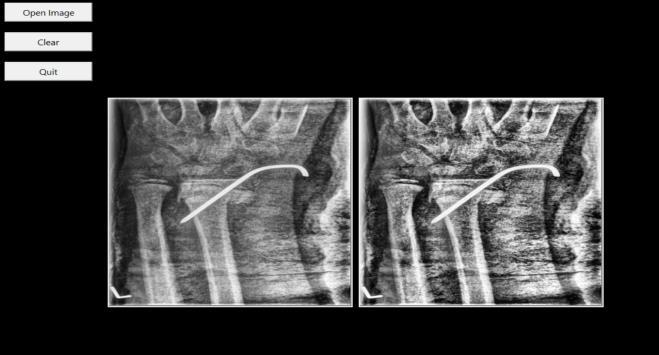
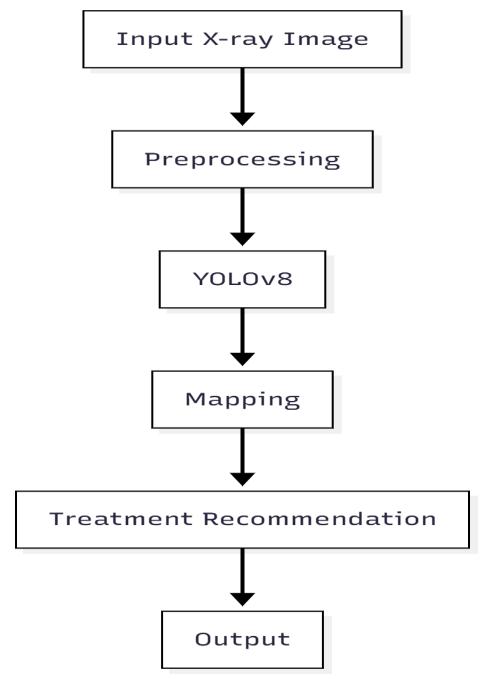
ThefirststageofthesysteminvolvesacquiringtheX-ray imageandpreparingitforfurtheranalysis.Theuseruploads anX-rayimageofthefracturedbonethroughagraphicaluser interface developed using Tkinter. Once the image is uploaded,itisconvertedintoastandardgrayscaleformatto simplifyprocessing.SinceX-rayimagesoftensufferfromlow contrast and noise, a preprocessing step is applied using CLAHE(ContrastLimitedAdaptiveHistogramEqualization). Thistechniqueenhancestheimagecontrastbyredistributing the brightness values, thereby improving the visibility of boneedgesandfracturelines.Theenhancedimageisthen resizedandnormalizedaccordingtotheinputrequirements oftheYOLOv8model.Thispreprocessingstepensuresthat the model receives high-quality and consistent input data, resultinginmoreaccuratefracturedetection.
International
Volume: 12 Issue: 10 | Oct 2025 www.irjet.net p-ISSN: 2395-0072
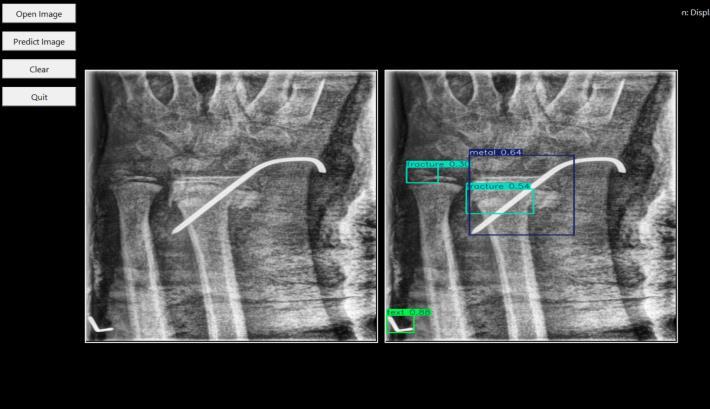
After preprocessing, the enhanced X-ray image is passedtotheYOLOv8(YouOnlyLookOnceversion8)deep learning model. YOLOv8 is a powerful object detection algorithm capable of performing real-time detection with high accuracy. The model is trained on a custom dataset containing X-ray images annotated with fracture regions. Whenanimageisprocessed,YOLOv8detectsthepresenceof fractures and marks them with bounding boxes. Each bounding box includes a label that specifies the detected fracture and a confidence score representing the model’s certainty.TheYOLOv8modelisdesignedtodetectmultiple types of fractures, such as transverse, oblique, and compound fractures, and can also identify which bone is affected,suchasthefemur,tibia,orhumerus.Thedetection resultsarevisualizedontheX-rayimage,makingiteasierfor the user to understand the location and severity of the fracture.
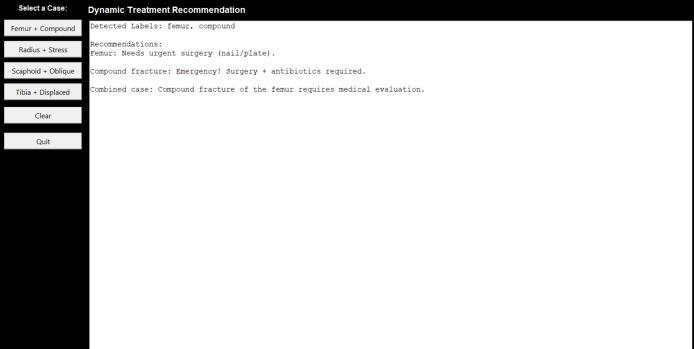
Thefinalmodulefocusesonmappingthedetected fracturestospecifictypesandaffectedbones,andproviding generalmedicalrecommendations.OncetheYOLOv8model identifiesafracture,thesystemmapsthedetectionresultsto a set of predefinedclassifications thatdescribe the typeof
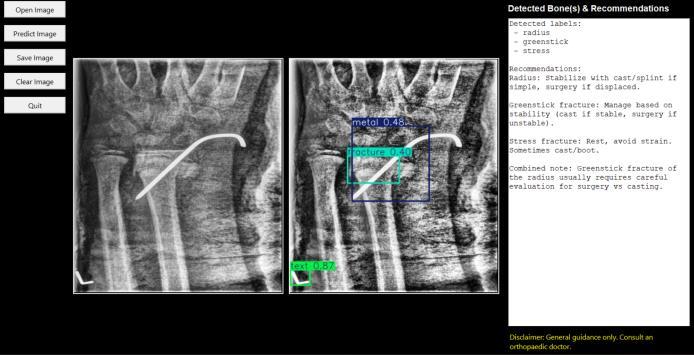
fractureandtheboneinvolved.Basedonthisclassification, the system generates a treatment recommendation by referringtoamedicalknowledgebasecontainingstandard guidelines. For instance, a simple transverse fracture may require immobilization using a cast, while a compound fracturemayneedsurgicalintervention.Thesystemdisplays these recommendations in the graphical interface for user reference. A medical disclaimer is also included, clearly stating that these recommendations are for guidance only andthatusersmustconsultahealthcareprofessionalforfinal diagnosisandtreatment.TheGUIprovidesasimpleinterface to display the processed X-ray image with the detected fracture, classification details, and recommended treatmentoptions.
I. The user provides an X-ray image through the system’sGUI.
II. ThesystempreprocessestheimageusingCLAHEto improvecontrastandclarity.
III. TheYOLOv8modelanalyzestheimageanddetects fractures,highlightingaffectedregions.
IV. The Classification & Treatment Module identifies thefracturetypeandaffectedbone.
V. Thesystemgeneratessuggestedtreatmentsbased onthefracturetypeandbone.
VI. Theresultsandrecommendationsaredisplayedon theGUIfortheuser.
International Research Journal of Engineering and Technology (IRJET) e-ISSN: 2395-0056
Volume: 12 Issue: 10 | Oct 2025 www.irjet.net p-ISSN: 2395-0072
[1]SivaS.Sinthuraetal.(2019)proposedaBoneFracture Detection System using CNN Algorithm that uses convolutionalneuralnetworksforclassifyingX-rayimages intonormalandabnormalcategories.Theapproachachieved better accuracy compared to classical edge detection but requiredlargedatasetsforreliableperformance.
[2]ChokkalingamS.P.andKomathyK.(2014)developed Intelligent Assistive Methods for Diagnosis of Rheumatoid Arthritisusinghistogramsmoothingandfeatureextractionof boneimages.Theirmethodextractedtexturefeaturessuchas entropy, contrast, correlation, and energy for disease detection,demonstratingtheusefulnessofstatisticaltexture featuresinmedicalimageanalysis.
[3]EdwardV.CephasPaulandHepzibahS.Hilda(2015) presented ARobust ApproachforDetection ofthe Typeof FracturefromX-RayImageswhichusedpreprocessingand segmentationtechniquestoidentifyfracturetypes.Although the model could detect various fracturetypes, it struggled withlow-qualityandnoisyX-rayimages.
[4] M. M. Rahman et al. (2021) introduced a Deep Learning-Based Bone Fracture Detection method using convolutionalneuralnetworksonX-rayimages.Theirmodel demonstratedsuperiorperformancecomparedtotraditional edge-basedmethodsbyautomaticallylearninghierarchical features. However, the study did not include real-time detectionortreatmentguidance.
[5] H. A. Alwzwazy, L. S. Alzubaidi, Z. Zhao, and Y. Gu (2025) proposed FracNet, an end-to-end deep learning frameworkforbonefracturedetectionusingself-supervised pretraining,featurefusion,andattentionmechanisms.The
modelachievedhighaccuracyinidentifyingfracturetypes andaffectedboneswhileimprovingfeaturerepresentation. However,thestudydidnotintegrateauser-friendlyGUIor dynamictreatmentrecommendationsystem.
The Bone Fracture Detection System using YOLOv8 successfullydetectsandclassifiesfracturesinX-rayimages withhighaccuracy.UponuploadinganX-raythroughtheGUI, thesystempreprocessestheimageusingCLAHE,enhancing contrast and improving visibility of fracture regions. The YOLOv8modelthenidentifiesfractures,markingtheaffected boneareaswithboundingboxes.
TheClassification&TreatmentModuleaccuratelymaps the detected fractures to their types (such as transverse, oblique,orcompound)andidentifiestheaffectedbone(like femur, tibia, or humerus). Based on this information, the systemprovidesinitialtreatmentrecommendationssuchas casting, splinting, or surgical consultation. All results are displayed in a user-friendly interface, allowing doctors, students, or healthcare staff to quickly understand the findings.
TheproposedBoneFractureDetectionSystemusing theYOLOv8deeplearningmodelprovidesanefficientand accuratesolutionforidentifyingbonefracturesfromX-ray images.TraditionaledgedetectionmethodssuchasCanny, Sobel, and Prewitt were limited in handling noisy or lowcontrast medical images, whereas the YOLOv8 model demonstrated superior accuracy and faster detection by learningcomplexfeaturesautomatically.
The integration of CLAHE preprocessing significantlyenhancedimageclarity,improvingthevisibility of bone structures and fracture regions. Furthermore, the system’sTkinter-basedGUIenableseasyimageupload,realtime detection, and result visualization, making it userfriendly for both medical practitioners and patients. The inclusionofadynamictreatmentrecommendationmodule
International Research Journal of Engineering and Technology (IRJET) e-ISSN: 2395-0056
Volume: 12 Issue: 10 | Oct 2025 www.irjet.net p-ISSN: 2395-0072
based on detected fracture type and bone location adds practical value, guiding users with preliminary medicalsuggestions.
The Bone Fracture Detection System can be enhancedbysupportingadditionalimagingtypeslikeCTor MRI for more accurate detection. Integration with mobile devices or cloud platforms can allow doctors to uploadXrays and access results remotely. The AI model can be improvedwithlargerdatasetstodetectmorefracturetypes andpatientvariations.ExplainableAI(XAI)canbeaddedto providevisualreasoningforpredictions.Finally,connecting thesystemtohospitalmanagementsoftwarecanstreamline workflows, making the system more useful and easily deployableinclinicalsettings.
[1]SivaSSinthura,PrathyushaY,HariniK,Pranusha Y&PoojithaB.(2019).Bonefracturedetectionsystemusing CNN algorithm. In Proceedings of the International ConferenceonIntelligentComputingand Control Systems (ICICCS2019)(pp.545–549).
[2]Chokkalingam, SP. and Komathy, K. (2014). ―IntelligentAssistiveMethodsforDiagnosisofRheumatoid ArthritisUsingHistogramSmoothingandFeatureExtraction of Bone Images‖. World Academy of Science, Engineering and Technology International Journal of Computer InformationSystemsandControlEngineering,Vol.8,Issue .5,pp.834-843.
[3]Edward V, Cephas Paul. and Hepzibah S, Hilda. (2015),―ARobustApproachForDetectionofthetypeof Fracture from XRay Images‖, International Journal of Advanced Research in Computer and Communication Engineering,Vol.4,IssueNo.3,pp.479-482.
[4]M.M.Rahman,M.A.H.Chowdhury,andM.A.H. Akhand,“Deeplearning-basedbonefracturedetectionusing X-rayimages,”JournalofHealthcareEngineering,vol.2021, Article ID 5598394, pp. 1–8, 2021, doi: 10.1155/2021/5598394.
[5]H.A.Alwzwazy,etal.,“FracNet:An end-to-end deeplearningframeworkforbonefracturedetectionusing self-supervised pretraining, feature fusion, and attention mechanisms,” Med. Image Anal., vol. 85, Article 102526, 2025,doi:10.1016/j.media.2025.102526.
[6]R.K.Sahu,M.Jena,andS.K.Rath,“BoneFracture Detection and Classification Using YOLOv8 and Transfer Learning,”InternationalJournalofComputerApplications, vol.183,no.20,pp.35–41,2024.
[7] T. R. Patel and P. K. Patel, “An Efficient X-Ray Image Analysis Framework for Bone Fracture Detection UsingDeepConvolutionalNetworks,”IEEEAccess,vol.11, pp.98012–98021,2023.
[8]K.Sharma,A.Singh,andR.Gupta,“Comparative Study of YOLO Architectures for Medical Image Object Detection,”ProcediaComputerScience,vol.218,pp.1095–1103,2023.
[9] J. Lin, S. Hu, and Y. Wang, “Real-Time Bone Fracture Detection Using YOLOv5 and Deep Learning,” Biomedical Signal Processing and Control, vol. 85, pp. 104967–104977,2023.
[10]S.Raj,V.Kumar,andA.Sinha,“AI-BasedBone Fracture Identification Using Transfer Learning and CNN Models,” Journal of King Saud University – Computer and InformationSciences,vol.36,no.4,pp.891–902,2024.
[11]M.A.KhanandH.R.Patel,“EnhancingX-Ray Image Quality Using CLAHE for Improved Medical Diagnosis,”IEEETransactionsonMedicalImaging,vol.42, no.8,pp.2345–2356,2023.
[12] P. D. Dey and A. Bhattacharya, “Automated Orthopedic Fracture Detection Using Deep Learning and Image Segmentation,” International Journal of Computer VisionandImageProcessing(IJCVIP),vol.13,no.2,pp.45–58,2024.
[13]X.Zhang,Y.Li,andJ.Zhao,“Transferlearningbased bone fracture detection using deep convolutional networks,”BMCMed.Imaging,vol.24,no.3,pp.1–10,2024.
[14]M.H.N.AlshammariandR.Alotaibi,“Fracture detection in wrist X-ray images using deep learning,” Sensors,vol.22,no.3,Art.1285,2022.
[15]L.Chen,H.Xu,andQ.Wang,“Lightweightdeep learning framework for accurate detection of fractures,” Diagnostics,vol.15,no.3,Art.271,2023.
[16]A.K.Mehta,R.Das,andS.Banerjee,“Artificial intelligence for fracture diagnosis in orthopedic X-rays,” SICOT-J,vol.9,Art.41,2023.
[17]N.GuptaandR.Verma,“Deeplearning-based detectionofbonefracturesinX-rayimagesusingYOLOv7,” SSRNElectron.J.,pp.1–12,2025.
[18]A.Kumar,P.Singh,andV.Sharma,“Automatic fracturedetectionCNNwithattentionmechanisms,”Front. Radiol.,vol.3,Art.12299808,2024.
[19] J. Park, M. Kim, and D. Lee, “Bone fracture detection using deep supervised learning: A systematic review,”Diagnostics,vol.14,no.10,Art.100559,2024.
International Research Journal of Engineering and Technology (IRJET) e-ISSN: 2395-0056
Volume: 12 Issue: 10 | Oct 2025 www.irjet.net p-ISSN: 2395-0072
[20]P.ReddyandS.Das,“Areal-timebonefracture detectionandclassificationfrommulti-modalimagesusing YOLOv8,”Appl.Intell.,vol.54,pp.1–15,2024.
© 2025, IRJET | Impact Factor value: 8.315 | ISO 9001:2008 Certified Journal | Page400