
International Research Journal of Engineering and Technology (IRJET) e-ISSN: 2395-0056
Volume: 13 Issue: 02 | Feb 2026 www.irjet.net p-ISSN: 2395-0072
International Research Journal of Engineering and Technology (IRJET) e-ISSN: 2395-0056
Volume: 13 Issue: 02 | Feb 2026 www.irjet.net p-ISSN: 2395-0072
Mr. M. Dhasaratham 1 , P.Pranavya 2 , S. Mallikarjun 3 , S. Lakshmi Narasimha 4 , M. Rohith Kumar5
1Professor, Department of IT, TKR College of Engineering and Technology, Telangana, India 2,3,4,5B.Tech Students, Department of IT, TKR College of Engineering and Technology, Telangana, India
Abstract - Blood donation is a critical healthcare service that saves lives during emergencies, surgeries, and medical treatments. However, many blood donation and blood bank management processes still rely on manualpaperwork,offline communication, and unstructured record keeping. These traditional methods often lead to delays, data loss, inaccurate stock updates, and poor coordination between donors, volunteers, blood banks, and administrators. To overcome these challenges, this paper presents BloodNet: A Real-Time Blood Emergency Response System, a web-based platform developed using the Django framework.Thesystemprovidesa centralized and secure environment where all stakeholders can interact through role-basedmodulessuchasAdmin,Blood Bank, Volunteer, and Donor. Blood banks can update blood stock in real time and manage donationcamps,volunteerscan request participation and track approval status, and donors can upload donation receipts, check verification updates, and communicate with administrators. A transparent digital receipt verification mechanism ensures authenticity and reduces fake submissions. The system is implemented using Django, SQLite, and web technologies such as HTML, CSS, and JavaScript. Overall, BloodNet improves efficiency, enhances transparency, reduces manual errors, and enables faster communication and better emergency response in blood donation services.
Key Words: Blood Donation, Blood Bank Management, Real-Time Stock Updates, Django Web Application, Receipt Verification, Volunteer Management, Emergency Response System, Web-Based Healthcare System
Blood donation is one of the most essential healthcare services, as it supports emergency medical treatments, accident cases, surgeries, cancer therapies, and chronic diseasemanagement. Theavailabilityofbloodattheright time can directly impact patient survival. However, blood donationmanagementinmanyhospitalsandblood banks stilldependsonmanualpaperwork,offlinecoordination,and unstructuredrecordkeeping.Thesetraditionalapproaches createseriouschallengessuchasdelaysincommunication, inaccuratestockmonitoring,anddifficultyinverifyingdonor donationrecords.
In recent years, several digital solutions and mobile applicationshavebeenproposedtoimproveblooddonation awareness and donor participation [1], [2]. Yet, many systems still lack real-time stock monitoring, structured
volunteercoordination,andtransparentreceiptverification, whicharecrucialforemergencyresponse.Hence,thereisa strong need for a centralized platform that connects all stakeholderssuchasdonors,volunteers,bloodbanks,and administratorsinasecureandefficientway.
The proposed system, BloodNet: A Real-Time Blood EmergencyResponseSystem,isdesignedtodigitalizeand automatetheentireworkflowofblooddonationandblood bankmanagement.ThesystemisimplementedusingDjango for secure backend operations, SQLite for database management,andHTML/CSS/JavaScriptforauser-friendly interface.
The major motivation behind developing BloodNet is to reducethedelaysandinefficienciescausedbymanualblood donationprocesses.Duringemergencies,evenasmalldelay in locating blood availability can become life-threatening. Manualsystemsoftenfailtoprovidereal-timeupdates,and donorsareunabletotracktheirdonationstatusorreceipt verification. Studies show that mobile and web-based systems can significantly improve donor engagement and improve access to blood-related services [2]. Therefore, a digitalplatformlikeBloodNetbecomesnecessarytosupport fast,reliable,andtransparentblooddonationmanagement.
The existing blood donation ecosystem suffers from multipleoperationalissuessuchasmanualrecordkeeping, poorstocktracking,andcommunicationgaps.Bloodbanks maintain bloodunitavailabilityusingregisters,whichcan lead to outdated or incorrect information. Receipt verification is also performed manually, increasing the chancesofduplicateorfakereceiptsubmissions.Volunteer participationisnotwellstructured,causingconfusionand lackofcoordinationduringblooddonationcamps.Similar issueshavebeenreportedinearlierbloodbankmanagement systems and inventory control studies [1], [5]. These limitations highlight the need for a secure and automated system.
The proposed system, BloodNet: A Real-Time Blood Emergency Response System, is a web-based platform designed to digitalize and automate the complete blood
International Research Journal of Engineering and Technology (IRJET) e-ISSN: 2395-0056
Volume: 13 Issue: 02 | Feb 2026 www.irjet.net p-ISSN: 2395-0072
donationandbloodbankworkflow.Thesystemeliminates the limitations of manual processes by providing a centralizedenvironmentwhereallstakeholderscaninteract throughstructuredrole-basedaccess.BloodNetintegrates Admins,BloodBanks,Volunteers,andDonorsintoasingle secure platform that supports real-time stock monitoring, digital receipt verification, camp management, volunteer approval,anddirectcommunication.
ThesystemisdevelopedusingtheDjangowebframework due to its strong authentication support, secure session management, and rapid development capability. The frontend interface is designed using HTML, CSS, and JavaScripttoprovideasimpleanduser-friendlyexperience. SQLiteisusedasthedatabaseforefficientandlightweight storageofuserrecords,donationdetails,campinformation, andstockdata.
BloodNet is designed to improve coordination between donors, blood banks, volunteers, and administrators by providingasingledigitalplatform.Thesystemensuresthat donorscanregister,uploaddonationreceipts,viewdonation campinformation,andtracktheverificationstatusoftheir submissions. Blood banks can register and update blood stock availability in real time, which helps improve emergency response. Volunteers can register and request participationapprovalforcampsanddonationevents,and they can track their approval status within the system. Admins act as the central authority to verify receipts, approvevolunteers,managebloodbanks,managedonation camps, and respond to user queries.This structured workflow reduces confusion, improves transparency, and ensuressmoothmanagementofallblooddonationactivities.
The proposed system is divided into four major modules basedonuserroles.Eachmoduleisdesignedwithspecific responsibilities and access control. The Admin module controlsoverallsystemoperationssuchasverifyingdonor receipts, approving volunteer requests, monitoring blood bank activities, managing camps, and handling user messages. The Blood Bank module focuses on real-time bloodstockmanagementandcampcreation.TheVolunteer module supports volunteer registration, participation request submission, and approval tracking. The Donor module allows donors to register, upload receipts, check verification updates, view camp details, and communicate withtheadmin.
Thesystemworkflowisimplementedinsuchawaythatall user activities are logged and managed digitally. This ensures accurate record keeping and improves system accountability.
A key feature of BloodNet is its transparent and secure receiptverificationprocess.Donorsuploaddigitalreceipts afterblooddonation,whicharereviewedbytheadminfor authentication. This prevents duplicate submissions and reducesthepossibilityoffakereceipts,improvingtrust in thedonationprocess.Onceverified,thedonorreceivesan updatedverificationstatusintheirdashboard.
Inaddition,thesystemenablesbloodbankstoupdateblood unit availability instantly through the stock management module.Real-timestockupdatesimprovedecision-making during emergencies by providing accurate and updated blood availability information. The integration of receipt verificationandlivestockmonitoringmakesBloodNetmore reliableandeffectivethantraditionalmanualblooddonation systems.
The implementation of the BloodNet System converts the proposeddesignintoafullyworkingweb-basedapplication. The development focuses on integrating all stakeholders suchasAdmins,BloodBanks,Volunteers,andDonorsintoa single centralized platform. The system is implemented using the Django framework, which provides secure authentication, role-based access control, and efficient databasehandlingthroughORM.Thefrontendisdesigned using HTML, CSS, and JavaScript to ensure smooth navigation and usability. SQLite is used as the backend databaseforlightweightstorageandfastdevelopment.
The complete system is divided into multiple modules, whereeachmoduleisresponsibleforhandlingaspecificset of operations. The modules are interconnected, enabling real-time interaction between users. The implementation also supports digital receipt uploads, stock updates, volunteer approvals, camp management, and messaging betweenusersandadministrators.
TheBloodNetSystemisdevelopedusingPythonandDjango asthecorebackendframework.Djangoisselectedduetoits built-in security features such as authentication, authorization, session management, and CSRF protection. TheprojectiscreatedusingDjangoprojectinitializationand isorganizedintoseparateapplicationsforbettermodularity and maintainability. SQLite is configured as the database since it provides an easy-to-use and lightweight storage solution suitable for prototype-level implementation. Django’s Object Relational Mapping (ORM) is used for handlingalldatabaseoperationssuchascreating,updating, retrieving,anddeletingrecords.
Volume: 13 Issue: 02 | Feb 2026 www.irjet.net p-ISSN: 2395-0072
TheuserinterfaceisimplementedusingHTMLforstructure, CSS for styling, and JavaScript for interactive elements. Djangotemplatesareusedtodynamicallyrenderdatasuch ascampdetails,receiptstatus,andstockavailability.Media handlingisconfiguredinDjangotosupportsecureuploading andstoringofdonorreceipts.
Theimplementationisstructuredintofourmajorrole-based modules: Admin, Blood Bank, Volunteer, and Donor. Each module is implemented using Django models, views, templates, and URL routing. Models are designed to store key entities such as user accounts, donor receipts, blood stock,campdetails,volunteerrequests,andmessages.
The Admin module is implemented to manage the entire system workflow. It provides functionality for verifying donor receipts, approving volunteer requests, managing blood bank registrations, updating camp details, and replying to donor messages. The Blood Bank module is implemented to allow blood banks to update blood stock levels in real time and organize donation camps. The Volunteer module supports registration and participation request submission, where volunteers can track their approvalstatus.TheDonormoduleprovidesfeaturessuchas registration,profilemanagement,receiptupload,verification tracking,andcampviewing.
Allmodulesinteractwiththecentralizeddatabasethrough Django ORM. This ensures that all data is stored securely, andthesystemcanretrieveupdatedinformationinstantly. This integration improves data accuracy, reduces redundancy, and enables smooth coordination between differentstakeholders.
TheBloodNetSystemfollowsastructuredworkflowwhere each user interacts with the system through role-based dashboards.Afterregistrationandlogin,usersareredirected to their respective modules. Donors upload donation receipts, which are stored securely in the system and forwarded to the admin for verification. Admins verify receipts and update the verification status, which is then reflectedinthedonordashboard.
Bloodbanksupdatebloodstockdetailsregularly,andthese updatesarereflectedimmediatelywithinthesystem.This real-timestockmonitoringimprovesemergencyresponseby providingaccuratebloodavailabilityinformation.Volunteers registerandrequestparticipationapproval,andtheadmin updates the volunteer status based on eligibility and requirements.
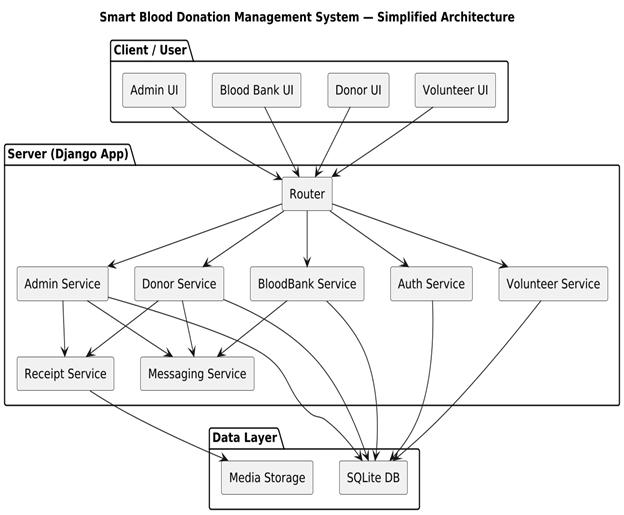
The architecture diagram represents how all modules interact through the Django backend and centralized
database. It also shows the flow of data between users, ensuring that the system supports real-time updates, transparent verification, and secure communication. This implementation ensures that BloodNet operates as a complete integrated platform, reducing manual effort and improvingreliability.
TheTheBloodNetsystemwassuccessfullyimplementedasa Django-based web application and tested to evaluate its functionality,usability,andsystemperformance.Theresults confirmthattheproposedsystemeffectivelydigitalizesthe blooddonationworkflowandimprovescoordinationamong Admins,BloodBanks,Volunteers,andDonors.Thesystem was tested under different scenarios such as user registration,login,receiptupload,receiptverification,camp creation,volunteerapproval,stockupdate,andmessaging. The platform provides real-time interaction between stakeholders, reduces manual processing, and ensures securehandlingofsensitivedata.Thesystemoutputswere validatedthroughmultipletestcasestoensurecorrectness andreliability.
All major modules were tested to verify whether the implementedfeaturesworkasexpected.TheAdminmodule successfully handled receipt verification, volunteer approvals,campmanagement,andmessagemonitoring.The Blood Bank module updated blood stock correctly, and changeswerereflectedinstantly.TheDonormoduleallowed donorstoregister,uploadreceipts,trackverificationstatus, and view camp details. The Volunteer module enabled
International Research Journal of Engineering and Technology (IRJET) e-ISSN: 2395-0056
Volume: 13 Issue: 02 | Feb 2026 www.irjet.net p-ISSN: 2395-0072
volunteerstoregister,requestapproval,andtrackapproval status.
Thesuccessfulexecutionoftheseworkflowsconfirmsthat BloodNet meets the requirements of a centralized blood donationmanagementplatform.
The Admin Dashboard provides a centralized view of all system activities. It displays the total number of donors, volunteers, blood banks, camps, and reports filed. The dashboardalsoprovidesdirectaccesstocoreadministrative functionssuchasmanagingbloodbanks,managingcamps, verifying receipts, handling volunteer requests, viewing messages,andsendingnotifications. Thisoutputscreenprovesthatthesystemsupportseffective monitoring and quick decision-making through a single interface.
Thesystemperformancewasevaluatedbasedonresponse time, database query efficiency, and workflow execution. Django’sORMenabledsmoothdatabaseoperationssuchas receiptstatusupdates,stockretrieval,andcampinformation access. SQLite provided fast read and write operations duringtestingduetoitslightweightdesign. The system significantly reduced the time required for receipt verification tracking and blood stock updates comparedtomanualprocesses.Real-timeupdatesensured thatusersreceivedupdatedinformationinstantly,improving emergencyresponseefficiency.
Theuserinterfacewasdesignedtobesimpleand user-friendly.Role-baseddashboardsreducedcomplexityby displayingonlyrelevantfeaturesforeachusertype.Status indicatorssuchasreceiptverificationstatusandvolunteer approval status improved transparency. The messaging moduleenabledstructuredcommunicationbetweendonors andadmins,reducingdependencyonofflinecommunication. Reliability was ensured through Django’s secure authentication,sessionhandling,andvalidationmechanisms. The receipt upload module was also tested for valid file submissionandsecurestorage,ensuringthatdonorrecords aresafelymaintained.
BloodNet:AReal-TimeBloodEmergencyResponseSystem was developed to digitalize and streamline the blood donation and blood bank management process through a centralized web-based platform. The traditional blood donation workflow is often slow, manual, and poorly coordinated, leading to delays in receipt verification, inaccuratestockupdates,andcommunicationgapsbetween donors,volunteers,bloodbanks,andadministrators.These
issues become highly critical during emergency situations wheretimelyaccesstobloodavailabilityisessential. The proposed system successfully integrates multiple stakeholderssuchasAdmins,BloodBanks,Volunteers,and Donorsintoasinglerole-basedapplication.Itenablesrealtimebloodstockupdates,structuredvolunteerparticipation, transparentreceiptverification,anddirectcommunication throughanintegratedmessagingmodule.ByusingDjango forsecurebackendoperationsandSQLiteforefficientdata storage, the system ensures reliability, accuracy, and improvedworkflowmanagement.
Overall,theimplementationandtestingresultsdemonstrate that BloodNet reduces manual errors, improves transparency, enhances user experience, and provides a faster and more efficient blood donation ecosystem. The systemcanbefurtherextendedinthefuturebyintegrating mobile applications, cloud deployment, geo-location matching,andsmartnotificationservicestosupportlargescalereal-worldusage.
Although the BloodNet system successfully provides a centralized platform for blood donation management and real-time coordination, several enhancements can be implemented to improve scalability and real-world deployment.Inthefuture,thesystemcanbeextendedintoa mobile application to allow donors, volunteers, and blood bankstoaccessservicesmorequicklyandconveniently.The integrationofSMS,email,andpushnotificationservicescan further improve emergency communication by instantly alertingnearbydonorsandvolunteersduringurgentblood requests.Thesystemcanalsobeupgradedbydeployingiton cloud infrastructure and replacing SQLite with scalable databasessuchasMySQLorPostgreSQLtosupportalarge number of users. Geo-location based matching can be introducedtoautomaticallyidentifynearbybloodbanksand donors, reducing response time during emergencies. Additionally, the system can be integrated with hospital databases and government health portals to verify blood requirements and ensure authenticity. Advanced features suchasmachinelearning-basedpredictiveanalyticscanalso be added to forecast blood demand trends and identify shortage patterns, helping blood banks maintain better inventory planning. These future improvements will enhance the effectiveness, scalability, and reliability of BloodNetinreal-worldhealthcareenvironments.
[1]K.Maheshwari,V.Birchha,andR.Gavlane,“BloodBank Management System,” International Journal of Novel ResearchandDevelopment(IJNRD),2024.
International Research Journal of Engineering and Technology (IRJET) e-ISSN: 2395-0056
Volume: 13 Issue: 02 | Feb 2026 www.irjet.net p-ISSN: 2395-0072
[2] L. Li, M. Valero, R. Keyser, A. M. Ukuku, and D. Zheng, “Mobile applications for encouraging blood donation: A systematicreviewandcasestudy,”SAGEJournals,2023.
[3]J.Ahmed,F.Hasan,H.C.Das,M.R.Hossain,andM.S.Mia, “Blood Management System,” ResearchGate Publication, 2022.
[4]T.PangteyandS.Upadhyaya,“ProblemsinAdoptionand ImplementationofE-RaktKoshSchemeintheBloodBank:A Single Center Experience from Uttarakhand, India,” Saudi JournalofPathologyandMicrobiology,2019.
[5]A.Shah,R.Bhuta,andS.Patel,“BloodBankManagement and Inventory Control Database,” Procedia Computer Science,vol.200,pp.317–326,2022.