International Research Journal of Engineering and Technology (IRJET) e-ISSN:2395-0056 p-ISSN:2395-0072

Volume:12Issue:04|Apr2025 www.irjet.net
International Research Journal of Engineering and Technology (IRJET) e-ISSN:2395-0056 p-ISSN:2395-0072
Volume:12Issue:04|Apr2025 www.irjet.net

Gannabathula Sri Prabhu Kiran1 , Kakileti Sai Prasanth2 , Pindi Srinivasarao3 , Lakkakula Tarak Sri Chandrahas4 , Shaik Sajid5
1CST, Sri Vasavi Engineering College(A), Pedatadepalli,Tadepalligudem-534101
2CST, Sri Vasavi Engineering College(A), Pedatadepalli,Tadepalligudem-534101
3CST, Sri Vasavi Engineering College(A), Pedatadepalli,Tadepalligudem-534101
4CST, Sri Vasavi Engineering College(A), Pedatadepalli,Tadepalligudem-534101
5CST, Sri Vasavi Engineering College(A), Pedatadepalli,Tadepalligudem-534101
Abstract - This design presents e-KYC Trust Block, a blockchain- grounded electronic Know Your client(e-KYC) system that enhances trust, security, and sequestration in identity verification. Traditional e-KYC systems calculate on pall storehouse and conventional encryption, leading to crucial operation complications and security vulnerabilities. To address these challenges, e-KYC Trust Block integrates Ciphertext Policy Attribute Grounded Encryption(CP- ABE) for fine- granulated access control and Interplanetary train System(IPFS) for secure document storehouse. also, it employs smart contracts to apply customer concurrence and insure auditability. By combining symmetric and publiccrucial encryption, the system minimizes communication outflow while maintaining data confidentiality. Experimental results validate its effectiveness, scalability, and security, making it a robust result for sequestrationconserving e-KYC processes.
KeyWords: Blockchain, Electronic Know Your Customer (e-KYC), Privacy Preservation, CiphertextPolicy Attribute-Based Encryption (CP-ABE), Smart Contracts, Interplanetary File System (IPFS), Identity Verification,DecentralizedSystems
1.INTRODUCTION
In the era of digital transformation, identity verification has become a critical requirement for financial institutions, telecom providers, and various government agencies. The process of Know Your Customer (KYC) ensures that organizations verify the identity of their clients to prevent fraud, money laundering, and other illicit activities. With the advent of digitization, the traditional paper-based KYC processes have evolved into electronic KYC (e-KYC) systems, aiming to streamline verificationandimprovecustomeronboarding.However, theseconventional e-KYCsystemspredominantlyrelyon centralized architectures and standard encryption models, which present major limitations in terms of data privacy, single points of failure, and complex key management.
Oneoftheprimaryconcernsincentralizede-KYCsystems is the lack of trust and transparency. Sensitive identity data stored in centralized cloud servers is susceptible to unauthorized access, data breaches, and insider threats. Furthermore, ensuring user consent and controlling access to personal data becomes increasingly difficult in such frameworks. As a result, there is an urgent need for an e-KYC solution that is secure, transparent, privacypreserving, and aligned with regulatory requirements suchasdataprotectionlaws(e.g.,GDPR,PDPB).
To address these challenges, this paper proposes e-KYC TrustBlock,adecentralized,blockchain-basedframework designedtoenhancethetrust,privacy,andsecurityofthe e-KYC process. The system utilizes Blockchain to ensure immutability and transparency of transactions, Ciphertext-Policy Attribute-Based Encryption (CPABE) to provide fine-grained access control over encrypted data, and InterPlanetary File System (IPFS) for decentralized and tamper-proof storage of sensitive identity documents. Furthermore, smart contracts are employed to enforce digital consent, automate authorization policies, and ensure accountability in every data-sharingevent.
The proposed system offers several advantages over existing e-KYC models. It reduces reliance on centralized storage, mitigates risks of unauthorized data access, and improves scalability through distributed technologies. By integratingboth symmetric and asymmetric encryption techniques, the system achieves secure data handling with minimal communication overhead. The architecture is designed to support secure onboarding, consent-driven datasharing,audittrails,andregulatorycompliance.
International Research Journal of Engineering and Technology (IRJET) e-ISSN:2395-0056 p-ISSN:2395-0072
Volume:12Issue:04|Apr2025 www.irjet.net
2.1Federated Learning for Privacy-Preserving KYC (2024)
This paper explores the use of federated learning to enable privacy-preserving KYC processes without centralizing sensitive data. It leverages differential privacy techniques to ensuredataprotectionwhileallowingfinancialinstitutionsto verify identities securely. The proposed method enhances privacy and security in KYC processes while reducing risks associatedwithcentralizeddatastorage.
2.2 Enhancing KYC with Behavioural Biometrics in Cloud Environments(2024)
Thispaperinvestigatestheuseofbehaviouralbiometricsand machinelearningtostrengthenKYCverification.Byanalysing user behaviour patterns, the system provides an additional layer of security for identity verification, particularly for mobileusers.Theapproachensuresdataownercontrolwhile improvingauthenticationaccuracyandreducingfraudrisksin cloud-basedKYCsolutions.
2.3 Enhancing Privacy in e-KYC Systems Using ZeroKnowledgeProofs(2023)
This study demonstrates how zero-knowledge proofs (ZKPs) can improve privacy in e-KYC systems by allowing identity verification without revealing sensitive data. It employs data anonymization techniques to enhance security and protect users'personalinformation.Theproposedsolutioneffectively reduces the risk of identity theft while maintaining compliancewithprivacyregulations.
2.4 ABlockchain-BasedApproachforSecureandEfficient Verification(2022)
This paper proposes a blockchain-based system for secure and efficient identity verification. It utilizes smart contracts and data encryption to ensure transparency and prevent fraudulent activities. By decentralizing the verification process, the system improves security, enhances trust, and eliminatesrelianceonthird-partyintermediaries.
2.5 Blockchain Technology for Secure and Transparent eGovernanceSystems(2021)
This research explores the potential of blockchain in egovernanceforsecureandtransparentidentityverification.By leveraging blockchain’s decentralized nature, the system enhances security and reduces the risks associated with centralized identity management. The proposed approach strengthenstransparencyandtrustine-governancesystems.
2.6 APrivacy-Preservinge-KYCSystem(2020)
This paper presents a privacy-preserving e-KYC system that employs cryptographic techniques, including zero-knowledge proofs,toprotectuserdataduringidentityverification.
Traditional e-KYC systems rely heavily on centralized cloud infrastructure and basic encryption techniques, leading to significantconcernsaboutdataprivacy,keymanagement,and lack of auditability. These systems often store sensitive customer information in centralized databases, making them attractive targets for cyberattacks. Additionally, user consent and access control mechanisms are typically not verifiable or enforceableinatransparentmanner.
3.1Centralized Architecture:
Current e-KYC implementations depend on centralized cloud storage, creating a single point of failure. This architecture is vulnerabletodatabreaches,unauthorizedaccess,andinternal misuse, compromising the confidentiality of user identity documents.
3.2WeakAccessControl:
Most traditional systems implement role-based or basic access control mechanisms, which lack the flexibility to enforce fine-grained policies. This limitation prevents effective control over who can access specific parts of the data,increasingtheriskofdataleaks.
3.3LimitedUserConsentManagement:
Existing solutions often do not offer robust mechanisms to recordorverifyuserconsentfordatasharing.Asaresult,user privacy may be compromised, and financial institutions may notcomplywithprivacyregulationseffectively.
3.4NoTransparentAudit Trail:
Without blockchain or distributed ledger technology, there is no reliable or tamper-proof way to track data access and modifications.Thisabsenceofauditabilityreducestrustinthe systemandcomplicatesregulatorycompliance.

Volume:12Issue:04|Apr2025 www.irjet.net
The proposed system, e-KYC TrustBlock, introduces a blockchain-based architecture designed to enhance the trust, security, and privacy of electronic Know Your Customer (e-KYC) processes through decentralized technologies.
The system integrates Ciphertext-Policy AttributeBased Encryption (CP-ABE) to provide fine-grained access control, enabling clients to control who accessestheirKYCdata.
A smart contract framework is implemented to automate the verification, registration, and consent processes. It includes modular contracts for client registration, e-consent generation, and KYC verification.
The system utilizes the InterPlanetary File System (IPFS) for decentralized and secure storage of encrypted e-KYC documents, ensuring availability andresistancetotampering.
The system ensures auditability and data integrity bymaintainingtamper-prooflogsofallactivitieson aprivateblockchainledger.
A combination of symmetric and asymmetric encryption techniques is used to ensure data confidentiality while maintaining efficient communication.
The solution is scalable, secure, and generalizable, making it adaptable to a wide range of identity verification use cases in banking and financial domains
5.BENEFITSOFTHEPROPOSEDSYSTEM
The proposed blockchain-based e-KYC system offers multipleadvantagesovertraditionalKYCmechanisms:
Enhanced Security: By integrating CP-ABE and blockchain,thesystemensuresthatonlyauthorized parties can access sensitive user data, reducing the riskofdatabreachesandunauthorizedaccess.
Improved Trust and Transparency: Smart contractsenforcesecure,verifiable,andtransparent operations across all actors, enhancing the overall trustintheKYCprocess.
Decentralized Control: Eliminating single-point control through blockchain ensures no single entity canmanipulateorcompromisethedata.
Efficient Consent Management: Digital e-consent mechanisms allow clients to have complete control over whoaccessestheirdata,fosteringdata privacy anduserautonomy.
6.METHODOLOGY:
1. RequirementAnalysis:
p-ISSN:2395-0072
Tamper-Proof Records: All transactions and credential storage are immutable and auditable, strengtheningdataintegrityandaccountability.
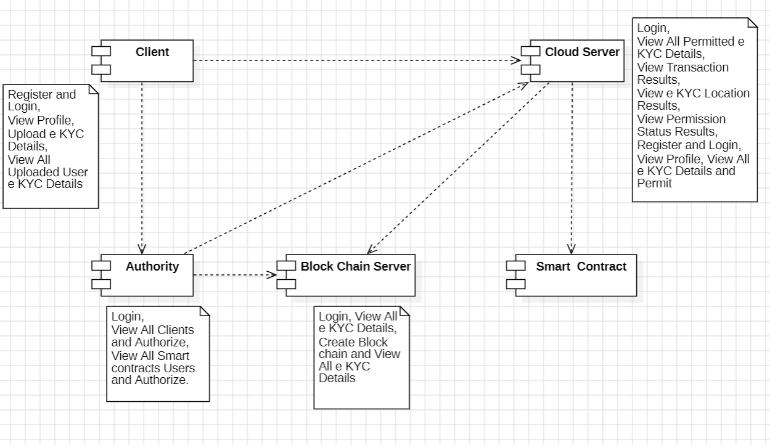
Identifyandunderstandtherequirementsofasecure, privacy-compliant e-KYC system. Define the roles of Clients, Financial Institutions, the Central Authority, Blockchain Server, and Smart Contracts. Determine the need for secure data storage, consent-based sharing, and access control using cryptographic techniqueslikeCP-ABE.
2. SystemDesign:
Design the overall architecture involving user roles and their interaction with the system. Develop a modular architecture using IPFS for decentralized storage and blockchain for immutability. Define the workflow for user registration, data upload, authorization, and KYC verification through smart contracts. Design the interfaces using JSP and Java Servlets.
3. Database and Blockchain Setup:
Use MySQL to store non-sensitive metadata such as user activity logs and access permission history. Blockchain is used to store encrypted hash values of KYC data, ensuring immutability and traceability. Implement CP-ABE to encrypt sensitive documents beforeuploadingtoIPFS.
4. Implementation:
DevelopthesystemusingJava,JSP,andServlets. Implementmodulesforeachactor:
4.1 Clients: Register,login,anduploadencrypted e-KYC documents. Clients digitally sign consent formsallowingFIstoaccesstheirdata.
4.2 Authority: Generates system keys, distributes secret keys using CP-ABE, and managesaccesscontrolanduserauthorization.
4.3 Smart Contracts: Automate the operations such as registration, consent verification, and data validation. Separate contracts handle registration,consent,andverification.
4.4 Blockchain Server: Stores all KYC-related activities and hashes. Ensures data immutability andmaintainstransactionhistory.
4.5 Cloud Server (IPFS): Stores encrypted documents and responds to queries by authorizedusersthroughhashlookups.
International Research Journal of Engineering and Technology (IRJET) e-ISSN:2395-0056 p-ISSN:2395-0072
Volume:12Issue:04|Apr2025 www.irjet.net
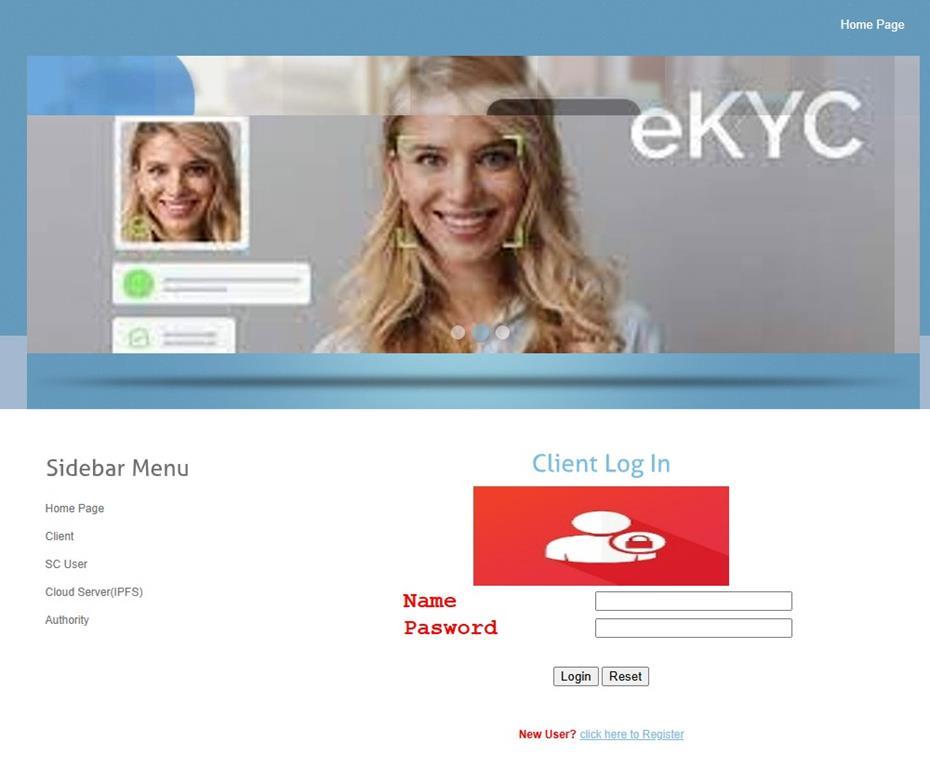
7.UserInterface:
8.CONCLUSION:
Thispaperpresentsasecureandprivacy-preservinge-KYCsystemleveragingblockchainandCP-ABEencryption.The proposedsystemenhances trust,security,andtransparencybydecentralizingthestorageandverificationofusercredentials throughsmartcontracts and encryptedcloudstorage.It enables users toretaincontrol overtheirdata witha digital consent mechanism, while ensuring tamper-proof records and access control. Thearchitecture demonstrates a scalable, efficient, and privacy-compliantsolutiontomodernizeKYCprocesses.Futureenhancementscanintegratezero-knowledgeproofsandlayer2scalabilitysolutionsforevengreaterperformanceandprivacy.
9.REFERENCES:
[1] Y. Zhong et al., “Distributed blockchain-based authentication and authorization protocol for smart grid,” Wireless Commun. Mobile Comput.,vol.2021,pp.1–15,Apr.2021,doi:10.1155/2021/5560621.
[2] S. Y. Lim et al., “Blockchain technology the identity management and authentication service disruptor: A survey,” Int. J. Adv. Sci. Eng. Inf. Technol.,vol.8,pp.1735–1745,Sep.2018.
[3]A.A.Mamun et al.,“SecureandtransparentKYCforbankingsystemusingIPFSandblockchaintechnology,”in Proc. IEEE Region Symp. (TENSYMP),Jun.2020,pp.348–351.
[4]M.Pic,G.Mahfoudi,andA.Trabelsi,“RemoteKYC:Attacksandcountermeasures,”in Proc. Eur. Intell. Secur. Informat. Conf. (EISIC),Nov.2019,pp.126–129.
International Research Journal of Engineering and Technology (IRJET) e-ISSN:2395-0056 p-ISSN:2395-0072
Volume:10Issue:12|Dec2023 www.irjet.net
[5]W.Shbair,M.Steichen,andJ.François,“Blockchainorchestrationandexperimentationframework:AcasestudyofKYC,” in Proc. 1st IEEE/IFIP Int. Workshop Manag. Managed Blockchain (Man Block),JejuIsland,SouthKorea,Aug.2018,pp.23–25.
[6] R. Norvill et al., “Demo: Blockchain for the simplification and automation of KYC result sharing,” in Proc. IEEE Int. Conf. Blockchain Cryptocurrency (ICBC),May2019,pp.9–10,doi:10.1109/BLOC.2019.8751480.
[7]T.MikulaandR.H.Jacobsen,“Identityandaccessmanagementwithblockchaininelectronichealthcarerecords,”in Proc. 21st Euromicro Conf. Digit. Syst. Design (DSD),Prague,CzechRepublic,Aug.2018,pp.699–706.
[8]S.Wang,R.Pei,andY.Zhang,“EIDM:Aethereum-basedclouduseridentitymanagementprotocol,” IEEE Access,vol.7,pp. 115281–115291,2019,doi:10.1109/ACCESS.2019.2933989.
[9]N.Ullah,K.A.Al-Dhlan,andW.M.Al-Rahmi,“KYCoptimizationbyblockchainbasedhyperledgerfabricnetwork,”in Proc. 4th Int. Conf. Adv. Electron. Mater., Comput. Softw. Eng. (AEMCSE),Mar.2021,pp.1294–1299.
[10] N. Kapsoulis et al., “Know your customer (KYC) implementation with smart contracts on a privacy-oriented decentralizedarchitecture,” Future Internet,vol.12,no.41,pp.1–13,2020.
[11] J. Bethencourt, A. Sahai, and B. Waters, “Ciphertext-policy attribute-based encryption,” in Proc. IEEE Symp. Secur. Privacy,Oakland,CA,USA,May2007,pp.321–334.
[12] I. Gutierrez-Aguero et al., “Burnable pseudo-identity: A non-binding anonymous identity method for ethereum,” IEEE Access,vol.9,pp.108912–108923,2021.
[13] S. Nakamoto, “Bitcoin: A Peer-to-Peer Electronic Cash System,” [Online]. Available: https://bitcoin.org/bitcoin.pdf Accessed:Jan.8,2022.
[14] J.P.Moyanoand O. Ross,“KYC optimizationusing distributedledger technology,” Bus. Inf. Syst. Eng.,vol. 59,no. 6, pp. 411–423,Dec.2017.
[15]A.Chowdhary,S.Agrawal,andB.Rudra,“Blockchainbased framework forstudentidentityand educational certificate verification,”in Proc. 2nd Int. Conf. Electron. Sustain. Commun. Syst. (ICESC),Aug.2021,pp.916–921.
[16]GDPREuropeanUnionGuidelines.[Online].Available:https://gdprinfo.eu/.Accessed:Aug.12,2021.
[17] G. Bramm, M. Gall, and J. Schütte, “BDABE-blockchain-based distributed attribute based encryption,” in Proc. 15th Int. Conf. e-Bus. Telecommun.,2018,pp.99–110.
[18] Y. Fan et al., “TraceChain: A blockchain-based scheme to protect data confidentiality and traceability,” Softw., Pract. Exper.,vol.52,no.1,pp.115–129,Jan.2022,doi:10.1002/spe.2753.
[19]C.Yuan et al.,“BlockchainwithaccountableCP-ABE:Howtoeffectivelyprotecttheelectronicdocuments,”in Proc. IEEE 23rd Int. Conf. Parallel Distrib. Syst. (ICPADS),Dec.2017,pp.800–803.
[20] A. Wu et al., “Efficient and privacy-preserving traceable attribute-based encryption in blockchain,” Ann. Telecommun., vol.74,nos.7–8,pp.401–411,Aug.2019.
[21]L.Guo,X.Yang,andW.-C.Yau,“TABE-DAC:Efficienttraceableattribute-basedencryptionschemewithdynamicaccess controlbasedonblockchain,” IEEE Access,vol.9,pp.8479–8490,2021,doi:10.1109/ACCESS.2021.3049549.
[22]M.Barati et al.,“Privacy-awarecloudauditing for GDPRcompliance verificationin online healthcare,” IEEE Trans. Ind. Informat.,vol.18,no.7,pp.4808–4819,Jul.2022,doi:10.1109/TII.2021.3100152.