
International Research Journal of Engineering and Technology (IRJET) e-ISSN: 2395-0056
Volume: 13 Issue: 02 | Feb 2026 www.irjet.net p-ISSN: 2395-0072
International Research Journal of Engineering and Technology (IRJET) e-ISSN: 2395-0056
Volume: 13 Issue: 02 | Feb 2026 www.irjet.net p-ISSN: 2395-0072
Mr. J. Ramesh
1
, M.Gayathri2, Sravani Sajjan3, M. Shivani4, Md Fareed Baba5
1Asst.Professor in Department of IT, TKR College of Engineering and Technology, Telangana, India 2345 BTECH Students in Department of IT, TKR College of Engineering and Technology, Telangana, India ***
Abstract – The increasing reliance on digital evidence in legalinvestigationsdemandssecureandtamper-proofstorage solutions. This project presents a Digital Evidence Management System (DEMS) that ensures the integrity, authenticity, and traceability of digital files using SHA-256 hashing. The system allows users to register, upload files, and generateuniquehashkeysforeachuploadedevidence.Admins have control over user management, including account activation, deactivation, and monitoring of all uploaded files. When a user uploads a file for verification, the system computes its SHA-256 hash and compares it with existing entries in the database, thereby detecting any tampering or alteration.Theuploadedfiles,alongwithassociatedmetadata such as file name, uploader, timestamp, and hash key, are stored securely in a local media folder, ensuring organized evidence management. The platform also incorporates a secure passwordrecovery mechanismusingemail-basedOTP verification. By integrating file hashing with a robust user management framework, the system offers a reliable and efficient solution for managing digital evidence in investigationsandlegalproceedings.Thisapproachprovidesa lightweight, blockchain-inspired model for evidence integrity withoutrequiringafullblockchainimplementation,makingit practical for small- to medium-scale investigative workflows.
Key Words: Digital Evidence, SHA-256, File Verification, Tamper Detection, Evidence Management System, Django.
Inmodernlegalandinvestigativeprocesses,digitalevidence has become a crucial component in establishing facts and proving cases. With the proliferation of digital data, the integrity,authenticity,andtraceabilityofsuchevidenceare paramount.Traditionalmethodsofevidencestorageoften involve manual handling, centralized databases, or unprotectedfilesystems,whicharevulnerabletotampering, accidentalloss,orunauthorizedaccess.Anyalterationinthe digitalevidencecancompromiseinvestigationsandleadto legal challenges. To address these challenges, the Digital EvidenceManagementSystem(DEMS)integratesSHA-256 hashingtosecurefilesuploadedbyauthorizedusers.Each fileisprocessedtogenerateauniquehashkeythatactsasa digitalfingerprint,ensuringthatevenminormodifications are detectable. The system incorporates robust user management, where admin approval is required for new
users, and allows admins to monitor and manage all uploadedevidence.Userscanverifytheauthenticityofafile atanytimebyre-uploadingitforhashcomparison,ensuring theevidencehasnotbeenaltered.Thisapproachprovidesa lightweight, blockchain-inspired solution for evidence security,offeringhighreliabilitywithoutthecomplexityof full-scale blockchain implementation. By combining file integrity verification, controlled access, and centralized metadata storage, the system provides an efficient and trustworthy platform for managing digital evidence in investigationsandlegalproceedings.
Inmoderncriminalinvestigations,digitalevidencesuchas CCTVfootage,forensicreports,callrecords,andcyberlogs plays a crucial role in solving cases and ensuring justice. However, traditional evidence storage systems often centralized or manually managed are vulnerable to data breaches,unauthorizedaccess,manipulation,andaccidental loss.Evenaminoralterationinevidencecancompromiseits integrity, leading to legal disputes and weakening its admissibility in court. To maintain the chain of custody, criminalevidencemustremainconfidential,immutable,and verifiablefromthemomentofcollectiontoitspresentation incourt.Asthevolumeofdigitalevidencegrowsrapidly,law enforcementagenciesrequirearobustsystemthatensures long-term preservation, traceability, and accountability while preventing tampering and insider threats. This challenge has highlighted the need for advanced security mechanismsbeyondconventionaldatabases.
Blockchaintechnologyoffersadecentralizedandimmutable ledgerthatcansignificantlyenhancethesecurityofcriminal evidence storage. By recording cryptographic hashes of evidence files on the blockchain, any unauthorized modificationcanbeinstantlydetected,ensuringauthenticity andnon-repudiation.Eachtransactionrelatedtoevidence access, transfer, or modification is time-stamped and transparently logged, strengthening trust among law enforcement agencies, forensic departments, and judicial authorities.
International Research Journal of Engineering and Technology (IRJET) e-ISSN: 2395-0056
Volume: 13 Issue: 02 | Feb 2026 www.irjet.net p-ISSN: 2395-0072
Cloud computing complements blockchain by providing scalable, cost-effective, and highly available storage infrastructure for large volumes of evidence data. When integrated with blockchain, secure cloud storage enables encrypted evidence files to be stored efficiently while blockchainmaintainsproofofintegrityandaccesscontrol. This hybrid approach ensures confidentiality, integrity, availability,andauditability,makingitanidealsolutionfor managingsensitivecriminalevidenceinalegallycompliant andtechnologicallyadvancedmanner.
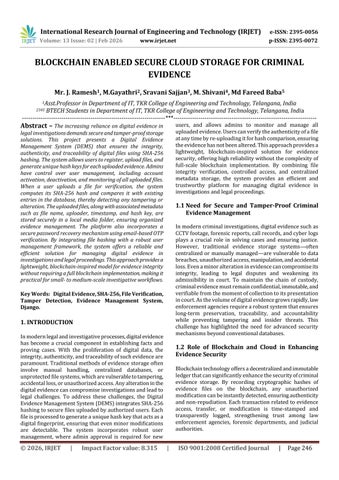
Theproposedsystem,DigitalEvidenceManagementSystem (DEMS), is designed to securely store, manage, and verify digitalevidenceininvestigativeandlegalenvironments.The system addresses the limitations of traditional centralized storage,includingvulnerabilitytotampering,accidentalloss, andunauthorizedaccess.Eachevidencefileuploadedbya user is processed using SHA-256 hashing to generate a unique digital fingerprint, ensuring its integrity and authenticity. Metadata such as the uploader’s details, file name,timestamp,andhashkeyisstoredinthedatabasefor audit and verification purposes. The system incorporates role-basedaccesscontrol,whereadministratorsapprovenew users,manageaccounts,andmonitoralluploadedevidence. Users can upload new files, verify existing evidence by uploading it for hash comparison, and receive immediate feedback on whether the file matches stored records. Passwordrecoveryisimplementedviasecureemail based OTP verification to enhance usability. By combining hashbased verification with controlled access and centralized metadata management, the proposed system provides a lightweight,blockchain-inspiredapproachtotamper-proof digitalevidencehandling.Itensuresreliability,traceability, andaccountability, making it suitableforlawenforcement agencies,forensicinvestigations,andotherscenarioswhere theauthenticityofdigitalevidenceiscritical.Thesystemis scalable,efficient,andpracticalforbothsmall-andmediumscaledeployments.
The system architecture of the Blockchain Enabled Secure CloudStorageforCriminalEvidenceisdesignedasalayered andmodularframeworktoensureconfidentiality,integrity, and traceability of digital evidence. At the front end, authorizeduserssuchaslawenforcementofficers,forensic experts, and judicial authorities interact with the system through a secure web interface with multi-factor authentication. Once evidence is uploaded, it is encrypted usingstrongcryptographicalgorithmsandstoredinasecure cloud and case ID is generated and recorded on the blockchainnetwork.Smartcontractsmanageaccesscontrol, evidencelifecycle,andloggingofalltransactions,ensuringan immutable audit trail. Any request to access or modify evidenceisverifiedagainstblockchainrecords,andintegrity
checks are performed by comparing stored hashes. This integrated architecture combines cloud storage efficiency with blockchain immutability, thereby maintaining an unbroken chain of custody and preventing unauthorized tamperingofcriminalevidence.
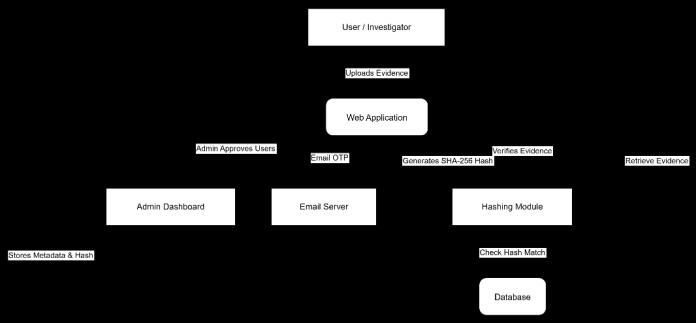
In the proposed system, all criminal evidence is secured before storage through strong encryption mechanisms to ensure confidentiality and prevent unauthorized access. When evidence such as images, videos, or documents is uploaded, it is encrypted at the client or application layer usingcryptographicalgorithms.Theencrypteddataisthen storedinasecurecloudstorageenvironment,whichprovides scalability,highavailability,andreliablebackup.Thislayer ensuresthatevenifcloudinfrastructureiscompromised,the actual evidence remains unreadable without proper decryptionkeys.Securecloudstoragealsoenablesefficient handling of large volumes of digital evidence while supportingcontrolledaccessbasedonuserrolesdefinedin thesystem.
International Research Journal of Engineering and Technology (IRJET) e-ISSN: 2395-0056
Volume: 13 Issue: 02 | Feb 2026 www.irjet.net p-ISSN: 2395-0072
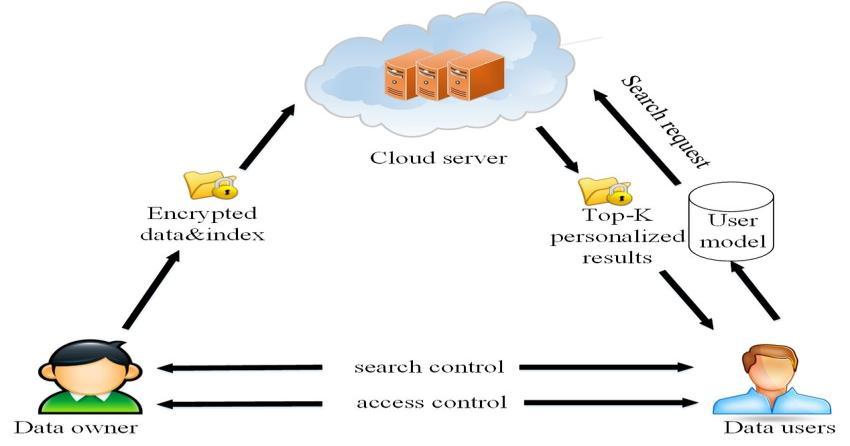
Theblockchainlayeractsasthecoretrustmechanismofthe proposed architecture by maintaining the integrity and traceabilityofcriminalevidence.Insteadofstoringtheactual evidencedataontheblockchain,cryptographichashvaluesof the encrypted files along with metadata such as case ID, uploaderidentity,andtimestampsarerecorded.Eachblockis linked to the previous one, making the stored records immutableandtamper-proof.Smartcontractsregulateaccess permissions and automatically log every evidence-related transaction, including uploads, access requests, and verificationevents.Thiscreatesatransparentandverifiable audit trail, ensuring an unbroken chain of custody and enhancingthelegaladmissibilityofdigitalevidence.
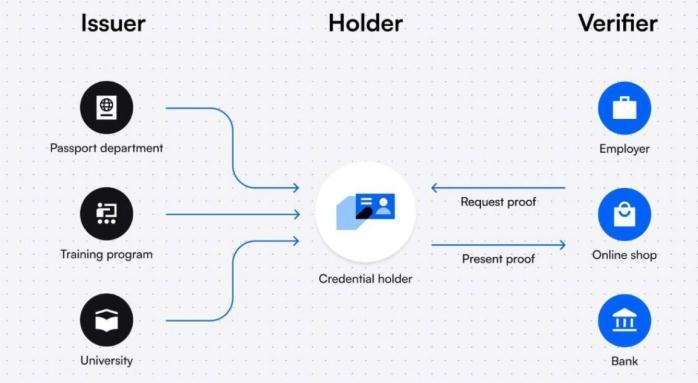
Itdescribesthepracticalstepstobuilda secure,auditable, tamper-evidentevidencemanagementsystemthatcombines cloud storage, cryptographic hashing, and blockchain notarization. The implementation plan follows a modular, testable approach so each component (ingestion, storage, verification,accesscontrol,blockchainanchoring,andaudit) can be developed, validated, and integrated. The system’s goal is to guarantee integrity, chain-of-custody, confidentiality, and controlled access for digital evidence usedinlegalproceedings.Theimplementationconvertsthe architecture and designs into working modules: Evidence Ingestion, Hashing & Notarization, Off-chain Storage (cloud/IPFS), Permissioned Blockchain Layer, Access & ForensicsServices,andAudit&Monitoring.
Implement using a layered architecture: Presentation (Frontend),Application(APIsµservices),Data(cloud storage+metadataDB),Blockchain(permissionedledger), Security(authentication,encryption,login).
BuildaresponsivewebUI(andoptionalmobileclient)for: Evidence upload forms with metadata capture (case id, uploader, timestamp, device info, chain-of-custody notes). Evidencebrowsing,search,andfilteredviewsforauthorized roles. Forensic tools UI: file preview, hash verification, timeline view of custody events. Implement client-side hashing (optional) to show user-generated hash before upload. Communicate with backend via secure REST/GraphQLandWebSocketforliveupdates.
The experimental results demonstrate that the proposed Blockchain Enabled Secure Cloud Storage for Criminal Evidencesystemeffectivelyensuresdataintegrity,security, and reliable evidence management with acceptable performanceoverhead.Duringevaluation,evidenceupload and retrieval operations showed minimal latency increase due to encryption and blockchain hash generation, while remaining within practical limits for real-world law enforcementuse.Integrityverificationtestsconfirmedthat any unauthorized modification of stored evidence was immediatelydetectedthroughhashmismatch,validatingthe immutabilityprovidedbytheblockchainlayer.Thesystem alsoexhibitedhighreliabilityandavailabilityduetocloudbased storage, even under increasing data volumes. Performance analysis indicates that while blockchain transaction processing introduces slight computational overhead, the benefits of tamper-proof audit trails, secure accesscontrol,andmaintainedchainofcustodysignificantly outweigh the costs. Overall, the results confirm that the proposedarchitectureachievesabalancedtrade-offbetween strongsecurityguaranteesandefficientsystemperformance, makingitsuitableforsecurecriminalevidencemanagement.
This project successfully presents a Blockchain Enabled Secure Cloud Storage for Criminal Evidence system that addresses critical challenges related to evidence security, integrity, and chain of custody in modern criminal investigations.Byintegratingstrongencryption,cloud-based storage, and blockchain technology, the proposed system ensuresthatdigitalevidenceremainsconfidential,tamperproof, and verifiable throughout its lifecycle. The use of blockchain to store cryptographic hashes and access logs provides transparency, immutability,and trust among law enforcement and judicial authorities, while cloud infrastructureoffersscalabilityandhighavailability.Overall, the proposed solution enhances the reliability and legal admissibility of criminal evidence and demonstrates the effectiveness of blockchain–cloud integration as a robust approach for secure evidence management in real-world scenarios.
International Research Journal of Engineering and Technology (IRJET) e-ISSN: 2395-0056
Volume: 13 Issue: 02 | Feb 2026 www.irjet.net p-ISSN: 2395-0072
TheproposedBlockchainEnabledSecureCloudStoragefor Criminal Evidence system can be further enhanced and expanded to address evolving technological and legal requirements.Future work mayincludetheintegrationof advancedcryptographictechniquessuchaspost-quantum encryptiontostrengthenlong-termsecurity.Incorporating artificial intelligence and machine learning models for automated evidenceclassification,anomalydetection,and tamperpredictioncanimproveinvestigationefficiency.The systemcanalsobeextendedtosupportmultimediaforensic data such as real-time CCTV feeds, body-worn camera recordings,andIoT-basedevidence.Additionally,deploying the solution on a consortium or permissioned blockchain across multiple law enforcement agencies can improve interoperability and trust while ensuring regulatory compliance. These enhancements would make the system moreintelligent,scalable,andadaptablefornext-generation digitalforensicapplications.
Therearemanyindividualswhohavecontributeddirectly andindirectlytothesuccessful completionofthisproject, and we take this opportunity to express our sincere gratitude to all of them. We are extremely thankful and indebtedtoourprojectsupervisor,Mr.J.Ramesh,Assistant Professor, Department of Information Technology, TKR College of Engineering and Technology, for his constant guidance,encouragement,andmoralsupportthroughoutthe project. We also express our heartfelt thanks to Dr. R. Muruganantham, Head of the Department, Department of InformationTechnology,forhiscontinuousencouragement and support. We are sincerely grateful to Dr. D. V. Ravi Shankar, Principal, TKR College of Engineering and Technology,forhistimelysupportandvaluablesuggestions during the course of the project. Finally, we extend our thanks to all the faculty and staff of the Department of InformationTechnology,aswellasourparentsandfriends, whose cooperation and support played a vital role in the successfulcompletionofthisproject.
[1] S. Nakamoto, “Bitcoin: A Peer-to-Peer Electronic Cash System,” Cryptography Mailing List, 2008.
DOI:10.1007/978-3-662-53357-4_8
[2] M. Crosby, P. Pattanayak, S. Verma, and V. Kalyanaraman, “Blockchain Technology: Beyond Bitcoin,” Applied Innovation Review, vol. 2, pp. 6–19, 2016.
DOI:10.48550/arXiv.1510.03520
[3] A.Zyskind,O.Nathan,andA.Pentland,“Decentralizing Privacy: Using Blockchain to Protect Personal Data,”
IEEE Security and Privacy Workshops, 2015.
DOI:10.1109/SPW.2015.27
[4] K.BiswasandV.Muthukkumarasamy,“SecuringSmart CitiesUsingBlockchainTechnology,”IEEEConference onSmartCities,2016.
DOI:10.1109/ICSCC.2016.7919677
[5] S. Wang, Y. Zhang, and Y. Zhang, “A Blockchain-Based FrameworkforDataSharingWithFine-GrainedAccess ControlinDecentralizedStorageSystems,”IEEEAccess, vol. 6, pp. 38437–38450, 2018.
DOI:10.1109/ACCESS.2018.2851611
[6] H. Li, D. Liu, Y. Dai, and T. H. Luan, “Engineering Blockchain-Based Cloud Data Provenance,” IEEE TransactionsonIndustrialInformatics,vol.15,no.6,pp. 3183–3195,2019.
DOI:10.1109/TII.2018.2878840
[7] Y.Zhang,J.Wen,andG.Chen,“Privacy-PreservingCloud Data Auditing Using Blockchain,” Future Generation Computer Systems, vol. 109, pp. 153–162, 2020.
DOI:10.1016/j.future.2020.03.041