
International Research Journal of Engineering and Technology (IRJET) e-ISSN: 2395-0056
Volume: 13 Issue: 04 | Apr 2026 www.irjet.net p-ISSN: 2395-0072
International Research Journal of Engineering and Technology (IRJET) e-ISSN: 2395-0056
Volume: 13 Issue: 04 | Apr 2026 www.irjet.net p-ISSN: 2395-0072
Indu Sahu1 , Laxmi Dhiman2 , Er. Mahesh Bahadur Singh3 Er. Bhim Nath Tiwari4
¹Student, Dept. of Computer Science and Engineering, SRMCEM, Lucknow, India
²Student, Dept. of Computer Science and Engineering, SRMCEM, Lucknow, India
³Assistant Professor, Dept. of Computer Science and Engineering, SRMCEM, Lucknow, India
4Assistant Professor, Dept. of Computer Science and Engineering, SRMCEM, Lucknow, India
Abstract - Thetraditionalland registry system suffersfrom issues such as lack of transparency, fraud, data manipulation, and inefficiency due to its centralized nature. This paper proposesa blockchain-based system fortrackinglandregistry that ensures secure, transparent, and tamper-proof managementof land ownershiprecords. Theproposedsystem uses Ethereum blockchain and smart contracts to automate land transactions and eliminate intermediaries. Additionally, the Inter Planetary File System (IPFS) is used for secure storage of land documents. The system enhances trust among stakeholders, reduces fraud, and improves efficiency in land ownershiptransfer.Theresultsdemonstratethattheproposed system significantly improves data integrity, transparency, and transaction speed compared to traditional systems.
Key Words: Blockchain, Land Registry, Ethereum, Smart Contracts, IPFS, Decentralization, Security
Land is one of the most important and valuable assets for individuals as well as governments and keepingaccurateownershiprecordsisessentialfor legal security and economic stability. However, traditional land registry systems are mostly centralized and controlled by government authorities.Becauseofthiscentralizednature,these systems are often vulnerable to problems such as fraud, data manipulation, corruption, and loss of records. In many cases, verifying ownership or transferring land takes a long time due to manual processes and the involvement of multiple intermediaries like brokers, agents, and officials. This not only increases the overall cost but also reducestrustamongstakeholders.
Withtherapidadvancementoftechnology,thereisa growing need for a more secure, transparent, and
efficient way to manage land records. Blockchain technology offers a promising solution to these challenges.Itisadecentralizedsystemwheredatais stored across multiple nodes, making it extremely difficult to alter or tamper with records. Each transaction is recorded permanently, ensuring transparency and accountability. This helps build trustamongusers,asallparticipantscanverifythe authenticity of the data without relying on central authority.
By integrating blockchain technology into land registrysystems,manyoftheexistingissuescanbe addressed effectively. The use of smart contracts allowsautomaticexecutionofagreements,reducing the need for manual intervention and minimizing delays. Additionally, decentralized storage systems cansecurelystoreimportantdocumentssuchasland deeds and certificates, ensuring they are always accessibleandprotectedfromlossordamage. Inthispaper,weproposeablockchain-basedsystem for tracking land registry that combines smart contracts and decentralized storage technologies. Thegoalistocreateareliable,secure,andefficient platform for managing land ownership and transactions, ultimately reducing fraud, increasing transparency,andsimplifyingtheentireprocessof landtransfer.
In recent years, blockchain technology has gained significantattentioninthefieldoflandregistryand property management. Many researchers have exploreditspotentialtoovercomethelimitationsof traditionalcentralizedsystems.Severalstudieshave proposed the use of private and permissioned blockchain frameworks, such as Hyperledger, to
International Research Journal of Engineering and Technology (IRJET) e-ISSN: 2395-0056
Volume: 13 Issue: 04 | Apr 2026 www.irjet.net p-ISSN: 2395-0072
enhancedatasecurity,privacy,andcontrolledaccess [1], [2]. These systems allow only authorized participants,suchasgovernmentofficials,tovalidate and update land records, thereby reducing the chancesofunauthorizedaccessanddatatampering.
Other research efforts have focused on the use of smartcontractstoautomatekeyprocessesinland registration, such as ownership verification, transaction validation, and property transfer. By eliminating manual intervention, these systems reducedelays,minimizehumanerrors,andimprove overall efficiency [7], [10]. Some solutions also integrateidentityverificationmechanismstoensure thatonlylegitimateuserscanperformtransactions, therebyincreasingtrustinthesystem[4].
Despite these advancements, existing approaches still face several challenges. One major issue is scalability,asblockchainnetworksmayexperience delays when handling many transactions. Additionally, many systems are complex to implementandrequiretechnicalexpertise,making themdifficulttoadoptinreal-worldscenarios[8], [15]. Another limitation is the lack of efficient storagesolutionsforlargedocumentssuchasland deeds,maps,andcertificates,whichcannotbestored directlyontheblockchainduetosizeconstraints.
Toaddressthestorageissue,someresearchershave suggestedintegratingdecentralizedstoragesystems such as IPFS (InterPlanetary File System). IPFS allows large files to be stored securely off-chain while maintaining their integrity through unique cryptographichashesstoredontheblockchain[12].
Buildingupontheseexistingworks,severalmodern studieshaveproposeddecentralizedframeworksfor securelandregistrationandfraudprevention[19]. However,thereisstillaneedforamorepractical, scalable, and user-friendly system. Therefore, this paper proposes a comprehensive and fully decentralized land registry system that combines blockchain technology, smart contracts, and IPFS. The aim is to create a more secure, scalable, and practical solution for managing land records,
ensuring transparency, reducing fraud, and simplifyingtheprocessofownershiptransfer.
The existing land registry system suffers from multiple challenges that reduce its efficiency, reliability, and trustworthiness. Most traditional systems are based on centralized databases maintained by government authorities or administrative bodies. This centralized approach createsasinglepointoffailure,meaningthatifthe systemiscompromised,corrupted,orattacked,the entire database can be affected. Such systems are also more vulnerable to data loss due to technical failuresorcyberattacks.
Another major issue is the high risk of fraud and unauthorizeddatamanipulation Sincerecordscan be altered by individuals with access privileges, there have been many cases of illegal property transfers, duplicate ownership claims, and forged documents.Thisunderminestrustinthesystemand often leads to legal disputes that take years to resolve.
Theverificationandapprovalprocessintraditional systems is often slow and inefficient. It involves multiple steps, including manual document verification,approvalsfromvariousauthorities,and physicalvisitstooffices.Thisnotonlyincreasesthe time required to complete a transaction but also addstotheoverallcostforusers.
Additionally, there is a significant lack of transparency among stakeholders. Buyers, sellers, and other parties do not have realtime access to reliable land records, making it difficult to verify ownershiphistoryortransactiondetails.Thislackof visibilityfurtherincreasesthechancesoffraudand miscommunication.
Thesystemalsoheavilyreliesonintermediariessuch as brokers, agents, and officials, which increases complexity and operational costs. These intermediariesmayintroducedelays,errors,oreven corrupt practices,makingthe process less efficient
International Research Journal of Engineering and Technology (IRJET) e-ISSN: 2395-0056
Volume: 13 Issue: 04 | Apr 2026 www.irjet.net p-ISSN: 2395-0072
and less trustworthy. Considering all these limitations, there is a strong need for a modern solution that ensures security, transparency, efficiency,andtrust. Adecentralizedapproachusing blockchaintechnologycaneffectivelyaddressthese issuesbyprovidingatamper-proof,transparent,and automated system for managing land registry records.
Theproposedsystemintroducesablockchain-based platform designed to securely manage land ownershiprecordsandpropertytransactions.Unlike traditional systems that rely on centralized databases, this solution leverages blockchain technology to create a decentralized and tamperproof environment. The system is built on the Ethereum blockchain, where all land-related transactions are recorded in a transparent and immutable manner. Smart contracts are used to automate various processes such as ownership verification and transfer, reducing the need for manualinterventionandminimizingdelays.
Theprimaryobjectiveofthissystemistoprovidea secure,efficient,andtrustworthyplatformforland registry management. By using blockchain, each transactionispermanentlyrecordedandcannotbe altered, ensuring the authenticity and integrity of data.Additionally,decentralizedstoragemechanisms suchasIPFSareusedtostorelargedocumentslike landdeeds,maps,andcertificates,makingthesystem morescalableandefficient.
4.1 Key Features
• Decentralized Storage of Land Records: Landdataisstoredacrossmultiplenodesin theblockchainnetwork,eliminatingtherisk ofasinglepointoffailureandensuringhigh availability.
• Immutable Transaction History:Oncea transactionisrecordedontheblockchain,it cannotbemodifiedordeleted.Thisensures complete transparency and prevents fraudulentactivities.
• Smart Contract-Based Ownership Transfer: Smart contracts automatically execute transactionswhenpredefinedconditionsare met, ensuring secure and error-free ownership transfer without the need for intermediaries.
• Secure Document Storage Using IPFS: Importantdocumentssuchaslanddeedsand certificates are stored on IPFS, which provides decentralized and secure storage. Onlythehashofthedocumentisstoredon theblockchain,ensuringdataintegrity.
• Transparent and Traceable Transactions: Alltransactionsarevisibleto authorized participants, allowing easy trackingofownershiphistoryandimproving trustamongstakeholders.
• Government Authority: Thisentityactsasa trusted verifier responsible for validating user identities and land documents. It ensuresthatonlylegitimatedataisaddedto thesystem.
• Seller: The seller registers their land on the platformbyprovidingnecessarydetailsand uploadingrelevantdocuments.Onceverified, thelandcanbelistedforsale.
• Buyer: The buyer can view available properties, verify ownership details, and initiatethepurchaseprocess.Theownership is transferred securely through smart contractsaftersuccessfulverification.
Thesystemoperatesinadecentralizedmanner whereusersinteractwiththeplatformthrough a web-based interface (DApp). When a seller uploadslanddetails,theinformationisverified bythegovernmentauthorityandthenstoredon the blockchain. If a buyer is interested in purchasingtheland,theycaninitiatearequest. Onceallconditionsaremet,thesmartcontract automatically executes the transaction and transfers ownership to the buyer. The entire
International Research Journal of Engineering and Technology (IRJET) e-ISSN: 2395-0056
Volume: 13 Issue: 04 | Apr 2026 www.irjet.net p-ISSN: 2395-0072
The overall workflow of the system is designed to be simple,secure,andefficient:
• Eliminatestheneedforintermediaries
• Reducestransactiontimeandcost
• Enhancesdatasecurityandintegrity
• Providesreal-timeaccesstolandrecords
• Minimizesfraudanddisputes
Thisproposedsystemprovidesamodernandefficient solutionforlandregistrymanagementbycombining blockchain technology, smart contracts, and decentralized storage, ultimately improving trust, transparency,andreliabilityinthesystem.
The proposed system is implemented as a Decentralized Application(DApp) thatintegratesauser-friendlyfrontend interface with backend smart contracts deployed on the Ethereumblockchain.Themethodologyfocusesonensuring securedatahandling,automatedtransactionprocessing,and transparent record management. By combining blockchain technologywithdecentralizedstorage,thesystemprovidesa robustsolutionformanaginglandregistryoperations.
The architecture follows a modular approach where each component frontend, blockchain, and storage works together to perform specific tasks efficiently. The frontend allowsuserstointeractwiththesystem,whilethebackend smart contracts handle all critical operations such as verification,validation,andownershiptransfer.
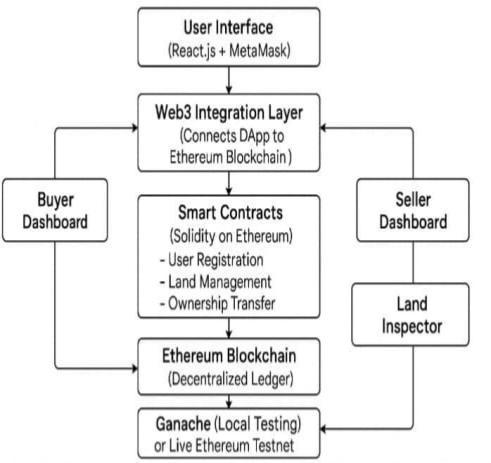
•User Registration and Identity Verification: Users (buyersandsellers)firstregisterontheplatform by providing their personal details. Identity verification is carried out by the government authoritytoensurethatonlylegitimateuserscan accessthesystem.
•Seller Uploads Land Details and Documents: The seller enters land-related information such as location, size, and ownership details. Supporting documents like land deeds and certificates are uploadedtothesystem.
•Government Authority Verification: Theuploaded data is verified by the government authority to confirm its authenticity. This step ensures that onlyvalidandlegallyapprovedlandrecordsare storedinthesystem.
•Data Storage on Blockchain and IPFS:Once verified, the land details are stored on the blockchain,whilelarge documentsare storedon IPFS. A unique hash (CID) generated by IPFS is linkedto the blockchain record to maintain data integrity.
•Buyer Requests Purchase:Interestedbuyers can view available land listings and initiate a purchaserequest.Theycanalsoverifyownership historyandtransactiondetailsbeforeproceeding.
•Smart Contract Executes Ownership Transfer: After successful verification and agreement between buyer and seller, the smart contract automaticallyexecutesthetransaction.Ownership is transferred securely, and the transaction is recordedontheblockchain
Smartcontractsplayacrucialroleinautomating and securing the system. The main functions include:
• RegisterLand(): Registersnewlanddetails alongwiththe owner’sinformationonthe blockchain.
• VerifyOwnership(): Validates the authenticity of land ownership before any transactionisinitiated.
• TransferOwnership(): Transfers ownership from seller to buyer once all conditionsaresatisfied.
International Research Journal of Engineering and Technology (IRJET) e-ISSN: 2395-0056
Volume: 13 Issue: 04 | Apr 2026 www.irjet.net p-ISSN: 2395-0072
• RecordTransaction(): Stores complete transaction details permanently on the blockchainforfuturereference.
• Immutability: Once data is recorded on the blockchain,itcannotbealtered,ensuringdata integrity.
• Automation: Smartcontractsreducemanual intervention and speed up the transaction process.
• Transparency: All stakeholders can access and verify transaction records, increasing trust.
• Security: Cryptographic techniques protect sensitivedatafromunauthorizedaccess.
Overall, the methodology ensures a secure, transparent,andefficientprocessformanagingland registry operations by leveraging the combined power of blockchain, smart contracts, and decentralizedstoragesystems.
The proposed system is implemented as a Decentralized Application (DApp) using modern web technologies combined with blockchain infrastructure. The implementationfocusesoncreatingasecure,user-friendly, andefficientplatformformanaginglandregistryoperations. Each component of the system is designed to perform a specificrole,ensuringsmoothinteractionbetweenusersand theblockchainnetwork.
• Frontend (React.js, HTML, CSS):The user interfaceoftheapplicationisdevelopedusing React.js, which provides a dynamic and responsive experience. HTML and CSS are usedforstructuringandstylingtheinterface. Thefrontendallowsuserstoregister,login, uploadlanddetails,viewrecords,andinitiate transactionsinanintuitivemanner.
• Backend (Node.js /Flask): The backend is responsible for handling application logic, user authentication, and communication between the frontend and blockchain. It managesAPIrequests,processesuserinputs, and ensures secure data flow within the system.
• Blockchain (Ethereum – Ganache for Testing): TheEthereumblockchainisusedto
storetransactionrecordsandexecutesmart contracts. For development and testing purposes, Ganache is used as a local blockchain environment, allowing fast and cost-effective testing without using real cryptocurrency.
• Frontend (React.js, HTML, CSS):The user interfaceoftheapplicationisdevelopedusing React.js, which provides a dynamic and responsive experience. HTML and CSS are usedforstructuringandstylingtheinterface. Thefrontendallowsuserstoregister,login, uploadlanddetails,viewrecords,andinitiate transactionsinanintuitivemanner.
• Backend (Node.js /Flask): The backend is responsible for handling application logic, user authentication, and communication between the frontend and blockchain. It managesAPIrequests,processesuserinputs, and ensures secure data flow within the system.
• Blockchain (Ethereum – Ganache for Testing): TheEthereumblockchainisusedto storetransactionrecordsandexecutesmart contracts. For development and testing purposes, Ganache is used as a local blockchain environment, allowing fast and cost-effective testing without using real cryptocurrency.
Theapplicationprovidesacompleteworkflowforland registrymanagement:
• Users can register and log in securely using the platform.
• Sellerscanuploadlanddetailsalongwithnecessary documents.
• Government authorities can verify and approve submitteddata.
• Buyerscanbrowseavailablepropertiesandrequest purchases.
• Smartcontractsautomaticallyexecutetransactions andtransferownership.
• All transactions are recorded permanently on the blockchain.
The system is designed with a focus on simplicity and usability.Theinterfaceprovidesclearnavigationoptions,
International Research Journal of Engineering and Technology (IRJET) e-ISSN: 2395-0056
Volume: 13 Issue: 04 | Apr 2026 www.irjet.net p-ISSN: 2395-0072
makingiteasyforuserstoperformactionssuchasadding land, verifying records, and initiating transactions. Realtime feedback and status updates improve user experience and ensure transparency throughout the process.
• All transactions are signed using cryptographic keysviaMetaMask
• Data stored on blockchain is immutable and tamperproof
• IPFSensuressecureanddecentralizeddocument storage
• Accesscontrolmechanismsrestrictunauthorized actions
Overall, the implementation integrates modern web technologieswithblockchaintocreateasecure,transparent, andefficientlandregistrysystem.Theuseofdecentralized architecturenotonlyimprovesreliabilitybutalsoreduces dependencyoncentralizedauthorities,makingthesystem morerobustandtrustworthy
Theimplementationoftheproposedblockchain-basedland registrysystemdemonstratessignificantimprovementsover traditional land management systems. By leveraging decentralized architecture, smart contracts, and secure storage mechanisms, the system addresses many of the existing challenges effectively. One of the major improvements observed is enhanced security. Since all transactions are recorded on the blockchain, the data becomes tamper-proof and cannot be altered once stored. Thisensuresthatlandownershiprecordsremainaccurate and protected from unauthorized modifications or cyber threats.
The system also provides a high level of transparency All transactionsarerecordedonadistributedledgerandcanbe verified by authorized users at any time. Another key advantage isimproved efficiency Traditional land registry processesinvolvemultiplemanualsteps,whiletheproposed systemautomatestheseprocessesusingsmartcontracts.The systemalsohelpsinfraudreductionbypreventingduplicate ownershipandillegalmodifications.Additionally,thesystem contributestocostreductionbyeliminatingintermediaries.
Table -1: ResultsComparisonTable
Parameter Traditional Land Registry System Proposed Blockchain System
Security Vulnerabletotampering Tamper-proofand secure
Transparency Limitedvisibility Fullytransparent
Processing Time Days/Weeks Minutes/Hours
Fraud Risk High VeryLow
Record Storage Centralizeddatabase Decentralized blockchain+IPFS
Intermediaries Required Eliminated
Ownership Tracking Difficult Easyandtraceable
Cost Highoperationalcost Reduced transactioncost
7.1 Observations:
• Land records were stored securely without modification
• Ownership transfer was completed successfully throughsmartcontracts
• DocumentstorageusingIPFSworkedefficiently
• MetaMaskenabledsecureuserauthentication
• Transaction history remained transparent and traceable
Overall,theproposedsystemprovidesareliable,secure,and efficientsolutionforlandregistrymanagement.Theresults clearlyindicatethatblockchaintechnologycansignificantly improve the performance and reliability of land record systems
Thispaperpresentsablockchain-basedsystemfortracking landregistrythateffectivelyaddressesthemajorlimitations of traditional land management systems. By leveraging blockchaintechnology,smartcontracts,anddecentralized storage through IPFS, the proposed system ensures that landrecordsaresecure,transparent,andtamper-proof.The useofadecentralizedapproacheliminatesdependencyona single authority and significantly reduces the risks associatedwithdatamanipulation,fraud,andcorruption.
International Research Journal of Engineering and Technology (IRJET) e-ISSN: 2395-0056
Volume: 13 Issue: 04 | Apr 2026 www.irjet.net p-ISSN: 2395-0072
The integration of smart contracts automates critical processes such as ownership verification and transfer, thereby reducing manual effort, minimizing delays, and improving overall efficiency. Additionally, the system enhances trust among stakeholders by providing a transparent and verifiable transaction history. Users can easily access and validate land records, which helps in reducingdisputesandincreasingconfidenceinthesystem. The results indicate that the proposed solution not only improves security and reliability but also reduces operationalcostsbyeliminatingintermediaries.Itprovides amodern,scalable,anduser-friendlyapproachtomanaging landregistryoperations,makingithighlysuitableforrealworldimplementation.
For future work, the system can be further enhanced by integratingitwithexistinggovernmentrecorddatabasesto enable seamless adoption. Advanced features such as AIbased fraud detection, GIS (Geographical Information System)integrationforlandvisualization, andbiometricor digitalidentityverificationsystemscanalsobeincorporated to improve accuracy and usability. Moreover, scalability improvements and deployment on public blockchain networkscanbeexploredtohandlelarge-scalereal-world dataefficiently.
Inconclusion,theproposedblockchain-basedlandregistry system offers a promising solution for transforming traditionallandmanagementpracticesintoamoresecure, transparent,andefficientdigitalecosystem.
[1] T. K. Sharma and R. Singh, "Blockchain Based Land Registry System for Fraud Prevention," International Journal of Computer Applications, 2020.
[2] A. Sharma and R. Singh, "Blockchain-Based Secure Land Record Management System," Journal of Computer Networks and Communications, 2020.
[3] Z. Zheng et al., "An Overview of Blockchain Technology: Architecture, Consensus, and Future Trends,"IEEE,2017.
[4] K. Shuaib et al., "Self-Sovereign Identity Solution for Blockchain-Based Land RegistrySystem: A Comparison," Security and Privacy, 2022.
[5] P. Thapaliya, "Potentials of Blockchain Technology in Streamlining Land Registries," American Journal of Information Science and Technology, 2022.
[6] Truffle Suite, "Blockchain Development Framework Documentation," 2023.
[7] K. V. R. Kumar et al., "Blockchain and Smart Contract for Land Registration Using Ethereum Network," IJERT, 2022.
[8] P. Kumar and V. Gupta, "Blockchain in Land Record Management System: A Review," IJACSA, 2022.
[9] MetaMask, "Connecting Web Applications with Blockchain Wallets Documentation," 2023.
[10] K. Christidis and M. Devetsikiotis, "Blockchains and Smart Contracts for the Internet of Things," IEEE Access, 2016.
[11] A. Anand et al., "Securing Property Transactions Using Blockchain Technology," ICSTCEE, 2021.
[12] M. Ali et al., "Blockstack: A Global Naming and Storage System Secured by Blockchains," USENIX, 2016.
[13] A. Kakad et al., "Blockchain Infused Decentralized Land Registry System," Current Trends in Signal Processing, 2024.
[14] M. Shuaib et al., "Blockchain-Based Framework for Secure andReliableLandRegistrySystem,"TELKOMNIKA, 2020.
[15] M. S. Shahariaret al., "A SecureLandRecordManagement System Using Blockchain Technology," arXiv, 2023.