

International Research Journal of Engineering and Technology (IRJET) e-ISSN: 2395-0056
Volume: 13 Issue: 04 | Apr 2026 www.irjet.net p-ISSN: 2395-0072
BLOCKCHAIN-ENHANCED SECURE EXAMINATION MANAGEMENT SYSTEM USING MFA
M. Vyshnavi Reddy1, P. Navya Sri2, R. Vivek3, T. Sree Nagesh Reddy4, Huma Qamar Khan5 1,2,3,4UG Students, Department of Computer Science and Engineering, Joginpally B R Engineering College, Hyderabad, India
5Assistant Professor, Department of Computer Science and Engineering, Joginpally B R Engineering College, Hyderabad, India
Abstract - Traditionalexaminationmanagementsystems are highly vulnerable to issues such as question paper leakage, unauthorized access, and data tampering due to centralized storage and manual handling processes. To address these challenges, this paper proposes a BlockchainEnhanced Secure Examination Management System using Multi-FactorAuthentication(MFA).
The system integrates blockchain technology to ensure immutability and transparency of records, while the InterPlanetary File System (IPFS) is used for decentralized and secure storage of encrypted question papers. MultiFactor Authentication strengthens access control by allowingonlyauthorizeduserstoaccesssensitivedata.
Experimental evaluation shows that the system demonstrates efficient performance with an average authentication time of 1.2–1.8 seconds, data retrieval latency of 1.5–3 seconds, and reliable transaction processing. The proposed approach significantly improves data integrity, security, and fault tolerance compared to traditionalsystems.
Overall, the system provides a scalable and robust solution forsecureexaminationmanagementandcanbeextendedto otherdomainsrequiringtamper-proofdatahandling.
Key Words: Blockchain, Examination Management System, Multi-Factor Authentication (MFA), Data Security, Decentralized Storage, IPFS, Data Integrity, Encryption, Tamper-Proof System, Secure Data Sharing
1. INTRODUCTION
Examination management systems play a critical role in maintaining the integrity and credibility of academic institutions. However, traditional systems that rely on manual processes and centralized databases are highly vulnerable to security threats such as question paper leakage, unauthorized access, and data tampering. These issuesnotonlycompromise examinationfairnessbutalso reducetrustintheoverallevaluationprocess.
With the increasing adoption of digital platforms, centralized systems continue to face challenges including single points of failure, lack of transparency, and susceptibility to cyber-attacks. Ensuring secure storage, controlledaccess,andtraceabilityofexaminationdatahas thereforebecomeamajorconcern.
To overcome these limitations, this paper proposes a Blockchain-Enhanced Secure Examination Management System integrated with Multi-Factor Authentication (MFA). Blockchain technology provides a decentralized and immutable ledger that ensures all transactions are tamper-proofandverifiable.TheuseoftheInterPlanetary File System (IPFS) enables secure and distributed storage ofencryptedexaminationdata,eliminatingdependenceon centralizedservers.
In addition, Multi-Factor Authentication strengthens system security by requiring multiple verification steps before granting access, thereby significantly reducing the risk of unauthorized entry. The integration of these technologies ensures confidentiality, integrity, and availabilityofsensitiveexaminationdata.
The proposed system aims to provide a secure, transparent, and scalable solution for managing examination processes. By combining decentralized storage,cryptographicsecurity,and strongauthentication mechanisms, the system addresses the critical challenges facedbytraditionalexaminationmanagementapproaches.
1.1 Problem Statement
Traditional examination systems are vulnerable to question paper leakage, unauthorized access, and data tampering due to manual processes and centralized storage. They lack strong security, transparency, and proper access control. Hence, there is a need for a secure and decentralized system that ensures data integrity, confidentiality,andcontrolledaccesstoexaminationdata.
1.2 Proposed System
The proposed Blockchain-Enhanced Secure Examination Management System using Multi-Factor Authentication(MFA)providesasecureanddecentralized solution for managing examination data. In this system,
Volume: 13 Issue: 04 | Apr 2026 www.irjet.net
question papers are encrypted and stored in IPFS, while their hash values are stored on the blockchain to ensure data integrity and prevent tampering. The system uses MFA to restrict access only to authorized users. When a user requests a paper, it is retrieved from IPFS and verified using blockchain before decryption. Overall, the system enhances security, transparency, and reliability in examinationmanagement.
2. LITERATURE REVIEW
Kapse et al. [1] showed that integrating blockchain with IPFS improves secure transmission of examination data by removing centralized risks. Christidis and Devetsikiotis [2] highlighted blockchain’s ability to provide decentralized and tamper-proof systems, while Zyskind et al. [3] focused on secure data storage and privacyusingblockchain.
Additionally, studies emphasized the role of IPFS and encryptioninprotectingsensitivedata,andAlouletal. [4] demonstrated that Multi-Factor Authentication (MFA) enhances system security by preventing unauthorized access. However, most existing systems address only specific aspects like storage or authentication. The proposed system overcomes this by integrating blockchain, IPFS, encryption, and MFA to provide a completeandsecureexaminationmanagementsolution.
3. METHODOLOGY
The proposed system begins with user authentication using MFA to ensure secure access. Teachers create and encrypt question papers, which are then stored in IPFS. The file’s hash is stored on the blockchain to maintain integrity.
When accessed, the file is retrieved, verified using blockchain, and then decrypted. This approach ensures secure storage, controlled access, and tamper-proof verification.
The system utilizes a blockchain platform (such as Ethereum) to maintain secure and controlled access to data.Cryptographichashing(SHA-256)isusedtogenerate unique identifiers for stored files, ensuring data integrity. Smart contracts are implemented to validate user access and enforce authorization rules, enabling secure and automatedtransactionprocessing.
3.1 System Architecture
The system architecture represents the overall structureoftheBlockchain-EnhancedSecureExamination Management System using MFA, designed using a layered approach. It consists of a frontend layer for user interaction, a backend layer for processing and security operations, and a decentralized layer that includes blockchainandIPFS.
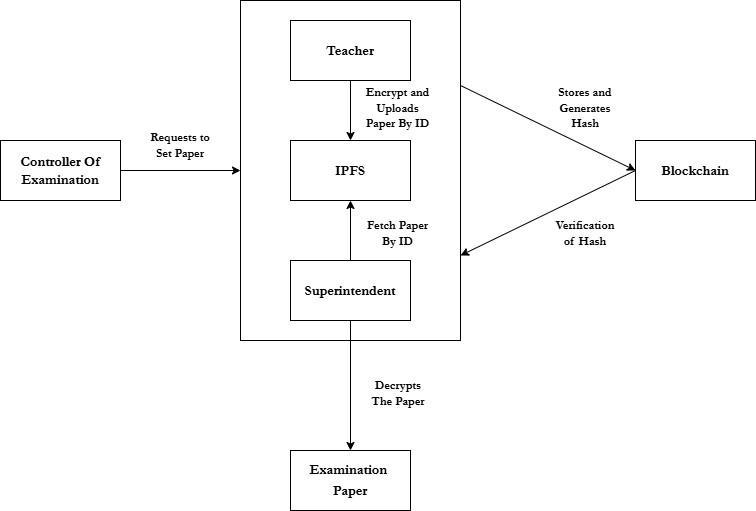
Fig.1: SystemArchitecture
The frontend provides interfaces for login, uploading, and retrieving question papers. The backend manages authentication using MFA, performs encryption and decryption, and controls communication between components. The decentralized layer stores encrypted files in IPFS and maintains hash values and transaction records on the blockchain, ensuring data integrity and tamperresistance.
The architecture ensures secure data flow between all components, preventing unauthorized access and data manipulation. It also improves system scalability and reliability by eliminating dependence on centralized storage. Additionally, it provides transparency through auditlogsandenhancestrustintheexaminationprocess.
3.2 Secure Examination Management Process
The system uses a secure workflow for managing examinationdata.AteacherfirstlogsinusingMulti-Factor Authentication (MFA) and uploads a question paper, which is encrypted before storage. The encrypted file is stored in IPFS, generating a unique Content Identifier (CID).Ahashofthefileisthenstoredontheblockchainto ensuredataintegrity.
When an authorized user requests access, the system retrievesthefileusingtheCIDandverifiesitbycomparing the hash with the blockchain record. If verified, the file is decrypted and displayed. This approach ensures confidentiality, integrity, and controlled access, reducing risksofdataleakageandtampering.
3.3 Algorithm
The secure examination process follows a structured approach to ensure confidentiality, integrity, and controlled access. Initially, users are authenticated using Multi-Factor Authentication (MFA). Question papers are encrypted before storage and stored in IPFS, while their hash values are recorded on the blockchain. During
International Research Journal of Engineering and Technology (IRJET)
-0056
Volume: 13 Issue: 04 | Apr 2026 www.irjet.net p-ISSN: 2395-0072
retrieval, the system verifies data integrity using blockchainbeforeallowingaccess.
Algorithm: Secure Examination Management using BlockchainandMFA
1. Userenterslogincredentials
2. System verifies user using Multi-Factor Authentication(MFA)
3. Ifauthenticationfails→denyaccess;elseproceed
4. Useruploadsexaminationdata
5. Dataisencrypted
6. EncrypteddataisstoredinIPFS→generateCID
7. CID and metadata are stored on blockchain using smartcontracts
8. Ondatarequest:
o VerifyuserusingMFA
o Validateaccesspermissions
9. RetrieveCIDfromblockchain
10. FetchencrypteddatafromIPFS
11. Verifydataintegrityusingblockchainhash
12. Decryptdataanddisplaytouser
13. Logallactionsonblockchainforauditing
Output: Secure, tamper-proof examination management system
3.4 System Workflow
Workflow: The workflow of the proposed system begins when the user logs in using Multi-Factor Authentication (MFA). Once authenticated, the teacher creates and uploads the question paper, which is then encrypted to ensure confidentiality. The encrypted file is stored in IPFS, and a unique Content Identifier (CID) is generated. A hash of the file is created and stored on the blockchaintomaintaindataintegrity.
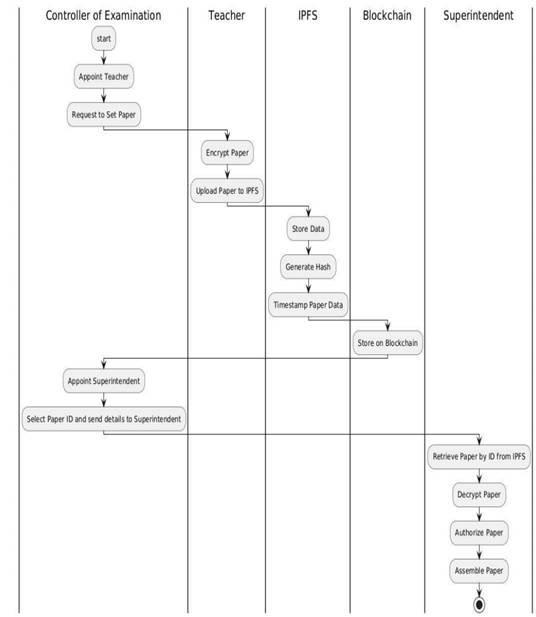
Fig.2: Workflow
This presents the system workflow: User login → MFA authentication→ Teacheruploadspaper→ Encryptfile → Store in IPFS → Store hash in blockchain → User requests access → Verify user → Retrieve file → Verify hash → Decrypt file → Display results → Record activity in blockchain.
4. IMPLEMENTATION AND RESULTS
The proposed system was implemented as a webbased application integrating blockchain, IPFS, and MultiFactor Authentication (MFA). The frontend manages user interaction, while the backend handles encryption, authentication, and communication with decentralized storageandblockchaincomponents.
Thesystemwastestedunderdifferentscenariosto evaluateperformanceintermsofauthentication,data storage,retrieval,andoverallsystemreliability.
4.1 Experimental Results
The performance of the system was evaluated using key parameters such as authentication time, data upload time,retrievallatency,andtransactionprocessingtime.
Volume: 13 Issue: 04 | Apr 2026 www.irjet.net
Parameter
Table1:ExperimentalResults
AuthenticationTime(MFA) 1.2–1.8seconds IPFSUploadTime 2–4seconds DataRetrievalTime 1.5–3seconds
3–5seconds SystemSuccessRate 96%
The results indicate that the system performs efficiently with acceptable latency while maintaining strong security features.
4.2 Dataset Description
The system works with structured data related to users, question papers, authentication details, and blockchainrecords.Questionpapersarehandledasdigital files, which are encrypted before storage to ensure confidentiality. Each uploaded file is assigned a unique identifier(CID)inIPFS,whileitscorrespondinghashvalue isstoredontheblockchain.
User data such as roles (Admin, Teacher, Controller) and authentication details are stored in the database to enable secure access control. This structured data management ensures efficient handling, retrieval, and verificationofexaminationinformation.
4.3 System Interface and Outputs
Theproposedsystemprovidesauser-friendlyinterface for secure examination management, including login, request handling, and authentication verification. The interface is designed to ensure ease of use while maintaining high security standards. Figures below show thekeyinterfacescreensofthesystem.
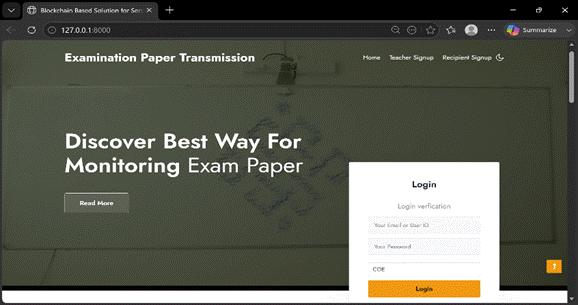
Fig.3: HomepageInterface
Thehomepagedisplaysthesystemtitleandaloginpanel forEmail,Password,andRole,allowingonlyauthorized userstoaccess.
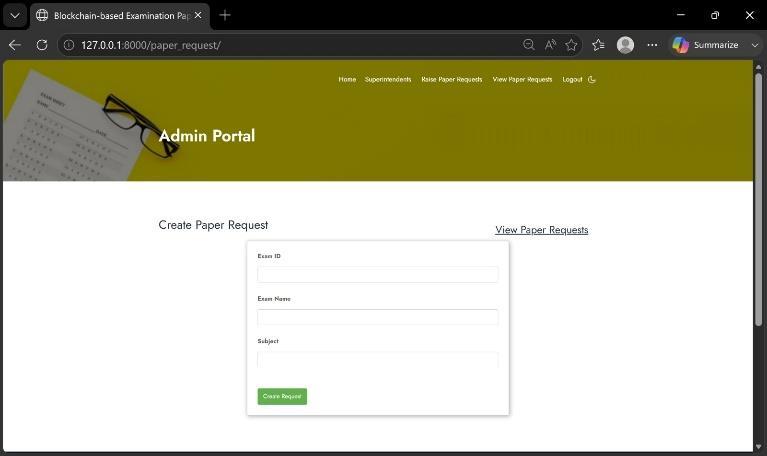
Fig.4: AdminPortal–PaperRequestCreation
The Admin Portal allows the Controller of Examination to create paper requests by entering Exam ID, Exam Name, and Subject, and to view existing requests for organized management.
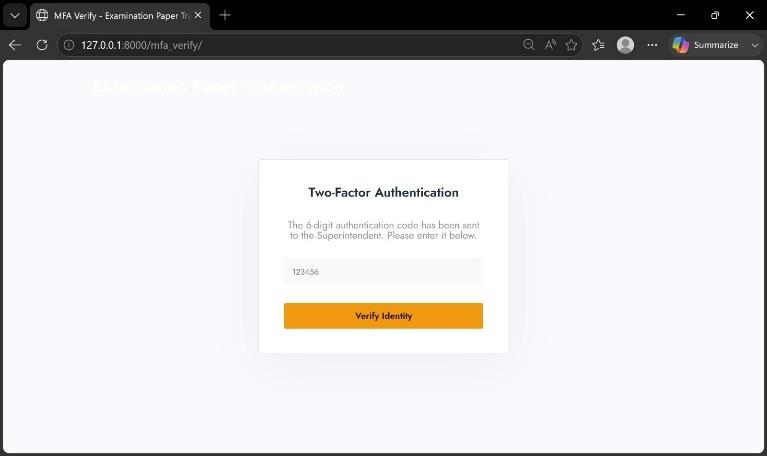
Fig.5: MFAVerificationInterface
This screen shows the MFA page where users enter a 6digit OTP, adding extra security to protect access to exam data.
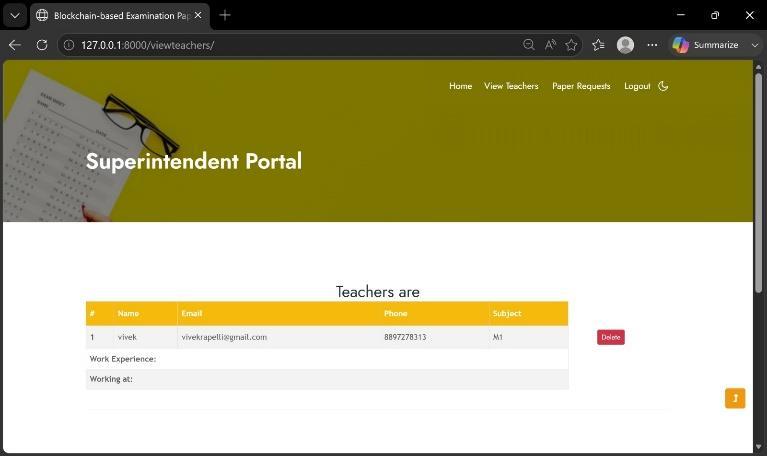
Fig.6: SuperintendentPortal–TeacherManagement
Displays a table of teachers with details, allowing the superintendenttomanageanddeleterecordstokeeponly authorizedstaff.
International Research Journal of Engineering and Technology (IRJET) e-ISSN: 2395-0056
Volume: 13 Issue: 04 | Apr 2026 www.irjet.net p-ISSN: 2395-0072
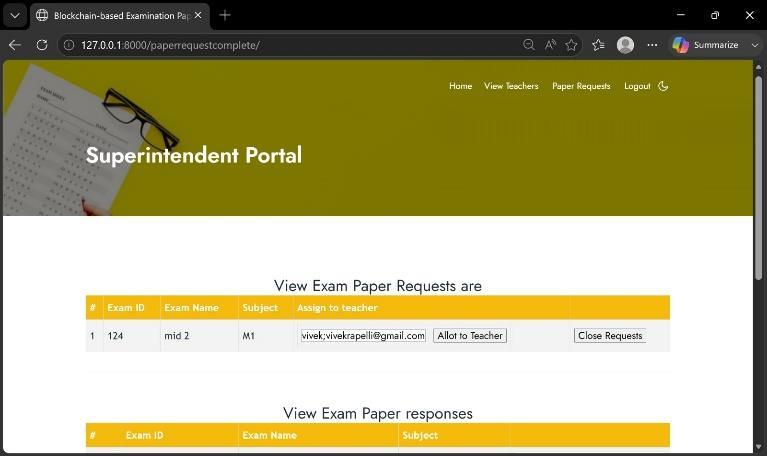
Fig.7: SuperintendentPortal–ExamRequest Assignment
Displays exam paper requests with details, allowing the superintendenttoassignthemtoateacherusingthe“Allot toTeacher”option.
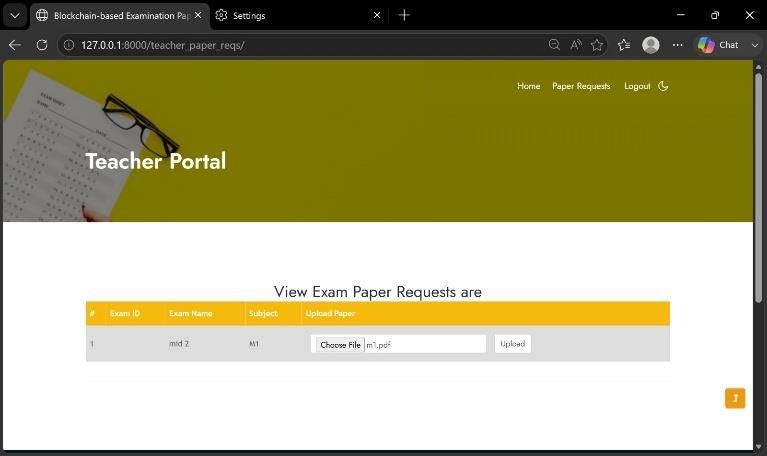
Fig.8: TeacherPortal–PaperUpload
Assigned teachers upload question papers (PDF), which arestoredontheInterPlanetaryFileSystem,withthehash recordedonEthereumblockchainforsecurity.
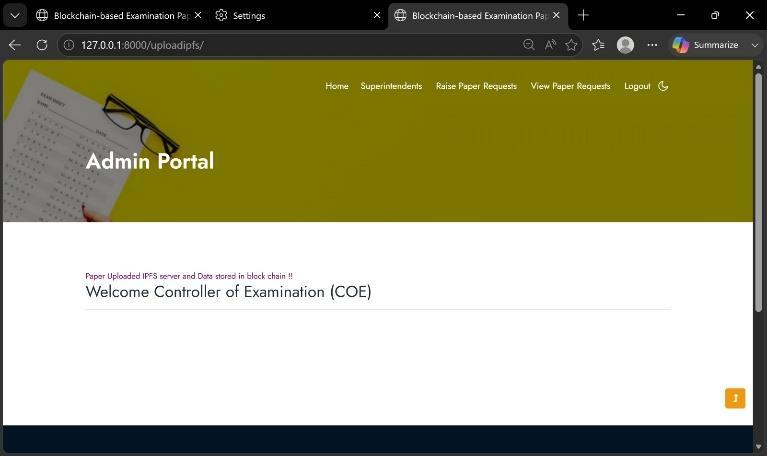
Confirms successful upload with storage on the InterPlanetary File System and Ethereum; the COE can trackandmanagerequestsfromthedashboard.
4.4PerformanceAnalysis
The performance of the proposed system is analyzed basedonsecurity,efficiency,andreliability.
Security: Blockchain ensures immutability of records, preventingunauthorizedmodification.MFAenhances access control by requiring multiple verification steps.
Efficiency:
The system demonstrates low processing time for authentication and data retrieval. IPFS enables fast distributedstorageandretrievalwithoutoverloading acentralserver.
Reliability:
The decentralized architecture eliminates single points of failure, ensuring continuous availability of dataevenifsomenodesfail.
Scalability:
The system supports multiple users and simultaneous requests without significant performancedegradation.
Overall, the system performs better than traditional centralized examination systems in terms of security, transparency,andfaulttolerance.
4.5ComparisonwithExistingSystems
Feature Traditional System ProposedSystem
DataStorage Centralized Decentralized(IPFS)
Security Low High (Blockchain + Encryption)
AccessControl Password-based Multi-Factor Authentication
DataIntegrity Vulnerable Tamper-proof
Transparency Limited High(AuditTrail)
FailureRisk High Low
5. CONCLUSION
The proposed *Blockchain-Enhanced Secure Examination Management System using Multi-Factor Authentication (MFA)* successfully addresses the major challenges faced by traditional examination systems, such as question paper leakage, unauthorized access, and data tampering. By integrating blockchain technology, IPFS, and encryption, the system ensures secure storage and transmission of examination data. The use of blockchain providesatamper-proofandtransparentaudittrail,while IPFS enables decentralized and reliable storage. MultiFactorAuthenticationstrengthensaccesscontrol,ensuring
International Research Journal of Engineering and Technology (IRJET) e-ISSN: 2395-0056
Volume: 13 Issue: 04 | Apr 2026 www.irjet.net p-ISSN: 2395-0072
that only authorized users can access sensitive information.
The system also improves efficiency by reducing manual processes and minimizing human errors. Overall, theimplementationdemonstratesenhancedsecurity,data integrity,andreliability,makingitapracticalandscalable solution for modern examination management. This approach can be further extended to other domains requiringsecuredatahandlingandverification.
Future work can focus on optimizing transaction latency and integrating AI-based anomaly detection for enhancedsecurity.
6. REFERENCE
[1] S. Kapse et al., “Blockchain Based Solution for Secured TransmissionofExaminationPaper,”Proc.IEEEiSSSC, pp. 1–6,2022.
[2]V.Sudha etal.,“BlockchainBasedStudentInformation ManagementSystem,”Proc.ICAECA,pp.1–4,2021.
[3] A. Jain et al., “Smart Contract Enabled Online ExaminationSystem Based onBlockchainNetwork,” Proc. ICCCI,pp.1–7,2021.
[4] J. Castella-Roca et al., “A Secure E-Exam Management System,”Proc.ARES,pp.1–8,2006.
[5] “RFID Based Question Paper Protection Shield,” Proc. ICCCNT,pp.1–5,2019.
[6] S. M. T. Rahman et al., “Secured Question Paper ManagementSystem,”AJSE,vol.20,no.1,pp.25–32,2021.
[7] Y. N. Patil et al., “A Decentralized and Autonomous Model to Administer University Examinations,” pp. 1–14, 2022.
[8] “Blockchain Based Examination System for Effective Evaluation,”Int.J.Eng.&Tech.,vol.7,pp.269,2018.
[9]H.S.Huangetal.,“ASecureFileSharingSystemBased onIPFSandBlockchain,”pp.1–4,2020.
[10] P. Ocheja et al., “Blockchain in Education: A Systematic Review,” IEEE Access, vol. 11, pp. 117261–117281,2023.