
International Research Journal of Engineering and Technology (IRJET) e-ISSN:2395-0056
Volume: 12 Issue: 08 | Aug 2025 www.irjet.net p-ISSN:2395-0072
International Research Journal of Engineering and Technology (IRJET) e-ISSN:2395-0056
Volume: 12 Issue: 08 | Aug 2025 www.irjet.net p-ISSN:2395-0072
1* Dr. Maya Jha, Department of Zoology, Patna University and Department of Environmental science, A.N. College Patna, India.
2.Kanhaiya Kumar: Department of Environmental Science, Tezpur University, Assam, India, e-mail: 3. Dr. Nimisha Vatsyayan: Department of Environmental science, A.N. College, Patna, India, 4.Dr. Nupur Bose: Department of Geography, A.N. College, Patna, India. India.
5.Dr. A.K. Ghosh: Mahavir Cancer Sansthan and Research Centre, Patna, India.
Abstract - Arsenic (As) contamination in groundwater has emerged as a serious environmental concern in recent years. However, efforts and initiatives to address this issue have been relatively limited. The present study explores a nature-based, sustainable approach for the remediation of dissolved arsenic in groundwater. Building on earlier research that identified and characterized two bacterial strains, this investigation examines their bioremediation potential. The strains, Brevibacillus borstelensis (coded as S1(c)) and Paenibacillus dendritiformis (S3(r)), were found to remove arsenite (As3+ ) from groundwater by up to 30.03±0.33% and 33.95±0.27%, respectively.
Key Words: Arsenic, bacteria, Hajipur, bioremediation, groundwater
1.INTRODUCTION
Arseniccontaminationingroundwaterisawidespreadenvironmentalissuewithsignificantimplicationsforpublichealth. Arsenic, a naturally occurring element and graded as class-I carcinogen by ICMR [1], in its inorganic forms is present as As3+ and As5+ in soil and water. As3+ being more toxic gets dissolved into groundwater [2]. The source of As in groundwatersisgeogenic[3-4]aswellasanthropogenic[5]. As reachesfoodchainthroughconsumingcontaminatedfood andwater[6-7] posingchronichealthriskstocommunitiesthataredependentonthesewatersources.Arecentstudyin Samastipur district of Bihar state by Jha et al, (2023) [8] observed 100% cancer risk in human population. Apart from canceritcausesseveralotherhealthproblemslikeskindiseases,neurologicalandgastricdisorders[9-11]
Mitigating arsenic contamination from groundwater and soil is a challenge that requires comprehensive strategies and efforts.Bioremediationisanaturalprocesstotacklepollutionproblemslikeheavymetals [12]andotherpollutants,inthe environment,donewiththehelpofbacteria,plants,andfungi.Bacteriamunchonpollutants,plantssoakthemup through their roots (phytoremediation), and fungi assist in the cleanup process too (rhizoremediation). This eco-friendly method removeharmfulsubstancesfromsoilandwater[13]. InBiharstate,arecentstudybyKumaretal,(2021)[14]statesthat 22outof38districtsarearseniccontaminated.Hence,bioremediationbyvariousmicrobialcommunitiesmightcontribute in restoring arsenic-contaminated groundwaters. Hajipur (located in Vaishali district of Bihar) is one of the arsenic contaminatedareasandsustainablemitigationtechniquestomitigatearseniccontaminationisthepresentneed.
Hajipur (25.6924N, 85.2083E) is located in the Vaishali district of Bihar, India (Figure 1). It lies along the banks of the GangesRiver,contributingtoitsvulnerabilitytoarseniccontamination.Vaishalidistrictisidentifiedasanarsenicaffected areawithsignificantlevelsofarsenicinitsgroundwater,witharsenicconcentrationsexceedingthesafelimitssetbyWHO andBIS(0.01ppm).Thealluvialsoilandsedimentcompositioncontributetoarsenicleachingintothegroundwater.
International Research Journal of Engineering and Technology (IRJET) e-ISSN:2395-0056
Volume: 12 Issue: 08 | Aug 2025 www.irjet.net p-ISSN:2395-0072
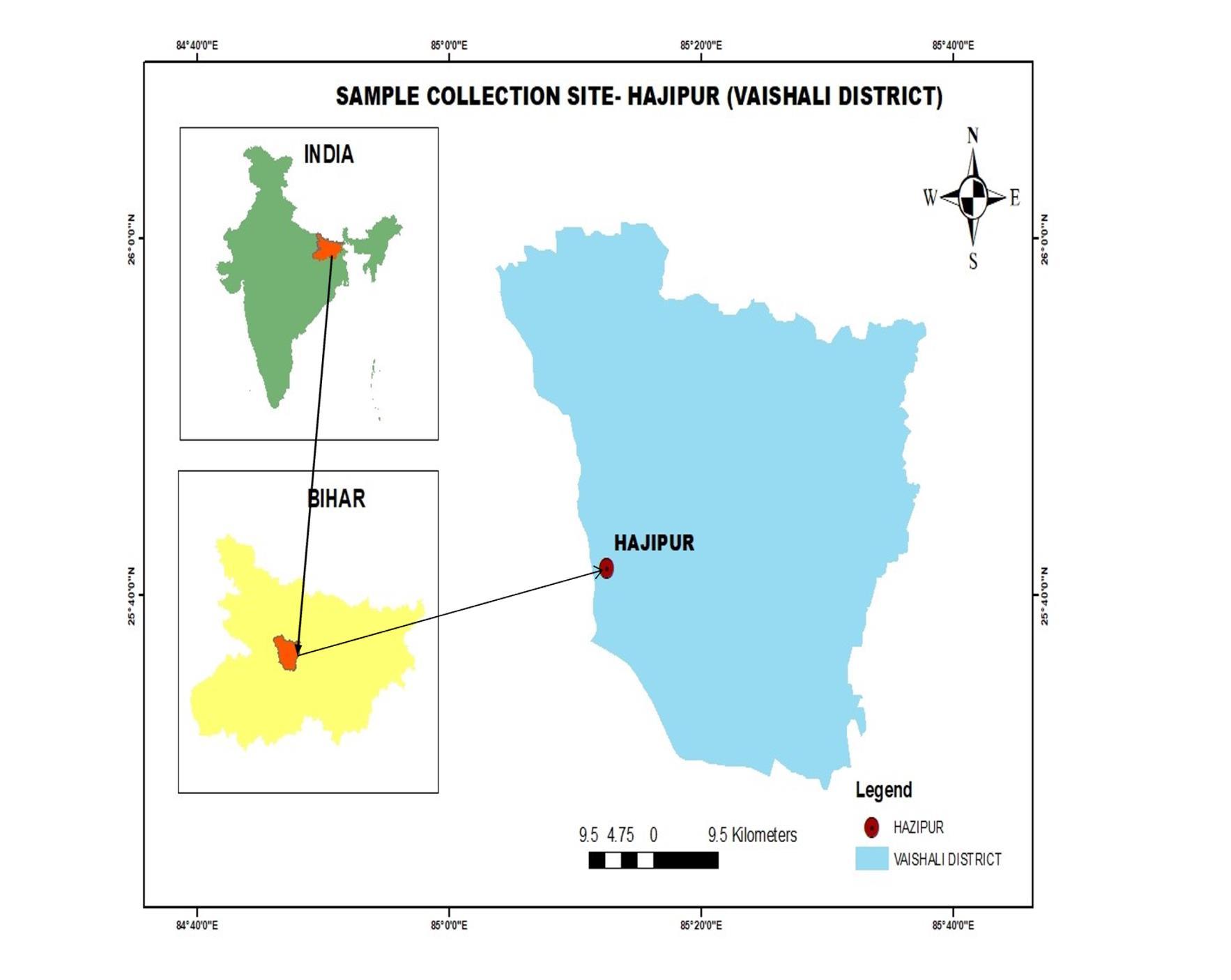
Maprepresentingsiteofsamplecollection
Previously reported bacterial strains
Brevibacillus borstelensis and Paenibacillus dendritiformis wereisolatedandidentifiedfromthesoilsofHazipurblock, andthisworkhasbeenpublished [15 & 16] Thefollowingarethepreviouslypublishedresultsofbiochemicaltestsdoneat CSIR-IMTECH(MTCClab.)Chandigarhoftheabovementionedbacterialstrains.
Biochemical test results
[i] Brevibacillus borstelensis strain S1(c)
The biochemical characterization of Brevibacillus borstelensis strain S1(c) revealed several notable features. The strain testedpositiveforamylaseactivity,indicatingitsabilitytohydrolyze starch,whileitshowedanegativeresultintheskim milk agar test. In carbohydrate fermentation tests, it exhibited strong positive fermentation for glucose (+++), moderate positivefermentationforlactose(++),andsucrose(++),demonstratingitscapacitytoutilizethesesugars.Thestrainalso tested positive for oxidase activity, but was negative for citrate utilization, indicating it cannot use citrate as the sole carbonsource.Inthetriplesugarironagar(TSI)test,acidproductionwasobserved,reflectingitsabilitytofermentsugars andproduceacidicbyproducts.
[ii] Paenibacillus dendritiformis - S3(r)
The biochemical characterization of Paenibacillus dendritiformis strain S3(r) showed distinct metabolic properties. The strainexhibitedastrongpositive(+++)resultintheamylasetest,indicatingahighabilitytohydrolyzestarch,whileitwas negative in the skim milk agar test. In carbohydrate fermentation tests, it showed moderate positive fermentation for
© 2025, IRJET | Impact Factor value: 8.315 | ISO 9001:2008 Certified Journal | Page468
International Research Journal of Engineering and Technology (IRJET) e-ISSN:2395-0056
Volume: 12 Issue: 08 | Aug 2025 www.irjet.net p-ISSN:2395-0072
glucose (++), no fermentation of lactose (–), and moderate positive fermentation for sucrose (++), reflecting selective sugarutilization.Thestraintestedpositiveforoxidaseactivityandalsoforcitrateutilization,suggestingitcanusecitrate as the sole carbon source. However, in the triple sugar iron agar (TSI) test, it was negative, showing no acid production underthegivenconditions.
3.1. Sample collection and testing
The water sample was collected (triplicate sampling) from the same location from where soil sample was collected. The watersamplewasfilteredthrough0.45µmsyringefilters,andNitricacid(HNO3)wasaddedasapreservativetoprevent arsenic adsorption and maintain its oxidation state. The preserved samples were stored in polyethylene bottles. pH was measured with a potable pH-meter on the spot. Finally, water samples were analysed in an AAS (atomic absorption spectrophotometer).
3.2. Culturing in arsenic amended media
The above 2 isolated strains (S1(c) and S3(r)) were incubated in the Nutrient broth media supplemented with different concentrationsofsodiumarsenite(As3+)
As3+ concentration starting from 500ppb to 5000ppm was supplemented with 20ml Nutrient broth and autoclaved. Finally, at normal temperatures, broth media was incubated (at 370C) with the above 2 bacterial strains. Control was maintainedforeachstrainseparatelyduringtheexperiment.
Opticaldensity/absorbanceofthebacteriawasnoteddownafterevery24,48and72hoursinaspectrophotometersetat 600nm wavelength to find out the minimum inhibitory concentration (MIC) and arsenic resistance in both. Experiments wererepeatedthricefortheaccuracyoftheresults.
3.3. Bioremediation potential
The bioremediation potential of both the strains S1(c) and S3(r) were analysed. Strains were incubated in the nutrient broth media prepared in 100 ppm As3+ solution and incubated at 370C. After 24, 48 and 72 h, of incubation the 10ml solution was centrifuged at 10,000 rpm for 10 min to separate the bacterial biomass from the broth media [17]. The bacterialbiomassobtainedwasfurtherdigestedforAsdetermination[18].Thefinalreadingofarsenicconcentrationwas takenonaGraphiteFurnaceAtomicAbsorptionSpectrophotometer(PerkinElmer,Pinnacle900T,Singapore)atMCS&RC, Patna.
4.RESULTS AND DISCUSSION
4.1.Differences of biochemical characteristics
S1(c) showsa broadersugarutilizationprofile andhigheracidproductionpotential. S3(r) hasstrongeramylaseactivity andcanutilizecitrate,whichcouldgiveitanadvantageinnutrientlimitedconditions,anditsuggestsbetteradaptabilityin environments with complex polysaccharides or citrate as a carbon source. However, both are oxidase positive and can fermentsucrose,indicatingsomesharedmetabolictraits.
4.2. Arsenic concentration and pH of the water sample of the study area.
Themean As concentrationofthewatersamplewasfoundtobe0.093ppm,whichismuchgreaterthanthe WHOlimitof 0.01ppmat7.4pH(slightlyalkaline).
4.3.Minimum inhibitory concentration (MIC)
Themaximumgrowthoftwoisolates(exponential phase)wasobservedat100ppm,followed bya gradual decrease,and finally the growth stopped at 3000 ppm at 72 hours for S1(c) and at 48 hours for S3(r). Hence, the minimum inhibitory concentration (MIC) of these two isolates was at 3000ppm at different time durations (Table 1a,1b and Figure 2,3). The growthpatternofisolatesS1(c)andS3(r)showstheirarsenictolerance.
International Research Journal of Engineering and Technology (IRJET) e-ISSN:2395-0056
Volume: 12 Issue: 08 | Aug 2025 www.irjet.net p-ISSN:2395-0072
Table1a.TablerepresentsabsorbanceandconcentrationofS1(c)atdifferentAs3+concentrationafter
and
hours ofgrowth.
Table1b.TablerepresentsabsorbanceandconcentrationofS3(r)atdifferentAs3+concentrationafter24,48and72 hours ofgrowth. *Unitofconcentrationiscolonyformingunitspermillilitre(CFU/ml),ppbis
International Research Journal of Engineering and Technology (IRJET) e-ISSN:2395-0056
Volume: 12 Issue: 08 | Aug 2025 www.irjet.net p-ISSN:2395-0072

As(III) concentration
2.GrowthofS1(c)after24,48and72hoursofinoculation
As(III)conc.
24hr 48hr 72hr
3.GrowthofS3(r)after24,48and72hoursofinoculation
4.4.Possible bioremediation of arsenic by these bacterial strains
When exposed to an arsenic concentration of 100 ppm in a broth medium for 72 hours, strain S1 (c) accumulated 180.2 ppm of arsenic in its biomass, achieving 30.03% bioremediation. In contrast, strain S3(r) demonstrated a higher arsenic uptake, with 203.7 ppm in its biomass, resulting in 33.95% bioremediation (Table 2). In the similar findings by Mandal, Sonar,etal.,(2022)[19]atthepresenceofvaryingarsenicconcentrations(2ppm,10ppm,and50ppm), Lysinibacillus sp and Bacillus safensis demonstratedsignificantbioremediationpotential. Lysinibacillus sp. exhibitedbioremediationratesof 31.20-32.33%,while Bacillus safensis achievedslightlyhigherratesof35.24-37.54%.
International Research Journal of Engineering and Technology (IRJET) e-ISSN:2395-0056
Volume: 12 Issue: 08 | Aug 2025 www.irjet.net p-ISSN:2395-0072
Dey et al., (2016) [17] found 2 isolates (SW2 and SW4) from water samples collected in Purbasthali block of Burdwan, WestBengal,India,whichcanremove51.45%and51.99%ofarseniteand53.29%and50.37%ofarsenate.
Arsenic-resistant bacteria, isolated from soil samples in Ratanpur Village, Varanasi District, Uttar Pradesh, demonstrated significant arsenic removal capabilities. TY6 exhibited a removal efficiency of 96 ±0.816% for As5+ and 66 ± 0.471% for As3+ ,while K7Pb achieved 98 ± 0.942% and 78 ± 1.247% removal for As5+ and As3+ respectively in the recent findings [20].
Table2:Bioremediationpotentialofbacterialstrains
Strain As dose mixed in broth (ppm) As in bacterial biomass after 72 h (ppm)
S1(c) 100ppm
180.2ppm
S3(r) 100ppm 203.7ppm
% bioremediation after 72 h
30.03±0.33%
33.95±0.27%
Bothbacterialisolates,S1(c)andS3(r),showedmaximumgrowthat100ppm.Thegrowthoftheisolatesstoppedat3000 ppm(MIC),withS1(c)reachingMICat72hoursandS3(r)at48hours.Bothbacterialstrains,wereeffectiveinremoving arsenic from the medium, with S3 (r) showing superior efficiency. Strain S1 (c) achieving 30.03± 0.33% bioremediation, whilestrainS3(r)resultingin33.95±0.27%bioremediation.
ACKNOWLEDGEMENT
This research was conducted with the support of the DST-WTI sponsored “Tribute Ganga” Project(DST/TMDEWO/WTI/2K19/EWFH/2019/201),whichisgratefullyacknowledged.
REFERENCES
1] K. M. Meghana and D. Sayantan, “Critical review on arsenic: Its occurrence, contamination and remediation from waterandsoil,”2021.doi:10.31018/jans.v13i3.2757.
[2] H.V.Aposhian,R.A.Zakharyan,M.D.Avram,M.J.Kopplin,andM.L.Wollenberg,“Oxidationanddetoxificationof trivalentarsenicspecies,” Toxicology and Applied Pharmacology,2003,doi:10.1016/S0041-008X(03)00324-7.
[3] S. J. Hug, L. H. E. Winkel, A. Voegelin, M. Berg, and A. C. Johnson, “Arsenic and Other Geogenic Contaminants in Groundwater-AGlobalChallenge,”2020.doi:10.2533/CHIMIA.2020.524.
[4] S.Yin,L.Yang,Q. Wen,and B.Wei,“Temporal variation andmechanism ofthegeogenicarsenicconcentrations in globalgroundwater,”2022.doi:10.1016/j.apgeochem.2022.105475.
[5] T.Tarvainen et al.,“Arsenicinagro-ecosystemsunderanthropogenicpressureinGermanyandFrancecomparedto ageogenicAsregioninFinland,” Journal of Geochemical Exploration,2020,doi:10.1016/j.gexplo.2020.106606.
[6] Rehman,M.U.,Khan,R.,Khan,A.,Qamar,W.,Arafah,A.,Ahmad,A.,Ahmad,A.,Akhter,R.,Rinklebe,J.,&Ahmad,P. (2021). Fate of arsenic in living systems: Implications for sustainable and safe food chains. Journal of Hazardous Materials 417,126050,https://doi.org/10.1016/j.jhazmat.2021.126050
[7] S. Singh, R. Yadav, S. Sharma, and A. N. Singh, “Arsenic contamination in the food chain: A threat to food security andhumanhealth,” Journal of Applied Biology & Biotechnology,2023,doi:10.7324/jabb.2023.69922.
[8] Jha,M.,Kumar,S.,Singh,T.B.N.,Srivastava,S.K.,Azad,G.K.,&Yasmin,S.(2023).Potential healthrisk assessment throughtheconsumptionofarsenic-contaminatedgroundwaterinpartsofthemiddleGangeticplain. Bulletin of the National Research Centre, 47(1),77.
[9] M. F. Naujokas et al., “The broad scope of health effects from chronic arsenic exposure: Update on a worldwide publichealthproblem,”2013.doi:10.1289/ehp.1205875.
2025, IRJET | Impact Factor value: 8.315 | ISO 9001:2008 Certified Journal | Page472
International Research Journal of Engineering and Technology (IRJET) e-ISSN:2395-0056
Volume: 12 Issue: 08 | Aug 2025 www.irjet.net p-ISSN:2395-0072
[10] K. S. Mohammed Abdul, S. S. Jayasinghe, E. P. S. Chandana, C. Jayasumana, and P. M. C. S. De Silva, “Arsenic and humanhealtheffects:Areview,”2015.doi:10.1016/j.etap.2015.09.016.
[11] Y. S. Hong, K. H. Song, and J. Y. Chung, “Health effects of chronic arsenic exposure,” Journal of Preventive Medicine and Public Health,2014,doi:10.3961/jpmph.14.035.
[12] J. R. Lloyd, “Microbial controls on arsenic release and mitigation in aquifer sediments,” in Arsenic Research and Global Sustainability - Proceedings of the 6th International Congress on Arsenic in the Environment, AS 2016, 2016. doi:10.1201/b20466-48.
[13] D.Mandal,M.Aghababaei,S.K.Das,S.Majumder,D.Chatterjee,andA.Basu,“IsolationandIdentificationofArsenic Hyper-Tolerant Bacterium with Potential Plant Growth Promoting Properties from Soil,” Minerals, 2022, doi: 10.3390/min12111452.
[14] Kumar,A.,&Ghosh,A.K.(2021).Assessmentofarseniccontaminationingroundwaterandaffectedpopulationof Bihar.In Arsenic toxicity: challenges and solutions (pp.165-191).Singapore:SpringerSingapore.
[15] N. Vatsyayan, “Isolation and Characterization of Microbes with Biofertilizer Potential,” IOSR Journal Of Environmental Science, Toxicology And Food Technology,2013,doi:10.9790/2402-0740509.
[16] N. Vatsyayan and A. K. Ghosh, “Isolation , characterization and cataloguing of microbes from the soil of Gangetic plainofVaishalidistrict(NorthBihar).,”vol.7,no.11,pp.574–580,2020
[17] U. Dey, S. Chatterjee, and N. K. Mondal, “Isolation and characterization of arsenic-resistant bacteria and possible applicationinbioremediation,” Biotechnology Reports,2016,doi:10.1016/j.btre.2016.02.002.
[18] NIOSH,“ELEMENTSinbloodortissue8005,” Blood,vol.7300,no.2,pp.1–6,1994.
[19] D.Mandal,R.Sonar,I.Saha,S.Ahmed,andA.Basu,“Isolationandidentificationofarsenicresistantbacteria:atool for bioremediation of arsenic toxicity,” International Journal of Environmental Science and Technology, 2022, doi: 10.1007/s13762-021-03673-9.
[20] R. Kushwaha, R. S. Singh, and D. Mohan, “Arsenic resistance and accumulation by two bacteria isolated from Ratanpur Village of Varanasi District, Uttar Pradesh,” Bioresource Technology Reports, 2023, doi: 10.1016/j.biteb.2023.101639.