
International Research Journal of Engineering and Technology (IRJET) e-ISSN: 2395-0056
Volume: 12 Issue: 10 | Oct 2025 www.irjet.net p-ISSN: 2395-0072
International Research Journal of Engineering and Technology (IRJET) e-ISSN: 2395-0056
Volume: 12 Issue: 10 | Oct 2025 www.irjet.net p-ISSN: 2395-0072
Miss. Dipali Chougule1 , Dr. Kishor Pandyaji2
1Student, 2Professor Département Of Electronics Engineering
Dr. V.P.S.S.Ms Padmabhooshan Vasantraodada Patil Institute of Technology, Budhgaon, Sangli, Maharashtra 416304 India.
Abstract - The proliferation of high-resolution medical imaging techniques like Computed Tomography (CT) and Magnetic Resonance (MR) generates vast amounts of data, posing significant challenges for storage and transmission. This paper presents a robust methodology for biomedical imagedenoisingandcompression usingtheDiscrete Wavelet Transform (DWT). The proposed approach leverages the multi-resolution analysis capability of wavelets to effectively separate noise from critical image features and to achieve highcompressionratioswithoutperceptiblelossofdiagnostic quality. The core of the system involves a detailed image processing pipeline implemented in MATLAB's Wavelet Toolbox. Various wavelet filters, including Biorthogonal and Daubechies families, are applied to biomedical images. The system's performance is quantitatively evaluated using the Peak Signal-to-Noise Ratio (PSNR). Experimental results demonstratethattheDWT-basedmethodsuccessfullydenoises images, preserving edges and critical details while achieving significant compression. This software-centric solution provides a practical and efficient approach for handling voluminous medical image data, facilitating quicker transmission and more economical storage in healthcare informatics.
Key Words: BiomedicalImageProcessing,DiscreteWavelet Transform (DWT), Image Denoising, Image Compression, PeakSignal-to-NoiseRatio(PSNR),MATLAB.
1. Introduction
A computer revolution has profoundly impacted the medical field, wherevastamountsofinformationmust be processedquicklyandaccurately.High-resolutionscanning techniquessuchasdigitalradiography,CT,andMRproduce imagescontainingcrucialinformationformedicalanalysis. However, the enormous data volume generated by these modalitiespresentsasignificantproblemfrombothstorage andnetwork transmission perspectives.Tomitigatethese issues,efficientdatacompressiontechniquesareessential.
Medical images are often corrupted by noise during acquisition and transmission, which can obscure critical diagnostic features. Image denoising is therefore a fundamental task in medical image processing, aiming to suppress noise while preserving essential structural information like edges. Traditional methods proposed by standards like JPEG have drawbacks, including blocking artifactsandaliasingdistortionsathighcompressionratios.
TheDiscreteWaveletTransform(DWT)offersasuperior alternativetotraditionalFourier-basedmethods.Unlikethe Fourier transform, which provides only a frequencyamplitude representation and loses time information, the wavelettransformdeliversatime-frequencyrepresentation ofthesignal.Thisallowsformulti-resolutiondecomposition, analyzing the image at different scales. Wavelets are mathematicalfunctionsthatdecomposedataintodifferent frequency components, enabling high energy compaction and sparse signal representation. This property is instrumentalforbothcompressionanddenoising.
Thispaperdetailsthedevelopmentandimplementation ofaDWT-basedsystemforbiomedicalimagedenoisingand compression.Theprimaryobjectiveistominimizeimagefile size and reduce noise to an acceptable level without compromisingdiagnosticquality.Themethodologyinvolves applyingdifferentwaveletfunctionstobiomedicalimages, calculating PSNR values for each, and determining the optimalwaveletfilterforthisspecificapplication.Theentire process is executed within the MATLAB environment, utilizingitspowerfulWaveletToolboxtocreateapractical, software-basedsolutionforhealthcarechallenges.
The field of biomedical image processing is analogous to biomedicalsignalprocessingbutinmultipledimensions.A significant challenge in medical imaging is the presence of highlevelsofnoise.Researchhasconsistentlyshownthatthe use of the wavelet transform significantly improves image quality by reducing noise [1]. The core objective of any denoising algorithm is to eliminate unwanted noise while preservingtheimage'simportantfeatures,ataskforwhich waveletsareexceptionallywell-suited.
EarlyandinfluentialworkbyChangetal.[2]exploredthe connection between lossy compression and denoising, demonstratingthatcoefficientquantizationincompression approximateswaveletthresholdingfornoiseremoval.They further developed BayesShrink, an adaptive wavelet thresholdingtechniquewithinaBayesianframework,which outperformed other contemporary methods [3]. The selection of the appropriate wavelet filter is critical for performance.Dilmaghanietal.[4]investigatedtheeffectof different wavelet filters from orthogonal and biorthogonal familiesonmedical imagequality.Theirfindingsindicated thatregularityandlinearityofthephaseresponseoffilters
International Research Journal of Engineering and Technology (IRJET) e-ISSN: 2395-0056
Volume: 12 Issue: 10 | Oct 2025 www.irjet.net p-ISSN: 2395-0072
are vital factors, with the Antonini filter (7/9) providing excellentresults.
TheJPEG2000standard,whichisbasedontheDWTusing the Daubechies (9,7) biorthogonal wavelet, integrates a denoisingprocedureviathresholding.ResearchbyConciet al. [5, 6] extensively compared 36 different wavelet compressionschemes,evaluatingtheirperformanceonboth syntheticandnaturalimageswithAdditiveWhiteGaussian Noise.Theirwork highlightedthatthebestwaveletchoice candependonimagecontentandthedesiredfidelity.Other approaches,suchastheFractal-Waveletschemeproposedby Ghazel etal. [7],offered edge-preservingsmoothing,while ChappelierandGuillemot[8]introducedanorientedwavelet transformforimprovedenergycompaction.
For medical image compression, the limitations of orthogonal wavelet transforms where wavelet functions cannot be both orthogonal and symmetric led to the adoptionofbiorthogonaltransforms.Biorthogonalwavelets allowtheuseofsymmetricfunctions,whichareessentialfor designing linear phase filters and avoiding artifacts in the reconstructed image [4, 9]. A comparison of various recognitionmethodsandtheirrelevancetoimageprocessing issummarizedinTable1.
Table -1: Comparison of Image Processing Techniques in Literature
Primary Method Application Focus Key Advantage Key Disadvantage
Fourier Transform General Signal Processing Global frequency analysis. Losestime/local spatial information.
JPEG(DCTbased) Image Compression Standardized ,widely supported. Blocking artifactsathigh compression.
Discrete Wavelet Transform (DWT)
Denoising & Compressio n Multiresolution, preserves edges. Choice of wavelet is critical.
BayesShrin k[3] Wavelet Denoising
Adaptive, data-driven threshold.
Performance dependson noisemodel.
FractalWavelet[7] Denoising Edgepreserving. Computationall ycomplex.
The methodology for efficient biomedical image compression and denoising is centered on the Discrete WaveletTransform.Theprocessinvolvesapplyingdifferent wavelet functions, calculating the PSNR for each, and comparing the results to determine the most effective waveletfilter.Theoperationalprocedureisasfollows:
1. Read thebiomedicalimage.
2. Denoise the image using different wavelet transforms.
3. Encode and decode (compress and decompress) theimage.
4. Obtain PSNR value for the results of different waveletfilters.
5. Conduct a comparative study toidentifythebestperformingwaveletfilter.
TheDWTischosenovertheFouriertransformbecauseit providesatime-frequencyrepresentation,allowingforthe analysis of a signal at different intervals of time. This is crucial for images, where the location of features (edges, textures) is as important as their frequency content. A wavelet is a mathematical function that divides data into different frequency components, each of which is then studied with a resolution matched to its scale. Wavelet compressionworksbyanalyzinganimageandconvertingit intoasetofmathematicalexpressionsthatcanbeefficiently encodedandlaterdecoded.
Imagedenoisingaimstoremovenoiseintroducedduring acquisition or transmission while retaining critical signal features. Wavelet thresholding provides an appropriate basisforseparatingnoisefromtheimagesignal.Theprocess involves:
Decomposingtheimageintowaveletcoefficients.
Applying a threshold to these coefficients (small coefficientsarelikelynoiseandaresettozero).
Reconstructing the image from the thresholded coefficientsusingtheInverseDWT(IDWT).
TheMATLABimplementationinvolves:
1. Selectingthe'Wavelet2-D'toolfromthewavemenu.
2. Loadingthebiomedicalimage(e.g.,"image1.jpg").
3. ConvertingtheRGBimagetograyscale.
4. Resizingtheimagetoastandard256x256format.
5. Choosingaspecificwaveletfilterfordenoising(e.g., 'bior3.7','db4').
6. Displayingandsavingthedenoisedimage.
International Research Journal of Engineering and Technology (IRJET) e-ISSN: 2395-0056
Volume: 12 Issue: 10 | Oct 2025 www.irjet.net p-ISSN: 2395-0072
Wavelet-based compression exploits the energy compaction property of DWT, where most of the image's informationisconcentratedinafewlargecoefficients.The stepsare:
1. Selecting'ImageCompression'fromthewavemenu.
2. Loadingthebiomedicalimage.
3. ConvertingtheRGBimagetograyscale.
4. Choosingawaveletandathreshold-dependentlevel ofdecomposition.
5. Decomposingtheimageusingtheselectedlevel.
6. Performingcompressionbyquantizingthewavelet coefficients.
7. Reconstructing the image using IDWT and calculatingthecompressionratio.
4. Experimental Results and Discussion
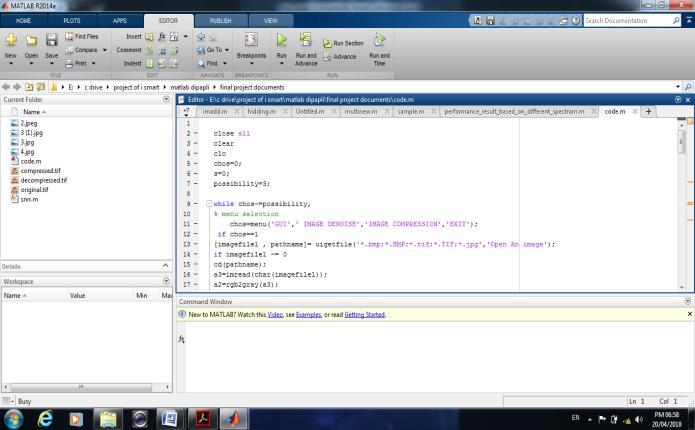
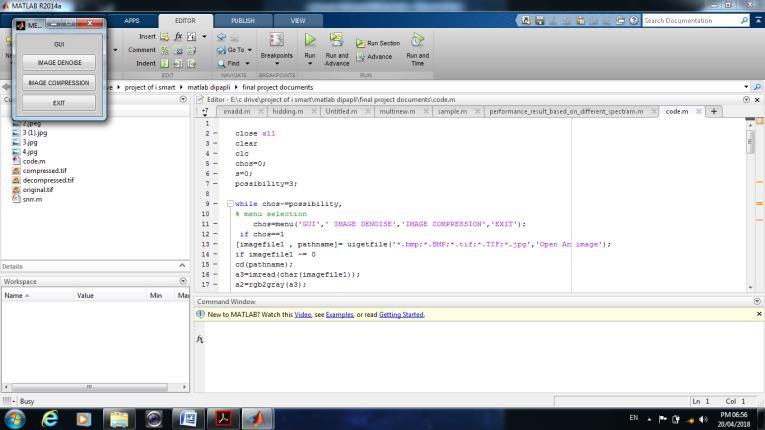
The main Wavelet 2-D menu is displayed, presenting the variousprocessingoptionsavailable.Selectingthe'Wavelet 2-D' option is crucial as it initializes the environment for two-dimensionalimageanalysis,whichformsthefoundation fortheentiredenoisingandcompressionworkflow.
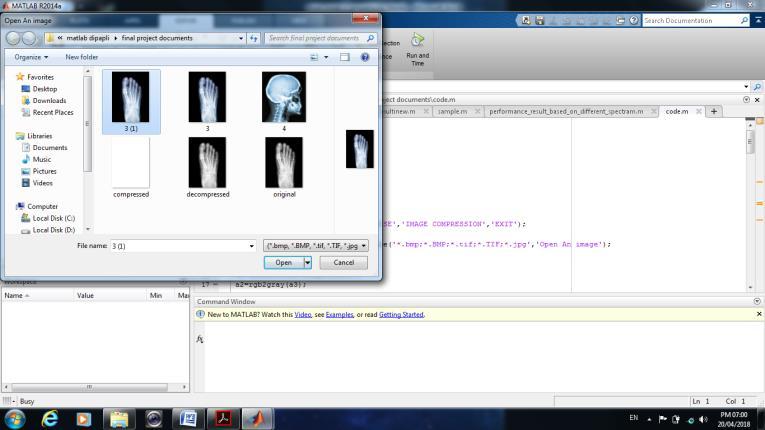
This figure illustrates the initial step of launching the MATLAB Wavelet Toolbox from the command prompt. Thewavemenucommandprovidesaccesstothespecialized graphical interface used for all subsequent wavelet processing, serving as the gateway to the denoising and compressionmodules.
Theoriginalbiomedicalimageisloadedintotheprocessing interface. This serves as the baseline input, a noisy image thatwillundergothewavelet-basedprocessingpipelineto demonstratetheeffectivenessoftheproposeddenoisingand compressiontechniques.
International Research Journal of Engineering and Technology (IRJET) e-ISSN: 2395-0056
Volume: 12 Issue: 10 | Oct 2025 www.irjet.net p-ISSN: 2395-0072
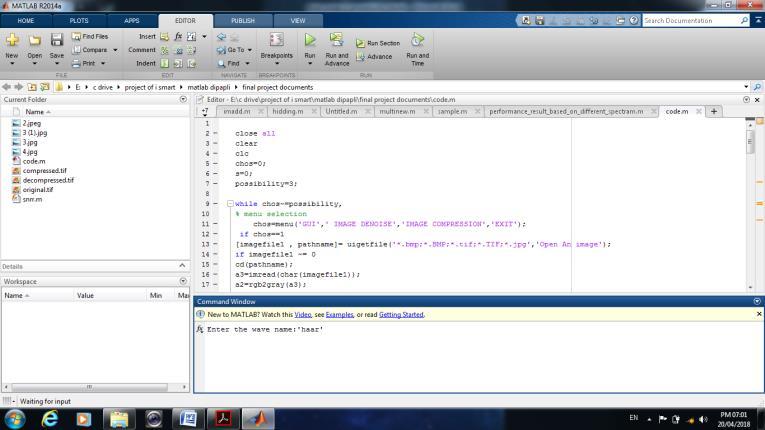
Fig4:-Waveletdecompositionoftheimageshowing approximationanddetailcoefficients.
This screen shows the result of the 2D discrete wavelet decomposition.Theimageisbrokendownintoitsfrequency sub-bands:theapproximationcoefficients(top-left)andthe horizontal,vertical,anddiagonaldetailcoefficients,which areessentialforbothnoiseidentificationandcompression.
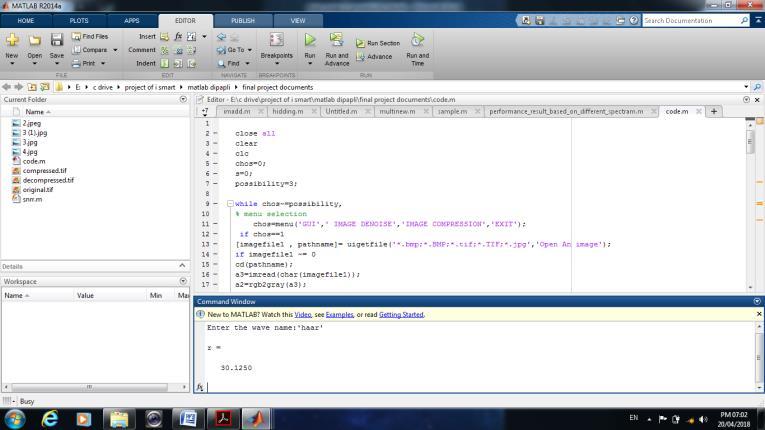
Fig5:-Thedenoisinginterfacewherethresholding parametersareappliedtoremovenoise.
The denoising interface is shown, where a thresholding functionisappliedtothe waveletcoefficients.Thisstep is central to the methodology, as it selectively removes coefficients below a certain magnitude, which are predominantly associated with noise, while preserving significantimagefeatures.
6:-Theresultingimageafterthewaveletdenoising processiscomplete.
Theresultingoutputafterthewaveletdenoisingprocessis complete.AvisualcomparisonwithFigure3clearlyshows the reduction in noise and graininess, while critical anatomical structures and edges within the biomedical imagearesuccessfullyretained.
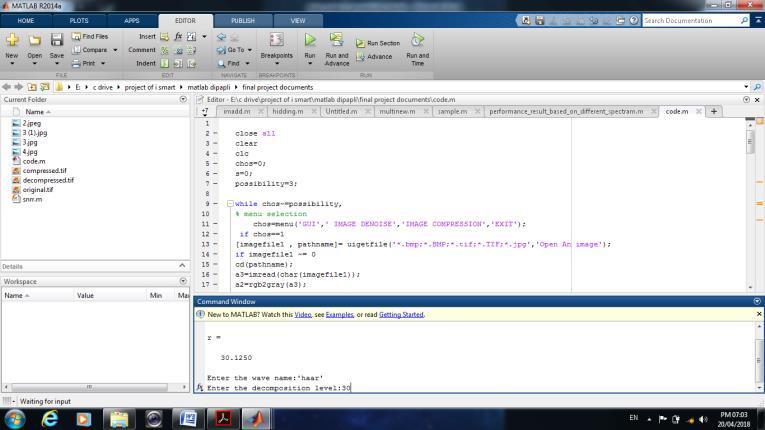
Fig7:-Single-levelwaveletdecompositionofthedenoised image.
A single-level decomposition of the denoised image is displayed.Thissimplifiedbreakdownisoftenthefirststepin the compression stage, allowing for the analysis of coefficient energy distribution prior to quantization and encoding.
International Research Journal of Engineering and Technology (IRJET) e-ISSN: 2395-0056
Volume: 12 Issue: 10 | Oct 2025 www.irjet.net p-ISSN: 2395-0072
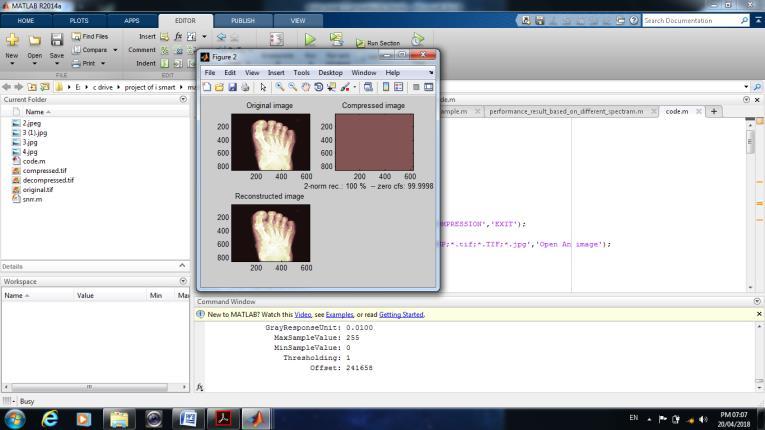
Fig8:-Multi-levelwaveletdecompositionforamore detailedanalysis.
Amulti-levelwaveletdecompositionispresented,providing a moregranular,hierarchical representationoftheimage. This multi-resolution analysis is key to achieving high compressionratiosbyefficientlyconcentratingimageenergy intofewer,significantcoefficientsacrossscales.
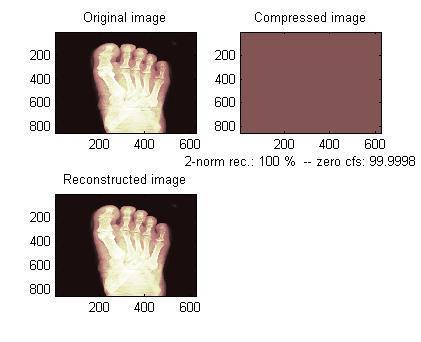
Fig9:-Thefinalcompressedandreconstructedimage afterapplyingDWT-basedcompression.
The final compressed and reconstructed image is shown after applying quantization and inverse DWT. The visual fidelityismaintainedclosetotheoriginal,demonstratingthe method's ability to achieve significant data reduction withoutperceptiblelossofdiagnosticquality.
4. Conclusion
This paper successfully demonstrated a DWT-based framework for biomedical image denoising and compression. By leveraging the multi-resolution analysis capabilities of wavelets, the system effectively separates noisefromcritical imagefeaturesandachievessignificant data reduction. The implementation within MATLAB's Wavelet Toolbox provides a practical, software-centric solutionthateliminatestheneedforspecializedhardware.
Thecomparativeanalysisofvariouswaveletfiltersallows fortheselectionofanoptimaltransformformedicalimaging applications,withbiorthogonalwaveletsoftenprovingmost effective. The resulting system enhances the efficiency of medicaldatastorageandtransmissionwhilepreservingthe diagnosticqualityoftheimages,therebyaddressingacritical need in modern healthcare informatics. Future work will involve extending this approach to 3D medical image volumes and exploring deep learning-based wavelet techniquesforenhancedperformance.
[1] Vipul Sharan, Naveen Keshari, Tanay Mondal, "Biomedical Image Denoising and Compression in Wavelet using MATLAB", International Journal of Innovative Science and Modern Engineering (IJISME), Volume-2,Issue-6,May2014.
[2] S.GraceChang,BinYu,MartinVetterli,"ImageDenoising Via Lossy Compression And Wavelet Thresholding", IEEE International Conference on Image Processing, 1997.
[3] S.GraceChang,BinYu,And MartinVetterli,"Adaptive Wavelet Thresholding For Image Denoising And Compression",IEEETransactionsOnImageProcessing, Vol.9,No.9,September2000.
[4] R.S.Dilmaghani,Dr.A.Ahrnadian,N.Maleki,"Choiceof Wavelet Filters for Medical Image Compression and Approximation",CanadianConferenceonElectricaland ComputerEngineering,2002.
[5] Aura Conci, Carlos S. Kubrusly, Thomas W. Rauber, "InfluenceoftheWaveletFamilyInTheCompressionDenoisingTechniqueOnSyntheticAndNaturalImages", IEEE International Conference on Signal and Image ProcessingApplications,2009.
[6] Aura Conci, Carlos S. Kubrusly, Thomas W. Rauber, "Influence of the Wavelet Family in the CompressionDenoisingTechniqueonSyntheticandNaturalImages", International Conference on Graphics, Patterns and Images,2007.
[7] M.Ghazel,G.H.Freeman,E.R.Vrscay,"Fractal-Wavelet Image Denoising", IEEE International Conference on ImageProcessing,2002.
[8] Vivien Chappelier And Christine Guillemot, "Oriented Wavelet Transform For Image Compression And Denoising",IEEETransactionsOnImageProcessing,Vol. 15,No.10,October2006.
[9] M.F.Fahmy,G.AbdelRaheem,U.S.Mohamed,OmarF. Fahmy And G. Fahmy, "Denoising And Image Compression Using Bspline Wavelets", IEEE National RadioScienceConference,2008.