
International Research Journal of Engineering and Technology (IRJET) e-ISSN: 2395-0056
Volume: 13 Issue: 02 | Feb 2026 www.irjet.net p-ISSN: 2395-0072
International Research Journal of Engineering and Technology (IRJET) e-ISSN: 2395-0056
Volume: 13 Issue: 02 | Feb 2026 www.irjet.net p-ISSN: 2395-0072
Nadim Akhtar1 , Laraib Ahmad Siddiqui2
1
Assistant Professor, Computer Science Engineering, Chandigarh University
2
MLOps Engineer, Accenture
Abstract - Generative user interfaces promise substantial gainsinspeedandbreadthofexplorationbyallowingteamsto produceinterfaceconcepts,componenttrees,andproduction code from natural-language intent. Yet current GenUI workflows are often brittle: they overfit to underspecified prompts, fail to respect product constraints such as accessibility and design-system rules, and provide limited visibility into why specific layout or interaction choices were made. These gaps are not merely model errors; they reflect misalignment between what people mean, what the system infers, and what downstream teams can validate and maintain. This paper frames the problem as bidirectional humanAIalignment,inwhichthetoolnotonlyadaptstousers but also helps users externalize intent as explicit, checkable commitments. We propose a mixed-initiative GenUI pipeline that converts multi-modal intent (text, screenshots, sketches, and existing UI code) into constraint artifacts, generates diverse UI variants linked to editable code, and performs verificationagainstconstraintsincludingcomponentpolicies, interaction invariants, and accessibility targets. Rather than relying on opaque prompting, the system surfaces traceable rationales,uncertaintymarkers,andtargetedself-critiquesso that designers and developers can negotiate trade-offs by adjusting constraints, not rewriting prompts. We outline an evaluation plan spanning controlled comparisons with prompt-only baselines, expert reviews with UX practitioners and front-end engineers, and longer deployments in real tool chains to study trust calibration, collaboration impacts, and maintainability. The goal is a GenUI workflow that is faster, more accountable, and easier to integrate into production design-to-code processes.
Key Words: Generative user interfaces, bidirectional alignment, mixed-initiative systems, design-to-code, constraint-based design, verification, explainable AI, developer tooling
Generative systems have moved from novelty to daily infrastructureinmanysoftwareteams,supportingideation, prototyping, copywriting, documentation, and code generation. User interface work is a natural next frontier because UI artifacts are structurally rich and tightly constrained: interfaces must express product intent while obeying platform conventions, design-system standards, accessibilityrequirements,andagrowingsetofgovernance
policies. In principle, Generative User Interfaces (GenUI) could compress the time between an early concept and a working prototype, enabling teams to explore more alternativesandtotestideasearlierwithusers.
Inpractice,prompt-basedUIgenerationcanraiseafamiliar risk: speed rises while accountability falls. Misalignment often shows up in small choices that accumulate into real cost-a layout that ignores spacing tokens, a component choicethatviolatesinteractionpolicy,oraflowthatlooks plausiblebutfailskeyboardnavigation.Theseproblemsare notalwaysvisibleatfirstglance.Manyarediscoveredonly when engineers integrate generated code into an existing codebase,whenQArunsaccessibilityaudits,orwhendesign reviews compare outputs against a system of reusable components.Thepracticalfailuremodeisthereforenotthat generation is impossible; it is that generation is easy to produce but hard to verify, explain, and maintain. The centralquestionbecomesnotonly“Canamodelgeneratea UI?” but “Can the output be interrogated, corrected, and handed off responsibly?” Human-centered AI work emphasizesthattrustworthysystemsrequirelegibilityand useragency,notmerelyhighaverageperformance[1].
Alignment is also socio-technical. UI work is distributed acrossroles,andeachroleinterpretscorrectnessdifferently. Adesignermayprioritizecoherence,hierarchy,andbrand consistency;an engineer mayprioritizecomponent reuse, testability,andfuturerefactoring;aproductmanagermay emphasize compliance and measurable outcomes; and an accessibilityspecialistmayfocusonsemantics,focusorder, and contrast. Prompt-only GenUI is typically optimized around one person’s immediate request, expressed in ambiguous language and without the surrounding organizationalcontextthatmakesaninterface“right.”Even whentheresultisacceptable,limitedtraceabilitymakesit difficulttoknowwhichpartsaresafetoacceptandwhich deserve scrutiny, producing “hiddenrework” whenissues surfacedownstream.
Several research strands suggest a more robust direction. Mixed-initiative interface principles argue that effective systemssharecontrol:automationproposesactionswhile peopleguide,override,andrefinebehavior [3].Guidelines forhuman–AIinteractionemphasizeshowingsystemstatus and confidence, enabling efficient correction, and maintainingusercontrol throughiterative refinement[2]. Interactivemachinelearninglikewisehighlightsthatreliable
International Research Journal of Engineering and Technology (IRJET) e-ISSN: 2395-0056
Volume: 13 Issue: 02 | Feb 2026 www.irjet.net p-ISSN: 2395-0072
outcomesoftenemergethroughfeedbackloopsthataligna systemtoauser’sevolvingnotionofsuccess[6].
This paper builds on these ideas by framing GenUI as bidirectionalhuman–AIalignment.Thetoolshouldnotonly adapt to users, but also help users externalize intent as explicit, editable constraints; verify generated artifacts against those constraints (including design-system and accessibilitytargets);andprovidetraceablerationalesand uncertaintymarkersthatsupporttrade-offnegotiation.The workflow shifts from “generate and hope” to “generate, check, and negotiate,” strengthening collaboration and reducinglate-stagesurprises
To design bidirectional alignment mechanisms, it is necessarytounderstandwheremisalignmentoriginatesin current GenUI workflows. A first source is under specification. Natural-language prompts are typically compact,whileUIrequirementsaredetailedandconditional. A prompt such as “make a checkout screen with a clean modern style” does not specify required fields, error handling, keyboard behavior, localization constraints, analyticstags,orcompliancerequirements.Inestablished teams, these requirements are encoded in design systems andengineeringconventions,notinprompts.Whenamodel generates an interface, it must implicitly fill in missing details. Even if the result looks coherent, those implicit choicesmaynotmatchwhattheorganizationexpects.The problemisnotthatthemodelcannotinventdetails;itisthat invented details are often indistinguishable from requirements.
A second source is ambiguity across stakeholders. UI correctnessismulti-dimensional,anddifferentdimensions are prioritized by different roles. Designers may describe intent in terms of hierarchy and tone; engineers may describeitintermsofstatemachinesandcomponentAPIs. Whenatoolisorientedaroundasinglepromptchannel,it tends to privilege whichever dimension is easiest to verbalize. This is why GenUI outputs can be visually persuasivebutstructurallyfragile:theysatisfysurface-level aestheticcueswhileviolatingarchitecturalconstraintsthat matterformaintenance.Inmixed-roleteams,thisbecomesa coordination problem: people spend time reconciling whetherthegeneratedartifactisaprototype,aproduction candidate,ormerelyasketch.Withoutexplicitsignals,each person interprets the artifact differently, which slows collaboration.
A third source involves hidden constraints in code and designsystems.ModernUIdevelopmentisrarelyGreenfield Teams reuse component libraries, theming tokens, and interaction patterns that embody decisions about accessibility, brand, responsiveness, and performance.
Prompt-based generation often produces “one-off” componentsthatlookcorrectbutdonotcorrespondtothe reusable primitives that teams depend on. This mismatch creates a fork: either engineers rewrite the UI to fit the system, or the system is bypassed, degrading consistency over time. The long-term cost of bypass is substantial becausedesignsystemsaremeanttoreducevarianceand acceleratedelivery.AGenUItoolthatdoesnotrespectthese constraintsmaycreatemoreworkthanitsaves,particularly forteamswithmaturesystems.
AfourthsourceisthedifficultyofverifyingUIbehaviorfrom static outputs. Many generative outputs are presented as images or static markup, but real interfaces depend on interaction logic: state transitions, form validation, asynchronousloading,anderrorrecovery.Inpractice,teams discover issues through testing, review, and instrumentation.IfGenUIproducescodethatisnottestable, orifitchangesbehaviorinsubtleways,misalignmentcan persist until late in the pipeline. This is where interpretability matters: if a system can explain what it assumedaboutinteractionstates,theteamcanmorequickly judge whether those assumptions match reality. Explanations are not a luxury; they are a mechanism for earlierdetectionofmismatch[4],[5].
A fifth source concerns the calibration of trust. When a system generates convincing outputs quickly, users may over-trusttheartifact,adoptingitwithoutsufficientreview. Conversely,afterencounteringseveralunexpectedfailures, users may under-trust the tool and treat it as unreliable, even in cases where it could be helpful. Human-AI interactionguidelinesemphasizethatsystemsshouldhelp usersunderstandwhenautomationislikelytosucceedand how to recover when it fails [2]. In GenUI, this means surfacing uncertainty in a way that is actionable. A vague disclaimer that “results may vary” does not support productivework.Whathelpsisspecificity:whichpartsofthe interfaceareconfident,whichviolateconstraints,andwhich areambiguousbecausetheintentwasnotcaptured.
Asixthsourceisthatiterationisoftenexpressedas“prompt churn.” Users repeatedly rewrite prompts to push the systemtowardthedesiredoutput.Thisistime-consuming andunreliablebecauseprompteditsareanindirectcontrol surface. Prompt churn also makes collaboration difficult, becausethereasoningbehindasequenceofprompteditsis rarelydocumentedinawaythatteammatescaninterpret.In designandengineeringteams,progressdependsonshared artifacts: annotated screens, decision logs, and versioned constraints. GenUI interaction that lives only in a prompt history is poorly aligned with these norms. This is why bidirectional alignment should include the production of artifactsthatcanbediscussed,reviewed,andaudited, not merelyoutputsthatcanbecopied.
International Research Journal of Engineering and Technology (IRJET) e-ISSN: 2395-0056
Volume: 13 Issue: 02 | Feb 2026 www.irjet.net p-ISSN: 2395-0072
Afinalsourceisgovernanceandresponsibility.UIdecisions can have ethical and legal consequences, especially when they influence user consent, privacy choices, or access to services.AGenUItoolthatgeneratespersuasiveinterfaces withoutmakingtrade-offsexplicitcanunintentionallysteer outcomes. Human-centered AI research emphasizes responsible design, including transparency about system behaviorandthesocietalimplicationsofautomation[1].In GenUI, responsibility requires more than telling users to “reviewcarefully.”Itrequiresbuildingthereviewintothe workflow, with checks for accessibility guidelines such as WCAG, warnings for dark-pattern-like structures, and documentationthatsupportsaccountability[10].Inshort, misalignmentarisesbecausetoday’sGenUIworkflowstreat generationastheendpoint,whilerealteamstreatgeneration asthebeginningofnegotiation.
Bidirectional human AI alignment reframes the interface between people and generative systems as a shared workspace rather than a command channel. The starting pointissimple:ifdesignintentcannotbefullycapturedina prompt, then a useful tool must help externalize intent in otherforms.Thisincludesextractingstructurefromsketches andscreenshots,importingconstraintsfromdesignsystems, andinterpretingexistingUIcodeasapartialspecification. Bidirectionalitymeansthesystemnotonlylearnsfromusers butalsoteachesuserswhatitneedstobehavepredictably. Inpracticalterms,thesystemshouldasktargetedquestions, proposeconstraintcandidates,andhighlightambiguity.Such interactions align with mixed-initiative principles, which treat uncertainty and negotiation as normal, not as error cases[3].
A key mechanism is representing intent as constraints. Constraints are valuable because they are checkable, composable, and discussable. They can encode layout policies(forexample, grid alignmentandspacing tokens), componentrules(onlyuseapprovedprimitives),interaction invariants (a submit button is disabled until validation passes), and accessibility targets (minimum contrast, keyboardfocusorder).Constraintscanalsocapturehigherlevel goals such as “prioritize clarity over density” by translating them into measurable proxies, though this translation must be visible and editable. The constraint representationbecomesastableartifact:unlikeaprompt,it canbeversioned,reviewed,andreusedacrossscreens.This matcheshowteamsalreadyworkwithdesign-systemtokens andlintrules,suggestingthatalignmentcanbeembedded intoexistingpracticesratherthanimposedasanewhabit.
Directionalityalsochangeshowthesystemcommunicates. Instead of presenting a single “best” output, the tool can presentasmallsetofdiversevariants,eachannotatedwith the constraints it satisfies and the trade-offs it makes.
Diversity is not only for creativity; it is a diagnostic tool. Whenvariantsdiffer,userscaninferwhichpartsofintent arestableandwhicharestillambiguous.Forinstance,ifall variants agree on component selection but differ on information hierarchy that suggests hierarchy constraints wereunderspecified.Thesystemcanthenproposefollow-up questions specifically about hierarchy rather than asking genericclarificationprompts.Thistargetedquestioningcan reduce cognitive load and shorten iteration, aligning with human-AIinteractionguidancetomakecorrectionefficient andfocused[2].
Another principle is traceability. Generated UI artifacts shouldbeaccompaniedbyrationalesthatareanchoredin constraints and in the source context the system used. Traceabilityisnotthesameasverboseexplanation.Thegoal is to support accountability: if a screen uses a particular layout, the user should be able to see that the choice was drivenbya“mobile-firstsinglecolumn”constraint,notbyan opaque stylistic guess. Where the system is uncertain, traceability should reflect that uncertainty explicitly. Explanations that admit uncertainty can improve trust calibrationbecausetheyhelpusersdecidewheretospend revieweffort[4].Importantly,traceabilityshouldextendto the design-to-code handoff: developers should receive a record of which constraints were assumed so they can decidewhetherthoseassumptionsstillholdinproduction.
Bidirectionalalignmentalsorequiressupportingrepair.In manygenerativetools,“fixing”meansre-runninggeneration with a modified prompt. A constraint-centered approach supportsmoredirectrepairstrategies.Ifspacingiswrong, theusershouldadjustspacingconstraintsorselectatoken; if component choice violates the design system, the user shouldswitchthecomponentpolicy;ifaccessibilityfails,the toolshouldproposespecificrepairs(e.g.,increasecontrast, addlabels,correctfocusorder).Thisiscloselyrelatedtothe idea of making the system’s actions reversible and supporting incremental changes, which are long-standing usabilityprinciplesandremaincriticalwhenautomationis involved[2],[7].Repairbecomeslessofaconversationwith a black box and more of an engineering-like iteration on explicitrequirements.
A further dimension is collaboration. Design and development are not solitary activities, and alignment mechanismsmustsupportsharedunderstanding.Constraint artifacts can be used as boundary objects: designers can specifyvisualandinteractionconstraints,engineerscanadd architecturalandperformanceconstraintsandbothcansee conflictswhenconstraintscollide.Forinstance,adesigner mightwantadenseinformationlayout,whileanengineer mightenforceaminimumtaptargetsize.Abidirectionaltool can surface such conflicts and offer options rather than silently picking one. Over time, the constraint library can become part of organizational knowledge, capturing
International Research Journal of Engineering and Technology (IRJET) e-ISSN: 2395-0056
Volume: 13 Issue: 02 | Feb 2026 www.irjet.net p-ISSN: 2395-0072
patterns that are otherwise spread across docs, code comments,andinformalmentorship.
Finally, bidirectional alignment must respect responsible generation. In UI work, responsible practice includes accessibility, privacy, and avoidance of manipulative patterns.AGenUItoolshouldthereforetreatauditsasfirstclass steps, not afterthoughts. Verification against accessibility guidelines and internal policies can be integrated into the generation loop, and warnings can be prioritizedbasedonuserimpact.Thisapproachisconsistent withhuman-centeredAIviewsthatemphasizetransparency andsocietalconcernsasintegraltodesign,notasexternal compliancesteps[1].Insummary,bidirectionalalignmentis bestunderstoodasatoolingprinciple:itisacommitmentto making intent explicit, making outputs checkable, and makingnegotiationandrepaircentraltotheuserexperience ofGenUI.
This section describes a practical system concept for bidirectional human AI alignment in GenUI, organized around a pipeline that turns intent into constraints, constraints into candidates, and candidates into verified, explainableartifactssuitableforhandoff.Thesystembegins withmulti-modalintentcapture.Userscanprovidenaturallanguagegoals,referencescreenshots,sketchannotations, and optionally an existing codebase context such as a component library. The tool parses inputs into an initial intentmodel:astructuredrepresentationofscreenpurpose, primary user tasks, information hierarchy, and target platforms.BecausemanyUIrequirementsareimplicit,the toolalsoproposesinferredconstraintsderivedfromcontext. Forexample,ifateamimportsadesignsystem,thetoolcan infer that spacing tokens must be used, typography must follow a scale, and components must be drawn from an approvedset.Theseinferencesaremarkedassuggestions, not requirements, and the user can accept, edit, or reject them.
Thesecondstageisconstraintcompilation.Theintentmodel is translated into a constraint set that is both humanreadable and machine-checkable. Constraints can be grouped into categories such as layout, components, interaction, content, accessibility, and engineering. Each constraint has a provenance label that records whether it came from the user explicitly, from imported systems, or frommodelinference.Provenancemattersbecauseitshapes howconflictsareresolved.Ifaninferredconstraintconflicts withanexplicituserconstraint,thesystemshoulddeferto theexplicitconstraintwhilestillflaggingtheriskofpolicy violation.Conversely,ifaconstraintcomesfromanimported designsystem,thesystemcantreatitashigherpriorityby default.Thisrankingiseditable,sinceteamsdifferinhow strictlytheyenforcedesign-systemcompliance.
The third stage is generation of UI variants. Rather than producingasingledesign,thesystemgeneratesasmallsetof candidatesthatintentionallyspandifferenttrade-offswhile satisfyingthehigh-priorityconstraints.Candidatesincludea rendered preview, a component tree, and code in a target framework(forexample,React,Flutter,orplatform-native code)withclearmappingtoreusableprimitives.Diversityis guided, not random: the system varies aspects such as hierarchy,density,andnavigationpatternswithinallowable bounds. Each candidate is accompanied by a compact “constraint report” showing which constraints were satisfied,whichwereviolated,andwhichwereonlypartially satisfied. This supports a workflow where selection is informedbycomplianceandbydesignintent,notjustvisual preference.
The fourth stage is verification. Verification includes deterministic checks (lint rules, token usage, component constraints, and accessibility checks) and probabilistic checks (uncertainty about intent interpretation). Deterministic checks align with existing engineering practice: teams already use linters and tests, and GenUI should leverage that ecosystem rather than bypass it. Accessibilitycheckscanincludelabels,roles,contrast,focus order,andtaptargetsizealignedtorelevantstandards[10]. Wherecheckscannotbefullyautomated,thetoolshouldstill surfacerisksandrecommendhumanreview.Forexample, content clarity and appropriateness are difficult to verify automatically; the tool can flag these as “requires review” andsuggestevaluationheuristics.Verificationoutputsare integrated directly into the design view, so users see violationsincontext,notinaseparatereportthatiseasyto ignore.
Thefifthstage isexplanationandrepair.Explanationsare constraint-linked:userscanclickaUIelementandseewhich constraints influenced its existence and properties. The system also provides self-critiques: targeted notes about where the candidate is likely weak, framed as repair suggestionsratherthangenericapologies.Forexample,ifa formismissinginlineerrorfeedback,thetoolcanpropose an error-state pattern consistent with the design system. Repairactionscanbeappliedlocally(fixthiscomponent)or globally(tightenspacingconstraints).Thekeyisthatrepair should be incremental and reversible, helping users converge without restarting. This reflects established principlesthatinteractivesystemsshouldsupportefficient correctionandenableuserstorecoverfromerrors[2],[7].
International Research Journal of Engineering and Technology (IRJET) e-ISSN: 2395-0056
Volume: 13 Issue: 02 | Feb 2026 www.irjet.net p-ISSN: 2395-0072
Table -1: Alignment artifacts and checks (example structure to include in Word as a table)
Alignment artifact
What it represents How it is checked
Intentmodel Screenpurpose, tasks,hierarchy
Consistency checks across inputs
Constraint set Explicit requirements andpolicies Ruleengineand linting
Variantset
Diverse UI candidates + code
Verification report Violations and riskflags
Typical user action
Approve or refine intent summary
Add, edit, prioritize constraints
Constraint report per variant Compare, select, mergeattributes
Accessibility, design system, tests Apply recommended fixesorwaive
Rationale trace Why decisions weremade Link decisions toconstraints
Audit decisions, justifyhandoff
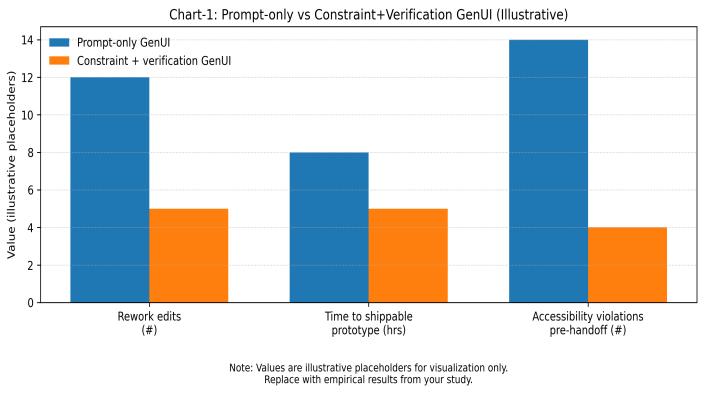
Comparison of prompt-only GenUI versus constraint and verification based GenUI on (a) number of rework edits beforeacceptance,(b)timetoreachashippableprototype, and(c)accessibilityviolationsdetectedpre-handoff.
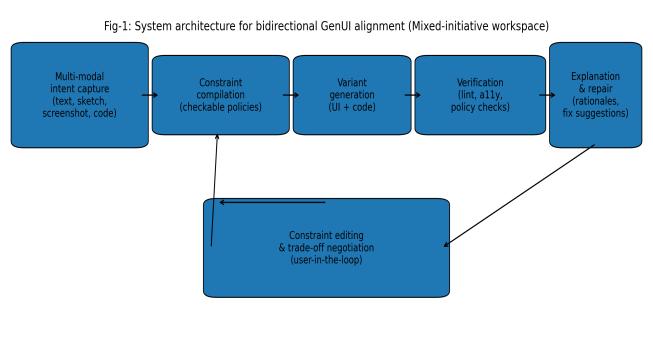
Pipeline showing multi-modal intent capture, constraint compilation,variantgeneration,verification,andexplanation
and repair loops integrated into a single mixed-initiative workspace.
Evaluationshouldmeasureoutcomesthatmattertoteams, notonlyaestheticquality.Controlledstudiescancompare the proposed workflow against prompt-only baselines on metrics such as time-on-task, number of iterations, perceived agency, and the rate of post-generation fixes required for design-system and accessibility compliance. Surveys and standardized instruments such as SUS can captureperceivedusability[8],whilequalitativeinterviews revealwhetherusersfeelmoreincontrolofthegenerative process.Practitionerevaluationswithdesignersandfrontend engineers can assess collaboration impacts, including whetherconstraintartifactsimprovecommunicationatthe design-to-code boundary. Longitudinal deployments can thenexaminewhetherteamscontinueusingthetoolonce noveltyfades,whetherconstraintlibrariesbecomeshared resources,andwhethermaintainabilityimprovesovertime asmeasuredbycomponentreuseandreduceddivergence fromdesignsystems.
GenUIwillbemostvaluablewhenitsupportsnotonlyrapid creationbutalsodependableintegrationintothesocialand technical realities of product development. Prompt-only generation has shown that plausible interfaces can be producedquickly;theremainingchallengeistomakethose outputslegibleandsustainable.Teamsmustbeabletosee what was assumed, how outputs relate to organizational constraints, and how to correct misalignment without repeatedly restarting. This paper has argued that these needsarebestaddressedbytreatingGenUIasabidirectional alignment problem, where both system and user adapt throughexplicitnegotiation.Theobjectiveisnottoremove iteration, butto make iterationstructured, checkable,and accountable.
Theproposedapproachrestsonthreecommitments.First, intentshouldbeexternalizedintoconstraintartifactsthat canbereviewed,reused,andversioned,shiftinginteraction fromtransientpromptingtodurablespecification.Second, generationshouldbepairedwithverificationsoviolations aresurfacedearly-withinthesameworkspacewheredesign choices are made-reducing downstream “hidden rework.” Third, outputs should include traceable rationales and targetedrepairsuggestionssouserscancalibratetrustand focus review effort where it matters most. These commitments align with core human-centered AI and human–AIinteractionprinciplesemphasizingtransparency, usercontrol,andefficientcorrection[1],[2].
A constraint-centered workflow also strengthens handoff between design and engineering by expressing intent in a formthatmapstobothUIstructureandengineeringrules. Versionedconstraintscreateadecisionhistorythatsupports
International Research Journal of Engineering and Technology (IRJET) e-ISSN: 2395-0056
Volume: 13 Issue: 02 | Feb 2026 www.irjet.net p-ISSN: 2395-0072
later maintenance and reduces reliance on institutional memoryasteamsandrequirementschange.
However, bidirectional alignment introduces challenges. Over-constraintcanreduceexploration,motivatingtheuse ofsoftconstraintsandtoolingthathelpsusersdecidewhatis negotiable.Constraintmanagementcanalsoaddcomplexity, requiring progressive disclosure and role-appropriate controls.Finally,becausenotall UIqualitydimensionsare fullyverifiable,thesystemmustcommunicateuncertainty carefully to avoid overstating confidence and to support appropriatetrustcalibration[4].
Responsible generation remains essential. GenUI tools shouldintegrateaccessibilityandpolicychecksasfirst-class capabilities [10] and preserve provenance so teams can distinguish policy-driven requirements from user instructionsandmodelinferences.Lookingahead,themost practical GenUI systems will likely be hybrid: combining generation with constraints, interactive editing, and establishedpracticessuchaslintingandtesting.Futurework should explore richer yet usable specification languages, methods for learning constraints from existing products without inheriting legacy errors, and collaborative workflowsthatsupportmultiplestakeholderseditingshared intent representations-validated through longitudinal studies that measure maintainability over months, not minutes[12]
GenUIwillbemostvaluablewhenitsupportsnotonlyrapid creation but also reliable integration into the social and technical realities of product development. Prompt-only generation has demonstrated that plausible UIs can be producedquickly.Theremainingchallengeistomakethose outputslegibleandsustainable:teamsneedtounderstand whatwasassumed,howtheoutputrelatestoorganizational constraints, and how to correct misalignment without starting over. This paper has argued that these needs are bestaddressedbytreatingGenUIasanalignmentproblem, specificallyabidirectionalalignmentprobleminwhichboth systemanduseradaptthroughexplicitnegotiation.Inthis framing, the goal is not to eliminate iteration but to make iterationstructured,checkable,andaccountable.
The proposed approach centers on three commitments. First,intentshouldbeexternalizedintoconstraintartifacts thatcanbe reviewedand reused.Thischangestheunit of interaction from a transient prompt to a durable specification. Second, generation should be paired with verification so that violations are discovered early, in the same workspace where design choices are made. This reduces hidden rework by shifting audits forward in the pipeline.Third,outputsshouldbeaccompaniedbytraceable rationalesandtargetedrepairsuggestions,enablingusersto calibratetrustandfocusattentionwhereitmatters.These
commitments align with established principles in humancentered AI and human-AI interaction, which emphasize control,transparency,andsupportforcorrection[1],[2]. Aconstraint-basedworkflowalsoimproveshandoffbetween designandengineering.Manyconflictsbetweendesigners anddevelopersarisebecauseintentisnotrepresentedina formbothcanworkwith.Designerscommunicatethrough screensandannotations; engineerscommunicatethrough codeandtests.Constraintscanbridgetheserepresentations byexpressingintentinaformthatmapstobothUIstructure andengineeringrules.Whenconstraintsareversioned,they createahistoryofdecisionsthathelpsteamsrevisittradeoffswithoutreconstructingpastreasoning.Thisisespecially importantforUIwork,whereproductrequirementsevolve andwhereteamsoftenchangeovertime.AGenUItoolthat exports a decision record alongside code can reduce the burdenofinstitutionalmemory.
Nevertheless, bidirectional alignment introduces its own challenges. One risk is over-constraint: if users encode requirements too rigidly, the system may produce conservative outputs that lack creativity or fail to explore meaningful alternatives. This suggests the need for mechanismsthatsupport“soft”constraintsandforUIthat helpsusersdecidewhichconstraintsarenegotiable.Another risk is complexity: if constraint management is too demanding,usersmayreverttopromptchurn.Tooldesign mustthereforeemphasizeprogressivedisclosure,providing simple controls for novices while enabling detailed constraint editing for experts. A third challenge is the integrationofprobabilisticanddeterministicchecks.Notall aspectsofUIqualitycanbeverifiedautomatically,andthe systemmustavoidpresentinguncertainjudgmentsasfacts. This is where careful communication of uncertainty is essentialfortrustcalibration[4].
Responsiblegenerationremainscentral.UIscanshapeuser behavior and may affect access, privacy, and well-being. GenUItoolsshouldintegrateaccessibilityandpolicychecks asfirst-classfeatures,makingiteasiertoproduceinclusive interfacesbydefault[10].Theyshouldalsosupportauditing and governance by preserving provenance: users should know whether a constraint came from policy, from user instruction, or from model inference. This is not only a technical feature but an ethical one, because it influences accountabilitywhenharmfulorbiasedoutcomesoccur.As human-centered AI work emphasizes, beneficial systems must be transparent and interrogable, particularly when deployed in contexts where mistakes have real consequences[1].
ThefutureofGenUIislikelytobehybridratherthanpurely generative. High-performing workflows will combine generationwithformalconstraints,interactiveediting,and established engineering practices like linting and testing. Programsynthesisresearchhaslongexploredthevalueof constraints and partial specifications [12], and GenUI
International Research Journal of Engineering and Technology (IRJET) e-ISSN: 2395-0056
Volume: 13 Issue: 02 | Feb 2026 www.irjet.net p-ISSN: 2395-0072
provides a contemporary arena in which these ideas can becomeusablebypractitioners.Futureworkshouldexplore richer specification languages that remain accessible to designers, better methods for learning constraints from existing products without propagating legacy errors, and collaborativeworkflowsthatsupportmultiplestakeholders editingasharedintentmodel.Longitudinalstudieswillbe particularlyimportanttounderstandwhetherbidirectional alignmentreducesmaintenancecostovermonths,notjust minutes.
In conclusion, bidirectional human AI alignment offers a practical path for making GenUI tools fit the realities of design and development work. By converting intent into checkable constraints, generating diverse candidates, verifyingoutputs,andprovidingtraceableexplanationswith incremental repair, GenUI can become more than a rapid sketch generator. It can become a reliable partner in the design-to-code pipeline: fast, yes, but also accountable, legible,andsustainable.
[1] [B.Shneiderman, Human-CenteredAI.OxfordUniversity Press,2022.
[2] S. Amershi, D. Weld, M. Vorvoreanu, A. Fourney, B. Nushi, P. Collisson, J. Suh, S. Iqbal, P. N. Bennett, K. Inkpen, T. Teevan, R. Kikin-Gil, and E. Horvitz, “Guidelines for Human-AI Interaction,” in Proc. CHI, 2019,doi:10.1145/3290605.3300233.
[3] E. Horvitz, “Principles of Mixed-Initiative User Interfaces,” in Proc. CHI, 1999, pp. 159–166, doi:10.1145/302979.303030.
[4] A. Holzinger, “From Machine Learning to Explainable AI,” in World Symposium on Digital Intelligence for Systems and Machines, 2018, doi:10.1109/DISM.2018.8351327.
[5] M. T. Ribeiro, S. Singh, and C. Guestrin, “Why Should I TrustYou?ExplainingthePredictionsofAnyClassifier,” in Proc. KDD, 2016, pp. 1135–1144, doi:10.1145/2939672.2939778.
[6] S.Amershi,M.Cakmak,W.Knox,andT.Kulesza,“Power to the People: The Role of Humans in Interactive MachineLearning,” AIMagazine,vol.35,no.4,2014,pp. 105–120.
[7] J.Nielsen,“HeuristicEvaluation,”in UsabilityInspection Methods,J.NielsenandR.L.Mack,Eds.Wiley,1994.
[8] J. Brooke, “SUS: A Quick and Dirty Usability Scale,” in UsabilityEvaluationinIndustry,P.W.Jordan,B.Thomas, B.A.Weerdmeester,andI.L.McClelland,Eds.Taylor& Francis,1996.
[9] T. Beltramelli, “pix2code: Generating Code from a Graphical User Interface Screenshot,” arXiv preprint arXiv:1705.07962,2017.
[10] W3C, “Web Content Accessibility Guidelines (WCAG) 2.2,”WorldWideWebConsortium,2023.
[11] H.Shen,T.Knearem,R.Ghosh,K.Alkiek,K.Krishna,Y. Liu,andD.Jurgens,“TowardsBidirectional Human-AI Alignment: A Systematic Review for Clarifications, Framework, and Future Directions,” arXiv preprint arXiv:2406.09264,2024.
[12] S. Gulwani, O. Polozov, and R. Singh, “Program Synthesis,” Foundations and Trends in Programming Languages,vol.4,nos.1–2,2017,pp.1–119.
[13] X. A. Chen, T. Knearem, and Y. Li, “The GenUI Study: ExploringtheDesignofGenerativeUIToolstoSupport UX Practitioners and Beyond,” in Proc. ACM Designing Interactive Systems Conference (DIS), 2025, pp. 1179–1196.
[14] T. Knearem, M. Khwaja, Y. Gao, F. Bentley, and C. E. Kliman-Silver,“ExploringtheFutureofDesignTooling: The Role of Artificial Intelligence in Tools for User ExperienceProfessionals,”in ExtendedAbstractsofCHI, 2023.
[15] T. Miller, “Explanation in Artificial Intelligence: InsightsfromtheSocialSciences,” ArtificialIntelligence, vol.267,2019,pp.1–38.