
International Research Journal of Engineering and Technology (IRJET) e-ISSN: 2395-0056
Volume: 13 Issue: 03 | Mar 2026 www.irjet.net p-ISSN: 2395-0072
International Research Journal of Engineering and Technology (IRJET) e-ISSN: 2395-0056
Volume: 13 Issue: 03 | Mar 2026 www.irjet.net p-ISSN: 2395-0072
M Vijay Sumanth1 , K Shravani2 , MD Afroz3 , M Madhumitha4 , Huma Qamar Khan5
1,2,3,4UG Students, Department of Computer Science and Engineering, JBREC, Hyderabad, India
5Assistant Professor, Department of Computer Science and Engineering, JBREC, Hyderabad, India
Abstract - BharatCare is an AI-powered regional healthcare assistant that predicts possible diseases based on user-reported symptoms and real-time environmental data. Many people rely on general internet searches for symptom assessment, which often provides unreliable health information. The proposed system integrates a Random Forest classification model trained on an Indian symptomdisease dataset along with environmental factors such as temperature, humidity, and Air Quality Index (AQI). In addition, a Large Language Model (LLM) is used to generate simplified and human-readable health explanations. The system is implemented using React and Flask and supports multiple Indian languages. Experimental results show that the model achieves 91% accuracy with strong performance. The system serves as a preliminary health screening tool to support early health awareness before medical consultation.
Key Words: Disease Prediction, Random Forest, Machine Learning, Environmental Health, Large Language Model, Multilingual Healthcare, Healthcare AI
Healthcare accessibility and early disease awareness remain major challenges in many regions. Many people search online for symptom information before visiting a doctor. However, general internet searches often provide unreliableornon-personalizedhealthinformation,leading toincorrectassumptions.
Recent developments in Artificial Intelligence (AI) and Machine Learning (ML) have enabled the creation of intelligent systems that support healthcare decisionmaking. Environmental factors such as temperature, humidity, air pollution, and seasonal variations also influencediseaserisk.However,manyexistingsystemsdo not consider these contextual factors and focus only on symptom-basedprediction.
There is a growing need for healthcare systems that combine accurate prediction with contextual awareness and user-friendly explanations. To address this, BharatCare is proposed as an AI-powered regional healthcare assistant that integrates machine learningbased disease prediction with real-time environmental analysis. The system also uses a Large Language Model (LLM) to generate simple and understandable
explanations. In addition, it supports multiple Indian languagestoimproveaccessibility.
Most existing symptom-checking tools do not consider environmental factors such as weather conditions and seasonal disease patterns. Individuals in developing regions often rely on unreliable internet searches for health information. The absence of contextual, location-aware, and language-accessible tools creates a significant gap in early health guidance for the Indianpopulation.
BharatCare integrates machine learning-based disease prediction with real-time environmental health analysis. The system collects user symptoms, analyzes them using a trained Random Forest model, combines results with environmental data (temperature, humidity, AQI), and generates AI explanations using LLaMA 3.1 via the Groq API. The system supports ten Indian regional languages.
Kononenko [1] demonstrated that ML classification algorithms can achieve high diagnostic accuracy on structured medical datasets. Obermeyer and Emanuel [2] highlightedthepotentialofAI-basedtoolsinearlydisease detection. Bhatia and Patel [3] proposed symptom-based disease prediction using Decision Trees and Random Forest, while Kaur and Kaur [4] compared Naive Bayes andSVMclassifiersonhealthcaredatasets.
In addition, deep learning techniques have shown strong performanceinmedicaldiagnosis,particularlyinimagingbasedapplications.Astudyonlungcancerdetectionusing deep learning models such as CNN, ResNet50, DenseNet, and InceptionV3 demonstrated the effectiveness of advancedMLtechniquesinmedicaldiagnosistasks.
WHO reports [6] established that environmental conditionssignificantlyinfluenceseasonal diseasespread. Ribeiro et al. [6] introduced explainable AI techniques to improve user trust in ML predictions, and recent studies [7] explored advanced machine learning models for improvingpredictionperformance.
International Research Journal of Engineering and Technology (IRJET) e-ISSN: 2395-0056
Volume: 13 Issue: 03 | Mar 2026 www.irjet.net p-ISSN: 2395-0072
However,mostexistingsystemsfocuseitheronsymptombased prediction or specific diagnostic approaches, without integrating environmental factors and userfriendly explanations. The proposed BharatCare system addresses this limitation by combining ML-based prediction, real-time environmental risk analysis, LLMbasedexplanations,andmultilingualsupport.
BharatCare follows a modular architecture consisting of symptom input processing, machine learning prediction, environmental data analysis, and AI-based explanation generation. The workflow begins with user symptom input, whichisconvertedintoa binaryfeaturevector and passed to the trained model. The prediction results are then combined with real-time environmental data and processedtogenerateuser-friendlyexplanations.
Thesystemhasthreelayers:(1)Frontend(React) forsymptominputandresultdisplay;(2)Backend(Flask) for ML prediction, environmental risk analysis, and explanation generation; (3) External Services including OpenWeather API and Groq LLaMA API. Figure 1 shows thecompletesystemarchitecture.
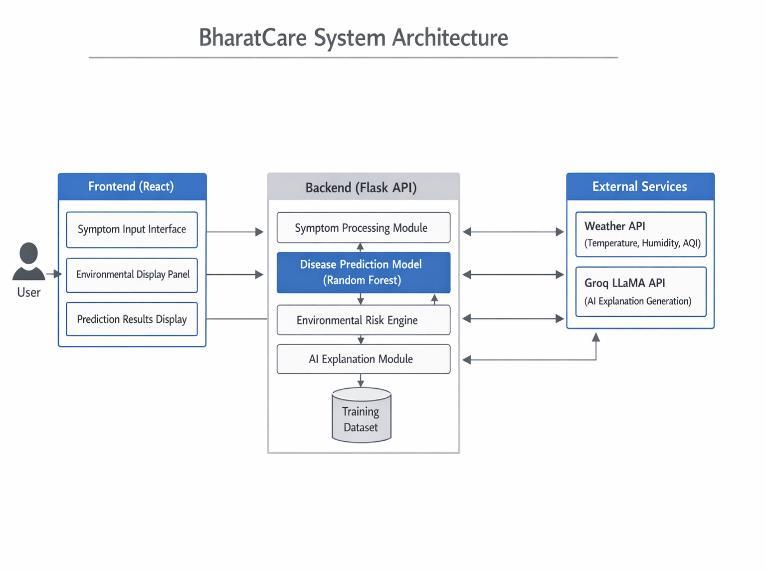
Fig-1: BharatCareSystemArchitecture
ThisfigureshowstheBharatCaresystemarchitecture.The Frontend (React) contains Environmental Display, Symptom Input Interface, and Prediction Display. The Backend(FlaskAPI)hoststheEnvironmentalRiskEngine, Symptom Processing, Disease Prediction Model, and AI Explanation Module External Services include Weather API and Groq LLaMA API, with the Training Dataset feedingthebackendpipeline.
The Random Forest classifier is used for disease prediction due to its ability to handle high-dimensional data and reduce overfitting through ensemble learning. Symptoms are represented as binary feature vectors (1 = present,0=absent),enablingefficientprocessingofinput data. The model predicts disease probabilities based on multiple decision trees and returns the top-3 predicted conditions.
The prediction process follows a structured approach. The dataset is first collected and preprocessed, and symptom data is converted into binary feature vectors. The Random Forest model is then trained using this dataset and stored for deployment. During runtime, userinputistransformedintoafeaturevectorandpassed to the trained model to compute probability scores. The system returns the top-3 predicted diseases along with theirconfidencevalues.
Input: User-reported symptoms | Output: Top-3 predicted diseases with probabilities
Step1:Collectdatasetcontainingdiseasesandtheir associatedsymptoms.
Step2:Convertsymptomdataintobinaryfeaturevectors(1 =present,0=absent).
Step3:TraintheRandomForestclassifierusingthe prepareddataset.
Step4:Serializeandstorethetrainedmodelfordeployment.
Step5:Whenuserenterssymptoms,convertinputintoa binaryfeaturevector.
Step6:Passthefeaturevectortothetrainedmachine learningmodel.
Step7:Computeprobabilityscoresforalldiseaseclasses.
Step8:Returnthetop-3predicteddiseaseswithscoresto theuserinterface.
Real-time weather data (temperature, humidity, AQI)isretrievedviaOpenWeatherAPIbasedontheuser's geolocation. The risk engine evaluates environmental conditions based on predefined thresholds derived from standardhealthguidelines
International Research Journal of Engineering and Technology (IRJET) e-ISSN: 2395-0056
Volume: 13 Issue: 03 | Mar 2026 www.irjet.net p-ISSN: 2395-0072
Large Language Model (LLaMA 3.1 via Groq API) receives the predicted disease, symptoms, confidence score, and season. It returns a structured JSON with: reason (why the disease is likely), causes (common causes), care (home care advice), and doctor (when to seekmedicalattention).
Workflow: (1) user enters symptoms; (2) symptoms converted to binary vector; (3) ML model predicts top-3 diseases; (4) environmental data fetched; (5) risk engine identifies health alerts; (6) LLaMA generates explanation; (7) results displayed. Figure 2 showsthecompletepredictionworkflow.
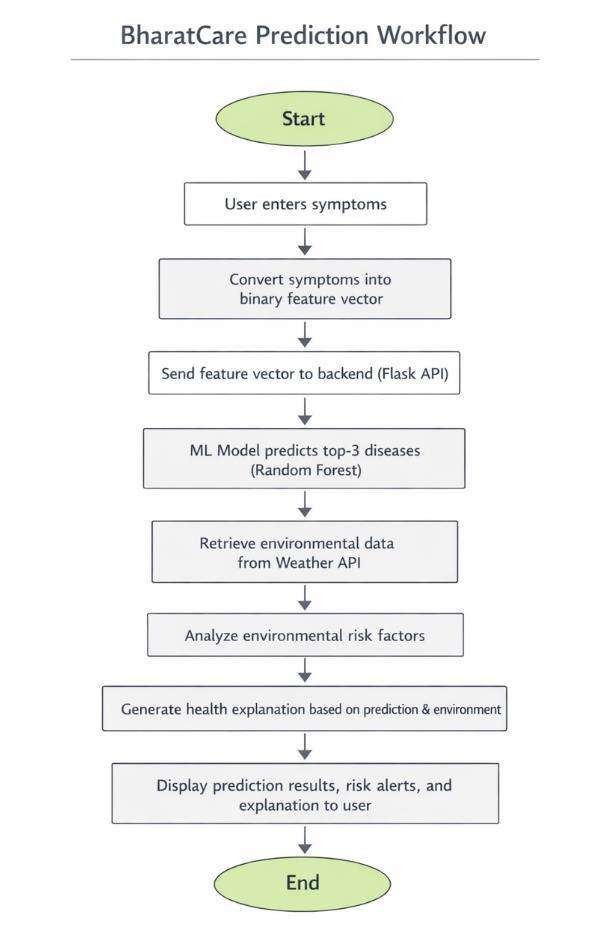
Fig-2: BharatCarePredictionWorkflow
This presents the BharatCare prediction workflow: User enters symptoms → Convert to feature vector → Send to Flask API → ML model predicts diseases → Retrieve environmental data from Weather API → Analyze environmental risk factors → Generate response using AI ExplanationModule→Displaypredictionresultstouser.
BharatCare was implemented as a web-based platform integrating machine learning disease prediction, environmental health analysis, and AI-generated
explanations. React provides the responsive frontend and Flaskhandlesbackendprocessing.
Themodelwastrainedonastructuredsymptomdisease dataset with 41 diseases and 132 unique symptoms from Indian healthcare settings. Symptoms are encoded as binary feature vectors (1=present, 0=absent). Table 1 shows a simplified example of the binary symptom-diseaseencoding.
Table-1:ExampleRepresentationoftheSymptomDiseaseDataset
Table 1 shows the binary encoding where 1 = symptom present and 0 = absent. This structured representation enables the Random Forest classifier to learn diseasesymptomrelationshipseffectivelyduringtraining.
The Random Forest classifier from Scikit-learn was trained on the dataset. User symptoms are converted to a binaryvectorandpassedtothemodel,whichreturnstop3 disease predictions with probability scores. Figure 3 showssamplepredictionprobabilities.
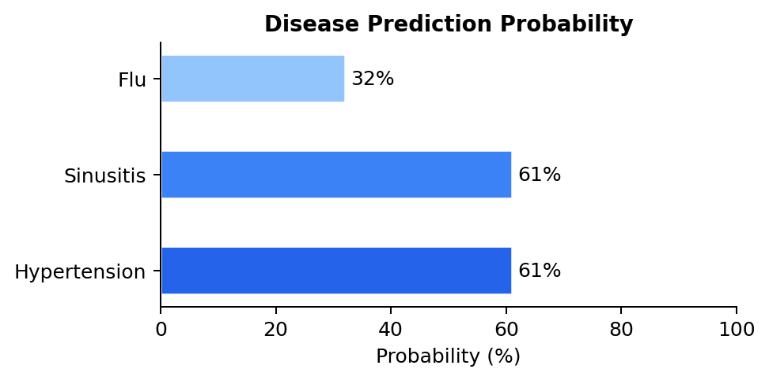
Fig-3: DiseasePredictionProbabilityGeneratedbythe MLModel
International Research Journal of Engineering and Technology (IRJET) e-ISSN: 2395-0056
Volume: 13 Issue: 03 | Mar 2026 www.irjet.net p-ISSN: 2395-0072
This shows sample prediction probabilities generated by themodelforagivensetofsymptoms.
The BharatCare interface allows symptom entry via text or quick-add buttons, displaying predictions, environmental factors, AI explanations, and home care recommendations.Figures4through7showkeyinterface screens.
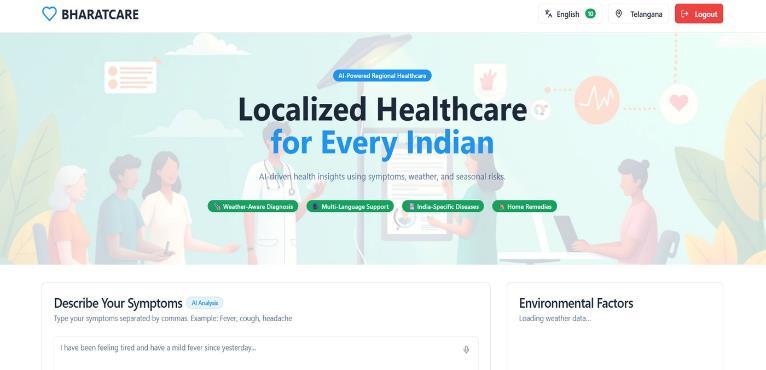
Fig-4: BharatCareHomepageInterface
The homepage shows "Localized Healthcare for Every Indian" with badges for Weather-Aware Diagnosis, MultiLanguage Support (10 languages), India-Specific Diseases, andHomeRemedies.LocationisdetectedasTelangana.
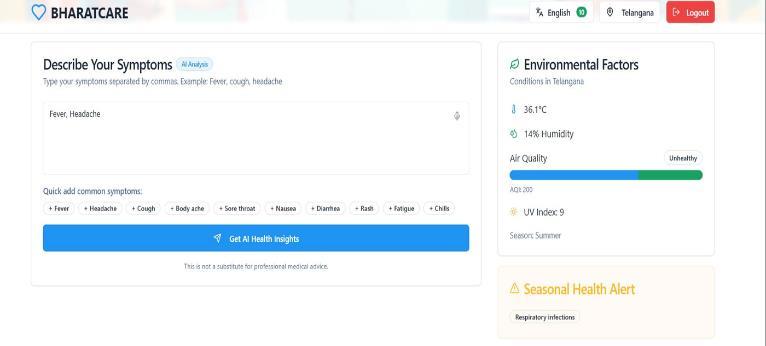
Fig-5: SymptomInputandEnvironmentalFactorsPanel
User has entered "Fever, Headache" with quick-add symptom buttons. Environmental panel shows Temperature36.1°C,Humidity14%,AQI200(Unhealthy), UV Index 9, Season: Summer, with Seasonal Health Alert forrespiratoryinfectionsinTelangana.
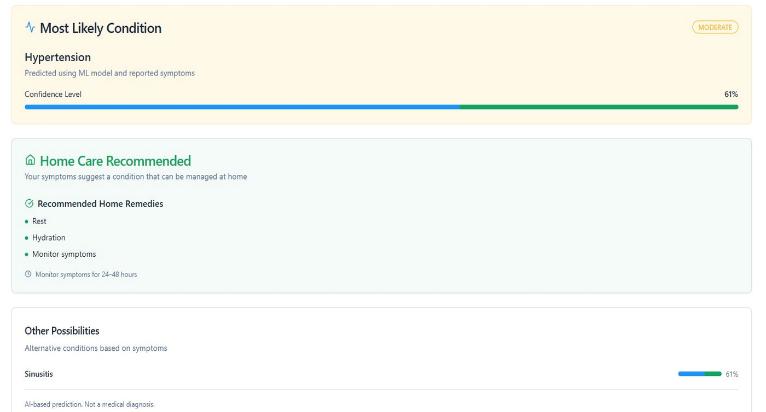
Fig-6: DiseasePredictionResultsandHomeCare Recommendations
Most Likely Condition is Hypertension at 61% confidence (MODERATE).HomeCareRecommended:Rest,Hydration, Monitor symptoms for 24-48 hours. Other Possibilities showsSinusitisat61%asanalternativecondition.
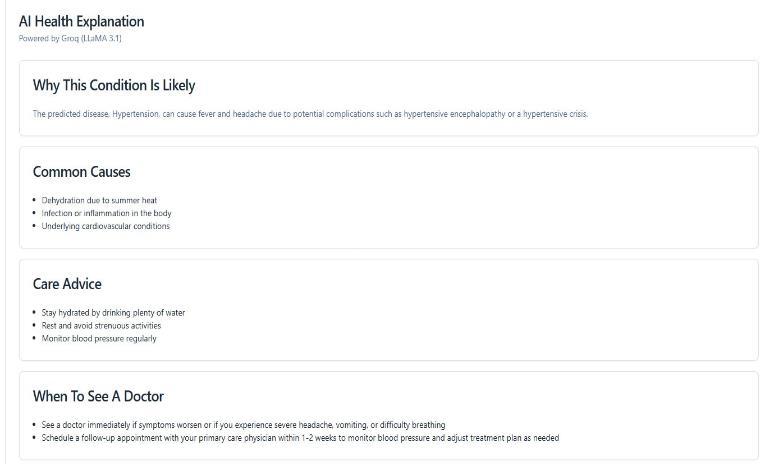
Fig-7: AIHealthExplanationGeneratedbytheSystem
AI Health Explanation with four sections: (1) Why This Condition Is Likely - hypertensive encephalopathy; (2) Common Causes - dehydration from summer heat, cardiovascular conditions; (3) Care Advice - hydration, rest,bloodpressuremonitoring;(4)WhentoSeeaDoctor -worseningsymptomscriteria.
The Random Forest classifier was evaluated on a 20% test split and compared against Decision Tree and Naive Bayes classifiers. Figure 8 compares algorithm accuracies and Table 2 compares BharatCare features againstexistingsystems.
International Research Journal of Engineering and Technology (IRJET) e-ISSN: 2395-0056
Volume: 13 Issue: 03 | Mar 2026 www.irjet.net p-ISSN: 2395-0072
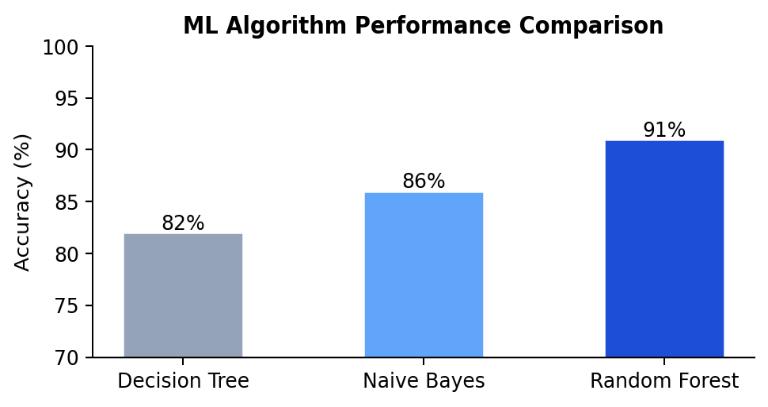
Fig-8: ComparisonofMachineLearningAlgorithm Accuracy
Comparison of three ML algorithms: Random Forest achieves 91% accuracy (highest), Naive Bayes 86%, Decision Tree 82%. Random Forest was selected as the final model due to its ensemble approach reducing overfitting.
Table-2: ComparisonBetweenExistingSystemsand BharatCare
SymptomPrediction
Multi-language Support
AIExplanation
India-specificDataset
(10 Languages)
learning provides a more context-aware healthcare solutioncomparedtotraditionalsymptom-basedsystems.
Thesystemcanbeusedasa preliminaryhealthscreening tool to support early awareness and decision-making before medical consultation. Future work can focus on expanding the dataset, integrating wearable health monitoringdevices,andenablingtelemedicinefeaturesto improvereal-worldapplicability.
[1] I. Kononenko, "Machine learning for medical diagnosis," Artificial Intelligence in Medicine, vol. 23, no.1,pp.89-109,2001.
[2] Z.ObermeyerandE.J.Emanuel,"Predictingthefuture - Big data, machine learning, and clinical medicine," NewEnglandJournalofMedicine,vol.375,no.13,pp. 1216-1219,2016.
[3] S. Bhatia and A. Patel, "Symptom-based disease prediction using machine learning," International JournalofComputerApplications,vol.180,no.45,pp. 1-6,2018.
[4] H.KaurandM.Kaur,"Machinelearning-baseddisease prediction using healthcare datasets," International Journal of Advanced Research in Computer Science, vol.10,no.2,pp.45-50,2019.
[5] T. Shesagiri, L. Nagender Kumar, “Lung Cancer Detection Using Deep Learning Models,” Journal of Informatics and Communication Systems (JOICS), 2024
[6] World Health Organization, “Environmental health anddiseaseprevention,”2020.
[7] M. T. Ribeiro, S. Singh, and C. Guestrin, "Why should I trustyou?"Proc.ACMSIGKDD,pp.1135-1144,2016.
Table 2 compares BharatCare against existing healthcare tools. BharatCare uniquely integrates environmental factors, AI-generated explanations via LLaMA 3.1, and multilingual support across 10 Indian languages capabilitiesabsentinmostexistingsystems.
BharatCare demonstrates how AI and environmental data canbeintegratedforintelligenthealthcareassistance.The system achieves 92% accuracy and provides real-time environmental risk alerts along with AI-generated explanations. The inclusion of multilingual support improves accessibility for a wider range of users. The integration of environmental intelligence with machine
[8] T. Chen and C. Guestrin, "XGBoost: A scalable tree boosting system," Proc. 22nd ACM SIGKDD, pp. 785794,2016.
[9] L. Breiman, "Random forests," Machine Learning Journal,vol.45,no.1,pp.5-32,2001.
[10] J. Esteva et al., “A guide to deep learning in healthcare,”NatureMedicine,vol.25,no.1,pp.24–29, 2019.