
International Research Journal of Engineering and Technology (IRJET) e-ISSN: 2395-0056
Volume: 12 Issue: 12 | Dec 2025 www.irjet.net p-ISSN: 2395-0072
International Research Journal of Engineering and Technology (IRJET) e-ISSN: 2395-0056
Volume: 12 Issue: 12 | Dec 2025 www.irjet.net p-ISSN: 2395-0072
Ar. Kshitij Kumar Kushwaha1 , Dr. Syed Mohammad Noman Tariq2
1MURP 2nd Year, Department of Architecture
2Associate Professor, Department of Architecture
Abstract - Short-distance mobility problems have gotten worse due to rapid urbanisation and an increasingrelianceon private motorised vehicles, particularly on big, crowded, and regulated university campuses. Congestion, parking pressure, safety issues, and ineffective use of internal circulation routes for quick and frequent journeys are common in these settings. In this regard, e-mobility choices like e-bikes and e-scooters are becoming more widely acknowledged as viable, low emission, and compact options for short-distance transport. By looking at a few national and international case studies, this paper investigates the viability and possible effects of implementinge-micromobilitywithininstitutionalprecincts.It focusses on important aspects such user acceptability, governance procedures, infrastructure needs, operational models, implementation methods, and safety management. The study finds crucial success factors, obstacles, and contextspecific limitations by examining how various organisations have planned, controlled, and integrated e-micromobilityinto their internal transportation systems. Building on this comparative analysis, the study suggests a methodology for evaluating and implementing e-micromobility in comparable institutional contexts. The framework is meant to assist planners, campus administrators, and legislators in methodically evaluating demand, creating suitable infrastructure and rules, and coordinating e-micromobility projects with more general sustainability, accessibility, and climate objectives. The study's ultimate goal is to facilitatethe shift from traditional, motorised short-trip patterns to safer, more effective, and cleaner campus mobility solutions.
Key Words: E-micro mobility, Campus-scale mobility, Sustainable campus, Mobility performance, Last-mile connectivity.
Theuseofe-bikes,e-scooters,e-carsande-busesasgreener substitutes for traditional fuel-powered vehicles in urban transportation networks is known as "e-mobility." The desire to reduce greenhouse gas emissions, lessen air pollution, and increase urban energy efficiency is a major drivingforceforthisshiftE-micro-mobilityisasubsetofthis larger category that focusses on small, light electric cars intended for short-distance travel, usually in urban or campussettings.Theseincludee-bikes,e-scooters,andother small devices that are ideal for short urban trips, internal campus circulation, and first- and last-mile connection. In order to supplement public transportation and lessen
relianceonprivatemotorisedcars,e-micro-mobilitysystems seek to provide flexible, low-emission, and space-efficient travelchoices.
1.1 Current Indian Government Initiatives for EMobility
National Electric Mobility Mission Plan (NEMMP): Launched in 2012 to promote hybrid and electric vehiclesinthecountry.
Faster Adoption and Manufacturing of hybrid and Electricvehicles(FAME):Phase1:2015-2019;Phase 2:2019-2022
PMElectricDriveRevolutioninInnovativeVehicle Enhancement(PME-DRIVE)
Scheme Electric Mobility Promotion Scheme 2024 (EMPS2024):ByMinistryofHeavyIndustries
2. Research Design
2.1 Aim
The aim of this research is to develop a framework for integratinge-micromobilityintheAMUcampusAligarh.
1. Tostudytheroleandsignificanceofe-micro-mobilityin theurbancontextandtoanalysisthevariouspolicies, schemes, and regulatory frameworks undertaken in Indiaforitspromotion.
2. Tostudythespatialcharacteristics,circulationpatterns, and campus movement behaviour in institutional environments to understand the potential for integratinge-micromobility.
3. To examine and compare cases of E-micro mobility strategiesbeingusedworldwide
2.3 Need of
Evenatlocationslikecampuseswheretheyarefrequently overkill,motorisedcarsneverthelesshandlethemajorityof shortjourneys,resultinginneedlesstraffic,safetyhazards, and pollution. Although e-micromobility is promoted as a greensolution,wedon'tcompletelyunderstandhowitworks outside of brief testing. The majority of studies ignore the
International Research Journal of Engineering and Technology (IRJET) e-ISSN: 2395-0056
Volume: 12 Issue: 12 | Dec 2025 www.irjet.net p-ISSN: 2395-0072
wholepicture,includingtherequirementsforinfrastructure, howpeopleactuallyuseit,andtheregulationsthatmakeit function,particularlyoninstitutionalgrounds.Plannersare left in the dark, which leads to uneven or unsuccessful rollouts. To identify the true obstacles and factors that contribute to their success, a realistic, side-by-side examinationofactualcollegeprogramsisrequired.
2.4 Methodology
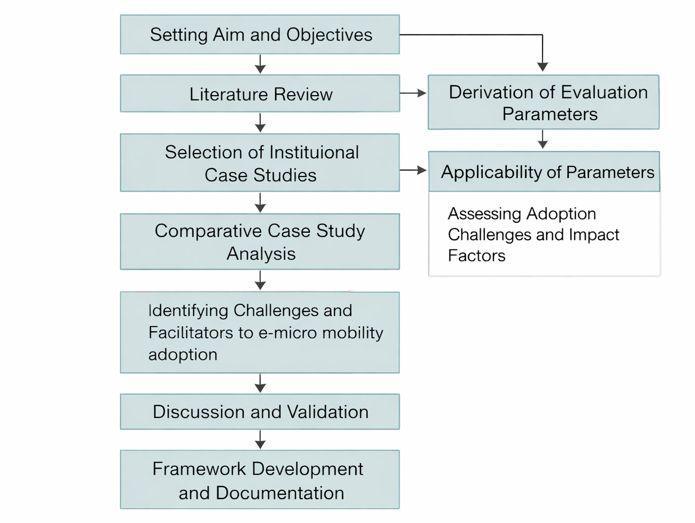
Fig -1:Methodology
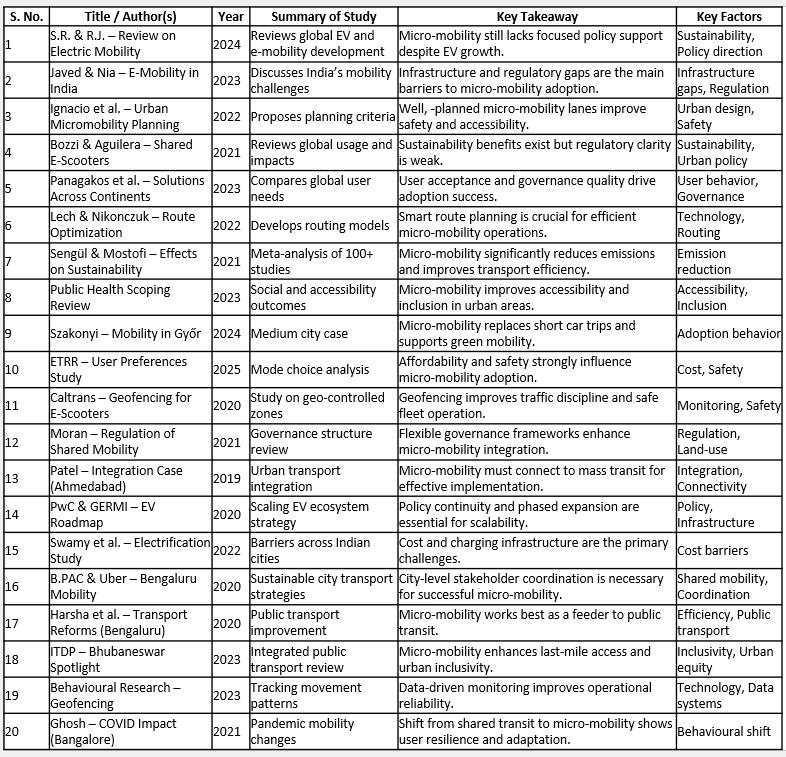
3 Literature Study
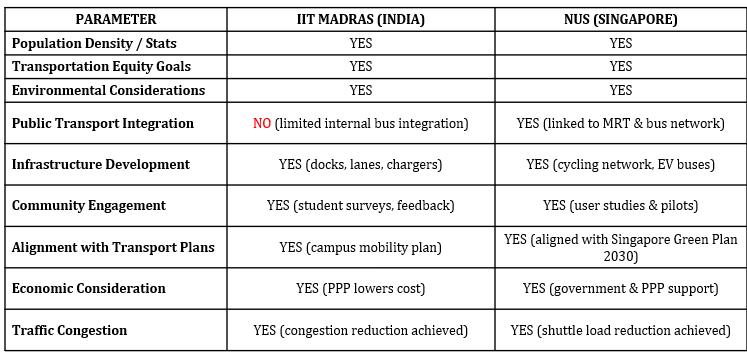
Table -1:LiteratureStudy
OneofthefirstsizableinstitutionalsettingsinIndiatouseemicromobilityonawidescaleisthecampusofIITMadras.It creates significant internal transit between dispersed academic buildings, dorms and research centres, which formerly relied mostly on individual two-wheelers and unofficialmotorisedtransportation.Itisaround620acresin size. This pattern disrupted the campus's environmentally delicate ecosystem, caused traffic jams, and raised safety concerns.
The institute responded by implementing a structured emicromobilitysystembasedonon-campuschargingstations, shared e-bikes, and electric shuttle services. With GPS monitoring, speed limitations, and geofenced regions to safeguardsensitivelocations,accessiscontrolledviaamobile application. In order to promote walking, cycling, and emobility,thecampusgraduallyintroducedprioritycorridors forlow-speedcarsandlimitedtraditionalmotorisedaccessin specific areas. In addition to improving circumstances for bicyclesandwalkers,theseactionshavedecreasedtheneed forprivatetwo-wheelersandhelpedtolessenlocalpollution andnoise.Allthingsconsidered,theIITMadrasexperience shows how technology-based monitoring tools, robust institutional control, and a gradual roll-out may make micromobilityfeasibleandsignificantinbigcampussettings.
Anexcellentglobalexampleofhowe-micromobilitymaybe includedintoasizable,technologicallyadvancedcampusis theNationalUniversityofSingapore(NUS).Theinstitutionis around 370 acres in size, and there is a lot of daily traffic betweentheteachingareas,residencehalls,hospitals,and publictransportationhubs.Thecampus'searlierrelianceon dieselshuttlebusesandothermotorisedvehiclesresultedin traffic jams, increased operational expenses, and negative environmentaleffects.
In response, NUS implemented a multi-layered emicromobilitystrategythatincludessharede-bikes,electric shuttle buses, and autonomous electric vehicle trials. A digital mobility platform that provides real-time vehicle positions, route planning, and service updates connects a networkofapprovedbikelanesandcontrolledtrafficzones. In addition to providing financing and clear laws, close cooperation with national transportation authorities has assisted in coordinating campus activities with citywide transportation strategies. Smoother internal circulation, safer walking and cycling environments and discernible decreases in local pollutants and fuel use are among the reported results. The NUS example demonstrates how emobilitycanbemadescalableanddependableinintricate institutional settings through well-coordinated policies,
International Research Journal of Engineering and Technology (IRJET) e-ISSN: 2395-0056
Volume: 12 Issue: 12 | Dec 2025 www.irjet.net p-ISSN: 2395-0072
Analysis
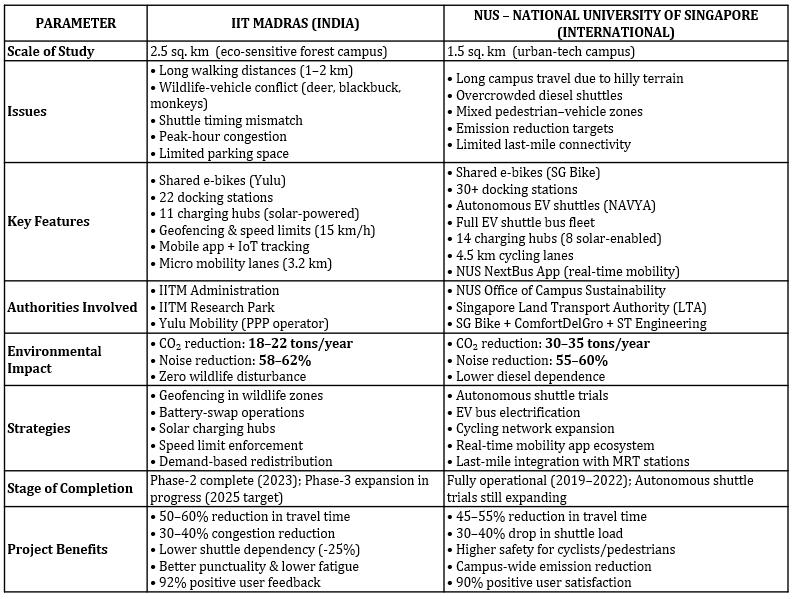
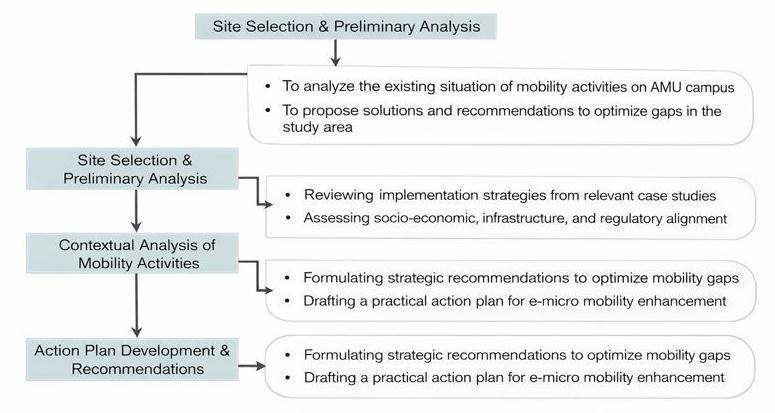
Inordertomatchfeasibilitycharacteristicsfromcasestudies withthesite'scontextandfindopportunities,thisresearchis expected to proceed with site selection and a first site investigation.
In conclusion, the case studies of National University of SingaporeandIITMadrasexpandsandsolidifiesthebroader globallessonsthatarecomingfromplaceslikeBengaluru, Paris, Brisbane, and San Francisco. The IITM and NUS examples indicate how comparable ideas may be operationalized inside big, semi-controlled institutional campuses, whereas global urban situations illustrate how micromobilitycanbegovernedatacityscale.Collectively, theseexperiencesdemonstratethate-micromobilityworks best when it is backed by transparent governance frameworks, context-specific laws, and specially designed low-speedinfrastructurethatprotectspedestriansandusers alike.
Stakeholder cooperation, data-driven operations, and flexible regulatory frameworks that can address safety concerns,publicspacechallenges,andchangingdemandare common success elements that appear in all situations. Campus-level policies like speed limits, wildlife-sensitive zones, and digital mobility platforms at IITM and NUS are paralleled by city-level efforts like geofencing in Paris or coordinated operator management in Brisbane. These similarities highlight the importance of factors like trip lengthappropriateness,pedestrianintensity,environmental sensitivity,andinfrastructurepreparednesswhenfiguring out where e-micromobility, particularly geo-fenced operations,maybedeployedinapracticalandresponsible manner.
Thefeasibilitystudyforinstitutionalsettingsbuildsonthese findingsbyidentifyingasetofassessmentmetricsthatcan helpdeterminewhetherandhowtogeofencecertainsites for the deployment of e-mobility. These include user acceptability, safety records, operational effectiveness, integration with current public transportation, and the abilityofcampusauthoritiestokeepaneyeonandenforce regulations. The paper presents e-micromobility as a scalable,flexibleinstrumentforprovidingcleaner,safer,and moreegalitarianshort-distancemobilityinbothinstitutional and urban settings by coordinating campus-scale frameworks with the more general lessons from global urbanexperience.
1. S,R.,&R,J.(2024).Reviewonelectricmobility:Trends, challenges and opportunities. Results in Engineering,23,102631. https://doi.org/10.1016/j.rineng.2024.102631
International Research Journal of Engineering and Technology (IRJET) e-ISSN: 2395-0056
Volume: 12 Issue: 12 | Dec 2025 www.irjet.net p-ISSN: 2395-0072
2. Javed, A., & Nia, H. A. (2023). A SHIFT TOWARDS EMOBILITYININDIA:CHALLENGESANDINNOVATIONS. Khulna University Studies. https://doi.org/10.53808/kus.2023.20.02.iccaua81-se
3. Ignaccolo,M.,Inturri,G.,Cocuzza,E.,Giuffrida,N.,Pira, M.L.,&Torrisi,V.(2022).Developingmicromobilityin urban areas: network planning criteria for e-scooters and electric micromobility devices. Transportation Research Procedia, 60, 448–455. https://doi.org/10.1016/j.trpro.2021.12.058
4. Bozzi,A.D.,&Aguilera,A.(2021).SharedE-Scooters:A ReviewofUses,HealthandEnvironmentalImpacts,and Policy Implications of a New Micro-Mobility Service. Sustainability, 13(16), 8676. https://doi.org/10.3390/su13168676
5. Panagakos, G., Goletz, M., Hasselwander, M., Mejia, A., Aittoniemi,E.,Barfod,M.B.,Dhar,S.,Barriga,M.R.M., Munshi,T.,Painuly,J.P.,Shrestha,S.,Silla,A.,Teko,E., Torrao, G., Werland, S., & Dematera, K. (2023). Emobilitysolutionsforurbantransportation:Userneeds across four continents. Transportation Research Procedia, 72, 2558–2565. https://doi.org/10.1016/j.trpro.2023.11.772
6. Lech,N.,&Nikończuk,P.(2022).Themethodofroute optimization of electric vehicle. Procedia Computer Science, 207, 4454–4462. https://doi.org/10.1016/j.procs.2022.09.509
7. Brooker, R. P., Qin, N., & Florida Solar Energy Center, UniversityofCentralFlorida,CocoaFL329224.(2015). IdentificationofPotentialLocationsofElectricVehicle Supply Equipment. https://www.sciencedirect.com/science/article/pii/S03 78775315302512
8. The Author(s). (2023). Geofencing in location-based behavioral research: Methodology, challenges, and implementation.InBehaviorResearchMethods(Vol.56, pp. 6411–6439) [Journal-article]. https://doi.org/10.3758/s13428-023-02213-2
9. CaltransDivisionofResearch,InnovationandSystem Information,Cutter,S.,&CTC&AssociatesLLC.(2020). Analysing the Potential of Geofencing for Electric Bicycles and Scooters in the Public Right of Way [Report].
10. Moran,M.E.(2021).Drawingthemap:Thecreationand regulation of geographic constraints on shared bikes ande-scootersinSanFrancisco,CA.JournalofTransport and Land Use, 14(1). https://doi.org/10.5198/jtlu.2021.1816
11. SFEnvironment.(2015).TheroleoftheElectricVehicle WorkingGroupinSanFrancisco[Report].
12. Christoforou, Z., Gioldasis, C., University of Patras, UniversitéGustaveEiffel,CIRAIG,&UniversityofParisEst.(2021).Whoisusinge-scootersandhow?Evidence from Paris. In Transportation Research Part https://doi.org/10.1016/j.trd.2021.102708DTransport andEnvironment.
13. AndrésBorthagaray.PublicspacesofmobilityinParis, Tokyo,andBuenosAires.2023.hal04071833
14. Pace, R., Pollard, M., Bunker, J., & SLR Consulting Australia Pty Ltd. (2021). Evaluating the impacts of personal mobility devices (e-scooters) in Central Brisbane. In Australasian Transport Research Forum 2021 Proceedings. Australasian Transport Research Forum.http://www.atrf.info
15. Murphy,R.(2021).Brisbane’se-mobilitystrategy20212023.
16. IIT Madras. (2019). Shared E-Bike Mobility within IIT Madras Campus: Mobilitydonationproposal (Student-led proposal).
17. PricewaterhouseCoopers India Pvt. Ltd., Cenex UK, Sinha, S. J., Teja, J., Government of Gujarat, Gujarat Energy Research and Management Institute (GERMI), Arnold,S.,Broadley,S.,&Das,M.K.(n.d.).Roadmapfor Transformation of Ahmedabad to a Global EV LighthouseCityinIndia.InRoadmapforTransformation ofAhmedabadtoa Global EVLighthouseCityinIndia [Report].
18. ITDPIndia.(2023).STA2023Spotlight:Bhubaneswar, IndiaCreatingIntegratedPublicTransportServicesthat Leave No One Behind. https://www.itdp.org/wp content/uploads/2023/09/MOBILIZEBhubaneswarSTA2023-final.pdf
19. Gössling,2020;Fishman,2016;Stevens&Brown,2019
20. (Cerveroetal.,2017;Gössling,2020;Liuetal.,2022)
21. European Transport Research Review. (2025). User preferences in micromobility transportation European Transport Research Review, 17(1),Article25.
22. Pace, R., Pollard, M., Bunker, J., & SLR Consulting Australia Pty Ltd. (2021). Evaluating the impacts of personal mobility devices(e-scooters)inCentralBrisbane Australasian Transport Research Forum 2021 Proceedings.
23. NationalUniversityofSingapore.(2022). Transforming campus mobility through electrification.NUSNews.
24. Murphy,R.(2021). Brisbane’s e-mobility strategy 2021–2023
25. National institute for land and infrastructure management & ministry of land, infrastructure, transportandtourism,japan.(2013).Citydialogueon clean air and sustainable mobility. In INTEGRATED COMPREHENSIVEMOBILITYPLANFORSUSTAINABLE BHUBANESWAR
26. Lech,N.,&Nikończuk,P.(2022).Themethodofroute optimization of electric vehicle.Procedia Computer Science, 207, 4454–4462.https://doi.org/10.1016/j.procs.2022.09.509
27. Brooker, R. P., Qin, N., & Florida Solar Energy Center, University of Central Florida. (2015). Identification of Potential Locations of Electric Vehicle Supply Equipment.https://www.sciencedirect.com/science/art icle/pii/S0378775315302512
28. Caltrans Division of Research, Innovation and System Information,Cutter,S.,&CTC&AssociatesLLC.(2020).
International Research Journal of Engineering and Technology (IRJET) e-ISSN: 2395-0056
Volume: 12 Issue: 12 | Dec 2025 www.irjet.net p-ISSN: 2395-0072
Analysing the Potential of Geofencing for Electric Bicycles and Scooters in the Public Right of Way. [Report]
29. Moran,M.E.(2021).Drawingthemap:Thecreationand regulation of geographic constraints on shared bikes ande-scootersinSanFrancisco,CA.JournalofTransport and Land Use, 14(1).https://doi.org/10.5198/jtlu.2021.1816
30. National Universityof Singapore.(2019). Autonomous shuttle trial starts at theNationalUniversityofSingapore NUSNews.
31. S. R. & R. J., 2024; Public Health-led Review, 2023; Ignaccoloetal.,2022)
32. GovernmentofIndia.(2013).NationalElectricMobility Mission Plan (NEMMP) 2020. Ministry of Heavy IndustriesandPublicEnterprises,NewDelhi.
33. Department of Heavy Industries, 2015; NITI Aayog, 2017;ICRIER,2019;TERI,2020
34. MinistryofFinance.(2024).BudgetHighlights2024–25. GovernmentofIndia.
35. Government of India. (2024). Electric Mobility PromotionScheme2024–OfficialNotification.Ministry ofHeavyIndustries.
36. Balsas, 2003; Shaheen & Chan, 2016; Piatkowski & Marshall,2015)
37. Cerveroetal.,2017;Gössling,2020;Liuetal.,2022
38. BEYONDTRADITIONALTRAFFICSOLUTIONS:Exploring thefeasibilityandimpactofE-micro-mobilityadoption (IRJET)
BIOGRAPHIES

Kshitij Kumar Kushwaha is a postgraduatestudentinUrbanand Regional Planning with an Architecturebackground,focusing onsustainablemobility and e-micromobilitysystemsinIndian campuses.

Dr.SyedMohammadNomanTariq is an Associate Professor in the Department of Architecture at Aligarh Muslim University, specializing in architectural design and planningeducation.Hehasguided numerous student projects and researchworks,contributingtothe academic and professional developmentoffuturearchitectsat AMU.