
International Research Journal of Engineering and Technology (IRJET) e-ISSN: 2395-0056
Volume: 13 Issue: 01 | Jan 2026 www.irjet.net p-ISSN: 2395-0072
International Research Journal of Engineering and Technology (IRJET) e-ISSN: 2395-0056
Volume: 13 Issue: 01 | Jan 2026 www.irjet.net p-ISSN: 2395-0072
G Ravitej1 , Srinivasrao Kulkarni2 , Dr. N Jayaramappa3
1PG(M.Tech) Student, Dept. of Civil Engineering, UVCE, Bengaluru
2Research Scholar, Dept. of Civil Engineering, Sri Siddhartha Academy of Higher Education, Tumkur.
3Professor, Dept. of Civil Engineering, UVCE, Bengaluru, Karnataka ***
Abstract - Bare steel frames exhibitlowlateralstiffnessand experience large displacements under lateral loads. This experimental study examines the effectiveness of horizontally folded ferrocement panels with window openings as infills for improving the lateral performance of steel frames. Scaleddown, single-bay two-storeysteelframespecimens,includinga bare frame and a frame infilled with horizontally folded ferrocement panels, were subjectedtoin-planelateralloading. The ferrocement panels were cast using thin cement mortar reinforced with chicken mesh and mild steel skeletal reinforcement, with window openings provided to represent practical conditions. Lateral displacements were measuredat each storey level. The results show that frames infilled with horizontally folded ferrocement panels exhibit significantly higher stiffness and load-carrying capacity with reduced storey displacements compared to bare frames. The folded configuration improves load distribution and deformation control, demonstrating that horizontally folded ferrocement panels are an efficient and lightweight infill solution for steel frame structures under lateral loads.
Keywords: Steel frames; Ferrocement infill; horizontally folded panels; Window openings; Lateral loading; Story displacement
Ferrocementisaversatilebuildingmaterialwhichismade upwiththeblendingofcementmortar,wiremeshandsteel reinforcementtocreatethin,strongcurvedstructureslike boats,roofs,andtanks.Itcanbeusedinvariousconstruction like building construction, pipes, irrigation purposes, sanitation. There is no need of high skilled labours. Ferrocementoffershighflexibilityforcomplexshapeswhile usinglesscementandsteel.Asitsthicknessgenerallyrange from25mmto50mmitislightweightandoffershightensile strength,flexuralcapacity,impactresistanceandisdurable enough to resist cracks and corrosion when compared to standardconcrete.
The ACI committee defines ferrocement as “a composite structural material comprising thin sections consisting of cement mortar reinforced by a number of closely spaced layersofsteelwiremesh” .
Steelframesarewidelyusedinmodernconstructiondueto theirhighstrength-to-weightratio,flexibilityinarchitectural designsandspeedofconstruction.Ifonlybaresteelframeis considered it exhibits low lateral stiffness making them vulnerabletolateralloadslikeseismicloadsandwindloads. Toovercomethisaspectmasonryinfillwalls,concreteinfills are used which add more dead load compared to Ferro cementinfillwallpanels.
In recent years, folded plate structures have gained more attentionduetotheirinherentstiffnessandabilitytospan longer distances with less material consumption. The presenceofwindowsanddoorsisunavoidableinresidential and commercial buildings which influences stress distribution, cracking pattern and overall lateral performanceofwalls
Thisstudyaimstoexperimentallyinvestigatethebehaviour of steel frames with and without horizontally folded ferrocementpanelswithwindowopeningswhensubjected tolateralload.
2.1 Materials
For this experimental investigation Ordinary Portland Cement(43Grade),M-sandasfineaggregate,flyash,GGBS, mild steel reinforcement bars, chicken mesh, super plasticizer, potable water was used. The cementitious materials were selected to ensure adequate strength, workability,anddurabilityoftheferrocementpanels.
Mildsteelbarsod6mmwereusedasskeletalreinforcement whilechickenmeshof0.4mmwirediameterwereusedas primary reinforcement due to its high surface area and effective crack control. To improve workability of mortar superplasticizerswereused.
Amortarmixproportionof1:3.3(cementitiousmaterialto fineaggregate)wasadopted.Cementwaspartiallyreplaced withFlyAsh,andGGBS
International Research Journal of Engineering and Technology (IRJET) e-ISSN: 2395-0056
Volume: 13 Issue: 01 | Jan 2026 www.irjet.net p-ISSN: 2395-0072
Mix design adopted was:
Cement(70%)+Flyash(10%)+GGBS(20%)+MSand+SP
0.5%ofcementitiouscontent
Ferro cement panels of 30mm thickness were casted in horizontallyfoldedconfiguration.Dimensionsofframeand panelswasscaleddownto1:3.3.Considering3mx3mwall withwindowopenings0.9mx1.8mwithsilllevelat0.6m. Panelsofdimension1mx1mwithwindowopeningof0.3mx
0.6mwithsilllevelat0.2mwascastedaccountingto18%of panelarea.Panelsweresubmergedinwaterandcuredfor28 days.
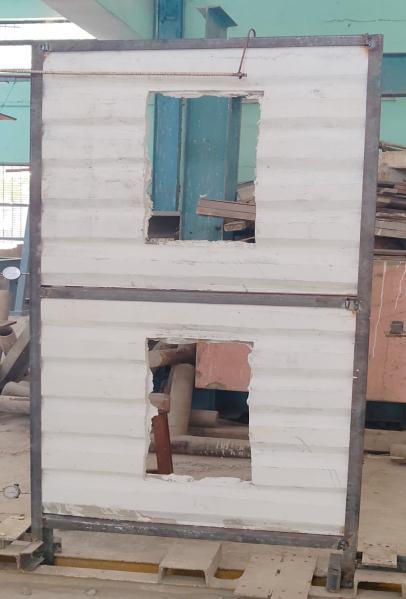
ISLC75channelsectionsofFe250gradesteelwasusedfor frame.Precastferrocementpanelswereinfilledwithinthe frames to behave as monolithically under loading. Below figureshowstheframeinfilledwithferrocementpanel.
4.
Theexperimentalinvestigationonbehaviourofsteelframes infilled with horizontally folded ferrocement panels with openingsunderlateralloads.
ForloadingframetwoISMC25080x10mmchannelsections placed 1500mm apart with total height 3700mm were selectedforverticalmembersandtwoISLB12575x6mm havinglength1500mmplaced100mmapartwereselected forhorizontalmembers.Baseplate1500mmlength,300mm wide,12mmthickconnectedbottomoftheseIsectionsand actedasbasetoframespecimens.
Apparatusused:
50kNcapacityLateralloadingframe(withfacilityto applytohorizontalload)fabricated
2Hydraulicjacksof100kNcapacityof0.5KNleast measurablevalues.
Threemagneticbasedialgaugesofleastcount0.01 mmtomeasurelateralsway.
The framespecimen with ferrocement panel with opening wasplacedinloadingframe.Twoloadpointswasmarkedat firstandsecondfloorlevels.
A custom fabricated loading frame of 50 KN capacity was used to apply in-plane-lateral loads. To simulate fixed end conditionssteelframewasrigidlyfixedatthebase.Lateral loadwasappliedattwolevelsmarkedatfloorlevelswere appliedwiththehelpofhydraulicjackstoreplicateseismic typeloading.
Magneticbasedialgaugesofleastcount0.01mmwereplaced at every storey level to measure lateral displacements. Gradualloadincrementswereappliedattwolevelandjacks werecontrolledbyindividualconsole.Forloadapplication handoperatedoilpumpswereused.Thejackswereplaced horizontallyinlinewiththecentreofbeamsofthespecimen. Frame specimen was painted to ensure visibility of cracks duringtesting.Thestaticlateralloadssimulatingearthquake loadsintheratio1:2respectivelyatlevelsoffirstandsecond floorwithincrementof2.5KN.
The 2D single bay two storey bare frame specimen was preparedsuchthatitcouldbeeasilyremovedfromcasting placeandlifted.Thespecimenwastransportedtoloading frame with the help of overhead crane available in laboratory.Twoloadpointsweremarkedatfirstandsecond floorandhydraulicjackswereplacedatthosepoints.The frame was aligned in loading frame such that it was erect with no tilt about horizontal or vertical plane. Using Arc welding,thecolumnbaseandplinthbeamweremedtohave fixedendcondition.Theloadingjackswerereadyandscale initializedtozero.MagneticbasedialgaugeofL.C.0.01mm werefixed totheloadingframetomeasurethehorizontal displacement (sway) at each storey level and the initial readingsweresettozero.Theloadswereappliedatfirstand secondstoreyintheratio1:2andincrementof2.5KN.
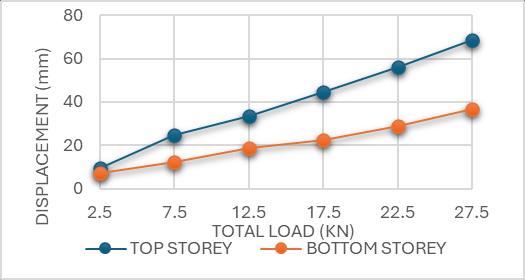
At every increment of load, frame members were closely examined for displacement. The maximum load recorded was27.5kN.Correspondingdisplacementoftopstoreywas 62.3mmandofbottomstoreywas35.67mm
International Research Journal of Engineering and Technology (IRJET) e-ISSN: 2395-0056
Volume: 13 Issue: 01 | Jan 2026 www.irjet.net p-ISSN: 2395-0072
Followingtablegivesthereadingsrecordedduringthetest onsteelframespecimen.
Table-1: Storey Displacement of Bare Frame Specimen
1
3
4
6
7
The following graph shows deflection of top and bottom storeyoftheframetothetotalloadappliedontheframe.
6.2 Testing of Frame Specimen Infilled with Ferrocement Panels with Window Opening
The 2D single bay two storey frames infilled with horizontallyfoldedferrocementpanelwithwindowopening was prepared such that it could be easily removed from casting place and lifted. The specimen was transported to loadingframewiththehelpofoverheadcraneavailablein laboratory.Twoloadpointsweremarkedatfirstandsecond floorandhydraulicjackswereplacedatthosepoints.The frame was aligned in loading frame such that it was erect with no tilt about horizontal or vertical plane. Using Arc welding,thecolumnbaseandplinthbeamweremedtohave fixedendcondition.Theloadingjackswerereadyandscale initializedtozero.MagneticbasedialgaugeofL.C.0.01mm werefixedtotheloadingframetomeasurethehorizontal displacement (sway) at each storey level and the initial readingsweresettozero.Theloadswereappliedatfirstand secondstoreyintheratio1:2andincrementof2.5KN.
At every increment of load, frame members were closely examined for displacement. The maximum load recorded
was52.5KN.Correspondingdisplacementoftopstoreywas 82.9mmandofbottomstoreywas41.62mm
. Followingtablegivesthereadingsrecordedduringthetest onsteelframespecimeninfilledwithferrocementpanel.
Table-2 Storey Displacement of Infilled Frame Specimen
Thefollowinggraphshowstotalloadanditscorresponding deflectionoftopstoreyandbottomstorey.
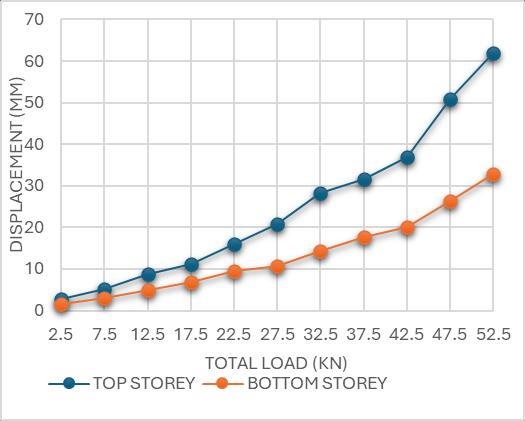
Chart-2: GraphShowingDeflectionofInfilledFrame
The following graphs represent load and deflection of top storey of a bare frame specimen and frame infilled with ferrocementpanelspecimen.
International Research Journal of Engineering and Technology (IRJET) e-ISSN: 2395-0056
Volume: 13 Issue: 01 | Jan 2026 www.irjet.net p-ISSN: 2395-0072
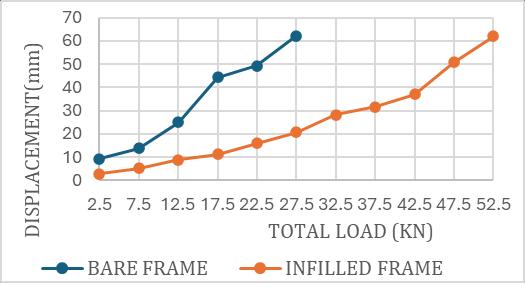
Chart-3: GraphShowingDisplacementofTopStorey
The following graphs represent load and deflection of bottomstoreyofabareframespecimenandframeinfilled withferrocementpanelspecimen
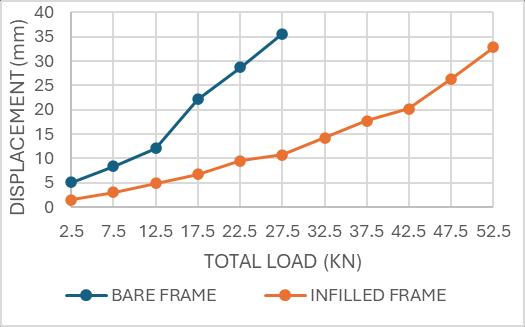
Chart-4 GraphShowingDeflectionofBottomStorey
7. CONCLUSIONS
Since Steel frames are ductile in nature no cracks or failure occurred when In-plane lateral load was applied.
Studying precast horizontally folded ferrocement panelswithwindowopeningshelpsinunderstanding itsbehaviorwhenlateralloadsareapplied.
Adding infills with window openings significantly increases overall stiffness of the frame by gradual decreaseindisplacement
In Bare frame, the stiffness is very least, there was a deflection of 62.3 mm (Top storey) when the load is 27.5KN
In Horizontally Folded Ferrocement with Window Openingsasinfill,topstoreydeflectionwas61.9mm, wheretheloadwas52.5KN.
Horizontally folded ferrocement with Window Openingsasinfill,bottomstoreydeflectionwas32.84 mm,wheretheloadwas52.5KN
Though we have tested for higher loads on infilled frames which has more stiffness when compared to bareframes.
TheInfilledframespecimensconsideredarestifferand canwithstandhigherloadthanbareframespecimen.
Frame with Horizontally folded Ferrocement infill specimen has higher stiffness, strength and deformationcapacity.
Fromtheabove,itcanbeseenthattheperformanceof infilled frame with horizontally folded ferrocement panelwithwindowopeningismuchbetterthanthatof bareframe.
Infilled frame with horizontally folded ferrocement infillcanbesaidtobegoodoptioninconstructions
[1] IS456:2000,PlainandReinforcedConcrete–Code ofPractice,BureauofIndianStandards,NewDelhi.
[2] IS 10262:2019, Concrete Mix Proportioning –Guidelines,BureauofIndianStandards,NewDelhi.
[3] N. Jayaramappa Dr. H. Sharada Bai “Behaviour of Ferrocement Panels Subjected to Inplane Lateral Load” Volume: 6 Issue: 6 June 2016 ISSN - 2249555XIF:3.919ICValue:74.50
[4] Somasekhar, N. Jayaramappa, C. Venkata Sai Nagendra “Comparative Study on Folded Ferrocement and Plain Ferrocement Panels SubjectedtoAxialLoading”57(6)December2021
[5] Mohamad N. Mahmood & Sura A. Majeed (2009) “FlexuralBehaviorofFlatandFoldedFerrocement Panels”Al-RafidainEngineeringVolume:17.
[6] Mariam Farouk Ghazy, Metwally Abd Allah. Abd Elaty,andAhmedAboElkhair“Flexuralbehaviour of geopolymer ferrocement plates and folded panels.” ICASGE’23 6-9 March 2023, Hurghada, Egypt.
[7] S.Kaliraj.S,P.Madasamy,andS.Dharmar,“Impact behaviourof geopolymer Ferro cement trough panel,” SSRG International Journal of Civil Engineering,pp.496-500,2017
[8] Malathy Ramlingam, Poornima Mohan, Parthiban Kathirvel and Gunasekaran Murali ‘‘Flexural Performance and Microstructural Studies of Trough-ShapedGeopolymerFerrocementPanels’’, PublishedbyMDPI.
[9] Sirajul Muneer. M & Dr.M. Neelamegam (2016), “Structural Behavior of Ferro cement Composite Wall Panels”, International Journal of Innovative Research in Science, Engineering and Technology Vol5,Issue6,pg.No-10442-10447