
International Research Journal of Engineering and Technology (IRJET) e-ISSN: 2395-0056
Volume: 13 Issue: 02 | Feb 2026 www.irjet.net p-ISSN: 2395-0072
International Research Journal of Engineering and Technology (IRJET) e-ISSN: 2395-0056
Volume: 13 Issue: 02 | Feb 2026 www.irjet.net p-ISSN: 2395-0072
Pooja G N1 , Dakshayini M L2 , Basavaraju M3 , Dr.H.C. Muddaraju4 , Dr. S. Gangadhara5
1 & 2MTech Student, Department of Civil Engineering, University Visvesvaraya College of Engineering (UVCE), Bengaluru, Karnataka, India – 560056
3Research Scholar Department of Civil Engineering, University Visvesvaraya College of Engineering (UVCE), Bangalore University, Bengaluru, Karnataka, India - 560056
4Associate Professor, Department of Civil Engineering, University Visvesvaraya College of Engineering (UVCE), Bangalore University, Bengaluru, Karnataka, India - 560056
5Professor, Department of Civil Engineering, University Visvesvaraya College of Engineering (UVCE), Bangalore University, Bengaluru, Karnataka, India - 560056
Abstract - Geogrid-reinforced soil foundations (GRSF) are widely employed in geotechnical engineering to enhance the bearing capacity of weak subgrades and to minimize footing settlement. Beyond their effectiveness insoft soilimprovement, GRS systems contribute to the overall stability and durability of infrastructure by redistributing stresses and providing tensile resistance within the soil mass. These reinforcement techniques have proven valuable in applications rangingfrom highway embankments and bridge approaches to retaining structures and foundation systems, where both load-bearing efficiency and long-term serviceability are critical
This study experimentally investigates the behavior of a square footing resting on unreinforcedandgeogrid-reinforced sand beds under static loading. Laboratory model tests were conducted using a rigid square footing of size 100 mm × 100 mm on sand prepared at a relative density of 35%. Commercially available biaxial polypropylene geogrids witha tensile strength of 40 kN/m were used as reinforcement. The depth of the first reinforcement layer was fixed at U/B = 0.3, while the reinforcement spacing (S/B = 0.3, 0.4 and 0.5) and number of layers (N=2,3,4&5) were varied. Results show significant improvement in bearing capacity and settlement response due to reinforcement. Regression models validated through ANOVA showed good agreement with experimental results, confirming the effectiveness of geogrid reinforcement under static loading.
Key Words: Shallow foundations, Geogridreinforcement, Bearing capacity, Static loading, ANOVA, Regression analysis, Square Footing
Geogrid-reinforced soil foundations (GRSFs) have been widely adopted in geotechnical engineering applications such as bridge abutments, approach slabs, building foundations,andembankmentsduetotheireffectivenessin improving the performance of shallow foundations. Soil reinforcement enhances bearing capacity and reduces
settlement, offering an economical alternative to conventionalgroundimprovementmethods.
Thegeogridsareeffectiveinreinforcedfoundationsystems owingtotheirsuperiorinterlockingwithgranularsoils.The performance of reinforced soil foundations is primarily governedbykeygeometricparameterssuchasthedepthof the first reinforcement layer (U/B), the vertical spacing between reinforcement layers (S/B), and the number of reinforcement layers (N). These parameters significantly influencetheload–settlementresponseandbearingcapacity ofreinforcedsoilfoundations.
Numerous researchers [1] to [21] have carried out experimental investigations and analytical studies employing geosyntheticreinforcementmaterialstoenhance the performance of soft soil foundations. Their work has demonstrated improvements in both foundation stability andstructuralintegrity
Abdrabbo et al. [2] experimentallydemonstratedthatsoil reinforcementsignificantlyimprovesthebearingcapacityof sand, with greater improvement observed in loose sand. TheyreportedoptimumreinforcementparametersofL/B= 3.0 and d/B = 0.30, and observed a punching-shear type failure mechanism. G. Madhavi Latha and Amit Somwanshi [11] conductedlaboratorymodelfootingtests and numerical analyses on square footings resting on geosynthetic-reinforced sand beds to evaluate the performanceofdifferentreinforcementforms.Theirresults indicatedthatgeocellreinforcementisthemosteffectivein improving bearing capacity and stress–displacement behavior,whilerandomlydistributedgeogridmeshelements are less efficient compared to planar and geocell reinforcements.
Asif Akbar et al.[4] studied the effectiveness of geocomposite reinforcement in layered soil systems as a sustainable solution for soft soils. They reported that geotextile–geogrid composite layers enhance soil confinement and shear strength, leading to 33.8–40.6 %
International Research Journal of Engineering and Technology (IRJET) e-ISSN: 2395-0056
Volume: 13 Issue: 02 | Feb 2026 www.irjet.net p-ISSN: 2395-0072
improvementinloadcarryingcapacityalongwithreduced settlements. Arvind Kumar and Swami Saran [4] investigatedthebehaviorofcloselyspacedstripandsquare footings on geogrid-reinforced sand and reported that providing continuous reinforcement layers significantly improvesbearingcapacity,settlement,andtilt,especiallyfor closelyspacedstripfootings,whileinterferenceeffectsfor square footings were minimal. Bera et al.[5] developed a power-based regression model to predict the bearing capacity of square footings on reinforced pond ash using extensive experimental data. Their analysis identified key reinforcement and geometric parameters influencing performanceandachievedahighpredictiveaccuracy(R²_adj ≈ 0.945), with most predictions falling within acceptable errorlimitsandvalidatedusingindependenttestdata.
G. Madhavi Latha et al.[12] reviewed existing analytical approachesanddevelopedamultipleregressionequationto predicttheultimatebearingcapacityofsquarefootingson geosynthetic-reinforcedsandconsideringkeyreinforcement andsoilparameters.Theirstudyshowedthatreinforcement aperturesizeplaysadominantrole,andtheproposedmodel reasonablypredictsthebearingcapacityofsquarefootings ondensesandreinforcedwithplanargeosynthetics.
Overall, the reviewed studies clearly indicate that soil reinforcement is an effective and reliable technique for enhancing the bearing capacity and deformation performance of foundation systems. The improvement is stronglyinfluencedbyreinforcementconfiguration,depth, spacing,stiffness,andsoildensity,withthree-dimensional systems such as geocells and geocomposites showing superior performance due to enhanced confinement and interlocking. Continuous reinforcement layers are particularly beneficial in reducing settlement and tilt, especiallyforcloselyspacedfootings.
Inaddition,regression-basedpredictivemodelshaveproven usefulincapturingthecomplexinteractionbetweensoiland reinforcement, highlighting the potential for developing reliable design-oriented equations to estimate bearing capacity of reinforced soils under various loading and boundaryconditions.
Multiple Linear Regression (MLR) is employed in this study to quantify the relationship between response variablesandmultipleinfluencingparametersinreinforced soilsystems.Themethodexpressesthedependentvariable as a linear combination of independent variables and regression coefficients, enabling assessment of both individual and combined parameter effects. Nonlinear behaviour is accommodated through polynomial and interaction terms, while model adequacy and predictive capabilityareevaluatedusingstatisticalmeasuressuchasR², adjustedR²,andsignificancetests.
Theselectionofgoverningparametersfortheregression analysiswasbasedontheirphysicalrelevanceandinfluence on the response of square footings resting on geogridreinforced sand beds under static loading. In the present study, bearing pressure and number of load cycles were considered as dependent variables, representing the loadcarryingcapacityandcyclicperformanceofthefoundation system.Reinforcementspacingandnumberofgeogridlayers were selected as independent variables, while relative density,reinforcementtensilestrength,andU/Bratiowere keptconstanttoisolatetheireffects.Theseparameterswere chosentocapturethecombinedinfluenceofreinforcement configurationonload–settlementbehavior,bearingcapacity, stiffness, and cyclic response, forming a consistent and reliablebasisforregressionmodeling.
A regression model is used to describe and predict the relationshipbetweenadependentvariableandoneormore independent variables based on experimental data. To account for nonlinear and interaction effects, a multiple polynomialregressionmodelmaybeexpressedas:
whereYisthedependentvariable,Xᵢaretheindependent variables,β₀istheintercept,βᵢ,βⱼⱼ,andβⱼⱼareregression coefficients, and ε is the random error term. Such models provideapracticalframeworkforinterpretingexperimental results and predicting system performance within the definedrangeofvariables.
Theoverallsignificanceoftheregressionmodelisexamined toverifywhetherthesetofindependentvariablescollectively explainsastatisticallysignificantportionofthevariationin theresponsevariable.Thisevaluationisperformedthrough hypothesistesting,wherethenullhypothesisassumesthatall regression coefficients associated with the independent variablesareequaltozero,indicatingnolinearrelationship, while the alternative hypothesis implies that at least one coefficientisstatisticallysignificant.
H₀:β₁=β₂=…=βⱼ=0
H₁:Atleastoneβⱼ≠0(j=1,2,…,k)
TheadequacyofthemodelisassessedusingtheF-statistic, defined as the ratio of the mean square due to regression (MSR)tothemeansquareerror(MSE):
Where
F=MSR/MSE
MSR=SSR/k
MSE=SSE/(n−k−1)
Here, k denotesthenumberofindependentvariablesand n representsthetotalnumberofobservations.Theregression
International Research Journal of Engineering and Technology (IRJET) e-ISSN: 2395-0056
Volume: 13 Issue: 02 | Feb 2026 www.irjet.net p-ISSN: 2395-0072
sumofsquares(SSR),errorsumofsquares(SSE),andtotal sumofsquares(SST)areexpressedas:
SST=Σ(yᵢ−ȳ)²
SSR=Σ(ŷᵢ−ȳ)²
SSE=Σ(yᵢ−ŷᵢ)² whereyᵢaretheobservedvalues,ŷᵢarethepredictedvalues from the regression model, and ȳ is the mean of the dependent variable. These components satisfy the fundamentalANOVArelationship: SST=SSR+SSE
Table -1: ANOVA Results for Regression Analysis
Source of Variation Sum of Squares Degrees of Freedom Mean Square F-value
Regressio n SSR k MSR= SSR/k F=MSR/ MSE
Error (Residual) SSE n−k−1 MSE= SSE/(n− k−1)
Total SST n−1
Astatisticallysignificantregressionmodelisidentifiedwhen thecalculatedF-valueexceedsthecriticalvalueatachosen significance level, indicating that the model explains a substantialproportionoftheobservedvariabilitycompared torandomerror.
Where:
n=totalnumberofobservations
k=numberofindependentvariables
SST=totalsumofsquares
SSR=sumofsquaresduetoregression
SSE=sumofsquaresduetoerror
Thegoodnessoffitofaregressionmodelreflectsitsability torepresentexperimentaldataandexplainthevariationin thedependentvariable.Thisiscommonlyassessedusingthe coefficient of determination (R²), which varies between 0 and 1, with higher values indicating improved model performance. However, since R² may artificially increase withtheadditionofextravariables,theadjustedcoefficient of determination is adopted to account for the number of predictorsinthemodel.TheadjustedR²isexpressedas:
AdjustedR²=1−[(1−R²)(n−1)/(n−k−1)]
where n is the total number of observations and k is the number of independent variables. A regression model exhibiting a high adjusted R², along with a low standard error and randomly distributed residuals, is considered statistically adequate for representing the experimental behaviourwithinthespecifiedrangeofvariables.
In multiple linear regression analysis, the statistical significanceofindividualregressioncoefficientsisexamined to evaluate the contribution of each independent variable whileaccountingfortheeffectsofotherpredictors.Foreach regression coefficient βj, the following hypotheses are tested:
H₀:βj=0
H₁:βj≠0
Thesignificanceofeachcoefficientisassessedusingthetstatistic,expressedas:
tj=βj/SE(βj) whereβjistheestimatedregressioncoefficientandSE(βj)is its standard error. A regression coefficient is considered statistically significant when the corresponding p-value is less than the selected significance level (α). The sign and magnitudeofstatisticallysignificantcoefficientsindicatethe directionandrelativeinfluenceoftheassociatedvariables, enablingidentificationofthekeyparametersgoverningthe regressionmodel.
Variables were selected based on physical relevance and theirinfluenceonreinforcedsandbehavior.Thenumberof reinforcement layers (N) and reinforcement spacing ratio (S/B) were taken as independent variables, while relative density,depthoftheupperreinforcementlayer(U/B),and tensilestrengthwerekeptconstant.Bearingpressureand number of load cycles were considered as dependent variablesunderstaticloading,respectively,ensuringastable andreliableregressionmodel.
Multiple linear regression analysis was performed on the resultsofmodelfootingtestsconductedunderstaticloading to establish a predictive relationship between bearing pressureandreinforcementconfigurationparameters.The regressionanalysiswascarriedoutusingtheleast-squares method with Analysis of Variance (ANOVA) to evaluate modeladequacy.Thereinforcementspacingratio(S/B)and thenumberofreinforcementlayers(N)wereconsideredas independentvariables,whilebearingpressure(q)wastaken as the response variable. Throughout the experimental program, the relative density of sand, tensile strength of reinforcement,anddepthoftheuppermostreinforcement layer(U/B)weremaintainedconstant.
The proposed regression model for static loading is expressedas:
q=β₀+β₁(S/B)+β₂N+β₃N²+β₄N³+β₅(S/B)N
International Research Journal of Engineering and Technology (IRJET) e-ISSN: 2395-0056
Volume: 13 Issue: 02 | Feb 2026 www.irjet.net p-ISSN: 2395-0072
where β₀ represents the intercept and β₁ to β₅ are the regression coefficients. Higher-order polynomial terms of the number of layers and an interaction term between reinforcement spacing and number of layers were incorporatedtoaccountfornonlinearandcombinedeffects. Theregressionmodelwasdevelopedusingatotaloftwelve experimentaldatapoints.
The very high F-value and extremely low p-value confirm that the regression model is statistically significant at conventional confidence levels and that the observed relationship between bearingpressureand reinforcement parametersisnotduetorandomvariation.Thelowresidual errorfurtherindicatesthatthemodelreliablyrepresentsthe experimental behavior within the investigated range of variables.
Source

Basedontheregressionanalysisoftheexperimentalresults, the final empirical expression for bearing pressure under staticloadingisgivenby: where
q=bearingpressure, S/B=spacingratiobetweenreinforcementlayers,and N=numberofreinforcementlayers.
The above equation incorporates linear, nonlinear, and interaction terms to capture the combined influence of reinforcementspacingandnumberoflayersonthebearing pressureofthereinforcedsandbedwithintheinvestigated parameterrange.
Table 2: Experimental data
Theregressionmodelexhibitsanexcellentfit,withMultiple R=0.99932,R²=0.99864,adjustedR²=0.99750,andalow standarderrorof46.74.Thesestatisticsconfirmthestrong agreement between experimental and predicted bearing pressurevaluesanddemonstratethereliabilityofthemodel withintheinvestigatedrange.
The adequacy and statistical validity of the proposed regressionmodelwereevaluatedusingAnalysisofVariance (ANOVA).Thecoefficientofdeterminationobtainedfromthe analysis (R² = 0.9986) indicates that 99.86 % of the total variation in bearing pressure is explained by the selected independentvariables,demonstratinganexcellentlevelof agreementbetweentheexperimentalandpredictedresults.
The statistical significance of individual regression coefficients was evaluated using p-values at a 95% confidencelevel(α=0.05)understaticloadingconditions. Theresultsindicatethatthenumberofreinforcementlayers (N)hasasignificantinfluenceonbearingpressure,whilethe higher-order terms (N² and N³) confirm a pronounced nonlinear response. The interaction term (S/B)·N is also statisticallysignificant,highlightingthecombinedeffectof spacing and reinforcement layering, whereas the spacing ratio (S/B) alone is not significant within the investigated range.Thesefindingsdemonstratethatbearingpressureis predominantlygovernedbyreinforcementlayeringandits nonlinear and interaction effects, supporting the adopted regressionformulation.
International Research Journal of Engineering and Technology (IRJET) e-ISSN: 2395-0056
Volume: 13 Issue: 02 | Feb 2026 www.irjet.net p-ISSN: 2395-0072
The normality of residuals was examined to verify the validityoftheregressionassumptionsunderstaticloading conditions. The Anderson–Darling test conducted at a significancelevelofα=0.05yieldedateststatisticofA²= 0.354, which is lower than the critical value of 0.679, indicating that the null hypothesis of normality cannot be rejected.Inaddition,thestandardizedresidualsfallwithin acceptablelimitswithoutextremeoutliers,confirmingthat the residuals are approximately normally distributed and that the regression model provides reliable statistical inference.
Acomparisonbetweenexperimentalandpredictedbearing pressure values was conducted to evaluate the predictive performance of the regression model under static loading conditions. As illustrated in Fig 1, the predicted values closelyfollowthereferenceline(y=x),indicatingexcellent agreement and high prediction accuracy. This is further supported by the high coefficient of determination (R² = 0.9986),whilethesmallandrandomlydistributedresiduals confirmtheabsenceofsystematicbias.Overall,themodel reliablycapturestheinfluenceofreinforcementspacingand numberoflayersonbearingpressure.
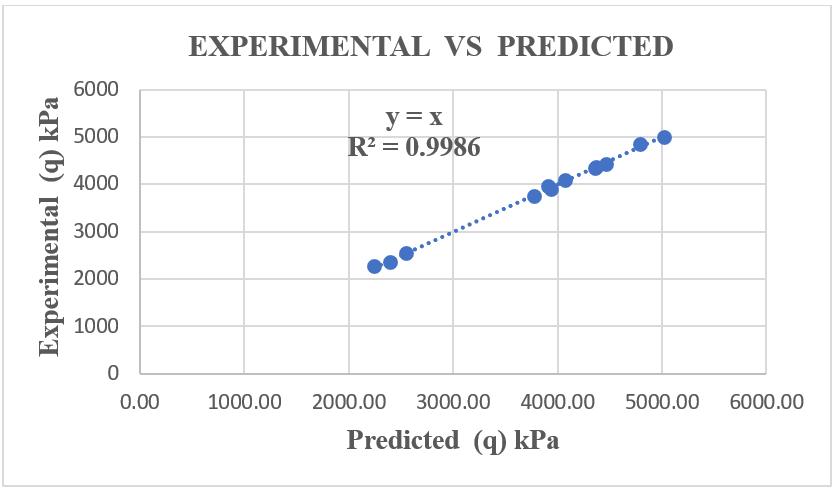
Fig -1:ComparisonbetweenExperimentalandPredicted BearingPressure
The proposed regression models reliably predict static bearingpressureandcyclicloadresponseofreinforcedsand foundationswithintheinvestigatedexperimentalrangeof reinforcementspacing(S/B)andnumberoflayers(N).The modelsarevalidonlywithinthetestedparameterlimitsand should not be extrapolated. Although derived from laboratory-scale experiments, the models provide dependable predictions within their scope, while field applicationrequiresappropriatecalibration.
A polynomial regression model was developed to predict bearing pressure (q) of square footings on geogridreinforced sand under static loading, with reinforcement spacingratio(S/B)andnumberofreinforcementlayers(N) asindependentvariables.
1. The model exhibited excellent predictive performance (R² = 0.9986, adjusted R² = 0.9975) withalowstandarderror(46.74),indicatingstrong agreement between experimental and predicted results.
2. Statistical validation using ANOVA confirmed the overall significance of the model, with reinforcement layering (N) identified as the dominantparameterinfluencingbearingpressure.
3. Thesignificanceofhigher-orderterms(N²,N³)and the interaction term (S/B·N) highlights the nonlinear and combined effects of reinforcement configuration.
4. Residual and normality analyses verified that regression assumptions are satisfied, with small, randomly distributed, and normally distributed residuals.
5. Although polynomial terms introduce multicollinearity, VIF analysisshowednoadverse effect on predictive accuracy, as the model is intendedforresponseprediction.
6. The proposed model is applicable within the investigated experimental range and provides a reliable tool for estimating static bearing performanceofreinforcedsandfoundations,with fieldapplicationrequiringappropriatecalibration.
International Research Journal of Engineering and Technology (IRJET) e-ISSN: 2395-0056
Volume: 13 Issue: 02 | Feb 2026 www.irjet.net p-ISSN: 2395-0072
[1] Abu-Farsakh,M.,Chen,Q.,andSharma,R.(2013),“An experimentalevaluationofthebehaviouroffootingson geosynthetic-reinforced sand”, Soils and Foundations, Vol. 53, Issue 2, Pages 335–348. DOI: https://doi.org/10.1016/j.sandf.2013.02.012
[2] Abdrabboetal.(2004),”BehaviorofsquareFootingson Single reinforced Soil”, American Society of Civil Engineers (ASCE) Journal of Geotechnical and Geoenvironmental Engineering, DOI: https://doi.org/10.1016/40713(2004)83
[3] Ahmad, H., Shukla, S. K., and Sivakugan, N. (2022), “Investigation of the influence of interaction of wraparound geogrid–sand on the load bearing–settlement behavior of strip footings”, Geotextiles and Geomembranes, Vol. 50, Issue 4, Pages 692–708. DOI: https://doi.org/10.1016/j.geotexmem.2022.02.003
[4] ArvindKumarandSwamiSaran(2003)“CloselySpaced FootingsonGeogrid-ReinforcedSand”AmericanSociety of Civil Engineers (ASCE) Journal of Geotechnical and GeoenvironmentalEngineering,Vol.129(7),660-664 DOI:https://doi.org/10.1061/(asce)10900241(2003)129:7(660)
[5] AsifAkbar,JavedAhmadBhat,BashirAhmedMir(2023) “Bearing Capacity of a Model Square Footing on Geocomposite Reinforced Layered Soil” Geotechnical and Geological Engineering. 42(2), pages 1-20. DOI: https://doi.org/10.1007/s10706-023-02613-3
[6] Bera, A.K., Ghosh, A., Ghosh, A. (2005). “Regression model for bearing capacity of square footing on reinforcedpondash.”GeotextilesandGeomembranes, Vol.23,Issue6,pp.480–495.
[7] Budania, R., Choudhary, A. K., and Jain, P. K. (2017), “Experimentalstudyofrectangularfootingrestingover geogrid reinforced sand”, International Journal of Geotechnical Engineering, Vol. 11, Issue 4, Pages 356–368. DOI: https://doi.org/10.1080/19386362.2016.1225304
[8] Demir, A., Laman, M., and Yildiz, A. (2013), “Experimental and numerical analyses of circular footingongeogrid-reinforcedgranularfillunderlainby softclay”, Soils and Foundations,Vol.53,Issue1,Pages 181–195. DOI: https://doi.org/10.1016/j.sandf.2012.12.012
[9] Hakeem, B. M. (2022), “Experimental study and numerical modelling on the performance of circular footingrestingongeogrid-reinforcedgranularsoilbed”, Innovative Infrastructure Solutions, Vol. 7, Article 150. DOI:https://doi.org/10.1007/s41062-022-00794-9
[10] Kutner, M. H., Nachtsheim, C. J., Neter, J., and Li, W. (2005), Applied Linear Statistical Models, 5th Edition, McGraw-Hill/Irwin,NewYork,USA.
[11] MadhaviLatha,G.,andSomwanshi,A.(2009),“Bearing capacityofsquarefootingsongeosyntheticreinforced sand”, Geotextiles and Geomembranes,Vol.27,Issue4, Pages 281–294. DOI: https://doi.org/10.1016/j.geotexmem.2009.01.001
[12] MadhaviLatha,G.,Raja,A.,andSomwanshi,A.(2013), “A multiple regression equation for prediction of bearingcapacityofgeosyntheticreinforcedsandbeds”, Geotextiles and Geomembranes, Vol. 39, Pages 1–12. DOI:https://doi.org/10.1016/j.geotexmem.2013.06.001
[13] MoghaddasTafreshi, S.N.,andDawson,A.R.(2010), “Comparison of bearing capacity of a strip footing on sand with geocell and with planar forms of geotextile reinforcement”, Geotextiles and Geomembranes,Vol.28, Issue 1, Pages 72–84. DOI:https://doi.org/10.1016/j.geotexmem.2009.09.004
[14] MoghaddasTafreshi,S.N.,Khalaj,O.,andDawson,A.R. (2012), “A comparison of static and cyclic loading responses of foundations on geocell-reinforced sand”, Geotextiles and Geomembranes, Vol. 32, Pages 55–68. DOI:https://doi.org/10.1016/j.geotexmem.2011.11.003
[15] Montgomery,D.C.,Peck,E.A.,andVining,G.G.(2012), Introduction to Linear Regression Analysis,5thEdition, JohnWiley&Sons,NewYork,USA.
[16] Myers,R.H.,Montgomery,D.C.,andAnderson-Cook,C. M.(2016), Response Surface Methodology: Process and Product Optimization Using Designed Experiments, 4th Edition, John Wiley & Sons, New York, USA.
DOI:https://doi.org/10.1002/9781118916018
[17] Raja,R.,andShukla,S.K.(2021),“Experimentalstudy on repeatedly loaded foundation soil strengthened by wraparound geosynthetic reinforcement technique”, Geotextiles and Geomembranes, Vol. 49, Issue 6, Pages 1536–1551.
DOI:https://doi.org/10.1016/j.geotexmem.2021.04.006
[18] Useche-Infante,D.,Guarin,A.,andDiaz-Rodriguez,J.A. (2019), “Experimental study of behaviour of circular footing on geogrid-reinforced sand”, Geotechnical and Geological Engineering, Vol. 37, Issue 3, Pages 1941–1960.
DOI:https://doi.org/10.1007/s10706-018-0743-1
[19] Wang,J.Q.,Wang,F.,andWang,J.H.(2018),“Load–settlement response of shallow square footings on geogrid-reinforced sand under cyclic loading”, Soil Dynamics and Earthquake Engineering,Vol.111,Pages 10–21.
DOI:https://doi.org/10.1016/j.soildyn.2018.04.019
International Research Journal of Engineering and Technology (IRJET) e-ISSN: 2395-0056
[20] Zamani, S., Shahrabi, M. M., and Hosseini, S. M. M. (2023),“Experimentalstudyofthebehaviourofsquare footing on reinforced sand with treated geotextile”, Construction and Building Materials, Vol. 366, Article 130103.
DOI:https://doi.org/10.1016/j.conbuildmat.2022.13010
3
[21] Zidan,A.F.(2012),“Numericalstudyofbehaviourof circularfootingongeogrid-reinforcedsandunderstatic anddynamicloading”, Alexandria Engineering Journal, Vol. 51, Issue 2, Pages 151–160. DOI: https://doi.org/10.1016/j.aej.2012.03.002
Volume: 13 Issue: 02 | Feb 2026 www.irjet.net p-ISSN: 2395-0072 © 2026, IRJET | Impact Factor value: 8.315 | ISO 9001:2008