
International Research Journal of Engineering and Technology (IRJET) e-ISSN:2395-0056
Volume: 12 Issue: 01 | Jan 2025 www.irjet.net p-ISSN:2395-0072
International Research Journal of Engineering and Technology (IRJET) e-ISSN:2395-0056
Volume: 12 Issue: 01 | Jan 2025 www.irjet.net p-ISSN:2395-0072
Santosh kumar Gupta1
1Department of Mechanical Engineering, Madan Mohan Malviya University of Technology, Gorakhpur, Uttar Pradesh -273010, India
1Mechanical Engineering, Department of Technical Education, Uttar Pradesh-India
Abstract - Aconstantvolume,adiabaticsystemwasused tostudytheexergylossduringthecycle.Thisanalysiswas conducted without any experimental measurements. The percentageoffuelavailableformethanol-airmixturesthat was used up in irreversible processes was computed as a function of temperature, pressure, and equivalency ratio. The quantity of accessible energy destroyed by combustion generally decreases as temperature rises. Because methanol and ethanol include some oxygen, they don't ignite with sparks. This study examines a fuel-air real cycle and performs equivalency ratio-dependent calculations for exergy destruction during compression, combustion, expansion, and exhaust. The methanol and ethanolanalyseswereconductedusingequivalencyratios of 0.8, 0.9, 1.1, and 1.2. Varying the equivalence ratio is novelty of research. As the equivalency ratio varied, calculations were also made for the destruction and availability of energy during compression for methanol and ethanol. Additionally, depending on the particular operating conditions, the equivalency ratio has a significant impact on availability and destruction. Discussion is held regarding the implications of these discoveries for the combustion processes of internal combustion engines. The impact of altering the equivalency ratio on the maximum temperature and combustionefficiencyisevaluated.
Key Words: Spark ignition engine, Exergy, Equivalent ratio, compression, combustion
It is well known that combustion processes result in an irreversible loss of energy or availability. One direct outcomeistheavailabilityofenergyconversionsystems.A powerful exposition of relevant physical facts, the second law of thermodynamics has numerous applications in engineering and energy conversion system operation. As anillustration,thesecondlawdeterminesthedirectionof processes, establishes equilibrium conditions, calculates the maximum performance of thermal systems, and identifies the elements of processes that are harmful to overall performance. The second law of thermodynamics offers a framework for a more comprehensive understanding of combustion processes. deep comprehension of the energy conversion mechanism. [1,2,3]
The objective of the current study was to examine in detail the destruction of availability due to the compression process. The compression process in adiabatic, constant volume combustion system was studied.
Ethanol, methanol, and propane are the alternative fuels under consideration. An engineer is interested in determining the most useful work that can be obtained from a system in a given state.[27][28] Obviously, the maximum work will be obtained only when the system's finalstateisinequilibriumwithitssurroundings.Inother words, until the system's interaction with the environment reaches a point where it can no longer function in any way. A system's availability is determined by the maximum amount of useful work that may be obtainedthroughoutaprocessthatendswhenthesystem reaches a state of inactivity or equilibrium with its surroundings.[4]Itisobviousthatasystem'savailabilityis dependentuponbothitsinternalandexternalconditions.
Thesecondlawofthermodynamics,a comprehensiveand potent statement of related physical observations with numerous implications for the engineering design and operation of energy conversion systems, directly leads to availability.[5].
Athermodynamicpropertyofasystem,availabilityisalso knownasexergyorexergy(essenceofenergy)byvarious authors. It measures the maximum useful work that a system can achieve when it is permitted to reversibly transitiontoa thermodynamicstatethat isin equilibrium withitssurroundings.[23][24]
The restricted dead state is used to characterize the conditions of the local environment. This was selected because, when a system reaches perfect balance with its immediate surroundings, it can no longer generate any morevaluableworkandisdeemedtobe"dead."Thisdead state is incomplete and called "restricted" because the contents of the system cannot mix or react with the surroundings.[24][25]
International Research Journal of Engineering and Technology (IRJET) e-ISSN:2395-0056
Volume: 12 Issue: 01 | Jan 2025 www.irjet.net p-ISSN:2395-0072
For the dead state conditions, 298.15 K and 101.325 kPa (1 atm) are the recommended temperature and pressure. Thecompositionofthedeadstateneedstobespecifiedin addition to the temperature and pressure of the dead state.
The entropy of a system plus its surroundings (i.e. an isolatedsystem)canneverdecrease(2ndlaw).Thesecond lawstates:[26]
(ΔS)System +(ΔS)surr.=0,whereΔ=final–initial
>0irreversible(realworld)
=0reversible(frictionless,ideal)
If Q is the heat from a source at T, then in an ideal situation,itsavailabilityorthemaximumamountofwork itcanproduceisQ(1-T0/T),
where T0 is the ambient temperature. It will always be less than this amount. We call the difference as irreversibility.
Availability=Maximumpossiblework-Irreversibility
W useful =W rev –I (1.1)

The differential amount of work done by the engine is givenby
dW=dQ =dQ(1-To/T) (1.2)
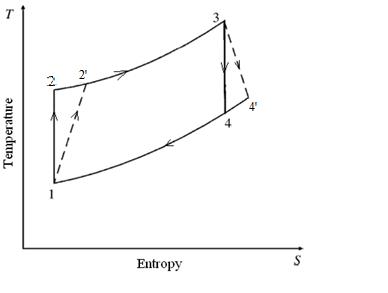
IftheCarnotengineworkstillthetemperatureofthebody attains a value T2 (Figure 1.2) the total work done by the reversibleengineisgivenby
Once the thermodynamic properties of a given set of conditions are known, determining availability is comparatively straightforward. The kinetic and potential energies are ignored in this development (and can be shown to be negligible). All the way through the system, everytime.[28,31,39]
a=(u-u0)+p0(v-v0)-T0(s-s0) (1.4)
Theavailabilitybalancereducesto adest=a1-a2 (1.5)
changeinentropyduetoirreversibility’sasfollows: adest=T
whereSgenisthechangeinentropyduetoirreversibility
A system's exergy is the maximum shaft work it can accomplish within a specific reference environment. It is assumed that the reference environment is limitless, harmonious,andencompassesallothersystems..[17]
Table3.1ofPropertiesofFuelsUsedinAnalysis
TABLE–3.1PROPERTIESOFVARIOUSFUELS[15,16]


W= = Q(1- )= -To

=Q-To (1.3)
International Research Journal of Engineering and Technology (IRJET) e-ISSN:2395-0056
Volume: 12 Issue: 01 | Jan 2025 www.irjet.net p-ISSN:2395-0072
4. Mathematical formulations
4.1Thermodynamic Relations
Inordertodefinethecompositionandfuelairequivalency ratio, it is useful to know the fuel air equivalency ratio, whichisdefinedas
Φ=(F/A)actual/(F/A)stoichiometric (4.1)
Themolecularweightsofthereactantsandproductswere calculatedusingthefollowingrelations.
MR=∑niMi/N (4.2)
The quantity of reactant or product moles per working fluid mass unit is denoted by ni. The species has a molecularmassofMiandatotalmolecularmassofN.The relationship is used to determine the specific heat of the reactantandproduct.
Cp = ∑ni Cpi/N (4.3) Cv = ∑ni Cvi/N (4.4)
ThevalueofCpandCvwerecalculatedattwopoints
Atthebeginningofthecompressionprocess
At the average temperature (temperature following compressionplusadiabaticflametemperature)/2during the combustion processValues of Cp and Cv of different fuelsarecalculatedusingthefollowingequations.Specific heatsasafunctionoftemperaturearerepresentedas
(TinK,Cpinkj/kmolK)
Thevaluesoftheconstantsa,b,canddaretakenfromthe table4.1.
The compression efficiency can be defined as (For the reversibleadiabaticprocess1-2s)
WhereγistheadiabaticindexanditsvalueisCp/Cv
Now polytropic index is calculated by using the following equation
whereVrepresentsthegasinthecylinder'svolume.
A balance equation for availability was used to determine themixture'savailabilityduringcompression.(1–2).[39]
The energy with work transfer is represented by the secondterminthisequation,andtheenergydestructionis representedbythethirdterm.
During the compression process, entropy generation is providedby Sgen =(Cp lnT2/T1 –RlnP2/P1 +Q/T
In this cycle, the choice of constant volume adiabatic combustion allows for the combustion process to be held responsible for any variations in availability. Since combustion is adiabatic, there won't be any availability transfer as a result of heat loss through the cylinder wall. Undesirably high temperatures are reached at the maximum cycle temperature when all of the fuel's energy isdeployed. Qin ×ηc ×LHV=mf Cv (T3 –T2) (4.12)
Wheremfisthemassflowrateoftheairfuelmixture.
The ratio of the net chemical energy released to the total energy released during combustion is known as combustionefficiency.[22] ηc =HR (TA)–HP(TA)/mf ×LHV (4.13) WhereHR (TA)–HP(TA)=m(∑ni∆hfi)R -(∑ni
∆hfi is the standard enthalpy of formation of species i at ambienttemperatureTA.
For every system going through any process, including reacting systems, the entropy balance is expressed as[25][26]
International Research Journal of Engineering and Technology (IRJET) e-ISSN:2395-0056
Volume: 12 Issue: 01 | Jan 2025 www.irjet.net
Sin –Sout +Sgen=ΔSsys (4.15)
Sin –Sout isnetentropytransferbyheatandmass. Sgen is entropy generation and ΔSsys is the change in entropy.
∑Qk/Tk +Sgen =Sprod -Sreact (4.16)
Where Tk is the temperature at the boundary where Qk crossesit.
Butforanadiabaticprocess(Q=0)soentropygeneration foranadiabaticprocessisgivenby
Sgen =Sprod -Sreact (4.17)
Absoluteentropyvaluesatpressuresotherthan1atmfor anytemperatureTareobtainedfromtheidealgasentropy changerelation.[19]
(T,P)= 0(T,Po)– lnP/Po (4.18)
(T,Pi)= 0(T,Po)– lnyi Pm/Po (4.19)
Where Pi is the partial pressure, yi is the mole fraction of thecomponent,andPm isthetotalpressureofthemixture.
Energy destruction during combustion process is given by[19],[20].
Edest =T0Sgen (4.20)
Percentageofenergydestructionisdefinedas Energy destruction during combustion/ Chemical energy ofthefuel (4.21)
TABLE–4.1CONSTANTVALUESFOREQN.(4.6)[21]
5.Analysis
Since the equivalency ratios of different fuels vary, the equivalencyratiosusedintheanalysisare0.8,0.9,1.1,and 1.2. This is because the entire exergy analysis is based on these differences. This is so because these discrepancies formthefoundationoftheentireexergyanalysis.
Figure6.1showstheAirfuelRatiovsEquivalenceratiofor the all-selected fuels. It is shown that changes in air fuel ratiofortheall-selectedfuels.
6.2 Energy Destruction during compression vs Equivalence ratio
Equivalance ratio
Figure 6.2 illustrates how the energy dissipation during compression changes the methanol and ethanol equivalency ratios. Energy destruction during compression is demonstrated to decrease up to the stoichiometric condition (Φ = 1), and this is because, for all selected fuels, temperature after compression decreases up to an equivalency ratio of 0.8 to 1. This reduces the amount of heat transfer through the wall. Figure 6.2 illustrates how energy destruction during compression rises in rich conditions to an equivalency ratioof1.1andthenfallsfurtherforallselectedfuels.The temperature at an equivalency ratio of 1.1 is higher than the temperature at an equivalency ratio of 1.2, which explains why.Because temperature isatits lowestduring
Volume: 12 Issue: 01 | Jan 2025 www.irjet.net
stoichiometric conditions, energy destruction during compressionisatitslowest.
6.3 Change in Availability during compression vs Equivalence ratio
Theavailabilityofeachofthechosenfuelschangesduring compression,asseeninFigure6.3.Itisdemonstratedthat availability increases for all selected fuels following compression, and this is because work is supplied during this process. Additionally, it is demonstrated that the trendsformethanolandethanoldiffer.
6.4 Percentage Exergy Destruction vs Equivalence Ratio
7 Figure 6.4 PercentageExergyDestructionvs EquivalenceRatio
Figure6.4illustratesthepercentageofexergydestruction. The availability of each selected fuel varies with changes in the equivalent ratio. Initially, the exergy destruction decreases as the equivalent ratio increases, reaching its minimum at an equivalent ratio of 1. Beyond this point, it startstoincreaseagain.Thistrendhighlightstheinfluence oftheequivalentratioonfuelefficiencyandenergylosses.
6.5 Change in availability during combustion

Equivalence ratio
Figure 5 Change in availability during combustion
Figure 5 showcases the relationship between the equivalency ratio and availability during combustion. For propane fuels, availability consistently increases with a rising equivalency ratio. In contrast, iso-octane and ethanol exhibit a wavy pattern, driven by fluctuations in the air-fuel ratio and combustion efficiency. As the equivalency ratio increases, both air-fuel ratio and combustion efficiency decline, influencing availability trends. Notably, under lean conditions (Φ = 0.8 and 0.9), availability variations are evident for propane, methanol, and ethanol as the equivalency ratio rises. These findings highlight the complex interplay between fuel type, equivalencyratio,andcombustiondynamics.
6.6 Exergy destruction during combustion
6 Exergy destruction during combustion
Volume: 12 Issue: 01 | Jan 2025 www.irjet.net p-ISSN:2395-0072
Figure 5 highlights how energy loss during combustion influences the equivalency ratios of methanol and ethanol. The temperature decreases as the equivalency ratio approaches 0.8 to 1 for all selected fuels. This trend indicates that energy destruction in the combustion process diminishes up to the stoichiometric condition (Φ = 1). At this point, the combustion process achieves optimal efficiency, minimizing energy loss. These findings emphasize the critical role of maintaining the equivalency ratio near stoichiometric levels to reduce energy destruction and enhance fuel efficiency.
Figure 6 Exergy destruction during compression vs fuel with varying equivalent ratio
Figure 6 presents the impact of energy dissipation during compression on methanol and ethanol equivalency ratios. Energy destruction decreases as the equivalency ratio approaches the stoichiometric condition (Φ = 1), attributed to a temperature drop during compression for all selected fuels between equivalency ratios of 0.8 and 1. This reduction minimizes heat transfer through the walls, enhancing efficiency. However, energy destruction increasesunderrichconditions(Φ=1.1)beforedeclining againforallfuelsastheequivalencyratiorises.Thehigher temperature at Φ = 1.1 compared to Φ = 1.2 explains this behavior. At stoichiometric conditions, where the temperature is lowest, energy destruction during compression reaches its minimum, ensuring optimal performance.
The calculations and analysis presented above lead to the conclusion that, in comparison to the compression process, the combustion process destroys the most energy. The effect of the reactant mixture equivalency ratios on the percentage of energy devastated for a constant volume process due to combustion and compression is being evaluated because methanol and ethanol vary with the in-equivalency ratio in different ways. The variation in availability during compression is also analyzed using the shift in the equivalency ratio. The effectoftheequivalencyratiochangeisevaluatedbecause
the engine's performance is influenced by both the maximum temperature and combustion efficiency. It is found that at stoichiometric conditions, energy destruction during combustion is negligible for both selectedfuels.
Itispossibletoconductfurtherresearchonthetwoother processes the expansion and exhaust processes, in particular.Afterthat,thetotalamountofenergydestroyed canbecalculated.Theenergylossesoverthecourseofthe full cycle are then estimated. Consequently, we can increase the efficiency of the SI engine or, on the other hand,theefficiencyoftheentirecyclewiththehelpofthe aforementionedcomputations.
Data availability: Data will made available on request. Conflict of Interest: Theauthorsstatethatthereisn'tany andthatalloftheavailabledataisbasedonexperiments.
Competing Interests: I and my co-authors have not any relevantfinancialornon-financialcompetinginterests.
Nomenclature:
η efficiency φ equivalenceratio
γ ratioofspecificheats
m mass[kg]
a air
T absolutetemperature[K]
c combustion
s entropy[kjkg-1K-1] f fuel
S absoluteentropy[kjK-1]
i ith species
a availability
p pressure[bar]
product
V volume[m3] R reactant
h specificenthalpy
adest AvailabilityDestruction
AFR AirFuelRatio
Cp AtConstantPressureSpecificHeat
Cv AtVolumePressureSpecificHeat
ED EnergyDestruction
HHV HigherHeatingValueofFuel
I Irreversibility
LHV LowHeatingvalueoffuel
MR MolecularWeight
mf The Mass Flow Rate of The Air Fuel
Mixture
ni MolesofWorkingFluid
N TotalMolecularMass η Efficiency ηc CombustionEfficiency
International Research Journal of Engineering and Technology (IRJET) e-ISSN:2395-0056
Volume: 12 Issue: 01 | Jan 2025 www.irjet.net p-ISSN:2395-0072
p0 InitialPressure
Q TotalHeat
engine, International Journal Of Energy Research,2006.

R NetChangeinSpecificHeat ChangeinEntropy
Sgen EntropyGeneration
ΔSsys ChangeinEntropyofsystem
T0 AmbientTemperature
u Internalenergy
u0 InitialInternalenergy
v Volume
v0 InitialVolume
W WorkDonebyReversibleEngine
1) J .A. Caton , “On the destruction of availability (energy) due to combustion process –with specific application to internal-combustion engines,” Energy, vol.25,pp.1097-1117,2000.
2) J .A. Caton, “Operating characteristic of a spark ignition engine using the second law of thermodynamics effects of speed and loads” In: SAE paper no.2000-01-0952.Society of AutomotiveEngineers,2000.
3) J A Caton, “The thermodynamic characteristic of high efficiency, internal combustion engines”, Energy Conversion and Management, 58 (2012) 84-93.
4) K. Y. Teh, S.L. Miller, and C.F. Edwards,“The thermo dynamic requirements for maximum internalcombustionenginecycleefficiency”,Int.J. EngineRes.Vol.9,2008.
5) J.A. Caton, “A review of investigations using the second law of thermodynamics to study internal combustion engine,” In: SAE paper no.2000-011081.SocietyofAutomotiveEngineers,2000.
6) W.R Dunbar, N. Lior “Sources of combustion irreversibility,” Combst. Sci. Technol, Vol.103, pp. 41-61,1994.
7) Shiparo and Moran et al., A Fundamental of Thermodynamics, seventh edition , John Wiley & Sons,Ltd(2014).
8) StuartDaw,K.Chakravarthy,JConklinandRonL. Graves, “Minimizing destruction of thermodynamic availability in hydrogen combustion”, International journal of hydrogen energy,vol.31,pp.728-736,2006
9) C. Sayin, M. Hosoz,y, M. Canakci and I. Kilicaslan, Energy and exergy analyses of a spark ignition
10) J.S.Jadhao,D.G.Thombare,“AReviewofexhaust gas heat recovery of I. C. Engine” International JournalofEngineeringandInnovativeTechnology (IJEIT)Volume2,Issue12,June2013
11) Kumar Umesh and M.N.Karimi “ low grade waste heat recovery for energy efficiencies and enhanced sustainability in process industries: a comprehensive review” International journal of multidisciplinarysciencesandengineering,vol.5, no.4,april2014.
12) DhayaprasadS.N.SrinivasaandParameshwarivN. “afeasibilitystudyonwasteheatrecoveryinanic engine using electro turbo generation” YMCA university(2012)
13) Pawar Harshal R. and Lawankar Shailendra M.” Waste plastic Pyrolysis oil Alternative Fuel for CI Engine – A Review” Research Journal of Engineering Sciences Vol. 2(2), 26-30, February (2013)
14) BayraktarH.2005. “Experimentalandtheoretical investigation of using spark ignition and ethanol blends in spark ignition engines”, Renewable Energy30:1733-1747.
15) L. Shenghua, E.R.C. Clemente, H. Tiegang, W Yanjv, “Studyof spark ignition enginefueled with methanol/ spark ignition fuel blends”, Appl. Therm.Eng. 27(11-12)(2007)1904-1910.
16) Som S.K.,Datt A.,”Thermodynamic irreversibilities and exergy balance in combustion processes”, Progress in Energy and Combustion Science 34 (2008)351–376
17) Fanhua Ma, YuWang, Haiquan Liu,Yong Li, JunjunWang, Shuli Zhao, ” Experimental study on thermal efficiency and emission characteristics of a lean burn hydrogen enriched natural gas engine”,InternationalJournalofHydrogenEnergy 32(2007)5067–5075.
18) Caton Jerald A.,” Implications of fuel selection for an SI engine: Results from the first and second laws of thermodynamics” Fuel 89 (2010) 3157–3166,insciencedirect.com
19) İsmetSezerandAtilla Bilgin, “Exergyanalysisof SIengines”Int.J.Exergy,Vol.5,No.2,2008.
20) C.D. Rakopoulos, E.G. Giakoumis, “Second law analyses applied to internal combustion engines
International Research Journal of Engineering and Technology (IRJET) e-ISSN:2395-0056
Volume: 12 Issue: 01 | Jan 2025 www.irjet.net p-ISSN:2395-0072
operation”, Prog. Energ. Combust. Sci. 32 (2006) 2-47.
21) Moran, M.J. “Engineering Thermodynamics “Mechanical Engineering Handbook, CRC Press LLC,1999.
22) Ganeshan V, A Course in Internal Combustion Engine, second edition,Tata McGraw hill (2005).
23) Van wylen , Sonttag, Brognakke, Fundamental of Thermodynamics,sixthedition.
24) Cengel et al, thermodynamics An engineering approach,fifthedition.
25) Cengel et al,introduction to thermodynamics and heattransfer,secondediton.
26) Ibrahim Dincer and Marc A. Rosen “Exergy,Energy,EnvironmentAnd Sustainable Development”2ndedition(2013).
27) Sezer ,Ismet and Bilgin, Atilla ”Mathematical analysisofSparkignitionengineoperationviathe combination of the first and second law of thermodynamics”. from http://rspa.royalsocietypublishing.org/ on June 25,2015.
28) S. Peucheret, M.L.Wyszy´nski, R.S. Lehrle, S. Golunski,H.Xu,”UseofCatalyticreformingtoadd natural gas HCCI combustion in engines: experimental and modeling result of open loop fuelreforming”InternationalJournalofHydrogen Energy30(2005)1583–1594
29) Nag P.K., Basic and Applied Thermodynamics , second edition(2002),Tata Mcgraw hill publications.
30) Pawar Harshal R. and Lawankar Shailendra M.” Waste plastic Pyrolysis oil Alternative Fuel for CI Engine – A Review” Research Journal of Engineering Sciences Vol. 2(2), 26-30, February (2013)
31) FanhuaMa,YuWang,HaiquanLiu,YongLi, JunjunWang,ShuliZhao,”Experimentalstudyon thermalefficiencyandemissioncharacteristicsof aleanburnhydrogenenrichednaturalgas engine”,InternationalJournalofHydrogenEnergy 32(2007)5067–5075.
32) VJLawandCaton,“Theeffectsofheattransferon performanceandenergydestructionfora turbocharged,spark-ignitionengine”,TexasA&M University,CollegeStation,TX,USA,17May2010.
33) HeywoodJB.1998.“Internalcombustionengine fundamentals”,McGraw-Hill,NewYork.
34) C.D. Rakopoulos , E.G. Giakoumis,” Second Law analyses applied to internal combustion engines operations”, Progress in Energy and Combustion Science32(2006)2–47.
35) A.Sakhrieh,E.Abu-Nada,I.Al-Hinti,Al-Ghandoor, B.Akash,“Computationalthermodynamicanalysis of compression ignition engine”, International Communications in Heat and Mass Transfer 37 (2010)299–303
36) H. Serdar Yucesu , Adnan Sozen , Tolga Topgu¨ , Erol Arcakliog (2007) did “comparative study of mathematical and experimental analysis of spark ignitionengineperformanceusedethanol –spark ignitionblendfuel”,AppliedThermalEngineering, 27(2007)358–368.
37) Heywood JB. 1998. “Internal combustion engine fundamentals”,McGraw-Hill,NewYork.
38) Santosh kumar Gupta,”Exergy analysis of SI engine during combustion and compression processes based on laternative fuels as methanol, ehanol”, International Research Journal of Engineering and Technology (IRJET), Volume: 12 Issue:01|Jan2025
39) Caton, J.A. ‘On the destruction of availability (exergy) due to the combustion process-with specific application to the internal combustion engine’,Energy,Vol.25,pp.1097–1117.