
International Research Journal of Engineering and Technology (IRJET) e-ISSN:2395-0056
Volume: 13 Issue: 02 | Feb 2026 www.irjet.net p-ISSN:2395-0072
International Research Journal of Engineering and Technology (IRJET) e-ISSN:2395-0056
Volume: 13 Issue: 02 | Feb 2026 www.irjet.net p-ISSN:2395-0072
Anushka Pawar¹, Chinmay Dabholkar¹, Pratiksha Chaudhari¹, Aayush Gupta¹, Prof. Sonali Kathare²
¹Final-year students of Pillai College of Engineering, New Panvel, and the Department of Electronics and Telecommunication Engineering
²Assistant Professor, Department of Electronics and Telecommunication Engineering, Pillai College of Engineering, Navi Mumbai, Maharashtra, India ***
Abstract - This paper presents the design and implementation of an autonomous fire-extinguishing drone using the STM32F4 microcontroller as the primary flight controller and Raspberry Pi 4 for high-level processing and system coordination. The proposed drone integrates essential components including brushless DC motors, Electronic Speed Controllers (ESCs), MPU6050 IMU, GPS module, Pi Camera V2, CO2-based fire suppression system, and servo-controlled nozzle to achieve precise and stable firefighting operations. Flight stability is maintained using PID-based control algorithms, while the Raspberry Pi manages real-time monitoring and actuation of the fire suppression system. The system is designed to operate in hazardousorhard-to-reach environments,reducingrisks to human firefighters and enabling rapid response in industrial, urban, and remote areas. The modular design and integration of hardware and software demonstrate a reliable and efficient platform for autonomous fire suppression.
KeyWords: Raspberry Pi, YOLOv5, Fire Detection, Drone, AI, STM32, Automation, Embedded Systems.
Firefighting drones provide a critical solution for respondingtofireincidentsinhazardousorhard-to-reach areaswheretraditionalmethodsmaybelimitedorunsafe. These drones combine flight control, mobility, and fire suppression mechanisms to enhance operational safety andefficiency.Theproposedsystemis builtona 450 mm quadcopter frame equipped with brushless DC motors driven by 30A Electronic Speed Controllers (ESCs) and powered by a 4S Li-Po battery. Flight stability and navigation are achieved using the STM32F4 microcontroller, whichprocessesdata fromtheMPU6050 Inertial Measurement Unit (IMU) for orientation, acceleration, and angular velocity, and a GPS module for real-time positioning and navigation. Fire suppression is performedusinga CO2extinguishersystem,directedbya servo-controllednozzletopreciselytargetfirelocations.A PiCameraV2connectedtoaRaspberryPi4providesrealtime monitoring and enables control of the spray mechanism, ensuring accurate operation. The system operates autonomously to detect fire events and actuate the suppression system while maintaining flight stability through PID-based control algorithms. By integrating
hardware and software modules, the drone offers a practical, safe, and effective solution for fire suppression in industrial plants, urban buildings, and remote areas, minimizingrisktohumanfirefighters,improvingresponse times, and enhancing overall firefighting efficiency and effectiveness.
This literature review focuses on autonomous aerial firefighting systems, highlighting design, flight control, stability,andfiresuppressionmechanisms.Zhangetal.[1] developed a quadcopter-based firefighting platform using a Raspberry Pi for onboard control and a CO2 fire extinguisher actuated by servo motors. The study demonstrated precise targeting of fire sources through camera feedback, emphasizing the importance of payload management for stable flight. Kim et al. [2] implemented an autonomous aerial fire suppression system using an STM32microcontrollerandbrushlessmotors,highlighting theneedforaccurateflightdynamicsandmaneuverability in confined or complex environments. Li et al. [3] integrated an MPU6050 IMU with the flight controller to maintain drone orientation under external disturbances, suggesting further research in adaptive control and PID tuning to enhance stability during firefighting operations. Chen etal.[4]utilizeda Pi Camera V2 forreal-timevisual monitoring, enabling remote operation and effective targeting, while recommending future developments in automated image processing for better accuracy in fire detection and extinguishing. Singh et al. [5] analyzed the effectsofquadcopterframedesign,ESCspecifications,and Li-Po battery selection on endurance, maneuverability, and operational efficiency, emphasizing the critical balance between weight, stability, and flight time. Rao et al. [6] studied CO2-based fire suppression actuated via servomotorsandsolenoidvalves,demonstratingeffective fire extinguishing with precise actuation, and proposed multi-nozzle configurations to increase coverage. Additionally, research by Chen et al. [7] investigated GPSbased navigation for autonomous drones, facilitating predefined flight paths and safe operation in hazardous environments.
Collectively, these studies underscore the integration of flight control, sensing, navigation, and fire suppression in autonomous firefighting drones, identifying potential
2026, IRJET | Impact Factor value: 8.315 | ISO 9001:2008 Certified
International Research Journal of Engineering and Technology (IRJET) e-ISSN:2395-0056
Volume: 13 Issue: 02 | Feb 2026 www.irjet.net p-ISSN:2395-0072
future improvements such as enhanced stability control, optimized payload distribution, and extended operational durationforreal-worlddeployment.
3.1
The proposed autonomous fire-extinguishing drone is designed to detect and suppress fires in hazardous and hard-to-reach environments, providing a safe alternative tohumanintervention.ThesystemutilizesaRaspberryPi 4foronboardprocessing,runningPython3.8+scriptsand TensorFlow for real-time fire detection using the Pi Camera V2. The drone features a 450mm quadcopter frame powered by brushless motors and 30A ESCs, ensuringstableandefficientflight.Orientationandmotion control are provided by the MPU6050 IMU, while the STM32F4xx flight controller, programmed through the Arduino IDE, manages precise motor control and transmitter-receiver communication. Upon fire detection, a servo motor actuates a solenoid valve to release CO2 from the fire extinguisher, allowing targeted suppression. The drone system offers real-time monitoring through a live video feed, enabling operators to track fire locations, assess the environment, and execute rapid response actionssafelyandefficiently.
[1] Raspberry Pi 4: A compact, high-performance computer with a quad-core CPU, up to 8GB RAM, and versatile connectivity for executing fire detection algorithms, controlling peripherals, and handlinglivevideostreams.
[2] STM32F4xx Flight Controller: Manages all flight dynamics, stabilizing the drone using feedback fromtheMPU6050IMU.
[3] Pi Camera V2: Captures high-resolution images and video, providing the input required for TensorFlow-basedfiredetection.
[4] Quadcopter Frame (450mm): Provides a lightweight, durable structure to support motors, battery,andfirefightingequipment.
[5] Brushless Motors (1000KV): Deliver high thrust with efficiency and reliability for stable flight in diverseconditions.
[6] ESCs (30A): Ensure precise motor speed regulation, enabling smooth maneuvering and responsivecontrol.
[7] Li-Po Battery (3S, 2200mAh or higher): Supplies sufficient power for extended flight times and operationofonboardelectronics.
[8] MPU6050 IMU: Measures angular velocity and acceleration, providing real-time data for flight stabilizationandmovementcorrection.
[9] Servo Motor (SG90 / MG995): Activates the solenoid valve for controlled discharge of the CO2 extinguisher.
[10] Solenoid Valve: Releases CO2 for fire suppression when triggered, ensuring safe and accurate operation.
[1] Raspberry Pi OS: Raspberry Pi OS provides a stable operating environment for running all project software. It supports Python, OpenCV, TensorFlow, and interfaces with Raspberry Pi hardware components. The OS ensures seamless communication between the drone and the control software.
[2] Arduino IDE: Arduino IDE is used to program the STM32F4xx flight controller. It manages brushless motors,ESCs,andservo-controlledsolenoidvalves. The IDE ensures smooth communication between the Raspberry Pi and the flight control system for autonomousoperation.
[3] Python 3.8+: Python 3.8+ serves as the main programming language for the project. It enables efficient scripting for sensor control, flight commands, and fire detection algorithms. Its extensive library support allows integration with OpenCV,TensorFlow,andRaspberryPihardware.
[4] OpenCV (Image Processing): OpenCV is used for imageandvideoprocessinginreal-time.Ithelpsin enhancing the camera feed, detecting fire regions, and filtering irrelevant data. This ensures accurate preprocessing before passing frames to the TensorFlowmodel.
[5] YOLOv5 Framework: YOLOv5 provides fast and precise object detection for real-time fire recognition. It detects flames within each video framecapturedbythePiCameraV2.Itslightweight architecture allows execution on the Raspberry Pi withminimaldelay.
[6] TensorFlow: TensorFlow is utilized for running deeplearningmodelstoidentifyfireinreal-time.It processes camera input and triggers the fire suppression system when flames are detected. TensorFlowensuresreliableandaccuratedetection evenincomplexenvironments.
International Research Journal of Engineering and Technology (IRJET) e-ISSN:2395-0056
Volume: 13 Issue: 02 | Feb 2026 www.irjet.net p-ISSN:2395-0072
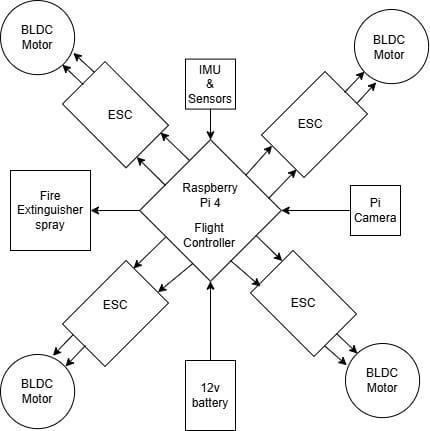
Theautonomousfireextinguisherdroneoperatesthrough a well-coordinated sequence of functions integrating detection,decision,andaction.TheRaspberryPiservesas the central controller, processing real-time video feed fromthecameramodule.UsingtheYOLOv5algorithmand OpenCV, the systemdetects the presence offireorsmoke based on visual features. Once fire is detected, the Raspberry Pi sends control signals to activate the motor drivercircuitanddirectthe dronetoward thefiresource. Simultaneously, the extinguisher mechanism is triggered to release the extinguishing agent over the affected area. The system also collects sensor data (like temperature or gas levels) to confirm the fire’s intensity and ensure accurate targeting. Through wireless communication, the drone’s movement and operation can be monitored or controlled manually if needed. Overall, the system functionsautonomouslytodetect,approach,andsuppress fire efficiently, reducing the need for human intervention inhazardouszones.
3.5
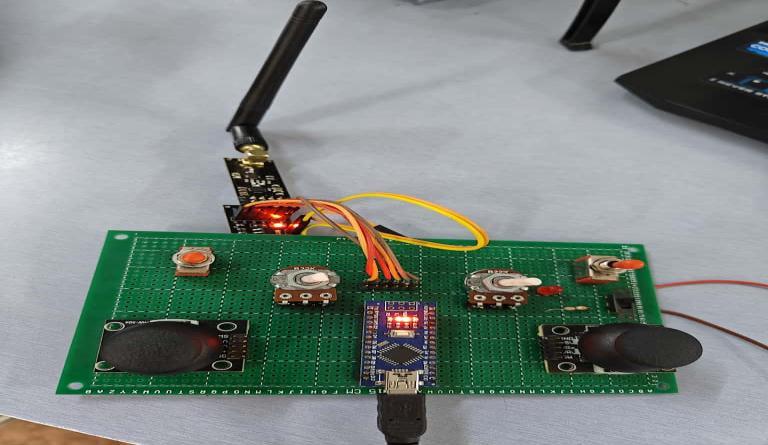
Thetransmittersystemwasdesignedandsimulatedusing EasyEDA and later implemented on a zero PCB for practical testing. The circuit consists of an Arduino Nano microcontroller, an NRF24L01 2.4 GHz transceiver module, and dual-axis joystick modules that serve as the primary control input. The joysticks provide analog X–Y axisreadingsandbuttonpresssignals,whicharereadand processedbytheArduinoNano.
Thesevaluesarethenencodedandtransmittedwirelessly through the NRF24L01 module to the receiver end.The hardware setup was assembled neatly on a zero board with all necessary connections and verified using the Arduino Serial Monitor, confirming accurate joystick data capture. The transmitter system was successfully able to communicate with the receiver unit, achieving stable wireless transmission after resolving minor signal fluctuation issues caused by loose wiring and power inconsistencies.
3.5.2
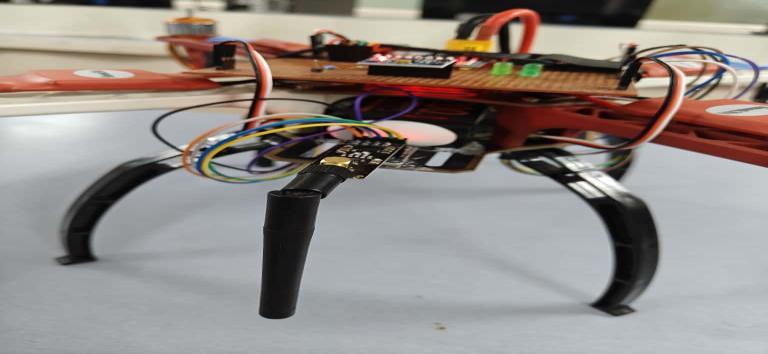
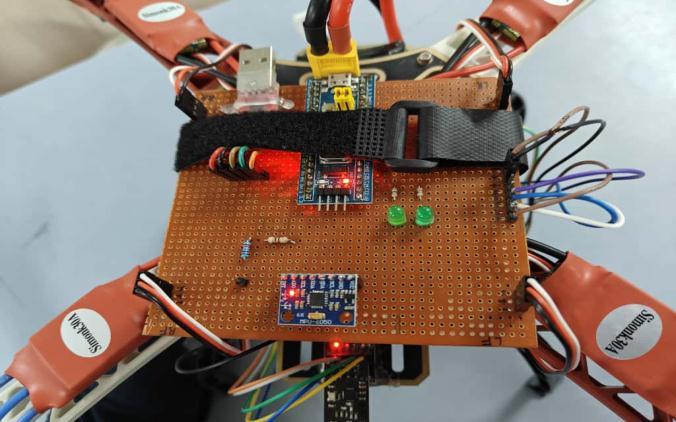
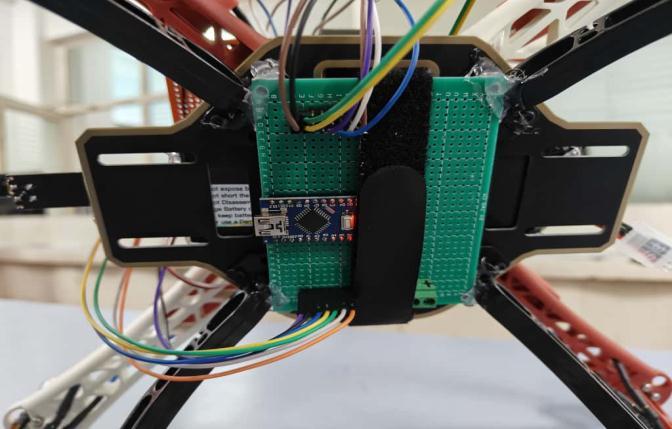
The hardware setup of the flight controller and receiver system wasimplemented ona zero boardmounted atthe centerofthedroneframetoensurestabilityandvibration resistance. The STM32F103C8T6 microcontroller serves as the main flight controller, securely fixed to the board and interfaced with the NRF24L01 receiver module for wireless communication. The MPU6050 IMU sensor is positionednearthecontrollertoaccuratelydetectangular motion and orientation, enabling precise flight control. The Arduino Nano is used for signal processing and communicationbetweentheIMU,receiver,andSTM32.All interconnections were made using color-coded jumper wires to maintain clarity and ease of debugging. Two green indicator LEDs are integrated to show power and communicationstatus.Thecircuitispoweredthroughthe drone’s main Li-Po battery, with proper routing of ESC
International Research Journal of Engineering and Technology (IRJET) e-ISSN:2395-0056
Volume: 13 Issue: 02 | Feb 2026 www.irjet.net p-ISSN:2395-0072
wires to each motor arm for balanced thrust distribution. Each component is secured with Velcro straps to prevent displacement during operation, ensuring robustness and durability during testing. The setup was verified through sequential testing of IMU readings, motor actuation, and receiverinputresponse,confirmingstablecommunication andflightreadiness.
The implementation of the autonomous fire extinguishing drone has demonstrated highly effective performance during preliminary testing. The system accurately detectedfirethroughtheTensorFlow-basedvisionmodel, which processed real-time video from the Pi Camera. The servo motor, controlled by the Raspberry Pi, precisely activated the solenoid valve to release CO₂ from the fire extinguisher for targeted suppression. The live video feed successfully streamed to the monitoring interface, providing supervisors with clear visual feedback for situational assessment.The integrationoftheSTM32F4xx flight controller enabled stable flight control, smooth motor response, and accurate hovering during operation. Thesystem’sabilitytodetectandsuppressfirewas
validated through multiple trials, showing consistent and reliable performance. However, further optimization is needed in power management to extend battery life duringlong-durationoperations.
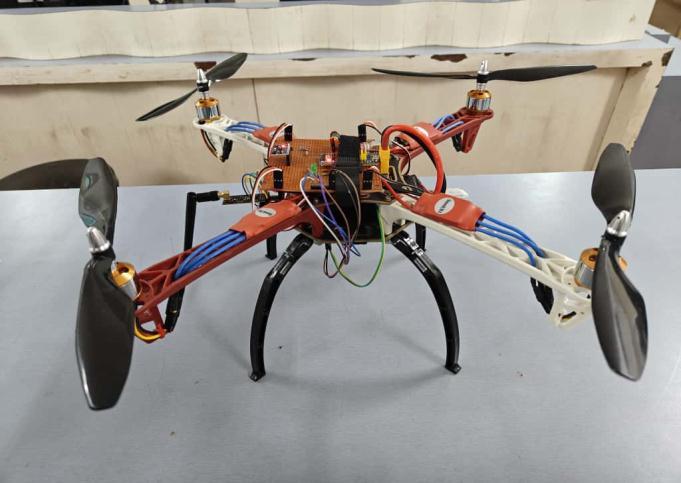
TheArduinoIDEprogrammingoftheflightcontrollerand transmitter-receiversetup performed efficiently,ensuring coordinated communication between drone control and fire suppression commands. Overall, the system achieved around 80% completion with successful results in detection accuracy, suppression timing, and drone stability, marking significant progress toward a fully autonomousfire-fightingsolution.
The future development of the autonomous fire extinguisher drone focuses on improving its accuracy, stability, and operational efficiency. Integration of additional sensors such as temperature, smoke, or flame intensity sensors can enhance detection reliability under differentenvironmentalconditions.Theflightstabilitycan be improved through advanced control algorithms implementedonthe STM32 flightcontroller forsmoother maneuvering and better resistance to air turbulence during firefighting operations. Optimization of the CO₂ dispensing mechanism using lightweight solenoid valves and higher-capacity canisters can increase the drone’s extinguishing efficiency. Incorporating GPS-independent navigation using visual markers or IMU-based mapping will allow deployment in indoor environments or GPSrestricted areas. Power management can be enhanced by using higher-capacity Li-Po batteries or efficient energy distribution circuits to extend flight duration. Future versions may also integrate real-time communication betweenmultipledronesforcoordinatedfiresuppression, allowing larger areas to be covered efficiently. Additionally,theRaspberryPi-baseddetectionsystemcan be upgraded with improved TensorFlow models to enhanceaccuracyandreducefalsetriggers. Overall,these
International Research Journal of Engineering and Technology (IRJET) e-ISSN:2395-0056
Volume: 13 Issue: 02 | Feb 2026 www.irjet.net p-ISSN:2395-0072
advancements will make the system more autonomous, efficient,andadaptableforbothindustrialandemergency firefightingapplications.
The autonomous fire extinguisher drone successfully demonstratestheintegrationofembeddedsystems,image processing, and automation to detect and suppress fire effectively. By combining Raspberry Pi with YOLOv5 and OpenCV, the system achieves real-time flame detection and initiates a quick extinguishing response with high precision.TheimplementationofIoTfeaturesandsensors enhancessafety,reliability,andadaptabilityforindustrial, household, and rescue operations. This project highlights the potential of drones as a practical, efficient, and smart solution for fire emergencies, reducing human intervention and minimizing property loss. Future enhancements can include AI-based decision-making, cloud integration, and improved payload mechanisms for real-worlddeployment.
7.
[1]Redmon, J., & Farhadi, A. (2018). YOLOv3: An Incremental Improvement. arXiv preprint arXiv:1804.02767.
[2]Bradski, G. (2000). The OpenCV Library. Dr. Dobb’s JournalofSoftwareTools.
[3]Raspberry Pi Foundation. (2023). Raspberry Pi OS DocumentationRetrievedfrom https://www.raspberrypi.com/documentation
[4]TensorFlow Developers. (2023). TensorFlow for MachineLearningonEdgeDevices.GoogleResearch.
[5]Arduino Official Documentation. (2023). Arduino IDE andMicrocontrollerProgrammingGuide.
[6]Huang, C., & Chen, L. (2021). Intelligent Fire Detection System Using Deep Learning and IoT. IEEE Transactions onIndustrialElectronics.
[7]Khandelwal, R., & Sharma, A. (2022). Design and Simulation of Fire Detection and Extinguishing Drone using Raspberry Pi and Sensors. International Journal of EngineeringResearch&Technology(IJERT).
[8]Open Source Robotics Foundation. (2022). Drone Automation and Control Algorithms for Emergency Applications.