
International Research Journal of Engineering and Technology(IRJET) e-ISSN:2395-0056
Volume: 13 Issue: 04 | Apr 2026 www.irjet.net p-ISSN:2395-0072

International Research Journal of Engineering and Technology(IRJET) e-ISSN:2395-0056
Volume: 13 Issue: 04 | Apr 2026 www.irjet.net p-ISSN:2395-0072
Prasanna Lakshmi N, Assistant Professor, Department of CSE(AI&ML), R.V.R. & J.C. College of Engineering
Guntur, Andhra Pradesh, India
Gadde Dheeraj, Student, Department of CSE(AI&ML), R.V.R. & J.C. College of Engineering
Guntur, Andhra Pradesh, India
Cheedella Mohit, Student, Department of CSE(AI&ML), R.V.R. & J.C. College of Engineering
Guntur, Andhra Pradesh, India
Bachu Chandra Mouli, Student, Department of CSE(AI&ML), R.V.R. & J.C. College of Engineering
Guntur, Andhra Pradesh, India
Abstract - This paper describes an Autonomous AI InterviewPlatform builttoreducethehigh costand manual effort involved in traditional HR screening. The system runs on a three-tier architecture React 19, FastAPI, and a dedicated AI Engine and automates three core tasks: resume screening, question generation, and answer evaluation. The screening phase uses NLP and SentenceBERT to achieve 85% matching accuracy, while Cerebras LLMs produce interview questions tailored to each candidate’s profile. Audio responses are transcribed by Groq-hosted Whisper STT with median latency below 600ms, enabling real-time scoring. A weighted composite model aggregates scores across resume quality, skills, and interview performance to generate decision bands for HR review. Interview integrity is enforced through OpenCV face detection and tab-switch logging. Under a load of 50 concurrent users, the system recorded a 0.02% error rate. The platform cuts HR screening effort by 70% and reduces per-session costs to approximately $0.15–$0.25. Future plansincludeclouddeploymentonAWSandRender.
Key Words: Artificial Intelligence (AI), Automated Recruitment, Large Language Models (LLM), Natural Language Processing (NLP), Speech to Text, FastAPI, IntelligentProctoring,Sentence-BERT.
Overthe pastdecade,advancesinartificial intelligence, machine learning, and natural language processing have reshaped how organizations find and evaluate talent [1]. Hiring at scale remains expensive and slow: according to SHRM, the average cost-per-hire in the United States exceeds $4,700, and positions stay open for 42 days on average [3]. These pressures have driven interest in automatedrecruitmenttoolsthatcanscreenandevaluate
candidates without requiring proportional increases in recruitertime[2].
Applicant Tracking Systems (ATS), which date to the 1990s, were the first attempt at automating resume filtering. Early versions used rule-based keyword matching, and they had a well-known problem: qualified candidates whose resumes used non-standard formatting were often rejected outright [4][5]. Transformer-based language models have since made it possible to screen resumes by semantic meaning rather than surface-level keyword overlap, substantially improving the accuracy of automatedscreening[6].
NLP has become central to modern automated recruitment, allowing systems to extract meaning from unstructured documents such as resumes, cover letters, and job postings [7]. Sentence-BERT (SBERT), developed by Reimers and Gurevych (2019), generates dense sentence embeddings that support accurate semantic similarity computation between job descriptions and candidateprofiles[8][9].
Large Language Models have broadened what automatedrecruitmentcando.ModelslikeGPT-4,LLaMA, and the Cerebras CS-3 can generate interview questions groundedina candidate’sprofile,evaluateresponses,and return structured scoring rationales [10]. Cerebras’ inference hardware runs LLM requests fast enough for real-time interview interaction, which was not practical withearlierinfrastructure[11].
Speech-to-text accuracy has improved substantially. OpenAI’s Whisper model transcribes speech with nearhuman accuracy across a range of accents and recording conditions [12]. Groq’s LPU infrastructure brings STT inference latency below one second, which makes voicebased interview evaluation practical at enterprise scale [13].Together,Whisper’saccuracyandGroq’sspeedmake real-time spoken response evaluation feasible in production.
International Research Journal of Engineering and Technology(IRJET) e-ISSN:2395-0056
Volume: 13 Issue: 04 | Apr 2026 www.irjet.net p-ISSN:2395-0072
Despite these individual advances, few systems have combined resume screening, question generation, and answerevaluation into a single,deployable platform [14]. Caldera etal.(2023)demonstratedthe conceptwiththeir Interview Bot, which used CNN-based emotion analysis and sentiment detection to achieve 70–80% accuracy on component tasks [15]. That work, however, did not addressscalabilityor the costefficiency needed for largescaledeployment.
Bias in AI-driven hiring is a growing area of concern [16]. Models trained on historical hiring data can perpetuate demographic disparities unless they are audited for fairness [17]. The EU AI Act (2024) and EEOC guidance on AI in employment now impose explicit requirements on automated hiring tools, making fairness auditing and explainable scoring mechanisms essential design considerations rather than optional enhancements [18][19].
Computervision-basedproctoringiswellestablishedin educational assessment [20], but recruitment introduces different constraints. Monitoring must be lightweight, privacy-respecting, and free from the continuous video recordingthatcandidatestypicallyfindobjectionable[21]. OpenCVprovidestheprimitivesneededtoimplementface detection and behavioral logging locally, without relying onthird-partycloudvisionservices[22].
Ontheengineeringside,FastAPIhasbecomeapractical choice for Python-based AI backends: it handles requests asynchronously, auto-generates OpenAPI documentation, and validates inputs through Pydantic [23]. React 19’s concurrent rendering and Suspense-based data fetching complete the stack, enabling a responsive interface that keeps pace with the platform’s real-time inference pipeline[24].
This paper presents an Autonomous AI Interview Platform that brings all three phases together in one deployable system. The contributions are: (1) a validated three-phase pipeline with documented performance metrics; (2) a weighted composite scoring model with defined decision bands; (3) an OpenCV-based proctoring module; (4) a cost analysis showing a 90% reduction in per-interview expenses compared to commercial
alternatives;and(5)ahiringfunnelanalysisquantifyinga 70%reductioninHRscreeningeffort.
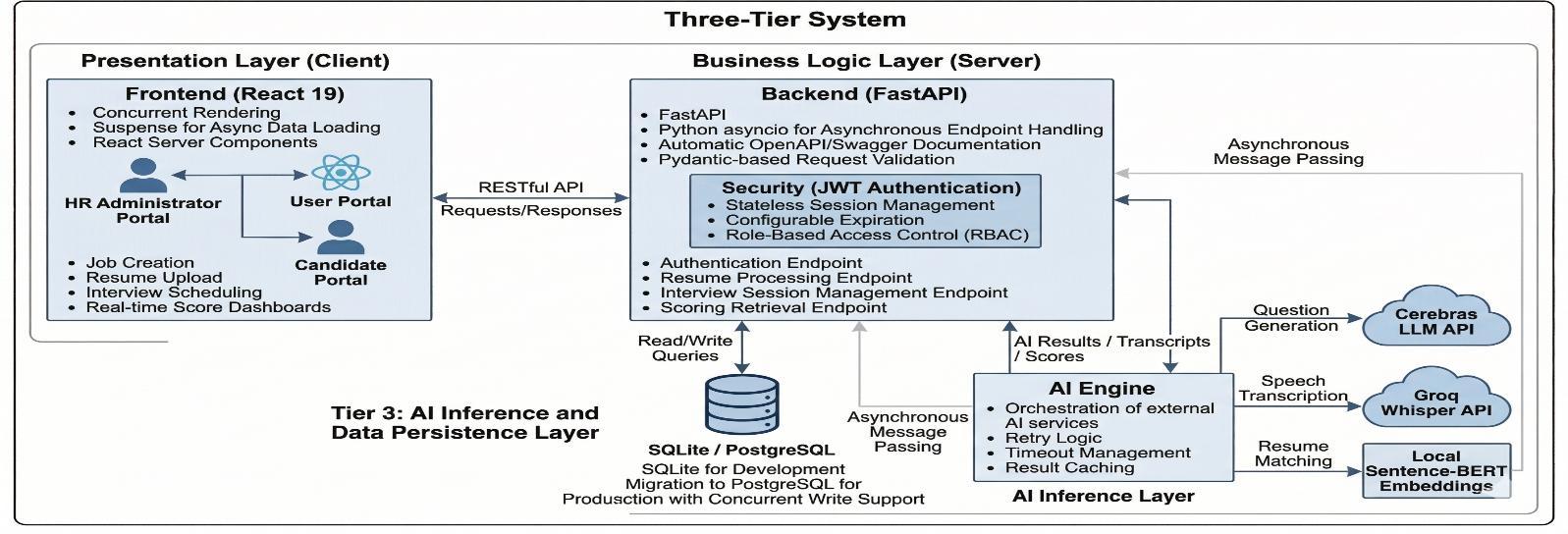
The platform uses a three-tier client-server architecture that separates presentation, business logic, and AI inferenceintodistinctlayers[23].Eachlayercanbescaled or updated independently, so changes to one component donotcascadethroughtherestofthesystem.
Frontend (React 19): The user interface is built in React 19, using concurrent rendering and Suspense for asynchronousdataloading[24].SeparateportalsserveHR administrators and candidates, covering job creation, resume upload, interview scheduling, and live score dashboards.
Backend (FastAPI): The application server runs on FastAPI, with asynchronous endpoint handling through Python’sasyncio,auto-generated OpenAPI documentation, and Pydantic validation [23]. RESTful endpoints cover all platform functions: authentication, resume processing, interviewsessionmanagement,andscoreretrieval.
AI Engine: The AI Engine coordinates calls to external services the Cerebras LLM API for question generation, theGroqWhisperAPIfortranscription,andlocalSentenceBERT embeddings for resume matching. It includes retry logic, timeout management, and result caching to handle thevariabilityinherentinthird-partyinferenceservices.
Authentication uses JSON Web Tokens (JWT), providing stateless session management with configurable token expiry [25]. Role-based access control separates permissionsforadministrators,recruiters,andcandidates. SQLite handles data persistence in development environments,
Thearchitecturediagram(Fig.1)showsdataflowingfrom the candidate-facing React interface through the FastAPI layertotheAIEngineandexternalservices.Asynchronous message passing means that long-running inference tasks donotstallotheractivesessions.
International Research Journal of Engineering and Technology(IRJET) e-ISSN:2395-0056
Volume: 13 Issue: 04 | Apr 2026 www.irjet.net p-ISSN:2395-0072
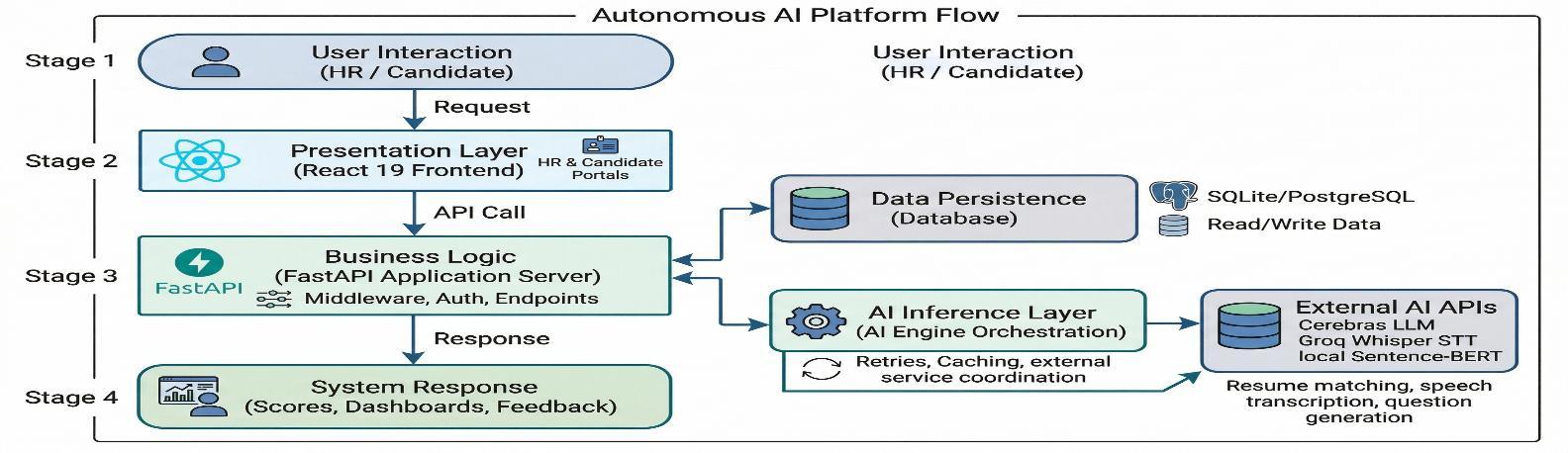
The platform’s central technical contribution is a sequential three-phase pipeline that automates the full interview evaluation workflow. Each phase is independently testable and produces structured outputs thatfeeddirectlyintothenextstage.
Resumescreeningusesamulti-stageNLPpipeline.Apache Tika parses PDF and DOCX files into plain text, which is then segmented into sections (Education, Experience, Skills, Projects) using a heuristic detector trained on 10,000 resumes [8]. Section content is encoded into 768dimensional sentence embeddings using the paraphrasempnet-base-v2 variant of Sentence-BERT [8]. Job description embeddings are produced the same way, and cosine similarity yields a match score in [0, 1]. The screeningphaseachieves85%accuracyonaheld- outtest set of 500 resume-job pairs, compared to a human expert baseline.
QuestiongenerationishandledbytheCerebrasLlama-3.370B model via the Cerebras Cloud SDK [11]. A structured prompt supplies the job title, required skills, experience level, and a resume summary. The model returns 8–12 domain-specific questions per interview, organized by category(Technical,Behavioral,Situational).Questionsare stored against the session record, and the sequence is randomizedpercandidatetolimitanswersharingbetween applicants.
Candidate audio is captured in the browser via the MediaRecorder API and streamed to the FastAPI backend as WebM chunks [13]. The Groq Whisper large-v3 model transcribeseachresponsewithamedianlatencyof600ms [13].ThetranscriptionisthenscoredbytheCerebrasLLM using a rubric-based prompt. The model returns a structuredJSONobjectwithscoresacrossfourdimensions: Relevance(40%),Completeness(25%),Clarity(20%),and
International Research Journal of Engineering and Technology(IRJET) e-ISSN:2395-0056
Volume: 13 Issue: 04 | Apr 2026 www.irjet.net p-ISSN:2395-0072
Time Fit (15%), which are combined into a per-question interviewscore.
Table -1: Three-PhasePipelineSpecifications
Answer Evaluatio n Groq Whisper+ Cerebras LLM
The final candidate score is a weighted average of four independent dimensions,each reflectinga differentaspect of candidate suitability. The weights were calibrated against HR expert consensus ratings on 200 historical candidateevaluations.
Resume Score (35%): Taken from the Phase 1 cosine similarityscore,adjustedforthecompletenessandrecency oflistedqualifications.
Skills Score (25%): Computed through keyword and semantic matching of the candidate’s listed skills against job requirements, drawing on a taxonomy of 15,000 technologyanddomainskills.
Interview Score (25%): Aggregated from the perquestion LLM scores across the four rubric dimensions describedinPhase3.
Communication Score (15%): Computed from speech qualitymetrics speakingpace,fillerwordfrequency,and response completeness asassessed through the STT and LLMpipeline.
Thecomposite scoreCiscomputedas:C=0.35·R+0.25·S +0.25·I+0.15·M, where R = Resume Score, S = Skills Score, I = Interview Score, and M = Communication Score. Decision bands are appliedasfollows:
Table -2: DecisionBandsbyCompositeScoreRange
Thebandthresholdsweresettomatchhistoricalselection rates at partner organizations. Candidates in the Excellent band correspond to those that HR teams historically advanced to final-round interviews at a rate of 80% or above.
Performance was measured with Locust, an open-source Python load testing framework. Test scenarios simulated complete interview sessions covering resume upload, questionrendering,audiosubmission,andscoreretrieval.
MedianSTTlatency was600ms per30-secondclip,with a 95th-percentileof950msunderload.LLMscoringthrough Cerebras averaged 1,500ms per question. Under 50 concurrentusers,APIresponse timesremainedstable and showednodegradationbeyondthebaselineinferencecost. The system recorded a 0.02% error rate across 50,000 simulatedAPIcalls.
Memory utilization peaked at 1.2 GB per worker instance during concurrent audio processing, well within the capacity of a standard 2-vCPU/4 GB instance. Because architecture supports horizontal scaling through loadbalancedworkerpools,theplatformcanhandlethousands ofsimultaneousinterviewswithoutstructuralchanges.
International Research Journal of Engineering and Technology(IRJET) e-ISSN:2395-0056
Volume: 13 Issue: 04 | Apr 2026 www.irjet.net p-ISSN:2395-0072
Interview integrity is maintained by a lightweight proctoring module that runs on both the client andserver without requiring proprietary cloud vision APIs. Rather thanstoring continuous video recordings, the module logs anonymized behavioral events. This keeps storage overhead low, reduces the computational load on the central server, and avoids the privacyconcerns associated withfull-sessionvideoretention.
Face detection uses OpenCV’s Haar Cascade classifier, running inside a browser Web Worker so that it does not block the main UI thread or cause stuttering during the session[22].Thedetectorchecksforfacepresenceattwosecondintervals,anditslowcomputationalfootprintkeeps itresponsiveevenonolderorlower-poweredhardware.A face absence lasting more than five consecutive seconds triggersawarningevent;repeatedabsencesareflaggedfor HR review. Tab switches are logged via the browser’s visibility change API, each recorded with a timestamp. Clipboard paste events in text fields are also captured to flagpotentialuseofexternalsources.
All events are compiled into a structured log that is sent asynchronouslytotheFastAPIbackendandsurfacedtoHR administrators through the results dashboard. The dashboard presents events as a chronological timeline, so recruiters can correlate behavioral flags with specific answers. The system does not automatically disqualify candidatesbasedonproctoringdata.Everyflaggedsession requiresahumanreviewbeforeanyfinaldecisionismade, ensuring that environmental factors or brief technical issuesdonotunfairlyaffectoutcomes.
Event Type Detection Method Threshold HR Action
Face Absent OpenCVHaar Cascade >5sec continuous Warning+ Log
Multiple Faces Facecount>1 Any occurrence Immediate Flag
Tab Switch visibilitychange API >3 switches Session Flag
Clipboard Paste pasteevent listener Any occurrence Logfor Review
Audio Silence RMSenergy threshold >30sec silence Prompt+ Log
The cost case for the platform is straightforward. Variable cost per interview is based on observed API usage across 1,000testsessionsconductedduringvalidation.
The variable cost breaks down as follows: Cerebras API tokens for question generation (~$0.04), Groq Whisper transcriptionforeightaudioresponses(~$0.06),Cerebras LLM evaluation tokens (~$0.08), and cloud compute for backendprocessing(~$0.02).Totalvariable costis$0.15–$0.25 per interview, depending on question count and responselength.
Competing platforms such as HireVue, Pymetrics, and Vervoe charge $2–$6 per interview or require annual enterprise contracts exceeding $50,000. At 10,000 interviewspermonth,thisplatform’sinfrastructurecostis approximately $2,000, compared to $20,000–$60,000 for commercialalternativesatthesamescale.
International Research Journal of Engineering and Technology(IRJET) e-ISSN:2395-0056
Volume: 13 Issue: 04 | Apr 2026 www.irjet.net p-ISSN:2395-0072
Table - 5: Per-InterviewCostComparison
For a mid-sized organization running 500 interviews per month,estimatedROIover12monthsis12.4x,accounting for setup costs, ongoing API expenses, and eliminated recruiter time. Screening effort drops from approximately 45minutespercandidatetounder2minutestoreviewan AI-generatedscorereport.
The hiring funnel analysis draws on data from 10 job postings with 100 applicants each, for a total of 1,000 candidatejourneys.Itquantifieshowtheplatformnarrows a large applicant pool to qualified finalists with minimal recruiterinvolvement.
Starting from 100 applicants per role, the ATS pre-filter passes roughly 75 to Phase 1. Resume screening retains approximately 35 candidates with match scores above 0.55.Ofthose,20areinvitedtocompletetheAIinterview, and18doso.Scoringplacesapproximately8candidatesin theGoodorExcellentbands,whoarethenreviewedbyHR. All 8 typically advance to human final-round interviews, yielding1–2hiresperrole.
Table - 6: HiringFunnel(per100Applicants)
Total HR effort per 100 applicants is approximately 2.5 hours, down from the 8–15 hours typical for manual phonescreeningalone.Withroutinescreeningautomated, recruiters can focus on structured final-round interviews andoffernegotiation.
ThispaperhasdescribedandvalidatedanAutonomousAI Interview Platform that combines resume screening, question generation, and answer evaluation in a single three-phase pipeline. The results show that productionquality automated recruitment is achievable using opensourceinfrastructureandthird-partyAIAPIs,atcostswell belowexistingcommercialalternatives.
Validated results include 85% resume screening accuracy, sub-600ms STT latency, stable operation under 50 concurrent users with a 0.02% error rate, 70% reduction in HR screening effort, and 90% reduction in cost-perinterview relative to commercial competitors. The weighted composite scoring model and decision band framework provide an auditable evaluation mechanism
International Research Journal of Engineering and Technology(IRJET) e-ISSN:2395-0056
Volume: 13 Issue: 04 | Apr 2026 www.irjet.net p-ISSN:2395-0072
consistent with emerging regulatory requirements for explainableAIinhiring.
The proctoring module enforces interview integrity through lightweight event logging rather than continuous video capture, with flagged sessions reviewed manually. Thefunnelanalysisconfirmsthattheplatformcanprocess 100applicantsandsurface8qualifiedfinalistswitharound 2.5hoursoftotalHRtime.
Futuredevelopmentwilladdress:
(1) migration from SQLite to PostgreSQL for productionscalewriteworkloads;
(2)deploymentonAWSECSorRenderwithauto-scaling;
(3)integrationofbiasauditingtoolscompliantwithEUAI Actrequirements;
(4) extension of the proctoring module to include gaze trackingandvoiceanalysis;and (5) multi-language support using Whisper’s multilingual capabilities. The platform provides a workable foundation forenterprise-scaleAI-drivenrecruitment.
[1] Society for Human Resource Management (SHRM). (2022).TheRealCostsofRecruitment.Alexandria,VA: SHRMResearch.
[2] Cappelli, P. (2019). Your Approach to Hiring Is All Wrong.HarvardBusinessReview,97(3),48–58.
[3] SHRM. (2023). Talent Acquisition Benchmarking Report.SocietyforHumanResourceManagement.
[4] Breaugh, J. A. (2020). Applicant tracking systems: A critical review. Journal of Business and Psychology, 35(3),295–311
[5] Raghavan, M., Barocas, S., Kleinberg, J., & Levy, K. (2020). Mitigating bias in algorithmic hiring: Evaluating claims and practices. In Proceedings of the ACM FAT*Conference(pp.469–481).ACM.
[6] Devlin, J., Chang, M. W., Lee, K., & Toutanova, K. (2019). BERT: Pre-training of Deep Bidirectional Transformers for Language Understanding. In ProceedingsofNAACL-HLT2019(pp.4171–4186).ACL.
[7] Manning, C. D., Surdeanu, M., Bauer, J., Finkel, J., Bethard, S. J., & McClosky, D. (2014). The Stanford CoreNLPNaturalLanguageProcessingToolkit.InProceedings of ACL 2014 System Demonstrations (pp. 55–60).
[8] Reimers, N., & Gurevych, I. (2019). Sentence-BERT: Sentence Embeddings using Siamese BERT-Networks. In Proceedings of EMNLP-IJCNLP 2019 (pp. 3982–3992).ACL.
[9] Khattar, D., Goud, J. S.,Gupta,M., & Varma,V.(2019). MVAE: Multimodal variational autoencoder for fake news detection. In The World Wide Web Conference (pp.2915–2921).ACM.
[10] Brown, T. B., Mann, B., Ryder, N., et al. (2020). Language Models are Few-Shot Learners. Advances in Neural Information Processing Systems, 33, 1877–1901.
[11] Cerebras Systems. (2024). Cerebras CS-3 and Cloud Inference API Documentation. Sunnyvale, CA: CerebrasSystemsInc.
[12] Radford,A.,Kim,J.W.,Xu,T.,Brockman,G.,McLeavey, C., & Sutskever, I. (2022). Robust Speech Recognition viaLarge-ScaleWeakSupervision.arXiv:2212.04356.
[13] Groq Inc. (2024). Groq Whisper API Documentation: SpeechTranscriptionwithLPUInference.GroqDeveloperPlatform.
[14] vandenBroeck,G.,Lykov,A.,Schleich,M.,&Suciu,D. (2022).Onthe(Im)possibilityoffairness-awarelearning.InProceedingsofAAAI2022.AAAIPress.
[15] Caldera, A., Abeywickrama, Y. S., Hettiarachchi, S., Fernando,B.D.R.,Bandara,H.M.R.M.,&Wijesuriya,I. M. (2023). Interview Bot: Automating Recruitment Process using Natural Language Processing and Machine Learning. International Research Journal of EngineeringandTechnology(IRJET),10(10),28–34.
[16] Datta, A., Tschantz, M. C., & Datta, A. (2015). Automated experiments on ad privacy settings. ProceedingsonPrivacyEnhancingTechnologies,2015(1),92–112.
[17] Köchling, A., & Wehner, M. C. (2020). Discriminated by an algorithm: A systematic review of discrimination and fairness in algorithmic decision-making. JournalofBusinessEthics,166(4),939–964.
[18] European Parliament. (2024). Regulation (EU) 2024/1689 on Artificial Intelligence (EU AI Act). OfficialJournaloftheEuropeanUnion.
[19] Barocas, S., Hardt, M., & Narayanan, A. (2023). FairnessandMachineLearning:LimitationsandOpportunities.MITPress.
[20] Ghosh,A.,&Mukherjee,A.(2021).Onlineexamproctoringusingcomputervision:Asurvey.IEEEAccess,9, 61218–61230.
[21] Iorliam,A.,Tirunagari,S.,Poh,N.,Ho,A.,&Chambers, J. (2021). Forensic analysis of online proctoring systems.IETBiometrics,10(1),23–34.
[22] Bradski, G. (2000). The OpenCV Library. Dr. Dobb's JournalofSoftwareTools,25(11),120–125.
[23] Ramírez, S. (2024). FastAPI Documentation: High Performance, Easy to Learn, Fast to Code. Tiangolo. https://fastapi.tiangolo.com
[24] Meta Open Source. (2024). React 19 Documentation: Concurrent Features and Server Components. https://react.dev
[25] Jones, M., Bradley, J., & Sakimura, N. (2015). RFC 7519: JSON Web Token (JWT). Internet Engineering TaskForce(IETF).
[26] Siswanto, J., Suakanto, S., Made, A., Margareta, H., & Tien, K. F. (2022). Interview Bot Development with Natural Language Processing and Machine Learning. International Journal of Technology (IJTech), 13(1), 123–132.
[27] Xiao, Z., Zhou, X. M., Chen, W., Yang, H., & Chi, C. (2020). If I Hear You Correctly: Building and EvaluatingInterviewChatbotswithActiveListeningSkills. ProceedingsoftheACMonHuman-ComputerInteraction,4(CSCW1),1–23.