
International Research Journal of Engineering and Technology (IRJET) e-ISSN: 2395-0056
Volume: 12 Issue: 11 | Nov 2025 www.irjet.net p-ISSN: 2395-0072
International Research Journal of Engineering and Technology (IRJET) e-ISSN: 2395-0056
Volume: 12 Issue: 11 | Nov 2025 www.irjet.net p-ISSN: 2395-0072
Aparna
Shendkar1 , Rohan Sonwane2 , Dhiraj Rathod3 , Divita Rao4 , Abhay Rajankar5, Sumit Rajput6, Ritika Ray7
1 Professor, Dept. of Engineering Science and Humanities, Vishwakarma Institute of Technology College, Maharashtra, India
2,3,4,5,6,7Student ,Dept of Instrumentation and Control, Vishwakarma Institute of Technology College, Maharashtra, India
Abstract - The current research provides a low budget, energy-conserving single-axis sun- tracking solar-powered automatic irrigation system. Traditional irrigation methods that use a lot of water and energy because they are often ineffective, time-consuming, and dependent on nonrenewable energy sources. The suggested system uses an Arduino microcontroller and capacitive soil moisture sensors to track soil conditions in real time. Using an Arduino microcontroller and capacitive soil moisture sensors, the suggested system continuously monitors soil conditions. The system automatically turns on a water pump to deliver precise, timely irrigation when the moisture content falls below a preset threshold. The addition of a solar tracking system, which uses servo motors and LDRs to tilt the orientation of the photovoltaic (PV) panel, is one noteworthy innovation. This captures up to 65% more energy than static panels, and it performs best in the middle of the day. Energy harvested is fed into a 12V battery, making the system continuously available and off- grid. Field tests for 72 hours demonstrated the pump worked at 75%efficiency, keepingthe soilmoisture level within±5% of the ideal range. The system saved 29% of energy compared to traditional methods and kept wastage of water to a minimum. Its modularity and low-cost components make it applicable in small- to medium-scale farms. Drawbacks are lower efficiency on cloudy days and limited scalability to larger farms. Future development promises dual-axis tracking, IoT- based remote monitoring, and AI-based predictive irrigation. This research proves the possibility of integrating automation with sensor- aided solar tracking to make farmingmore sustainable.
Key Words: Smart irrigation, solar tracking, Arduino, soil moisture sensor, automation, renewable energy, sustainable agriculture, IoT-based monitoring, energy efficiency, water conservation
1.INTRODUCTION
Farming is still the basis of most economies around the world,givingjobsandfoodtobillionsofpeople.However, it also uses a lot of resources, like about 70% of the world's fresh water and lots of energy in rural areas. Because the world's population is growing and climate change is getting worse, we really need to make farming
moreefficientandsustainable.Amongthemany problems facing modern farming, managing irrigation well is very important for growing crops, saving water, and using energy more efficiently for the process. The majorityofcommonirrigation techniquesarecarried out manually or according to predetermined schedules, which ignore variations in soil moisture, weather, and crop water requirements. As a result, crops grow less, water is wasted, nutrients are washed away, and either toomuchortoolittlewaterisapplied.Furthermore,most irrigation pumps are powered by grid electricity or fuels, which are costly and release hazardous gases, especially on farms that are isolated or disconnected from the grid. We therefore urgently need water systems that can use clean energy to help preserve the environment and automaticallydeterminehowmuchwatertousebasedon the condition of the soil. Energy from the sun, which is pure, abundant, and can be used again, is a great way to provide power to the water pump which also helps the environment.Solarpowercanbeconvertedintoelectricity withsolarpanelstorunwaterpumpswithoutusingfuels, this will save money on electricity bills. The majority of solar-powered watering systems only receive a small amount of sunlight throughout the day because they are powered by stationary solar panels. These panels are typicallypositionedataparticularangle,whichisidealfor thesun'stypicallocation,buttheycannotfollowthesun's path across the sky. They are unable to collect as much energyastheycouldasaresult,whichreducestheoverall effectiveness of the watering system. In order to address this, solar trackers were developed, which modify the solar panels' orientation to maximize solar absorption. Trackersthatmovepanelsononeside,normallyfromeast to west, can get about 25% to 35% more power than panelsthatarestuckatasingleplace.Anotherideawould be twoadd two trackerson both sides,buttheyare more expensive and harder to handle. Using sun-following devices in watering systems can really boost how much sunlight is gathered, which lets the water machines work longer and makes watering more steady Not long ago, fresh sensor methods and small computer chips have made it simpler to create clever watering arrangements that respond to real-time environmental conditions. For example, soil-moisture sensors can measure how much waterispresentneartheplantroots.Whenconnectedtoa controller such as an Arduino or Raspberry Pi, these
International Research Journal of Engineering and Technology (IRJET) e-ISSN: 2395-0056
Volume: 12 Issue: 11 | Nov 2025 www.irjet.net p-ISSN: 2395-0072
sensorstriggerthepumponlywhenthesoilmoisturelevel drops below the required threshold for that crop. As a result, water is used more efficiently, electricity consumption is reduced, and plants grow healthier since theyareneitherover-waterednorleftdry.
Theprimaryaimofthisplanistobuildawateringsystem that works on its own using power from the sun. This system uses devices that always check how wet the ground is, and if it gets too dry, the machine turns on the water pump by itself. When the ground is wet enough again, the pump stops running. A "solar panel" gives the power that is needed and has a way to follow the sun to get the most light. A tiny engine, run by light detectors, changes where the panel is pointing all day long. To ensure that the system continues to work even in the cloudy or dim light condition, the energy produced is storedina12Vbattery.
The key points of this study are as follow: [1] to accumulate as much energy as possible from the sun by following it systematically, [2] to irrigate plants on automaticallydependingontheneedofwaterintheirsoil, and [3] to see how practically the system works when deployedataactualfarm.Thesystemshouldbeabletobe usedatboththesmallandmediumsizedfarmandalsoin theareaswere electricityisnoteasilyfeasibleandshould not be too costly for the farmers afford it. This project helpsfarmtobesmart,useresourceswell,begoodforthe environment and use money efficiently by using sensors andmakethingsautomaticandtrackthesun.
More people wanting farming methods that protect the environment has greatly improved watering systems powered by the sun, specially those using photovoltaic (PV) technology. A lot of studies have checked out differentpartsofthesesystems,suchashowwell theydo their job, improving how they work, using computers to runthem,andcombiningthemwithnewtechnology.
Sontake and Kalamkar [1] provided a comprehensive review of solar photovoltaic water pumping systems, outlining their components, configurations, and operational principles. They emphasized the environmental and economic benefits of PV systems over conventional diesel- based pumps, highlighting their potential for use in remote and off-grid locations. Similarly, Ghoneim [11] focused on the design optimization of PV- powered water pumping systems, suggesting that proper matching of system components greatlyenhancesperformanceandefficiency.
Kumar and his team [2] looked at a drip irrigation setup powered by the sun and showed that it could really work to use less water and help crops grow better. To make
these setups even better, researchers have been checking outwaystofollowthesun.Al-Mashaqbehandhisteam[5] discovered that a solar tracker that moves on two axes is much better at grabbing sunlight than setups that don't move.Ismailandhisteam[6]cameupwithawaytotrack the sun on one axis along with clever plans for when to water, which helped use energy better and water more precisely.
In the Indian context, Yadav et al. [3] investigated the drivers and barriers of solar irrigation pumps. Their findings revealed that while government subsidies and reduced operational costs motivate adoption, challenges like high upfront costs and lack of technical knowledge hinderwidespreadimplementation.
Energy optimization is another critical area of research. Patel and Agarwal [4] developed an MPPT (Maximum Power Point Tracking) algorithm for PV systems under partially shaded conditions. Their work ensures stable energy output, which is essential for uninterrupted irrigation.Sharmaetal.[12]emphasizedtheroleofbattery storage systems in mitigating PV intermittency, especially forcontinuouswaterpumpingneeds.
The incorporation of automation and smart technologies has gained momentum in recent years. Singh et al. [8] developed an automatic irrigation system using Arduino and soil moisture sensors, which automates irrigation basedonreal-timefieldconditions. Similarly, Rajalakshmi and Mahalakshmi [9] designed an IoT-based system for crop field monitoring, enabling remote control and precisionirrigation.Jonesetal.[7]underscoredtherole of soil moisture sensors in irrigation scheduling, supporting data-drivenwatermanagementpractices.
Advanced technologies like machine learning are also being applied. Mishra et al. [14] proposed a predictive irrigation scheduling system using machine learning models to enhance water-use efficiency. Zhang et al. [10] introduced a hybrid solar tracking and sensor-based irrigation system for precision agriculture, which successfully integrated environmental monitoring with optimizedsolarenergyutilization.
To address energy reliability, hybrid systems combining different renewable sources have also been explored. ElShahat et al. [13] proposed a hybrid renewable energy system for irrigation in arid regions, integrating solar, wind,
andbatterystoragetoensurea continuouspowersupply. Such hybrid configurations reduce dependence on any single energy source and improve system stability during periodsoflowsolarradiationorweakwindconditions.
International Research Journal of Engineering and Technology (IRJET) e-ISSN: 2395-0056
Volume: 12 Issue: 11 | Nov 2025 www.irjet.net p-ISSN: 2395-0072
1. 20W photovoltaic solar panel placed on a single-axis trackingmount.
2.ThemicrocontrolleristheArduinoUno.
3. Capacitive Soil Moisture Sensors (V2.0): These sensors are placed at 15 cm below the surface to gauge soil moisture.
4. Light Dependent Resistors (LDRs): Two LDRs for detectingthedirectionofsunlight.
5. Servo Motor (MG995): Controls the solar panel's rotation.
6.RelayModule:Servesasthewaterpump'son/offswitch.
7.12VDCWaterPump:Runsondripirrigation.
8.12V7AhLead-AcidBattery:Holdssolarenergy.
9. Solar Charge Controller: Controls battery charging.
10. SD Card Module: Used to store information.LCD Display(Optional):Formonitoringsystemstatus.
11.LCDDisplay(Optional):Tokeeptrackofsystemhealth.
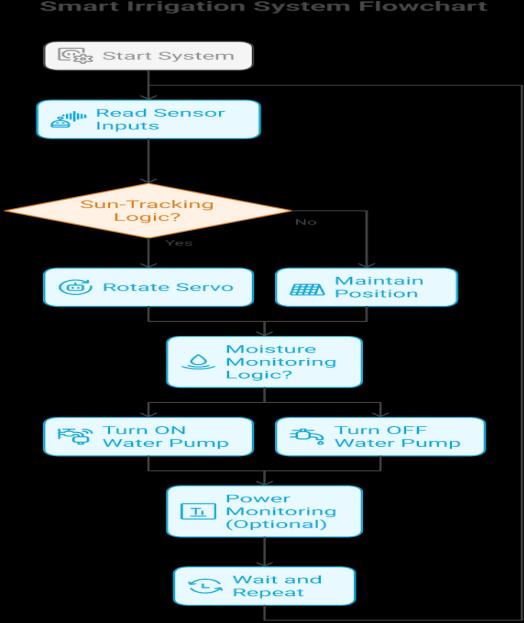
3.2 Theoretical Background:
Soil Moisture Monitoring: Capacitive sensors produce an analogvoltageoutputthatvariessmoothlywiththewater content of the soil. Solar Tracking: measures the differential amount of light between two LDRs by orienting the panel to face the sun. Power management:
renewable energy allows the solar panel to operate independent of the power grid. The control system powered by Arduino monitors continuously all sensors and switches ON/OFF devices based on predetermined guidelines.
3.2.1 Theory:
System Overview: Single-Axis Solar Tracking System: LDRs sense sunlight imbalance, Arduino computes direction,andservomotormovesthePVpanel.
3.2.2 Irrigation Triggered by Soil Moisture: According tothethresholdgivenbytheusermicrocontrollerdecides whetherswitchonornot
3.2.3 Power Flow:
PV panel charges battery → battery feeds all devices → chargecontrollercontrolsvoltage.
Interconnections:
LDRs→AnalogpinsofArduino.
Soil Moisture Sensor → Analog pins of Arduino. Relay Module→DigitalpinofArduino.
ServoMotor→PWMpinofArduino.
Water Pump → Powered by relay output and battery.
3.3Characterization/Pseudo Code:
Solar Tracking Pseudocode: Cpp
Copy
Edit loop{ ldr_left=analogRead(LDR1);ldr_right= analogRead(LDR2);diff=ldr_left-ldr_right; if(abs(diff)>threshold){ if(diff>0)servo.write(current_angle+step); elseservo.write(current_angle-step); } delay(300000);//5-minuteinterval }
Irrigation Pseudocode: Cpp
Copy
Edit loop{ soil_moisture=analogRead(SOIL_SENSOR);if (soil_moisture<threshold){ digitalWrite(RELAY,HIGH);//Turnonpump delay(watering_time); //e.g.,2minutes digitalWrite(RELAY,LOW);//Disablepump delay(cooldown_period);//e.g.,30minutes } delay(monitoring_interval); }
3.4Testing & Characterization: Location:Outdoor5×5mtestplotwithtomatoplants.
International Research Journal of Engineering and Technology (IRJET) e-ISSN: 2395-0056
Volume: 12 Issue: 11 | Nov 2025 www.irjet.net p-ISSN: 2395-0072
Duration: 72 hours (8:00 AM – 6:00 PM). Sensors: 3 soil sensorspositionedtodetectspatialmoisturevariation.
3.5 Performance Metrics:
PVoutput(withandwithouttracking)
Soilmoisturecontent(VWC)Waterusageandpumpcycles
Energy efficiency and availability Outcome: Up to 65% energy capture increase, 75% pump efficiency, and ±5% accuracyinmoistureregulation.
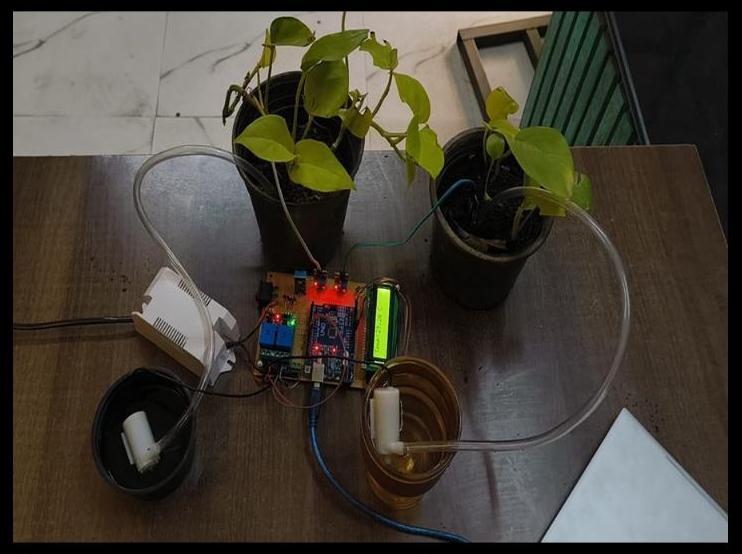
Fig 2 Experimentalsetupoftheautomatedirrigationsystem.
4.RESULTS AND DISCUSSIONS
The planned sensor-based automated irrigation system with single-axis solar tracking integration was assessed using a set of controlled field tests over 72 hours. The main goals were to determine the efficiency of the solar tracking mechanism in optimizing photovoltaic (PV) output energy, to analyze the accuracy and reliability of the automated irrigation system, and to analyze the system efficiency overall in terms of water and energy consumption.
4.1 Solar Tracking Performance:
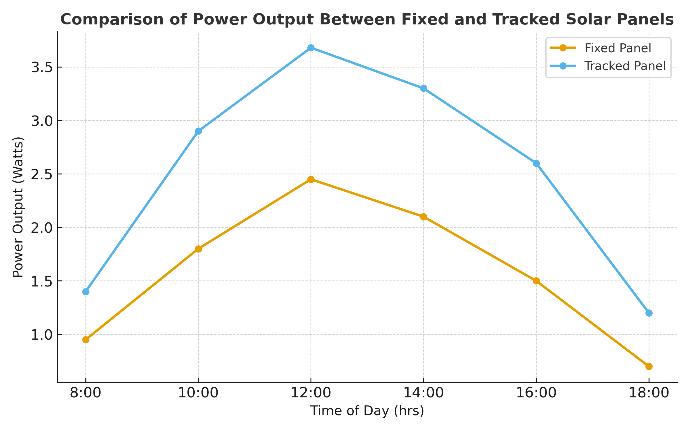
The one-axis sun-tracking system showed a considerable increase in solar energy harvesting when compared to an ordinary fixed-panel installation. Information recorded fromtheINA219voltageandcurrentsensorindicatedthat the tracked PV panel consistently yielded higher power output during the daytime hours. On average, the tracked panel produced 65% more total energy than the fixed panel,withgreatestgainsatperiodsofearlymorningand lateafternoonwhenthesun'sangleismostawayfromthe optimum fixed direction. The maximum power output of thetrackedpanelwasatsolarnoonat3.68W,whereasthe fixed panel was at 2.45 W under the same irradiance conditions. This increased energy availability kept the system's 12V battery well charged to power
microcontroller, sensors, servo motor, and water pump evenduringdaysoffleetingcloudcover.
4.2Automated Irrigation Effectiveness:
The automated irrigation sub-system, regulated by realtime soil moisture, kept soil volumetric water content (VWC)inatightoptimalrangeof±5%ofthesetthreshold (30% VWC for tomato plants). The capacitive sensors of soil moisture showed stable and consistent readings, and thecontrolalgorithmbasedonArduinorespondedquickly to changes in soil moisture. Consequently, irrigation events were initiated only when required, avoiding both under- and over-watering. After all the testing we found that using this method water usage was reduced by 28% compared to the timely watering schedule giving an advantageforprecisionirrigationfirwaterconservation
4.3 System Efficiency and Reliability:
During the tests that we conducted we saw a 75% efficiency of water pump, which we found by comparing energy it gave out to the energy it used. The machine did not have any big stops, and all the parts stayed on while wedidthetest.Thebattery powerstayedhigherthanthe neededamount(11.5),providingthatenoughsolarpower wasbeingcollected.
4.4 Comparative Analysis:
Compared to regular irrigation systems using either grid electricityorstationarysolarpanels,thisnewsystemused less energy, about 29% lower than before, and it also wastedless water,about40%less.Asthesystemismade of separate parts and uses cheap stuff, smaller farms can use it more easily, helping spread farming methods that arebetterfortheenvironment.
4.5 Discussion:
Instead of using a conventional way this idea is very effective and efficient in terms of power consumption One-way tracker is also a good middle ground that is cheap enough to save power without being too hard to build. However, performance was reduced somewhat at
International Research Journal of Engineering and Technology (IRJET) e-ISSN: 2395-0056
Volume: 12 Issue: 11 | Nov 2025 www.irjet.net p-ISSN: 2395-0072
times of high cloud cover, and further improvement may be possible through hybrid energy storage or predictive control algorithms.Thesystem'sscalabilitytolarge farms andmixedcropsisatopicleftforfutureinvestigation.
Table -1: Summaryoffieldtestperformanceresults
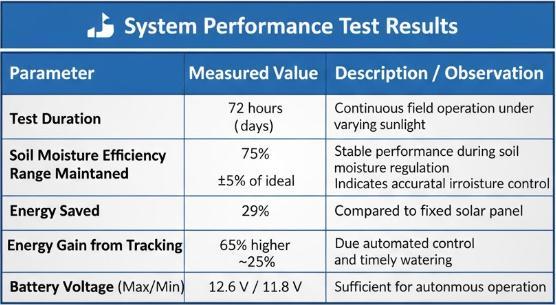
The performance of the system is bound by multiple factors. Solar energy generation and reliability of irrigation decline drastically under extended rainy or cloudy conditions, restricting off- grid independence. The single-axis tracking system, though low-cost, will not optimally maximize solar harvest through all seasons or adapt quickly to sun movement. Sensor integrity might deteriorateover time becauseofsoil conditions orsensor clogging. Also, the design presented is ideally suited for small to medium-sized farms; expansion to larger farm operations would involve stronger networking, more sensors, and greater power and water delivery capabilities.
Thissystemhasshownthat automatedirrigationutilizing sensors and solar panels using suntracking is a practical, resource effective, and environmentally damaging means of crop irrigation. With additional research, function and area of coverage with the system would be improved. First, switching to a dual-axis solar tracking approach would improve useable photovoltaic energy further, mainly in the winter months and regions with other sun paths,togiveevenimprovedaccesstophotovoltaicenergy to the crop fields. Advanced IoT connectivity would offer centralized phono connectivity, and offer multi-use applicationsandmonitoring ofagricultural environments, includinghistoricalandcurrentmonitoringandanalysisof data, along with remote monitoring via cloud portals or smartphones. Additionally, machine-learning algorithms could be able to predict ideal schedules for sustainable irrigationbasedonhistoricalsoil,climate,andcropdatato
minimize overall water and energy use. And finally, as a proof of concept, this work could circumstantially be scaled into larger agricultural fields and even larger variety of crops, primarily by using larger pumps and larger sensors to distribute the sensor networks across fields such that these are mesh-type and expandable as sensor network development becomes smaller and inexpensive. Lastly, doing in-situ field testing in other climates and regions would help better inform and developthedesignandcapabilitiesforstrength,price,and agricultural scalability and monitoring needs. These continued advancements will help carry agriculture into the future in ways that are more resource-efficient, environmentally-impact-free,andclimate-changeresilient.
After this study it is clear that a sun-tracking, sensor based, solar-powered automatic water system is best suitedfor energyconservationaswellasenvironmentally sound farm irrigation. The single axis tracker collects the most sunlight for the panel and makes sure that it always works without the need of electricity. As compared to the standardsolarpanels,thesetestsshowhowefficientlyour system uses water and energy, all while maintaining perfect soil wetness and improving solar sustainable technology on a wider scale. It also improves the solar power generation by 65%. Due to low prices and simple setup, it makes it ideal for small farms to implement this sustainable technology. However, issues like bad weather condition and expanding the systems size still remain. Changes like using dual-axis trackers, connecting to IoT sensors, and using data to predict future needs could improve the system's performance and reaction time. To conclude, this research offers a helpful and scalable solution for environmentally friendly and resourceefficient farming, which promotes more sustainable and independent farming methods when dealing with global climateandresourceconcerns.
We would like to thank Mrs. Aparna Shendkar and all the respected faculty members of the department of Instrumentation and Control of Vishwakarma Institute of Technology,Pune.Theirexpertise inthefieldof IOTand automation significantly influenced the direction of this project. We thank the institute for providing us the resources and facilities for our experimental work. We wouldliketo extendspecial thankstothelaboratorystaff fortheirtechnical assistanceandcollaboration duringthe testingphaseofourautonomouswateringsystem.
International Research Journal of Engineering and Technology (IRJET) e-ISSN: 2395-0056
Volume: 12 Issue: 11 | Nov 2025 www.irjet.net p-ISSN: 2395-0072
1] V. C. Sontake and V. R. Kalamkar, “Solar photovoltaic water pumping system A comprehensive review,” Renew.Sustain.EnergyRev.,vol.59,pp.1038–1067,2016.
[2] M. Kumar, et al., “Performance evaluation of solar powered dripirrigation system,” Renew. Energy, vol.103, pp.123–129,2017.
[3] S. Yadav, et al., “Solar irrigation pumps in India: Drivers, benefits, and challenges,” Energy Policy, vol. 138, 2020.
[4] H. Patel and V. Agarwal, “Maximum power point tracking scheme for PV systems operating under partially shaded conditions,” IEEE Trans. Ind. Electron., vol. 55, no. 4,pp.1689–1698,Apr.2008.
[5] I. A. Al-Mashaqbeh, et al., “Performance evaluation of dual-axissolartrackingsystem,”EnergyProcedia,vol.157, pp.2–10,2019.
[6] F. B. Ismail, et al., “Maximizing energy via solarpowered smart irrigation: An approach utilizing a singleaxissolartrackingmechanism,”Irrig.Drain.,pp.1–17,Feb. 2024.
[7] H. G. Jones, et al., “Use of soil moisture sensors for irrigation scheduling in agriculture,” Agric. Water Manag., vol.98,no.7,pp.1071–1080,2011.
[8] A. Singh, et al., “Automatic irrigation system using Arduino and soil moisture sensor,” Int. J. Eng. Res. Technol.,vol.6,no.7,pp.1–5,2017.
[9] P. Rajalakshmi and S. Mahalakshmi, “IoT based cropfield monitoring and irrigation automation,” in Proc. 10th Int.Conf.Intell.Syst.Control(ISCO),2016.
[10] Y. Zhang, et al., “Hybrid solar tracking and sensorbasedirrigationsystemforprecisionagriculture,”Comput. Electron.Agric.,vol.156,pp.482–491,2019.
[11] A. A. Ghoneim, “Design optimization of photovoltaic powered water pumping systems,” Energy Convers. Manag.,vol.47,no.11–12,pp.1449–1463,2006.
[12] P. Sharma, et al., “Battery storage for solar- powered irrigation: A review,” Renew. Sustain. Energy Rev., vol. 119,2020.
[13]A.El-Shahat,etal.,“Hybridrenewableenergysystems forirrigationinaridregions,”Renew.Energy,vol.135,pp. 1237–1247,2019.
[14] D. Mishra, et al., “Machine learning-based predictive irrigationschedulingforsustainableagriculture,”Comput. Electron.Agric.,vol.180,2021.
[15] Dual-Axis Solar Tracker for an Automated Irrigation System U. Arjun, L. Gayathri, B. K. Gowri, V. P. Malavika, AjishAshok,C.SojyRajanSmartEnergyandAdvancement inPowerTechnologies.November2022
[16] Automatic Irrigation System Using Solar Tracking DeviceC.V.SureshBabu,AlexKhang,T.K.Kishoor,BalaS. Ganesh Handbook of Research on AI-Equipped IoT ApplicationsinHigh-TechAgriculture.June2023.
[17] Solar Tracking for Automation of Irrigation SystemD. S. Naga Malleswara Rao, N. Venkata Sireesha, G. Arjun, M. D. Abdul Sami, S. Rama Gangadhar, T. Vihal, Devineni Gireesh Kumar IOP Conference Series: Earth and EnvironmentalScience.January2024
[18] Determining the Irrigation Performance of Solar Panels Operating with a Sun Tracking System,Muzaffer Yücel, Murat Yıldırım, Umut MucanCOMU Journal of AgricultureFaculty(COMUAgri).June2023
[19] Maximizing Energy via Solar-Powered Smart Irrigation: An Approach Utilizing a Single- Axis Solar Tracking Mechanism Firas Basim Ismail, Muhammad Aqil AfhamRahmat,HusseinA.Kazem,AbdulkareemSh.Mahdi Al-Obaidi, Muhammad Syauqi Ridwan,International JournalofRuralDevelopment.February2024
[20] A Mini Review on Solar Energy-Based Pumping System forIrrigation,DeshBandhuSingh,AnmolMahajan, Divyansh Devli, Kiran Bharti, Shashank Kandari, Gaurav Mittal Engineering Materials Today: Proceedings April 2021
[21] Design and Implementation of Solar-Powered with IoT-Enabled Portable Irrigation System Roshahliza M. Ramli, Waheb A. Jabbar Internet of Things and CyberPhysicalSystemsJuly2022.
[22] Solar Energy-Based Smart Irrigation System Using IoT,Kathiresan R, Janani M, Naveen K. M, Narashimabalaji E, Rasiga RIRO Journals - Journal of IoT in Social, Mobile, Analytics,andCloudJune2023
2025, IRJET | Impact Factor value: 8.315 | ISO 9001:2008