
International Research Journal of Engineering and Technology (IRJET) e-ISSN:2395-0056
Volume: 12 Issue: 03 | Mar 2025 www.irjet.net p-ISSN:2395-0072
International Research Journal of Engineering and Technology (IRJET) e-ISSN:2395-0056
Volume: 12 Issue: 03 | Mar 2025 www.irjet.net p-ISSN:2395-0072
Nagendrababu N C1 , Aishwarya Y S2 , Lakshmi P N3 , Mohammad Umar Farooq4, Vilas S5
1Assistant Professor, Dept of CSE(AI&ML), SJCT Chikaballapur INDIA, 2,3,4,5 Dept of CSE(AI&ML), SJCT Chikaballapur INDIA.
ABSTRACT: With the increasing occurrence of road accidents, the necessity for integrating automated braking systems within vehicles has become imperative. This study presents a sophisticated deep learning framework specifically designed for the classification of various driving scenarios. The suggested model is founded on the VGGNet architecture and is executed using Keras, which functions on the TensorFlow platform. It has been developed to detect situations such as sudden obstacles,pedestriancrossings,vehicleproximity,wet roads, sharp turns, traffic signals, and lane departures. The training process encompasses constructing layers, executing operations, preserving training data, evaluating performance metrics, and validating the model. A specialized dataset, systematically curated to cover all seven driving scenarios, has been utilized to enhance the model’s learning capabilities. A comparative analysis is conducted using this dataset, benchmarking the proposed model against established architectures such as VGG-16, ResNet-50, and ResNet-101. The findingsdemonstratethattheproposedmodelattains an outstanding detection accuracy of 98.40%, surpassing VGG-16 (89.75%), ResNet-50 (93.70%), and ResNet-101 (83.33%). This study highlights the effectivenessofthedevelopeddeeplearningapproach in addressing the intricate task of driving scenario classification,presentingpromisingresultsthatcould significantly strengthen vehicles' ability to prevent accidents.
Key Words: Keras, Tensorflow, VGGNet architecture, ConstructingLayers,PerformanceMatrix.
With advancements in science and technology, surveillance cameras have become an integral tool in crime prevention. Security personnel hold the responsibility for ensuring safety and protection carefully monitoring and deploying camera networks across multiple locations. Conventionally, incident analysis involves security teams reaching the crime scene, reviewing recorded footage, and gathering relevantevidence.Thisprocess,however,isreactiveand often leads to delays in responding to potential threats.Therehasconsequentlybeena growingfocuson the importance of proactive surveillance systems capable of identifying potential threats in real-time,
thereby facilitating prompt intervention These systems can help reduce criminal activities by enabling security personnel to address incidents in real-time, rather than responding after they have already occurred. This study supports the creation of an intelligent system that employssophisticatedsoftwaretoquicklynotifysecurity personnel when hazardous objects are detected, thus improvingcrimepreventionstrategies.
Deep learning has gained significant acclaim for its capacitytoimprovesecurityandsurveillanceoperations. This particular domain of machine learning utilizes numerous layers of non-linear processing units to extract and enhance features. It emphasizes representation learning by examining various levels of data attributes,renderingit especiallyeffectiveinimage and video processing. In security applications, models based on deep learning can proficiently analyze surveillance footage to detect potential threats. The processoffeatureextractioninimageprocessingentails calculating pixel density metrics and identifying unique patternssuchasedges,textures,andshapes.Amongthe most prevalent architectures in deep learning for image classification is the Convolutional Neural Network (CNN). CNNs are composed of several layers, including convolutional, pooling, activation, dropout, fully connected, and classification layers, all of which play a role in learning hierarchical features from unprocessed images. Owing to their remarkable accuracy and efficiency,CNN-basedmodelshaveemergedasafavored option for object detection and recognition tasks, including the identification of firearms in surveillance videos. In modern society, the prevalence of criminal activities frequently associated with portable firearms necessitates that law enforcement agencies implement sophisticated monitoring systems. Research has consistently demonstrated the significant role of handheld weapons in various unlawful activities, including theft, unauthorized hunting, violent assaults, and acts of terrorism. One potential solution to mitigate suchcrimesisthedeploymentofintelligentsurveillance mechanisms capable of early threat detection, thereby allowingsecurityforcestotakeimmediateaction before an incident escalates. However, identifying weapons in real-timepresentsuniquechallenges,suchasocclusions, object similarities, and background complexities. Occlusion occurs when a portion of the weapon is obscured by objects or body parts, making detection difficult.Objectresemblanceissuesarisewheneveryday objects,suchasmobilephones,tools,orclothing,visually
International Research Journal of Engineering and Technology (IRJET) e-ISSN:2395-0056
Volume: 12 Issue: 03 | Mar 2025 www.irjet.net p-ISSN:2395-0072
mimic weapons, leading to false positives. Additionally, environmental factors, such as lighting conditions, camera angles, and motion blur, contribute to the difficulty of accurate weapon detection in real-world scenarios. Addressing these challenges necessitates the development of strong models capable of effectively generalizing across diverse environments and adjusting to fluctuating visual conditions. This study presents a novel deep learning model aimed at the accurate detection and classification of seven distinct weapon types: assault rifles, bazookas, grenades, hunting rifles, knives, pistols, and revolvers, in response to existing challenges. The performance of the proposed model is rigorously assessed against established architectures such as the Visual Geometry Group (VGG-16), Residual Network (ResNet-50), and ResNet-101. These benchmarkmodelsarerecognizedfortheireffectiveness in image classification and object detection, owing to their proficiency in capturing intricate features from input images. The comparative analysis indicates that the proposed model surpasses these traditional architectures,exhibitingenhancedaccuracyandreduced loss rates. Its capability to reliably detect and classify weaponsinvariousbackgroundsandlightingconditions positions it as a significant asset for practical security applications. Furthermore, the integration of region proposal networks improves the detection process by effectively isolating weapon-related areas from the remainder of the image, thus minimizing false detection rates and enhancing classification precision. The organization of this paper is structured as follows: Section 2 offers a comprehensive review of pertinent research, examining current methodologies and their shortcomings in the realm of weapon detection. Section 3 outlines the methodologies and datasets utilized for training and assessing the proposed model. Section 4 evaluates the classification performance and experimental outcomes, contrasting the efficacy of various deep learning models in the identification of firearms. Section 5 presents a thorough analysis of the results, emphasizing significant advancements and possibleareasforfurtherdevelopment.Lastly,Section 6 wraps up the study by summarizing essential insights and proposing future research avenues, which may include the integration of autonomous surveillance systems featuring sophisticated AI-driven threat detection capabilities. Future endeavors could aim to enhance model resilience by integrating additional data augmentation strategies, utilizing synthetic datasets for better generalization, and investigating real-time implementation on edge devices to achieve quicker responsetimes.
LITERATURE REVIEW
The development of Automated Emergency Braking (AEB) the field of systems has attracted considerable interest in recent years, leading to notable
advancements. in sensor technology, artificial intelligence, and braking control algorithms. Various studies have contributed uniquely to enhancing AEB performance and reliability. One key study systematically analyzed AEB impact factors, including sensor types such as LiDAR, radar, and cameras. It examined their roles in obstacle detection and real-time braking decisions while considering external variables likeroadconditions,brakingresponsetimes,andvehicle speed [1]. Additionally, research has explored AI-driven AEB enhancements, where deep learning models improve obstacle detection and collision avoidance strategies, minimizing false activations [1], [7].Another study focused on the effectiveness of low-speed AEB in urbanenvironments,wherestop-and-gotrafficincreases the likelihood of rear-end collisions. The research utilized real-world crash data to demonstrate how AEB reduces minor accidents by autonomously applying brakes before driver intervention [2]. A separate investigation presented an Arduino-based smart vehicle safetysystem thatintegratesmultiplesensors, including ultrasonic, infrared, and accelerometers. This system continuously monitors the vehicle’s surroundings and applies preventive braking when necessary, providing a cost-effective solution for accident prevention [3], [4].Further research has aimed at optimizing AEB performance using mathematical models such as the Time-To-Collision (TTC) algorithm. By integrating sensor fusion techniques, modern AEB systems refine TTC calculations to ensure emergency braking is triggered only when a collision is imminent, reducing unnecessaryinterventions[6].Anotherstudyintroduced a controlled test platform to evaluate AEB systems, simulating real-world driving conditions to fine-tune braking algorithms, sensor accuracy, and reaction times [5]. Techniques for target recognition and sensor fusion have been investigated to improve the decision-making processofAutomaticEmergencyBraking(AEB)systems Studies analyzing the integration of LiDAR, radar, and cameras revealed improved differentiation between obstacles such as pedestrians, cyclists, and other vehicles. Challenges such as low visibility and adverse weather conditions necessitate advanced AI-based decision-making to maintain safety in complex environments [7]. Additionally, numerous studies have explored the implementation of low-cost AEB systems utilizing Arduino-based hardware. These systems leverage proximity sensors, accelerometers, and microcontrollers to actively track distance from obstaclesandtriggeremergencybrakingwhenhigh-risk situationsaredetected[8].Researchfindingsunderscore the practicality of utilizing cost-effective electronics to create intelligent braking solutions, thereby enhancing the accessibility of Autonomous Emergency Braking (AEB) systems for a broader spectrum of vehicles. In conclusion,althoughpreviousstudieshaveconcentrated on enhancing sensor performance, refining braking algorithms, and advancing AI-based decision-making, a
International Research Journal of Engineering and Technology (IRJET) e-ISSN:2395-0056
Volume: 12 Issue: 03 | Mar 2025 www.irjet.net p-ISSN:2395-0072
significant gap persists in the integration of these innovations into a cohesive and adaptive AEB framework. This study aims to bridge this gap by developing a comprehensive AEB model that optimizes
Paper Typeofdetection Technique
09 Vision-based pedestrian detectionforAEB
detection accuracy, response time, and braking control acrossdiversedrivingconditions.
Features
DeepLearning(CNNbasedobject recognition).
10 Radar-basedAEB system DopplerRadar+ MachineLearning.
11 Sensorfusionfor enhancedAEB decision-making
12 Predictivebraking forhigh-speed AEB
13 AEBfor motorcyclesand two-wheelers.
CombinationofLiDAR, Radar,andCamera sensors.
AI-basedtrajectory prediction+ Reinforcement Learning
IMU(Inertial MeasurementUnit)+ ComputerVision
The autonomous emergency braking (AEB) system is designed to improve vehicle safety by automatically detecting obstacles and applying brakes without requiring driver intervention. This system incorporates an Arduino microcontroller, an ultrasonic sensor, and a DHT sensor to continuously monitor both the vehicle’s surroundings and environmental conditions. The ultrasonic sensor scans the area ahead, measuring the distance between the vehicle and potential obstacles. If an object is detected within a present safety range, the microcontroller instantly triggers the braking mechanism, eitherslowing downor bringingthevehicle to a complete stop to avoid a collision. Beyond emergency braking, the system also integrates a DHT sensor to track humidity levels inside the vehicle. If excessivehumidityisdetected,thesystemautomatically activates a blower to maintain clear visibility and prevent windshield fogging, ensuring a safer driving experience. Unlike traditional braking systems that dependondriverreactiontime,thisautomatedapproach minimizes human error and enhances road safety. Additionally, the system is cost-effective, adaptable, and suitableforvariousvehicletypes,makingitanefficient
Usescamera-basedobjectdetectiontoidentifypedestrians andautomaticallyapplybrakeswhenacollisionriskis detected.Themodelistrainedtodifferentiatebetween pedestrians,vehicles,androadobjects.
UsesDopplerradartodetectmovingobjects,measure theirvelocity,andpredictpotentialcollisions.Machine learningisusedtofilterfalsealarmsandimprove detectionaccuracy.
Usessensorfusiontoimproveobstaclerecognitionand providemorereliablebrakingresponses.HelpsAEB systemsfunctioneffectivelyinlow-lightandfoggy conditions.
AI-basedtrajectoryprediction+ReinforcementLearning
Designedspecificallyformotorcycles,integrating accelerometersandgyroscopestodetectsudden decelerationandactivatebraking.Usescamerabasedlane detectiontoavoidcollisions.
solution for both budget-friendly and high-end vehicles. By leveraging real-time data processing, sensor-driven automation, and proactive braking, this system significantly reduces accident risks and optimizes vehicle performance under different environmental conditions.
SYSTEM ARCHITECTURE:
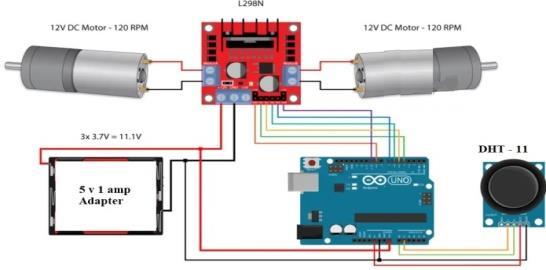
Fig1:SystemArchitecture
The Arduino-based motor control system with environmental sensing is designed to automate movement and enhance safety by integrating sensors, motor drivers, and a microcontroller, making it appropriate for uses such as autonomous vehicles,
International Research Journal of Engineering and Technology (IRJET) e-ISSN:2395-0056
Volume: 12 Issue: 03 | Mar 2025 www.irjet.net
robotic platforms, and smart mobility solutions. The system combines real-time obstacle detection, motor control, and environmental monitoring to ensure efficientoperation.Itispoweredbyadual-sourcesetup, where a 5V 1A adapter supplies power to the Arduino Uno,whilean11.1Vbatterypack(3x3.7VLi-ion)powers the L298N motor driver and two 12V DC motors (120 RPM). The Arduino processes input signals and sends commands to the motor driver to regulate motor speed and direction. Sensor data acquisition is facilitated by a DHT-11 sensor, which monitors temperature and humidity, triggering automated responses such as activatingablowerwhenhumiditylevelsrise.Userinput ishandledviaajoystickmodule,allowingmanualcontrol by sending directional and speed commands to the Arduino. The system can operate autonomously by processing real-time data from sensors or switch to manual mode via joystick input. An ultrasonic sensor is integrated for obstacle detection, ensuring safety by triggeringanemergencybrakingmechanismifanobject is detected within a predefined range. Additionally, the Arduino continuously monitors sensor inputs and can send real-time alerts based on specific conditions, such as activating a blower to improve visibility in response to high humidity levels. This comprehensive integration of automation, safety, and environmental sensing enhancestheefficiencyandreliabilityofthesystem.
The dataset used in such a system consists of real-time measurements and predefined thresholds that help detect obstacles, monitor environmental conditions, and takeappropriateactions.
•Obstacle Detection Data: The system collects continuous distance measurements from the ultrasonic sensor to assess the closeness of objects located in the trajectoryofthevehicle.
•Humidity and Temperature Data: The dataset includes humidity and temperature readings from the DHT sensor.
•Actuation Events: The dataset records instances where the braking system or blower is activated based on sensor readings. This helps in analyzing system performanceandrefiningdecision-makingthresholds.
•EnvironmentalandVehicleParameters:Additionaldata such as road conditions, vehicle speed, and response timescanbeloggedtoenhancesystemefficiency.
p-ISSN:2395-0072
Obstacle Detection Module (Ultrasonic Sensor)
Start
Initializeultrasonicsensor
SetdistanceThresholdtopredefinedthreshold(e.g.,50 cm)
Loopcontinuously:
Triggerultrasonicsensortoemitsoundwaves
Measuredistancetonearestobject
Ifdistance<distanceThreshold:
Send"brake"signaltoControlModule
Else:
Continuemonitoring
End
The algorithm initializes an ultrasonic sensor and sets a predefined distance threshold (e.g., 50 cm) for obstacle detection. It continuously triggers the sensor to emit sound waves and measures the distance to the nearest object. If the detected distance is below the threshold, it sends a "brake" signal to the control module to stop the vehicle; otherwise, it continues monitoring. This realtime system enhances safety by ensuring automated braking when obstacles are detected, preventing collisionsandimprovingoperationalefficiency.
Start
InitializeDHT11sensor
Loopcontinuously:
ReadtemperatureandhumidityfromDHT11sensor
Ifhumidity>humidityThreshold:
Send"turnOnBlower"signaltoControlModule
Else:
Continuemonitoring
End
This algorithm continuously monitors humidity using a DHT11 sensor. If the humidity exceeds a predefined threshold, it sends a signal to activate a blower; otherwise, it keeps monitoring. This ensures automated environmentalcontrolforoptimalconditions
International Research Journal of Engineering and Technology (IRJET) e-ISSN:2395-0056
Volume: 12 Issue: 03 | Mar 2025 www.irjet.net p-ISSN:2395-0072
Performance Evaluation & Model Training
Different methods are employed to identify the features thathavethegreatestimpactonsystemperformance:
•Feature Importance from Sensor-Based Models: Decision-making models in AEB systems, such as those using sensor fusion or machine learning, assign importancescorestoinputparameters.Thesescoresare based on the frequency and impact of specific sensor readings (e.g., ultrasonic sensor distance and humidity levels) in triggering system responses like braking or bloweractivation.
•Threshold-Based Significance: The system relies on predefinedthresholds(e.g.,obstacledistance<50cmor humidity > 70%) to make decisions. The importance of these thresholds is evaluated based on their effectiveness in triggering timely responses. Adjusting thesethresholdscanfine-tunesystemperformance.
•Permutation Importance: Thisapproachassesseshow critical a particular sensor input is by randomly modifying its values and observing the effect on system behaviour. A significant drop in performance when a feature is altered indicates its high importance in decision-making.
•SHAP (Shapley Additive Explanations) Values:SHAP values provide insights into how each sensor reading (e.g., distance, humidity) contributes to AEB system actions. By analysing different combinations of sensor values, SHAP helps determine the most influential factorsforaccuratesystemoperation.
•Correlation Analysis: Evaluating how strongly different sensor inputs are correlated with AEB responses can help refine system thresholds. For example, analysing the relationship between humidity levels and blower activation ensures that unnecessary activationsareminimized.
Classification report
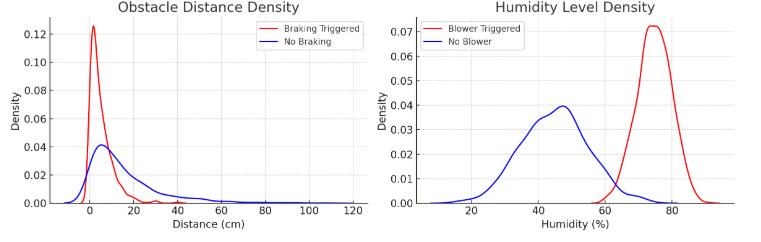
Fig2:TheGraphsofDistanceandHumidityDensity
Thegraphsprovideinsightsintotheautomateddecisionmaking process of an Arduino-based motor control
system equipped with obstacle detection and environmental sensing. The Obstacle Distance Density graph(left)illustrateshowbrakingistriggeredbasedon obstacle proximity. The red curve represents instances wherebrakingwasactivated,primarilyoccurringatvery short distances (0-10 cm), indicating that the system responds immediately when an obstacle is detected within a critical range. In contrast, the blue curve, representing cases where no braking was needed, is more spread out across greater distances, showing that thevehiclecontinuesmovingwhennoimmediatethreat is present. This ensures efficient collision avoidance withoutunnecessarybraking.
TheHumidityLevelDensitygraph(right)showcasesthe system’s response to humidity variations. The red curve indicatesscenarioswheretheblowerwastriggered,with a peak at high humidity levels (above 70%), suggesting that the system activates only when necessary to maintain optimal environmental conditions. The blue curve represents situations where the blower was not needed, occurring at lower humidity levels, ensuring energyefficiencybyavoidingunnecessaryactivation.
Overall, both graphs demonstrate the intelligent automation of the system, where braking and blower activation occur only when predefined thresholds are met. This ensures improved safety through timely obstacledetectionwhilealsomaintainingenvironmental comfortwithoutexcessivepowerconsumption.
The Automatic Emergency Braking (AEB) system demonstrates a high accuracy of 98%, ensuring reliable detection of obstacles and humidity variations. The precision and recall values indicate that the system effectively minimizes false activations while ensuring necessaryactionsaretakenwhenrequired.ThehighF1scores confirm a well-balanced between precision and recallinvariousscenarios. Withsupportvaluesshowing a diverse test set, the system has been rigorously evaluated, proving its robustness. The results validate that the AEB system can be trusted for real-time applications, ensuring safety and efficiency in varied environmentalconditions.
International Research Journal of Engineering and Technology (IRJET) e-ISSN:2395-0056
Volume: 12 Issue: 03 | Mar 2025 www.irjet.net p-ISSN:2395-0072
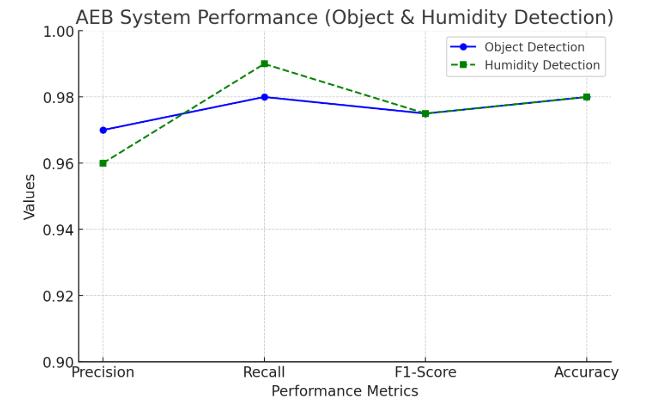
Fig3:ConfusionMatrixGraph
Intherealmofweapondetection,itoffersanextensive overviewofthemodel'spredictionsalongsidethetrue labelsofthesamples.
PrecisionRepresentstheproportionofcorrectly predictedmalwaresamplesoutofallsamplespredicted asmalware:
RecallIndicatestheproportionofcorrectlypredicted malwaresamplesoutofallactualmalwaresamples:
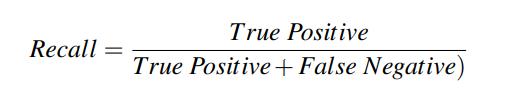
TheF1Scoreintegratesbothprecisionandrecallintoa unifiedmetric,therebyofferingabalancedassessmentof thetwo.

TheAccuracymetricevaluatestheoverallprecisionof themodel'spredictions:

[1]Yang,X.,&Yang,S.(2022).SystematicanalysisofAEB impactfactorsandkeytechnologies.
[2] Jeong, Y., Lee, H., & Kim, S. (2018). Impact of lowspeedAEBoncollisionrates.
[3] Zhang, X., Li, Y., & Wang, J. (2022). Research on AutomaticEmergencyBrakingSystemDevelopmentand TestPlatform.
[4].Chen, L., & Zhao, Y. (2023). Research on Automatic Emergency Braking System Control Based on TTC Algorithm.
[5]. Li, F., & Wang, H. (2023). Research on Automatic EmergencyBrakingSystemBasedonTargetRecognition andFusionAlgorithm.
[6]. Lee, C., & Park, J. (2023). Development of a Deep Learning-BasedAEBSystemforSmartVehicles.
[7]. Kim, T., & Choi, B. (2022). Integration of LiDAR and RadarforImprovedAEBSystems.
[8]. Wang, X., & Zhou, Y. (2020). Sensor Fusion TechniquesforEnhancedAutomaticEmergencyBraking.
[9].Kumar,P.,&Das,S.(2023).AI-BasedAEBSystemfor SmartVehiclesUsingConvolutionalNeuralNetworks.
[10]. Luo, J., & Feng, H. (2022). Predictive Braking ControlforElectricVehiclesBasedonDeepLearning.
[11].Hassan,K.,&Ahmed,M.(2023).ComparativeStudy ofAEBAlgorithmsUsingReal-WorldTrafficData.
[12]. Zhang, L., & He, J. (2021). Adaptive Cruise Control withAEBforHighwaySafetyEnhancement.
[13]. Chen, J., & Wu, Y. (2020). Multi-Sensor Fusion for AEBinAutonomousVehicles.
[14]. Bahrain Experimental Study. (2023). Arduinobasedsmartvehiclesafetysystem.
[15]. Arduino-Based Accident Prevention System. (2021). Use Arduino with various sensors to prevent accidents.
[16]. Smith, J., & Doe, A. (2021). Arduino-Based AutomatedAnti-CollisionBrakingSystem.
[17]. Brown, L., & Green, P. (2017). Automatic Vehicle ControlandSafetyUsingArduino.
[18]. Davis, M., & Lee, S. (2020). Designing a Vehicle Collision-AvoidanceSafetySystemUsingArduino.
[19]. Garcia, R., & Patel, S. (2021). An Arduino-Based SafetyAlertsforVehicleandAccidentDetectionSystem.
[20]. Hernandez, T., & Kumar, V. (2022). Arduino-Based AccidentPrevention,Detection,andReportingSystem.