
International Research Journal of Engineering and Technology (IRJET) e-ISSN:2395-0056
Volume: 12 Issue: 05 | May 2025 www.irjet.net p-ISSN:2395-0072
International Research Journal of Engineering and Technology (IRJET) e-ISSN:2395-0056
Volume: 12 Issue: 05 | May 2025 www.irjet.net p-ISSN:2395-0072
Adarsh
CS1 , Aslam T A,2Fathima
Firoz
3 ,
Sharafudeen
K A4
1 2 3 Student , Ilahia College Of Engineering and Technology, Muvattupuzha, Kerala, India
4 Assistant professor, Ilahia College Of Engineering and Technology, Muvattupuzha, Kerala, India
Abstract To tackle the increasing complexity of cyber threats, this study introduces an Automated Penetration Testing Tool aimed at making security evaluations easier through automation and AI analysis. Although traditional penetration testing methods are effective, they can be slow, require expert knowledge, and consume many resources, making them hard for organizations with limited security manpower to access. The proposed tool automates vulnerability scanning, integrates exploitation frameworks, and provides real-time security insights, enabling both cybersecurityprofessionalsandbeginnerstoconductthorough assessments.
Key Words: Automated Penetration Testing, Cybersecurity, AI-driven Security, Vulnerability Assessment, API Security, ContainerSecurity.
1. INTRODUCTION
As virtual infrastructures become more complex and interdependent, cybersecurity has emerged as a top priority for organizations looking to safeguard their data and infrastructure. Penetration Testing (PT) is one of the essential proactive security activities that can be used to identify and remediate vulnerabilities. Traditional PT approaches tend to demand high technical expertise, time, and resources, making them unaffordable for smaller organizations or individuals with limited technical personnel. This is a major impediment to guaranteeing strong cybersecurity for all business sizes. Additionally, as cyber attacks become increasingly sophisticated, depending on periodic manual testing could expose organizations to risk between testing intervals. Automated penetration testing tools have surfaced as a possible alternative, providing ongoing security analysis with minimal human interaction. Yet, current automated tools can be inflexible and unadaptable compared to human testers, creating vulnerability detection and remediation gaps. To fill this gap, there is increasing demand for intelligent, user-friendly penetration testing tools that find a balance between automation and sophisticated threat analysis. These tools should offer full-spectrum vulnerability scanning, real-time risk assessment, and thorough remediation instructions withoutbeingtoocomplicatedforuserswithdifferentlevels of cybersecurity knowledge. By combining artificial
intelligence, machine learning, and automation, these emerging generation penetration testing tools can enable organizations of various sizes to tighten their security position without needing excessive technical resources. In addition,withtheemergenceofcloud-nativeenvironments, containerized apps, and API-based architectures, contemporary organizations need security tools that go beyond legacy web application testing. The suggested Automated Penetration Testing Tool embeds cutting-edge features like container security scanning, API testing, and real-time anomaly detection to provide coverage of emerging attack surfaces. In contrast to traditional tools, this tool is developed with customizability, modular test frameworks, and AI-driven report generation, enabling securityassessmentstobemoreaccessibleandefficient.
Moreover, the incorporation of Large Language Models (LLMs)improvesthetool'susabilitythroughthecreationof human-readable vulnerability reports with remediation plans, lessening the dependence on cybersecurity professionals. This paper seeks to introduce a scalable, smartpenetrationtestingframeworkthatnotonlyidentifies vulnerabilities effectively but also offers actionable recommendations for enhancing security postures in variousdigitalinfrastructures.
The focus of this business sets the boundaries and objectives of the automated penetration testing tool. It is designed to serve the needs of small to medium-sized enterprises, freelance security professionals, and security enthusiasts.Thesegroupstypicallydon'thavetheresources or skills to carry out complete security scans, so an automatedandeasy-to-usetoolisextremelyvaluable.
The main features of the tool are automating the vulnerability detection with Python and employing YAML templates.Throughserverresponseanalysis,thetoolisable to detect security vulnerabilities like SQL injection and cross- site scripting (XSS). It also incorporates AI-powered reporting, which provides technical results in understandable human-friendly reports. This makes it easy for users at any level of expertise to easily comprehend vulnerabilitiesandperformremediation.
International Research Journal of Engineering and Technology (IRJET) e-ISSN:2395-0056
Volume: 12 Issue: 05 | May 2025 www.irjet.net p-ISSN:2395-0072
Modern progress in penetration testing is fueled by AI and automation, with enhanced accuracy, efficiency, and scalability compared to old-fashioned manual techniques. Research such as PenHeal and CIPHER illustrates how machinelearning and LLMs augment vulnerability discovery and remediation. Research also mentions changing web and network testing methodologies, with a focus on real-time, intelligenttesting.Basedonthis,oursolutionbrings together AI-powered analysis, OWASP-conformant attack templates, YAML-based configuration, and LLM-powered remediation, providing adaptive, scalable, and affordable web app, API, andcontainerizedenvironmentpenetrationtesting.
The suggested machine is an automated penetration testing device meant to select out weaknesses in net packages thru customizable attack templates, advanced reaction assessment, and LLM integration for full reporting. The device is built to be easy to use, effective, and scalable, ensuring that every protection specialists and developers can utilize it for comprehensive protection tests. One of the significant thing features of this device is its customizable templates, which allow customers to define and tailor assault scenarios primarily based totally on their unique needs. The device supports assorted assault vectors, including SQL Injection, Cross-Site Scripting (XSS), and differentOWASPTop10risks,makingitbendyandtargeted penetrationtryingout.Theseattacksaredesignedtheuseof properly mounted OWASP payloads and executed successfullywiththeuseofPythonscripts.
TheResponseAnalysismoduleperformsaessentialfunction in detecting protection weaknesses. It strategies server responses to pick out styles indicative of vulnerabilities, together with surprising database errors, contemplated input,orunauthorizedgetrightofentrytopoints.This realtime evaluation guarantees correct detection and minimizes fakepositives.
A huge enhancement of this machine is its Large Language Model(LLM)integration,speciallyleveragingtheGPT-4API. The detected vulnerabilities are fed into the LLM, which generates particular human-readable reviews with insights into the safety risks, capacity assault impacts, and remediationrecommendations.Thistechniquecomplements theexcellentofpenetrationtryingoutreviews,makingthem extra on hand to each technical and non-technical
stakeholder. Additionally, the file technology module compiles and codecs the LLM-generated content material into complete, dependent reviews, making sure that protection groups acquire actionable insights. These reviewsmaybeexportedindiversecodecsforcleansharing andcompliancedocumentation.
The automated penetration testing tool offers automated scan scheduling, enabling continuous security monitoring without manual intervention. It supports multi-protocol testing, allowing comprehensive vulnerability assessments across HTTP, HTTPS, FTP, and SSH. An interactive dashboard provides real-time insights, historical data, and trendanalysis,makingsecuritymanagementmoreeffective.
The tool incorporates a custom rule engine, allowing users to define security policies and compliance requirements. Role- Based Access Control (RBAC) ensures secure user management by restricting access based on assigned roles. With cloud and on-premise deployment, organizations can choosethebestinfrastructurefortheirsecurityneeds.
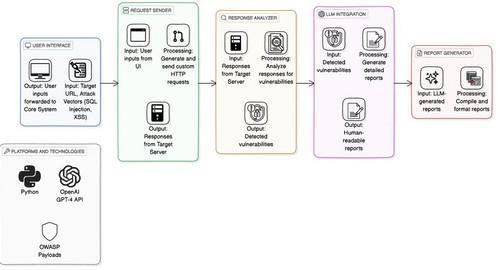
The suggested automated tool for penetration testing has a well-defined system architecture, which is intended to effectivelydetectvulnerabilities,examinesecurityrisks,and produce informative reports. The system consists of a number of distinctive components, each responsible for playing a decisive role in the process of penetration testing illustratedinfig4.1:
1.UserInterface(UI)
The user interface is the interface through which one interacts with the system. The UI provides facilities for users to enter key parameters like the target URL, attack vectors (SQL Injection, Cross-Site Scripting), and scanning settings. The UI further passes this input to the underlying system so that the interaction with the system can be smooth and user-friendly, even for starters and advanced securityexperts.
This module is responsible for generating and dispatching custom HTTP requests based on the user’s inputs. It automates the process of sending attack payloads to the target system, mimicking real-world penetration testing scenarios. The request sender ensures that the penetration tests are conducted in a structured and systematic manner by following pre-configured attack templates aligned with OWASPsecuritystandards.
International Research Journal of Engineering and Technology (IRJET) e-ISSN:2395-0056
Volume: 12 Issue: 05 | May 2025 www.irjet.net p-ISSN:2395-0072
3.ResponseAnalyzer
After the target system responds, the Response Analyzer analyzes the returned data to determine possible security vulnerabilities. This module checks responses for signs like unexpected error messages, database errors, or incorrect handling of input, which may indicate vulnerabilities in the system. Using pattern recognition algorithms, it increases the accuracy of vulnerability detection, minimizing false positivesandincreasingreliability.
4.LLMIntegrationforReportGeneration
For better usability and efficacy of penetration testing reports, the system incorporates a Large Language Model (LLM) like GPT-4. This feature accepts identified vulnerabilities as input and produces humanunderstandable reports that contain elaborative explanations, possible security consequences, and suggested remediation procedures. The implementation of LLM makes it possible for even non-cybersecurity experts to comprehend the vulnerabilities and take corresponding action.
5.ReportGenerator
Upon analysis of the vulnerability, the Report Generator organizes findings in a well-formatted way to ensure readability and correctness. Reports contain vulnerability descriptions, severity ratings, affected areas, and steps for remediation. Final reports can be exported in formats such as PDF or HTML and are valid for security audits, compliancereports,andinternalscans.
6.PlatformsandTechnologies
The system is developed on Python, making use of commonly used cybersecurity frameworks and libraries. It incorporates the OpenAI GPT-4 API for artificial intelligence-based reporting and OWASP payloads for structured penetration testing. These technologies as a whole guarantee an efficient, scalable, and flexible penetration testing solution that can be applied in a wide rangeofsecurityassessmentscenarios.
By integrating automation, AI-based insights, and systematic security assessment methods, this solution improves the effectiveness of penetration testing while making cybersecurity evaluations more scalable, accessible, andreliable.
Step 1: Start Initializetool
Step 2: User Input Collection DISPLAY"EnterTargetURL:" READtarget_url
DISPLAY "Enter Attack Vectors (comma-separated): " READ AttackVectors
READCustomPayloads
Step3:RequestSending FOR EACH attack_vector IN attack_vectors DO FOR EACH
DISPLAY "Enter Custom Payloads (optional, commaseparated):" payloadINcustom_payloadsDO response = SEND_HTTP_REQUEST(target_url, attack_vector,payload) STOREresponseinresponse_listENDFOR
ENDFOR
Step4:ResponseAnalysisvulnerabilities=[] FOREACHresponseINresponse_listDO IFDETECT_VULNERABILITY(response)THEN ADDresponseTOvulnerabilitiesENDIF ENDFOR
Step 5: LLM Integration for Report Generation IFvulnerabilitiesISNOTEMPTYTHEN report=GENERATE_LLM_REPORT(vulnerabilities) ELSE report="Novulnerabilitiesdetected."
ENDIF
Step6:ReportCompilationandFormatting formatted_report = FORMAT_REPORT(report) SAVEformatted_reportAS"Pentest_Report.pdf"
International Research Journal of Engineering and Technology (IRJET) e-ISSN:2395-0056
Volume: 12 Issue: 05 | May 2025 www.irjet.net p-ISSN:2395-0072
Step7:CompletionandLogging
LOG_RESULTS(formatted_report)
DISPLAY "Total vulnerabilities detected: " + LENGTH(vulnerabilities)
Step8:End TERMINATEtool END
FUNCTION SEND_HTTP_REQUEST(url, vector, payload)
PRINT "Sending " + vector + " attack with payload: " + payload+"to"+url response = { "url": url, "vector": vector, "payload": payload, "status_code":200,
"response_time":0.5} RETURNresponse ENDFUNCTION
FUNCTIONDETECT_VULNERABILITY(response)
IF"error"INresponse.status_codeTHEN RETURNTRUE ELSE
RETURNFALSE ENDIF
ENDFUNCTION
FUNCTION GENERATE_LLM_REPORT(vulnerabilities)
RETURN "Generated report with " + LENGTH(vulnerabilities)+"vulnerabilities." ENDFUNCTION
FUNCTION FORMAT_REPORT(report_data)
PRINT"Formattingreport..." RETURN"FormattedReport:"+report_data ENDFUNCTION
5.
The penetration testing tool was successfully created and tested, proving its capability to detect security vulnerabilities in web applications. The tool successfully identified typical vulnerabilities like SQL Injection, CrossSite Scripting (XSS), and server misconfigurations by examining server responses to specially crafted HTTP requests. Utilizing OWASP payloads, the system was able to emulatereal-worldattacksandmarkedsecurity weaknesses, withfewerfalsepositivesthanconventionalsecuritytesting.
Another major point of emphasis with the tool was its effective response analysis, which effectively detected anomalousserverbehaviorlikeincorrecterrorhandlingand informationdisclosure.
Unlike traditional penetration testing tools, which provide raw logs, this system used GPT-4 API to create structured, human-readablevulnerabilityreports,facilitatingeasierrisk assessmentandmitigationbysecurityprofessionals.TheAIgenerated reports offered impact analyses, remediation plans, and risk classifications, allowing for faster and more sounddecisions.
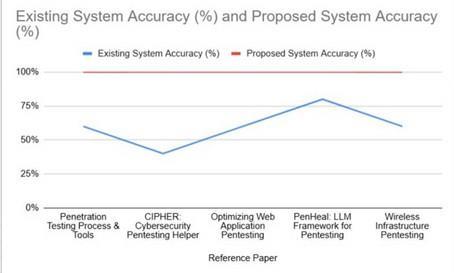
The fig 5.1 illustrates the accuracy of current penetration testing systems and a suggested system. The blue line illustrates the accuracy of current systems in various reference papers, with variations in performance, where some approaches are about 50% accurate and others reach up to about 75%. Conversely, the suggested system, represented by the red line, has a uniform 100% accuracy for all cases, demonstrating its superior performance and dependability in cybersecurity penetration testing. The tool was created with a simple interface that can be utilized by both security experts and users with minimal cybersecurity expertisetocarryoutpenetrationtestsefficiently.
Its scalability was established with simultaneous test running, which qualifies it for large enterprise testing. Its editable attack templates support customized scenarios, whichpavethewayforfutureAPIandcloudsecuritytesting extensions.
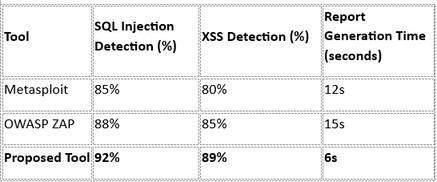
Table 5.1 PerformanceComparison
International Research Journal of Engineering and Technology (IRJET) e-ISSN:2395-0056
Volume: 12 Issue: 05 | May 2025 www.irjet.net
Though the system demonstrated good efficiency and accuracy, there are some points of improvement. The tool can possibly need sophisticated evasion methods to evade contemporary security defenses like Web Application Firewalls (WAFs). This table 5.1 analyzes the performance of Metasploit, OWASP ZAP, and an anticipated penetration testing tool. The anticipated tool performs better than the current toolsin SQL Injectionand XSSdetectionprecisionat 92% and 89%, respectively. Also, it reduces report generation time significantly to 6 seconds from 12s for Metasploitand15sforOWASPZAP.
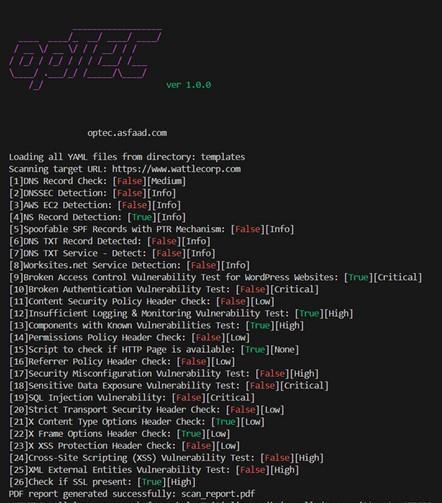
fig 5.2 shows the scanning result. The tool(named optec) analyzes a target URL (https://vulnweb.com/) for various vulnerabilities. The tool checks for DNS records, authentication issues, security headers, and critical vulnerabilities like SQL Injection, XSS, and Broken Access Control.Itcategorizesfindingsbasedonseveritylevels(Info, Low, Medium, High, Critical). The scan identifies multiple vulnerabilities, including Broken Authentication, SQL Injection, and Cross-Site Scripting (XSS), highlighting security weaknesses in the target system. A scan report is generatedsummarizingtheresults.
p-ISSN:2395-0072
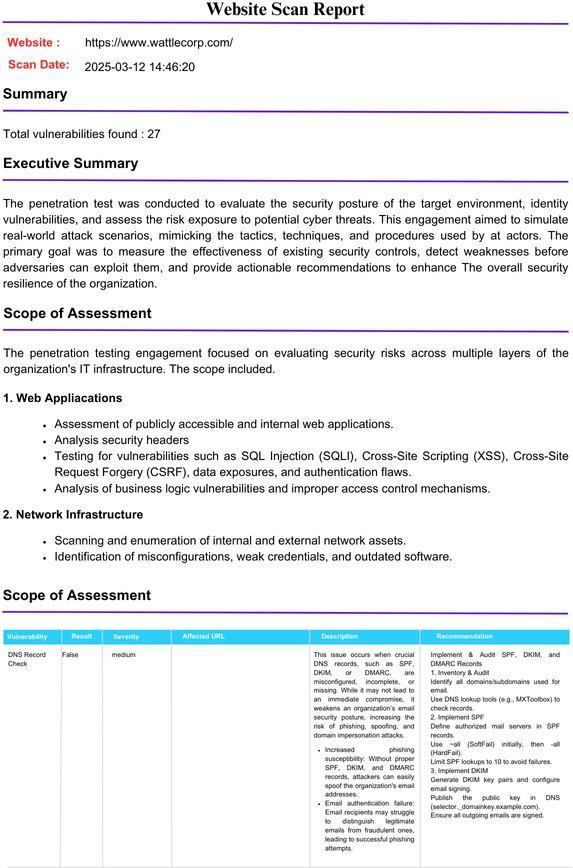
Following the scanning process, Fig 5.3 illustrates the successful generation of a comprehensive PDF report containing the detailed findings from the security assessment.Thereportincludes:
ExecutiveSummary–Anoverviewofthescanningresults, key security issues identified, and potential risks associatedwiththevulnerabilities.
Scope of Assessment – A detailed description of the parameters and objectives of the penetration test, includingthetargetsystemandmethodologiesused.
Vulnerability Details – A structured breakdown of each identified vulnerability, including severity classification, technical descriptions, possible attack scenarios, and recommendedremediationsteps.
http://vulnweb com/
Fig 5.3 Samplereportgenerated
International Research Journal of Engineering and Technology (IRJET) e-ISSN:2395-0056
Volume: 12 Issue: 05 | May 2025 www.irjet.net
The envisioned penetration testing tool bridges ease of use with advanced security features, making it accessible for both beginners and experts. It automates key tasks like custom request creation, vulnerability scanning, and response analysis, enabling efficient security audits without requiring deep expertise. Highly customizable, it detects a wide range of vulnerabilities including SQL injection, XSS, misconfigurations,andauthenticationflawsacross web apps andnetworksystems.
Its adaptable design provides compatibility with various infrastructure configurations, either on-premises, cloudbased, or hybrid infrastructures, for easy integration into currentsecurityprocesses.
Oneof itsbestfeaturesistheinclusionofanunlocked Large Language Model (LLM) that facilitates the penetration testing process by producing human-readable reports. The reports include comprehensive descriptions of the detected vulnerabilities, impact analysis, and recommended remediations, allowing even non-professionals to comprehend and solve security problems efficiently. The reporting mechanism powered by AI not only streamlines technical terminologies but also ranks vulnerabilities in termsofseverity, soorganizationscantackleseriousthreats first.Byremovingthenecessityofinterpretingrawscandata manually, the tool increases efficiency by a huge margin, enablingsecurityteamstomakewell-informeddecisionsata faster rate. Additionally, the application is scalable to suit both small and large companies, making it possible for organizations without specialized security staff to conduct efficient security scans. Through the democratization of penetration testing and provision of an exhaustive but userfriendly solution, it gives users the capability of executing quality, repeatable security tests with little effort, eventually bolstering the security stance of organizations in different sectors.
The modular design of the tool provides the ability to enhance it in the future, including machine learning-driven anomaly detection, behavioral analysis for zero-day threat detection,andcloudsecurityscanning.
Inaddition,addingagraphicaluserinterface(GUI)canmake itmoreeasiertouse,enablingnon-techuserstomanageand runsecurityscanswithease.Throughconstantdevelopment and addition of the latest cybersecurity technologies, this penetration testing tool can help transform security checks into more powerful, efficient, and accessible to all organizationsofanysize.
p-ISSN:2395-0072
[1] Huang, J., Zhu, Q., “PenHeal: A Two-Stage LLM Framework for Automated Pentesting,” IEEE Security, 2023.Pentest-standard.org.(2018).
[2] X. Wei, J. Li, K. Feng, X. Zhang, J. Li and Z. Lu, "Optimum design and analysis of anti-high-overload structure of roll stabilized platform", Zhongguo GuanxingJishuXuebao/J.Chin.InertialTechnol.,vol.26, no.5,pp.603-609,2018.
[3]H. Hemmati, L. Briand, A. Arcuri, and S. Ali, ``An enhanced test case selection approach for model-based testing: An industrial case study,‘’ in Proc. 18th ACM SIGSOFT Int. Symp. Found. Softw. Eng., Santa Fe, NM,USA, Nov. 2010,pp.267276.
[4]L. Q. Sumter, ``Cloud computing: Security risk,'' in Proc. 48th AnnuSoutheast Regional Conf., Oxford, MS, USA, 2010,p.112.
[5]D. Zhang, J. Li, X. Wei, K. Feng, Y. Wang and J. Zhao, "Signal measurementof projectile penetrationoverload based on charge sensor", IEEE Access, vol. 7, pp. 178139-178152,2019.
[6]X.Wei, J.Li,K.Feng, X.Zhang,J.LiandZ.Lu,"Optimum design and analysis of anti-high-overload structure of roll stabilized platform", Zhongguo Guanxing Jishu Xuebao/J.Chin.InertialTechnol.,vol.26,no.5,pp.603609,2018.