
International Research Journal of Engineering and Technology (IRJET) e-ISSN: 2395-0056
Volume: 13 Issue: 03 | Mar 2026 www.irjet.net p-ISSN: 2395-0072

International Research Journal of Engineering and Technology (IRJET) e-ISSN: 2395-0056
Volume: 13 Issue: 03 | Mar 2026 www.irjet.net p-ISSN: 2395-0072
Sharanya
Kommendala1, Namrata Deshpande2, Snehal Mali3, Pooja Rathod4
1,2,3,4 Electronics and Telecommunication Pillai College of Engineering New Panvel
Abstract - The Automated Inventory Management System is designed to simplify and enhance the process of managing electronic components in an academic environment. The system uses barcode scanning technology to automate the issuing, returning, and tracking of components, minimizing manual errors and saving time for both students and laboratory staff. Each component is assigned a unique barcode linked to a centralized web portal that maintains real-time records of availability, issue history, and user details. The system automatically sends email notifications to students regarding component issuance, return due dates, and overdue reminders, ensuring transparency and accountability.Byintegratinghardware(barcodescanners) with a web-based software platform, this project demonstrates an efficient approach to digital inventory control. The solution enhances operational efficiency, reduces paperwork, and supports better resource utilization, making it a reliable tool for academic and institutionalinventorymanagement.
Automated Inventory System, Barcode Scanning, Web Portal, Email Notification, Component Tracking, Database Management, Resource Optimization, Inventory Control, Automation,AcademicLaboratoryManagement
In educational institutions and electronic laboratories, managingandtrackingnumerouscomponentsmanuallyis often time-consuming and prone to errors. Traditional inventory systems rely heavily on paperwork and manual record-keeping, which can lead to data inaccuracy, component misplacement, and inefficient utilization of resources. To overcome these limitations, the Automated Inventory Management System provides a modern and efficient solution by integrating hardware and software technologies.
The system uses barcode scanning to automate the process of issuing and returning components, while a web-based portal maintains real-time records of inventory status. Each transaction is automatically updated in the database, ensuring accurate and transparenttracking.Additionally,thesystemsendsemail notifications to students for issuing, returning, and overdue reminders, enhancing accountability and communication.
By reducing human intervention and improving data accuracy, this system streamlines the entire inventory workflow. It not only saves time and resources but also
promotes better organization and accessibility of electroniccomponentsinlaboratories,contributingto the overallefficiencyofinstitutionalmanagement.
Efficient inventory management plays a vital role in ensuring smooth operations in both industrial and academic environments. Traditional manual inventory systems often lead to errors, data loss, and inefficiency in resource tracking. As a result, researchers have proposed automated approaches using digital technologies to enhanceaccuracyandreliability.
Barcode technology hasbeenwidelystudiedasalow-cost and accurate method for tracking items. According to Kumar et al. (2019), barcode-based systems significantly reduce manual errors and provide real-time visibility of inventory records. Similarly, Sharma and Patel (2020) highlightedthatbarcodeautomationimprovesthespeedof data entry and ensures better accountability in laboratory environments.
With technological advancements, Radio Frequency Identification (RFID) has emerged as an alternative for automation. Mehta and Sahu (2021) reported that RFID systems enable faster data capture without line-of-sight scanning; however, they require higher installation costs, making them less feasible for small-scale institutions. Therefore, barcode-based systems remain the preferred choiceforcost-effectiveinventorymanagement(Raoetal., 2020).
Several studies also emphasize the importance of integrating database management systems (DBMS) with web-based interfaces for effective record maintenance. Gupta and Reddy (2021) demonstrated that a centralized databaseconnectedtoa web portal allowsusers toaccess real-time information about stock availability and transaction history. Moreover, Thomas and Nair (2022) proposed incorporating automated email notifications into inventory systems to remind users about due dates and overdue returns, improving communication and user accountability.
Overall, the reviewed literature suggests that combining barcode scanning, database management, and webbased automation provides an efficient, accurate, and user-friendly inventory management solution. Such a system is particularly useful for academic laboratories where frequent issuing and returning of electronic
Volume: 13 Issue: 03 | Mar 2026 www.irjet.net p-ISSN: 2395-0072
Backend: Python(Flask/Django)orNode.js
1.2
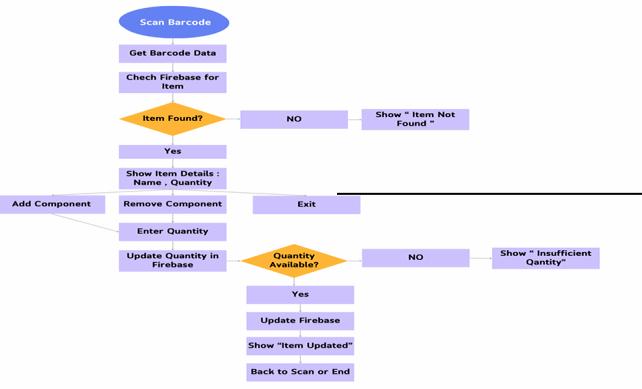
The AutomatedInventoryManagementSystem followsa systematic flow that ensures smooth coordination between the hardware, software, and user interface components. The process begins when a student or laboratory assistant scans the barcode of a component using a barcode scanner connected to the system. The scanner reads the unique identification code and sends it to the web portal or backend server. The system then verifies the scanned ID with the database to check the availability status ofthecomponent.Ifthecomponentis available,thebackendcreatesanewtransactionentrythat includes details such as the student’s ID, issue date, and return due date. Once the transaction is successfully recorded,an automated email notification issenttothe studentconfirmingtheissueofthecomponent.
When the student returns the component, the barcode is scanned again, prompting the system to update the transaction record as “returned” and adjust the available stockquantityaccordingly.Ifacomponentisnotreturned by the due date, the system’s scheduler module automatically detects the overdue entry and sends a reminderemailtothestudent.Administratorscanloginto the web portal at any time to view stock reports, track issued items, or analyze component usage trends. All interactions between users, the server, and the database occursecurelythroughAPIcommunication,ensuring data integrity and real-time synchronization. This automated flow minimizes manual record-keeping, preventsdataduplication,andenhancestheefficiencyand accuracyofinventorymanagementwithinthelaboratory
2. Implementation
1. System Overview
TheAutomatedInventoryManagementSystemmanages electroniccomponentsinalab.Ituses barcode scanning, a web portal,and email notifications fortrackingissuing, returning,andoverduecomponents.
2. Hardware Requirements
BarcodeScanner(USBorwireless)
Computer/Server (for hosting web portal and database)
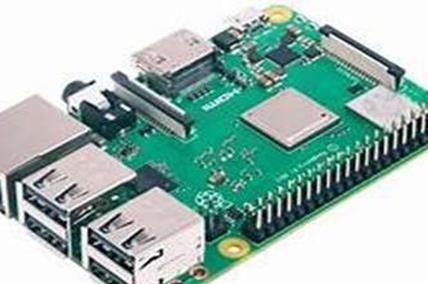
Arduino/Raspberry Pi (Optional) if automated RFID or sensor-basedrackingisrequired Network connectivity fordatabaseandemailnotifications
Frontend: HTML, CSS, JavaScript (React.js optional)
Database: MySQLorSQLite
Email Service: SMTP (Simple Mail Transfer Protocol)
Functional Workflow
A. Issuing aComponent
1. StudentscansIDbarcodeandcomponentbarcode.
2. Systemcheckscomponentavailability.
3. UpdatestheTransactionstablewithtype=“Issue” andsetsdue_date.
4. Sendsemailnotificationtostudent.
5. Updates quantity in Components table.
B. Returning a Component
1. Studentscanscomponentbarcode.
2. System validates pending transaction for that student.
3. Updatestransactionstatusto“Returned”.
4. Updatescomponentquantity.
5. Sends confirmation email to student.
Table -1: Componentstable
Volume: 13 Issue: 03 | Mar 2026 www.irjet.net
Results
The Automated Inventory Management System successfully manages the issuing, returning, and tracking of electronic components in a lab environment. Students can issue components by scanning their ID and the component barcode, with the system automatically updating inventory quantities and setting due dates. Returned components are promptly recorded, restoring the stock levels, while overdue items trigger automated email notifications to the respective students. The system also provides a real-time dashboard for administrators, showingtotalinventory,issueditems,availablequantities, and pending returns. Overall, the system demonstrates efficientperformance,reducesmanualerrors,andensures accurate, real-time tracking of inventory, enhancing the overallmanagementprocess.

-1:Result
-1:systemarchitecture
3. CONCLUSIONS
Overall, the Automated Inventory Management System improves efficiency and accuracy by automating the processes of issuing, returning, and tracking components. It ensures real-time inventory updates, reduces manual errors, and provides automated notifications for overdue items.Thesystem’suser-friendlyinterfaceanddashboard allow both students and administrators to manage inventory effectively, making it a reliable and practical solutionforeducationalandlaboratoryenvironments.
[1] S. K. Singh, "Inventory Management System Using Barcode Technology," International Journal of Computer Applications, vol. 179, no. 18, pp. 20–25, 2018.
[2] A. Sharma and R. Verma, "Automated Inventory Control Using IoT and Barcode Scanning," International Journal of Advanced Research in ComputerScience,vol.10,no.4,pp.45–51,2019.
International Research Journal of Engineering and Technology (IRJET) e-ISSN: 2395-0056
Volume: 13 Issue: 03 | Mar 2026 www.irjet.net p-ISSN: 2395-0072
[3] J.Smithand P.Brown,Practical GuidetoBarcodeand QR Code Inventory Systems, New York: TechPress, 2020.
[4] M. Kumar, "Real-time Inventory Tracking Using RFID and Barcode Systems," Journal of Automation and ControlEngineering,vol.6,no.2,pp.88–94,2018
2026, IRJET | Impact Factor value: 8.315 | ISO 9001:2008