
International Research Journal of Engineering and Technology (IRJET) e-ISSN: 2395-0056
Volume: 12 Issue: 03 | Mar 2025 www.irjet.net p-ISSN: 2395-0072
International Research Journal of Engineering and Technology (IRJET) e-ISSN: 2395-0056
Volume: 12 Issue: 03 | Mar 2025 www.irjet.net p-ISSN: 2395-0072
Asma Begum1 , Dayala Akshitha2 , Nalla Bharat Kumar3 , Ms. V. Alekya4
1B-Tech 4th year, Dept. of CSE (DS), Institute of Aeronautical Engineering
2 B-Tech 4th year, Dept. of CSE (DS), Institute of Aeronautical Engineering
3 B-Tech 4th year, Dept. of CSE (DS), Institute of Aeronautical Engineering
4Assistant Professor, Dept. of CSE (DS), Institute of Aeronautical Engineering, Telangana, India ***
Abstract - This project introduces an automated system that helps users choose the best fonts for different types of documents, such as academic papers, business reports, legal documents, and creative works. The system uses a machine learning model called DenseNet-201 to suggest fontsbasedon the user’s needs and preferences. To develop this system, a collection of Google Fonts was organized into five categories: Sans-serif, Serif, Handwriting, Display/Decorative,andMonospaced. These fonts were then transformed into grayscale images, each 300x300 pixels, for training the DenseNet-201 model. After the model is trained, it analyzes input documents by extracting and classifying text, which helps it suggest the most suitable font style, size, and weight to improve readability and appearance. The system was tested with a dataset of fonts and proved to be effective at accurately recognizing different font styles and providing helpful recommendations for various document types. Byautomating the font selection and document analysis process, this system offers users a useful tool for improving their documents’ visual quality and professionalism.
Key Words: Font recommendation, DenseNet-201, Google Fonts, image conversion, text extraction, classification, automatedsystem.
In the digital age, font selection plays a critical role in enhancing the readability, aesthetic appeal, and professionalism of documents. Whether for academic, business,legal,orcreativepurposes,choosingtherightfont styleandsizecansignificantlyinfluencehowadocumentis perceived.Despitetheavailabilityofnumerousfontoptions, usersoftenfacechallengesinselectingthemostappropriate font for their specific needs. This research addresses this challengebydevelopinganautomatedfontrecommendation system that leverages machine learning to assist users in selectingoptimalfontsfordiversedocumenttypes.
Tobuildthesystem,acomprehensivedatasetoffontimages wasmanuallycollectedfromGoogleFontsusingtheGoogle FontsAPI.TheAPIallowedustoprogrammaticallyaccess fontmetadataanddownloadURLs,facilitatingthecreation of a diverse dataset. Fonts were categorized into six main styles: Serif, Sans-serif, Script, Display, Monospaced, and Handwritten,representingawidevarietyoffontscommonly usedindocument.
FontCategoriesandStyles:Fontsaregroupedintoseveral categories, each serving distinct purposes based on the nature of the document. Serif fonts, for instance, are commonlyusedinformaldocumentssuchasacademicand legaltextsduetotheirtraditionalappearance,whileSansserif fonts are preferred for modern and digital content becauseoftheircleanandminimal design.Understanding these categories Serif, Sans-serif, Script, Display, Monospaced, and Handwritten helps in selecting a font thatcomplementsthetoneandpurposeofthedocument.
ReadabilityandLegibility:Theprimarygoaloffontselection is to ensure the text is easy to read. Fonts with clear and distinguishablecharactersenhancelegibility,especiallyfor long-formdocuments.Factorssuchasfontsize,weight,and spacingalsoplayasignificantroleinimprovingreadability. For instance, Sans-serif fonts are often used in digital documentsduetotheirhighlegibilityonscreens,whileSerif fontsarebettersuitedforprintedtext,wheretheyguidethe reader’seyeacrosslines.
Document Context and Audience: The context of the document and its intended audience are critical in font selection. Business reports, for example, demand professional, clean fonts like Sans-serif, whereas creative projects may benefit from more expressive fonts like HandwrittenorDisplay.Understandingthepreferencesand expectationsofthetargetaudiencehelpsinselectingafont that enhances the document’s message and visual appeal withoutdistractingfromitscontent.
A custom function was developed to automate the font download process, retrieving font files from the API and saving them for further analysis. In addition, another functionwascreatedtogeneratecharacterimagesusingthe downloadedfonts,providingvisualrepresentationsofhow eachfontrendersdifferentcharacters.Theseimageswere crucial for training the DenseNet-201 model used in the recommendation system. By converting the fonts into 300x300 pixel grayscale images, the system was able to classify font styles and provide tailored font recommendationsforvariousdocumenttypes.
Thispaperpresentstheprocessofdatasetcollection,image generation, and the subsequent application of machine
International Research Journal of Engineering and Technology (IRJET) e-ISSN: 2395-0056
Volume: 12 Issue: 03 | Mar 2025 www.irjet.net p-ISSN: 2395-0072
learningtorecommendfonts.Theaimistostreamlinefont selectionandimprovedocumentpresentation,makingthe system a valuable tool for users who seek to enhance the visualqualityoftheirwrittenmaterials.
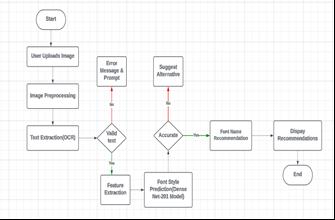
Thesystemoperatesintwokeyphases.First,ittrainsona comprehensivedatasetoffontimages,learningtorecognize andclassifydifferentfontstyles.Second,itprocessesinput documents by extracting and analyzing text, enabling the systemtoprovidetailoredfontrecommendationsbasedon thedocument’scontentandpurpose.Thisdualapproachnot only ensures accurate font recognition but also aligns the recommended fonts with the specific requirements of the documenttype.
Theresultingautomatedsystemoffersapracticalsolution for users seeking to enhance the visual quality and professionalappearanceoftheirdocuments.Bystreamlining thefontselectionprocessandensuringthatfontsarechosen with consideration of both aesthetic appeal and functionality, the system has the potential to significantly improvetheoveralldocumentcreationexperience.Therest ofthepaperisorganizedasfollows.SectionIIsummarizes the related literature. Section III introduces the proposed anomaly detection approach. Section IV details the experiments and presents the evaluation results, while SectionVfurtherdiscussestheinterpretationoftheresults andmakescomparisons.Finally,theconclusionandfuture researchdirectionsarepresentedinSectionVI.
Theselectionofappropriate fontsiscrucial forenhancing thereadabilityandappearanceofvariousdocuments.Over time, researchers have developed different techniques for font recognition, generation, and recommendation using machine learning and neural networks. The growing availabilityoflargefontdatasetsandadvancementsindeep learning have made it possible to develop sophisticated systemsthatautomaticallysuggestsuitablefontsbasedon textcharacteristicsanduserpreferences.
[1]Spohr,Hollink,andCimiano(2011)exploredtheuseof machine learning for ontology matching across multiple languages, emphasizing the importance of matching data based on specific linguistic characteristics. Although their focus was on language processing, their methods provide insightintohowfontclassificationacrossvariousstylesand languagescanbeapproachedinasimilarway,contributing to the development of automated font recommendation systems.
[2]RapeeandIgarashi(2010)introducedanexample-based methodforautomaticfontgeneration,wherenewfontswere created by learning from existing examples. This idea parallels the concept of training deep learning models on existing fonts, as it allows machines to understand the
characteristics of fonts and generate recommendations accordingly.
[3]KimandByun(2007)focusedonoptimizingfontsetsfor multilingualinputsystems, highlightingtheimportanceof fontrecognitionindiverselanguagecontexts.Theirworkis particularly relevant to font recommendation systems, as fonts must be selected based on language-specific requirementsinadditiontoaestheticpreferences.
[4] Chen et al. (2014) presented a large-scale visual font recognition system using deep learning techniques. Their approachinvolvedtheclassificationoffontsbasedonvisual features extracted from font images. This work demonstrates how machine learning models, such as DenseNet-201,caneffectivelyclassifyfontsbylearningfrom visual data. The use of grayscale images of fonts in the currentresearchdrawsinspirationfromthismethod,asit allowsthemodeltorecognizefontstyleswithhighaccuracy.
[5]O’Donovanetal.(2014)exploredfontselectionbasedon crowdsourcedattributes,allowinguserstoselectfontsbased on the perceived personality of each font. This work underlines the subjective nature of font choices and how user preferences can be incorporated into automated systems.Thecurrentresearchintegratesuserpreferencesas partofthefontrecommendationprocess,aimingtodeliver fonts that are both aesthetically pleasing and functionally appropriate.
Automated font recommendation system using deep learning. It starts with Font Dataset Collection and Preprocessing,followedbyFeatureEngineeringusingdata augmentation. The DenseNet Model Training phase trains the model on the prepared data, and Model Testing and Validationensuresitsaccuracy.Thesystemthenprovides Font Recommendations based on user input, and its effectivenessisassessedinthePerformanceEvaluationstep.
Forthisproject,DenseNet-201wasselectedduetoitsability toefficientlyhandleimageclassificationtasksbycapturing intricatepatternsandfeaturesintheinputdata.DenseNet’s architecture,whichpromotesfeaturereusethroughdensely connected layers, makes it particularly suitable for recognizing font characteristics from image data. Its deep learning capabilities allow for accurate classification and recommendation of fonts by learning complex patterns acrossvariousfontstyles,makingitanidealchoiceforthis automatedfontrecommendationsystem.
International Research Journal of Engineering and Technology (IRJET) e-ISSN: 2395-0056
Volume: 12 Issue: 03 | Mar 2025 www.irjet.net p-ISSN: 2395-0072
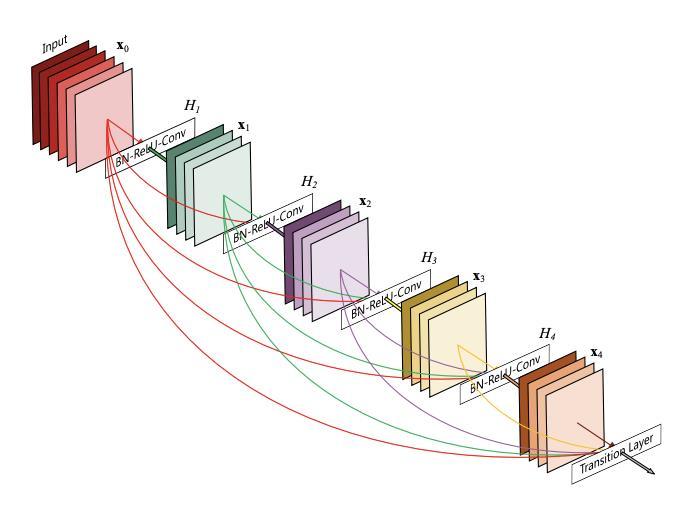
3.2 System Architecture
The model training process in this system uses DenseNet201, a deep learning architecture known for its abilitytohandleimageclassificationtasks.Fontimagesare preprocessedinto300x300grayscaleimagesandundergo augmentation techniques such as rotation, zooming, and flipping to create a diverse training set. DenseNet-201 is trained on this enhanced dataset to learn various font patterns and styles. This training enables the model to provide font recommendations that match the user’s preferencesandthedocument’scontext
3.3 Dataset
Thedatasetfortheautomatedfontrecommendationsystem wasmanuallycollectedfromGoogleFontsusingtheirAPI.It includes various font categories such as Serif, Sans-serif, Script,Display,Monospaced,andHandwritten.Eachfontis represented by images of characters rendered in a standardizedformattoensureconsistency.
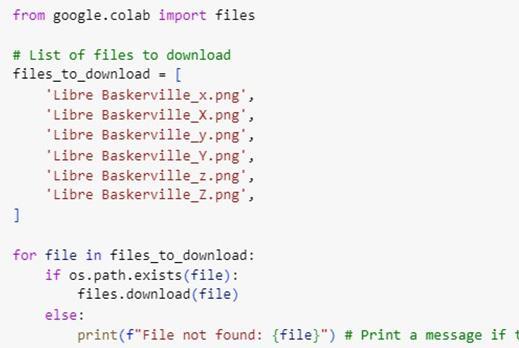
-3: Codetodownloadspecificcharacterimagefilesall inequalsize
Thisdiversedatasetprovidesacomprehensivefoundation fortrainingthemodeltorecommendfontsbasedon differentstylesandusecases.

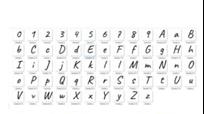
Datapreprocessingbeganwithcleaningtherawfontfiles, ensuringtheywereproperlydownloadedandinthecorrect format.Anycorruptedfileswereremovedorreplaced.We thenstandardizedthefontimagesbyrenderingcharactersat aconsistentsizeandresolutiontoensureuniformityacross different styles. Finally, the images were normalized to
Volume: 12 Issue: 03 | Mar 2025 www.irjet.net p-ISSN: 2395-0072
grayscale,removinganynoiseorcolorinconsistencies.The datasetwasthensplitintotraining,validation,andtestsets, preparingitforaccuratemodelevaluationinfuturetasks.
The implementation of a deep learning model using the DenseNet201 architecture for image classification tasks. Initially, the model is set up by loading the pre-trained DenseNet201withweightsfromImageNet,excludingthetop classificationlayer,andspecifyinganinputshapesuitedfor RGB images. To adapt the model for a custom task, global averagepoolingisappliedtoreducethedimensionalityof the features extracted by the Dense Net base model. Following this, a dense layer with 1024 units and RLU activationisaddedtointroduceafullyconnectedlayer.The final output layer uses a SoftMax activation function to classifytheinputintooneofseveralcategories,depending onthenumberofclasses.
Thecodealsodemonstratesacommontechniqueintransfer learning:freezingandunfreezinglayers.Intheinitialphase oftraining,alllayersoftheDenseNetbasemodelarefrozen toretainthepre-trainedfeaturesandfocusontrainingthe newlyaddedlayers.Afterthis,fine-tuningisperformedby unfreezing the last 40 layers of the base model, allowing theselayerstobeupdated duringtraining witha reduced learningrate.Thisgradualfine-tuninghelpsthemodellearn task-specific features without overfitting or losing the generalizationpoweracquiredfrompre-trainedweights.
1.LoadingthePre-trainedModel:TheDenseNetarchitecture is initialized with pre-trained weights derived from ImageNet (weights=’imagenet’) while omitting the fully connectedtoplayers(includetop=False).Theinputshape for the architecture is defined through the input shape parameter, presented as (img height, img width, 3), representingRGBimageswithsizesindicatedbyimgheight andimgwidth.
2. Adding Custom Layers: The output from the base architecture is linked to a GlobalAveragePooling2D layer, which compresses the spatial dimensions of the feature maps into a single vector for each channel. A dense (fully connected)layercontaining1024unitswithReLUactivation is incorporated to capture more intricate features. The concludinglayerconsistsofadenselayerwithnumclasses unitsandsoftmaxactivationforthepurposeofmulti-class classification.
3. Freezing the Base Model: At first, the layers within the base architecture are frozen (layer. trainable = False), preventing their weights from being modified during the trainingphase.Thisapproachistypicalwhenutilizingthe pre-trainedarchitecture’sfeatureswithoutalterations.
4. Compiling the Model: The architecture is compiled utilizingtheAdamoptimizer,categoricalcross-entropyloss
(appropriateformulti-classclassification),andaccuracyas themetricforevaluation.
5. Fine-tuning the Model: Certain layers within the base architecture are unfrozen to allow for fine-tuning, specificallythelast40layersinthisinstance(basemodel. Layers[-40:]).Thetrainableattributefortheselayersisset to True, allowing them to be modified during the training process.
6.RecompilingwithaLowerLearningRate:Subsequentto unfreezingthelayers,thearchitectureisrecompiledwitha reducedlearningrate(learningrate=0.0001)tomakesure thatthefine-tuningproceduredoesnotresultinsignificant weight changes, which may interfere with the features learnedbythepre-trainedarchitecture.
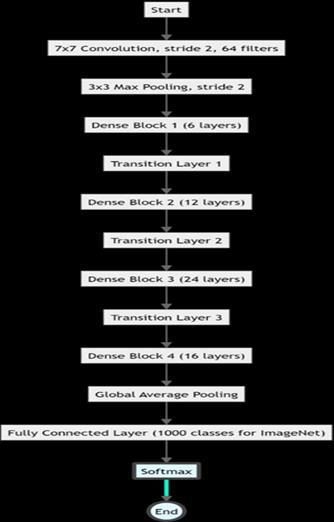
Fig -5: Processforfeatureextraction
3.6 Training & Testing
Thetrainingdatasetfortheautomatedfontrecommendation system consists of carefully curated font images sourced
International Research Journal of Engineering and Technology (IRJET) e-ISSN: 2395-0056
Volume: 12 Issue: 03 | Mar 2025 www.irjet.net p-ISSN: 2395-0072
fromGoogleFonts.Thisdatasetincludesa widevarietyof fontstyles,encompassingcategoriessuchasSerif,Sans-serif,
Script,Display,Monospaced,andHandwritten.Eachfontis representedbyimagesofmultiplecharacters,allowingthe model to learn the unique features and characteristics of differenttypefaces.Toensureeffectivetraining,thedataset was preprocessed to standardize image size and format, facilitatingconsistentinputforthedeeplearningmodel.This diverse and well-structured training dataset enables the Dense Net model to accurately capture font distinctions, improvingitsabilitytorecommendsuitablefontsbasedon user input. The inclusion of various styles and designs furtherenhancesthemodel’srobustnessandadaptabilityin real-worldapplications.
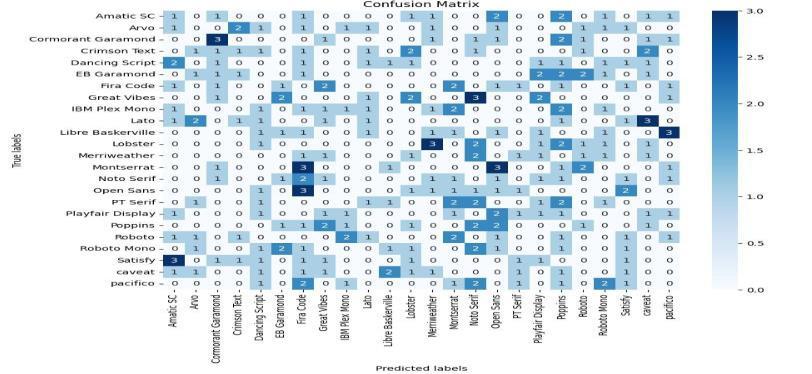
Thetestingdatasetfortheautomatedfontrecommendation system was specifically created to evaluate the model’s performanceonunseendata.Itconsistsofadistinctsetof font images that were not included in the training phase, ensuring that the model’s recommendations are assessed fairly. Similar to the training dataset, this testing set encompasses a variety of font categories, including Serif, Sans-serif,Script,Display,Monospaced,andHandwritten. Eachfontinthetestingdatasetisrepresentedbyimagesof multiplecharacters,allowingforacomprehensiveevaluation of the model’s ability to recognize and recommend fonts accurately.Byusingthisseparatedataset,wecangaugethe effectivenessoftheDenseNetmodelinreal-worldscenarios, measuring metrics such as accuracy, precision, and recall. Thisapproachhelpsensurethatthemodelgeneralizeswell beyond the training data and can effectively recommend fontsbasedonawiderangeofinputs.
The graphs display the model’s training and validation performanceacrossepochsintermsofaccuracyandloss.In the accuracy plot, the training accuracy consistently improves, reaching approximately 95% by the end of the training.However,thevalidationaccuracyremainsrelatively lower, fluctuating around 65%, indicating that the model might be overfitting to the training data, as it generalizes poorlyonthevalidationset.
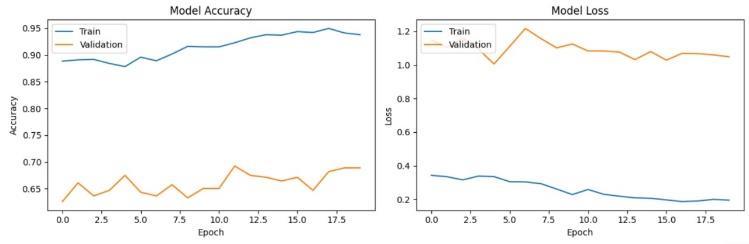
Fig -7:Modelaccuracyandmodelloss
In the loss plot, the training loss decreases steadily, suggesting that the model is learning effectively. On the otherhand,thevalidationlossincreasesafterafewepochs,a furtherindicationofoverfitting.Thewideninggapbetween trainingandvalidationperformancesuggeststhatwhilethe model performs well on training data, it struggles to maintain the same level of performance on unseen data, which calls for adjustments like regularization or early stopping. The image shows the result from an Automated FontRecommendationSystem,whichisdesignedtoidentify andsuggestappropriatefontsforvarious documenttypes based on an image of a font provided by the user. In this case,thesystemhaspredictedthefontintheimagetobe”PT Serif”withahighconfidenceof99.14%.
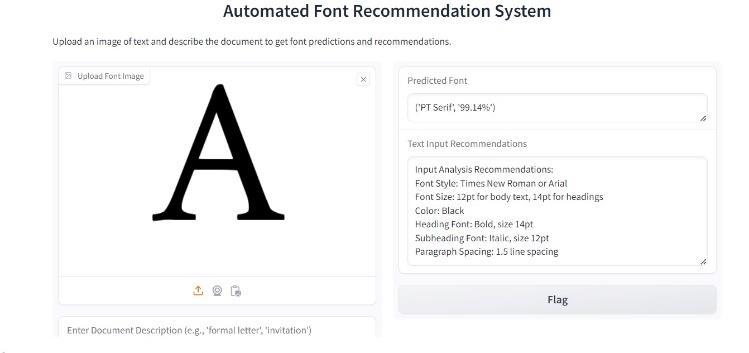
Fig -8:AutomatedFontIdentificationandTextFormatting Recommendations
Additionally, the system provides text input recommendations,suggestingthatfordocumentslikeformal letters or invitations, the preferred font styles could be TimesNewRomanorArial.Therecommendedfontsizeis 12ptforbodytextand14ptforheadings.Othersuggestions includeusingblackcolorfortext,boldfontforheadings(size
International Research Journal of Engineering and Technology (IRJET) e-ISSN: 2395-0056
Volume: 12 Issue: 03 | Mar 2025 www.irjet.net p-ISSN: 2395-0072
14pt), italic font for subheadings (size 12pt), and 1.5 line spacingforparagraphformatting.Theserecommendations aim to ensure clarity and professionalism in formal documents.
Inconclusion,theautomatedfontrecommendationsystem developed using DenseNet-201 demonstrates significant potential in enhancing the process of font selection for various types ofdocuments. Byleveragingadvanced deep learning techniques, the system effectively analyzes input text and user preferences, providing tailored font suggestions that improve both readability and aesthetic appeal. The implementation of a robust training process, alongwiththoroughevaluationandvalidation,ensuresthat themodelperformsreliablyacrossdifferentfontcategories. Thisprojectnotonlystreamlinesthefontselectionprocess butalsocontributestothebroaderfieldofautomateddesign tools.Lookingahead,thereareseveralavenuesforfurther development of this project. Enhancing the model with additional data sources, including user feedback and realtime font usage patterns, could lead to more personalized recommendations.
Additionally, exploring the integration of user interface elements, such as a web-based application or plugin for designsoftware,wouldmakethetoolmoreaccessibletoa wideraudience.Investigatingthepotentialformultilingual font recommendations could also broaden the system’s applicability across different languages and cultural contexts.Finally,incorporatingadvanceduserprofilingand machine learning techniques, such as reinforcement learning, could continuously refine the recommendation processbasedonuserinteractionsandpreferences.
[1] D.Spohr,L.Hollink,andP.Cimiano,“Amachinelearning approach to multilingual and cross-lingual ontology matching,” in Proc. Semantic Web-ISWC 10th Int. SemanticWebConf.,Bonn,Germany.Berlin,Germany: Springer,Oct.2011,pp.665–680.
[2] S.RapeeandT.Igarashi,“Example-basedautomaticfont generation,”inProc.Int.Symp.SmartGraphics.Berlin, Germany:Springer,2010,pp.127–138.
[3] K. Kim and J. Byun, “An implementation of optimized hangulfontsetformultilingualIMengine,”inProc.6th Int.Conf.Adv.Lang.Process.WebInf.Technol.(ALPIT), Aug.2007,pp.200–205.
[4] J. Ja-Yeon, “Automatic extraction of hangul stroke elementusingfasterR-CNNforfontsimilarity,”J.Korea MultimediaSociety,vol.23,no.8,pp.953–964,2020.
[5] S.-B.Lim,J.Lee,X.Zhao,andY.Song,“Detectionmodelof hangul strokeelements:Expansionofnon- structured font and influence evaluation by stroke element combinations,” Electronics, vol. 12, no. 2, p. 383, Jan. 2023.
[6] G. Chen, J. Yang, H. Jin, J. Brandt, E. Shechtman, A. Agarwala, and T. X. Han, “Large- scale visual font recognition,” in Proc. IEEE Conf. Comput. Vis. Pattern Recognit.,Jun.2014,pp.3598–3605.
[7] Y.Zhu,T.Tan,andY.Wang,“Fontrecognitionbasedon globaltextureanalysis,”IEEETrans.PatternAnal.Mach. Intell.,vol.23,no.10,pp.1192–1200,Oct.2001.
[8] P.O’Donovan,J.L¯ibeks,A.Agarwala,andA.Hertzmann, “Exploratory font selection using crowdsourced attributes,”ACMTrans.Graph.,vol.33,no.4,pp.1–9,Jul. 2014.
[9] S.DawnandB.Chaparro,“Perceptionoffonts:Perceived personalitytraitsand appropriateuses,”Digital Fonts Reading. World Scientific, 2016, ch. 13, pp. 226–247. [Online]. Available: https://doi.org/10.1142/97898147595400013
[10] C. Hsien-Chih, M. Ma, and Y. C. Feng, “The features of Chinese typeface and its emotion,” in Proc. Int. Conf. KANSEIEng.EmotionRes.,Mar.2010,pp.1–11.
[11] X. Kong and Z. Liu, “Reaserch on monolingual font recommendationbasedontargetperception,”inProc. Int.Conf.Intell.Design(ICID),Dec.2020,pp.94–97.
[12] N. Samadiani and H. Hassanpour, “A neural networkbased approach for recognizing multi-font printed English characters,” J. Electr.Syst. Inf. Technol.,vol.2, no.2,pp.207–218,Sep.2015.