
International Research Journal of Engineering and Technology (IRJET) e-ISSN: 2395-0056
Volume: 12 Issue: 03 | Mar 2025 www.irjet.net p-ISSN: 2395-0072
International Research Journal of Engineering and Technology (IRJET) e-ISSN: 2395-0056
Volume: 12 Issue: 03 | Mar 2025 www.irjet.net p-ISSN: 2395-0072
Rushikesh Kurtadkar1 , Ketaki Lokare2 , Sujata Patil3, Riddhi Kadam4, Prof. S. C. Saraf5
1234Electronics and Telecommunication Engineering, JSPM NAHRE TECHNICAL CAMPUS, PUNE, MAHARASHTRA 5Electronics and Telecommunication Engineering, JSPM NAHRE TECHNICAL CAMPUS, PUNE, MAHARASHTRA ***
Abstract –
The proper separation of ferrous and non-ferrous metals plays a critical role in recycling and manufacturing processes. This research proposes an automatic metal sorting system that involves the use of an inductive proximity sensor with a conveyor belt system. The system operates basedon object detection laid on the conveyor belt by the inductive proximity sensor, which determines whether the object is ferrous or non-ferrous. A motorized sorting system, consisting of a vertically mounted motor with a mounted thin sheet, facilitates efficient sorting. The motor runs in its natural mode to sort non-ferrous metals and reverses its mode when ferrous metals are detected, ensuring accurate separation. An ESP32-CAM module, used for real-time monitoring and live streaming, is part of the system, which facilitates remote monitoring of the sorting processes. An ESP8266 microcontroller, integrated with an L298N motor driver, controls the operational processes of the system. An AI-based counter, which tracks the count of ferrous and non-ferrous objects sorted, is also part of the system. This project proposes a cost-effective and automated solution towards metal sorting, with high applicability in waste management, recycling, and industrialautomation.
Metal segregation is an important operation in recycling, waste treatment, and manufacturing industries. Effective differentiation between ferrous and non-ferrous metals enhances the efficacy of resources and minimizes environmental degradation. The conventional sorting procedure is based on manual intervention, which is error-prone and time-consuming. To overcome such limitations, automated metal sorting equipment with sensors and real-time monitoring has become indispensable.
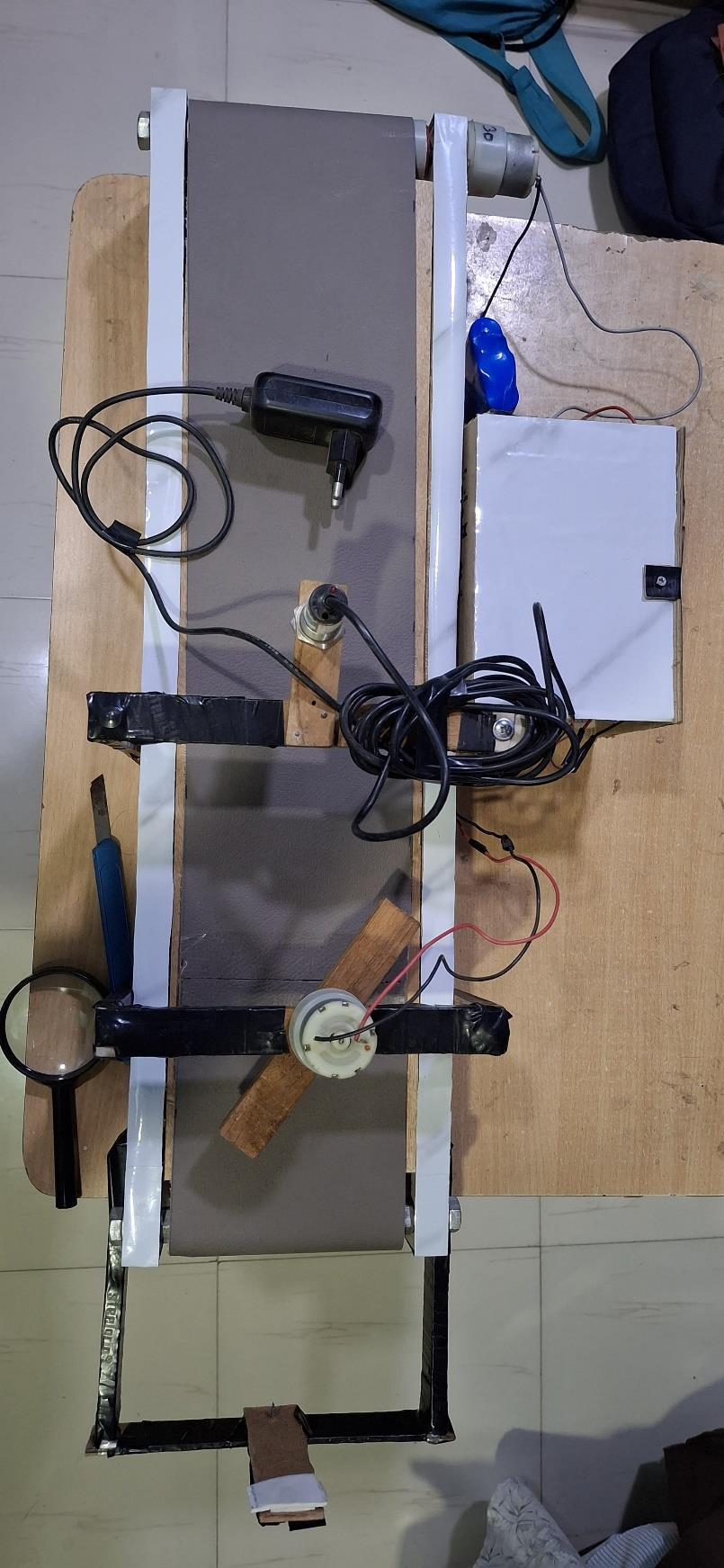
Thisresearchprojectinvolvesthecreationofanautomatic sorting system for metals, utilizing an inductive proximity sensor to detect ferrous and non-ferrous material. The items are placed on a conveyor belt, where the sensor detects the material type. A motorized sorting system
separates the items based on the type of classification determined by the sensor. The system is controlled by an ESP8266 microcontroller, which guarantees proper and efficientoperation.
To further improve monitoring and data acquisition, the system incorporates an ESP32-CAM module for real-time streaming of the sorting process. Moreover, the system includesanAI-drivencounterthatmonitorsthevolumeof ferrous andnon-ferrous objectssorted,showingreal-time figures. The integration of automation, sensor technology, and AI enhances the accuracy of sorting and facilitates remotemonitoring,thusbeingacost-efficientsolutionfor industrialandrecyclingprocesses.
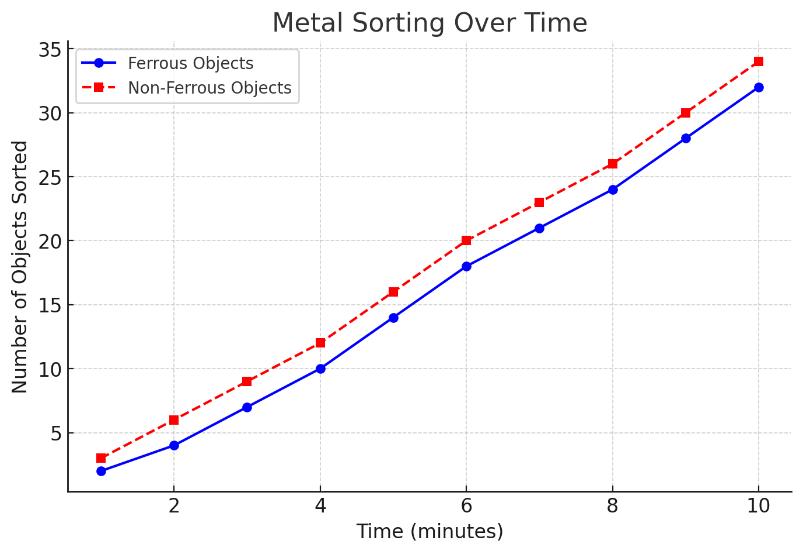
The graph displays the count of ferrous and non-ferrous items separated over time by the automatic metal sorting system. With time passing, the count of both ferrous and non-ferrous metals increases, reflecting the steady operation of the system. The non-ferrous items are separated at a slightly increased rate than ferrous items because of their greater prevalence or quicker default separationprocess.Thisvisualizationassistsinexamining the efficiency and regularity of the sorting process throughoutaspecifiedperiodoftime.
International Research Journal of Engineering and Technology (IRJET) e-ISSN: 2395-0056
Volume: 12 Issue: 03 | Mar 2025 www.irjet.net p-ISSN: 2395-0072
METHODOLOGY
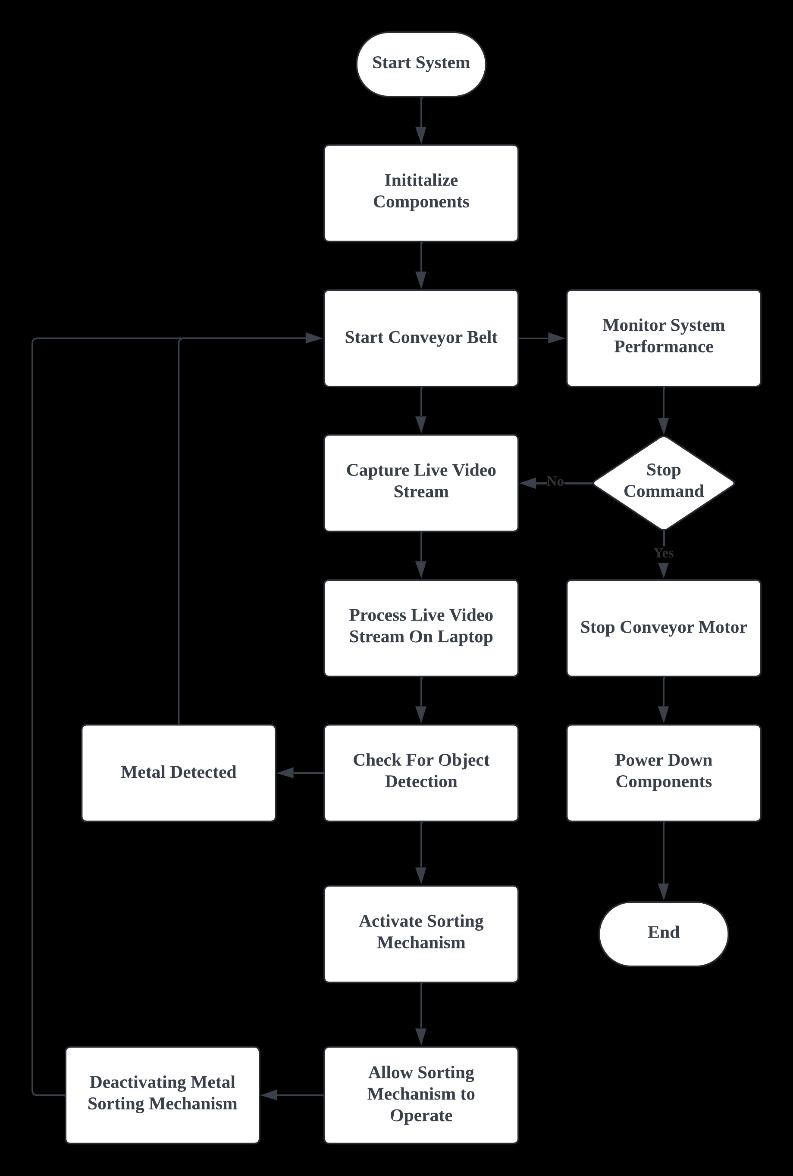
Themethodologyoftheautomatedmetalsortingsystemis a systematic process of detecting, classifying, and sorting
ferrous andnon-ferrous metalswithreal-timemonitoring andAI-basedcounting.Thestepsareasfollows:
1. Placement of Object on Conveyor Belt
The metal object is placed on a conveyor belt driven by a 12VDCmotor.Theconveyorbeltismovedatacontrolled speedtofacilitateproperdetectionandsorting.
2. Metal Detection Via Inductive Proximity Sensor
Astheobjecttravelsonthe conveyorbelt,itgoesthrough aninductive proximitysensor. The sensor identifiesif the object is ferrous or not ferrous based on its electromagneticreaction.
3. Signal Processing and Categorization
The inductive proximity sensor sends the signal to the ESP8266 microcontroller. The microcontroller processes the sensor information and decides the category of the object:
Ferrous Metal: Picked up by the sensor because of its magneticnature.
Non-FerrousMetal:Notpickedupbythesensor,sinceitis notmagnetic.
4. Activation of Sorting Mechanism
A 12V DC motor, with a thin deflector sheet attached, is employedtosortobjects
Themotorworksasfollows:
DefaultRotation:Non-ferrousobjectsareallowedtomove furtheralongtheconveyorbelt.
Reverse Rotation: When the object is ferrous, the motor turns around, moving the deflector sheet to deflect the objectintoanalternatecollectionarea.
5. Live Monitoring through ESP32-CAM
An ESP32-CAM module records and streams the sorting activity in real time. The real-time feed is accessible remotelyformonitoring.
6. AI-Based Counting and Display
Data is processed using an AI-based system to determine thenumberofferrousandnon-ferrousitems.Thecountis displayedonanattachedscreenforreal-timemonitoring.
7. Data Analysis and Optimization
Data is accumulated on sorting over a period of time, which is used to enhance efficiency. Possible enhancements involve modifying conveyor speed, sensor
International Research Journal of Engineering and Technology (IRJET) e-ISSN: 2395-0056
Volume: 12 Issue: 03 | Mar 2025 www.irjet.net p-ISSN: 2395-0072
positioning optimization, and cloud-based monitoring integration.
Benefits of the Automated Metal Sorting System
1. Improved Efficiency – Automates sorting, minimizing theuseofmanuallabor.
2. High Accuracy – Employs an inductive proximity sensor to accurately sort ferrous and non-ferrous metals.
3. Real-Time Monitoring – ESP32-CAM facilitates live streamingandremotemonitoring.
4. AI-Based Counting – Monitors and shows the number ofsortedobjectsforanalysis.
Shortcomings of the Automated Metal Sorting System
1. Restricted to Metal Detection – Ineffective for sorting materialsapartfrommetals.
2. Initial Cost – Needs to be invested in parts such as sensors,motors,andmicrocontrollers.
3. Sensor Accuracy Dependence – Dependent on the sensitivityoftheinductiveproximitysensor.
4. Potential Maintenance Problems – Maintenance is neededformotorsandconveyorbelts.
1. Enhancing Recycling Efficiency – Helps manage wastesbyaccuratelyseparatingrecyclablemetals.
2. Industrial Automation – Reduces reliance on human labor, boosting productivity in metal processing plants.
3. Cost Savings – Minimizes operational costs by restrictinghumanintervention.
4. Monitoring-Driven By Data – Provides real-time data foranalysisandoptimization.
5. ImprovedWorkplaceSafety–Eliminateshumantouch inriskysortingplants.
6. Scalable For Mass Implementation – Can be scaled to handlelargeloadsinenterprises.
7. Integrability in Smart Manufacturing – Can be integrated with IoT devices for remote monitoring andcontrol.
We extend our deepest gratitude to our project guide, Professor S.C. Saraf, for their invaluable support and insights, which greatly enriched our understanding of AIpowered predictive maintenance systems for industrial equipment. Additionally, we express our sincere appreciation to Professor Mrs. S.P. Kurlekar, Head of the Department, for fostering a learning environment that promotes innovation and academic excellence, inspiring us throughout our studies. We are grateful to each of you foryourcontributions,whichmadethisresearchpossible.
[1] Paul J. LaNasa: "Automated Continuous Process Control"
[2] JohnJ.Craig:"IntroductiontoRobotics:Mechanicsand Control"
[3] W. Zhang et al: "Intelligent Sorting of Materials Based on Image Processing and Machine Learning Techniques,"
International Research Journal of Engineering and Technology (IRJET) e-ISSN: 2395-0056
Volume: 12 Issue: 03 | Mar 2025 www.irjet.net p-ISSN: 2395-0072
[4] S. Smith, A. Jones: "Metal Detection Techniques in Recycling,"
[5] Automation.com: "How Inductive Proximity Sensors Work"
[6] ResearchGate: "Understanding Image Processing Techniques"