
International Research Journal of Engineering and Technology (IRJET) e-ISSN: 2395-0056
Volume: 12 Issue: 04 | Apr 2025 www.irjet.net p-ISSN: 2395-0072
International Research Journal of Engineering and Technology (IRJET) e-ISSN: 2395-0056
Volume: 12 Issue: 04 | Apr 2025 www.irjet.net p-ISSN: 2395-0072
Mr. Pratik H. Gurav1
Dept. of Computer Engineering
Dr. Pravin Jangid2
Dept.ofComputerEngineering
Shree L RTiwariCollege ofEngineering ShreeLRTiwariCollegeof Engineering Mumbai, Maharashtra, India Mumbai, Maharashtra, India
Abstract - The tracking and analysis of plant leaf sickness are critical issues in modern agriculture since the condition of a plant determines the total agricultural yield and productivity. Plant diseases are often linked with various issues, but are typically linked with a failure to identify and evaluate at the right time. In the present work, the authors created a robust methodology for plant leaf disease identification using a combination of deep and machine learning techniques for various crops witha dataset that covers tomatoes, peppers, and potatoes. The model uses Convolutional Neural Networks for classifying images and a multi-species dataset of plants, including tomatoes, peppers, and potatoes. The system has various steps such as image pre-processing, segmentation and feature extraction. Apart from K-Nearest Neighbors (KNN), other was also utilized for the fine-tuning of the classification results. Experimental results indicate high accuracy rates in training (98.45%) andtesting (98.15%) for various disease types such as bacterial, fungal, and viral. This model not only identifies diseases with accuracy, but also identifies important features such as the type of disease, the affected region, and the health condition of the plant under consideration. Using CNN allows automatic feature extraction, whereas Random Forest guarantees effectiveclassification leading to better accuracy and precision. This piece of work helps the field of precision agriculture through an effective, low-cost, and scalable solution for real-time monitoring of plant diseases.
Key Words: Plant Disease Detection, Deep Learning, CNN, KNN, Image Pre-processing, Feature Extraction, Agricultural Automation, Plant Health Monitoring, Disease Classification, Precision Agriculture.
Agriculture is the most significant industry of the global economy, supporting food sovereignty and tapping rural economies.Pathogenssuchasfungi,bacteria,andvirusesare extremely devastating to crop health, exacerbating economic, social, and ecological losses. Crop quality and yieldslargelyrelyonearlydiagnosisofthesediseases.The employment of fully trained experts for plant visual diagnosis is conventional and not very efficient since it is
subjective and time-consuming. This requires and more immediacy.Recentdevelopmentsindeeplearningcombined with image processing methods have brought about a revolutioninthefieldofplantdiseasedetection.Automatic diagnosisbasedonneuralnetworkmodels,orinparticular ConvolutionalNeuralNetworks(CNNs),isappliednowadays withremarkablesuccesssinceithelpsinimageclassification byautomaticallyidentifyingdifferentdiseasesintheleaves andotherstructuresoftheplants.CNNshavebeenprovento be much more precise and quicker compared to conventional methods, which depend on human interpretation of data, since they can extract and learn featuresindependently.Agricultureisthemostsignificant sectoroftheglobaleconomy,supportingfoodsovereignty andleveragingruraleconomies.Fungi,bacteria,andviruses arehighlydevastatingtoplanthealth,however,furthering economic,socialandecologicallosses.Thequalityandyield ofcropsrelygreatlyuponearlydiagnosingthedisease.The age-oldpracticeofapplyingfullytrainedexpertsforvisual inspectionofplantsisinefficientandnotveryeffectivesince it is slow and subjective. This necessitates and a greater immediacy.Recentdevelopmentsindeeplearningcombined with image processing algorithms has brought about a revolution in the world of plant disease detection. Neural network model-based automatic diagnostics, that is, ConvolutionalNeuralNetworks(CNNs),areemployedtoday withmuchsuccessbecauseitfacilitatesimageclassification throughautomaticidentificationofvariousdiseasesonthe leaves and in other parts of the plants. CNNs have been found to be more accurate and quicker compared to conventional methods that are based on manual interpretation of data since they can learn features and extract by themselves. The current study attempts to examine the use of machine learning and deep learning methods for diagnosing as well as plant disease classification. Improving the performance and detection accuracyofdetectionsystemsistheobjectiveofusingCNNs and other machine learning classifiers in the model proposed.Weaimtocontributetothedevelopmentoflowcost and accessible technologies for plant disease managementinregionswithlimitedagriculturalknowledge throughthisstudy.Literaturereview,methodology,results, andtheimpactsuchdevelopmentcanhaveonagriculture areincludedinothersectionsofthispaper.
International Research Journal of Engineering and Technology (IRJET) e-ISSN: 2395-0056
Volume: 12 Issue: 04 | Apr 2025 www.irjet.net p-ISSN: 2395-0072
Plant disease diagnosis is a crucial part of precision agriculture, and recent advances in image analysis and machinelearninghaveenabledmoreefficientandaccurate diagnosis systems. This survey gives a comprehensive overviewofthemethods,methodologies,andoutcomesof variousresearchersinthearea.
Narvekar&Patilappliedcolorandtextureanalysisforhighaccuracyfeatureextractionindiseasediagnosis.However, their method was affected by inconsistency in the input imageenvironment.2015[1],Kaur&KaurutilizedGLCMand histogram-based features and the K-Nearest Neighbors (KNN) algorithm. While this improved classification accuracy,themethodfacedcomputationalinefficiencieswith high-resolution images. [2], Rahul Das & Kanchana incorporated HSV color space conversion with Support Vector Machine (SVM) classification, which significantly improveddetectionperformance.Overfittingwasobserved, however,withtinydatasets.2017[3].
Vipinadas&Thamizharasiutilizededgedetectiontechniques andSVMs,observingthatCNNswouldpossiblyworkbetter thantraditionalapproaches.Theirwork,however,wasnot specifically deep learning-focused.2015 [4], Ferentinos compared architecture types like VGG16, ResNet, and DenseNettoidentifyplantdiseases.DenseNetwasshownto perform better than others through effective reuse of features, though with extreme computationally expensive.2017[5], Mohanty et al. proposed a CNN-based modelandattainedthestate-of-the-artaccuracyonalargescaledatasetofplantleafimages.However,similartomost deep learning architectures, it used to overfit on smaller data.2016[6],Sladojevicetal.demonstratedgoodaccuracy acrossseveralplantspecieswithCNNsbutattheexpenseof highcomputationalresources.2016[9],Prajwalaetal.(2018) and Atabay (2017) used CNN and ResNet respectively for detection of tomato leaf disease with high precision and recallbutwithoutdatasetcomplexitydetails.[16],Kawasaki etal. successfullyemployedCNNsindetecting viral plant diseases,showcasingthepotentialofdeeplearningforsome diseasecategories.2015[19].
The shift from traditional image processing techniques to deeplearning-basedmodelshassignificantlyimprovedthe robustnessandaccuracyofplantdiseasedetectionsystems. While CNNs and more recent architectures like DenseNet have set the bar high, challenges such as overfitting, computational cost, and small datasets continue to exist. Future research could focus on light and interpretable models, better dataset preparation, and domain-aware optimizationmethodstotakethisareafurtherforward.
Thesystemofdetectionandplantleafdiseaseclassification presentedherecombinesadvancedimageprocessingwith
machine learning. The methodology is explained in the followingsections.
1. Dataset and Image Acquisition
Plant Village dataset (www.plantvillage.org) is employed by the system. The dataset contains 20,636 images of plant leaves of 15 classes of diseases. The dataset is focused primarily on tomatoes,peppers,andpotatoesbecausetheyare majorcropsgloballyandeveninIraq.Eachimageis saved as RGB and without any loss in quality or detailsinJPGformat.
2. Image Editing
Inordertoimprovethepaceoftrainingandreduce theburdenontheprocessingunit,eachimagewas clipped to a square size of 128x128 pixels. All images are confirmed to be optimized so that nothingisdeletedintermsofdatawhichensuresno informationintheimages'detailislost.
3. CNN Training
•70% for training the CNN model and 30% is utilizedfortestingandvalidating.
•TheCNNmodelistrainedbyadjustingtheweights inconvolutionlayersandthefullyconnectedlayers tominimizethelossfunction(actualandpredicted diseaselabelsdifference).
•The network istrainedfor multiple epochs,and theweightsareupdatedthroughbackpropagation tominimizetheclassificationerror.
4. Feature Extraction Techniques
•GrayLevelCo-occurrenceMatrix(GLCM)isused to derive texture features from the images. GLCM helpsinmeasuringthespatialrelationshipofpixels, which provides texture features like contrast, energy,entropy,andhomogeneity.
•K-meansClustering:Thismethodisusedforimage segmentationtoseparatethediseasedregionfrom the healthy regions of the leaf. The K-means algorithmgroupspixelsintoclustersdependingon their color and intensity characteristics. The diseasedareasaredetectedintheclusterwiththe mostpixeldensity.
5. Convolutional Neural Network (CNN) Architecture
The fundamental of the system relies on a CNN framework, for effective feature extraction and diseaseclassificationofplantleaves.
International Research Journal of Engineering and Technology (IRJET) e-ISSN: 2395-0056
Volume: 12 Issue: 04 | Apr 2025 www.irjet.net p-ISSN: 2395-0072
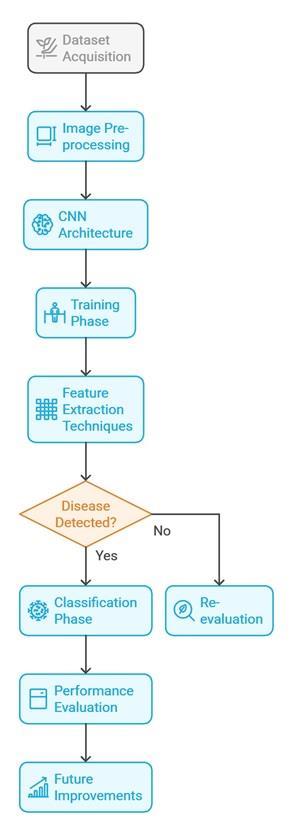
6. Detection and Classification of Disease
•Aftertraining,thesystemistestedwithunseenimagesto classifythediseasesproperly.
•Theimagesarepassedthroughthepre-trainedCNN,and thefeaturesareextractedbyconvolutionlayers.
•SVM(SupportVectorMachine)isemployedinsomecases for the purpose of comparison with CNN. SVM classifies images based on the extracted features, which forms a secondvalidationlayer.
7. Performance Evaluation
•Accuracy:Theaccuracyofthesystemismeasuredinterms ofhowaccuratelythesystemidentifiescorrectlyclassified images as opposed to the total number of images in the dataset.
•AffectedAreaCalculation:Oncetheareaofthediseaseis detected,thesystemcalculatestheaffectedareapercentage oftheleafusingthefollowingformula:
AffectedRegion(%)=XY×100AffectedRegion(%)=X/Y× 100AffectedRegion(%)=YX×100
whereXXXisthenumberofpixelsintheaffectedareaand YYYisthenumberofpixelsintheleafimage.
•The strategy proposes the expansion of dataset size to incorporatemoreplantvarietiesandtypesofdiseases.
•Experimenting with different convolution filters and classifierssuchasKNN(K-NearestNeighbors)andRandom Forestmightimproveaccuracyevenfurther.
•Includingmoreadvancedfeatureextractionalgorithmsand usingmore diversesources ofimagescouldlead tobetter generalization.
ThePlantDiseaseDetectionSystemwasimplementedona dataset of different leaf disease images, such as Rust, PowderyMildew,Scab,andHealthyleaves.Thesystemwas programmedtoclassifyplantleafimagesbasedonahybrid deeplearningmodelbasedonDenseNet121andXception. The following is the presentation of the performance metrics,observations,andresultsanalysis.
Evaluation Metrics
•Accuracy: Ratioofthenumberofcorrectlyclassified samplesoutofthetotalnumberofsamples.
• Precision: Precision=TPTP+FPPrecision=TP+FPTP
• Recall (Sensitivity): Recall=TPTP+FNRecall=TP/(TP+ FN)Recall=TP+FNTP
• F1-Score: F1=2×Precision×RecallPrecision+RecallF1=2 ×(Precision×Recall)/(Precision+ Recall)F1=2×Precision+RecallPrecision×Recall
• Specificity: Specificity=TNTN+FPSpecificity=TN/(TN +FP)Specificity=TN+FPTN
Where:
• TP = TruePositives(accuratelypredicted positivecases)
International Research Journal of Engineering and Technology (IRJET) e-ISSN: 2395-0056
Volume: 12 Issue: 04 | Apr 2025 www.irjet.net p-ISSN: 2395-0072
• FP = FalsePositives(inaccuratelypredicted positivecases)
• TN = TrueNegatives(accuratelypredicted negativecases)
• FN = FalseNegatives(inaccuratelypredicted negativecases)
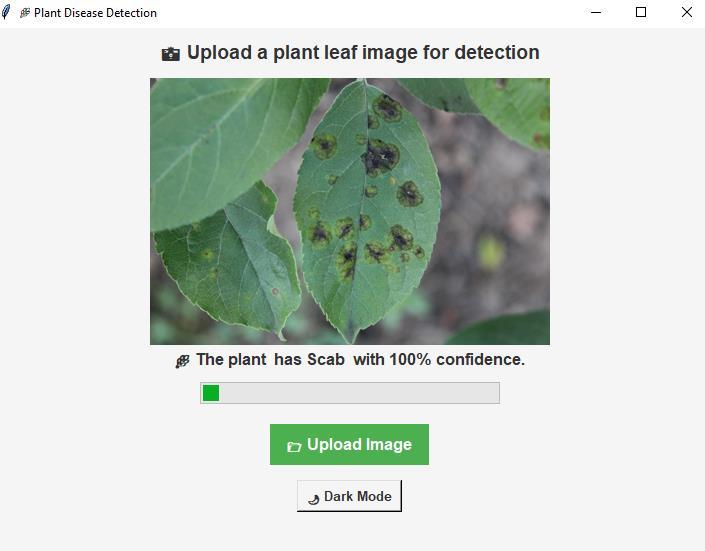
Table-1:ResultsandAccuracyMatrix

In short, the research effectively demonstrates that deep learning techniques, here being Convolutional Neural Networks(CNN),canbesuccessfullyappliedtodetectand classify diseases in plant leaves. The proposed method effectivelyincreasesdiseasedetectionwithahighaccuracy rate of over 98%, and it provides both efficiency and accuracy.TheintegrationofsegmentationalgorithmslikekmeansclusteringandfeatureextractionalgorithmslikeGray LevelCo-occurrenceMatrix(GLCM)hasproventobehighly effective in the identification of diseased areas on plant leaves. Furthermore, the difference between different machinelearningclassifierslikeK-NearestNeighbors(KNN) andSupportVectorMachine(SVM)reflectsscopeforfurther improvementintheclassificationprocess.Themainstrength ofthisapproachistheabilitytocategorizenumerousplant diseases from extensively researched to less-researched ones,anditprovidesscopeformorecomprehensivedisease managementstrategies.Theresearchalsoemphasizesthe applicationoflargeanddiversedataformodeltrainingas well as cross-validation of different convolution filters or sizesforimprovingclassificationaccuracy.Themethodology appliedintheidentificationoftomatoleafdisease,asCNNs with the LVQ algorithm, has been promising, especially highlightingthefutureofAI-basedsolutionsinagriculture. The future may involve expanding the dataset to include more plant species and diseases, trying other machine learningapproaches,andenhancingtheabilityofthesystem to generalize. This research represents a thrilling move towards utilizing AI and machine learning to improve the detectionandmanagementofplantdisease,andthusdrive improvedcrophealthandgreeneragriculture,especiallyin countries like Iraq, where the economy is reliant on agriculture.
International Research Journal of Engineering and Technology (IRJET) e-ISSN: 2395-0056
Volume: 12 Issue: 04 | Apr 2025 www.irjet.net p-ISSN: 2395-0072
[1] P. Narvekar and S. N. Patil, "Novel algorithm for grapeleafdiseasesdetection," InternationalJournal ofEngineeringResearch and GeneralScience,vol.3, no.1,pp.1240–1244,2015.
[2] R. Kaur and M. M. Kaur, "An Adaptive Model to Classify Plant Diseases Detection using KNN," InternationalJournalofTrendinScientificResearch and Development (IJTSRD),ISSN:2456-6470.
[3] P.V,RahulDas,andV.Kanchana,"Identificationof Plant Leaf Diseases Using Image Processing Techniques," IEEE International Conference on TechnologicalInnovationsinICTForAgricultureand Rural Development, 2017, doi:10.1109/TIICTARD.2017.
[4] M.J.VipinadasandA.Thamizharasi,"ASurveyon PlantDiseaseIdentification," International Journal ofComputerScienceTrendsandTechnology(IJCST), vol.3,no.6,pp.1–5,Nov.-Dec.2015.
[5] K. P. Ferentinos, "Deep learning models for plant disease detection and diagnosis," Computers and Electronics in Agriculture, vol. 145, pp. 311–318, 2017.
[6] J.M.AL-TuwaijariandS.I.Mohammed,"FaceImage RecognitionBasedonLinearDiscernmentAnalysis and Cuckoo Search Optimization with SVM," International Journal of Computer Science and Information Security (IJCSIS), vol. 15, no. 11, Nov. 2017.
[7] S.P.Mohanty,D.P.Hughes,andM.Salathé,"Using deep learning for image-based plant disease detection," FrontiersinPlantScience,vol.7,p.1419, 2016.
[8] G. Dhingra, V. Kumar, and H. D. Joshi, "Study of digitalimageprocessingtechniquesforleafdisease detection and classification," Springer Science+Business Media, LLC, part of Springer Nature,2017,doi:10.1007/s11042-017-5445-8.
[9] S. Sladojevic, M. Arsenovic, A. Anderla, D. Culibrk, and D. Stefanovic, "Deep neural networks-based recognition of plant diseases by leaf image classification," Computational Intelligence and Neuroscience, vol. 2016, Article ID 3289801, 11 pages,2016.
[10] G. L. Grinblat, L. C. Uzal, M. G. Larese, and P. M. Granitto, "Deep learning for plant identification usingveinmorphologicalpatterns," Computersand Electronics in Agriculture,pp.418–424.
[11] J. M. AL-Tuwaijari and S. I. Mohammed, "PerformanceEvaluationofFaceImageRecognition Based Voila–Joins with SVM," Iraqi Journal of Information Technology,vol.9,no.3,2017.
[12] A.Chattopadhay,A.Sarkar,P.Howlader,andV.N. Balasubramanian, "Grad-CAM++: Generalized gradient-based visual explanations for deep convolutionalnetworks,"in ProceedingsoftheIEEE Winter Conference on Applications of Computer Vision (WACV),pp.839–847,2018.
[13] A. Krizhevsky, I. Sutskever, and G. E. Hinton, "ImageNet classification with deep convolutional neuralnetworks," Communications of the ACM,vol. 60,no.6,pp.84–90,2017.
[14] J.Dengetal.,"ImageNet:Alarge-scalehierarchical image database," in Computer Vision and Pattern Recognition(CVPR),2009IEEEConferenceon,IEEE, pp.248–255,2009.
[15] D. P. Hughes and M. Salathé, "An open access repositoryofimagesonplanthealthtoenablethe developmentofmobilediseasediagnostics," CoRR, vol.abs/1511.08060,2015.
[16] T. M. Prajwala, A. Pranathi, K. Sai Ashritha, N. B. Chittaragi, and S. G. Koolagudi, "Tomato Leaf Disease Detection using Convolutional Neural Networks," in Proceedings of the Eleventh International Conference on Contemporary Computing (IC3),2018,doi:10.1109/IC3.2018.31.
[17] H.A.Atabay,"DeepResidualLearningforTomato Plant Leaf Disease Identification," Journal of TheoreticalandAppliedInformationTechnology,vol. 95,no.24,pp.1–7,2017.
[18] M.Ranjan,M.R.Weginwar,N.Joshi,andA.B.Ingole, "Detection and classification of leaf disease using artificial neural network," International Journal of TechnicalResearchandApplications,vol.3,no.3,pp. 331–333,May-June2015.
[19] Y. Kawasaki, H. Uga, S. Kagiwada, and S. Iyatomi, "Basicstudyofautomateddiagnosis ofviral plant diseases using convolutional neural networks," in Advances in Visual Computing: 11th International Symposium (ISVC),2015,pp.638–645.