
International Research Journal of Engineering and Technology (IRJET) e-ISSN: 2395-0056
Volume: 13 Issue: 04 | Apr 2026 www.irjet.net p-ISSN: 2395-0072

International Research Journal of Engineering and Technology (IRJET) e-ISSN: 2395-0056
Volume: 13 Issue: 04 | Apr 2026 www.irjet.net p-ISSN: 2395-0072
Om Shivade¹, Ashlesh Satpute², Ishita Jagkar ³, Kiran Balde ⁴, Prof. Sujata Tirpude⁵
¹,²,³,´ Dept. of Computer Engineering, Bharat College of Engineering, Badlapur, Maharashtra, India µ Assistant Professor, Dept. of Computer Engineering, Bharat College of Engineering Badlapur, Maharashtra, India
Abstract - Digital payments in India have seen a sharp rise over the past few years, with UPI transactions alone crossing billions of monthly transfers [1]. Yet despite this growth, most users still rely on manual methods to track where their money goes spreadsheets, notes apps, or nothing at all [2]. The core problem is not motivation but friction: transaction data is scattered across banking apps, wallets, and SMS inboxes, and no single tool pulls it together without requiring cloud access or invasive permissions [3], [4]. AutoLedger is an Android application built to solve this at the device level. It listens to payment notifications using Android's Notification Listener Service [5], pulls out transaction details through rule-based parsing, and logs everything into an encrypted local database [7], [8] no internet required, no data leaving the phone. The approach is different from most existing trackers, which either need SMS read access (increasingly restricted on modern Android) or push financial data to remote servers.
Key Words: Expense Tracking, Offline Systems, Notification Parsing, Android Application, Data Privacy, Financial Analytics, Rule-Based Categorization.
PayingforsomethinginIndiatodayrarelyinvolvescash.UPI hasmadeitpossibletosplitarestaurantbill,payanautorickshawdriver,ortransferrentinundertenseconds[1]. Theaverageurbansmartphoneusernowmakesdozensof digital transactions every week across multiple apps GPay,PhonePe,Paytm,bankapps eachgeneratingitsown notificationandrecord.
Theproblemisthatnoneoftheseappstalktoeachother.A userwhowantstoknowhowmuchtheyspentonfoodlast monthhastomanuallycheckfourorfivedifferentapps,add up the numbers, and hope they did not miss anything [2]. Mostpeopledonotbother.Thisisnotadisciplineproblem itisadesignproblem.Thetoolsforspendingmoneyare seamless;thetoolsforunderstandingspendingarenot. Existingattemptsatfixingthisfallintotwocamps,bothwith realdrawbacks.SMS-basedtrackersparsebankmessagesto log transactions automatically, but Android has progressivelytightenedSMSpermissionssinceversion6.0, making these apps less reliable with each OS update [3]. Cloud-basedfinanceappsoffercleandashboardsandcrossdevice sync, but they requireuserstohand over sensitive
financial data to third-party servers a trade-off many usersareunderstandablyuncomfortablewith[4].
AutoLedger takes a different route. By reading payment notificationsthroughAndroid'sNotificationListenerService [5] rather than SMS, it stays within current permission boundaries. All processing and storage happens on the deviceitself,usinganencryptedlocaldatabase[7],[8].The resultisanexpensetrackerthatworksautomatically,works offline,anddoesnotrequiretheusertotrustanyonewith theirdata.
Research in personal finance management systems has exploredmultipleapproachestoautomateexpensetracking andimprovefinancialawareness.
SMS-basedexpensetrackingwasoneofthefirstserious attemptsatautomatingpersonalfinanceloggingonAndroid. The core idea wasstraightforward bank-generated text messagesalreadycontaintransactiondetails,soparsingthem removestheneedformanualentryentirely[3].Systemsbuilt on this approach used rule-based parsers and, later, classifiers like Naive Bayes to extract amounts, merchant names,andtimestampsdirectlyfromthemessagetext[2].
Inpractice,though,thisapproachstartedrunningintoa wall around Android 6.0, when Google began tightening READ_SMSpermissions.ByAndroid10,manySMS-reading methodswereoutrightblockedforthird-partyappsnotset as the default messaging application. Banks also keep changing their message formats a parser tuned to one bank's alerts breaks silently when that bank updates its template. The result is a category of apps that requires frequentmaintenancejusttostayfunctional,andeventhen cannot detect transactions from UPI apps that never send SMSatall.
Cloud-connected finance apps solve the datafragmentationproblemdifferently bypullingtransactions frommultiplesourcesintoasingleaccountandsyncingthem acrossdevices[1].SomeintegratedirectlywithbankingAPIs; others use credential-based screen scraping. The user
International Research Journal of Engineering and Technology (IRJET) e-ISSN: 2395-0056
Volume: 13 Issue: 04 | Apr 2026 www.irjet.net p-ISSN: 2395-0072
experienceistypicallypolished,withbudgetingdashboards, categorybreakdowns,andspendingtrendcharts.
Thetrade-offisthattheuserhastohandtheirfinancial datatoathird-partyservertogetanyofthat[4].Forusersin India where data privacy regulation around fintech is still evolving, that is a meaningful concern. There is also a practicalreliabilityissue theseappsstopworkingwithout an internet connection, which matters in areas with inconsistent mobile data coverage. A system that fails preciselywhenauserisinamarketortravellingisnotmuch useasadailytracker.
Notification-baseddetectionemergedasamiddlepath itcapturestransactionalertsfrombankingappsinrealtime withoutneedingSMSaccessorbankingAPIcredentials[6]. Android's NotificationListenerService was designed for accessibilitytools,butitworksequallywellforintercepting payment confirmations from apps like GPay, PhonePe, or HDFCMobileBanking.
Researchinthisarea,includingShaiketal.[3],hasshown that notification parsing can match SMS-based detection coveragewhilerequiringfarfewersensitivepermissions.The limitation identified in most implementations is that the detectionlayerispairedwithacloudbackendforstorageand analysis whichpartiallydefeatstheprivacyargumentfor avoidingSMSaccessinthefirstplace.AutoLedgerspecifically addresses this by keeping the entire pipeline, from notificationcapturetostorage,on-device.
Categorization is where most research effort has gone. Thakareetal.[2]demonstratedthatNaiveBayesclassifiers canclassifyexpensetransactionsfromnotificationtextwith reasonable accuracy when trained on labeled data. Other studies have applied Random Forest and SVM-based approaches to the same problem, reporting accuracy improvements at the cost of larger model sizes and less interpretableoutputs[3].
ThepracticalissuewithML-basedcategorizationforan offline,privacy-firstappisthebootstrappingproblem you needtrainingdatatobuildthemodel,andcollectingthatdata requireseitheracloudpipelineoruserstolabeltheirown transactions. Rule-based categorization sidesteps this entirely.Itislessadaptive,butforawell-definedsetofIndian merchantsandspendingcategories,acuratedkeyword-tocategorymappingworksreliablywithoutanydatacollection, modeltraining,orinferenceoverhead[4].
Whatismissingacrossthesecategoriesisasystemthat combines automatic detection, full offline operation, and transparent categorization in a single app without routing
financialdatathroughexternalservers.SMS-basedsystems fail on permission grounds; cloud-based systems fail on privacy grounds; notification-based systems mostly fail by still depending on cloud backends; and ML-based systems introducecomplexitythatdoesnotfita lightweightoffline tool.
AutoLedger is designed to close all four gaps simultaneously notification-based detection through Android's NotificationListenerService [6], rule-based categorization that runs entirely on-device [2], encrypted local storage via Room with SQLCipher [7], [8], and supplementary manual entry and receipt scanning for transactions that generate no digital alert at all. A comparativeanalysisofexistingexpensetrackingapproaches ispresentedinTable-1
Table -1: ComparativeAnalysisofExpenseTracking Approaches
Approach Key Feature Limitation
Manual Tracking[2]
Fullusercontrol
Time-consuming
SMS-Based[3] Automaticlogging Permission restrictions
Cloud-Based[4] Sync&analytics
Privacy&internet dependency
ML-Based[9] Accurate categorization Complex,less transparent NotificationBased[6] Real-time detection Oftenclouddependent
AutoLedger (Proposed) Offline,secure, automated Limited adaptability
The AutoLedger system is built around a single design constraint:nothingleavesthedevice.Everymodule from notificationcapturetodatastoragetoreportgeneration runslocallyontheuser'sAndroidphone.Thisisadeliberate departurefromhowmostexpensetrackingappsarebuilt, wherethedeviceisessentiallyathinclientthatshipsdatato acloudbackendforprocessing[4].
Thearchitectureismodular,witheachcomponenthandling onewell-definedjobandpassingstructureddatatothenext. Fig.1showsthefullpipeline.Threeinputsourcesfeedinto thesystem theNotificationListenerServiceforautomatic digital transaction detection, the Manual Expense Entry moduleforcashandofflinepayments,andtheReceipt&Bill Scanningmoduleforphysicalreceipts.Allthreeconvergeat theTransactionParsinglayer,flowthroughtheRule-Based Categorization Engine, and land in the Encrypted Local Database.TheUserInterfacelayersitsontopofthedatabase andhandleseverythingtheuseractuallysees
International Research Journal of Engineering and Technology (IRJET) e-ISSN: 2395-0056
Volume: 13 Issue: 04 | Apr 2026 www.irjet.net p-ISSN: 2395-0072
This is where the system starts. Android's NotificationListenerService[5]isasystem-levelAPIthatlets apermittedapplicationreadnotificationsastheyarriveon thedevice thesamemechanismusedbyaccessibilitytools andsmartwatchcompanionapps.AutoLedgerregistersitself asanotificationlistenerandwatchesspecificallyforalerts frombankingandUPIapplications.
When a payment goes through on GPay, PhonePe, or a bank app, a confirmation notification fires within seconds. Thelistenerinterceptsthatnotificationtextandforwardsit to the parsing module. No SMS permission is needed, no bankingAPIcredentialsarerequired,andcrucially,theraw notificationtextneverleavesthedevice.Thisapproachworks across any app that generates payment confirmations whichinpracticecoverstheentireIndianUPIecosystem[3]
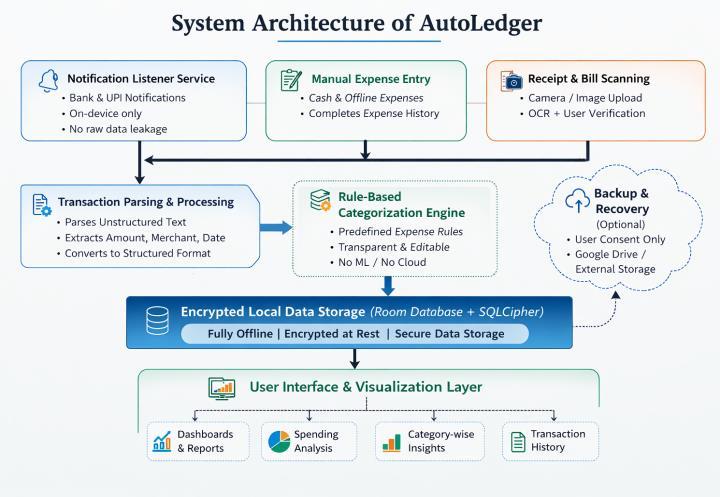
Raw notification text from different banks looks very different.AnHDFCalertreadsdifferentlyfromanSBIone, and a GPay confirmation has a different structure from a Paytmone.Theparsingmodulehandlesthisvariabilityusing arule-basedtextanalysismechanismthatscansforknown keywordsandnumericalpatterns
Foreachincomingnotification,themoduleattemptsto extractfivekeyattributes:transactionamount,merchantor receivername,dateandtime,paymentmethod(UPI,card,or bank transfer), and transaction status. Keywords like "debited", "paid", "credited", and "transaction successful" anchortheextractionlogic.Onceidentified,theseattributes areassembledintoastandardizedtransactionobject the samestructureregardlessofwhichbankorappgenerated
theoriginalalert.Thisstandardizationiswhatallowstherest ofthepipelinetoworkconsistently[6].
Once a structured transaction object arrives at the categorization engine, it gets assigned to one of the predefined expense categories: food, transportation, shopping,utilities,entertainment,andsoon.Theenginedoes this by matching the merchant name or transaction descriptionagainstastoredkeywordtable[9]
A transaction from Swiggy or Zomato maps to food. A paymentatafuelstationmapstotransportation.Atransfer to an online shopping platform maps to shopping. The mapping is explicit, deterministic, and inspectable if a transaction lands in the wrong category, the reason is traceable and fixable. This is a conscious choice over MLbasedcategorization,whichcanproducecorrectresultsbut through logic that is difficult for a user to understand or correct[2].Therulebasecanbeextendedinfutureversions asnewmerchantsandpaymentpatternsemerge
Noteveryexpensegeneratesanotification.Cashpaidtoa vegetablevendor,arickshawfare,orachaiatalocalstall none of these produce digital alerts. The manual entry module existsspecificallyfor thesecases.Users canlogan expensebyenteringtheamount,selectingacategory,picking adate,andoptionallyaddinganote.Theserecordsarestored in exactly the same database structure as automatically detected transactions, so the reporting layer treats them identically[2].
This is what makes AutoLedger a complete expense trackerratherthanjustaUPImonitor.Withoutmanualentry, thefinancialpicturewouldbesystematicallyincompletefor anyonewhostillusescashforeverydaysmallpurchases whichdescribesmostusersinsemi-urbanIndia
Thereceiptscanningmodulehandlesathirdcategoryof expense physicalbillsfromshops,restaurants,orservice providers where a digital payment was made but the notification was missed or not generated. Users can photographa receipt withthe devicecamera oruploadan imagefromtheirgallery
Themoduleextractstherelevantdetails primarilythe totalamountandmerchantname andpresentsthemtothe userforconfirmationbeforesaving.Theconfirmationstepis intentional: OCR accuracy depends on image quality and receiptlayout,andawrongamountsavedsilentlyisworse thannoentryatall[3].Aftertheuserconfirms,therecord enters the database through the same path as any other transaction.
Volume: 13 Issue: 04 | Apr 2026 www.irjet.net p-ISSN: 2395-0072
All transaction records whether auto-detected, manually entered, or scanned are stored in a Room Database[7]encryptedwithSQLCipher[8].Roomprovidesa structured, query-friendlyabstraction overSQLite thatfits naturallyintoAndroid'sarchitecturecomponents.SQLCipher addsfulldatabaseencryption,meaningthedatabasefileitself is unreadable without the correct key even if someone extractsitdirectlyfromdevicestorage.
Theschemaorganizesrecordsintotableswithfieldsfor transactionID,merchantname,category,amount,timestamp, paymentmethod,andtransactiontype(debitorcredit).All reads and writes happen locally with no network calls involved, which also means retrieval is fast there is no round-triplatencytoaremoteserver.
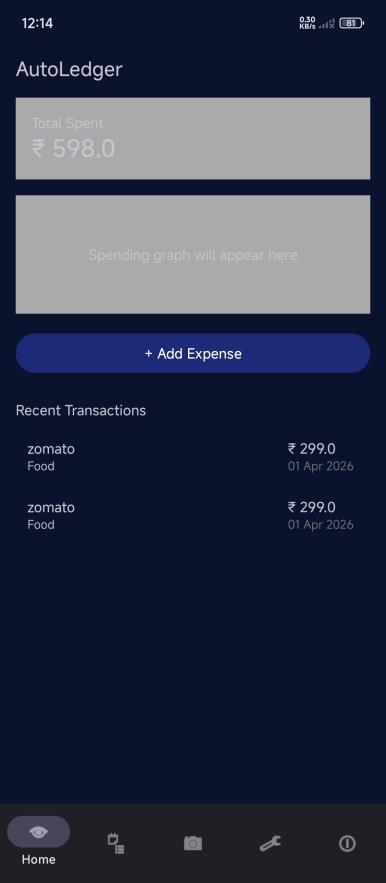
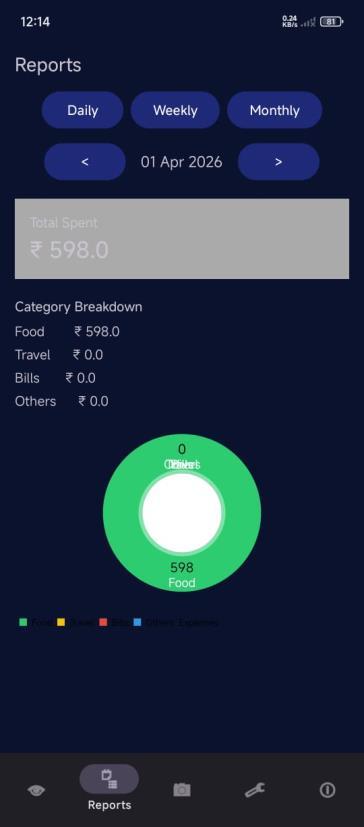
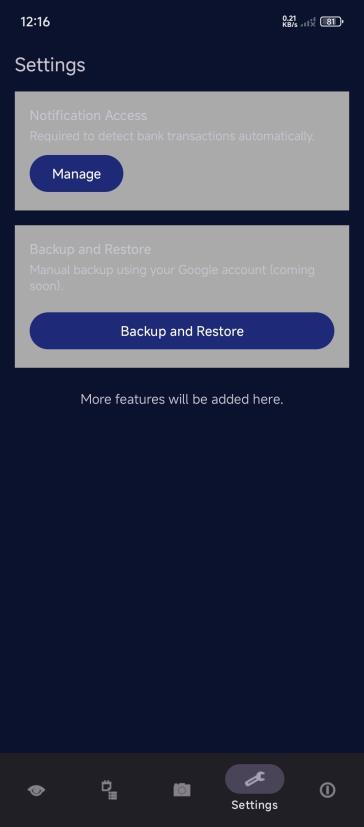
The UI layer is built on Android XML with Material Componentsandorganizedaroundasingle-activity,multifragment navigation pattern. HomeFragment displays the current transaction list and total spent. ReportsFragment generatesdaily,weekly,andmonthlyspendingbreakdowns by category. ScanFragment handles the camera and image uploadflowforreceiptscanning.SettingsFragmentmanages permissions,applockconfiguration,andbackuppreferences
The dashboard gives users a category-wise spending breakdownthatupdatesinrealtimeasnewtransactionsare recorded. The goal is not just to log expenses but to make spending patterns visible because awareness is what drivesbetterfinancialdecisions[1].
Sincealldatalivesonthedevice,losingthedevicemeans losingthedata unlessa backupexists.Thebackupmodule letsusersexportanencryptedcopyofthedatabasetoGoogle Driveorshareitviaemail.Thekeywordis"lets" backupis neverautomaticwithouttheuserinitiatingit.Thiskeepsthe system'soffline-first,consent-firstdesignconsistent:nodata movesanywheretheuserhasnotexplicitlydirectedittogo [4]
Restoring from backup reverses the process the encrypted file is imported and decrypted into the local database,recoveringthefulltransactionhistory
3.9 Use Case Diagram
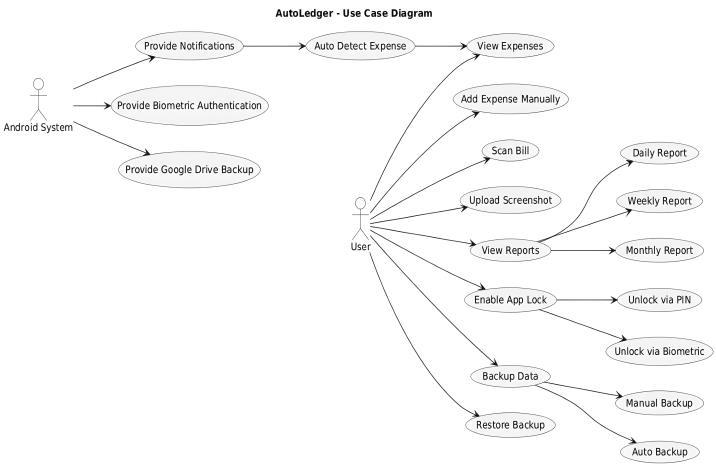
Fig.2showstheusecasediagramforAutoLedger.There are two actors in the system the User and the Android System.TheAndroidSystemisa supportingactorthatthe user never directly interacts with; it exists in the diagram because three things the app depends on notification delivery,biometricauthentication,andGoogleDrivebackup are services the OS provides rather than things AutoLedgerimplementsitself[5].
The User's interactions branch into eight primary use cases. Auto Detect Expense is triggered by the Android SystemforwardingabankorUPInotification,afterwhichthe usercanViewExpensesfromtheloggedrecord.AddExpense Manuallycoverscashandofflinetransactionstheuserenters directly. Scan Bill and Upload Screenshot both feed the receipt scanning pipeline for transactions not captured throughnotifications.ViewReportsextendsintothreesubcases DailyReport,WeeklyReport,andMonthlyReport giving users spending breakdowns at different time granularities.
The two remaining use cases cover security and data management.EnableAppLockextendsintoUnlockviaPIN and Unlock via Biometric, both of which depend on the AndroidSystem'sauthenticationservices.BackupDataand RestoreBackuparepairedoperations backupwritesan encryptedcopyofthedatabasetoGoogleDrive,restorereads it back. Both are user-initiated; neither runs automatically [7],[8].
What the diagram makes clear is that AutoLedger is designedaroundtwodistinctusagemodesthatcoexistinthe sameapp:afullyautomaticmodewherethesystemrunsin the background and logs transactions without any user action, and a manual mode where the user can audit, supplement,andmanagetheirfinancialrecordsdirectly
3.10 Sequence Diagram
Fig. 3 traces the component interaction for the receipt scanningflow,whichisthemostinvolvedofthethreeinput pathsbecauseitcrossesthemostmoduleboundaries.The sequencestartswhentheUseropenstheappthroughMain Activityandnavigatestothescanninginterface.Fromthere, theusercapturesabillimageoruploadsonefromthegallery bothpathsreachScanFragment,whichhandstheimageoff forprocessing
ScanFragmentpassestheinputtoTransactionParser.This is the module doing the actual work of reading the image
International Research Journal of Engineering and Technology (IRJET) e-ISSN: 2395-0056
Volume: 13 Issue: 04 | Apr 2026 www.irjet.net p-ISSN: 2395-0072
content and pulling out the financial details amount, merchant, and timestamp. Once TransactionParser has produced a structured transaction object, it sends that to CategoryEngine,whichrunsthekeyword-matchinglogicand returns an assigned expense category. The round trip betweenTransactionParserandCategoryEngineproducesa complete,categorizedtransactionrecord[9]
ThatrecordthengoestoAutoLedgerDatabaseforstorage. Room handles the write operation with SQLCipher encryptionappliedtransparentlyatthestoragelayer[7],[8]. AutoLedgerDatabasereturnsasuccessconfirmation,andon that signal, ReportsFragment triggers a data refresh pulling the updated transaction list and recalculating the spendingsummariesdisplayedonthedashboard.
The entire sequence from image capture to the dashboardupdating happenson-devicewithnoexternal calls. The user sees their new transaction appear in the reportswithinsecondsofconfirmingit[6].
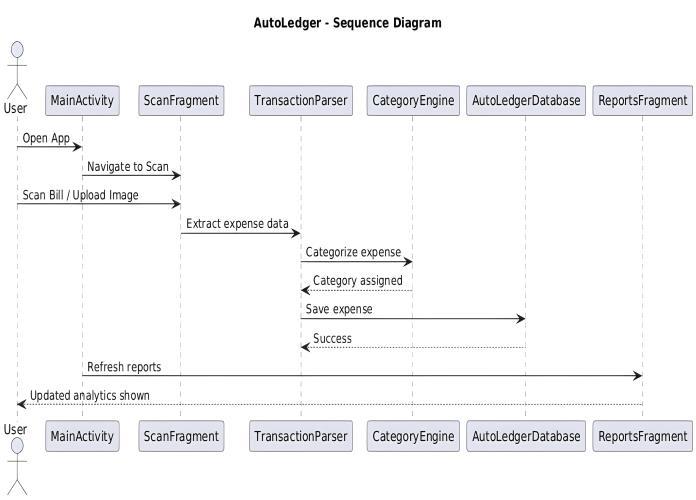
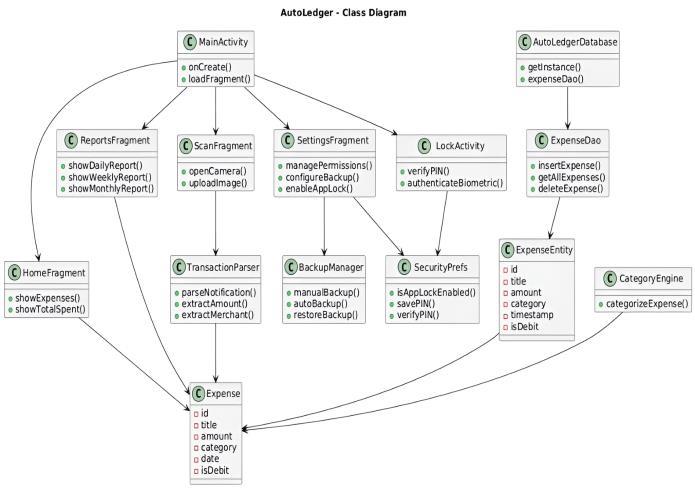
Fig. 4 shows the class structure of the AutoLedger application. The design follows a single-activity, multifragment pattern with MainActivity at the top of the navigation hierarchy. MainActivity owns two methods onCreate() and loadFragment() and is responsible for routing the user between the four main fragments: HomeFragment, ScanFragment, ReportsFragment, and SettingsFragment.
HomeFragment exposes showExpenses() and showTotalSpent(),givingtheusertheircurrenttransaction listandarunningtotal.ReportsFragmentextendsthiswith showDailyReport(), showWeeklyReport(), and showMonthlyReport() threetime-granularityviewsbuilt fromthesameunderlyingdata.ScanFragmenthandlesthe camera and upload interface through openCamera() and uploadImage()
Theprocessingsideofthediagramsitsseparatelyfrom theUIside.TransactionParserreceivesnotificationorimage data and runs three extraction methods parseNotification(),extractAmount(),andextractMerchant() to produce a structured transaction object. That object flowstoCategoryEngine,whichhasasinglepublicmethod categorizeExpense() that applies the keyword ruleset and returnsacategoryassignment[9]
Storage is handled by AutoLedgerDatabase and ExpenseDao working together. AutoLedgerDatabase is a singleton accessed through getInstance() and exposes the DAO through expenseDao(). ExpenseDao implements the three core database operations: insertExpense(), getAllExpenses(),anddeleteExpense().Theentitystoredby theseoperationsisExpenseEntity,whichcarriessixfields id,title,amount,category,timestamp,andisDebit[7],[8].
Thesecurityandbackupclassescompletethediagram. LockActivity manages the app lock screen and exposes verifyPIN()andauthenticateBiometric().SecurityPrefsstores the lock configuration state through isAppLockEnabled(), savePIN(),andverifyPIN().BackupManagerhandlesthethree backup operations: manualBackup(), autoBackup(), and restoreBackup() thoughautoBackup()onlyrunswhenthe userhasexplicitlyscheduledit,notsilentlyinthebackground [4].
Theclassstructurereflectsacleanseparationofconcerns: UIfragmentsdonottouchthedatabasedirectly,processing classesdonotknowabouttheUI,andsecurityisisolatedin its own layer. This separation makes each component independently testable and straightforward to extend in futureversions[1].
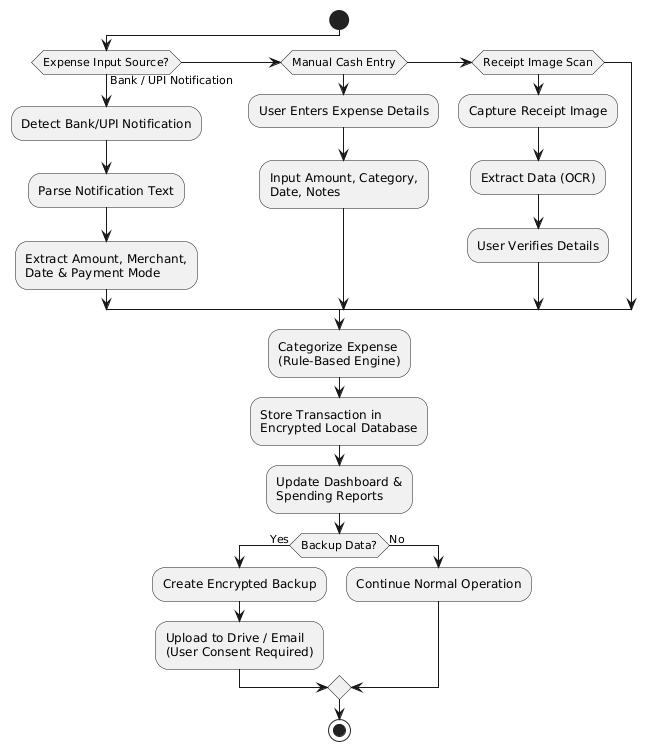
The AutoLedger system follows a structured workflow to automatically capture, process, and store financial transactions generated through banking and UPI applications. Process begins with real-time detection of
International Research Journal of Engineering and Technology (IRJET) e-ISSN: 2395-0056
Volume: 13 Issue: 04 | Apr 2026 www.irjet.net p-ISSN: 2395-0072
transaction notifications using Android’s Notification Listener Service [5]. These notifications are analyzed to extract essential financial details such as transaction amount,merchantname,date,andpaymentmethodusing rule-basedparsingtechniques.
The extracted information is then transformed into a standardizedformatandclassifiedintopredefinedexpense categoriesbasedonkeywordandmerchant-basedrules[9]. This approach ensures consistent and transparent categorizationwithoutrelyingoncomplexmachinelearning models.
Allprocessedtransactiondataissecurelystoredinalocal database implemented using Room with SQLCipher encryption, ensuring data privacy and offline accessibility [7], [8]. In addition to automated tracking, the system supports manual expense entry and receipt scanning to capture transactions that are not detected through notifications.
Receiptscanningcoversthegapbetweenthetwo digital payments where the notification was missed, or card transactions that produced a paper receipt. The user photographs or uploads a receipt image through ScanFragment;TransactionParserappliesOCRextractionto pull the amount and merchant; the result is shown in a confirmation screen before anything is saved [3]. The confirmation step exists because OCR accuracy depends heavilyonimagequality awrongamountconfirmedby theuserisacceptable,awrongamountstoredsilentlyisnot.
Finally,thestoreddataispresentedthroughdashboardsand reports, enabling users to analyze spending patterns and gainmeaningfulfinancialinsights.Theoverallworkflowof theproposedsystemisillustratedinFig-5.
TheAutoLedgersystemwasevaluatedunderpracticalusage conditions to assess its functionality, reliability, and performance.Sincethesystemoperateswithoutpredefined datasets, testing was conducted using real-time financial transactions generated through various banking and UPI applications. Multiple transactions were performed to ensurethatthesystemcouldaccuratelycapturenotifications andhandlevariationsinmessageformats[6].
TheapplicationwasdevelopedusingJavainAndroidStudio, with the user interface designed using XML and Material Components.Transactiondetectionwasimplementedusing Android’s Notification Listener Service [5], while data storage was handled locally using Room Database with SQLCipherencryptiontoensuredatasecurity[7],[8].The systemwastestedonAndroiddevicesrunningversion9.0 and above, with a minimum of 4 GB RAM and standard hardwareconfigurations.
Evaluation focused on key functional aspects, including accuracyofnotificationdetection,correctnessoftransaction data extraction, reliability of expense categorization, and overallsystemperformance.Therule-basedcategorization mechanism ensured consistent classification without the need for training data, maintaining transparency and efficiency[9].Additionaltestingwasperformedformanual expenseentryandreceiptscanningtoverifythatthesystem supportscompleteexpensetracking.
International Research Journal of Engineering and Technology (IRJET) e-ISSN: 2395-0056
Volume: 13 Issue: 04 | Apr 2026 www.irjet.net p-ISSN: 2395-0072
Theresultsindicatethatthesystemperformsefficientlywith minimal processing delay, as all operations are executed locally without reliance on cloud services. This approach reduces latency and enhances system responsiveness comparedtocloud-basedexpensetrackingsolutions[4].The applicationmaintainedstableperformanceacrossdifferent scenarios, demonstrating its suitability for real-world personalfinancemanagement.
International Research Journal of Engineering and Technology (IRJET) e-ISSN: 2395-0056
Volume: 13 Issue: 04 | Apr 2026 www.irjet.net p-ISSN: 2395-0072
TheAutoLedgersystemdemonstratedreliableperformance during real-world testing, successfully capturing and processingfinancialtransactionsfrommultiplebankingand UPI applications. The notification-based detection mechanism consistently identified transaction events and extractedrelevantdetailssuchasamount,merchantname, andtimestampwithhighaccuracy.
Therule-basedcategorizationapproachprovidedconsistent andtransparentclassificationofexpensesintopredefined categories. While machine learning-based systems offer adaptivelearningcapabilities,theproposedapproachavoids complexity and ensures predictable results, making it suitableforofflineenvironments[9].
Intermsofperformance,thesystemoperatesefficientlyas all processing is performed locally on the device. This eliminatesdelaysassociatedwithnetworkcommunication and ensures smooth execution even on mid-range smartphones. The use of Room Database with SQLCipher encryptionensuressecurestorageoffinancialdatawithout compromisingaccessspeed[7],[8].
The integration of additional features such as manual expenseentryandreceiptscanningensurescomprehensive expense tracking, covering both digital and offline transactions.Furthermore,thereportingmoduleprovides meaningful insights through categorized summaries, enablinguserstobetterunderstandtheirspendingpatterns.
Overall, the results indicate that AutoLedger achieves a balance between automation, privacy, and performance. Compared to cloud-based expense tracking systems, the proposed solution offers enhanced data security and operationalindependencewhilemaintainingusabilityand efficiency[4].
This paper presented AutoLedger, an offline-first expense trackingsystemthatautomatestheprocessofrecordingand managing financial transactions using notification-based detection. By leveraging Android’s Notification Listener Service, the system eliminates the need for manual data entry and reduces dependency on SMS parsing or cloudbasedsolutions.
Theproposedapproachensuresthatalltransactiondatais processed and stored locally using secure database mechanisms,enhancinguserprivacyandsystemreliability. The integration of rule-based categorization enables transparentandconsistentclassificationofexpenseswithout introducingcomputationalcomplexity.
Experimentalresultsdemonstratethatthesystemperforms efficiently across different usage scenarios, providing accurate transaction detection and meaningful financial
insights. Additional features such as manual entry and receipt scanning further improve the completeness of expensetracking.
The system offers a practical and secure solution for personal financial management bycombiningautomation, privacy,andusabilitywithinaunifiedframework.
FutureenhancementstotheAutoLedgersystemcanfocuson improving adaptability, intelligence, and user experience. Onepossibleextensionistheintegrationoflightweightondevicemachinelearningmodelstoenableadaptiveexpense categorization based on user behavior, while still maintainingprivacy.
Thesystemcanalsobeenhancedbyincorporatingadvanced receipt recognition using Optical Character Recognition (OCR) techniques to improve accuracy in extracting data from physical bills. Additionally, expanding support for multiple languages and diverse notification formats can improveusabilityacrossawiderrangeofusersandfinancial platforms.
Another area of improvement is the implementation of secure cross-device synchronization using end-to-end encryption, allowing users to access their financial data across multiple devices without compromising privacy. Furtherenhancementsmayincludepredictiveanalyticsand personalizedfinancialinsightstoassistusersinbudgeting andspendingdecisions.
These improvements can extend the capabilities of AutoLedger, making it more intelligent, scalable, and adaptabletoevolvinguserneeds.
The authors sincerely thank Prof. Sujata Tirpude and the Department of Computer Engineering, Bharat College of Engineering,fortheirguidanceandsupport.
The authors acknowledge the use of AI-assisted tools for language refinement, formatting, and structuring of the manuscript. All technical content, system design, and implementation details are based on the authors’ original workandunderstanding.
[1]T.Stefanov,M.Stefanova,S.VarbanovaandS.Temelkov, "PersonalFinanceManagementApplication,"TEMJournal, vol. 13, no. 3, pp. 2066-2075, Aug. 2024, doi: 10.18421/TEM133-34.
International Research Journal of Engineering and Technology (IRJET) e-ISSN: 2395-0056
Volume: 13 Issue: 04 | Apr 2026 www.irjet.net p-ISSN: 2395-0072
[2] S. A. Sabab, S. S. Islam, M. J. Rana and M. Hossain, "eExpense:ASmartApproachtoTrackEverydayExpense," 20184thInternationalConferenceonElectricalEngineering and Information & Communication Technology (iCEEiCT), Dhaka, Bangladesh, 2018, pp. 136-141, doi: 10.1109/CEEICT.2018.8628070.
[3]S.Shaik,A.S.R.Mikkili,M.R.NandyalaandD.R.Namani, "Automating Financial Management: An Exploration of AutomaticExpenseTrackingSystems,"inIntelligentSystems withApplicationsinCommunications,ComputingandIoT, LectureNotesoftheInstituteforComputerSciences,Social InformaticsandTelecommunicationsEngineering,vol.621, Springer,Cham,2025,pp.270-282,doi:10.1007/978-3-03192614-3_20.
[4] X. T. Koo and K. C. Khor, "Expense Tracking with Tesseract Optical Character Recognition v5: A Mobile Application Development," 2023 IEEE Symposium on IndustrialElectronics&Applications(ISIEA),KualaLumpur, Malaysia, 2023, pp. 1-5, doi: 10.1109/ISIEA58478.2023.10212265.
[5] Android Developers, "NotificationListenerService," Available:https://developer.android.com/reference/android /service/notification/NotificationListenerService
[6]S.Shaik,A.S.R.Mikkili,M.R.NandyalaandD.R.Namani, "Automating Financial Management: An Exploration of AutomaticExpenseTrackingSystems,"inIntelligentSystems withApplicationsinCommunications,ComputingandIoT, LectureNotesoftheInstituteforComputerSciences,Social InformaticsandTelecommunicationsEngineering,vol.621, Springer,Cham,2025,pp.270-282,doi:10.1007/978-3-03192614-3_20.
[7] Android Developers, "Room Persistence Library," Available: https://developer.android.com/training/datastorage/room
[8] Zetetic LLC, "SQLCipher: SQLite Database Encryption," Available:https://www.zetetic.net/sqlcipher/
[9] R. Thakare, N. Thakare, R. Sangtani, S. Bondre and A. Manekar,"ExpenseTrackerApplicationusingNaiveBayes," SSRGInternational Journal ofRecent Engineering Science, vol. 10, no. 3, pp. 50-56, 2023, doi: 10.14445/23497157/IJRES-V10I3P108.
2026, IRJET | Impact Factor value: 8.315 | ISO 9001:2008