
International Research Journal of Engineering and Technology (IRJET) e-ISSN: 2395-0056
Volume: 13 Issue: 03 | Mar 2026 www.irjet.net p-ISSN: 2395-0072

International Research Journal of Engineering and Technology (IRJET) e-ISSN: 2395-0056
Volume: 13 Issue: 03 | Mar 2026 www.irjet.net p-ISSN: 2395-0072
Asmabi V.1, Shamma Fathima2 , Nadhima P.3, Muhammed Ameen P. P.4, Muhammed Shifin5 ,
Yadhukrishnan H.6
1Associate Professor, Dept. of Electronics and Communication Engineering, Al Ameen Engineering College, Palakkad, India
23456Student, Dept. of Electronics and Communication Engineering, Al Ameen Engineering College, Palakkad, India
Abstract - This project presents the design and development of a smart Internet of Things based medical delivery and patient monitoring robot for healthcare environments. The system integrates embedded hardware, sensor-based monitoring, and web technologies to enable automated medicine delivery and real time patient health tracking. The robot is controlled through a web interface developed using a Flask based server and allows users to manually control robot movement or navigate to predefined hospital rooms. The system is built using ESP32 and ESP8266 microcontrollers for wireless communication and devicecontrol.
When the robot reaches a patient room, integrated biomedical sensors measure important health parameters such as heart rate, blood oxygen saturation, and body temperature. These values are transmitted through a Wi-Fi based HTTP communication system and displayed on a web dashboard for monitoring. A servo driven compartment automaticallyopensto delivermedicinestothe patient. To improve hospital hygiene and reduce contamination risks, the system also includes an automated sanitization dock. An infrared sensor detects the robot and activates a mist-based disinfecting mechanism along with UV light for disinfection of the robot surface. The proposed system demonstrates aneffective integrationof robotics, Internet of Things technology, and healthcare monitoring to create a smart hospital assistance platform that improves efficiency, hygiene,andpatientcare.
Key Words:IoT Healthcare, Medical Delivery Robot, Patient Monitoring, ESP32, Web Based Control, SanitizationSystem,FlaskServer,HealthSensors.
Healthcare environments require efficient systems for medicine delivery, patient monitoring, and infection control. Withthe rapid development ofInternetofThings technologies and embedded systems, it is possible to design intelligent robotic platforms that assist medical staff while improving patient safety and hospital hygiene. Automated medical delivery systems can reduce human contact, minimize workload for healthcare workers, and enablefasterservicewithinhospitalenvironments.
ThisprojectpresentsthedevelopmentofasmartInternet of Things based medical delivery and patient monitoring robot with an automated sanitization dock. The system integratesrobotics,web technologies,biomedical sensors, and wireless communication to create a multifunctional healthcare assistance platform. The robot is capable of delivering medicines to predefined hospital rooms while simultaneously monitoring patient vital parameters such as heart rate, blood oxygen saturation, and body temperature.Therobotiscontrolledthroughaweb-based interface developed using Flask and HTML, which allows users to manually control robot movement or send the robottopredefineddestinationssuchasRoom1orRoom 2. Communication between the web interface and the robotisachievedusingWI-FIbasedHTTPcommunication through ESP32 and ESP8266 microcontrollers. The robot follows a predefined time-based navigation algorithm to reachtheselectedlocation.
To improve hygiene and reduce contamination risk, the system also includes anautomated sanitization dock When the robot reaches the dock, an infrared sensor detects its presence and automatically activates a mistbaseddisinfectingmechanismalongwithanUVlight.This ensures that the robot is sanitized before and after interactingwithinhospitalenvironments.
In many hospitals, medicine delivery and patient monitoring are still performed manually by healthcare workers. This process can be time consuming and increases the risk of contamination, especially in environments where hygiene and infection control are critical. Additionally, manual monitoring of patient vital parameters may delay real time reporting. Therefore, there is a need for an automated system that can deliver medicines,monitorpatienthealthparameters,andensure proper sanitization to maintain a hygienic healthcare environment.
International Research Journal of Engineering and Technology (IRJET) e-ISSN: 2395-0056
Volume: 13 Issue: 03 | Mar 2026 www.irjet.net p-ISSN: 2395-0072
Themainobjectivesoftheproposedsystemare:
1. To design a web controlled medical delivery robot.
2. Tomonitorpatientvitalparameterssuchasheart rate, blood oxygen saturation, and body temperature.
3. To enable remote robot control through a web interface.
4. To implement predefined navigation for hospital rooms.
5. To develop an automated sanitization dock for disinfectingtherobot.
6. To improve hospital hygiene and reduce manual workload.
Recentadvancementsinhealthcareautomationhaveledto the development of intelligent systems for patient monitoringandmedicalassistance.Variousresearchworks have focused on integrating Internet of Things (IoT) technologywithroboticsystemstoimproveefficiencyand reducehumaninterventioninhospitalenvironments. These systems primarily focus on reducing the workload of healthcare staff and improving service speed. However, most existing systems lack integrated sanitization mechanisms, which are crucial in maintaining hygiene in sensitive environments such as hospitals. IoT-based healthcare monitoring systems have also been widely developed to track vital parameters such as heart rate, blood oxygen saturation (SpO₂), and body temperature in real time. These systems enable remote monitoring and timely medical intervention. However, many of these solutions operate independently and are not integrated with robotic delivery systems In addition, mobile robots used in hospitals are generally controlled through predefined paths or manual control methods. While these robots improve operational efficiency, they often lack features such as real-time data transmission, automated decision-making, and user-friendly web-based interfaces. To address these limitations, the proposed system integrates medical delivery, patient monitoring, and automatedsanitizationintoasingleplatform.Theinclusion of atouchless IR-based hand sanitization mechanismand asanitization dock with mist and UV disinfectionprovides an added advantage over existing systems by ensuring hygiene and safety. Thus, this project presents a more comprehensive and efficient solution by combining robotics, IoT communication, healthcare monitoring, and automateddisinfectioninaunifiedsystem.
The proposed system integrates a robotic delivery platform, biomedical monitoring sensors, a web-based
control interface, and an automated sanitization station. The system uses ESP32 andESP8266 microcontrollers for robotcontrolandwirelesscommunication.
The system also includes an automated sanitization dock for robot disinfection. The web interface developed using Flask allows users to control the robot, monitor health parameters, and trigger robot movements. Commands are sent through WI-FI using HTTP communication. The ESP8266 receives these commands and forwards them to theESP32microcontrollerwhichcontrolsmotors,sensors, andotheractuators.
The system uses a local network-based communication setup where the web interface is accessed through a Telegrambot-generatedIPaddress.
The robot is capable of navigating to predefined hospital rooms, delivering medicines using servo-controlled compartments, and collecting patient health data. After completing its tasks, the robot returns to a sanitization station where an automatic mist generator disinfects the robotbeforethenextoperation.
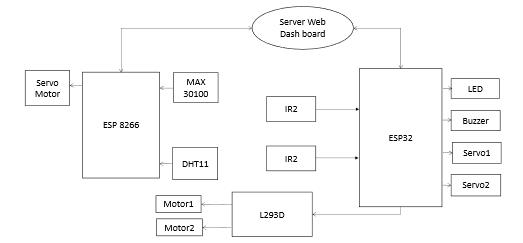
The robot movement is controlled using theL293D motor driver module.The motor driver receivessignals from the ESP32andcontrolstwoDCmotorswhichenabletherobot to move forward, backward, left, and right. The system usestime-based movementto navigate the robot to predefinedlocationssuchasRoom1andRoom2.
ThesystemusesESP32 microcontrollerforcontrol and communication. The ESP32 acts as the main processing unit thatcontrols motors, servo mechanisms, sensors, and other hardware components. The ESP8266 is responsible forWIFIcommunicationandconnectstherobottotheweb server. Commandsfrom theweb interfaceare transmitted totheESP32throughtheESP8266module.
The robot movement is controlled using theL293Dmotordrivermodule.Themotordriverreceives
International Research Journal of Engineering and Technology (IRJET) e-ISSN: 2395-0056
Volume: 13 Issue: 03 | Mar 2026 www.irjet.net p-ISSN: 2395-0072
signalsfromtheESP32andcontrolstwoDCmotorswhich enable the robot to move forward, backward, left, and right. The system usestime-based movementto navigate the robot to predefined locations such as Room 1 and Room2
Servomotorsareusedtocontroltheopeningand closing of medicine compartments. When the robot reaches the patient room, a buzzer indicates arrival and the servo motor opens the medicine box for the patient. Afterafixedtimeinterval,thecompartmentautomatically closes.
The system measures important patient health parameters using biomedical sensors. TheMAX30100 sensoris used to measure heart rate and blood oxygen saturation (SpO₂). TheDHT11 sensoris used to measure temperature. These sensors send data to the ESP8266 whichthentransmitstheinformationtothewebinterface wherethedataisdisplayedinrealtime.
4.5
Infrared sensors are used to detect obstacles during robotnavigation.Ifanobstacleisdetected,thesystemcan stoporadjustmovementtoavoidcollision.
Theproposedsystemincorporatesadual-levelsanitization mechanism to ensure hygiene and prevent contamination in healthcare environments. This includes asanitization dock systemand atouchless hand sanitization unitintegratedwithintherobot.
The sanitization dock is designed as a dedicated station where the robot undergoes automatic disinfection beforeandaftercompletingitstasks.
-AnIRsensordetectsthepresenceoftherobot.
-The sensor signal is processed by anArduino Nano controller.
Arelaymoduleisactivatedtocontrolhigh-powerdevices.
-Theultrasonicmistgeneratorproducesdisinfectantfog.
-UV LED is used for disinfection by reducing microbial contamination, thereby enhancing overall sterilization efficiency.
This ensures complete surface-level disinfection of the robot.
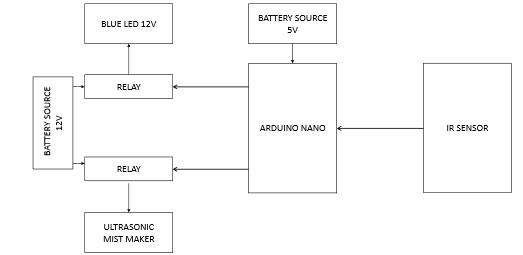
The sanitization station uses an Arduino Nano microcontroller to control the mist generator and LED indicator. The Arduino receives signals from an infrared sensor which detects the presence of the robot inside the sanitizationstation.
The IR sensor detects when the robot enters the sanitization area. Once detection occurs, the sensor sends asignaltotheArduinoNano.
The Arduino activates relay modules which controlhighpowerdevicessuchasthemistgeneratorand UV Light LED. The relay acts as a switch that allows the low voltage microcontroller to control higher voltage components.
The ultrasonic mist generator produces disinfectant fog which covers the robot surface and eliminates microorganisms. This ensures proper sanitizationbeforetherobotcontinuesoperation.
A UV blue LED is used in the sanitization dock to enhance the disinfection process. It emits light in the ultraviolet/blue spectrum, which helps in reducing microbial contamination by damaging the DNA of microorganisms. When combined with the mist-based disinfectant
To ensure user hygiene during medicine collection, a touchless sanitization mechanism is integrated into the robot.
-AnIRsensorisplacednearthesanitizerunit.
-Whenahandisdetected:
-Sanitizerisdispensedautomatically.
-SignalissenttoESP32.
The system allowsmedicine access only after sanitization. This creates acondition-based access control mechanism, improvinginfectionprevention.
International Research Journal of Engineering and Technology (IRJET) e-ISSN: 2395-0056
Volume: 13 Issue: 03 | Mar 2026 www.irjet.net p-ISSN: 2395-0072
The system software consists of embedded programming andaweb-basedcontrolinterface.
Arduino IDE is used to program the ESP32 and Arduino Nano microcontrollers. The firmware controls robot movement, sensor readings, servo motors, and communicationwiththewebinterface.
6.2
The web interface is developed using Python Flask framework.
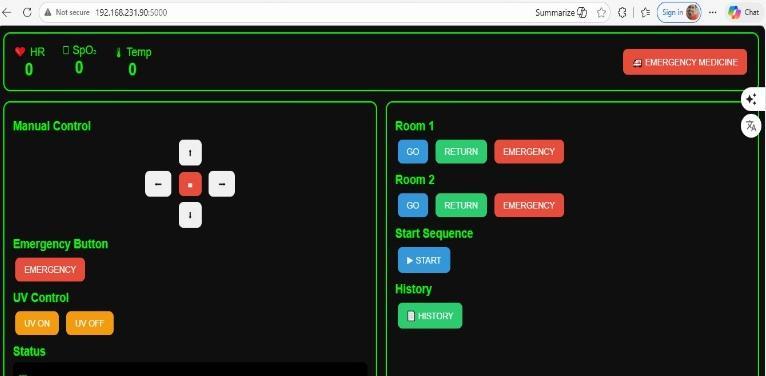
The interfaceallows users to control the robotmovement, start delivery sequences, and monitor patient health parameters. The dashboard displays real time values of heartrate,SpO₂,andtemperature.Italsoprovidesmanual navigation controls, room selection buttons, emergency commands,andUVcontrol options. Theweb dashboardis accessed through a dynamically generated URL provided via a Telegram bot. The Flask-based web server operates on a local Wi-Fi network, and the dashboard is accessible only when the user device and the embedded system are connected to the same network. The Telegram bot generatestheIP-basedURL,whichisthenopenedinaweb browser to access the control interface. This ensures secure and controlled local communication between the userandtherobot.
The system uses HTTP protocol for communication betweenthewebinterfaceandtherobot.Commandsfrom the dashboard are sent through Wi-Fi to the ESP8266 modulewhichforwardsthemtotheESP32forexecution.
The performance of the proposed system depends on the accuracy,reliability,andresponsetimeofthesensorsused forpatientmonitoringandobstacledetection.
TheMAX30100sensorisusedformeasuringheartrateand blood oxygen saturation (SpO₂). It operates using optical sensing techniques and provides stable and reliable readings with good accuracy. This makes it suitable for continuous and non-invasive health monitoring in basic healthcareapplications.
The DHT11 sensor is used for temperature measurement. Although it offers moderate accuracy compared to advanced sensors, it is sufficient for general patient monitoringinnon-criticalenvironments.
Infrared (IR) sensors are used for both obstacle detection andtouchlesshandsanitization.Thesesensorsworkbased onthereflectionofinfraredlightandprovidedigitaloutput when an object or hand is detected. Their fast response timeensuresreal-timeoperation
Table -1: SensorSpecifications
2395-0056
Volume: 13 Issue: 03 | Mar 2026 www.irjet.net p-ISSN: 2395-0072
8.1 Algorithm
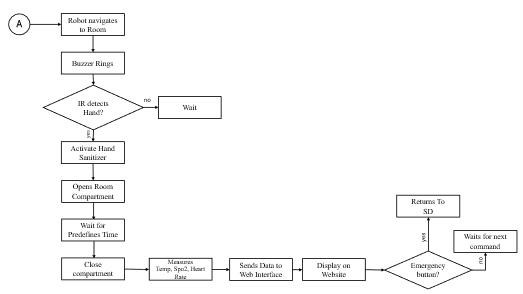
When the system is powered ON, all microcontrollers including ESP32, ESP8266, and Arduino Nano are initialized. The system establishes a Wi-Fi connection and activates all sensors, actuators, and communication modules. The robot initially remains positioned at the sanitization dock. The sanitization dock ensures that the robot is disinfected before and after operation. When the robot enters or returns to the dock, an infrared (IR) sensor detects its presence. Upon detection, the Arduino Nano processes the signal and activates a relay module. The relay switches ON the ultrasonicmistgeneratorandUVlight.Themistgenerator produces a fine disinfectant fog that uniformly covers the robot surface, while the UV light provides additional microbialdisinfection.Aftercompletion,theArduinoNano deactivatestherelay,turningOFFboththemistgenerator and UV light. The robot is now considered safe for operation and waits for user commands from the web interface.
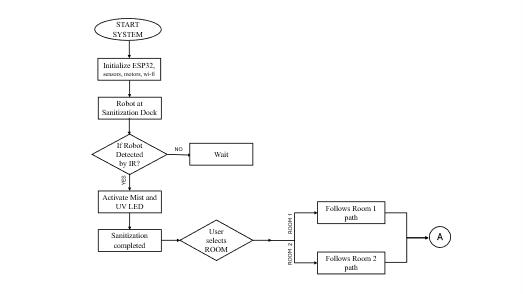
The user accesses the web dashboard and selects a command such as Room 1, Room 2, Manual Control, or Emergency. Based on the selected command, the web server sends an HTTP request through the ESP8266 module, which forwards the command to the ESP32 microcontroller. TheESP32 controlsthemotordriverand initiates robot movement toward the selected destination using time-based navigation. During movement, infrared sensors continuously monitor for obstacles to ensure safe andcollision-freeoperation.
Upon reaching the selected room, the robot stops and a buzzer is activated to indicate arrival. Before allowing access to the medicine compartment, a hygiene verification step is enforced through a touchless hand sanitizationsystem.AnIRsensorplacednearthesanitizer
detects the presence of the user’s hand. When a hand is detected, the sanitizer mechanism is automatically activated, dispensing sanitizing liquid without physical contact. This ensures a hygienic interaction between the userandtherobot.
Only after successful hand detection and sanitization, the system proceeds to the next step. The ESP32 then activates a servo motor to open the medicine compartment. The compartment remains open for a predefined duration, allowing the user to collect the medicine,andthenautomaticallycloses.
If an emergency command is triggered at any time, the robotimmediatelystopsitscurrentoperationandreturns toitsinitialpositionorsanitizationdock.
The system uses a Flask-based web interface to enable user interaction and control of the robot. The web dashboard is accessed through a dynamically generated URLprovidedbyaTelegrambot.
The Flask server operates on a local Wi-Fi network, and the web interface can be accessed only when the user device and the robot system are connected to the same network. The Telegram bot generates an IP-based URL correspondingtothelocalserver,whichisthenopenedin awebbrowsertoaccessthedashboard.
Whentheuserselectsacommandonthewebinterface,an HTTP request is sent to the ESP8266 module. The ESP8266actsasacommunicationbridgeandforwardsthe request to the ESP32 microcontroller, which executes the corresponding operation such as robot movement, servo control, or sensor activation. Simultaneously, patient health data such as heart rate, SpO₂, and temperature are collectedusing biomedical sensorsand transmitted to the webinterfaceviaWi-Fi.Thesevaluesaredisplayedinreal timeonthedashboard,enablingcontinuousmonitoring.
International Research Journal of Engineering and Technology (IRJET) e-ISSN: 2395-0056
Volume: 13 Issue: 03 | Mar 2026 www.irjet.net p-ISSN: 2395-0072
The web interface also supports manual navigation, predefined room selection, and emergency control features,makingthesystemflexibleanduser-friendly.
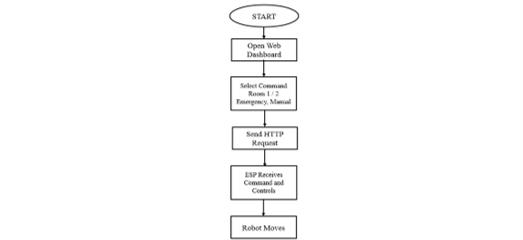
Theoverallworkingprocessofthesystemisasfollows:
1. Theuseropensthewebdashboard.
2. A command is selected such as Room 1, Room 2, orManualControl.
3. The web server sends an HTTP request to the robot.
4. TheESP8266receivesthecommandandforwards ittotheESP32.
5. The ESP32 controls the motors and moves the robottotheselectedlocation.
6. When the robot reaches the patient room, health sensorsmeasurepatientparameters.
7. Compartment opens only after successful hand sanitizationdetectedbyIRsensor
8. The sensor data is displayed on the web dashboard.
9. Aftercompletingdelivery,therobotreturnstothe sanitizationstation.
10. The IR sensor detects the robot and activates the mistgeneratorandUVLighttodisinfectit.
This sequential operation ensures a fully automated, hygienic, and contactless medical delivery system with integratedsafetyvalidation.
The proposed Auto-Med Trolley system was successfully developed and tested for medical delivery, patient monitoring, and automated sanitization in a controlled environment. The system demonstrated reliable performance in executing all major functions including robot navigation, sensor-based monitoring, and disinfectionprocesses.
The robot was able to navigate to predefined locations such as Room 1 and Room 2 using time-based movement control. The integration of infrared sensors ensured effective obstacle detection, preventing collisions during movement. The addition of atouchless IR-based hand sanitization mechanismimproved safety by ensuring that the medicine compartment opens only after proper hand sanitization.
The biomedical sensors used in the system, including MAX30100 and DHT11, provided stable and reasonably accurate readings for heart rate, SpO₂, and temperature. Thedatawassuccessfullytransmittedtothewebinterface using Wi-Fi-based HTTP communication and displayed in realtime,enablingremotemonitoring.
The sanitization dock performed effectively by automatically detecting the robot and activating the mist generator and UV disinfection system. This ensured proper sterilization before and after robot operation, significantlyimprovinghygienestandards.
The web-based control system developed using Flask allowed users to easily control robot movement and monitor patient data. The interface was responsive and user-friendly, making the system suitable for practical healthcareapplications.
Overall, the system achieved its objectives of reducing manual workload, improving hospital hygiene, and enabling real-time patient monitoring. The integration of multiple technologiesinto a single platform demonstrates the feasibility and effectiveness of IoT-based healthcare roboticsystems.
The proposed Auto-Med Trolley system offers several advantagesinhealthcareenvironments:
1. Reduces manual workload of healthcare staff by automatingmedicinedelivery
2. Minimizes human contact, thereby reducing risk ofinfectionspread
3. Ensures hygiene through dual sanitization:dock sanitization (mist + UV)andhand sanitization (touchlessIR-based)
International Research Journal of Engineering and Technology (IRJET) e-ISSN: 2395-0056
Volume: 13 Issue: 03 | Mar 2026 www.irjet.net p-ISSN: 2395-0072
4. Providesreal-timepatientmonitoring(heartrate, SpO₂,temperature)
5. Enables remote control through a web-based interface
6. Low-cost and easy to implement using readily availablecomponents
7. Improves operational efficiency and response timeinhospitals
8. User-friendly interface with simple controls and real-timedatadisplay
The performance of the system was evaluated based on navigation accuracy, sensor response, communication reliability,andsanitizationefficiency.
The robot demonstrated stable navigation using timebased control, successfully reaching predefined locations such as Room 1 and Room 2. Obstacle detection using IR sensorsprovidedquickresponse,ensuringsafemovement without collisions. The biomedical sensors (MAX30100 and DHT11) showed consistent performance with acceptable accuracy for non-critical monitoring applications. Real-time data transmission via Wi-Fi and HTTPprotocolwasreliablewithinthelocalnetwork,with minimallatency.
Thehand sanitization mechanismoperated effectively, ensuring that the medicine compartment opened only afterdetectingproperuserinteraction.Thisaddsanextra layerofhygienevalidation.
Thesanitization dockshowed efficient performance by automatically activating mist and UV disinfection uponrobot detection. The combined disinfection process improved overall cleanliness and reduced contamination risk. Overall, the system achieved reliable performance in automation, communication, and hygiene control. The integration of condition-based access control, real-time monitoring, and dual sanitization mechanisms demonstrates the system’s effectiveness for practical healthcare deployment, especially in infection-sensitive environments.
The proposed system can be further enhanced with the followingimprovements:
1. Integration ofautonomous navigationusing linefollowing or SLAM instead of time-based movement
2. Use ofadvanced sensorsfor more accurate patientmonitoring
3. Cloud integration for remote monitoring beyond localWi-Finetworks
4. Mobileapplicationdevelopmentforeasiercontrol insteadofbrowser-basedinterface
5. AI-based health analysis and alert system for abnormalconditions
6. Cameraintegrationforreal-timevideomonitoring
7. Voicecontrolorassistant-basedinteraction
8. Battery optimization and wireless charging for continuousoperation
9. Expansion to multi-room or multi-floor hospital environments
The proposed system presents an effective IoT-based medical delivery robot integrated with real-time patient monitoring and advanced sanitization mechanisms. By incorporatingbothdock-baseddisinfectionusingmistand UV light, and touchless hand sanitization with conditionbasedaccesscontrol,thesystemensureshighstandardsof hygieneandsafety.Theuseofweb-basedcontrolandlocal network communication enables efficient and reliable operation. Overall, the system reduces manual workload, minimizes human contact, and enhances operational efficiency in healthcare environments, making it a practicalandscalablesolutionformodernhospitals.
[1] P. Joel Josephson, P. S. Kavhat, and H. U. Pawar, “IntegratedSmartTrolleySystemforPatientCareand Isolation,”IJARET,2024.
[2] M. Young, The Technical Writer’s Handbook. MillValley,CA:UniversityScience,1989.
[3] A. Zanella, N. Bui, A. Castellani, L.Vangelista, and M. Zorzi, “Internet of Things for Smart Cities,” IEEE Internet of Things Journal, vol. 1, no. 1, pp. 22–32, 2014.
[4] Espressif Systems, “ESP32 Technical Reference Manual,”EspressifSystems,2023.
International Research Journal of Engineering and Technology (IRJET) e-ISSN: 2395-0056
Volume: 13 Issue: 03 | Mar 2026 www.irjet.net p-ISSN: 2395-0072

Asmabi V. - Associate Professor in the Department of Electronics and Communication Engineering at Al Ameen Engineering College, Palakkad. Her areas of interest include embedded systems, IoT, and communication technologies. She has guided several student projects in the fieldofautomationandsmartsystems.


Shamma Fathima– Undergraduate Student in Electronics and Communication Engineering. Her areas of interest include IoT and embeddedsystems.Shecontributedto embedded programming, Pythonbased web development, microcontroller interfacing, and the implementation of the sanitization dockinthisproject.
Nadhima P - an undergraduate student in Electronics and Communication Engineering with interests in sensor systems and embedded design. She contributed to sensor integration, circuit design, the mechanical body work of the robot and documentation work of the project.


Muhammed Ameen P. P. - is a student specializing in Electronics and Communication Engineering with a focus on robotics and IoT systems. He contributed to body integration and the integration of the health monitoringsystem.
Muhammed Shifin - an undergraduate student with an interest in embedded systems and automation. He contributed to body design, motor control, power supply connections, andtheintegrationofthemistandUV sanitizationsystem

Yadhukrishnan H. - student in Electronics and Communication Engineering with an interest in communication systems and IoT. He contributed to body work and overall component integration, ensuring proper assembly and system functionality