
International Research Journal of Engineering and Technology (IRJET) e-ISSN: 2395-0056
Volume: 12 Issue: 11 | Nov 2025 www.irjet.net p-ISSN: 2395-0072
International Research Journal of Engineering and Technology (IRJET) e-ISSN: 2395-0056
Volume: 12 Issue: 11 | Nov 2025 www.irjet.net p-ISSN: 2395-0072
Dr. Shweta Kumbhaj1, Anjali Verma2
1Asst. Professor, Department of Chemistry, Shaheed Veer Narayan Singh Govt. College Jobi-Barra, Raigarh, Chhattisgarh, India
2Research Scholar, Department of Botany, Guru Ghasidas Vishwavidyalaya, Bilaspur, Chhattisgarh, India
Abstract- This research investigated the physicochemical properties and nutrient dynamics of soils affected by coal mining activities in the Chhal mining region of India analysis revealed significant spatial variations in soil pH, electrical conductivity (EC), organic carbon, macronutrients (N, P, K), andtrace metalconcentrations across mine-affected(C1)and western control (S1–S5) sites. The C1 soil sample exhibited a markedly acidic pH of 4.89 and a low EC value of 0.29 dS/m, indicating leaching and reduced soluble salt content, which is typical of degraded mine soils. In contrast, the western samples displayed near-neutral pH and moderate EC, suggesting comparatively better soil health in the western region. The organic carbon content in C1 (0.28%) was substantially lower than that in the western samples, reflecting diminished microbial activity and organic matter accumulation due to mining-induced disturbances. However, the elevated concentrations ofnitrogenand phosphorus in C1 were attributed to anthropogenic deposition and localized enrichment from mining emissions and mineralized rock weathering. Conversely, potassium levels were higher in western soils, likely resulting from enhanced mineral weathering and a stable soil structure. Trace metal analysis revealed elevated levels of Cr, Pb, Ni, and Zn in the C1 sample, confirming contaminationbycoalextractionandassociated activities. Overall, the findings demonstrate that coal mining operations profoundly alter soil chemistry, reducing fertility, organic matter content, and microbial activity, while increasing heavy metal contamination. Such degradation underscores the need for targetedreclamationstrategies and continuous soilmonitoringto restoretheecologicalbalancein mining-impacted landscapes.
Key Words: Soil, physicochemical properties, macronutrients, trace metal
Chhal mines, which are situated in Chhattisgarh's Raigarh district,haveasubstantialimpactontheadjacentvillages' soil quality. The primary causes of the damage are coal miningoperationsandoverburdendumping. TheBarakar
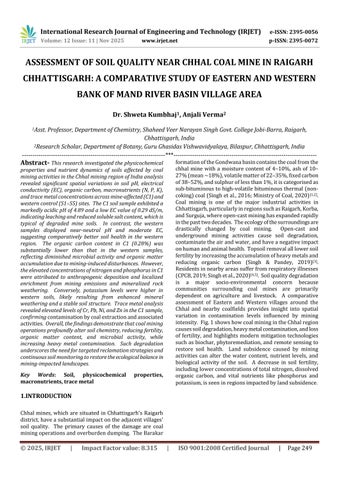
formationoftheGondwanabasincontainsthecoalfromthe chhal mine with a moisture content of 4–10%, ash of 10–27%(mean~18%),volatilematterof22–35%,fixedcarbon of38–52%,andsulphuroflessthan1%,itiscategorisedas sub-bituminous tohigh-volatilebituminous thermal (noncoking)coal(Singhetal.,2016;MinistryofCoal,2020)[1,2] . Coal mining is one of the major industrial activities in Chhattisgarh,particularlyinregionssuchasRaigarh,Korba, andSurguja,whereopen-castmininghasexpandedrapidly inthepasttwodecades. Theecologyofthesurroundingsare drastically changed by coal mining. Open-cast and underground mining activities cause soil degradation, contaminatetheairandwater,andhaveanegativeimpact onhumanandanimalhealth. Topsoilremovalalllowersoil fertilitybyincreasingtheaccumulationofheavymetalsand reducing organic carbon (Singh & Pandey, 2019)[3] Residentsinnearbyareassufferfromrespiratoryillnesses (CPCB,2019;Singhetal.,2020)[4,5]. Soilqualitydegradation is a major socio-environmental concern because communities surrounding coal mines are primarily dependent on agriculture and livestock. A comparative assessment of Eastern and Western villages around the Chhal and nearby coalfields provides insight into spatial variation in contamination levels influenced by mining intensity. Fig.1showshowcoalminingintheChhalregion causessoildegradation,heavymetalcontamination,andloss of fertility, and highlights modern mitigation technologies suchasbiochar,phytoremediation,andremotesensing to restore soil health. Land subsidence caused by mining activities can alter the water content, nutrient levels, and biological activity of the soil. A decrease in soil fertility, includinglowerconcentrationsoftotalnitrogen,dissolved organic carbon, and vital nutrients like phosphorus and potassium,isseeninregionsimpactedbylandsubsidence
International Research Journal of Engineering and Technology (IRJET) e-ISSN: 2395-0056
Volume: 12 Issue: 11 | Nov 2025 www.irjet.net p-ISSN: 2395-0072
1: Sustainable
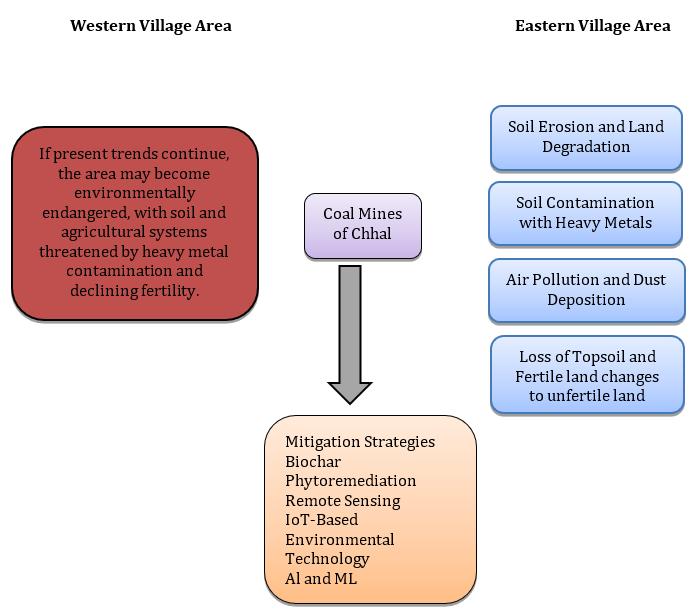
Thepresentstudywasconductedinwesternandeastern village area in bank of Mond river basin, located in the kharsia tehsil of Raigarh district, Chhattisgarh, India (Latitude22°07’to22°128’N,Longitude83°055’to83°140’ E). The village area lies on the western bank of the Mand river, a tributary of the Mahanadi river basin, and is traversed by the Kurket river, which provides seasonal surfacewaterflowandsupportsnearbyagriculturallands. Theregionexperiencesasubtropicalclimate,characterized byhotsummers(upto45°C),moderatewinters(aslowas 10°C),andanaverageannualrainfall ofabout1200–1400 mm,mainlyfromthesouthwestmonsoon.
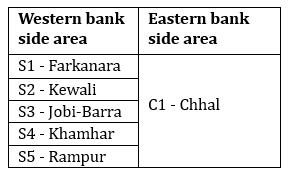
Fivesoilsamples werecollectedfromnearthewestern bank of the Mand river basin village area in the Kharsia tahsil,andonesoilsamplewastakenfromtheeasternbank oftheMandriverbasinarea,whichrepresentstheminingaffected agricultural zone of Raigarh district, Chhattisgarh(shownin Table1). Thesampleswere taken fromadepthof0to20cminthefield. Aftercollection,the soil was cleaned by removing herbs, plant residues, and stones by hand. The samples were kept in plastic sample bags. Thesoilwasthenair-driedandpassedthrougha2mm brass sieve to remove larger particles. After sieving, the samples were stored in an oven at 30°C until further use. Fromeachsample,100gramsofsoilwastransferredintoa labelledsamplebag. Eachbagwasmarkedwiththesample date, location, and sample number. Five samples were selectedandastudywascarriedoutbasedonawiderange ofphysio-chemicalproperties.
Table -1: Listofcollectedsoilsamples
Thesoilsampleswerebroughttothelaboratoryforfurther analysis. Soil samples were air-dried, sieved (2 mm), and examinedforfundamentalphysico-chemicalcharacteristics. AdigitalpHandconductivitymeterwasusedtomeasurethe pHandelectricalconductivity(EC)ofthesoilina1:2.5soil–water suspension, respectively (Jackson, 1973)[6]. The Walkley and Black (1934)[7] wet-oxidation method, which involves oxidizing organic materials with potassium dichromateandtitratingwithferrousammoniumsulphate, was used to analyse organic carbon (OC). The alkaline permanganate method (Subbiah & Asija, 1956)[8], which releases nitrogen as ammonia by oxidation with alkaline KMnO₄ and measures it by acid titration, was used to determineavailablenitrogen(N). Olsen'smethodwith0.5M NaHCO3 (pH8.5)wasusedtoextractavailablephosphorus (P), which was then colorimetrically quantified using the molybdate blue method (Olsen et al., 1954)[9]. A flame photometer was used to measure the amount of available potassium (K), which was extracted using 1 N neutral ammonium acetate (Jackson, 1973)[6]. The data were represented in kg/h of soil on an oven-dry basis, and all analyses were carried out in triplicate. Soil heavy metal concentrationsweredeterminedusingInductivelyCoupled Plasma–MassSpectrometry(ICP-MS)followingtheUSEPA Method3052(1996)[10] microwave-assistedaciddigestion protocol(APHA,2017;ISO17294-2:2016)[11,12] .
3.1
The highest mean value was observed in S3 (198.55 kg/ha), followed by S4 (196.88 kg/ha) and S1 (195.95 kg/ha), while S2 (189.67 kg/ha) and S5 (188.99 kg/ha) recorded the lowest values. The one-way analysis of variance(ANOVA)revealedasignificantvariationamongthe samples (p<0.05), indicating that the samples had a statisticallysignificantinfluenceonthemeasuredparameter. Tukey’s HSD post-hoc analysis further confirmed highly significantdifferences(p<0.01)amongallsamples(S1–S5), showninFig.2. Eachsampleexhibiteddistinctstatistical behaviour,withnooverlappingsignificancegroups.
International Research Journal of Engineering and Technology (IRJET) e-ISSN: 2395-0056
Volume: 12 Issue: 11 | Nov 2025 www.irjet.net p-ISSN: 2395-0072
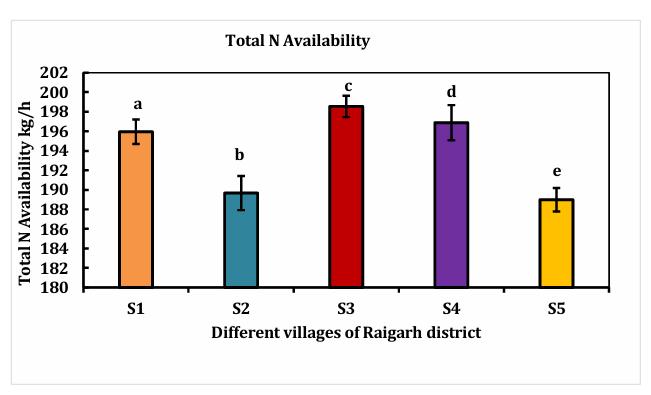
Fig. 2: Nitrogen(N)content(kg/ha)indifferentsamples (S1–S5).Valueswithdifferentlettersdiffersignificantly (TukeyHSD,p<0.01).
Fig.3showsthemeanvaluesofthetotalphosphorus(P) underdifferentsampleswere10.22(S1),10.89(S2),10.56 (S3),10.11(S4),and10.72(S5). Thehighestmeanvalue wasobservedintheS2sample,andthelowestmeanvalue of P was found in the S4 sample. The one-way ANOVA revealed a significant difference (p<0.05) among the samples, indicating that the sample had a statistically significantinfluenceontheparameter. Subsequentposthoc Tukey HSD analysis (p<0.01) confirmed that all samplesdifferedsignificantlyfromeachother,suggesting distincttreatmenteffects.
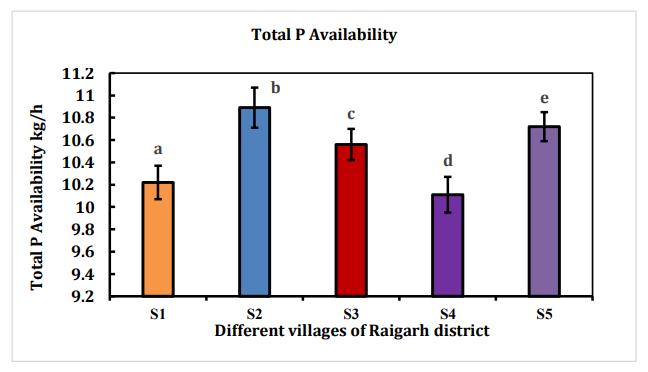
Fig. 3: Phosphorus(P)content(kg/ha)indifferent samples(S1–S5).Valueswithdifferentlettersdiffer significantly(TukeyHSD,p<0.01).
The mean K content under different samples was recordedas310.75(S1), 282.98(S2), 302.64(S3),285.36 (S4), and 305.43 (S5). The one-way ANOVA revealed a
significant difference (p < 0.05) among the samples, indicatingthatthesamplehadastatisticallysignificanteffect onpotassiumcontent.Further,thepost-hocTukeyHSDtest (p<0.01) confirmed that all pairwise sample comparisons (S1–S5) were highly significant, demonstrating distinct variationsin potassiumaccumulationamong the samples. Based on the mean comparison, S1 recorded the highest potassiumcontent(310.75),followedbyS5(305.43)andS3 (302.64), whereas S2 (282.98) and S4 (285.36) exhibited comparativelylowervalues(Fig.4)

Fig. 4: Potassium(K)content(kg/ha)indifferent samples(S1–S5).Valueswithdifferentlettersdiffer significantly(TukeyHSD,p<0.01).
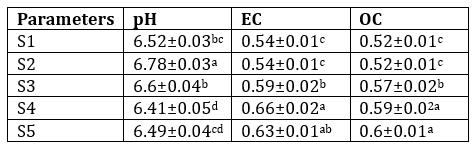
TheOrganiccarbon(OC)contentrangedfrom0.52%to 0.60%acrosssamples(S1–S5).ANOVA(p<0.05)indicated significantdifferencesamongthesamples(Table2). Tukey HSDshowedthatS1andS2werestatisticallysimilar,while S3,S4,andS5hadsignificantlyhigherOCvalues(p<0.05–0.01). TheOCtrendfollowedS5>S4>S3>S1>S2.
The soil pH values of different samples ranged from 6.42to6.78,indicatingthatallsampleswereslightlyacidic in nature. The highest pH (6.78) was recorded in S2, followedbyS3(6.60),S1(6.52),S5(6.49),andthelowestin S4 (6.42). The one-way ANOVA (p<0.05) confirmed a significant difference in soil pH among the samples, suggesting that the amendments influenced soil reaction. According to the Tukey HSD post-hoc test, S2 differed significantly(p<0.01)frommostothersamples(S1,S3,S4, and S5), while differences between S1, S3, and S5 were statisticallyinsignificant.S4showedasignificantlylowerpH comparedtoS2andS3,indicatingstrongeracidifyingeffects underthistreatment,asshowninTable2.
International Research Journal of Engineering and Technology (IRJET) e-ISSN: 2395-0056
Volume: 12 Issue: 11 | Nov 2025 www.irjet.net p-ISSN: 2395-0072
Theelectricalconductivity(EC)ofsoilvariedfrom 0.54to0.66dSm⁻¹amongthesamples.ThelowestECwas recordedinS1(0.54dSm⁻¹)andS2(0.54dSm⁻¹),whilethe highestwasfoundinS4(0.66dSm⁻¹),followedbyS5(0.63 dSm⁻¹)andS3(0.59dSm⁻¹). Theone-wayANOVA(p<0.05) indicatedasignificantdifferenceinECamongthesamples, suggesting that soil salinity levels were affected by the appliedsample. AccordingtotheTukeyHSDpost-hoctest, S1andS2showednosignificantdifference,butbothwere significantly lower than S3, S4, and S5 (p<0.05–0.01). S4 exhibitedthehighestEC,differingsignificantlyfromS1, S2,andS3,whileS4andS5werestatisticallysimilar, showninTable2.
Table. 2:.Variationinsoilphysico-chemicalproperties(pH, EC, and OC) under different samples (S1–S5). Values representmean±standarddeviation(n=3).Meansfollowed by different letters within a column differ significantly accordingtoTukey’sHSDtest(p<0.05).
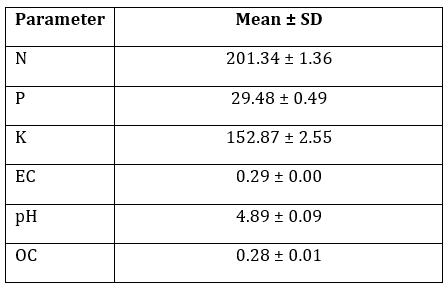
The concentrations of Cr (196.87 mg/kg), Ni (120.04 mg/kg), Cu (112.19 mg/kg), Pb (312.06 mg/kg), and Zn (318.55 mg/kg) in the C1 soil sample exceeded the WHO/FAO(1978)permissiblelimits,particularlyforCrand Ni,showninTable3. Thisindicatessignificantheavymetal contamination, likely arising from industrial and mining activities,whichmaynegativelyimpactsoilqualityandpose environmental and health risks. The soil sample showed slightly acidic pH (4.89) with low electrical conductivity (0.29 dS/m), indicating minimal salinity. Organic carbon (0.28%)waslow,suggestingpoororganicmatter.Nitrogen (201.34 mg/kg) and phosphorus (29.48 mg/kg) were moderate,whilepotassium(152.87mg/kg)was relatively high,reflectingbalancedbutslightlynutrient-deficientsoil fertility,shownin(Table4).
Table. 3: Theconcentrationofselectedheavymetals(Cr, Ni,Cu,Pb,andZn)insoilsampleC1wascomparedwith thepermissiblelimitsprescribedbyWHO/FAO(1978)
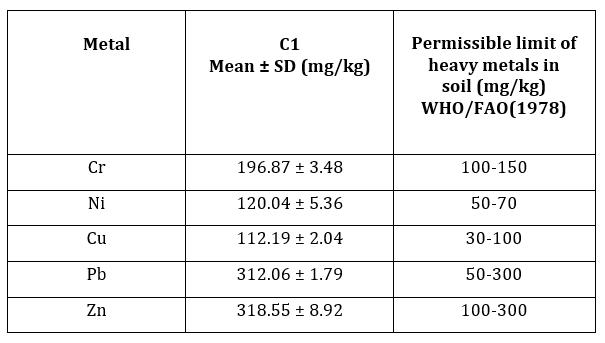
Table 4: Physico-chemicalpropertiesofthesoilsample(C1) showingtriplicatevalues (mean±SD,n=3).Parameters include nitrogen (N), phosphorus (P), potassium (K), electricalconductivity(EC),pH,andorganiccarbon(OC).
The pH of soils in coal mining regions generally varies fromacidictoslightlyalkaline,reflectingalterationsinsoil chemistrycaused bymining activities(Shownin Table 5). Studies have reported increased concentrations of trace elementssuchasCr,Pb,Co,Cu,Cd,Fe,Ni,Mn,Zn,As,andAl in the surrounding soils of mining areas in India, largely attributed to mining operations (Chakraborty et al., 2023)[13].TheC1soilsample,locatedneartheChhalmines, exhibited a pH value of 4.89, indicating a highly acidic nature. Such acidity can adversely influence nutrient availabilityandmicrobialactivity.Coalminingcanalterthe pH and electrical conductivity (EC) of the soil. The alterationsinsoilstructureleadtochangesinphysicaland chemicalproperties,includingpHandEC(Zhangetal.,2022; Ivanova et al., 2023)[14,15]. Soil EC, an indicator of soluble saltsandoverallsoilsalinity,isdirectlyrelatedtonutrient statusandcanbealteredbycoalminingactivities.According toOthamanetal.(2020)[16] ,thecorrelationbetweenECand macronutrient (NPK) levels is critical in assessing soil
International Research Journal of Engineering and Technology (IRJET) e-ISSN: 2395-0056
Volume: 12 Issue: 11 | Nov 2025 www.irjet.net p-ISSN: 2395-0072
fertility. The EC value of 0.29 dS/m observed in the C1 sample suggests leaching and a low soluble salt content, characteristicofreclaimedordegradedcoalminesoilswith reduced fertility. Comparative analysis of the five soil sampleswiththeChhalmine(C1)samplerevealeddistinct variations in nutrient distribution. The concentrations of nitrogen (N) and phosphorus (P) were higher in the C1 sample compared to the western site samples, indicating localizedenrichmentpossiblyduetoanthropogenicinputs from mining activities. In contrast, potassium (K) concentrationwashigherinthewesternsamplesthaninC1, whichmaybeattributedtobettersoilstructureandmineral weathering in less-disturbed areas. Moreover, organic carbon content was found to be higher in the western samplesandcomparativelylowerinC1.Coalminingresults insoilcompactionandpollution,whichfurtherdegradesoil quality.Thepresenceofheavymetalsandotherpollutants fromminingtailingscanleadtoadecreaseinsoilnutrients and microbial diversity, as toxic compounds impede the functioningofsoilmicroorganisms(Rouhanietal.,2023;Li etal.,2011) [17,18]
Table – 5: Comparativeassessmentofsoilnutrientand chemicalpropertiesbetweeneasternChhalmineareasoil (C1)andwesternsoilsamples(S1,S2,S3,S4,S5)ofthe Mandriverbasin
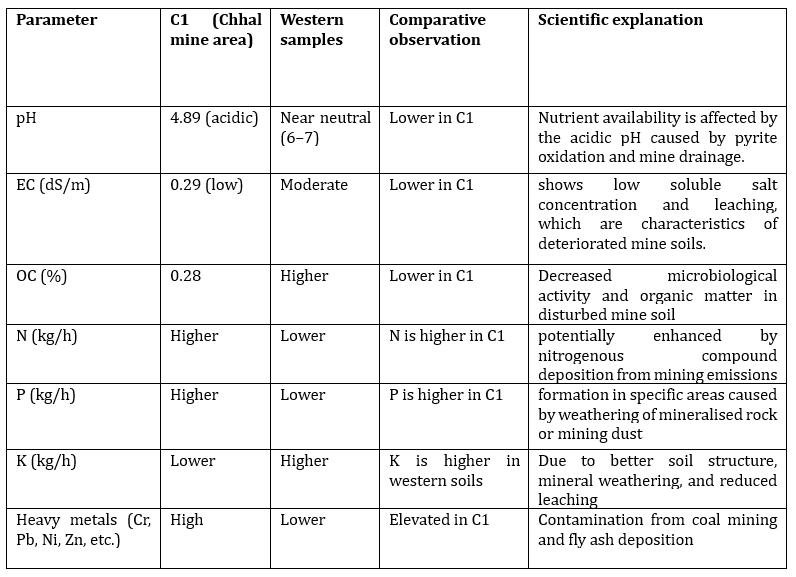
ThecomparativeassessmentofsoilsamplesfromtheChhal mining region and western sites revealed significant variationsinsoilchemicalpropertiesandnutrientdynamics influencedbyminingactivities. TheC1sampleexhibiteda
highly acidic indicating leaching and reduced soil fertility typical of mine-affected soils. Elevated nitrogen and phosphorus concentrations in C1 suggest localized enrichment from mining-related anthropogenic inputs, whereashigherpotassiumandorganiccarbonlevelsinthe westernsoilsreflectbetterstructuralstabilityandbiological activity. Overall, the findings indicate that coal mining operationshavecausednotabledegradationofsoilquality throughacidification,nutrientimbalance,andorganicmatter depletion. Restoration strategies involving organic amendmentsandvegetationcoverareessentialtoimprove thefertilityandecologicalresilienceofreclaimedminesoils.
[1]Singh,A.K.,Singh,M.P.,Singh,P.K.,&Banerjee,I.(2016) “Petrographiccharacteristicsandgeneticimplicationsof the coal seams from Mand-Raigarh Coalfield, Chhattisgarh, India”, International Journal of Coal Science&Technology,3(1),1–14.
[2]MinistryofCoal,GovernmentofIndia.(2020) “Detailed Project Report: Chhal Coal Mine Expansion, MandRaigarhCoalfield,Chhattisgarh
[3] Singh, A. K., & Pandey, M. (2019) “Assessment of soil quality around coal mining areas of central India JournalofSoilScienceandEnvironmentalManagement, 10(3),45–53.
[4]CPCB.(2019) “ReportonEnvironmentalImpactofCoal Mining in India” , Central Pollution Control Board, GovernmentofIndia.
[5]Singh,P.,Verma,R.,&Sharma,S.(2020) “Humanhealth risks associated with particulate pollution near coal mining regions” Environmental Monitoring and Assessment, 192(5),314.
[6] Jackson,M.L. (1973) “Soil Chemical Analysis” Prentice HallofIndiaPvt.Ltd.,NewDelhi.
[7] Walkley, A., & Black, I. A. (1934) “An examination oftheDegtjareff method for determining soil organic matter,andaproposedmodificationofthechromicacid titrationmethod” SoilScience,37(1),29–38.
[8]Subbiah,B.V.,&Asija,G.L.(1956) “Arapidprocedurefor the estimation of available nitrogen in soils “Current Science,25:259–260.
[9] Olsen, S.R., Cole, C.V., Watababe, F.S. and Dean, L.A. (1954) Estimation of available phosphorus in soils by extraction with sodium bicarbonate. U.S. Dept. of AgriculturalCircular939.
[10]USEPAMethod3052(1996)–MicrowaveAssistedAcid DigestionofSiliceousandOrganicallyBasedMatrices.
[11]APHA(2017)–StandardMethodsfortheExaminationof WaterandWastewater,23rdEd.
[12]ISO17294-2(2016)–Waterquality-ApplicationofICPMS-Determinationofselectedelements.
[13]Chakraborty,S.,Patra,A.K.,&Singh,S.K.(2023) “Heavy metal contamination and soil quality assessment around coal mining areas in India “Journal of HazardousMaterialsAdvances, 10,100239.
International Research Journal of Engineering and Technology (IRJET) e-ISSN: 2395-0056
Volume: 12 Issue: 11 | Nov 2025 www.irjet.net p-ISSN: 2395-0072
[14]Zhang,K.,Bai,L., Wu, X.,Zheng, X.,Zhao,J., &Yang,K. (2022) “Effects of Underground Coal Mining on Soil Spatial Water Content Distribution and Plant Growth Type inNorthwestChina “ACS Omega,7(22), 18688–18698.
[15]Ivanova,S.,Vesnina,A.,Fotina,N.,&Prosekov,A.(2023) Influence of Coal Mining Activities on Soil’s Agrochemical and Biochemical Properties Qubahan AcademicJournal,3(4),387–399.
[16] Othaman, R., Bakar, R. A., & Rahim, S. A. (2020) “Relationship between soil electrical conductivity and nutrientavailabilityindegradedtropicalsoils” Applied Sciences, 10(5),1711
[17] Rouhani, A., Tack, F. M. G., & Skousen, J. (2023) “An OverviewofSoilPollutionandRemediationStrategies inCoalMiningRegions “Minerals,13(8),1064.
[18]Li,H.,Li,W.,Shao,H.,Bai,Z.,&Bi,R.(2011) “Improving SoilEnzymeActivitiesandRelatedQualityPropertiesof Reclaimed Soil by Applying Weathered Coal in Opencast‐Mining Areas of the Chinese Loess Plateau CLEAN–Soil,Air,Water,40(3).
[19]FAO/WHO(1978):JointFAO/WHOExpertCommittee on Food Additives: Evaluation of Certain Food Additives and Contaminants WHO Technical Report SeriesNo.631.WorldHealthOrganization,Geneva.