
International Research Journal of Engineering and Technology (IRJET) e-ISSN: 2395-0056
Volume: 12 Issue: 11 | Nov 2025 www.irjet.net p-ISSN: 2395-0072
International Research Journal of Engineering and Technology (IRJET) e-ISSN: 2395-0056
Volume: 12 Issue: 11 | Nov 2025 www.irjet.net p-ISSN: 2395-0072
Prof.
Shobha S. Biradar 1 , Chitralekha2
1, Professor, Master of Computer Application, VTU’s CPGS, Kalaburagi, Karnataka, India
2, Student, Master of Computer Application, VTU’s CPGS, Kalaburagi, Karnataka, India
Abstract-The research project is developed on the basis of using High-Res. Satellite Imagery and Deep Learning technologytopredictlandslides.ItappliesImageProcessing techniques to enhance the quality of satellite imagery and implements Fine-Tuned ResNet101 deep learning architecture to classify images into Landslide vs NonLandslide categories. The system is also deployed online as an app for users (and) Administrators to utilize. The experimental results show that using the Deep Learning technology offers a 96.88% accuracy in predicting landslide events which demonstrates the validity of the proposed method for Disaster Risk Management & Early Warning Systems.
Landslidesoccurasaresultofseriousnaturaldisastersin mountain and hilly areas, particularly in the Himalayas. Increasedconstructionactivityandnaturaldisasters,such as heavy rain or earthquake activity, will increase the potential for slope failure. The traditional methods to monitorsusceptibleslopesareslowtodevelopandcanbe inefficient if limited in scope. In the past few years, satellite technology and the application of Artificial Intelligence(AI)havemadeitpossibletoprovideaccurate and timely predictions/forecasts of landslides at a much larger scale than before. This project takes advantage of these advancements by using a fine-tuned ResNet101 model and image pre-processing tools along with Deep Learning to enhance the quality of detection of landslides and provide supporting elements of early warning systems.
In mountainous areas and regions of high rainfall, landslides are a threat to life, infrastructure and environment.Currentlandslidemonitoringtechniquesare mainly based on manual surveying, ground sensors and historical analysis. They are often expensive, timeconsuming and limited in geographical coverage. In addition, traditional methods are unable to offer timely predictions across wide area. Satellite images provide a better geographical coverage and frequency of observations; however, their automated analysis for landslidepredictionisstillanongoingprocess.Asaresult, the development of an accurate, scalable and automated solutionforthefastanalysisofsatelliteimagestoprovide
reliable predictions of landslide prone areas using deep learningtechnologieswillbebeneficial.
Themaingoaloftheprojectistocreateanautomatedand accurate system for predicting landslides using deep learning and satellite imagery. This includes preprocessing high-resolution satellite images to improve data quality and using a customized version of the ResNet101modelforclassifyingimagesaseitherlandslide or no landslide. Additionally, this project also includes developing a web-based system that enables users to uploadimagesandreceivetimelypredictions.Thisproject also aims to develop a prediction model with high accuracy, enabling early warning systems, assisting governmental agencies in effective disaster risk management/mitigation.
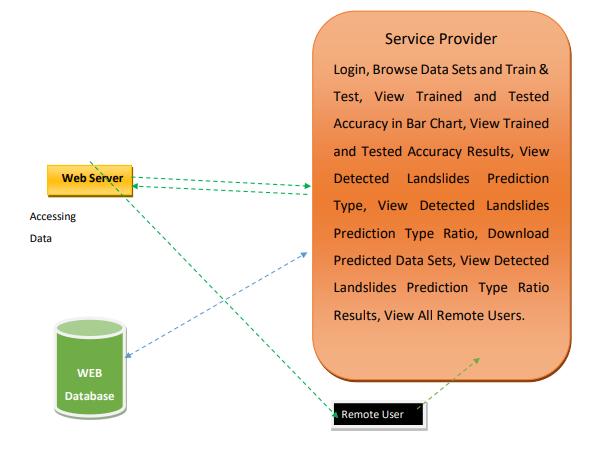
The research methodology utilizes a structured approach tobuildanautomatedlandslideforecastingmodelthrough the use of deep learning techniques and satellite imagery. Thefirststageofthismethodologyisacquiringacollection of high-quality satellite images obtained from reputable sourcesandenhancingthemodel'sabilitytogeneralizeby augmentingtheseimages(inversetransform).Theimages undergo various preprocessing methods to remove noise, normalize them, resize them and segment them into smaller sections. The processed images are then used to train a ResNet101 fine-tuned CNN to classify into two categories; landslide and non-landslide. To evaluate the newly developed ResNet101 model, it is scored against commonlyacceptedstandardssuchasaccuracy,precision, recall, and F1-score. Ultimately, following this evaluation, the adopted methodology incorporates the validated ResNet101 model into an online platform that allows users to upload images and obtain real-time predictions. The adopted methodology establishes validation within the proposed framework for disaster risk management throughvalidation,scalabilityandusability.
The role of remote sensing and machine learning in assessingandpredictinglandslideshasrecentlyincreased as technology improves. Traditional methods of assessing
International Research Journal of Engineering and Technology (IRJET) e-ISSN: 2395-0056
Volume: 12 Issue: 11 | Nov 2025 www.irjet.net p-ISSN: 2395-0072
and predicting landslide risk utilized both geotechnical surveys as well as statistical models based on rainfall, slope, and soil conditions; however, many of these conventional means suffered from limited spatial extent and delayed progression. Now that satellite imagery has become available at high resolution, researchers are beginning to employ both machine and deep learning techniques to identify the likelihood of landslides occurring on their own. Convolutional neural networks (CNNs)havebeenfoundtoexcelatrecognizing"complex" spatial patterns that exist on a topographical image of a regionoronaland-usefeaturelayer.Severalauthorshave stated that accuracy has increased when using transfer learning techniques to implement pre-trained deep networks (VGG, Res Net, and Efficient Net). Other researchers have contributed to the body of work by developing methodologies that enhance the predictive capabilityofdeepnetworksbyutilizingtechniquessuchas pre-processing images, augmenting data sets, and fusing features. Although numerous articles indicate success utilizing these methods, significant obstacles still exist when working with the following three issues: Class imbalance; differences in image quality; the lack of generalization ability across different geographical regions. Based on the literature reviewed thus far, deep learning and satellite imagery represent an effective and scalable method for predicting landslides; therefore, this approachwillserveastheframeworkforthisstudy.
International Research Journal of Engineering and Technology (IRJET) e-ISSN: 2395-0056
Volume: 12 Issue: 11 | Nov 2025 www.irjet.net p-ISSN: 2395-0072
[2]X. Ma, J. Cheng, and Y. Zhou (2019).Landslide Susceptibility Mapping Using Convolutional Neural Networks. Geomatics, Natural Hazards and Risk, 10(1), (pp.1–18).
[3]S. Ding, L. Zhang, and X. Wu (2019). Landslide detection from high-resolution satellite imagery using deeplearning.RemoteSensing,11(4),(pp.1–16).
[4]A. Krizhevsky, I. Sutskever, and G. E. Hinton (2012). ImageNet Classification with Deep Convolutional Neural Networks. Advances in Neural Information Processing Systems(NIPS),25,(pp.1097–1105).
Detected Landslide type ratio page
Utilizing deep learning and satellite imagery, an automatedlandslidepredictionsystembasedonreal-time data has been developed to assist with early warning systems and disaster risk management. Upon completion of the automated landslide prediction system using deep learning and satellite imagery, it has proven to be a valuable resource to assist with the construction of realtime early warning systems and disaster risk management. This application of the deep learning model based on a modified ResNet101 architecture has successfully provided reliable identification of landslides and non-landslides by providing accurate classification of land use types through the application of refined image processing techniques and applications to provide an online application to the end-user(s) with real-time prediction capabilities. Based on the validation testing results obtained, the prediction capabilities of this study havedemonstratedahighlevelofaccuracy,validatingthe value and effectiveness of the programmed predictive capability model for identifying landslide-prone areas. Future research on the fully developed predictive model will include utilization of real-time environmental characteristics such as precipitation, soil moisture levels andterrainmapsinordertoprovideimprovedaccuracyin predicting when and where landslides may occur. A comprehensiveapproachtothecumulativedatacollection for the predictive modeling application will enable the future development of the model to be enhanced for scalability and ease of application on cloud- and mobilebased platforms for large-scale disaster management purposes.
[1] G. Cheng, C. Yang, and J. Han (2018). When deep learning meets remote sensing - A review of the application of deep learning for image classification. IEEE Geoscience and Remote Sensing Magazine, 6(2), (pp. 18–36).
[5]T. Ghorbanzadeh, J. Blaschke, and P. Ghamisi (2019). Evaluation of different machine learning methods for landslide detection using remote sensing data. Sensors, 19(3),(pp.1–20).
[6]Y. LeCun, Y. Bengio, and G. Hinton (2015).Deep Learning.Nature,521,(pp.436–444).
[7]S. Saha, A. Roy, and P. Pradhan (2020). Landslide Hazard Assessment Using Satellite Images and GIS-Based Machine Learning Techniques. International Journal of DisasterRiskReduction,45,(pp.1–12)