
International Research Journal of Engineering and Technology (IRJET) e-ISSN: 2395-0056
Volume: 12 Issue: 06 | Jun 2025 www.irjet.net p-ISSN: 2395-0072
International Research Journal of Engineering and Technology (IRJET) e-ISSN: 2395-0056
Volume: 12 Issue: 06 | Jun 2025 www.irjet.net p-ISSN: 2395-0072
Kamil Ansari1 , Dr. Peeyush Kumar Pathak2
1Master of Technology, Computer Science and Engineering, Goel Institute of Technology And Management, Lucknow, India
2Assistant Professor, Department of Computer Science and Engineering, Goel Institute of Technology And Management, Lucknow, India ***
Abstract - ArtificialIntelligence(AI)has grownsofastand its impact has had a great role in shaping and use of programming languages that have not only affected the structure of the programming languages but also of the developers. The given paper dwells upon the notion that AI reshapes classical codes paradigm by bringing automation, natural language processing, intelligent code generation, and adaptive environments of developing. The study started with a historical perspective of tracing the path of symbolic reasoning to the formation of the current AI-assisted tools including GitHub Copilot and the OpenAI Codex. In comparative analysis, we look at the performance and efficiency of the AI generated code as compared to traditional human coded solutions through the realms of web development, mobile applications and game design as some of the major domains in which we analyze such initiatives. Empirical findings suggest that AI helps to reduce the amount of time it takes to develop, decrease the occurrence of syntactic mistakes, yet cannot comprehend contexts and excel in the process of problem-solving most of the times. According to the finding, the future of programming is worked in the area of collaborative intelligence, whereby developers are helped by AI and not being replaced. This work helps to comprehend better the transformative role of AI in the sphere of programming and determine the possible perspectives of the rational and responsibleapplicationoftheidea.
Key Words: Artificial Intelligence, Programming Languages, Code Automation, Natural Language Processing, Software Development, AI-assisted Coding, GitHubCopilot,CodeEfficiency.
1.
1.1 Background
History of programming languages can only be characterized by the constant evolution in the programminglanguagesbasedonthenecessityofabetter abstraction, efficiency, and communication with humans. Whether it was primitive machine languages that were run with the binary commands to basic high-level languages such as FORTRAN, LISP and C, programming languages have been evolving over the years to fit the requirements of new technology. The invention of
structural, object-oriented and functional paradigms further increased the space and flexibility of the expressions in the programming practices. At the same time,ArtificialIntelligence(AI)whichstartedasanareaof study with the languages such as LISP and PROLOG has already become another dramatic change in software development[1].
Sincethelastfewyears,AIdevelopedpastbeingthetopic of programming, and has become an accomplice in programming itself. Machine learning, the use of natural language processing and large language models (LLMs) like GPT-3 and Codex have allowed AI to contribute to writing, debugging and optimizing code. GitHub Copilot, DeepCode, and TabNine are tools that depict such a crossroad, as AI does not only assist software development but contributes to it directly. Since AI technologies are becoming more ingrained into the development context, they start affecting not only the design of the code but also the design of programming language to support and promote the capabilities offered byAI[2].
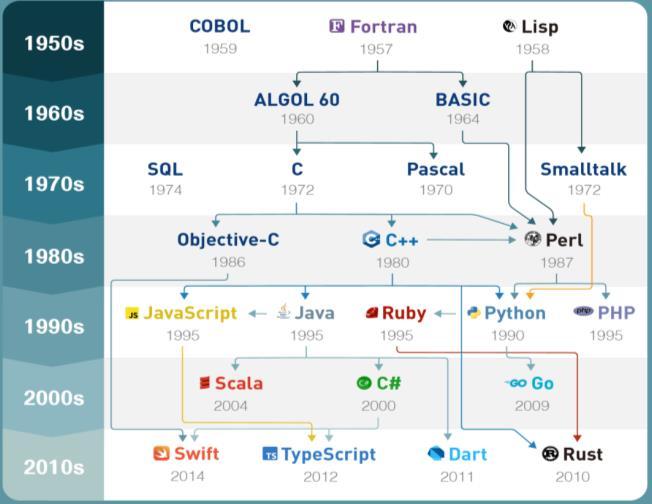
Figure-1: Evolution of Coding Languages.
1.2 Problem Statement
Even though the application of AI-based tools into the process of software development is becoming common, fewempiricalstudieshavebeencarriedouttoassesstheir
International Research Journal of Engineering and Technology (IRJET) e-ISSN: 2395-0056
Volume: 12 Issue: 06 | Jun 2025 www.irjet.net p-ISSN: 2395-0072
actual effectiveness in the configuration of programming language, productivity of developers and coding habits. Conventional methods of doing work basing on manual programming, debugging and refining are being confronted by the AI-aided systems that hold to be more fast-track and efficient in developing the work. Nevertheless, a loophole exists in the comprehension of theimpactthetoolshaveonthecreativity,maintainability, and moral responsibilities of the developers. Questions have been raised on reliability, adaptability, and future impactofAIsystemsuponsoftwareengineeringasa field as the systems start forming language syntax rules, produce large chunks of code, and start shaping design paradigms.
In this research, the author is going to analyze the evolution of programming languages and software development processes that can emanate along with the incorporation of AI technologies. It pays attention to the determination of the way in which AI modifies structural paradigms of programming languages and how such changes affect cognitive and creative development of developers. The most important goal is to contrast a machine-generated code with one that people developed in terms of effectiveness, human-readability, scalability, and ethics. In so doing, the research will evaluate the benefitsandtheshortcomingsoftheusageofAItoaidthe development process during the real-life example of codingsuchasofweb,mobile,andgameapplications.
Also, the study aims to put the role of AI in context not necessarily in a capacity of the tool used, but as the partner in the development. This entails the examination ofAIsystemsonlearningabilitiesandthebehaviorofthe systemanditseffectonhumanjudgmentduringthecodes. Finally, this study is going to merge into a complex framework to assess the changing role of AI in the programming context and present the recommendations ofitssuccessfulandartlessintegration.
These two are the merge of artificial intelligence and programming language that over the years has evolved. However in the initial phases AI was much as something that can be programmed but not as something that takes partin the system of programming.Somelanguages were even designed to be particularly geared toward symbolic reasoning and logical inferenceliketheLISPandPROLOG languages [20-21]. In 1958 LISP was introduced which was known specifically to be able to manipulate a symbolic computation and also recursion as well as list processing, and thus was popular with AI research in the subsequent decades. In the same way, PROLOG using the
formallogic,provideddeclarativestyleofprogrammingin which relationships and facts were important rather than sequential instructions. These languages embodied the intellectual structure of the early AI: rule-based, deterministic and firmly rooted in the mathematical logic [3].
Due to the development of machine learning and deep learning, in particular, the point of view planned by AI went in the direction of data-driven models. The innovation of the current AI especially the large language models such as GPT-3 and Codex created by OpenAI shifted the paradigm in which AI communicated in programminglanguages[22].Now,trainedwithhugecode andnatural-languagecorpora,suchmodelshavebeenable to learn to produce syntactically valid and functionally meaningful tuplesofcodeinsitu[4].Theopportunitiesof AI to assist in writing are already seen in such tools as GitHub Copilot, which is powered by Codex and has already proven itself in its growing ability to process not only meaning but also hint at the use of refactoring and codebase improvements [18-19]. Such transition will entailachangeinhowAIisusedsothatitisnolongerthe tool that is programmed, but a helpful and intelligent partner in programming with the ability to exercise a measure of control over the structure of language, design andevenflowofworkinsoftwaredevelopment[5-6].
Behind the development of AI in programming are rival theoretical models that describe the strengths as well as the weaknesses of the technology. Among the most important dichotomies there is a symbolic versus connectionist approaches dichotomy. Symbolic Artificial intelligence,whichwasmostprominentduringthemid20 th and late 20 th century is based on deterministic representations of knowledge and logic-based reasoning. Such languages as LISP and PROLOG were developed based on this paradigm where the main focus was made onstructuredknowledge,rules,anddeduction[7].Onthe contrary, the present-day AI breakthroughs rely on connectionist models, including artificial neural networks [12].Theyareflexibletoprocessthelanguage,vision,and other complex inputs without having established rules to learn,becauseinthemthepatternsaretaughtbymeansof data[8].
International Research Journal of Engineering and Technology (IRJET) e-ISSN: 2395-0056
Volume: 12 Issue: 06 | Jun 2025 www.irjet.net p-ISSN: 2395-0072
Foundedonlinguisticsandcognitivescience,theso-called sound symbolism and language evolution theories have been introduced also as the explanations of the way AI models learn to use and acquire the language-like structures [11]. Research indicates that artificial intelligence(asisthecaseofahumanlearner)mightlearn phonetic patterns and symbolic associations without any actual rule. More so, the concept of convergence of language,orthatAIstartstoresemblethecommunication of a human being, has finally picked up with the emergence of NLP-driven models [9]. Such models can now respond in a humanlike way, can adjust the intonation and syntax, can even engage in a contextspecific conversation. When translated to the realm of code,suchcapabilitieswouldturnintoAIcapabilitiesthat wouldnotjustrewritethesyntax,butstarttounderstand semantics and design intent as well, and would be closer tohowhumandevelopersthinkoftheproblem[10].
Though the theoretical and technical progress is quite significant,somegapsinresearchcouldbeobservedinthe sphere of AI and programming. A gap in studying empirically the direct comparisons between the traditional human-centric coding and AI-assisted or AIgeneratedprogrammingin real-worldapplications(inthe real environment and not on simulated environments) might be one of the most urgent ones. Though there are some anecdotal reports and case studies showing the efficiency increase of using such tools as GitHub Copilot, there have been no rigorous quantitative studies of the quality, reliability, and maintainability of the code generated by AI tools in general or in specific application domains(suchaswebdevelopment,mobileplatforms,and embeddedsystems).Also,theimpactofAIsolutionsonthe cognitive load of programmers, learning curves of the newbies,andlong-rangeconsequencesofsuchpatternson the education and best programming practices remain poorlyanalyzed[13-14].
In addition, most of the current researches focus on the potential strength of AI without mentioning the disadvantages and ways in which it can be abused. Algorithms as well as AI generated codes, have ethical considerations including algorithmic discrimination, explainability as well as accountability that are normally given in theory but are hardlyeverput to test in practice. Lack of critical and comparative analysis hampers us in learning how AI is moving programming in radically new directions than those provided by the surface level automation capabilities of AI. To do so, the gaps in the literatureshouldbeaddressedandformtheframeworkof a more nuanced and evidence-based approach suitable to direct the future research, tool development, and responsibleuseofbothresearchsoftwareengineeringand AIinsoftwareengineering.
Thedesignoftheresearchiscomparativeandofamixedmethodtypeasit wouldcombine both a qualitativeanda quantitativemethodtodeterminetheconsequencesofthe introduction of artificial intelligence into the contemporary programming process. The reasoning behind such a design is that besides measuring the performance variables like speed and accuracy, there is also the need to make the subjective observations that pertaintotheelementsofusability,adaptabilityaswellas theexperienceofthedevelopers[15].Thequalitativepart is used in order to learn the contextual and experiential aspects of the AI-assisted programming, whereas the quantitative part is utilized in order to measure the empirical results such as the frequency of errors, their time effectiveness, and codes robustness. With this bilateral framework, there is a change of perspective that balances the analysis of AI and the conventional programmingapproachestogiveabetterinsightintotheir positiveandnegativeattributes.
The experimentation, which is the basis of research, is conducted in real life either through AI-based or conventionalprogrammingenvironment.Inthecaseofthe AI-assisted programming, the tools like GitHub Copilot, ChatGPT, and DeepCode were used. GitHub Copilot works with OpenAI codex and supports IDE code suggestion in real-time. ChatGPT was applied when creating code snippets and natural language processing and DeepCode provides intelligent static code analysis and on-the-fly suggestions on how to improve the quality of software [16].Ontheoldschool,work isdoneonReactNativeasa mobile app, HTML/CSS/PHP as a web development platform and Python integrated development environmentslikethePyCharmtotestanddebugcodeby hand.Thetoolsarewidely-usedplatformsinAI-enhanced
International Research Journal of Engineering and Technology (IRJET) e-ISSN: 2395-0056
Volume: 12 Issue: 06 | Jun 2025 www.irjet.net p-ISSN: 2395-0072
andtraditional programcodingspace, whichmakesitfair tocompareitwithvariousprojectstypes.
To quantify efficiency and performance of both the AIassistedand conventional techniques of coding,a number of criteria of evaluating were introduced. Those are code efficiency (measured as compactness and runtime of the code), error rates (measured as number of syntax and logic errors identified during the process of execution or review), development time (measured as timestamps between starting the process and a successful deployment), and adaptability (how easy it is to purport thecodetoothertasksorplatforms).Thecriteriaprovide amultidimensionalconceptofthesoftwarequalityandan individualprogrammerefficiency.
Table-1: A comparative summary of metrics.
Metric AI-Assisted Coding Traditional Coding
Code
Efficiency
ErrorRate
Development Time
Adaptability
3.4
Highforbasictasks, moderateinlogicheavyfunctions
Lowinsyntax,higher inlogicflaws
Significantlylower
Medium,often requiresdeveloper intervention
Highincomplex structures,lowerin rapidprototyping
Moderate,mitigated byexperienceand debugging
Higher,especiallyin largeprojects
High,especiallyfor experienced programmers
In order to test the above metrics in a real-life scenarios, the following are the three different situations that were chosen in which software development is involved; web development, mobile application, and game development. Thewebdevelopmentexamplerelatestothedevelopment of a "Contact Us" page in HTML, CSS, and PHP, where the content was created with the help of AI, in the form of ChatGPT,andlayoutproposesuggestionsweremade.The developedmobileappconsistedofaformthatwassimple tocreate on the basisof ReactNativeand requireda user toenterdataintoitandsubmitit,withAItoolsgivingboth content and a code snippet at the component level. The game development case concentrated on a traditional Snake game made using the React Native. Both methods andAIwereusedinbothinstancestogeneratesomething thatworked just thesame, whichis why the performance acrossmethodscouldbecomparedheadtohead.
The selected case scenarios are likely to be encountered during the practice being of practical value and having a variety in terms of coding complexity, models of
interaction and platform-specific requirements. They allowedanallroundcomparisonoftheusefulnessofAIin various situations of programming, ranging as far as the basicUIgenerationortheengaginglogicandinteractivity withtheuser.
A set of observation logs, performance Benchmarks and human expert reviews had been used in the collection of thedata.Ineverycodingsession,wekeptlogsinorderto record the duration of development, alterations of codes andrectificationof errors.Therewerealsobenchmarking toolsin order to determine run times and responsiveness of codes especially in the mobile and game development activities.Further,experiencedprogrammerswereableto revise each codebase blindly (without knowing it was generated by either AI or a person) and leave qualitative feedback on theaspectof maintainability, readability,and logicbehindthedesign.
The validation was provided by performing several runs per task on various environments and with the provision of similar baseline objectives. Triangulation of feedback usingthelogs,benchmarks,andreviewerswasdonesoas to make valid conclusion. The way of implementation is transparent, can be reproduced, and has practical importance, which places the study as valid technically andbasedonsoftwaredevelopmentchallengesinthereal world.
4.1
As evidenced by the conducted comparative study of AIgenerated and traditional human-written programs, significant distinctions could be observed along the main parameters, such as the speed, the number of errors, and the complexity of codes. According to the rapidity of development, AI-based devices like GitHub Copilot and ChatGPT saved much time when working on monotone andboiler-plateediting.Itispossiblethatdeveloperswho codewiththehelpofthesetoolscanperformfunctionsof code segments more rapidly than developers who code manually mainly because the AI allows auto-complete of structures, library suggestions, and work on syntactic formattingwithalimitedcontributionofhumanbeings.
But as regards the error rates, there were differences in results based on the complexity of tasks. Although AIassisted code had fewer syntactic bugs because of the mannerinwhichitwasmodeledusinglargesetsofcorrect code, it sometimes injected logical errors, particularly where it performed tasks that demanded contextual intelligence or non-sequential programming. Conversely, the traditionally coded programs were slower to code with, but displayed greater logical correctness and lesser
International Research Journal of Engineering and Technology (IRJET) e-ISSN: 2395-0056
Volume: 12 Issue: 06 | Jun 2025 www.irjet.net p-ISSN: 2395-0072
runtime faults, mostly because of the human instinct and debuggingknow-how.
When it came to code complexity, it was also observed thatAIsolutionsweredenseorover-generalizedinnature whichalthoughdidwork,werenotveryclearandmodular in structure as they would be had they been written by a human. This made the script a little less maintainable or readable, especially in more advanced logic based applications like games. On the whole, AI-assisted coding can perform much better than conventional coding when it comes to designing prototypes and syntax control, but when it comes to edge cases, subtle logic, traditional codingappearstobemorefrugal.
The paper had implemented three case scenariosdevelopment of web, mobile application and implementation of game logic to analyze AI-based and regular programming methods within the specified conditions.
Both AI and conventional computing methods performed similar tasks in the challenge of developing a web. The completed code with the help of AI was about 40 percent quicker and was semantically in its words and HTML and CSS structures. The created content and layout were not only beautiful and artistically pleasing but also professionally accurate, which means that AI tools would be perfect to make an ordinary web application based on UI. The traditional coding was also slower but with customization and provided better control on form validationandserversidescriptingwiththeuseofPHP.
In the case of mobile app development, AI proved to be a lot faster, having done the task with almost 50 percent speed of a manual coder. Nonetheless, the use of AI to compile the React Native code produced problems when edge-case scenarios were added, including output validation without being completed and incorrect use of APIs along with its failing. There was need of human intervention where developers had to manually ensure thatsuchcasesweredealtproperlywhich meansthat the anticipating powers of the AI was not so competent. Conversely, the human-coded one proved to be more trustworthy in a larger scope of the test cases, however, time-andeffort-consuming.
In this case the white world scenario was comprised of a game development scenario, where we were expected to usea popularSnakegame,thatiswhytheclassicgameof Snake was developed with the help of React Native, and the traditional code was more successful than AI in the aspect of logical consistency and error control. Although AI might have created simple game loops and user interface, it was not able to produce coherent rules to manage collisions, scoring and to change game state. The
logic that human-coded was more specific, modular and scalableanditstressesthenecessityofexperiencerelated to the problem-solving skills in the case of working with logic-intensivetasks.
To support the qualitative findings, the following table summarizes key metrics measured across each task for bothAI-assistedandtraditionalapproaches:
Tanle-2: Quantitative Comparison.
Task
Web Page
Low Medium High(AI)
Mobile App 50% Medium Low Medium (Human)
Game Logic 30% High Low High (Human)
Itisevidentinthetablethatascomparedtootherprojects that have the same requirement, AI can be applied to speed up the development process, in particular, in instances involving repetitive or UI-intensive activities. Nevertheless, the complexity of the topical tasks raises fewer doubts with regard to the lack of AI capabilities: logic,sensitivity,andvulnerability.Inproblemareasofthe need of human perspective or profound problem solving logic, human programmers still offer the better error managing,flexibilityandtreasuredstructuredesign.
The results of the research indicate the subtle perception of an ever-shifting position of artificial intelligence in the programming sphere. Among the most obvious results, it is worth highlighting the ability of AI to significantly increasedeveloperproductivity,mainlyintheareaswhere anyrepetitivestructure,userinterface,andthegeneration of boilerplate code can be involved. With the help of GitHub Copilot and ChatGPT, developers can code at 50 percent faster in some domain areas of application including web and mobile development. These tools shortenthedevelopmentlife-cyclethroughtheproduction of immediate recommendations, and minimized syntactic problems,andmechanicaloverheadbuild-up.
Nevertheless, this increase in productivity has a price to be paid since most of the high-end problem solving and issues that involve a high level of understanding over application principles or out of the box software
International Research Journal of Engineering and Technology (IRJET) e-ISSN: 2395-0056
Volume: 12 Issue: 06 | Jun 2025 www.irjet.net p-ISSN: 2395-0072
architecture are involved. In game development, as an example,thelogicgeneratedbyAIoftencrashedwhenput in situations requiring multi-state logic or decision management situations or abstract cross-algorithms. AI can easily get the wrong context or produce a generic pattern that may bring logical inconsistency or poor design. These disadvantages indicate the existing weaknessoftheabilityofAItoreasonbeyonditstraining set of data and underline the necessity in the software engineering with high level of complexity of the human intuition,knowledge,andcreativity.
Although efficiency is introduced with the help of AI in programming, there are also some important ethical and practical questions which should be discussed further. Amongthelistofthegreatestconcernsisthepossibilityof bias in AI-born code. The other issue is that models such as Codex and GPT-3 are trained on public code repositories, which can unwittingly transmit an existing bias or other undesirable trends or practices or out-ofdate coding conventions to the models. Such biases might berevealedinalgorithmicdecisionsthatareunfairorthat may be applied in such sensitive areas as healthcare or finances.
Furthermore,thehallucinatedcodeisa more recentissue of concern, a process during which the AI produces the code thatis grammaticallycorrect but eithersemantically incorrect or non-functional altogether. Such code may cause undesired behaviours (or security flaws) in situations when the output is not directly verified. The developers can trust the outputs of the AI excessively, at leastinthesituationswhenthecodeseemstobeproperly structuredandtechnicallysound.
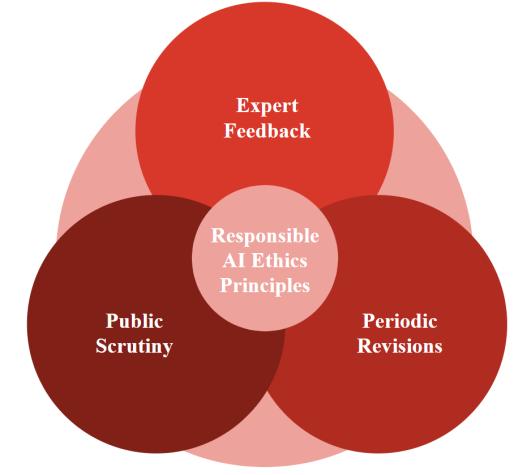
Accountabilityisanotherburningproblem.Intheclassical softwaredevelopmentthesourceofapieceofcodeandits code logic can be attributed to particular developers or groups, so it can be clearly attributed. Code produced by AIdevicestendstobreakthebarrierbetweentheworkof ahumanandtheworkofacomputersinceyoucannotsay withcertaintythatsomecodewaswrittenbytheoneand not by the other. This makes it harder to attribute legal and professional accountability especially in a situation where the code is faulty and the result is data mining or failure within the system. With a growing involvement of AI in the code generation process, there is a critical need to develop well-defined ethical guidelines and norms that would provide some levels of transparency, validation, andsupervisionofthehumanresponsibilitytotheoverall developmentflow.
Thisisbecauseofalltheadvantagesandtheshortcomings of AI, the human-AI cooperation seems to be the most
progressive one in the field of programming. Instead of defininganAIassomethingthatcouldreplacedevelopers, it needs to be explained as an auxiliary tool that can help them be more productive, ease them the burden of mechanical work, and have more time to concentrate on innovation and architecture-level work. This symbiosis modelenvisagestheworkprocessinwhichAIwillprovide a code suggestion, complete routine logic, or assist in documenting the work, whereas human developers will review,optimize,andapprovetheoutcomes.
The developers in this model have creative as well as ethical control of code creation making it careful, purposeful, and contextually aware on designer decisions and that, its decision in coding is centered on the greater system objectives. Human performance in terms of abstracting, innovating and contextualizing is beyond match.Simultaneously,AIalsopromotesthedevelopment process as it can act as a daily helper, learning specific coding patterns, proposing some improvements, and indicatingthepossibleriskstoauser.
Inclusion and openness in the process of coding development might also be provided through integration of AI into development and making it accessible and available to both beginners and non-programmers. The idea of developing software with the aid of natural languageinterfacesmakesitpossiblenowadaystoconvert your idea into an actually working application even without having considerable knowledge in coding, expanding the demographic range in software development.
Table-3: complementary roles of AI and human developer.
Aspect AI Role Human Role
Speed&Efficiency
LogicalDepth
ErrorManagement
Creativity& Innovation
Suggestscode, auto-completes routines Reviews suggestions, integrateslogic
Limitedcontextual understanding Designscore algorithmsand workflows
Detectssyntaxand commonbugs
Resolvescomplex errorsandlogic gaps
Lacksoriginality Inventsnew patternsand solutions
Accountability Noethical responsibility
Holdslegaland moral responsibility
International Research Journal of Engineering and Technology (IRJET) e-ISSN: 2395-0056
Volume: 12 Issue: 06 | Jun 2025 www.irjet.net p-ISSN: 2395-0072
6.1
The paper has addressed the revolutionary nature of artificial intelligence on the various programming languages and developmental processes. The conclusions put emphasis on the fact that AI is not only speeding up the process of programming but also changing the face of writing, interpreting and using programming languages. The role of AI is changing due to such tools as GitHub Copilot and ChatGPT that help developers write code, optimize it, and debug applications in real-time. This development marks the beginning of a new stage in softwareengineeringwhereAIcannolongerbedescribed asapassivetoolinthebackendbutratherbeseenasproactive co- authored software creation. Notably, the paper alsoindicatesthatalthough AIhasasignificantnumberof strong pointsinconnection tospeed andautomation,it is incapable of generating contextual intelligence and the creativityoflogicdesignanddecision-making.
The most hopeful one is the appearance of cross-breed intelligence, where AI does not cut off humanity, but complementsitsabilities.Insuchaparadigm,AIwouldbe used to process repetitive and predictable work and human developers would be put to regulating architecture, innovation, ethical decision making and so on. This is because such a collaborative type guarantees effectiveness and efficiency, in addition to quality, innovativeness and responsibility in software systems. Thesetwocolludingintelligencecantakethetechnological programming to greater heights of developing programs that are far much easier, productive, and with life in the softwaredevelopmentprocess.
Although the present research has provided great knowledge,ithadsomelimitationsinregardtothescope. First, the study mostly dealt with frontend work of web development, mobile apps, and somewhat game algorithms, which, at the same time, is sound and quite applicable, but it does not cover all possible fields of software engineering. It was only focused on front-end development,databaseintegration,systemsprogramming, and applications of enterprise scale; therefore it is one of the areas where performance of AI is not examined. Accordingly, the certain solutions made here will not be universallyapplicabletoanyformofdevelopmentduties.
Second,theAImodelsappliedinthestudy(suchasGitHub CopilotandChatGPT)areonesthatgettrainedonpublicly available code and are accurate, biased, and more or less diverse in domain to an extent. This only restricts the nature of generalisability of results particularly in highly specialized, or niche areas where these models might not be exposed. In addition, applications in the real world
deployment scenarios of scalability, security, and maintainabilitywerehardlytoucheduponsincethemajor testing was performed in the controlled development environments. This has presented some limitations implyingthatthereshouldbemoreempiricalapplications inproductionlevelsettings.
With the current progress on the development of AI and its active involvement in the development of programming, a number of possible perspectives of the further studying and implementation become apparent. TherepresentationofoneofthedirectionsistheuseofAI in the design of compilers. The traditional compilers concentrateonsyntaxandrulesofoptimization,however, the compilers driven by AI may learn how to optimize adaptively,findinefficiencies,andevensuggestalternative syntactic forms to achieve performance improvements. This type of compilers would in effect fill the gap that currently exists between high-level specifications and implementation.
The other exciting direction is the ability to create individual programming AI assistants, which learn about the particular developer, their style, preferences, and coding history. These assistants would not be the generic AI tools, but could provide specific suggestions, use consistent design patterns and even suggest future code requirements,basedontheuserhabits.Thiswouldgreatly increaseproductivityespeciallyinanareaofateameffort wherecontinuityandstylisticconsistencyisafactor.
1. Ahmad, Aqueel et al. “Unified Pre-training for Program Understanding and Generation.”Proc. NAACL-HLT’21,2021,pp.2655–2668.(dl.acm.org)
2. Alon, Uri; Sadaka, Roy; Levy, Omer; Yahav, Eran “StructuralLanguageModelsofCode.”ArXivpreprint, Sept. 2019. doi: 10.48550/ARXIV.1910.00577. (arxiv.org)
3. Chen,Mark etal.“EvaluatingLargeLanguageModels Trained on Code.”ArXiv preprint, July 2021. doi: 10.48550/ARXIV.2107.03374.(ouci.dntb.gov.ua)
4. Cunningham, Cody et al. “GPT-3 Few-Shot Learning for Code Explanations.”SIGCSE ’22, 2022, pp. 551–557.doi:10.1145/3478431.3499370.(dl.acm.org)
5. Feng, Zhangyin et al. “CodeBERT: A Pre-Trained Model for Programming and Natural Languages.”ArXiv preprint, Feb. 2020. doi: 10.48550/ARXIV.2002.08155.(ouci.dntb.gov.ua)
6. Ferrario, Paolo; Winter, Eugen “Applying Human Values Theory to Software Engineering
International Research Journal of Engineering and Technology (IRJET) e-ISSN: 2395-0056
Practice.”IEEETrans.SoftwareEng.,vol.49,no.3,pp. 973–986, Mar. 2023. doi: 10.1109/TSE.2022.3170087.(arxiv.org)
7. Finnie-Ansley, James et al. “The Robots Are Coming: Exploring the Implications of OpenAI Codex on Introductory Programming.”ACE ’22, 2022, pp. 10–19.doi:10.1145/3511861.3511863.(dl.acm.org)
8. Floridi, Luciano; Chiriatti, Massimo “GPT-3: Its Nature, Scope,Limits,andConsequences.”Mindsand Machines, vol. 30, no. 4, pp. 681–694, Oct. 2020. (dl.acm.org)
9. Guo, Ensheng et al. “Exploring the Potential of ChatGPT in Automated Code Refinement: An Empirical Study.”ArXiv preprint, Sept. 2023. arXiv:2309.08221.(arxiv.org)
10. Guo, Philip “Online Python Tutor: Embeddable WebBased Program Visualization for CS Education.”SIGCSE ’13, 2013, pp. 579–584. (dl.acm.org)
11. Hellendoorn, Vincent et al. “PolyCoder: Large OpenSource Model for C Code Generation.”Proc. ACM SIGPLANMach.Program.’22,2022.(dl.acm.org)
12. Helmuth, Matthew; Kelly, Peter “PSB2: The Second Program Synthesis Benchmark Suite.”Proc. GECCO ’21, 2021. doi: 10.1145/3449639.3459285. (dl.acm.org)
13. Idrisov, Bulat; Schlippe, Tim “Program Code Generation with Generative AIs.”Algorithms, vol. 17, no. 2, p. 62, Feb. 2024. doi: 10.3390/a17020062. (mdpi.com)
14. Imai, Saki “Is GitHub Copilot a Substitute for Human Pair-Programming? An Empirical Study.”Proc. ICSE ’22 Companion, 2022, pp. 319–321. doi: 10.1145/3510454.3522684.(dl.acm.org)
15. Kanade, Aditya et al. “Learning and Evaluating Contextual Embedding of Source Code.”ICML ’20, 2020,pp.5110–5121.(pmc.ncbi.nlm.nih.gov)
16. Khan,JunaidYounas;Khan,GhulamUllah“Automatic Code Documentation Generation Using GPT-3.”ArXiv preprint, Sept. 2022. doi: 10.48550/ARXIV.2209.02235.(arxiv.org)
17. Liu, Deyu et al. “Multi-task Learning Based PreTrained Language Model for Code Completion.”ASE ’20,2020,pp.473–485.(pmc.ncbi.nlm.nih.gov)
18. Mohammadi,Behrad “Pel, AProgrammingLanguage for Orchestrating AI Agents.”ArXiv preprint, May 2025.arXiv:2505.13453.(arxiv.org)
19. Niu, Rui et al. “CodexLeaks: Privacy Leaks from Code Generation Language Models in GitHub Copilot.”USENIX Security ’23, 2023, pp. 2133–2150. (arxiv.org)
20. Ochs, Moritz; Narasimhan, Karthik; Mezini, Mira “Evaluating and Improving Transformers PreTrained on ASTs for Code Completion.”IEEE SANER ’23,2023,pp.834–844.(arxiv.org)
21. Olausson,Leoetal.“DemystifyingGPTSelf-Repairfor Code Generation.”ArXiv preprint, June 2023. arXiv:2306.09886.(arxiv.org)
22. Ombredanne, Philippe “Free and Open Source Software License Compliance: Tools for Software Composition Analysis.”Computer, vol. 53, no. 10, pp. 105–109,Oct.2020.(arxiv.org)
23. OpenAI “GPT-4 Technical Report.”ArXiv preprint, Mar.2023.arXiv:2303.08774.(arxiv.org)
24. Parvez, Nabil et al. “Retrieval Augmented Code Generation and Summarization.”Findings of ACL EMNLP’21,2021,pp.2719–2734.(arxiv.org)
25. Pearce, Hammond et al. “Asleep at the Keyboard? Assessing the Security of GitHub Copilot’s Code Contributions.”IEEE S&P ’22, 2022, pp. 754–768. (arxiv.org)
26. de la Torre, Javier “From Tool Calling to Symbolic Thinking: LLMs in a Persistent Lisp Metaprogramming Loop.”ArXiv preprint, June 2025. arXiv:2506.10021.(arxiv.org)
Volume: 12 Issue: 06 | Jun 2025 www.irjet.net p-ISSN: 2395-0072 © 2025, IRJET | Impact Factor value: 8.315 | ISO 9001:2008