
International Research Journal of Engineering and Technology (IRJET) e-ISSN: 2395-0056
Volume: 12 Issue: 11 | Nov 2025 www.irjet.net p-ISSN: 2395-0072
International Research Journal of Engineering and Technology (IRJET) e-ISSN: 2395-0056
Volume: 12 Issue: 11 | Nov 2025 www.irjet.net p-ISSN: 2395-0072
Jayashree R1, Mr Sathishkumar M2
1 PG Student, Department Of Computer Applications, Jaya College Of Arts and Science, Thiruninravur, Tamilnadu, India
2Assistant Professor, Department Of Computer Applications, Jaya College Of Arts and Science, Thiruninravur, Tamilnadu,India
Abstract - The integration of Artificial Intelligence (AI) in personalizedlearninghastransformedtraditionaleducational paradigms by enabling adaptive, data-driven, and studentcentered learning experiences. Recent advancements in AI technologies such as machine learning algorithms, natural language processing, and predictive analytics have facilitated the development of intelligent tutoring systems, adaptive learning platforms, and personalized feedback mechanisms. These tools analyze learners’ behaviors, preferences, and performance to tailor instructional content and pacing, thus enhancing engagement and learning outcomes.Currentdevelopmentsincludetheuseofgenerative AI for content creation, chatbots for real-time support, and learning analytics for early intervention and performance prediction.
Key Words: Artificial Intelligence, Personalized Learning, Adaptive Learning, Educational Technology, Future of Education
1.INTRODUCTION
The rapid advancement of Artificial Intelligence (AI) has revolutionized numerous sectors, and education is no exception. In recent years, AI has emerged as a transformative force in reshaping teaching and learning processes, particularly through the development of personalizedlearningsystems.Personalizedlearningrefers to instructional approaches that tailor educational experiences to meet the unique needs, abilities, interests, andlearningstylesofindividualstudents.Unliketraditional one-size-fits-all models, AI-driven personalized learning leverages algorithms and data analytics to adapt content, pace,andassessmentinrealtime,ensuringthateachlearner receives the most suitable support and challenge. AI technologies suchasmachine learning, natural language processing, predictive analytics, and recommender systems are being increasingly integrated into learning management systems and digital educational platforms. Thesetechnologiesenablecontinuousmonitoringoflearner performance,identificationoflearninggaps,andgeneration of adaptive feedback, thus promoting self-directed and efficientlearning.Forinstance,intelligenttutoringsystems andadaptivee-learningplatformscanautomaticallyadjust
instructionalmaterialsbasedonlearners’progress,whileAI chatbotscanofferinstantacademicassistanceandemotional support.
Artificialintelligence(AI)inpersonalizedlearningreframes instruction from one-size-fits-all to adaptive, learnercenteredpathwaysthattailorcontent,pacing,feedback,and assessment to individual needs. Modern AI-driven personalizationisbuiltaroundastackofcapabilitieslearner modeling, adaptive sequencing/pedagogical policies, automatedcontentandfeedbackgeneration,anddashboards forteachersandstudents whichtogetheraimto increase engagement,acceleratemastery,andsupportdifferentiated instruction at scale. Recent syntheses highlight how this stackhasmaturedfromrule-basedsystemstoprobabilistic and deep learning approaches that operate on rich interactiondata.IntelligentTutoringSystems(ITS)remaina foundationalclassofinterventionsforpersonalizedlearning. ITSs provide step-by-step tutoring, worked examples, hintingstrategies,andadaptivetasksequencing;systematic reviews and meta-analyses over the past decade report consistent short-term gains in performance, especially in well-structured domains like mathematics, though effect sizes and generalizability vary by implementation quality and study design. The literature emphasizes that ITS effectiveness often depends on careful modeling of skills, high-quality domain models, and the fidelity of classroom implementation.
3.1
TheExistingsystemofpersonalizedlearningprimarilyrelies on traditional digital learning platforms and rule-based adaptivesystems.Thesesystemsusepredefinedalgorithms andfixedlearningpathsdesignedbyeducatorsordomain experts. The personalization process in this framework is limited to analyzing learners’ test scores, time spent on activities,orbasicdemographicdatatoadjustthedifficulty levelorcontentsequence.IntelligentTutoringSystems(ITS) and Learning Management Systems (LMS) with adaptive featuresrepresentthemaintechnologicalfoundationofthe current approach. These systems apply basic artificial
International Research Journal of Engineering and Technology (IRJET) e-ISSN: 2395-0056
Volume: 12 Issue: 11 | Nov 2025 www.irjet.net p-ISSN: 2395-0072
intelligencetechniques,suchasdecisiontreesandBayesian knowledgetracing,toestimatealearner’sknowledgestate andprovideadaptiverecommendations.
TheProposedsystemaimstoadvancepersonalizedlearning by integrating modern artificial intelligence methods particularly machine learning, deep learning, and large language models (LLMs) to create a fully adaptive, intelligent learning environment. Unlike rule-based approaches, this system uses continuous data collection from learners’ interactions, assessments, and behavioral patterns to train dynamic models capable of real-time adaptation.TheproposedAI-drivenframeworkwillinclude three main components: (1) Learner Modeling, which constructsacomprehensivecognitiveandemotionalprofile foreachstudentusingpredictiveanalyticsandmultimodal data such as text responses, facial cues, and engagement levels;(2)AdaptiveContentGeneration,wheregenerativeAI models dynamically create customized lessons, exercises, and feedback based on the learner’s needs and learning style; and (3) Predictive Recommendation Engine, which uses reinforcement learning to select the most effective learning sequence for each student, optimizing outcomes through continuous feedback loops. The proposed system alsointegratesteacherdashboardsthatexplainAIdecisions, ensuringtransparencyandhumanoversight.Furthermore,it employs fairness-aware algorithms to minimize bias, privacy-preservingtechniquestosecurestudentdata,and explainableAImodelstoimprovetrustandinterpretability. Theultimategoalofthismethodologyistoachievedeeper personalization, equitable access, and continuous improvementinlearningoutcomesthroughintelligent,datadriven,andethicallyalignedAItechnologies.
ARCHITECTURE DIAGRAM
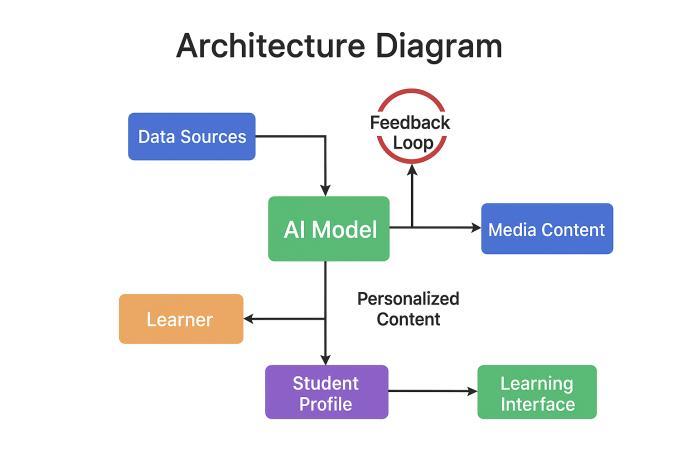
This module serves as the foundation of the entire personalizedlearningsystem.Itcollectsandprocessesdata relatedtoeachlearner’sacademicperformance,interaction history, behavior, and preferences. The data sources may includequizzes,assignments,browsingpatterns,discussion participation,andeventimespentoneachtopic.Advanced analyticstechniquesandsensors(inmodernsystems)may alsocaptureemotionalengagementandattentionlevels.The collecteddataispreprocessedandconvertedintostructured formatsforanalysis.
Thismodulefocusesonbuildingadynamicprofileforevery learner, often called a “student model.” It continuously updates and refines the learner’s profile based on their progress, responses, and behavior patterns. The learner model typically includes cognitive attributes (knowledge level, mastery of concepts), affective states (motivation, engagement), and personal learning preferences. In the existingsystems,thismodelingisrule-basedandstatic,but in the proposed AI-driven system, deep learning and predictive analytics are used to enhance accuracy and adaptability.
Thismoduleusesartificialintelligencetechniquesespecially largelanguagemodels(LLMs)andgenerativeAItodesign anddelivercustomizedlearningmaterialsinrealtime.Based onthelearner’sprofileandcurrentperformance,itselects, modifies, or generates suitable content such as text explanations,videorecommendations,interactiveexercises, and assessments. Unlike traditional systems that rely on fixedcontentlibraries,thismodulecandynamicallycreate new examples or explanations tailored to the learner’s needs.Itensuresthatthedifficultylevel,contentformat,and pacingareoptimizedforeachindividual.
WhileAIhandlespersonalization,humanoversightremains critical. This module provides educators with a comprehensive dashboard that visualizes each learner’s progress, engagement level, and predicted outcomes. Teachers can track performance trends, identify at-risk students, and adjust course plans accordingly. The dashboard also explains AI-generated recommendations through transparent metrics, ensuring that educators understandandtrustthesystem’sdecisions.Thishuman-AI collaboration ensures accountability, fairness, and pedagogicalalignmentwhilemaintainingefficiencyinlarge classroomenvironments.
International Research Journal of Engineering and Technology (IRJET) e-ISSN: 2395-0056
Volume: 12 Issue: 11 | Nov 2025 www.irjet.net p-ISSN: 2395-0072
Theimplementationofartificialintelligenceinpersonalized learning involves integrating intelligent algorithms, data analytics, and adaptive learning techniques within an educationalenvironment.Theprocessbeginswiththesetup of a digital learning platform capable of collecting and processinglearnerdatasuchasquizresults,timespenton lessons,responsepatterns,andengagementlevels.Thisdata isstoredsecurelyinacentraldatabaseforanalysis.Machine learninganddataminingalgorithmsarethenimplemented tointerpretthisdata,identifylearningbehaviors,anddetect individual strengths and weaknesses. Through these insights, the system forms a detailed learner profile that becomes the foundation for personalization. The implementationprocessalsorequiresintegratingAPIsand learningmanagementsystems(LMS)toensurethattheAI engine can communicate seamlessly with educational content repositories and user interfaces. In the existing system, implementation mainly relies on rule-based personalizationmethodswherecontentismanuallytagged, and adaptive learning paths are predefined by educators. Thesesystemsarerelativelysimplebutlackflexibilityand deep personalization capabilities. To overcome these limitations, the proposed AI-based implementation uses advancedtechniquessuchasneuralnetworks,deeplearning, and reinforcement learning to achieve dynamic and intelligent adaptation. The AI models are trained using historicallearningdatatopredictlearnerperformanceand recommendsuitablecontentinrealtime.Forexample,ifa student consistently struggles with a specific topic, the system automatically generates remedial exercises or providesalternativeexplanationsuntilmasteryisachieved. Thisdynamicresponsemakesthelearningexperiencemore engagingandeffectivecomparedtostatic,pre-programmed systems. The implementation also incorporates Large Language Models (LLMs) and Generative AI to automate contentcreationandfeedbackgeneration.Thesemodelsare fine-tuned to understand learning objectives, simplify complex topics, and generate personalized learning materials such as summaries, quizzes, and step-by-step explanations.NaturalLanguageProcessing(NLP)isusedto evaluate students’ written or spoken inputs, enabling the systemtoprovideimmediate,meaningfulfeedback.
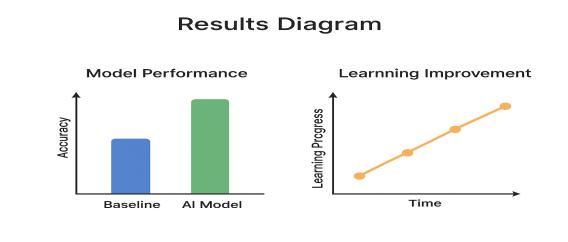
Artificial Intelligence has emerged as a powerful tool for transforming the landscape of education by enabling personalized, data-driven, and adaptive learning experiences.Throughtheintegrationofmachinelearning, data analytics, and intelligent tutoring systems, AI allows educatorsandplatformstotailorlearningmaterials,pace, andstrategiesaccordingtoeachstudent’sindividualneeds andcapabilities.Unliketraditionalteachingmethods,which often apply a uniform approach to all learners, AI-driven personalizedlearningidentifiesstrengthsandweaknessesin real time and provides targeted support to improve understandingandretention.Thisshiftfromageneralizedto alearner-centricapproachmarksasignificantmilestonein modern education, ensuring that learning becomes more engaging,efficient,andinclusive.
The future scope of Artificial Intelligence in personalized learningisvastandcontinuouslyexpandingastechnology evolvesandeducationalneedsbecomemorediverse.Inthe comingyears,AIisexpectedtomakelearningenvironments moreintelligent,inclusive,andlearner-centered.Oneofthe most promising directions is the integration of advanced machine learning and deep learning models that can understandnotonlywhatalearnerknowsbutalsohowthey think and feel while learning. This will allow systems to predict learning difficulties even before they occur and provide proactive guidance. AI-based personalization will move beyond academic content to include emotional and motivational support, making learning experiences more holisticandengaging.
[1] Wang,Q.,Han,X.,&Yang,J.(2024).ASystematicReview of Artificial Intelligence in Education: Applications, Challenges, and Future Directions. Computers and Education:ArtificialIntelligence,7(2),100204.
[2] Lin, C., Chen, T., & Liu, S. (2023). Intelligent Tutoring SystemsandPersonalizedLearning:Advances,Challenges, and Prospects. Education and Information Technologies, 28(6),6859–6881.
[3] Létourneau,S.,Dillenbourg,P.,&Nkambou,R.(2025). AI-Driven Personalized Learning: A Meta-Analysis of IntelligentTutoringSystemsandAdaptivePlatforms.Journal ofEducationalComputingResearch,63(4),945–972.
[4]U.S. Department of Education. (2023). Artificial Intelligence and the Future of Teaching and Learning: Insights and Recommendations. Washington, DC: Office of EducationalTechnology.
[5] Xing, W., Chen, X., & Zhang, J. (2025). Large Language ModelsinEducation:Opportunities,Challenges,andEthical Considerations. Springer NatureEducation Review, 31(2), 135–152.
International Research Journal of Engineering and Technology (IRJET) e-ISSN: 2395-0056
[6] Holmes, W., Bialik, M., & Fadel, C. (2019). Artificial Intelligence in Education: Promises and Implications for Teaching and Learning. Center for Curriculum Redesign, Boston,MA.
[7] Luckin, R., Holmes, W., Griffiths, M., & Forcier, L. B. (2022). Intelligence Unleashed: An Argument for AI in Education.PearsonEducation,London.
Volume: 12 Issue: 11 | Nov 2025 www.irjet.net p-ISSN: 2395-0072 © 2025, IRJET | Impact Factor value: 8.315 | ISO 9001:2008 Certified Journal | Page 169