
International Research Journal of Engineering and Technology (IRJET) e-ISSN:2395-0056
Volume: 12 Issue: 06 | Jun 2025 www.irjet.net p-ISSN:2395-0072
International Research Journal of Engineering and Technology (IRJET) e-ISSN:2395-0056
Volume: 12 Issue: 06 | Jun 2025 www.irjet.net p-ISSN:2395-0072
Dr Sandhya Kulkarni 1, Aniket Lakhe 2, Mayuri Rajput3
1 Professor, Department of Electrical Engineering, Government College of Engineering Aurangabad, Chhatrapati Sambhajinagar, Maharashtra, India.
2 UG Student, Department of Electrical Engineering, Government College of Engineering Aurangabad, Chhatrapati Sambhajinagar, Maharashtra, India.
3 UG Student, Department of Electrical Engineering, Government College of Engineering Aurangabad, Chhatrapati Sambhajinagar, Maharashtra, India.
Abstract - This project presents the detection and diagnosis of stator winding short-circuit faults in Permanent Magnet Synchronous Motors (PMSM) using artificialintelligencetechniques.PMSMbehavioris modeled and analyzed in MATLAB Simulink to simulate both healthy and faulty operating conditions. Simulation provides insights into dynamic behavior and electromechanical interactions under fault conditions without requiring physicalexperimentation.
TheapproachinvolvessimulatingPMSMperformanceunder normal and stator winding short-circuit scenarios. Results demonstrate close alignment between simulated and expected behaviors. For fault detection, the K-Nearest Neighbours (KNN) algorithm is applied to classify motor conditions basedonfeatures extractedfromcurrentsignals. For fault diagnosis and severity estimation, Decision Tree ClassifierandRandomForestRegressormodelsareused.
The analysis shows KNN effectively detects faults, while Decision Tree and Random Forest models accurately diagnose the type and extent of stator faults. The motor modeling and fault analysis system, developed in MATLAB Simulink, enables detailed study and evaluation of fault scenarios.
Using machine learning (ML) for PMSM fault detection and diagnosis offers advantages over traditional methods. ML models can automatically learn complex patterns from large datasets, allowing for early and accurate fault detection. Once trained, these models enable real-time monitoring and predictive maintenance, enhancing system reliability and reducing costs. This data-driven approach significantly improves the efficiency and effectiveness of faultdiagnosisinPMSM.
Key Words: AI-Based techniques, Machine Learning (ML), KNN, Decision Tree Classifier, Random Forest Regressor.
Fault Detection and Diagnosis (FDD) is an essential condition monitoring technique designed to assess the operational status of electric motors. By enabling early detection of faults and distinguishing between fault types, FDD helps in proactive decision-making to prevent potentialhazardsandensuresystemreliability.
Permanent Magnet Synchronous Motors (PMSMs) are widelyusedinmodernelectricvehicles(EVs)duetotheir high efficiency, high torque density, and superior performance characteristics. However, like all electrical machines,PMSMsarevulnerabletovarioustypesoffaults during operation, with stator winding short-circuit faults being among the most common and critical. Early detection and accurate diagnosis of such faults are essential to ensure the reliability, safety, and longevity of EVdrivesystems.
Traditional fault detection methods, such as thermal monitoringorvibrationanalysis,areoftenlimitedinterms ofsensitivityandresponsetime.Withtheadvancementof computational tools and artificial intelligence (AI) techniques, data-driven approaches have emerged as powerfulalternativesfortheearlydetectionanddiagnosis of motor faults. AI-based systems can analyze complex patternsinmotorsignalsandclassifyfaulttypeswithhigh accuracy.
This project focuses specifically on the detection and diagnosis of stator winding short-circuit faults in PMSMs usingAItechniques.ThePMSMmotormodelisdeveloped and simulated in MATLAB Simulink software under both healthy and faulty conditions. For fault detection, the KNearest Neighbours (KNN) algorithm is employed, which classifiesthemotor'soperationalstatusbasedonfeatures extracted from the stator current signals. For fault diagnosisandseverityestimation,DecisionTreeClassifier and Random Forest Regressor models are used to further analyzeandcategorizethefaultcondition.
Electric Vehicle (EV) motors are key to how well an EV performs,how efficientitis, andhowsafeitremainsover time. However, these motors can develop faults like short circuits in the stator windings, which, if not caught early, can cause sudden failures, increase repair costs, and shortenthemotor’slife.
Traditional ways ofdetectingmotor faultsusuallyinvolve a lot of physical checking and may not catch problems early enough. Thanks to advancements in Artificial Intelligence (AI) and machine learning, we can now spot motor issues faster and more accurately using data-based methodsthatdon'trequireinstallingextrasensors[1].
By using motor models built in MATLAB Simulink and applying AI techniques like K-Nearest Neighbours (KNN), DecisionTrees,andRandomForests,it’spossibletocreate a smart system that can detect faults quickly and even judge how serious the problem is. This helps keep EVs safe,reliable,andefficient.
Because of its importance to today’s automotive industry andthepushtowardsmarterelectricvehicles,thistopicis very relevant and opens new opportunities for research intoAI-basedmotormonitoringsystems[2].
The goal is to develop a smart system that can quickly detect and diagnose faults in Electric Vehicle (EV) motors using Artificial Intelligence (AI) techniques. By simulating motor behaviour in MATLAB Simulink and applying machine learning algorithms like K-Nearest Neighbours (KNN), Decision Trees, and Random Forests, the system willidentifythetypeoffaultandhowsevereitis.Thiswill help prevent motor failures, reduce maintenance costs, andimprovethesafetyandreliabilityofEVs[2].
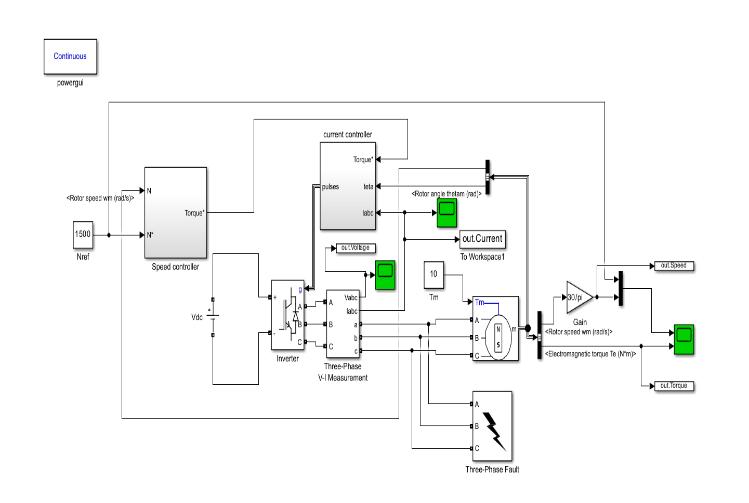
Battery is a device that stores chemical energy and converts it into electrical energy through electrochemical reactions. It is a portable and convenient source of DC (DirectCurrent)power.
Inourprojectsimulation,wehaveusedabatterymodelto representthepowersource fortheelectricmotorsystem. The battery was configured with a voltage rating of 300 volts, which is a typical value for mid-range electric vehicle applications. This voltage level was chosen to ensure the simulation closely resembles real-world EV performance scenarios, allowing accurate analysis of current flow, motor response, and overall system behaviourundervariousoperatingconditions.
Aninverterinanelectricvehicleisakeypowerelectronics device that converts DC (Direct Current) from the battery into AC (Alternating Current) to drive the AC motor (typically a synchronous or induction motor). Since most EV motors operate on 3-phase AC power, the inverter plays a vital role in enabling motor control and vehicle movement.
In our project simulation, we have incorporated an inverter block to control the AC synchronous motor. The inverterreceives300VDCfromthesimulatedbatteryand converts it into 3-phase AC, which is then supplied to the motor. This setup enables accurate modeling of motor dynamics, torque-speed characteristics, and overall systemperformanceundervariousloadconditions.
The Voltage and Current Measurement block in MATLAB Simulink is used to monitor electrical quantities such as voltageandcurrentinasimulatedelectricalcircuit.
In our project simulation, we have used the VI Measurement block to accurately monitor the voltage acrosstheInverterandthecurrentsuppliedtothemotor. This helped us analyze the electrical behaviour of the system under different load and speed conditions, ensuring realistic simulation results and performance validation.
In electric vehicle (EV) motor control systems, Current and Speed Controllers are essential components that ensure smooth and efficient motor performance. Current Controller regulates themotor’sarmatureorstatorcurrent,whichdirectlyaffects torque output, while Speed controller maintains the International Research Journal
International Research Journal of Engineering and Technology (IRJET) e-ISSN:2395-0056
Volume: 12 Issue: 06 | Jun 2025 www.irjet.net p-ISSN:2395-0072
rotational speed of the motor based on driver or system input.
Three Phase Fault Block
The Three-Phase Fault block in MATLAB Simulink is used to simulate electrical faults in power systems, such as short circuits between phases or to ground. It is a critical toolforanalyzingsystembehaviorunderfaultcondition.
Permanent Magnet Synchronous Motor
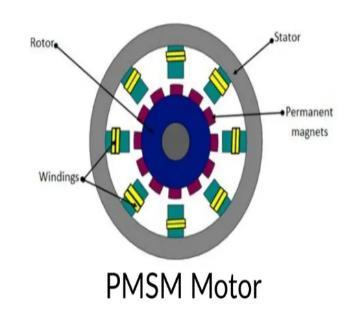
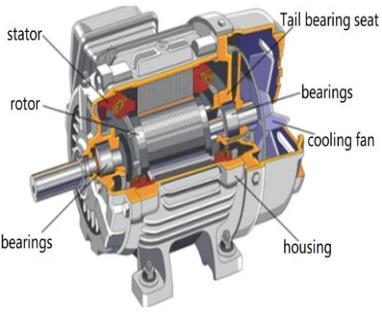
Figure-2: StructureofPMSM
A PMSM is a type of AC synchronous motor in which the rotor contains permanent magnets instead of windings as showninfigure-2.
PMSM have several key advantages that make them a popularchoiceforelectricvehicles(EVs):
HighEfficiency
HighPowerDensity
PreciseControl
HighTorqueDensity
ReliabilityandDurability
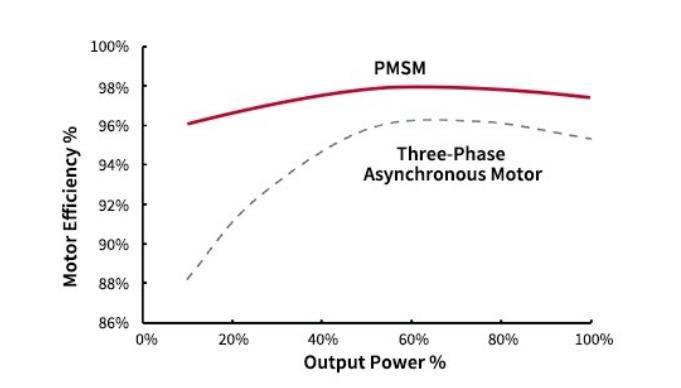
Figure-3: PMSMMotorEfficiencyVsOutputPowerplot.
Figure-3showsplotbetweenMotorEfficiencyandOutput Power. This motor was selected for its high efficiency, torquecontrolaccuracy,andsuitabilityforelectricvehicle applications. It allows us to simulate realistic vehicle behaviour under varying load and speed conditions, supporting detailed analysis of performance and energy consumption[3].
Figure-4: FaultInjectionandSimulation
3.1 Speed and Torque Characteristics
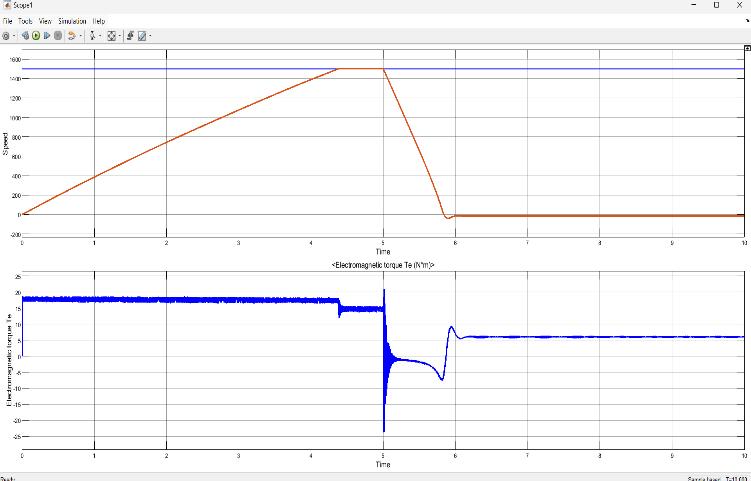
Figure-5: SpeedandTorqueCharacteristicsofPMSM
In the present study, a Permanent Magnet Synchronous Motor (PMSM) is used to simulate the operational behaviour under both normal and fault conditions as showninfigure-5.Themotorisinitiallysettooperateata constant speed of 1500 RPM, which corresponds to the synchronousspeedina50Hz,4-polesystem.
Normal Operating Condition (0 – 5 seconds):
Speed: Speed increases to 1500 RPM and stays constant.
StartingTorque:Atstartup,themotorgeneratesa hightorqueof18N·mtoovercomeinitialinertia.
Running Torque: After achieving rated speed, the torque stabilizes at 15 N·m, which is sufficient to drive the mechanical load in steady-state operation.
The torque remains steady and aligned with the load demandduringthisperiod,indicatingnormaloperationof thePMSMwithoutanyfaultsordisturbances.
International Research Journal of Engineering and Technology (IRJET) e-ISSN:2395-0056
Volume: 12 Issue: 06 | Jun 2025 www.irjet.net p-ISSN:2395-0072
A fault is introduced at 5 secondsby using Three Phase Faultblockasshowninfigure-4.
Speed Response: Due to the fault, the motor is unabletosustainitsrotationandthespeeddrops rapidlyto0RPM,whichwecanobserveinfigure5.
Torque Response: As the motor loses synchronization and power delivery is disrupted, the torque also decreases sharply, this is illustratedinfigure-5.
This behaviour indicates a complete shutdown or stalling ofthemotorasaresultofthefault,whichreflectsalossof controlorfailureinthedrivesystem.
This behaviour of the PMSM under normal and fault conditions is essential for validating the fault detection and diagnosis technique being developed in our project. The clear transition in torque and speed offers valuable data for identifying the onset of motor faults using AIbasedanalysismethods.
Data Acquisition
Sensors:SensorisinstalledontheEVmotortocollectdata related to its performance. This sensor can measure currentvaluesofstatorwinding.
The stator current waveform of a Permanent Magnet Synchronous Motor (PMSM) provides critical insight into the motor’s performance and health. In our project, the motoroperatesunderanormalloadforthefirst5seconds and then experiences a fault, which is clearly reflected in thecurrentprofile[4].
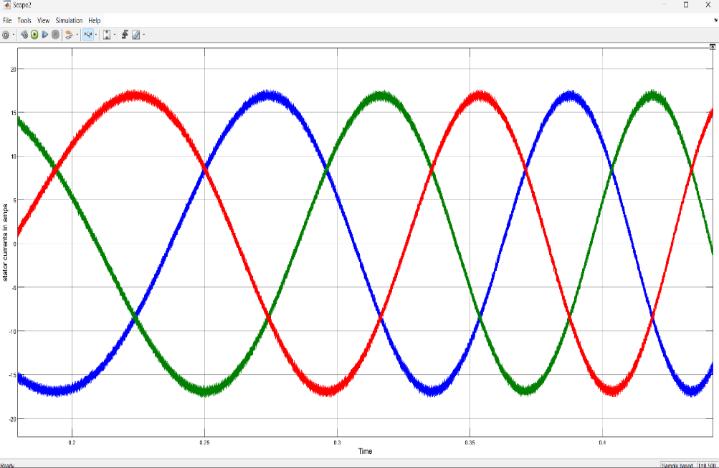
Figure-6-a.
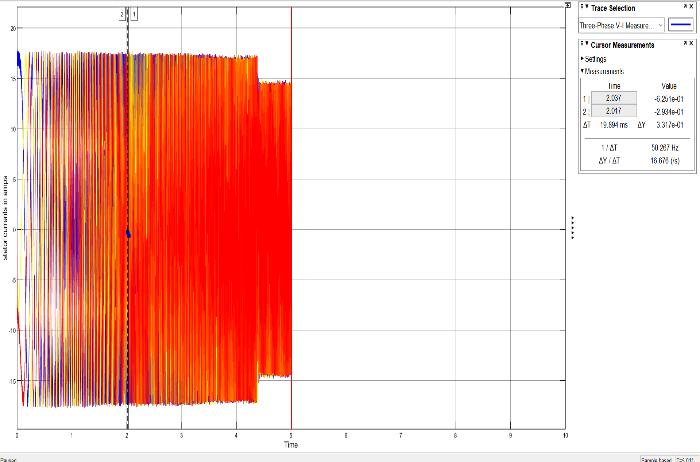
Figure-6-b.
Figure-6(a,b): Currentundernormaloperatingcondition ofPMSM.
Duringnormaloperation,thePMSMmotordrawsasteady current of 17 A. This current supports continuous operation at 1500 RPM with a running torque of 15 N.m. The waveform in figure-6 is balanced and sinusoidal, indicatinghealthymotorbehaviour[4].
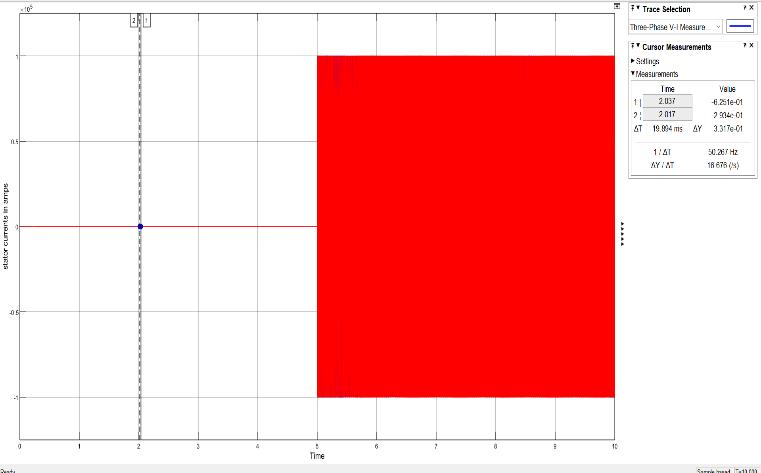
Figure-7: Currentafterstatorwindingshortcircuit.
At the 5-second , a stator winding short circuit fault is introduced. As we can see in figure-7, the stator current reacts sharply, spiking to extremely high levels between 50 kA and 100 kA. This sudden surge is indicative of a severe short-circuit fault, where the impedance drops drastically and the motor draws an abnormally high current.Thewaveformbecomesdistorted,non-sinusoidal, and highly unstable, often accompanied by harmonic content and transients. Such high fault currents pose a significant risk to the motor windings, power electronics, andoverallsystemstability[4].
Data Collection
The sensors continuously collect data, capturing the normal and abnormal operating conditions of the motor.
International Research Journal of Engineering and Technology (IRJET)
Volume: 12 Issue: 06 | Jun 2025 www.irjet.net
To facilitate the development of our AI-based fault detection system, we implemented a data collection mechanismusingMATLABSimulink[5].
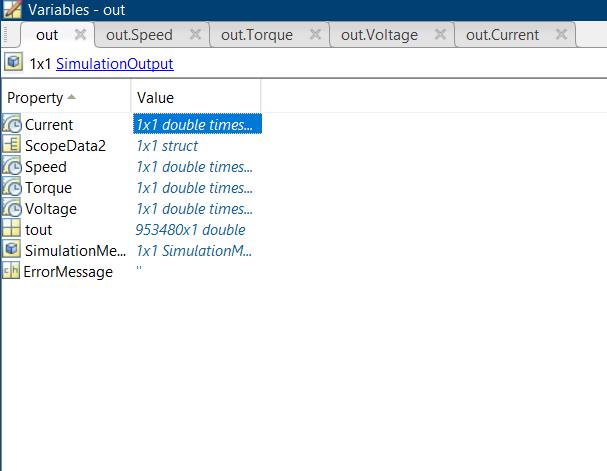
Figure-8: SimulationoutputinMATLABWorkspace
Key motor parameters such as stator current, speed, and torque were monitored and logged during simulation. We utilized the ‘To Workspace’ blocks in Simulink to export thesesignalsdirectlytotheMATLABworkspaceasshown in figure-8. This enabled us to capture accurate timedomain data under both normal and fault conditions as shown in figure-9. The collected data was then used for feature extraction and further processed for training and testing machine learning algorithms. This approach provided a robust dataset necessary for analyzing motor behaviourandvalidatingthefaultdetectionmodel.
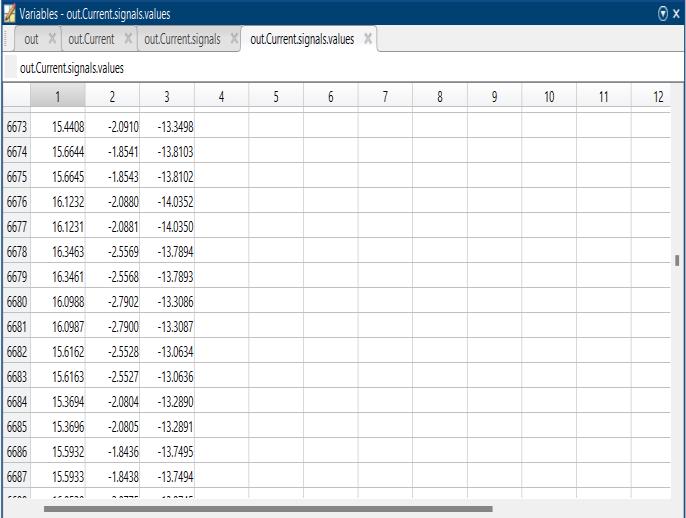
Figure-9: DataCollectioninMATLABWorkspace
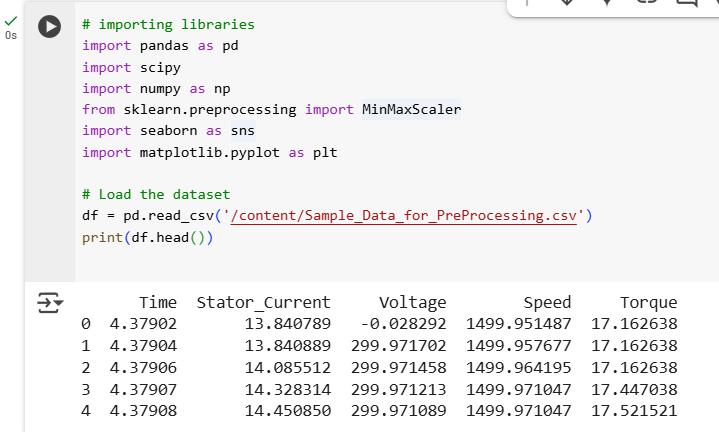
Figure-10: ImportingLibrariesandloadingdataset.
In this code, we have imported the necessary libraries required for data analysis, preprocessing, and visualization.Aftersettinguptheenvironment,weloaded the dataset using the read_csv() function. The dataset, which appears to be related to diabetes, has been successfullyreadintoaDataFrameandthefirstfewrows are displayed using the head() function. As shown in the picture,thisallowsus toget aninitial viewofthedataset, including its structure and the types of values it contains. This step is important for understanding the data before proceedingtofurtheranalysisormodelbuilding.
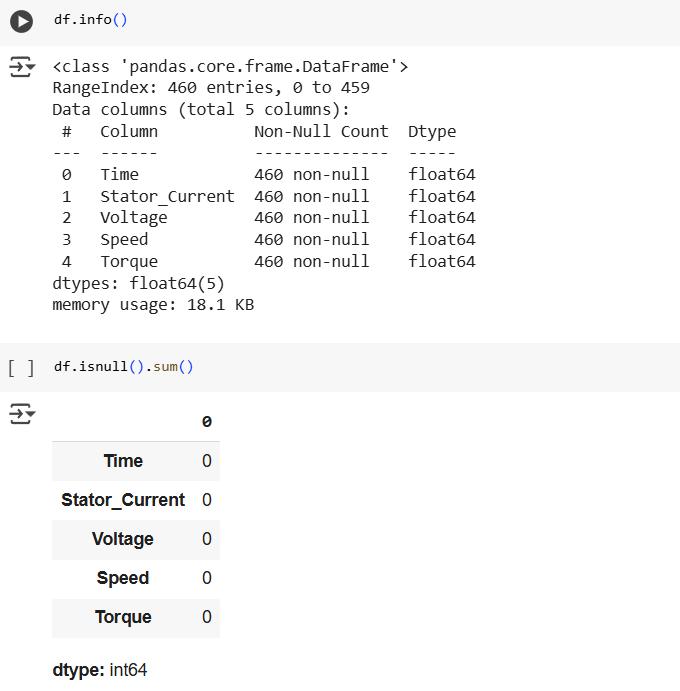
Figure-11: Checkingformissingvalues.
In this part of the code, we use the df.info() function to obtain a concise summary of the dataset. This function providesvaluableinformationsuchasthetotalnumberof entries,thenumberofnon-nullvaluesineachcolumn,the data types of each feature, and the memory usage of the DataFrame.Ithelpsinunderstandingtheoverallstructure of the dataset and identifying if any columns contain missing values or incorrect data types. Additionally, by using df.isnull().sum(), we check for the presence of null or missing values in each column. This function returns
International Research Journal of Engineering and Technology (IRJET) e-ISSN:2395-0056
Volume: 12 Issue: 06 | Jun 2025 www.irjet.net p-ISSN:2395-0072
the total number of null values in every column, which is crucial for detecting incomplete or inconsistent data that mightaffectfurtheranalysisormodeltraining.Identifying andhandlingmissingdataisanimportantstepinthedata preprocessingphase[5].
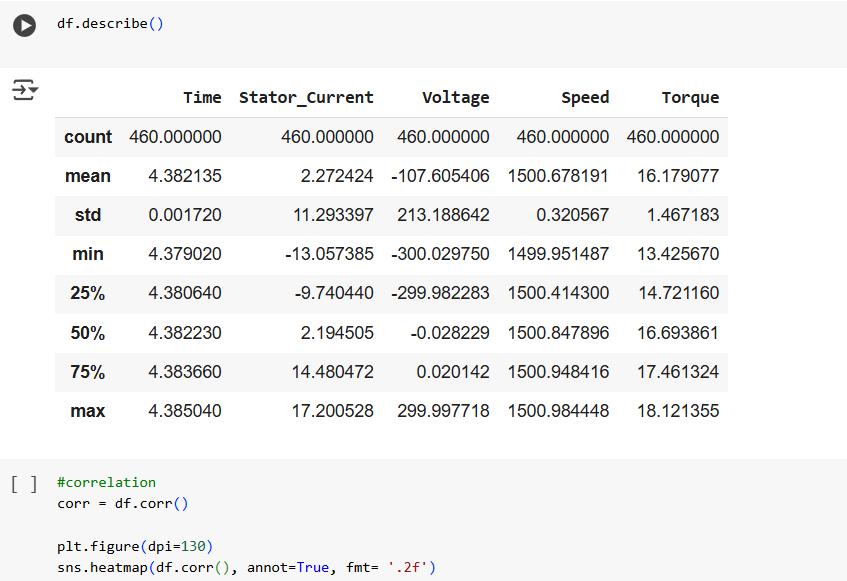
Figure-12: Discriptionofvariousparametersindataset
We have used the df.describe() code to get a descriptive overviewofthedataset.Thisprovidesaquicksummaryof key statistical measures for each numerical column, such as the count, mean, standard deviation, minimum and maximumvalues,andthequartiles.Ithelpsusunderstand the distribution, central tendency, and spread of the data, which is useful for detecting outliers or unusual patterns. In addition to this, by analyzing these statistics, we can also observe potential correlations or relationships betweendifferentvariablesinthedataset,whichcanguide further analysis or feature selection in the modeling process.
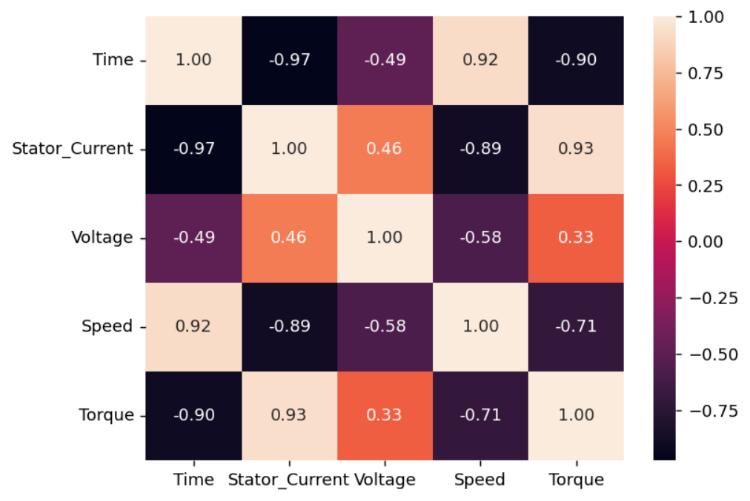
Figure-13: Correlationbetweendifferentparameters
Figure-13 represents a correlation matrix visualized as a heatmap, showing the pairwise correlations between different parameters of a PMSM (Permanent Magnet Synchronous Motor). The variables include Time, Stator_Current, Voltage, Speed, and Torque. Each cell in
thematrixcontainsacorrelationcoefficientrangingfrom1 to 1, indicating the strength and direction of the linear relationshipbetweentwovariables.
Avalueof1.00(asseenonthediagonal)indicatesperfect positive correlation of each variable with itself. For example, Stator_Current and Torque show a strong positive correlation of 0.93, suggesting that as the torque increases, the stator current also increases. On the other hand, Time and Stator_Current have a strong negative correlation of -0.97, meaning as time progresses, the stator current tends to decrease. Similarly, Speed and Torquearenegativelycorrelatedat-0.71,implyingthatan increaseinspeedmayresultinadecreaseintorqueunder certainconditions.
This type of correlation analysis is crucial in understanding how motor parameters influence each other, which can be valuable for fault detection, control strategies,andsystemoptimization.
For model training and fault detection, we employed the K-NearestNeighbours(KNN)algorithmusingPython.The dataset used for training was obtained from MATLAB Simulink simulations of the PMSM motor under both normalandfaultconditions[6].
Keyfeaturesuchascurrentmagnitudewereextractedand labeled accordingly. The KNN model was trained to classify the motor's operating state based on this feature. During testing, the model demonstrated high accuracy in distinguishing between normal and fault conditions by comparing the input feature to the most similar instances in the training data. This method proved to be effective due to KNN's simplicity, interpretability, and ability to handle non-linear fault patterns present in real-time motorsignals[6].
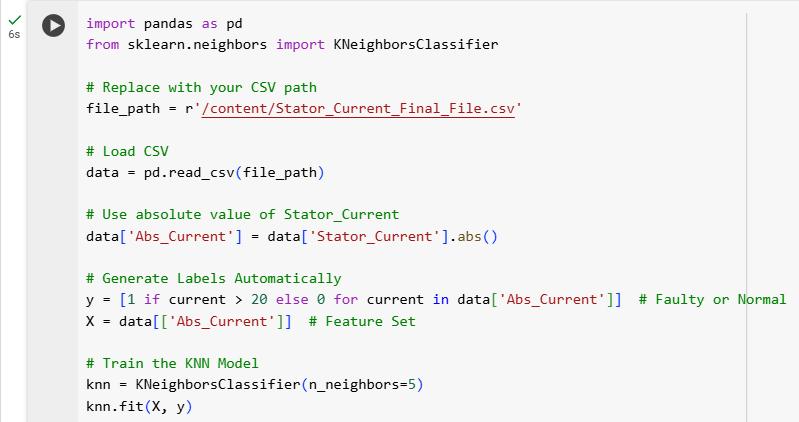
Figure-14: ImportingLibrariesanddatasetloadingfor modeltraining
International Research Journal of Engineering and Technology (IRJET) e-ISSN:2395-0056
Volume: 12 Issue: 06 | Jun 2025 www.irjet.net p-ISSN:2395-0072
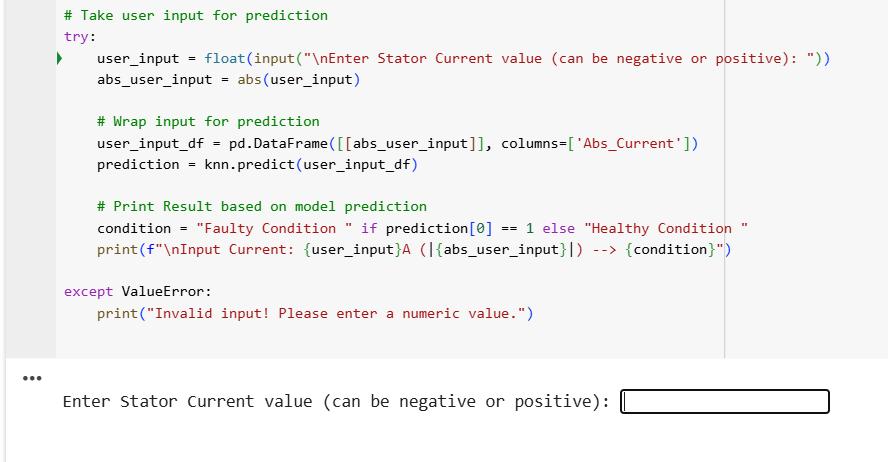
Figure-15: Userinputforprediction
After training the KNN model using extracted current features, the system is now capable of detecting motor conditions based solely on current data. When new realtimecurrentvaluesareprovidedwhetherfromsimulation or actual operation the model analyzes the pattern and magnitude of the input and classifies the motor state as either normal or faulty. This approach simplifies the detectionprocessbyrelyingonasingle,easilymeasurable parameter, while still maintaining reliable fault identificationperformance.
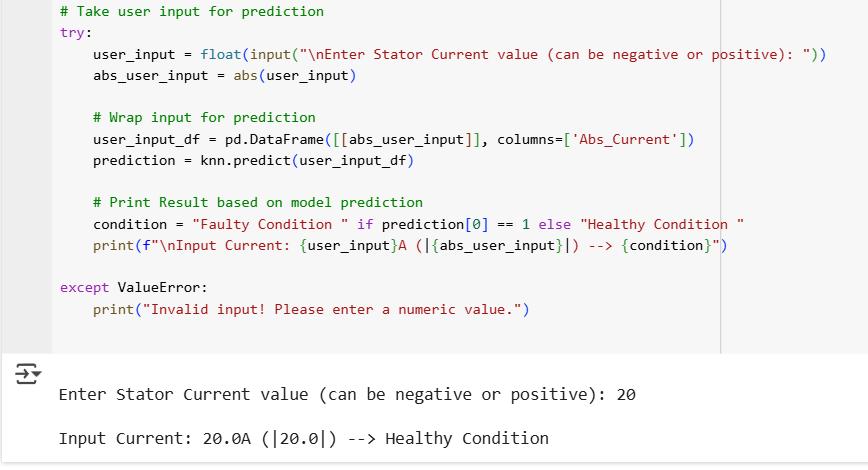
Figure-16: Modeloutputforhealthymotorcurrent
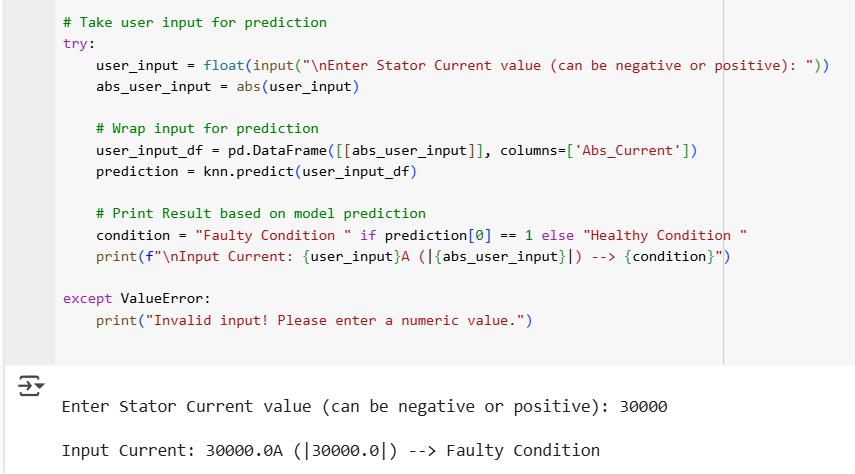
Figure-17: Modeloutputforfaultymotorcurrent
By observing the outputs generated from the KNN model, itisevidentthatthesystemisaccuratelyidentifying faults inthePMSMmotorbasedoncurrentdata.Duringtesting, the model was provided with new current inputs representing both normal and fault conditions. In each case, the model successfully classified the motor state by comparingtheinputfeaturestothenearestpatternsinthe trainingdataset[6].
In this project, stator current was used as the sole input feature to analyze motor faults. Once the model has classified the data, a decision is made regarding the severityandlocationoffault[7].
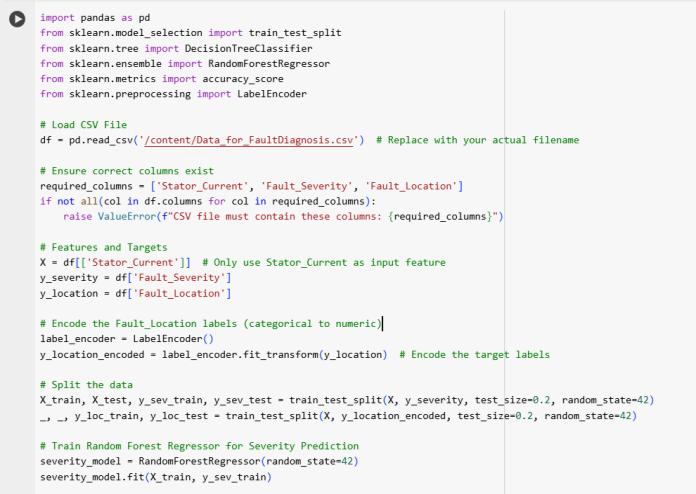
Figure-18: Importinglibrariesanddatasetloadingfor faultdiagnosis
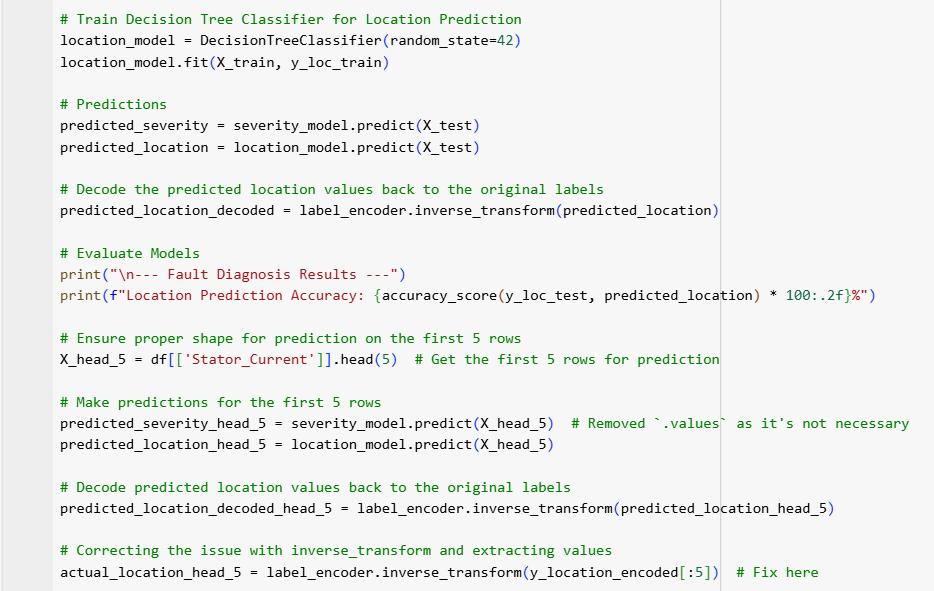
Figure-19: Modeltrainingforfaultdiagnosis
International
Volume: 12 Issue: 06 | Jun 2025 www.irjet.net
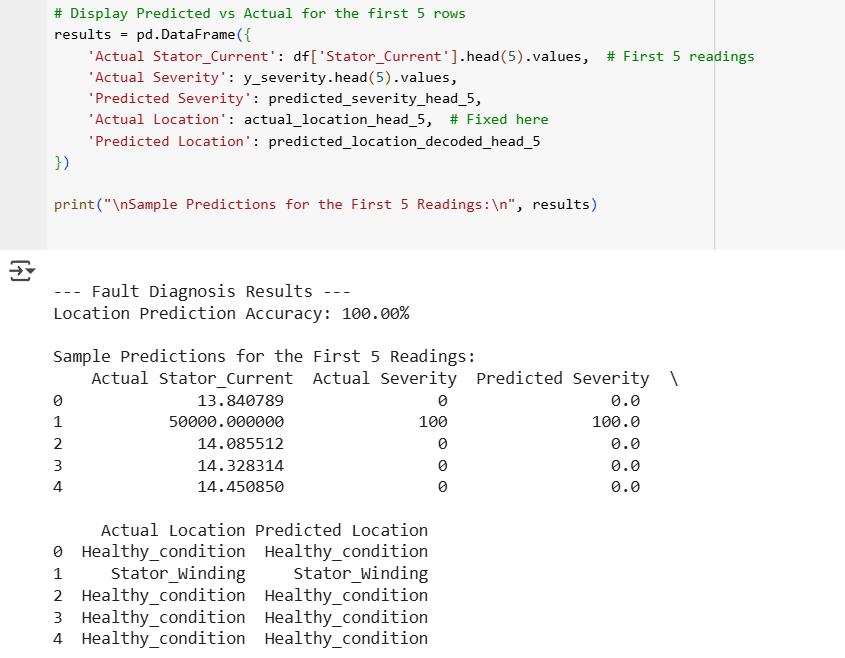
Figure-20: Modeloutputindicatingaccuratefaultlocation andseverity
ADecisionTreeClassifierwasimplementedtoidentifythe location of the fault within the motor system. By learning patterns in the current signal, the model classifies which sectionorcomponentislikelyaffected[8].
To assess the severity of the fault, a Random Forest Regressor was employed. It predicts a continuous value representing how severe the fault is, based on variations inthestatorcurrent.TheensemblenatureoftheRandom Forest improves prediction accuracy and robustness by averagingtheoutputsofmultipledecisiontrees[9].
Using just the stator current signal, this approach offers a non-invasive and efficient method for fault detection, localization,andseverityestimationinelectricmotors.
Action to be taken
Appropriate actions can be taken based on the fault diagnosis, such as initiating maintenance procedures, reducingmotorpower,oractivatingsafetysystems[10].
Normal Operating Current Range:
During normal operation, the PMSM motor draws a currentintherangeof 14 A to 17 A,indicatingstableand fault-freeconditions.
Fault Condition Current Range:
Under fault conditions, the motor exhibits an abnormal current range of 30 kA to 100 kA, significantly deviating fromthenormalrange,whichclearlysignalsthe presence ofafault.
Diagnosed Fault Current:
Inthediagnosedscenario,theMLmodelidentifieda fault current of 50 kA, marking the presence of a severe fault inthesystem.
Predicted Fault Location:
The machine learning model successfully predicted the fault to be located in the stator winding of the PMSM motor,aligningwiththeexpectedfaultscenario.
Predicted Fault Severity:
The fault severity was evaluated and predicted as 100%, indicating a complete and critical failure in the affected motorcomponent.
Location Prediction Accuracy:
The model achieved 100% accuracy in predicting the fault location, demonstrating the high reliability and effectivenessoftheML-baseddiagnosticsystem.
Based on the simulation results, the project successfully demonstrates the effectiveness of machine learning techniquesforfaultdetectionanddiagnosis inPermanent Magnet Synchronous Motor. The ML model accurately identified abnormal operating conditions, diagnosing a fault current of 50 kA, which significantly exceeded the normal range of 14 A to 17 A. It precisely predicted the fault location in the stator winding with 100% accuracy and assessed the fault severity as 100%, highlighting the model’sreliabilityandsensitivitytocriticalmotorfailures.
These outcomes confirm that ML-based methods offer a powerful alternative to traditional diagnostic techniques by providing faster, more accurate, and automated fault identification. The simulation-based approach proved to be safe and efficient for validating diagnostic algorithms, making it a valuable tool for predictive maintenance and enhancingtheoperationalsafetyofelectricdrivesystems.
[1] WangjieLang,,YihuaHu,ChaoGong,XiaotianZhang, Hui Xu, and Jiamei Deng, “Artificial Intelligence-Based Technique for Fault Detection and Diagnosis of EV Motors: A Review”, IEEE transactions on transportation electrification, vol. 8, no. 1, march 2022.
[2] H.Henaoetal.,“Trendsinfaultdiagnosisforelectrical machines:A review of diagnostic techniques,” IEEE Ind.Electron.Mag.,vol.8,no.2,pp.31–42,Jun.2014.
[3] S. S. S. R. S. Duvvuri, “Rotor inter-turn short-circuit fault diagnostics relevant modeling of slip-ring
International Research Journal of Engineering and Technology (IRJET) e-ISSN:2395-0056
Volume: 12 Issue: 06 | Jun 2025 www.irjet.net p-ISSN:2395-0072
induction motor,” in Proc. IEEE 8th Power India Int. Conf.(PIICON),Dec.2018,pp.1–6.
[4] R. Natarajan, “Failure identification of induction motors by sensing unbalanced stator currents,” IEEE PowerEng.Rev.,vol.9,no.12,pp.35–36,Dec.1989.
[5] R. K. Patel and V. K. Giri, “Feature selection and classification of mechanical fault of an induction motor using random forest classifier,” Perspect. Sci., vol.8,pp.334–337,Sep.2016.
[6] E. H. El Bouchikhi, V. Choqueuse, and M. Benbouzid, “Induction machine faults detection using stator current parametric spectral estimation,” Mech. Syst. SignalProcess.,vols.52–53,pp.447–464,Feb.2015.
[7] D. T. Hoang and H. J. Kang, “A motor current signalbasedbearingfaultdiagnosisusing deeplearningand information fusion,” IEEE Trans. Instrum. Meas., vol. 69,no.6,pp.3325–3333,Jun.2020.
[8] K.A.Loparo,M.L.Adams,W.Lin,M.F.Abdel-Magied, and N. Afshari, “Fault detection and diagnosis of rotating machinery,” IEEE Trans. Ind. Electron., vol. 47,no.5,pp.1005–1014,Oct.2000.
[9] Q. Yao, J. Wang, L. Yang, H. Su, and G. Zhang, “A fault diagnosis method of engine rotor based on random forests,” in Proc. IEEE Int. Conf. Prognostics Health Manage.(ICPHM),Jun.2016,p.3.
[10] Q. Hu, X.-S. Si, A.-S. Qin, Y.-R. Lv, and Q.-H. Zhang, “Machinery fault diagnosis scheme using redefined dimensionless indicators and mRMR feature selection,”IEEEAccess,vol.8,pp.40313–40326,2020.
BIOGRAPHIES

Dr Sandhya S. Kulkarni, Professor, DepartmentofElectricalEngineering, Government College of Engineering Aurangabad, Chhatrapati Sambhajinagar,Maharashtra,India.

Aniket M. Lakhe, UG Student, DepartmentofElectricalEngineering, Government College of Engineering Aurangabad, Chhatrapati Sambhajinagar,Maharashtra,India

Mayuri V. Rajput, UG Student, DepartmentofElectricalEngineering, Government College of Engineering Aurangabad, Chhatrapati Sambhajinagar,Maharashtra,India.